Wednesday, January 27, 2010

Masterful class: Fly at Manhattan School of Music


[Image above: Ed Ruscha]

"This is kind of a personal question, but does music ever scare you?" A Manhattan School of Music student posed this unconventional inquiry on Monday toward the end of an afternoon master class with Fly. The musicians seemed slightly caught off guard, but they dove in. Drummer Jeff Ballard recalled being severely freaked out by what he referred to as the "bestial" energy of a recent Sam Rivers recording. Saxist Mark Turner, whose calm, cryptic responses throughout the afternoon had a strong Zen aura, grinned faintly and answered, "Yeah, it does--and I kind of like it."

I stumbled into the event pretty much by accident. As previously reported, I had been meaning to catch Fly this past weekend at Jazz Standard, but it didn't work out. I wrote the group's publicist Monday morning to ask if they had any more gigs coming up and she mentioned that I was welcome at the MSM session that very day. I had to scramble a little to make it uptown, but I'm very glad I did.

Prior to this, I wasn't sure I even understood what went on at a master class. What transpired wasn't terribly different from what I'd expected: The band simply alternated between performing a tune and pausing for discussion and Q&A, a process that repeated for 90 minutes. To some the lengthy spoken interludes might have distracted from the music. I found them enthralling. Often when audience discussions go down at concerts out in the real world (i.e., outside of academia), you get a lot of audience members trying to impress one another with their supposedly sophisticated or insider inquiries. I picked up none of that from the MSM students. They seemed genuinely fascinated by Fly--their motivation was to learn, not to show off.

The talk got technical at times, but mostly it was philosophical. The band members' mini treatises on improvisational problem solving seemed only incidentally music-related. When one student asked about the players' conception of the beat, Ballard and bassist Larry Grenadier each dove deep into metaphor, with the former likening time to a curtain ("The time is draping") and the latter comparing it to a circle with the strict metronomic pulse in the center and all sorts of fruitful approximations surrounding it. The musicians returned often to the idea of tension and release, specifically the notion that supposed musical freedom means little unless it's juxtaposed with structure. Without some kind of framework to serve as contrast, Turner ventured, "The obscurity is no longer obscure." Ballard put it another way: Of musical freedom, he joked, "It's not free--it costs a lot.

Also, fascinating insights into process, preference, personality. "How did you find your sound?" Ballard struggled with his words and then simply began striking different parts of his kit--a tap near the edge of the untightened snare, a thwack to the metal rim of the tom--by way of demonstrating that he simply focused on the timbres and textures he enjoyed most. When someone asked about listening preferences, Ballard and Grenadier chided Turner for his love of Depeche Mode and Echo and the Bunnymen. ("It's true," Turner professed.) Later the notion of musical personality or "concept" came up again and things once again turned reflective. Turner, a former visual artist (anyone know what particular medium he worked in?), discussed how that pursuit had come much easier to him than music and how a part of him wished he'd stuck with it. As for the notion of a concept, he was typically reticent: "I don't think I have a concept yet."

You'd never hear this sort of stuff in a jazz club, and that's probably appropriate: A lot of patrons wouldn't be interested in a hour of analytical discussion mixed in with their music. On the other hand, though, I think a lot of fans of jazz--or any other style of music, for that matter--would like to see this kind of performer/audience interplay go down outside of academia. I'm sure there are series around NYC that approximate this dynamic, but I know there's room for the model to expand further. Personally, I find it fascinating to witness musicians both practicing *and* preaching.

And speaking of practicing, the music Fly played on Monday was glorious--filled with brain-teasing restraint and forms that initially sounded conventional but later revealed mystifying idiosyncrasies. Re: this lopsided account, I don't mean to short-shrift what was played; I just wanted to point out that the talking seriously enhanced my enjoyment of the music. If it turns out that Fly-caliber jazz artists give master classes regularly at MSM, I might have to start paying tuition.

Friday, January 22, 2010

Feeling Fly


If you stripped the term "smooth jazz" of every single negative connotation, and then sought out the epitome of what those words actually mean, you might find yourself obsessing over Fly, as I currently am. If I'd have spent due time with this trio's 2009 release, Sky and Country, it probably would've placed a lot higher on my year-end jazz list. The album has mystified me over the past days: so wispy that it recedes into the background with even a moment's lapse of attention, but so sturdy and engaging if you can manage to focus.

Saxophonist Mark Turner's sublimated heat and drummer Jeff Ballard's exceedingly delicate yet hard-driving momentum. Bassist Larry Grenadier ruminating or holding it down. Compositions with thorough, convincing architecture. A lot of variety from piece to piece: backbeat, post–second-great-Miles-quintet freebop, hushed prayers, even a crazy drum 'n' bass styled thing. (All rendered on Sky and Country with inimitable ECM classiness: perfectly elegant.) It almost goes without saying, but this is a working band (and one that bills no player's name out front, which I love). This weekend they'll be working at Jazz Standard. Jim Macnie has some brief words of praise and a great video. David Adler wrote a nice profile for TONY last year. [After writing this, I discovered some strong recent live recordings on the Fly MySpace.]

/////

Also: Tonight, Hexa and The Octagon share a bill at Bruar Falls. Both bands feature good friends of mine and musical collaborators past and present. I'm biased but both also create outstanding modern guitar-pop music. The Octagon has a great new record out on Serious Business--you should definitely pick it up.

Also: Jean-Ralphio. I cannot stop watching this.

Also: Neglected to mention here that Roaratorio has an awesome new limited-edition Joe McPhee LP out with liner notes by me, sourced from this blog post. (The gig you hear on the record is the very same one I wrote about.)

Friday, January 15, 2010

Lately


Anyone got any solid suggestions re: where to donate for Haiti relief? What a terrible thing this is.

/////

Two exceedingly less important items of business:

*My review of last night's Julian Casablancas show at Terminal 5, with pics by Laal. A solid show, one that did justice to Phrazes for the Young, which I love (especially "11th Dimension," "Left & Right in the Dark" and "River of Brakelights"). Apparently, Julian is a big Alicia Keys fan.

*My brief commentary on last weekend's smashingly successful Winter Jazzfest. Top discovery of the night: J.D. Allen's ultra-sick trio. I know I'm the last one on the Allen bandwagon; glad to find that the fuss was justified.

Friday, January 08, 2010

Jack DeJohnette at Birdland, etc.

It's the first week of the new year, and it's a busy one, musicwise and otherwise. Coming off a solidly lengthy "winter break"--it felt a little like college again--filled with good people (for one: a dear old comrade, now living overseas, payed a visit with his girlfriend) and a healthy amount of doing-nothing time.

The coming weekend was supposed to be all about ALL. Sadly, the shows--which I had previewed in this week's TONY--have been cancelled, a fact I find mildly devastating. I really hope that whatever's ailing one of the greatest drummers alive abates soon. Fortunately the Winter Jazzfest lineup looks stellar.

/////


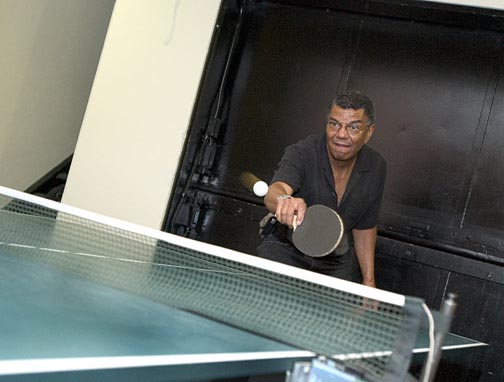
[Jack DeJohnette pic: courtesy Celebrities Playing Table Tennis (!)]

Re: Jazzfest, I warmed up with Jack DeJohnette & Co. at Birdland last night. (Thanks to Steve for the multiple Twitter tips [e.g.] on this gig--I didn't even realize it was going down.) A great set, and I encourage you to head down tonight or tomorrow, even if it means missing a bit of WJF. I'd never caught DeJohnette live before, and that was a major draw, but I think what really enticed me was the backing band: Rudresh Mahanthappa on sax, David Fiuczynski on guitar (double-necked!), George Colligan on keys (w/ some serious MIDI vibes, simulating harpsichord, harmonium, organ, etc.) and Jerome Harris on acoustic bass guitar. I wasn't disappointed.

During the first few minutes of the opening tune, "One for Eric"--a classic that debuted on the fantastic Special Edition album in 1979--I was struck by how turbulent the improvising was. Whenever I'm hearing challenging or abstract jazz in a club like Birdland, I can't help but feel for those tourist-types who may have wandered in unawares in search of smooth dinner music. I'll just say I was glad I wasn't dining last night. DeJohnette really smacks the drums, and on "One for Eric" he laid down a rocky, free-time landscape once the solos got going. (He saved the incredibly supple and intricate low-volume swing for the bass solo.)

But the cool thing about DeJohnette as a bandleader and composer is that he makes that kind of wildness feel accessible and fun. The set closer, "Ahmad the Terrible," with its knotty melody and carnival-esque acceleration, registered more like off-the-wall party music than anything foreboding. And even during the prickly unaccompanied Mahanthappa solo--surely the out-est moment of the evening--that preceded the tune, DeJohnette flashed a few grins at Harris, which took a little of the edge off.

The drummer really knows how to construct a set. Last night, in addition to the bookend classics mentioned above, we got "Music We Are," a killer ballad with DeJohnette rocking the melodica in fine, yearning style--weirdly, his sound on the instrument reminds me of the beautiful synth-harmonica theme that accompanies the underwater level on the classic Super Nintendo game Donkey Kong Country--and some chaotic rubato poetry, "Dearly Beloved"-style, from the ensemble. Then, "Spanish Seven," a fast Latin-y romp in said time signature that built into a nasty sort of fusion, part electric-Miles funk and part jaunty klezmer. (I remember Colligan riding the groove with unhinged glee.) And "Ahmad" concluded with an odd Indian-music breakdown, with Colligan providing faux-harmonium and Harris on otherworldly vocals, a little like the higher pitched Tuvan stuff demonstrated here.

So it was all pretty out there but also down to earth. Challenging, but without any stone-faced self-importance. Flashy and occasionally even a bit gimmicky in its eclecticism, but not watered down. You left feeling like you'd been in good, honest hands. And somewhat unexpectedly, with less recollection of the individual players than of the band as a single organism. Wouldn't wanna deny props to Mahanthappa's solos (nimble and peppery, with a lot of sublimated freakiness) or Fiuczynski's (effortlessly classy on the fretted guitar neck, sproingy and slightly alien-sounding on the fretless one), but DeJohnette's concept(s) prevailed, and it was one all the sidemen got behind wholeheartedly. I don't know DeJohnette's full discography well enough to tell you how unprecedented this group's sound is within his catalog--in a Voice blurb, Jim Macnie alludes to a 1989 album called Audio-Visualscapes that I haven't heard--but I really think someone should record this band.

Monday, December 28, 2009

Recent e-vents


*Each member of the Time Out New York music staff recently compiled a list of the top ten albums of the decade. Here is mine. A tough cut to make, but these are all amazing records, so no need for second thoughts. However, I ought to give all due respect to Bodies for Strontium 90. (You can read my colleagues' lists here, here, here and here.)

*In case you missed it, here's my 2009 top ten. My list of five favorite singles of the year doesn't appear to be online yet, but the No. 1 is a no-brainer. And for good measure, here's the jazz list again.

*And here is my review of Saturday night's Danzig show out in Jersey. Even if the current band doesn't hold a candle to the classic lineup, this was still pretty killer.

Friday, December 18, 2009

High-school sweetheart: The For Carnation live


Last night I saw The For Carnation play in Brooklyn. Here, via the Volume, is a review of the concert. Showgoing-wise, it's been an almost unbelievably nostalgic stretch. The Jesus Lizard in November, Jawbox last week and now this.

Like many a music nerd coming of age in the mid-'90s, I harbored an intense obsession for Slint. But that band was long gone by the time I got into them, so it was only logical that I would seek out all the ex-members' then-current projects, including Dave Pajo's pretty, austere Aerial M, and Ethan Buckler's absurd yet hilarious King Kong. By far the most compelling of all these offshoots, though, was The For Carnation, led by Slint guitarist and sometime vocalist Brian McMahan. The band's two EPs, Fight Songs ('95) and Marshmallows ('96) struck me at the time as the next best thing to Slint, removing most of the heaviness and dissonance from that band's equation but retaining all its disarming tenderness and sublimated horror. (I still vividly remember my two favorite TFC tracks: Fight Songs' free-form ballad "Grace Beneath the Pines"--"...with crackheads and assassins and burn victims and millionaires' sons"--and Marshmallows' creepy dirge "Salo"--"She kicks but they hold her legs.")

The For Carnation's activity since then has been really sporadic. I did see them play once at Mercury Lounge in NYC many years ago. Not sure when it was, but I'm guessing it was about 2000, since they performed some tracks from their great self-titled LP, which came out that year. As I recall, there was absolutely no one at that show, maybe like ten people, and last night's attendance wasn't much better. As I mention in my review, it always sort of shocks me how little attention people pay this band in light of the worshipful aura that surrounds Slint to this day (speaking of which, I can't wait to read Scott Tennent's 33 1/3 book on Spiderland). Then again, TFC isn't exactly pounding the pavement. I could very well be wrong, but I don't think they've toured since that last time I caught them. Anyway, as you might guess if you've heard the records, they're unflaggingly subdued live, and things did get a little snoozy from time to time last night. But overall I still really get into McMahan's shadowy talk-singing and the band's throbbing, soporific grooves. Some offbeat covers (Randy Travis, Michelle Branch and--I think--a song by the Impressions) livened things up, and overall it was a nice, cozy show.

It's kind of cool seeing a band and having no idea whether you'll ever get the chance to see them again. Music (at least the practices of making records and touring) seems to be a really part-time thing for Brian McMahan these days. I heard some talk about Slint possibily getting together to record again, but then they made a big production of selling their gear on eBay. To borrow a hilarious line from A Serious Man, which I saw the other day and loved, the best course of action for a McMahan fan seems to be: "Accept the mystery."

/////

P.S. My 2009 top ten list can be viewed over at Time Out New York, along with my colleagues' selections. "Dear Coach's Corner" forever...

Monday, December 14, 2009

Talkback: A 2009 jazz roundtable


I'm honored to be a part of a 2009 year-in-jazz e-mail conversation, hosted by Nate Chinen and also including contributions from fellow scribes Peter Margasak, Andrey Henkin and Ben Ratliff. My own contribution (which takes as its motif the currently rampant rock trend of supergroups, symbolized above) is up now, as is Nate's. Check The Gig in the coming days to hear what the others have to say, and check back here soon for more year-end goodies.

Tuesday, December 08, 2009

The list, part one (Jazz)


You can check out a list of my top ten jazz records of 2009 over at the Jazzhouse blog. The roundup also includes one DVD, one book, ten honorable-mention discs and seven live shows. I heard tons and tons of great jazz this year. Thanks very much to all the artists, labels and publicists who saw fit to send me their wares. Please do keep them coming in 2010.

Look for my general 2009 top ten in TONY soon.

/////

On the pop side of things, here are my reviews of last week's Rihanna show (check out the festive crowd video I shot during "Umbrella") and the new Chris Brown album. Pretty fascinating to hear both sides of this sad story in rapid succession.

Monday, November 30, 2009

History lessons: Thelonious Monk + Norwegian black metal

Been spending time with two important new works of music history.

/////

Thelonious Monk: The Life and Times of an American Original
As expected, Robin D.G. Kelley's new Thelonious Monk biography is outstanding. I feel like I'm learning something on every page. Did you know that to this day Monk shares a "Round Midnight" composer credit with both trumpeter Cootie Williams and lyricist Bernie Hanighen, neither of whom had much to do with the tune in its original state? Or that it was Herbie Nichols (yes, the genius pianist) who penned the first published review of a Monk performance? Or that when Bud Powell was first breaking into the scene, Monk escorted him to jam sessions and essentially forced other musicians to give him a chance? I'm just now getting to the part where the bebop revolution takes off and leaves Monk behind. Can't wait to find out exactly how and when the man began to get his fair due and really come into his own as a composer. Listeningwise, the book has already sent me off on a Monk spiral. I pulled out the Monk/Trane Carnegie Hall set over the Thanksgiving weekend and was re-amazed by its special grace, especially the opening sax-piano duo version of "Monk's Mood," which is simply one of the most sublime jazz recordings in existence. I also spun a bit of Elmo Hope, an interesting and underrated pianist who, according to Kelley, used to pal around quite a bit with Monk and Bud Powell.

/////

Until the Light Takes Us
Yes, this is the highly anticipated black-metal documentary that I've been hearing about for quite some time. (It opens in NYC this Friday.) Definitely worth seeing, especially if you're an enthusiast of this subculture. Might come off as somewhat sketchy for the uninitiated, but there's still enough here to pique plenty of interest and stimulate further study. There's more to this story, for sure, but no one can fuck with the film's basic primary-source approach. The infamous Varg "Count Grishnackh" Vikernes (of Burzum fame) is interviewed here at length about his nefarious deeds. You probably already know what he did, but there's no substitute for hearing him describe it firsthand. (Simply terrifying and nigh unbelievable.) The strongest aspect of Until the Light Takes Us is the way the filmmakers contrast Vikernes's charismatic yet obviously utterly insane take on the black-metal ethos with that of Darkthrone drummer Gylve "Fenriz" Nagell. It's basically the difference between a literal interpretation of the gospel ((Vikernes) and an aestheticized one (Fenriz), the result being that circa now the former man has just been released from a lengthy prison sentence while the latter is still living a humble yet productive musician's life in Oslo. It's fascinating to see how even though the two no longer communicate they still exert some strange gravitational pull on one another, as though the extraordinarily fucked-up events of the early-'90s black-metal scene have locked them in an eternal bond. Whatever you think of this music or the mystique that surrounds it, you should definitely have a look at this flick - at this point, it's the closest thing we have to a definitive treatment. Like many music docs, it skimps a bit on the actual music, but there's enough here to spark further research if you're so inclined. (Though in my experience, old-school black metal heard on record doesn't always live up to the legend.)

Wednesday, November 25, 2009

Morbid thanks

Happy Thanksgiving, everyone. One solid reason to be grateful: the recent news that Morbid Angel has signed with the Season of Mist label (home to ridiculously good bands such as Cynic and Confessor). A new record - Morbid's first with founding frontman David Vincent since 1995 - is due in 2010. Can't wait. If you haven't heard it yet, here's "Nevermore," the fantastic preview track the band has been playing live for a while now, in a new pro-shot version.


P.S. Post-Vincent Morbid frontman Steve Tucker participated in a confounding yet cool metal happening at Santos Party House last weekend, conceived by Egyptian artist Nader Sadek and also including Mike Lerner (Behold...the Arctopus) and Flo Mounier (Cryptopsy). Read my review (w/ pics by Laal) here.