Monday, April 26, 2010

The fine art of saying no: A glorious new Rush documentary


Beyond the Lighted Stage, the new documentary about Rush that premiered at the Tribeca Film Festival this weekend, is a near-perfect film that answers one simple question: Why is this band different from all other bands? As someone who's loved Rush for going on 15 years, it was thrilling and vindicating to see someone plead their case so lovingly.

Thematically, the doc focuses on the notion that Rush's sustained success throughout four decades boils down to the band's shrewd instinct, both as a trio and as individuals, for knowing when to say no:

*Alex Lifeson saying no to making his parents proud by getting a "real" job

*Neil Peart saying no to suppressing his bookish tendencies in the name of rock & roll, and later to the idea that he ought to make himself unduly available to obsessive fans

*Rush as a whole saying no to debauchery on the road (as no less a debauchery authority than Gene Simmons of Kiss, who toured with Rush in the early days, attests in the film)

*...saying no to the record label's demand for more concise, accessible material after the failure of Caress of Steel (Rush's middle-finger answer? a little album called 21-frickin'-12)

*...saying no to letting the band overwhelm the members' family lives

*...saying no to continuing as an epic-prog band after they'd outgrown that sound in the early '80s

*...saying no to continuing as a keyboard-drenched pop-rock band after they'd outgrown that sound in the late-'80s

*...saying no to hurrying back into working mode after Peart suffered the loss of his daughter and wife in rapid succession in 1997

There are many more examples, but you get the idea. And in case you don't, the film offers a parade of talking-head rock experts to hammer home its theses: Trent Reznor, Billy Corgan (who blew me away with his quiet poise and articulateness), Kirk Hammett, Rage Against the Machine's Tim Commerford, Tool's Danny Carey, Primus's Les Claypool, the aforementioned Simmons, Skid Row's Sebastian Bach (utterly hilarious), Pantera's Vinnie Paul (yes!) and many more, including a hammy but still sincere Jack Black. Counterbalancing these celebs are major behind-the-scenes players (longtime producer Terry Brown, Rush's early label and radio champions Donna Halper and Cliff Burnstein, etc.) as well as each member's loving parents and a few handpicked fans, who offer a crucial perspective re: how Rush speaks to the alienated teen in all of us.

And then there's the footage. Oh, the glorious footage. A vintage version of "Xanadu" (one of my most treasured Rush songs) that gave me chills; Rush's first-album lineup performing in a school auditorium; the band members warming up backstage; Lifeson and Geddy Lee scarfing sandwiches and signing autographs in a restaurant. And tons more gems.

I honestly have no idea how this will play to the non Rush fan. My love of the band is so deeply ingrained that it's impossible for me to take an objective view. (Though a sympathetic yet nonfanatical friend who accompanied me to the screening was riveted.) But I will say that I don't think this film could have been done better and that Rush geeks the world over are going to go wild. I'd enjoyed codirector Sam Dunn's previous feature, Metal: A Headbanger's Journey (great metal 101 doc), but this is a much richer, warmer film, a beautifully wrought summation of a truly singular career. And the best part is, it isn't an epitaph. Rush is touring this summer and they've got new material on the way. Bring it on, I say. (Seeing the doc sent me immediately back to 2002's Vapor Trails, which is rapidly ascending the ranks of my favorite Rush albums.)

For more info on Rush: Beyond the Lighted Stage, check out my TONY colleague Joshua Rothkopf's recent Q&A with Lifeson.

Monday, April 19, 2010

Like a prayer: What "metal" can and should learn from Ludicra


Just returned from seeing Ludicra at Club Europa, a show I previewed for TONY. Late on a Sunday, feeling fried, but I'm so glad I went. I think I can say definitively that Ludicra's set was the most organically heavy performance I've ever witnessed by a metal band.

Too often, metal as it exists in my mind is not how it exists in the world. If you keep up with the genre, you know that over the past two decades, a sonic revolution has taken place, namely an abhorrent artificiality that sucks all the life out of the genre. Drum triggers, Pro Tools, noise gates -- it all adds up to fake, inanimate music. It might be a hackneyed argument, but it bears repeating over and over and over. Metal should be heavy. More and more, all this airless-sounding nonsense sends me screaming to my Zeppelin and Sabbath records, craving that fix of warm realness.

Ludicra's set was like a time machine to an era before all this nonsense. I encouraged my bandmate Joe to check out the band's magnificent new album, The Tenant (album cover above), and today he told me that it made him think of Kill 'Em All. I definitely agree that it takes you back via its holy rough fullness, its primal, thudding grace. The revelation that drums ought to sound like drums, the courage to have everything come at you in a real way.

I had a feeling they'd open their set with "Stagnant Pond," the lead track from The Tenant, and they did, and thus began 50 minutes or so of shock and rapture. I guess being a drummer myself I'm always going to fixate on the drummer, but I will tell you that Ludicra's percussionist, Aesop Dekker, is a master, worthy of any accolade. He drove the band with an unholy snare thwack which cut through the guitars like a gun shot, crystal-clear bell-of-the-ride accents placed with poetic accuracy, and a true patience and love of groove, whether that meant a speed-freak blast beat or a half-time trudge.

Bassist Ross Sewage alternately zoning out on the music's epic architecture and regarding the crowd with an unsettling scowl. Guitarist Christy Cather, a true metal hero with her curly blonde mane, Flying V axe and leather vest. The other six-stringer, John Cobbett, running his dancing fingers through their paces. And vocalist Laurie Sue Shanaman... I don't even know how to describe it. You won't do better than Laal did, pegging her movements as theatrical and goblinlike. Her vocals convey genuine horror and despair. Not that generic black-metal, screaming-for-the-sake-of-screaming crap. There's no word for what comes out of her throat other than DIRE. She stomps around, contorts her body and face. It's almost but not quite cartoonish, a pantomime of evil, a stylized sort of possession.

The band charges as a team, headbanging in furious unison. Cather and Sewage shared one of those classic leaning-back-to-back guitar-tandem moments. The quintet had such a chemistry, such an effortless group choreography. I'm not sure exactly how long this lineup has been together, but you really got the vibe of a crew, of an "on-and-off-the-court" camaraderie.

And all in the service of maximum epic grimness, the epitome of what all metal really aspires to. This set was like a master class in the history of the genre, cherry-picking the awesomest aspects of all the various substyles. The neck-snapping groove of '80s thrash, as heard on The Tenant's "In Stable," which embodies the midtempo assault of Megadeth at their best. Holy, hymnlike interludes touching on the gothy beauty of bands like My Dying Bride. Hailstorm blast sections that could stand up against any of the Norwegian luminaries. Crawling-through-a-snowstorm-and-finally-glimpsing-the-sun, dark-yet-luminous doom metal. It sounds like a prayer.

I only know the new album so there were a few songs I didn't recognize, including a long, glorious encore. The crowd was so there, so present. I saw so much dancing, so much convulsing, so much screaming at the sky in response to the expertly orchestrated evil-ness of it all, and I was right there. Couldn't have sat down if I'd tried. Eyes closed, grimacing privately.

It was all poetry, all a reminder of why I'd had this music in my blood since my teens. You won't get this reassured feeling from very many bands. The genre is in vogue and it's overrun with... with itself really. With bands that hew closely to convention as if to a buoy in the sea. I say let it all go, unless it's something like this, that sums up the swelling emotion, the vastness, the power, the sorrow -- and served raw, please, without the spit-and-polish nonsense that passes for production, not to mention live sound, these days. Black Sabbath deserves a better legacy. Any band calling itself metal needs to provide maximum mood and maximum chops all filtered through a huge, gut-punching, organic sound. It should feel like getting flattened by a baroquely adorned tank and Ludicra did. Shock and awe indeed.

Thursday, April 15, 2010

Peter Steele, sardonic goth-metal genius, has died


I read the news today, oh boy. Peter Steele, frontman of Type O Negative, has passed away. I've loved his music since my teens. My friends and I once stood outside Type O's tour bus, waiting patiently for autographs, which each member kindly granted. I saw the above video on Headbanger's Ball in the early '90s and it spun me around. I had no idea what "goth" was or any of that. I only knew that I loved the sumptuousness of the sound, the combination of steely metal and deep-voiced, almost choral crooning. I loved the perversity of the lyrics (see: "Christian Woman," one of the most potent statements I know re: the carnality at the heart of Christianity), and as I investigated further, I came to understand that here was a man (Steele) who not only got the dark and gloom; he also got the hilarity of it all.

You wouldn't find that in, say, Nine Inch Nails, or any of the other well-known angst purveyors of the time. You had to go to Type O Negative to get a song called "Unsuccessfully Coping with the Natural Beauty of Infidelity (I Know You're Fucking Someone Else)" or to get an absolutely brilliant faux live album wherein the band sparred with merciless imaginary hecklers. (Hunt down the original cover art for that one, and you'll get a nasty treat.) Or to find out that your tortured hero had posed for Playgirl.

After losing track of Type O for a few years, I was thrilled to find that the band's most recent album, Dead Again, was every bit as sick and satisfying as their vintage work. I hadn't seen them play live since that show way back when (I think they were opening for Danzig), and I was really looking forward to checking them out next time around. Since there won't be a next time, please understand that this man was a genius. For a lot of reasons, but chiefly because he was brave enough to push buttons, to mix the dark and the light in utterly perverse and fucked-up ways that made you feel baffled and challenged and enthralled and spooked. And I haven't even touched on Carnivore...

We will miss you, Mr. Steele.

Monday, April 05, 2010

In full: Xiu Xiu's Jamie Stewart


Very happy to be able to link to my hot-off-the-press profile of Xiu Xiu on the TONY site, as well as the full transcript of my conversation with bandleader Jamie Stewart on the Volume. Re: the former link, don't miss the list Stewart compiled at the end of five albums that scare him: a classic assortment of the perverse and/or extreme, with records by Cecil Taylor, Diamanda Galás and more. Speaking of Taylor, jazz heads might be interested to hear Stewart's further thoughts on the maestro, which come right at the end of the unedited Q&A.

If you haven't heard Xiu Xiu, I'd probably recommend The Air Force, which landed on my 2006 top ten list. Imagine an almost surreally perverse Casio-fueled version of Scott Walker, only with much catchier choruses, and you'll get some idea of the strangeness and intensity of this project. The new album (Dear God, I Hate Myself) is outstanding, and you can hear it via that first TONY link above. For the totally uninitiated, The Air Force's "Boy Soprano" is probably my favorite Xiu Xiu 101 track.

Friday, March 26, 2010

Six songs

Offered without comment. Just really been wanting to share these recent obsessions. Wish I had web storage space, but for the moment, I don't, so video embeds will have to do. The artists are, respectively, Chatmonchy, Death (Detroit, not Florida), Xiu Xiu, Cynic, the Outfield and Looker.


Videos tu.tv


Friday, March 12, 2010

Maynard James Keenan's Puscifer at the Grand Ballroom: The curveball that could


Photo: Isaac Brekken

I've been a fan of Tool for a really long time. Like most, I came on board in '93, when "Sober" hit Headbanger's Ball. I lost track of the band for a while during college, but when I checked back in with them in the early aughts, I was pretty blown away by what had emerged in the interim, specifically Lateralus, an absolute classic of the dark-and-epic-rock mode. I grappled with 10,000 Days when it first came out, but I've since come to accept it as mostly awesome, and I can't wait till the band reactivates.

It almost goes without saying that Maynard James Keenan's voice is one of Tool's key features for me. I'm sure this is true for the great majority of fans. There's just something alchemical in the way his sinuous chant mingles with the band's crisp roboprog riffs.

Even so, I cannot say I had terribly high hopes for last night's Grand Ballroom show by Keenan's latest side project, Puscifer. (Check out my friend and colleague David Fear's excellent Q&A with Keenan to get up to speed, and note also that Puscifer performs again on Saturday at the Apollo.) Prior to the gig, my exposure to Puscifer was minimal, just a few press releases over the past few years and some promo CDs that I'd never brought myself to engage with. Why? Simply, it was the humor that did it. As any music fan knows, humor can be the ultimate moodkiller. It's not that humor doesn't belong in music; it's that when humor exists as part of whatever artist's palette, it too often overwhelms any other element that might be present. It's alienating, mainly because if you don't happen to find a particular artist's brand of humor funny, you're likely to be turned off the entire endeavor. Everyone has an example of this. For me it's Zappa. I know there's some substance there, but I find his pervasive comedic element completely insufferable: smug and cheesy and dated and just the ultimate turn-off. Maybe one day I'll go there, but so far, the funny-stuff armor has kept me far away. (It goes both ways, of course: Such accusations could certainly be leveled at two of my favorite bands, Ween and Cheer-Accident, but the difference for me in both cases is the almost sadistic mingling of light and dark.)

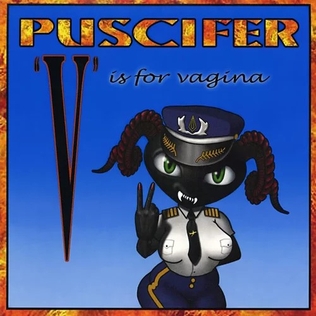
Anyway, so in sum, I heard some years back that Keenan had a side project called Puscifer; I learned that the band's debut album was entitled "V" Is for Vagina; and I checked out the asinine cartoon cover art. In short, I snap-judged the hell out of the thing, deciding that this sort of goofing off was just not what I wanted from Keenan. After all, don't we, as fans, have the right to decide what to consume and what to pass on? Sure, perhaps I had typecast Keenan, deciding that I'd turn to him for dark and sumptuous, not silly and irreverent, but this is not an uncommon move. We all do the same thing: We want X mood or vibe from X artist and we don't want curveballs, even if said artist is "challenging" or whatever. I believe I'd be just as initially dismissive of the idea of a comedic project from, say, Cecil Taylor. (Or, for that matter, a dramatic project from, say, Aziz Ansari.)

As for last night's show, let me say two things definitively.

One: The humor aspect was indeed pervasive and often unfunny. The entire performance, a sort of multimedia revue complete with costumes, video interludes and dramatic "business," was structured around a fictional airline called Vagina Air, a conceit that provided a platform for all sorts of stale jokes about post-9/11 air-travel paranoia and the like.

Two: The music was so fantastically cool that it was nearly impossible to care. In other words, I really underestimated Keenan. Amid all the silliness, there were these incredible songs: jauntier, groovier, hammier, simpler and in many ways catchier than Tool--I'd describe it industrial-, cabaret- and metal-tinged art pop--but still very driving and still perfect vehicles for Keenan's voice. And oh, that voice... Like the rest of the cast (there were seven or so people onstage), Keenan spent the entire show in a pilot's outfit, complete with shades. He sang mostly from behind a video screen--see above--which projected his face as a sort of fish-eye caricature. But none of this detracted from his performance. I'm not kidding: He sounded absolutely stunning, yielding perhaps the most just-like-the-record live vocal sound I've ever heard in my life. I'd seen Tool a few years back but the mix was terrible and Keenan was largely inaudible. At this Puscifer show, the sound was PERFECT and you could hear every contour, every warble, that haunting sing-song you'd heard so many times on albums. Laal (also a huge Tool fan) and I kept turning to each other with mouths agape, one or the other of us exclaiming, "I seriously cannot believe how good he sounds."

And the material, though unfamiliar, was an excellent vehicle for Keenan's gifts. Most of it was swaggery and driving, pitched right between the sinister and the playful. But some of it was downright balladic, with a distinctly loungey feel, with Keenan coming off like a histrionic though entirely sincere Vegas crooner. The music and the presentation had a gimmicky element, but crucially, Keenan played it straight and sang his ass off. (To be fair, the band ruled, especially the really solid, crushing drummer and an excellent female vocalist--Carina Round--who served as an excellent foil for Maynard.)

The stunning quality of his performance had the really remarkable effect of legitimizing everything around it. Gradually, all the cheesy video interludes came to seem delightful; the theatrical hubbub going on simultaneous to the music began to come off like a charming complement to the already vaguely Broadway-ish material. (Former Primus drummer Tim Alexander played the role of a flight attendant, while opening acts Neil Hamburger (!) and Uncle Scratch's Gospel Revival sat in faux airplane seats at center stage, chatting, drinking and reading the paper during the majority of the performance.) Overall it was like watching a performer jump the shark, but doing so in such a professional and expertly choreographed fashion that the joke was on you for trying to put them in an aesthetic box in the first place. You actually felt like you were being forced to accept an aspect of Maynard James Keenan that you weren't ready for and you couldn't help but be won over.

Think about this for a second: When was the last time an artist actually won you over with a complete curveball? That's a mixed metaphor, but you know what I'm saying: It's a pretty profound thing when you see something so cool that you lay down your bias then and there, conceding, "You know what, you're right. This is in fact awesome." Again, as I said above, an unfunny attempt at humor may be the most profound turn-off in art, but I left this show completely convinced that Puscifer is every bit as legitimate an outlet for Keenan's singular gifts as Tool. Strong words, but I'm serious.

It seems like such a simple concept, this notion of being challenged, but I really don't think it is. Even with dark or abrasive art, we usually want a certain thing and we get that certain thing and we're happy. We say we want a challenge, but we want it on our terms, deciding when we want it and from whom. Whatever your feelings on Puscifer, the project poses an aesthetic challenge to Keenan die-hards (and there are many far more rabid than myself), and moreover, it actually rewards the effort. It's not a curveball for curveball's sake--it's a very fruitful outlet for a guy who just happens to display really schizophrenic artistic tendencies.

Now I'm going to have to dive into Keenan's other other band, A Perfect Circle, which I've barely heard. I can only hope I'm initially completely repelled by what I discover.

Sunday, February 28, 2010

The point


A phenomenon I treasure, experienced twice this weekend: when a piece of writing about music sends me scurrying, more or less frantically, to listen. It's like a command. Two CDs I'd had for ages, lying amid the innumerable stacks in my room, and to which I'd never paid ample attention. Two writers, persuading and prepping me. Thanks to Alex Ross, I dug into the stark but inviting Xenakis Percussion Works, and thanks to Howard Mandel, I spun Ornette's fantastically exuberant Friends and Neighbors. Reminders that, yes, there is a point to this endeavor, and the point is to point, to make a case for why, even in the midst of info overload, you should really take a minute to check this here thing out. Ross puts it as succinctly as it could be put when he titles his forthcoming book Listen to This.

Thursday, February 18, 2010

Sunny Murray's time now (and then)


Where are they now, the still-living architects of free jazz? For one, they're in Sunny's time now [sic], a 2008 documentary about Sunny Murray that has just reached me on DVD. The descriptor "sprawling" was invented for films like this: It's all over the place. Sometimes rambling, sometimes pointed, but for anyone who's into this stuff, it's riveting, mainly because of the cast.

Everyone is here. It's like a family reunion. Sonny Simmons, Grachan Moncur III, Henry Grimes, William Parker, Bobby Few, Cecil Taylor, Tony Oxley, Robert Wyatt (?!) and tons of others whom I was either unfamiliar with or knew only marginally: François Tusques, Tony Bevan, Fritz Novotny and more. And then the scholars and scribes: Val Wilmer (hail), Ekkehard Jost, Tony Herrington, etc.

All assembled to illuminate a difficult personality. I adored Sunny Murray, and then I caught him live at Tonic in October of '04 with Sabir Mateen and Dave Burrell, a gig documented by Eremite but which I could barely stand to relive. Without going into detail, Murray appeared in a visibly altered state and after Burrell took it upon himself to bring some much-needed focus to a wholly disjointed and directionless performance, the drummer stood up, tapped the pianist on the shoulder and stopped him cold. Cecil Taylor recounts the incident in Sunny's time now and seems to have found it amusing. To me, it was a travesty: Burrell chose to take the gig seriously and Murray didn't, and that was that. (I hate to slander anyone, but sometimes the facts are the facts, as this review of a Murray performance from last June attests: "...Sunny Murray spent most of the performance stumbling off his drum stool, lurching through the crowd and talking loudly while [Odean] Pope gamely tried to keep some semblance of a concert together. Left to himself for most of the gig, Pope padded time with a lecture and demonstration on Clifford Brown. Just as he was wrapping it up, Murray staggered back to the stage and grabbed the mic. “I just want you to know, I’m not drunk,” he asserted in a slur....")

So I've had some mixed feelings re: Murray over the years, and for a while I couldn't even listen to him. But who could stay mad at The Copenhagen Tapes or Nefertiti, the Beautiful One Has Come? And then I started to warm up to the relaxed splendor of the later work, especially the amazing Dawn of a New Vibration, a 2000 duo session with Arthur Doyle on Fractal. (A contemporaneous example of that badass partnership is here.) There just wasn't much point in staying mad at Sunny Murray.

The film doesn't shy away from Murray's foibles. Murray's son, who shows up in a few brief interview clips, expresses a bit of pride at his father's renown but even more vexation re: Dad's uneven temperament. Cecil Taylor, in his inimitably catty way, provides more evidence of same. And rehearsal footage of an insanely star-studded large-ensemble gig in Luxembourg depicts Murray as impish and distracted.

But there's so much to love and to marvel at here. Try a duo concert with Bobby Few, like the entire film, beautifully shot and recorded. Try the aforementioned Luxembourg gig. We only get a few segments, but dear God, the lineup: Murray, Grimes, Moncur, Few, Simmons, Pope, Rasul Siddick, Tony Bevan and more. And--so poetic and humble and real, I can't even begin to express--a small-group version of "Round Midnight" from a Paris club gig with Simmons, Few and some others. Tons of jazz musicians come full circle, moving through free jazz and back into standards, but rarely do they re-address the tradition with such grace as these expatriate free-jazz types. Simmons and Few, I already knew about, but Murray is such a good match for them. His restraint (perfectly content to wisp about with brushes) will astound you. Some very intrepid and enterprising producer needs to get these three together for a trio session pronto.

There's also so much here that has nothing to do with Murray. Little scraps re: the European and British perceptions of American free jazz. François Tusques praising Archie Shepp for his political awareness and mocking Frank Wright for his political ignorance. Val Wilmer going through old Murray photos she took, admiring how they capture his intense (and, she asserts, unusual for the idiom) love for his family.

Again, a mixed bag, but an essential one. The performance footage is golden. Loved seeing/hearing Murray in duet with Novotny, a soprano sax player with whom I was totally unfamiliar. And the concluding presentation of the Murray, Bevan and John Edwards trio is a mindfuck, full of brawn and sweat, but also grace. Didn't care for Spring Heel Jack contributions or another gig featuring unfortunate electric bass, but it all just hangs out there and becomes part of the film's weird patchwork quality. Maybe it's because Murray himself isn't directly interviewed (he is on the bonus disc, though), but everything here feels like a tangent. Fortunately many of these tangents also register as revelations.

But as I (tried to) indicate above, what will stick with you are the personalities of these still feisty old men, the immense variance. Simmons's absurdly charming rakishness, Few's heart-melting sweetness, Moncur's mercurial oddness, Taylor's relentless superciliousness. What an unbelievably diverse bunch of men, these first-wavers. This film's greatest triumph is to place all these artists in the NOW. We know them from records, and we often fetishize their discographies over their physical presences. (As the Murray gig I described above indicates, sometimes the artists have given us good reason to do so.) But they still have a lot to tell us.

Sunny's time now, yes. But it's also the time of all the others who lit the fire in the '60s and kept raging, albeit in a sublimated way. Think of Bill Dixon, whom I just listened to today in a fantastic trio with two young improv masters. Think of the aforementioned Dave Burrell, whose recent records are some of his very best.

In Murray's case, it's somewhere in between. For sheer ecstatic insanity, you're not going to beat his early work. But when he manages to keep his composure these days (the Bevan/Edwards band seems like a particular good focusing agent for him), he's really got something going, a droopy dance, the pinnacle of unhurriedness, following buzzy, uneven snare rolls with clumsy yet thunderous thwacks on bass drum and crash. And (as you can hear in the "Round Midnight" I mentioned above) a tremendous respect for song form, for contour, and (again, when he's behaving) for his fellow players. In the majority of the live footage in this film, he is, in fact, behaving, and accompanying in a remarkably sympathetic fashion. So if nothing else, the film helped me to further forgive Murray for the disastrous 2004 gig I'd caught. We may only get sporadic brilliance from Murray these days--a statement that applies to several of the aforementioned early-free-jazz survivors--but the good stuff is worth the required patience.

Anyone else have any similar stories of resentment and/or redemption re: first-wave free-jazzers, i.e., seen players of this style, caliber and age turn in either notably subpar or phenomenal gigs? I feel like this unpredictability is something every free-jazz fan has dealt with at one time or another.

Saturday, February 13, 2010

Canceled? Check


Bummed, bummed, bummed. Steeve Hurdle—see previous post—has canceled his Stone appearances for tonight and tomorrow. That makes two for two, re: 2010 shows I was looking forward to like Christmas morning (Hanukkah night, technically), and which I previewed in TONY, only to have them called off. Lest I curse another gig, I do hereby (mock-)promise not to go out of my way to prepublicize the next NYC show I'm dying to see. In the meantime, ALL and Steeve Hurdle, please reschedule soon!

Sunday, February 07, 2010

O Canada

Not unusually, I have Canadian music on the brain. Thinking about the marvelous spectrum. This evening I reveled in "Last of the Blacksmiths" and "Sleeping," and read up on the upcoming Rush documentary (codirected Sam Dunn, the man responsible for the oustandingly diverse Metal: A Headbanger's Journey). Topped it all off by indulging my current obsession with the joint work of Luc Lemay and Steeve Hurdle, the latter of whom is (I seriously can't wait) headed NYC-ward in a week's time. Feel it: