Friday, February 28, 2014
DFSBP archives: Whit Dickey
During my interview with Andrew Hock, we talked quite a bit about the guitarist Joe Morris. I hadn't spun a Morris record in a while, so I pulled out a few old favorites in the days that followed, and this listening excursion led me to the latest in a neverending series of drumcentric soundchasing jags—this one focused on Whit Dickey, a frequent Morris collaborator for two-plus decades.
I've always felt that Dickey was a seriously underrated artist, even among free-jazz heads. I first heard him right as I began to explore the downtown NYC scene in the early aughts. I have a distinct memory of seeing him play at the Mercury Lounge, of all places, as part of an improv round robin organized by the Vision Festival crew. I think it was at that show that I approached him to see if he'd be interested in appearing on air with me, for an episode of WKCR's Musician's Show. (DFSBP readers might recall the Grachan Moncur III interview, another installment of the same program.) You can stream—via the blue Streampad bar at the bottom of the page—or download that three-hour program below, split into four segments:
Whit Dickey - WKCR Musician's Show - 5/2/01, pt. 1
Whit Dickey - WKCR Musician's Show - 5/2/01, pt. 2
Whit Dickey - WKCR Musician's Show - 5/2/01, pt. 3
Whit Dickey - WKCR Musician's Show - 5/2/01, pt. 4
I was, and still am, a huge fan of Transonic, Dickey's 1998 debut as a leader—a trio date with saxist Rob Brown and bassist Chris Lightcap. I reviewed it for AllMusic.com way back when. I know I wouldn't frame my impression now the way I did then—"One does not normally look to a drummer-led jazz session for innovative compositions…" (groan)—but I'm still struck by what a strong concept Dickey puts forth on this record. It's not just his writing, which is punchy, concise and memorable; it's the way he drives a band with palpable yet slippery force. Much like the great Sunny Murray, whom Dickey really sounds very little like, his playing acts as a sort of vortex, drawing the music toward it, sometimes very subtly. I feel the same sort of confidence, the same entrancement when I listen to both players, the sense that they're helping to lend a sort of elemental weight to whatever setting they appear in, without having to assert themselves in bombastic ways. This kind of sorcery, or cultivation-of-vibe, if you will—heard in everyone from Motian to Oxley to Graves—is my number-one aesthetic priority when it comes to improv-driven percussion, and Whit Dickey's playing oozes that quality. In the WKCR interview, Dickey talks quite a bit about environmental vibration, and how he seeks to translate what he hears around him into his playing; that might sound like mumbo-jumbo, but if you listen to enough of his work, you'll understand exactly what he means. (On the other hand, he also discusses his studies at New England Conservatory, so there's more than intuition at work in what he does.)
I actually know what are probably the best-known Dickey records—his collaborations with David S. Ware—the least well. I reserve a special place in my jazz pantheon for his leader dates: Transonic; its follow-ups, Big Top and Life Cycle (credited to the Nommonsemble); the extraordinary and hard-to-find Prophet Moon (by Trio Ahxoloxha, i.e., Dickey/Brown/Morris, the same trio heard on the earlier Youniverse); the more recent Coalescence (with Brown, Morris [on bass here] and the late Roy Campbell Jr.) and Emergence (with Daniel Carter and Eri Yamamoto); and, a record I've just discovered, Understory, a super-earthy/emotive 2013 collaboration with Sabir Mateen and Michael Bisio under the Blood Trio moniker. (I haven't yet spent good time with the handful of recent Ivo Perelman records on the Leo label that feature Dickey, but those are definitely on my list.) These albums could all be considered part of the free-jazz continuum, stretching from the ’60s ESP cats up through the ’90s Aum Fidelity / Vision Festival cohort and beyond, but thanks in large part to Dickey's presence, they embody a special kind of sonic poetry. He's among a select group of improvisers whose affiliation with a given session makes the record in question an instant must-hear for me.
The Aum Fidelity website identifies Dickey as a "somewhat mysterious figure." As you'll hear, he was perfectly friendly and forthcoming in the interview setting, but I understand what that description was getting at. Dickey's never been much for self-promotion; to this day, he doesn't have a real Web presence, and I always seem to hear about his releases and gigs after they occur. (It's worth noting too that there don't seem to be any other interviews with him online.) It's been a good while since I've seen him live—I caught a great show by Matthew Shipp's trio, which includes Dickey and Bisio, at the Stone probably four or five years back—and I hope to remedy that soon. In the meantime, there's a substantial body of recorded work to savor. You'll hear a nice sampling from both Transonic and Big Top in the WKCR program—as well as Dickey-curated selections from his favorite drummers, including Steve McCall, Freddie Waits and Milford Graves. To complement that, here's a good chunk of Whit Dickey on Spotify:
Labels:
aum fidelity,
interview,
joe morris,
matthew shipp,
rob brown,
whit dickey,
WKCR
Wednesday, February 26, 2014
Heavy Metal Be-Bop #11: Andrew Hock
The 11th installment of Heavy Metal Be-Bop is live. This time around, the subject is Andrew Hock, best known for his starring role in Castevet and costarring role in Psalm Zero, who are about to release one of the best records of 2014 so far. HMB moves to a new home yet again: Noisey, which hosts an excerpt from the Q&A, as well an exclusive audio clip of Hock improvising with pianist Leo Svirsky; you'll also find a related Spotify playlist there. As always, the director's-cut version lives at heavymetalbebop.com.
Andrew is an interesting case when it comes to the jazz/metal overlap, because unlike some of the subjects so far—who look at each of these styles as discrete disciplines—he's worked concertedly for years to find a way to reconcile the two traditions. I'm not sure I've met too many other musicians who spent time in college transcribing Eric Dolphy solos and playing them on distorted electric guitar. Also, Andrew is young enough to have been influenced at a formative age by musicians such as Mick Barr, Weasel Walter and Mary Halvorson, all key members of the current NYC vanguard, in which jazz, metal, improv, noise, etc. have started to look like different facets of a single polyglot aesthetic.
Monday, February 17, 2014
Flesh on bone: Stanley Crouch's animation of Bird
Yesterday, while hanging around at home, I listened about as closely and joyfully as I ever have to the early work of Count Basie. Classic jazz, undoubtedly, but as is often the case—at least for me—it was also jazz under glass. Unlike with, say, Blanton-Webster-era Ellington, I'd never really gotten up close with this music, inhaled it firsthand, rather than say digested its importance as a matter of received knowledge.
I have Stanley Crouch to thank for this. His new Charlie Parker early-years bio, Kansas City Lightning, is as readable, fun and info-packed a music book as I've read. It gets you close to Bird indeed, often uncomfortably so, but it also gets you close to his musical milieu, the sonic air he breathed as an insatiably curious up-and-comer. For the first time, here, I understood how 1930s jazz might have sounded, felt to a young fan growing up at that time, how Parker and his contemporaries obsessed over Chu Berry and Buster Smith in much the same way my friends and I—growing up in the very same city in the early ’90s—geeked out over Ian MacKaye or Glenn Danzig. Crouch's writing, and his portrayal of the gladiatorial bent of the jazz scene at the time, the way you had to step onto the bandstand with total command or risk being sent home with, as Parker associate and Crouch interviewee Gene Ramey puts it in the book, your "asshole blown out," has the effect of animating a period that can sometimes seem impossibly distant.
Crouch traces Parker through his various apprenticeships, obsessions, physical journeys in search of the elusive authority and dignity he craves. And he discusses the sociological stacked deck, resulting from segregation and racism, with which the saxophonist and all his contemporaries were forced to play. We learn about Kansas City swing, and how its flavor—just like that of the city's barbecue, highly acclaimed by Jay McShann in one unforgettable Kansas City Lightning passage: "…that wood-burning smell mixed up with that meat would hit you and you knew good and damn well you was in the right place. No mistake had been made. None."—differed from that of its New Orleans, Chicago and NYC counterparts. We learn about how the Bennie Moten and Walter Page bands gave rise to the great Basie organization, and about the improvisational heroes—both household-name (Lester Young, Roy Eldridge) and largely unsung (Berry, Smith)—of the day. We learn of Bird's obsessive fandom and thirst for knowledge, the way he'd find a record he loved, or a willing practice partner, and wring every last drop of useful information out of the source in question.
But what makes this a truly special book, and not just a particularly vivid origin story, is the way Crouch juxtaposes his gripping artistic coming-of-age tale with a much darker shadow narrative: Parker's early descent into addiction, and the catastrophic effect it had on his first marriage, narrated with the help of Parker's then-wife, Rebecca Ruffin, whom Crouch interviewed in the early ’80s. We've always known that Charlie Parker was a "complex" character. But there are scenes here that will chill your blood. Crouch doesn't take sides, and in the end, this is much more a musical biography than a character study. But in spending as much time as he does on Parker's personal shortcomings, he forces us to reckon with the totality of his subject, to grapple with the emotional toll of his rise to genius.
When I first heard about Kansas City Lightning, I was turned off by the idea that the book only covered Parker's prefame years. I tend to grow impatient with the early pages of biographies, the accounts of childhood, schooling and the like. But Crouch draws you in by opening with Parker's first major career milestone, a blockbuster appearance with Jay McShann's band in NYC, and then looping back to the beginning. We know that we're working toward a shining moment, and we can't wait to learn how Parker got there. Read this book, and you'll come away with a step-by-step understanding, technical at times but mostly lay-friendly, of how Parker developed into the master and revolutionary, the architect of a new jazz language, that he became. It's a perspiration story more than an inspiration one—to hear Crouch tell it, Parker got where he got because he simply wanted it more than any of his peers. And the book's greatest achievement, aside from its witty, musical and generally outstanding prose feel—part insidery raconteur's tale, part sweeping, research-dense history—swift pacing and artful digression, is how intensely it makes you feel that wanting, that burning desire to improve, to achieve and to be recognized for it, that it so central to the Charlie Parker origin story.
Kansas City Lightning conveys the feeling of bebop, and swing before it, as something that had to be fought for, step by agonizing step, through obstacles both aesthetic and societal. And how, at least in Parker's case, that fight wasn't some noble, romantic climb to the top but rather a particularly harrowing and even repulsive evolution, an almost literal shedding of skin that took an extreme toll on the young musician and everyone around him. We hear about this idea of "warts and all"; that's what Kansas City Lightning is: a 360-degree view, as well as a high-powered X-ray, not just of the subject, but of the culture (1930s America) and subculture (Swing Era jazz) that birthed him. I feel ’30s and ’40s jazz in a new way thanks to this book, as something I can bite into rather than simply respect. Crouch's book fulfills the chief criterion of a great, general-readership biography: It puts flesh on its subject's bones.
Sunday, February 09, 2014
Soundchasing: Sunny Murray
In various writings on Milford Graves, I've mentioned the idea of chasing a sound. I'm not sure what it is about this certain species of drummer—Graves, Paul Motian, Sunny Murray, Elvin Jones—but sometimes I get it into my head that I just can't listen to anything else other than the sound of one of these players. It's like a craving for a certain kind of food that overcomes me, sticks around and then gradually departs. And I'm finding that it's cyclical. My pantheon is taking concrete shape, in other words. I'm open to new information, but I think the names mentioned above will always be a part of the rotation; these strong desires to hear them, and only them, will come back around.
Lately, the sound I'm chasing is Sunny Murray's. As with Milford Graves's, Murray's sound can be a hard one to really locate. It's been ages since I've seen the man perform, and that was not a positive experience. So I've been been busy sifting through what's there to sift through on record. Again, as with Milford Graves, I defy the museum-ification of artists like this, the holding up of their
"legendary" early recordings—often the ones on ESP or BYG, or the ones with some similar kind of first-wave cachet—as the best place (other than live) to hear them. Recent examples aren't as numerous as I'd like them to be, but both Graves and Murray have been extremely well-served by state-of-the-art modern recording technology.
Right now, I'm listening to Tiresias, a 2011 release under Louie Belogenis's name. As Clifford Allen—a serious Murray scholar—points out in the liner notes, we should treasure this opportunity to hear Murray in such gorgeous studio fidelity. (Beyond Quantum, a 2008 Tzadik set featuring William Parker and Anthony Braxton, is probably the closest equivalent in the Milford Graves discography.) So I've got this record on, and I just want to dive deep down in it. The crisp rattle of the snare, the lavish boom of the toms and bass drums—a sublimated thunder, as though Murray could shake the walls if he wanted to, but is content to flutter around wraithlike. And then gradually swelling the cymbals, rustling and conjuring, behind Belogenis. It's such a loving curtain of sound that Murray drapes over this session. He was obviously onto something similiar as early as Spiritual Unity, but I think he's a better listener, a better drummer, a better musician now.
The sound quality on I Stepped Onto a Bee, recorded in 2010 with Murray's current working-triomates Tony Bevan and John Edwards, isn't quite as stellar as what you hear on Tiresias—there's a certain brittleness to the sound, kind to the high end, but less so to the Elvin-y low end that's so crucial to Murray's overall delivery—but this one's also essential for the devoted Sunny Murray soundchaser.
There's a prevailing sense that Murray's approach to drumming is a sort of a default: He couldn't swing back in the day, so he had to resort to this. There aren't enough good vintage examples of Murray trying to "swing" for us to really make that call. I think Murray's dangerously easy to underestimate, though. Certainly, unlike Milford Graves—at least in my experience of seeing him play, Graves has never seemed anything less than scarily poised—there are times (such as the 2003 Tonic gig I caught) where Murray has appeared on the bandstand in a less-than-ideal headspace. You listen to these recent records, though, and you hear Murray's voice as clearly as if he were speaking; he's not doing this thing because he can't do that thing. He's doing this thing because it's the thing he's chosen and perfected.
This signature Murray style isn't the only style he's capable of delivering, by any means. There are plenty of obscure recent sessions—such as this very strange and not quite satisfying Archie Shepp record with Richard Davis, and an astounding bootleg I grabbed off Soulseek years ago of a 1998 Sonny Simmons / Sonny Murray duo gig in Cambridge—where you can hear Sunny Murray capably swinging in a relatively traditional vein, and sounding utterly like himself at the same time. But at his best, such as on I Stepped Onto a Bee, the idea of whether or not he's technically swinging is irrelevant. The point is that he controls the pace and the sensation of the music completely, decides whether it will be a ghostly dirge-blues, or this sort of surging free shout. And while the Murray sound is enveloping, especially that patented irregular cymbal swell, which carries you along like a mist at your back, what's most impressive is the blend, the way he occupies certain frequencies, fills up all the sound around his collaborators, so that he's buffeting them rather than drowning him out. (It would seem from this great Paris Transatlantic interview with Murray that there's more science to this—i.e., that very special way in which Murray inhabits and sort of plasticizes musical space—than many have thought. "I wanted to get more from the beat than just the beat," as he puts it.)
On Dawn of a New Vibration, Murray's tough-to-find 2000 duo session with the late Arthur Doyle (see also: Burning Ambulance), the drummer gets so much more from the beat than just the beat. One of the tracks here is titled "Elephant Dreams," and that's exactly how I think of Murray's sound on this record. The shaggy, loping weight of the sound coming off his kit here is just extraordinary. More and more, this is what I look for in a drum sound. It's Bonham; it's Elvin; it's Milford; it's Motian; it's prime Sunny Murray. It's that sense of dragging sound and rhythm, hauling it around like a sack of potatoes. It's not mutually exclusive with a certain kind of nimbleness, but the principal imperative is the earth-ness of the sound, the way that it rumbles through the ground and the air. Dawn of a new vibration, indeed.
During times like these, I need nothing more than that thwack, that thump and shimmer, that unmistakable sonic signature. It's not something you can capture. You need to be in the room with it, really. But recent, top-quality studio recordings can get you about halfway there, which is saying a lot. Right now, I'm breathing it in like oxygen.
/////
In terms of sheer distinctiveness of voice, I've also been deep into both Neil Young's Waging Heavy Peace and Stanley Crouch's Kansas City Lightning. Such a pleasure to hear these men speaking, as Sunny Murray does, with such authority and idiosyncrasy—being themselves at such a simultaneously refined and unapologetically raw level, in other words. That is what we mean by author, artist.
And since hearing this wonderful news, I've also been chasing the sound of Slint drummer Britt Walford, another player who's got a secure spot in my aforementioned percussive pantheon. When it comes to boomy, wide-open girth of sound, and a gorgeously loose feel, he is one of our contemporary masters. Such a shame that his discography is so tiny—really just three Slint releases and one relatively unrepresentative LP apiece by the Breeders and Evergreen, as well as various odds and ends, including this crucial pre-Slint rarity by Maurice. Even Graves's and Murray's relatively scant recorded works dwarf Walford's. I did find this enticing tidbit from last year, though. By the way, all fans of Britt Walford specifically and Slint in general need to read Scott Tennent's 33 1/3 book on Spiderland. The coming Lance Bangs doc ought to be a revelation, but until then, Scott's volume represents the deepest knowledge base we have on this insular band/scene.
Thursday, January 30, 2014
Demilich, reissued
Everything about Demilich is intriguing. Their name, which sounds like a German curse word, spat out of the mouth. Their penchant for jumbled words (Nespithe = "the spine") and absurdly elongated song titles ("The Planet that Once Used to Absorb Flesh in Order to Achieve Divinity and Immortality (Suffocated to the Flesh that it Desired...)"). Their Finnish origin and super-spiny logo. The putrid vocal belch of Antti Boman. They clearly get/got that extreme metal can be a space of pure fantasy and wild invention.
I remember leafing through the pages of Metal Maniacs as a young death-metal head in the early ’90s, spying ads and reviews that mentioned Demilich's Nespithe album. I don't think I even sought out the music back then—I just let those weird words roll around in my brain.
A couple of years ago, I actually bothered to listen to the damn thing. I grew even more intrigued when I realized that the prize, the music itself, was as enticing as the bait had been. I now look at Nespithe as one of those great underground missing-link math-rock texts—not generically "math rock," but an embodiment of what I was getting at here. The acrobatics of RIFF. If you get into that sort of thing, you need this record in your life. Forget the death-metal trappings—or, at least, consider that there might be more to the story. Nespithe is classic subterranean prog.
Here, via Pitchfork, is my review of 20th Adversary of Emptiness, a new Demilich 3-LP/2-CD release—from Svart Records, the label behind that awesome 2013 Convulse comeback—that bookends a remastered Nespithe with the demos that preceded it and a few tracks from the band's 2006 reunion. It's so gratifying when a curio like this receives the kingly box-set treatment it deserves. Long may the Big D shred/belch.
Tuesday, January 21, 2014
The Jesus Lizard's essential 'Book'
The new Jesus Lizard book—titled Book, in classic Jesus Lizard fashion—is really something. I'd heard about the volume before it came out, and honestly, despite my intense fandom, it seemed at best like something I might want to flip through for a few minutes in a bookstore. I'm happy to report that I severely underestimated the concept.
Basically, Book (out 3/4/14 from Akashic) is an autobiographical coffee-table hardcover. It's beautifully illustrated with live shots from throughout the band's career, archival pics of all four members from childhood up through the 2009 reunion shows, flyers, candid Polaroids from the road, etc. There's a detailed band oral history, written by the members and other key players (Corey Rusk of Touch and Go, Steve Albini, the band's longtime booker and soundman, etc.) and presented serially, that takes you from each member's personal origin story to the band's endpoint. There are unabashedly biased notes on each LP by David Wm. Sims. (Among the revelations: He thinks Shot is the best Jesus Lizard album; he thinks Down—one of my favorites, incidentally—is the worst; and both he and Duane Denison still seem bitter over the fact that so many fans and critics dismissed their two Capitol LPs outright.) There are all kinds of great testimonials from peers (e.g., Fugazi's Guy Picciotto, Shudder to Think's Nathan Larson, Girls Against Boys' Alexis Fleisig, the great Mike Watt), critics, boosters and buds. There's a conversation between David Yow and Gang of Four's Andy Gill, who produced the final Jesus Lizard LP, Blue. There's a complete chronology of TJL live shows. Any fan will eat all this up.
But for me, what makes Book essential, is the window it provides into the innerworkings of a rock band and the camaraderie, both social and musical, that grows between the members. Interspersed within each member's narrative are testimonials from the other three re: what made him great. So we get, for example, Duane Denison's detailed run-down of why he feels David Yow was underrated as a lyricist, or a beautiful Mac McNeilly–penned tribute to his rhythm-section crony, Sims: "And that sound. It was an unmistakable mix of growl and the bite of steel that makes me think of being held in the air fifty feet high with one of David's bass strings whipping me back and forth." Anyone who's ever cultivated long-term relationships with bandmates will recognize this brand of reverence; what critics and fans say is one thing, but—at least in all high-functioning bands—the highest praise, the most perceptive appreciation always originates from within the group.
Along the same lines is my single favorite item in the whole book (p. 63, if you're following along): a sort of Jesus Lizard aesthetic manifesto by Duane Denison. Basically, this piece is him describing, modestly yet forcefully, the band's core strengths. Some examples:
"Almost all our songs were riff-driven. Finding a melodic phrase that bears repetition isn't easy, and a good riff should be repeated. Repetition creates motoric power, and a great riff should pick up momentum as it's played. That's what rock music is—energy, power, dynamics, excitement… I get fired up just writing about it! I always felt that focusing more on riffs and songs would better serve me than working on guitar solos and fancy licks. I think I was right."
"We all had a very strong sense of how we wanted our gear to sound. We had very specific tastes when it came to guitars, amps, and drums, and it wasn't quite the same as what was common at the time." [Ed.: Amen.]
"…in music, there's three kinds [of motion]: parallel, contrary and oblique. We used them all."
Equally as insightful are David Wm. Sims's frank essays on band economics. He talks about how all the members were able to buy houses after signing with Capitol, because they didn't waste money on fancy tour buses and other perks. And he walks us through the nitty-gritty of the major-label deal, discussing its various pros and cons. In the end, Sims makes it clear that he has no regrets about that chapter of the Jesus Lizard's history, or, really about anything else involving his musical career (except having once joined a band called Rapeman, a name he found abhorrent).
To me, the most poignant part of Book is the brief account of Mac McNeilly's struggle to balance family commitments with touring life, and his eventual departure from the band. Sims, on the impossibility of untangling this particular knot: "Part of me thinks we should have borne whatever career costs it would have imposed [i.e., to scale back so as to accommodate McNeilly]; another part is sure that it couldn't have worked. The more I think about it, the more turned around and sad I get. I'll never really know. Life can be like that."
Basically, Book suits the Jesus Lizard as well as, say, The Dirt suits Mötley Crüe. Because it's predominantly written by the four members, it captures their collective personally perfectly: sardonic and sometimes cynical but also deeply devoted to the art and craft of rock music, to carrying the guitar-bass-drums-vocals format forward, to adoring the underground but refusing to let it fence the band in. And, just as with much of the artwork that adorned the band's albums, shirts, flyers, etc., the visuals are all right on. (My only complaint is that Book isn't more portable—ever since I've gotten ahold of it, I've wanted to take it everywhere.) It's a satisfying period at the end of an exemplary career. Everyone I know loves the Jesus Lizard, and all those same folks are going to love Book. It's no substitute for the music, of course, but it's as compelling a companion piece as I could imagine. [Cue "Then Comes Dudley"…]
*Book info, origin story and endorsement from David Yow.
Labels:
book,
david wm. sims,
david yow,
duane denison,
review,
steve albini,
The Jesus Lizard
Monday, January 13, 2014
Amiri Baraka: Two works
Hope to be able to tune in to the webcast of the 2014 NEA Jazz Masters Concert, going down tonight at 7:30pm EST. I believe you'll be able to watch here. In conjunction with the festivities, Josh Jackson posted a very welcome Richard Davis conversation. I was intrigued by their frank discussion of the "angry black man" trope. At the 18:00 mark, Richard Davis self-identifies as such, but adds, "I contain that type of energy because it scares people, and they won't listen to you when you throw out anger."
To judge by the content of his various obituaries—many of which have fixated on the "Somebody Blew Up America" controversy—Amiri Baraka scared plenty of people. I hesitate to speak for him, but something tells me this was intentional. Containment wasn't his thing.
I don't know Baraka's body of work well, but a few items really speak to me, among them "Dope."
There no mistaking the message here, nor the near-hysterical rage that underlies it. It's an astonishing performance, and, for me, one of the best illustrations I can think of for the idea that poetry is oratory, dramaturgy, as well as writing. You could see these words on a page and they might draw you in. Baraka wants to grab you by the throat, though, and to do that, he has to stand up, open his mouth and spit fire.
For me, the other key Baraka work is "Black Dada Nihilismus," which he reads on the great self-titled New York Art Quartet album (recorded approximately 39 years and 10 months ago). The words are terrifying—hyper-specific yet more oblique, message-wise, than "Dope."
I haven't heard a lot of jazz/poetry that speaks to me. This is a major exception. I heard "Black Dada Nihilismus" in the car yesterday (part of a Ben Young–hosted edition of WKCR's Jazz Profiles, devoted to Baraka) and was re-struck by the tension between the ominousness, tipping over at times into outright horror ("Come up, black dada / nihilismus. Rape the white girls. Rape / their fathers. Cut the mothers' throats. Black dada nihilismus, choke my friends / in their bedrooms with their drinks spilling / and restless for tilting hips or dark liver / lips sucking splinters from the master's thigh") of the verse, and the composure of the delivery. "Dope" is all sardonic, jittery catharsis. But this performance of "BDN" embodies an eerie chill, as though Baraka, making a recording for the ages, wanted to make very, very sure that emotional static didn't obscure the clarity of his words.
I'm bummed that I missed Baraka with Milford Graves at last year's Vision Festival—see here—but I'm glad I was able to see him read/speak a couple times over the years. He was a riveting presence. I'll never forget witnessing Baraka choking up while discussing his relationship with fellow poet Ed Dorn (some thoughts buried within this 2007 post). That was one of those moments when I really felt the weight of the artistic lineage, the procession of the generations, the obligation survivors feel to pass on the message of their contemporaries who die too soon. It's clear from reminiscences like Ishmael Reed's and Questlove's that Baraka's legacy is just as heavy.
To judge by the content of his various obituaries—many of which have fixated on the "Somebody Blew Up America" controversy—Amiri Baraka scared plenty of people. I hesitate to speak for him, but something tells me this was intentional. Containment wasn't his thing.
I don't know Baraka's body of work well, but a few items really speak to me, among them "Dope."
There no mistaking the message here, nor the near-hysterical rage that underlies it. It's an astonishing performance, and, for me, one of the best illustrations I can think of for the idea that poetry is oratory, dramaturgy, as well as writing. You could see these words on a page and they might draw you in. Baraka wants to grab you by the throat, though, and to do that, he has to stand up, open his mouth and spit fire.
For me, the other key Baraka work is "Black Dada Nihilismus," which he reads on the great self-titled New York Art Quartet album (recorded approximately 39 years and 10 months ago). The words are terrifying—hyper-specific yet more oblique, message-wise, than "Dope."
I haven't heard a lot of jazz/poetry that speaks to me. This is a major exception. I heard "Black Dada Nihilismus" in the car yesterday (part of a Ben Young–hosted edition of WKCR's Jazz Profiles, devoted to Baraka) and was re-struck by the tension between the ominousness, tipping over at times into outright horror ("Come up, black dada / nihilismus. Rape the white girls. Rape / their fathers. Cut the mothers' throats. Black dada nihilismus, choke my friends / in their bedrooms with their drinks spilling / and restless for tilting hips or dark liver / lips sucking splinters from the master's thigh") of the verse, and the composure of the delivery. "Dope" is all sardonic, jittery catharsis. But this performance of "BDN" embodies an eerie chill, as though Baraka, making a recording for the ages, wanted to make very, very sure that emotional static didn't obscure the clarity of his words.
I'm bummed that I missed Baraka with Milford Graves at last year's Vision Festival—see here—but I'm glad I was able to see him read/speak a couple times over the years. He was a riveting presence. I'll never forget witnessing Baraka choking up while discussing his relationship with fellow poet Ed Dorn (some thoughts buried within this 2007 post). That was one of those moments when I really felt the weight of the artistic lineage, the procession of the generations, the obligation survivors feel to pass on the message of their contemporaries who die too soon. It's clear from reminiscences like Ishmael Reed's and Questlove's that Baraka's legacy is just as heavy.
Thursday, December 26, 2013
Best of 2013: index, etc.
To recap, here are:
My 10 favorite albums of 2013, all genres in play.
My 10 favorite jazz albums of 2013, plus one honorable mention and a list of fave live shows.
My 10 favorite metal albums of 2013, plus three honorable mentions and a list of fave live shows.
Here, via Pitchfork, is a Year in Music post, which puts a personal spin on some of the above, and also includes a list of my 10 favorite tracks of 2013, plus a shout-out re: a new-to-me old album that blew my mind this year. Originally, I had more Haim, RVIVR and Diarrhea Planet on the songs countdown, but I decided to limit myself to one track per band so as to yield a broader assortment and rep for some names I didn't include on the albums list. My No. 11, incidentally, would undoubtedly be Drake's "Hold On, We're Going Home." Just heard that for the umpteenth time while out and about earlier this week, and found its smoothness newly undeniable.
/////
There was one band not featured in any of the above reckonings that was nevertheless a big part of my musical year, and that band is Pearl Jam. I think Lightning Bolt is a very good album. If the second half were as good as the first half, and did not—in my opinion—nosedive into tepid meandering, it would be a great album and very likely would've made my overall top 10. As I wrote in TONY, this LP is not going to change anyone's mind about Pearl Jam, but for lapsed fans such as myself—I love albums 1 through 5 pretty much unequivocally but have only heard bits and pieces of the four full-lengths in between those and Lightning Bolt—this is a great place to get back on board. I'd say that at least four of the songs in the playlist below are insta-canonical PJ, with the other two lagging only slightly behind. My favorites are probably "My Father's Son" and "Sirens." If the latter doesn't move you, even just a little, we probably have pretty different tastes. Eddie Vedder is in roaring form on all these. Again, if you can't at least admit to that—well, you know the rest.
/////
One other thing: The Fleetwood Mac show at MSG in April was excellent. Anyone who cares about the coexistence of raw performance intensity and widely accessible songs needs to see Lindsey Buckingham live. The 2011 solo show I saw was outstanding; it was totally different, and equally spellbinding, to hear him in the company of what he's dubbed the Big Machine.
2013 metal top 10
My 2013 metal-only top 10 is live now, appended to Brandon Stosuy's year-end Show No Mercy countdown at Pitchfork. Several of these records overlap with my overall top 10 and a 2013 death-metal round-up I recently put together for Noisey, so I'll link inward/outward where applicable.
Here's a Spotify playlist including all the records below, including the honorable mentions, aside from the Pentagram Chile and the Six Feet Under.
1. Carcass Surgical Steel
See 2013 top 10.
2. Suffocation Pinnacle of Bedlam
See 2013 top 10.
3. Black Sabbath 13
See 2013 top 10.
4. Gorguts Colored Sands
See 2013 top 10. Incidentally, seeing Gorguts perform this entire album live at Saint Vitus—see here or here—was thrilling. What an incredible group of songs, and… this.
5. Sorcery Arrival at Six
See 2013: A Year in Death Metal.
6. In Solitude Sister
I have been a huge Danzig fan for the majority of my life. There's not a lot of other music that gets me anywhere close to that place—that lair, more like it—that is the Danzig soundworld. That place where rock is shirtless, sensual, musty, musky, snarling, evil, shamelessly bountiful. This record goes there, folks. The term "gothic" is just a genre tag these days, but this record is dripping with the atmosphere of the occult—red candle wax, black robes, pallid skin. This is rock at once mournful and beefy, forlorn and savage. If all of Sister were as stupefyingly great as the first half, this would've been a serious contender for my all-genres-in-play top 10. I dig the whole thing, but I do feel there's a bit of a drop-off after track 4. That said, I think this record is very nearly a masterpiece, the kind of album you plunge into, anoint yourself with. Such crafty, manly music, like Danzig III infused with Thin Lizzy and the Cult. Terrifying and awesome, and a great companion to my No. 1 album of 2012, Christian Mistress's Possession, another record so earthy, it sounds like it has moss growing on it.
7. Voivod Target Earth
As I've suggested before, Voivod is all about total aesthetic immersion. It takes a while to get on this band's weird, flamboyantly proggy wavelength. But while some past Voivod records only make sense in context, this one seems to stand unusually strong on its own merits. It almost seems like blasphemy to say so, given that Target Earth is the first Voivod record not to include any contributions from the band's late guitarist and co-mastermind, Denis "Piggy" D'Amour, but this record really oozes that weird Voivodian flavor, summed up perfectly by the garish color scheme of the album cover. As he did with Gorguts on the way-underrated From Wisdom to Hate album, Daniel Mongrain, Piggy's replacement, really takes charge on Target Earth. As Mongrain discusses here, this is one of those situations of being so steeped in a band's musical grammar as a fan and disciple that one is able to join up with their heroes and actually compose fluently in that style. (For more on this phenomenon, see Justina Villanueva's crucial "Join Your Idols" interview series.) It's a pretty impressive feat, and it's resulted in a total re-energization of this deservedly legendary band. Voivod is still an acquired taste, and may they always be so, but I can think of few of their records that distill their appeal so potently as Target Earth does. Fun and weird and epic and quirky and shredding and geeky as hell, just like Voivod should be.
8. Immolation Kingdom of Conspiracy
See 2013: A Year in Death Metal. See also my Pitchfork review.
9. Pentagram Chile The Malefice
See 2013: A Year in Death Metal. I strongly suggest getting your hands on the 2-CD version of this if at all possible. The bonus disc, containing re-recorded versions of Pentagram's early cult-favorite demo tracks, is an excellent addition to the package. Heck, there's even a great extra track on disc 1, "King Pest."
10. Six Feet Under Unborn
See 2013: A Year in Death Metal.
/////
A trio of honorable mentions:
Convulse Evil Prevails
Evil Prevails was on the main list above until a late-inning rally from In Solitude unseated it. Was bummed not to be able to find a place for this record, because I love it. But I was happy to be able to throw a bit of ink Convulse's way via 2013: A Year in Death Metal, not to mention my Maryland Deathfest recap and subsequent post on the brilliance of World Without God (which also touches on the Sorcery record cited above). Evil Prevails isn't quite as gruff and relentless as WWG, but it's a super-satisfying return to that general ballpark, with some nifty enhancements here and there.
Vista Chino Peace
You'll recall …Like Clockwork, the latest Queens of the Stone Age disc, ranking among my general ’13 top 10. Well, this is what some of Josh Homme's old Kyuss bandmates have been up to. They were originally operating under the name Kyuss Lives! but had to drop that moniker following a lawsuit from Homme. Honestly, that was probably the best thing that ever happened to them. They got down to business and wrote a great set of songs in the old Kyuss mode, which should satisfy longtime fans while at the same time vaulting the band out of the nostalgia bracket. Such grit and soul in this music, thanks mainly to vocalist John Garcia and godly drummer Brant Bjork. A very worthy addition to a killer body of work that also includes Blues for the Red Sun and Sky Valley, both adolescent faves of mine that have held up well. This is one to crank and savor.
Philip H. Anselmo and the Illegals Walk Through Exits Only
Another old friend, listening-wise. Haven't been so into the various Anselmo projects—most prominently Down, but also Superjoint Ritual and a bunch of others—that have come down the pike since the demise of Pantera, whom I consider to be one of the greatest metal bands of all time. But Jesus, this is a hell of a corrective. This music is super nasty and caustic but also blackly funny and bizarrely introspective, almost like Anselmo had gone Woody Allen, or something. I really admire what an extreme statement this project represents—this is exactly the kind of thing you'd hope to hear from a lifer who can basically do whatever he wants at this point. Anselmo is indulging his sickest musical fantasies with the Illegals, and it sounds fucking great. His constant repping for metal's cult underground is no mere lip service; he actually goes there with this band. See also my TONY preview and Ben Ratliff's excellent live review. I missed that show, but I really hope to see them live soon. I should also add that the band's follow-up Scion single is every bit as good as the LP, with "Pigs Kissing Pigs" maybe even topping anything on that release. Can't wait to see what happens next with this project.
/////
Metal shows of the year:
3.30
Incantation at Saint Vitus
I previewed the mighty -tion trio for TONY back in March and was very happy to see all three of these bands live in 2013. John McEntee and Co. were the rawest and nastiest. Was great to hear a few of the Vanquish in Vengeance songs live. Video.
4.5
Suffocation at Saint Vitus
See also the aforementioned -tion preview. They completely owned, of course. Amazing to see them in a small room. Frank Mullen was in a particularly goofy mood. Dug the Exhumed opening set, but not as much as I've been digging the badass, bar-raising Necrocracy. Video.
5.24, 5.25
Maryland Deathfest
See my recap.
6.5
Cannibal Corpse + Napalm Death + Immolation at Music Hall of Williamsburg
The Corpse seemed a hair less ferocious / more perfunctory than at previous shows I've caught. Napalm Death were their usual mayhem-sowing selves, and it was great to finally see Immolation bring it (-tion preview). Love that they're leaning hard on Kingdom of Conspiracy in the current live set.
8.4
Black Sabbath at PNC Bank Arts Center
Don't listen to anyone who tells you that the current Sabbath incarnation is an embarrassment, either on record or onstage. Seeing Ozzy, Geezer and Tony live was an amazing experience, period. I loved hearing 13 tracks like "Age of Reason" interspersed with the old warhorses. Do I wish I had seen Bill? Of course I do. But to sit out on this would've been a really bad idea.
9.25
Carcass + Immolation at Saint Vitus
As discussed in the Deathfest lineup, Carcass circa now are scarily pro. So insanely crisp and powerful, and again, seeing them in a room this size isn't an experience I'll soon forget. Another raging Immolation set was the icing. Video.
10.6
Deicide + Broken Hope + Disgorge at Gramercy Theatre
I've been a Deicide fan for roughly 20 years but had never seen them live until this show. Their live sound is super-weighty and punishing, and man, do those songs from the first couple albums hold up. As with Carcass, very, very pro. Broken Hope didn't impress me here *quite as much as they did at Deathfest, but I still consider myself an overnight fan thanks to the D-fest set and the awesome Omen of Disease. Disgorge, meanwhile, were downright scary.
10.9, 10.10
Obituary at Saint Vitus
The stompingest, most rifftastic show I saw this year, so much so that I went back for seconds the next night. Video.
11/12
Morbid Angel at Irving Plaza
Morbid Angel is friendlier and campier now than they were two decades ago, when they were my chief musical obsession. (Or at least, that's how I imagine their early-’90s incarnation stacking up against their present selves, since I didn't see the band live till after their mid-aughts reunion with David Vincent.) But the playing is still dead-on, and my God, those songs! Covenant in its entirety + one song apiece from every other album, including the non-Vincent ones + typical Azagthoth insanity = a very satisfied fan. Again, the drummer issue: Wish it had been Pete, but what can you do?
11/14
Eyehategod at Saint Vitus
And yet again, drummers: Rest in peace, Joey LaCaze. I felt weird about seeing an EHG show so soon after his passing, but Mike Williams and the rest gave him a very loving tribute at this gig, complete with "Jo-ey! Jo-ey!" chant. I was skeptical about anyone ably filling LaCaze's shoes, but Aaron Hill is the right man for this job. The sludge is intact. Video.
11/15
Kvelertak at Irving Plaza
There were two other bands on this bill, but the boys from Norway towered above them, making rubble out of the stage.
12.7
Revenge + Mausoleum at Saint Vitus
The closest I've ever been to one of the most unhinged musicians on the planet. Seeing Revenge at Deathfest was cool, but this was total lunacy. Had no idea I'd be seeing the masterful Jim Roe live as well, with Mausoleum.
12.21
Gorguts at Saint Vitus
See Colored Sands entry in albums list above.
Here's a Spotify playlist including all the records below, including the honorable mentions, aside from the Pentagram Chile and the Six Feet Under.
1. Carcass Surgical Steel
See 2013 top 10.
2. Suffocation Pinnacle of Bedlam
See 2013 top 10.
3. Black Sabbath 13
See 2013 top 10.
4. Gorguts Colored Sands
See 2013 top 10. Incidentally, seeing Gorguts perform this entire album live at Saint Vitus—see here or here—was thrilling. What an incredible group of songs, and… this.
5. Sorcery Arrival at Six
See 2013: A Year in Death Metal.
6. In Solitude Sister
I have been a huge Danzig fan for the majority of my life. There's not a lot of other music that gets me anywhere close to that place—that lair, more like it—that is the Danzig soundworld. That place where rock is shirtless, sensual, musty, musky, snarling, evil, shamelessly bountiful. This record goes there, folks. The term "gothic" is just a genre tag these days, but this record is dripping with the atmosphere of the occult—red candle wax, black robes, pallid skin. This is rock at once mournful and beefy, forlorn and savage. If all of Sister were as stupefyingly great as the first half, this would've been a serious contender for my all-genres-in-play top 10. I dig the whole thing, but I do feel there's a bit of a drop-off after track 4. That said, I think this record is very nearly a masterpiece, the kind of album you plunge into, anoint yourself with. Such crafty, manly music, like Danzig III infused with Thin Lizzy and the Cult. Terrifying and awesome, and a great companion to my No. 1 album of 2012, Christian Mistress's Possession, another record so earthy, it sounds like it has moss growing on it.
7. Voivod Target Earth
As I've suggested before, Voivod is all about total aesthetic immersion. It takes a while to get on this band's weird, flamboyantly proggy wavelength. But while some past Voivod records only make sense in context, this one seems to stand unusually strong on its own merits. It almost seems like blasphemy to say so, given that Target Earth is the first Voivod record not to include any contributions from the band's late guitarist and co-mastermind, Denis "Piggy" D'Amour, but this record really oozes that weird Voivodian flavor, summed up perfectly by the garish color scheme of the album cover. As he did with Gorguts on the way-underrated From Wisdom to Hate album, Daniel Mongrain, Piggy's replacement, really takes charge on Target Earth. As Mongrain discusses here, this is one of those situations of being so steeped in a band's musical grammar as a fan and disciple that one is able to join up with their heroes and actually compose fluently in that style. (For more on this phenomenon, see Justina Villanueva's crucial "Join Your Idols" interview series.) It's a pretty impressive feat, and it's resulted in a total re-energization of this deservedly legendary band. Voivod is still an acquired taste, and may they always be so, but I can think of few of their records that distill their appeal so potently as Target Earth does. Fun and weird and epic and quirky and shredding and geeky as hell, just like Voivod should be.
8. Immolation Kingdom of Conspiracy
See 2013: A Year in Death Metal. See also my Pitchfork review.
9. Pentagram Chile The Malefice
See 2013: A Year in Death Metal. I strongly suggest getting your hands on the 2-CD version of this if at all possible. The bonus disc, containing re-recorded versions of Pentagram's early cult-favorite demo tracks, is an excellent addition to the package. Heck, there's even a great extra track on disc 1, "King Pest."
10. Six Feet Under Unborn
See 2013: A Year in Death Metal.
/////
A trio of honorable mentions:
Convulse Evil Prevails
Evil Prevails was on the main list above until a late-inning rally from In Solitude unseated it. Was bummed not to be able to find a place for this record, because I love it. But I was happy to be able to throw a bit of ink Convulse's way via 2013: A Year in Death Metal, not to mention my Maryland Deathfest recap and subsequent post on the brilliance of World Without God (which also touches on the Sorcery record cited above). Evil Prevails isn't quite as gruff and relentless as WWG, but it's a super-satisfying return to that general ballpark, with some nifty enhancements here and there.
Vista Chino Peace
You'll recall …Like Clockwork, the latest Queens of the Stone Age disc, ranking among my general ’13 top 10. Well, this is what some of Josh Homme's old Kyuss bandmates have been up to. They were originally operating under the name Kyuss Lives! but had to drop that moniker following a lawsuit from Homme. Honestly, that was probably the best thing that ever happened to them. They got down to business and wrote a great set of songs in the old Kyuss mode, which should satisfy longtime fans while at the same time vaulting the band out of the nostalgia bracket. Such grit and soul in this music, thanks mainly to vocalist John Garcia and godly drummer Brant Bjork. A very worthy addition to a killer body of work that also includes Blues for the Red Sun and Sky Valley, both adolescent faves of mine that have held up well. This is one to crank and savor.
Philip H. Anselmo and the Illegals Walk Through Exits Only
Another old friend, listening-wise. Haven't been so into the various Anselmo projects—most prominently Down, but also Superjoint Ritual and a bunch of others—that have come down the pike since the demise of Pantera, whom I consider to be one of the greatest metal bands of all time. But Jesus, this is a hell of a corrective. This music is super nasty and caustic but also blackly funny and bizarrely introspective, almost like Anselmo had gone Woody Allen, or something. I really admire what an extreme statement this project represents—this is exactly the kind of thing you'd hope to hear from a lifer who can basically do whatever he wants at this point. Anselmo is indulging his sickest musical fantasies with the Illegals, and it sounds fucking great. His constant repping for metal's cult underground is no mere lip service; he actually goes there with this band. See also my TONY preview and Ben Ratliff's excellent live review. I missed that show, but I really hope to see them live soon. I should also add that the band's follow-up Scion single is every bit as good as the LP, with "Pigs Kissing Pigs" maybe even topping anything on that release. Can't wait to see what happens next with this project.
/////
Metal shows of the year:
3.30
Incantation at Saint Vitus
I previewed the mighty -tion trio for TONY back in March and was very happy to see all three of these bands live in 2013. John McEntee and Co. were the rawest and nastiest. Was great to hear a few of the Vanquish in Vengeance songs live. Video.
4.5
Suffocation at Saint Vitus
See also the aforementioned -tion preview. They completely owned, of course. Amazing to see them in a small room. Frank Mullen was in a particularly goofy mood. Dug the Exhumed opening set, but not as much as I've been digging the badass, bar-raising Necrocracy. Video.
5.24, 5.25
Maryland Deathfest
See my recap.
6.5
Cannibal Corpse + Napalm Death + Immolation at Music Hall of Williamsburg
The Corpse seemed a hair less ferocious / more perfunctory than at previous shows I've caught. Napalm Death were their usual mayhem-sowing selves, and it was great to finally see Immolation bring it (-tion preview). Love that they're leaning hard on Kingdom of Conspiracy in the current live set.
8.4
Black Sabbath at PNC Bank Arts Center
Don't listen to anyone who tells you that the current Sabbath incarnation is an embarrassment, either on record or onstage. Seeing Ozzy, Geezer and Tony live was an amazing experience, period. I loved hearing 13 tracks like "Age of Reason" interspersed with the old warhorses. Do I wish I had seen Bill? Of course I do. But to sit out on this would've been a really bad idea.
9.25
Carcass + Immolation at Saint Vitus
As discussed in the Deathfest lineup, Carcass circa now are scarily pro. So insanely crisp and powerful, and again, seeing them in a room this size isn't an experience I'll soon forget. Another raging Immolation set was the icing. Video.
10.6
Deicide + Broken Hope + Disgorge at Gramercy Theatre
I've been a Deicide fan for roughly 20 years but had never seen them live until this show. Their live sound is super-weighty and punishing, and man, do those songs from the first couple albums hold up. As with Carcass, very, very pro. Broken Hope didn't impress me here *quite as much as they did at Deathfest, but I still consider myself an overnight fan thanks to the D-fest set and the awesome Omen of Disease. Disgorge, meanwhile, were downright scary.
10.9, 10.10
Obituary at Saint Vitus
The stompingest, most rifftastic show I saw this year, so much so that I went back for seconds the next night. Video.
11/12
Morbid Angel at Irving Plaza
Morbid Angel is friendlier and campier now than they were two decades ago, when they were my chief musical obsession. (Or at least, that's how I imagine their early-’90s incarnation stacking up against their present selves, since I didn't see the band live till after their mid-aughts reunion with David Vincent.) But the playing is still dead-on, and my God, those songs! Covenant in its entirety + one song apiece from every other album, including the non-Vincent ones + typical Azagthoth insanity = a very satisfied fan. Again, the drummer issue: Wish it had been Pete, but what can you do?
11/14
Eyehategod at Saint Vitus
And yet again, drummers: Rest in peace, Joey LaCaze. I felt weird about seeing an EHG show so soon after his passing, but Mike Williams and the rest gave him a very loving tribute at this gig, complete with "Jo-ey! Jo-ey!" chant. I was skeptical about anyone ably filling LaCaze's shoes, but Aaron Hill is the right man for this job. The sludge is intact. Video.
11/15
Kvelertak at Irving Plaza
There were two other bands on this bill, but the boys from Norway towered above them, making rubble out of the stage.
12.7
Revenge + Mausoleum at Saint Vitus
The closest I've ever been to one of the most unhinged musicians on the planet. Seeing Revenge at Deathfest was cool, but this was total lunacy. Had no idea I'd be seeing the masterful Jim Roe live as well, with Mausoleum.
12.21
Gorguts at Saint Vitus
See Colored Sands entry in albums list above.
Monday, December 23, 2013
2013 jazz top 10
My 2013 jazz top 10 is live now at the Jazz Journalists Association site. My 2012 year-end jazz list was pretty extensive; this one is more concise, simply because I didn't spend as much time with new jazz, either on disc or out and about, as I did last year. That wasn't by design, or any indication of a large-scale shift in my tastes; jazz just wasn't as much where my listening brain was at during these past 12 months. That said: plenty of great records heard, and a handful of great shows witnessed, so let's talk about ’em.
(The Lloyd/Moran, Parks and Lonnie Smith albums aren't on Spotify; you can stream the other seven selections here.)
1. Black Host Life in the Sugar Candle Mines [Northern Spy]
I had high expectations for this record. I'd heard this band live two years back and was mightily intrigued. Life absolutely measures up. The Cleaver-as-a-leader discography is one of my favorite in contemporary jazz, and this is at least as strong a statement as Be It as I See It (discussed here). Probably stronger, because the personnel—Darius Jones, Brandon Seabrook, Cooper-Moore, Pascal Niggenkemper—is just so damn impressive. Serious kudos to Cleaver for figuring out a way to re-present the perennially underrated Cooper-Moore to the world. C-M's understated star turn on Life's concluding track, "May Be Home," is one of my favorite musical moments of the year. There's plenty of electrifying skronk on this record—some of which drags on a bit long for my tastes, that being the main reason this didn't crack my all-genres-in-play top 10—but the almost gospel-ish, soul-stirring element is what really draws me in. The quieter moments, such as the dreamy breakdown around 4:00 in "Hover," the heartbreakingly fragile "Citizen Rose" or the aforementioned "May Be Home" are pure bliss. For more on Life, see my Pitchfork review.
2. Charles Lloyd / Jason Moran Hagar's Song [ECM]
What a warm and sumptuous album this is. These two are just hanging out and playing great songs together. I'm a big fan of the Bandwagon, but I prefer Moran in a more unadorned setting, like this. There's no hook, no concept, just full engagement with the material. I'm currently revisiting one of my favorite tracks, "Bess, You Is My Woman Now," and Moran takes the most loving, unflashy solo, laying out the red carpet for Lloyd, whose presence throughout is, at the risk of sounding cliché, totally Zen-ed out. The epitome of a nothing-to-prove session. There's a little bit of modernist scrambling, but mostly this album is just songs (pop standards such as "God Only Knows" are treated as reverently as the jazz ones), with a bias toward luminous ballads. Absolutely fine by me. This is jazz you can really live with.
3. Aaron Parks Arborescence [ECM]
I would say the same of this album. I say, without shame, that both have served as cooking-dinner soundtracks for me. Is it doing a disservice to the deep beauty of Arborescence to say that it's ideal mood-setting music? I shy away from the idea of background music, but I wonder if the pianist himself would even take offense to that? He seems to really want to reach his audience here. These are mostly improvised pieces; to my ear, they're unrepentantly pretty and more classical-ish than jazzy. It's strange, but in a way, my experience of Arborescence is what I imagine the experience of The Köln Concert to be. I've never spent good time with that legendary record—no bias; I just haven't gotten around to the Jarrett solo repertoire in general—but judging by everything I've heard about Köln, Arborescence is, at least niche-wise if not style-wise, the same kind of piano record. One that, in theory, anyone could enjoy, and one that a purist might see fit to frown upon. Sometimes Arborescence is so wispy and drawn out that it almost seems to disappear, but there's real power in that ephemerality. You sit with this and you marvel at Parks's ability to simply make music, and to do so selflessly enough to make it so universal. It's hard to imagine an ear that doesn't crane toward this music as to soft morning sunlight, as mine is doing right now as I revisit it.
4. David Ake Bridges [Posi-Tone]
For me, the jazz writer of the year was Phil Freeman. He covered more of the music, in a more genuinely useful way—i.e., a way that made you want to seek out the sounds—than anyone else I read in 2013. Phil's year-end jazz round-up is essential; among the records he cited there, I got particularly into David Ake's Bridges, which I checked out a while back after reading this Burning Ambulance post. Bridges is one of those somewhat rare sessions where, going in, I'd never heard of the leader but I knew most of the other players well. The lineup is stellar—trumpeter Ralph Alessi, saxists Peter Epstein and Ravi Coltrane, bassist Scott Colley and drummer Mark Ferber—but it's what Ake, a pianist, does with the personnel that makes this album work. The compositions are maybe the tightest, most intricate and most memorable that I've heard on a jazz album this year. Ake leaves space for his sidemen to speak up—I'm listening to a great Colley solo, with commentary from Alessi, on the track "Sonomads"—but what you'll remember are these beautifully arranged, little-big-band themes, executed in a modern postbop style. Phil cited a minimalism influence, and I can definitely hear that, combined with the lusher, more meticulous end of the mid-’60s Blue Note sound—maybe a little bit of Dimensions and Extensions or The All-Seeing Eye, though Bridges is lighter in tone, funkier and more approachable, in a way that sometimes reminds me of Ravi Coltrane's own 2012 date Spirit Fiction (discussed here), which also features Alessi. Sometimes the mood gets greasier, slurrier, such as on the raucous and bluesy "Year in Review," where—as often happens on the album—the horns solo in unison. Even there, though, there's such a wonderful sense of order to this record, of a leader taking the time not only to assemble a great band but also to put together a compelling context for them to work within. I'd recommend this to any fan of well-made, composer-centric but also player-friendly small-group jazz.
5. Aaron Diehl The Bespoke Man's Narrative [Mack Avenue]
Same deal here, but in a more consciously retro idiom. As with the Aaron Parks above, I can think back to a time when I might have found a session like this—one that, God forbid, dares to hark back to that age-old connection between jazz and snappy dressing—distasteful. Now I find it to be the opposite. Anyone who writes this off due to the cover art is going to be missing on a gorgeous record. Steve Smith likened the concept here to the Modern Jazz Quartet, and he's right: That similarity is inescapable, given the piano-vibes-bass-drums instrumentation and almost obsessive polish and elegance on display in the playing and composition. But if there's retro-ness at play here, it's the most lived-in, un-gimmicky kind. There is such a nothing-to-prove quality about a piece like "Blue Nude" here; as with the Lloyd/Moran above—note that Bespoke also includes a marvelous version of "Bess, You Is My Woman Now"—Diehl just wants to play songs, to swing crisply, muse tastefully, give you a good feeling while at the same time presenting a striking portrait of who he is as a bandleader. You could hear, say, this group's reading of "Moonlight in Vermont" in passing and think it was merely "right," in the not-a-hair-out-of-place sense, but as with the MJQ, you listen closely and you're blown away by the unassuming skill, shrewdness, loving care of it all. Diehl's solo version of Ellington's "Single Petal of a Rose," burrows a little deeper; the ballads on Hagar's Song are astonishing in their unhurried composure, but this might even be more so. This record radiates love and care, for the material, yes, but also for the listener. Diehl wants to make you comfortable, not as an end in itself, but so that he can move you. The Bespoke Man's Narrative is radical in its sheer composure.
6. Matthew Shipp Piano Sutras [Thirsty Ear]
We think of Matthew Shipp as an avant-garde guy, someone on the opposite end of the spectrum from an immaculately groomed, Juilliard-trained, J@LC–anointed (complete with Wynton co-sign and Crouch liner notes) prodigy such as Diehl. And, to judge by Shipp's pugilistic stance toward the jazz maintream, he thinks of himself that way. But strip away the rhetoric and you're left with an aesthetic that's plenty approachable, plenty jazzy and, as heard on Piano Sutras, really, really satisfying. For one thing, Shipp takes the trouble to make records, as such. He's no Cecil Taylor, who for roughly the past 35 years has released almost exclusively live records, or rather others have released them. Taylor seems to have very little regard for how his music is consumed after it's made; Shipp, on the other hand, seems to only be getting better at plotting out programs that his listeners can genuinely engage with. Piano Sutras is a collection of 13 short-ish pieces. Aside from the standards, I'm not sure which are based on preconceived ideas and which were improvised on the spot, but each one seems to have a strong center and purpose—we're not just listening to Shipp jam. There are some tracks on this record that set a killer mood, that make essentially abstract, solo, sort-of-jazz piano seem like the same thing as songwriting: "Space Bubble" captures that crystalline sense of mystery that I associate with my favorite Shipp recordings (New Orbit, e.g.); "Blue Orbit" does sound like a blues, but refracted beautifully through the Shipp prism; "Cosmic Dust" comes off like a tug-of-war between Taylor and Andrew Hill. And then there are the standards, which strike me as deeply generous. I know that's a weird word to use, but the 71-second "Giant Steps" is just pure nourishing gorgeousness. "Nefertiti" is little more diffuse, but again, this is no deconstruction of, no attack on a chestnut; like the "Giant Steps," and like all great interpretations of standards, it's a celebration of the raw material. Overall, Piano Sutras is as warmly swinging as it is mad-scientist demented (see esp. "Cosmic Shuffle," which perfectly illustrates the tension between those two currents in Shipp's playing); it can be difficult, but generally, it meets you halfway. In that sense, I think Shipp has more in common with Hill than with Taylor. Thinking of Shipp as merely an iconoclast, whose output is as forbidding as his verbal critiques, does him a disservice. I like Piano Sutras because it's a record of weird solo piano that nevertheless invites you in.
7. Dr. Lonnie Smith Octet In the Beginning, Vols. 1 and 2 [Pilgrimage]
The second release from this veteran organist's own label, Pilgrimage, and the follow-up to a highly enjoyable trio set that made my jazz honorable-mentions list for 2012. Frequently, this record is the epitome of what you might estimate it to be: an exemplary soul-jazz set in the mode that Smith helped to perfect. Then, suddenly, when the leader goes off on one of his skipping-record excursions, wiggling his fingers relentlessly between two notes, or holding down a chord so long that it starts to feel like a laser beam of joy aimed at your skull, you start to realize that you're glimpsing the infinite. The band is pure fire and focus, whether the mode on display is crackling hardbop ("Turning Point"), strutting funk ("Move Your Hand," which features a beautiful Smith lead vocal) or pensive balladry ("In the Beginning"). The other soloists are generally strong; the arrangements, by saxist-flutist Ian Hendrickson-Smith; and the rhythm section—with guitarist Ed Cherry and drummer Jonathan Blake—kicks a great deal of ass. But the glory of this set is the leader himself, how hard he pushes, how, with each solo, he erases the line between music for your body and music for your spirit. You rarely hear a man so clearly convinced that his chosen instrument is a vehicle for transcendence, even salvation. Let's let Smith have the last word, via a quote from Ted Panken's informative liner notes: "I always say that the Hammond has all the elements in the world to me—the thunder and the lightning and the rainbow, the feel of the earth, the sun, the moon, the water."
8. Kirk Knuffke Chorale [SteepleChase]
I've dug cornetist's Kirk Knuffke's playing whenever I've heard him live, with bands like Ideal Bread or Merger (discussed here), as well as on recent records like Federico Ughi's self-titled quartet album, Max Johnson's Elevated Vegetation and the collaborative trio Sifter. I think Chorale is the first record I'd heard under Knuffke's own name. He's been making a bunch of cool CDs for the venerable SteepleChase label—including various collaborations with pianist Jesse Stacken—that I really need to take a closer look at, but Chorale grabbed me instantly, largely because I'm a complete sucker for anything with Billy Hart on it. Because of the unmistakable presence of Hart's drumming, its authority and weight—even when he's barely playing—he's going to be more or less a co-leader in any band in which he appears. That's definitely the case here, but Hart isn't dominating. The great thing is, no one is. Knuffke is a wonderfully patient, lyrical player, who's seemingly obsessed with the simple beauty of the line. You'll sometimes hear him going for slight timbral distortions, but mostly he's just singing, softly yet forcefully. He's not coming to the table on Chorale with a huge amount of compositional baggage. He seems to want to simply mix it up with the wonderful band he's assembled, which also includes pianist Russ Lossing and bassist Michael Formanek. What they're playing is a kind of cool-toned free jazz. In pieces like "Made," the musicians are jumping from one lily pad to the next, unbound by meter, but the interplay is so right-on—each player seeming so willing to help the others, as well as the overall sound, along. Sometimes the sound is more traditional, like on the gentle postbop dance "Standing," but the band maintains its wonderfully plush feel. Listening back now, I'm starting to hear the whole group concept of this record as an extension of Knuffke's songful cornet style, a style so self-assured that he doesn't have to raise his voice. There's not a lot of overt heat on Chorale, but the mojo bubbling beneath the surface is formidable. Like Hart, the rest of the players here know how to make their mark on a session simply by speaking clearly as themselves.
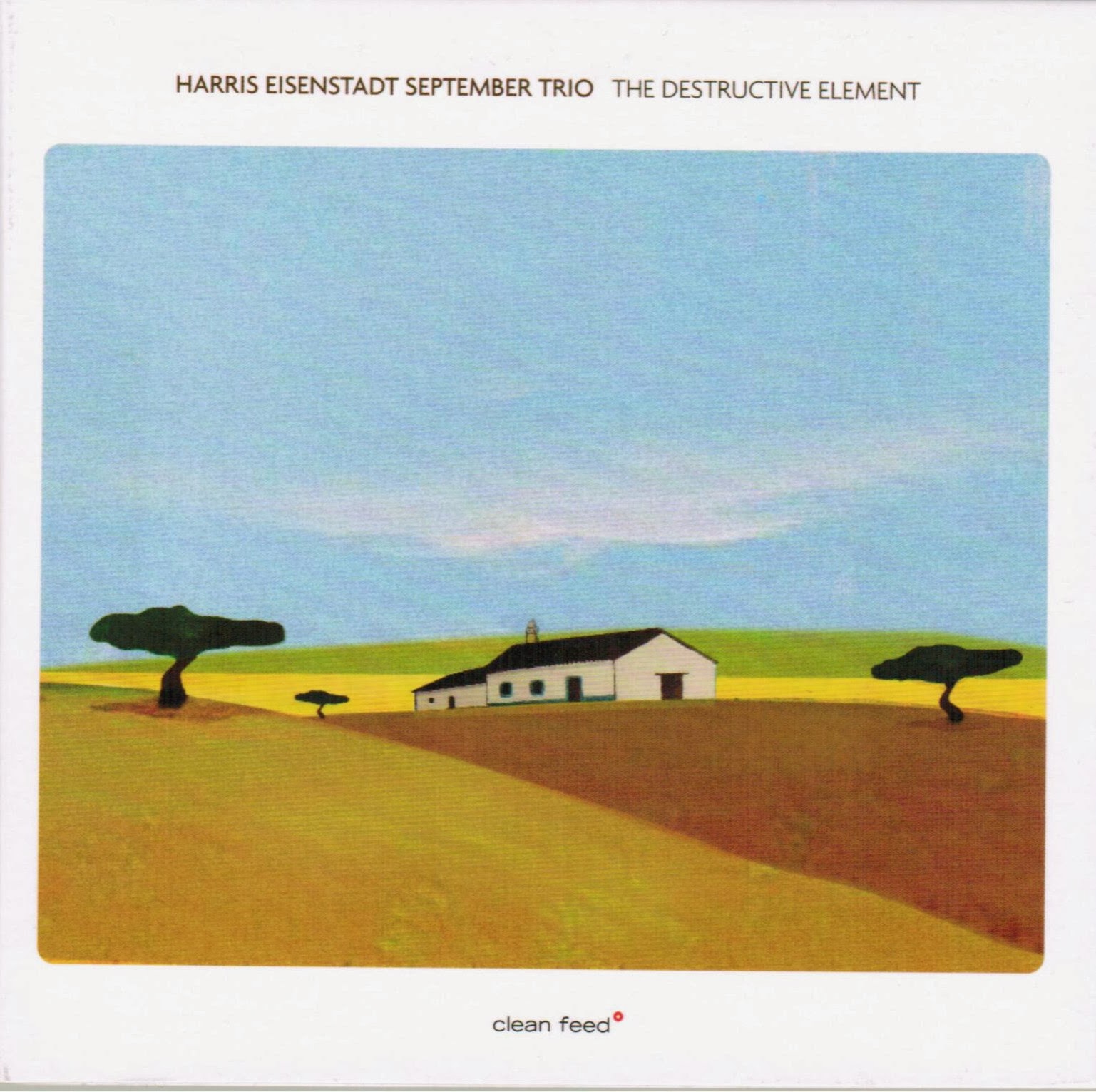
9. Harris Eisenstadt September Trio The Destructive Element [Clean Feed]
The Destructive Element is slightly heavier on the compositional emphasis than Chorale, i.e., the specific pieces here stand out as much as the overall feel, where on the Knuffke I tend to come away savoring the latter. As I indicated on last year's jazz recap, which featured a pair of new Harris Eisenstadt records (I think these were the third and fourth Eisenstadt albums that have turned up in my year-end coverage in recent years), I'm consistently impressed by this drummer-composer's ability to build bands that matter, that have something to say. A lot of jazz musicians are really fond of hatching projects, period. It's not always clear why a given composer/conceptualist feels the constant need to found their various ventures. But with Eisenstadt, I always feel like I understand why this group needs to be playing this music. That's really the case in the repertoire of the September Trio, which features two extraordinary players: pianist Angelica Sanchez and saxophonist Ellery Eskelin. I remember liking this band's self-titled 2011 debut, but I think this is better. The compositions on The Destructive Element seem to me to be Eisenstadt's love letters to his collaborators. He really seems to be working hard to give them what they need compositionally to be themselves as players. There are few things I've heard on record this year as beautiful as the ballad "Back and Forth"—Sanchez and Eisenstadt marching steadily forward as Eskelin emotes in that passion-packed yet anti-histrionic style of his. "Swimming, Then Rained Out"—an almost gospel-ish slow-burner—is another piece with the same kind of unassuming authority. All three of these players are known for venturing into various sorts of free-jazz territory, and there is a bit of hectic scramble on this record (e.g., the brief improv episodes that fall between the signpost theme statements in "Additives"). But gorgeousness is, I'd say, the chief imperative. There is so much pleasure and care and warmth and soul in these pieces—Eisenstadt working hard for Sanchez and Eskelin, and them working hard for him in turn. This isn't an all-ballads program, like they used to make back in the day, but it's definitely oriented that way, and it has the same spirit, i.e., "This is the vibe we're going to be working with, so get on board with it." I really admire that commitment, and I find myself wishing that this band would go even further in that direction on their next effort. Few working jazz groups I can think of have a more affecting, unpretentious way of singing a song together.
10. Kris Davis Massive Threads [Thirsty Ear]
This was a serious year for solo piano. In addition to Massive Threads, you've got the Parks and Shipp albums above, and a few other acclaimed discs—by Myra Melford, Bobby Avey, Geri Allen (hers was mostly solo, some duo)—that sounded intriguing to me on a first spin but that I didn't get a chance to put in good time with. This might be the most challenging of the whole crop. What I like about Massive Threads is that it sounds genuinely experimental, i.e., like a document of fresh ideas being road-tested, without coming off as ponderous. The first piece, "Ten Exorcists," is a study in what sounds like prepared-piano minimalism; I'm not sure if Davis is actually placing objects inside the piano, or simply muting the hammers with her fingers, but the net effect is something like a mini tuned-percussion orchestra. It's technically impressive, but why it works is that it sounds genuinely curious—like Davis is excited to share what she's found, rather than austerely demonstrating some rarefied technique. I feel the same of "Dancing Marlins," where she seems to really be getting down to basics with the piano, reveling in it as a sound generator, rather than an instrument with all this heavy tradition behind it. On a piece like this, she sounds almost playful, but there's clearly a heavy thought going into these exursions, as though she'd spent days and weeks homing in on a specific area of inquiry before tossing away the blueprints and hitting record. Like Craig Taborn—and I think of Massive Threads as a cousin to his Avenging Angel (discussed here), in a way—Davis is clearly a player of frighteningly advanced technique who often seems utterly ambivalent about showing it off. The idea is primary, the sense of chasing down some weird sound zone—cornering it, dissecting it, finally inhabiting it. These players are poker-faced; they can verge on Cecil Taylor's density and destabilization, but the torrential outbursts he's famous for aren't their style. With Taborn and Davis, there's more the sense that, yes, they could slay you at any moment, but they'd rather keep you, and themselves, in infinite suspense. You get on their wavelength or you turn the record off; it's that simple. As intimidating as that sounds, there's a deep, human pleasure in listening to Davis live with these ideas. "Desolation and Despair" (what a title!)—just crawling, limping along, but not maudlin or emotionally showy. She's seeking stillness on Massive Threads, just as much as she's seeking herky-jerky mobility on some of the other pieces. As with Taborn, whatever the area of inquiry, Davis is going to get to the very bottom of it, at her own pace. And that's a thrilling thing to witness.
/////
There are a bunch of other 2013 jazz records that I dug and hope to be able to spend more time with. These include the two Ethan Iverson–plus-contemporaries-and-veteran sessions (Tootie's Tempo, Costumes Are Mandatory), Tarbaby's Ballad of Sam Langford, Hush Point's self-titled debut, Dan Tepfer and Ben Wendel's Small Constructions and Dave Holland's Prism.
But the one formal honorable mention I feel like I need to make is of Ben Allison's The Stars Look Very Different Today, an album that came out recently and only made its greatest impact on me once I'd already filed my 2013 jazz ballot. I'm not sure that this one would've ended up displacing anything listed above, but I still probably would've given the matter serious thought if I'd had another couple weeks. Like Eisenstadt, Ben Allison has shown up on my end-of-year jazz list before; I loved Action-Refraction from 2011. I think Stars might be better. Allison is the kind of composer-bandleader that always seems to be heading further from jazz, per se, and nearer to his own personal soundworld. On The Stars, he's firmly in his own space. The instrumentation—Brandon Seabrook (it's great to compare his work here with that on the Black Host record, btw) and Steve Cardenas on wonderfully complementary guitars, and Allison Miller on drums—helps to give the record its individualized feel, but it's also the writing and the thrust of the performances. I've placed so much emphasis above on the idea of song. I have no problem repeating myself, because it so pleases me to hear a band zeroing in on that notion and getting it right. The songs here are magical—"Neutron Star," a sort of psychedelic roots-rock theme, is one of my favorite pieces of music of the year. There's great soloing on The Stars, but when I reflect on it, I think of a band laboring intensely in the pursuit of Allison's beautiful writing. Such that when they improvise, it's more like embellishment rather than departure. The thing is the singing of these wordless reveries, and the little mini idiom Allison has created here, this sort of folksy, funky, emotive, spacey-textured wordless pop that he's focusing on. He seems to want the instrumentation and the material to exist in perfect balance, so that you don't hear jazz, you hear these themes, and underlying them, the personal signatures of himself and his collaborators. I wish all "jazz" felt this personal, this generous, this simultaneously unfamiliar and inviting.
/////
My favorite historical releases (reissues/unearthings) of 2013 were:
Miles Davis The Bootleg Series, Volume 2: Live in Europe 1969 [Columbia/Legacy]
Pitchfork review here.
New York Art Quartet call it art [Triple Point]
Thoughts here.
Woody Shaw The Complete Muse Sessions [Mosaic]
I'm slowly making my way through this set, and it's sounding excellent—an important document of a period (mostly ’74–’87) that's a blank spot on many jazz maps, and was on mine until not that long ago. One session that blows my mind is the December ’65 date Shaw originally recorded for Blue Note—Wikipedia says it was a demo tape; the Mosaic liners say that Alfred Lion intended to release it but backed out after he sold the company. Anyway, those five tracks are as good as you'd hope/expect given the vintage and the personnel: Joe Henderson and Joe Chambers, along with either Larry Young (on piano rather than organ, a month after the great Unity, which features Shaw and Henderson) and Ron Carter, or Herbie Hancock and Paul Chambers. I'm curious to know how Woody Shaw's general stature in jazz would look if this album had come out on Blue Note at the time it was made. Anyway, point is, it's great, and I can't wait to spend more time with this set as a whole. (Speaking of Mosaic, I really want to get my hands on that Clifford Jordan box, as well.)
/////
On the live front, my favorite jazz performances of the year were:
1.11.13
Eric Revis, Kris Davis and Andrew Cyrille at Winter Jazzfest
Thoughts here.
3.22.13
A Tribute to Paul Motian at Symphony Space
Thoughts here.
10.5.13
McCoy Tyner, Gary Bartz and Co. at the Blue Note
Thoughts here.
9.21.13
9.28.13
12.6.13
Milford Graves with, respectively, Evan Parker, John Zorn and Joe Lovano, at, respectively, the Stone, the Metropolitan Museum of Art and the Stone.
Thoughts here.
I also loved seeing Black Host at Seeds (May 29) and Roy Haynes at the Blue Note (June 27).
/////
P.S. Aside from Phil Freeman's excellent jazz round-up, linked above, I've really enjoyed perusing the latest installment of Francis Davis's annual Jazz Critics Poll (plus the always-fascinating data breakdown by Tom Hull), as well as Seth Colter Walls's Rhapsody list, and Ben Ratliff and Nate Chinen's jazz-heavy NYT top 10s.
(The Lloyd/Moran, Parks and Lonnie Smith albums aren't on Spotify; you can stream the other seven selections here.)
1. Black Host Life in the Sugar Candle Mines [Northern Spy]
I had high expectations for this record. I'd heard this band live two years back and was mightily intrigued. Life absolutely measures up. The Cleaver-as-a-leader discography is one of my favorite in contemporary jazz, and this is at least as strong a statement as Be It as I See It (discussed here). Probably stronger, because the personnel—Darius Jones, Brandon Seabrook, Cooper-Moore, Pascal Niggenkemper—is just so damn impressive. Serious kudos to Cleaver for figuring out a way to re-present the perennially underrated Cooper-Moore to the world. C-M's understated star turn on Life's concluding track, "May Be Home," is one of my favorite musical moments of the year. There's plenty of electrifying skronk on this record—some of which drags on a bit long for my tastes, that being the main reason this didn't crack my all-genres-in-play top 10—but the almost gospel-ish, soul-stirring element is what really draws me in. The quieter moments, such as the dreamy breakdown around 4:00 in "Hover," the heartbreakingly fragile "Citizen Rose" or the aforementioned "May Be Home" are pure bliss. For more on Life, see my Pitchfork review.
2. Charles Lloyd / Jason Moran Hagar's Song [ECM]
What a warm and sumptuous album this is. These two are just hanging out and playing great songs together. I'm a big fan of the Bandwagon, but I prefer Moran in a more unadorned setting, like this. There's no hook, no concept, just full engagement with the material. I'm currently revisiting one of my favorite tracks, "Bess, You Is My Woman Now," and Moran takes the most loving, unflashy solo, laying out the red carpet for Lloyd, whose presence throughout is, at the risk of sounding cliché, totally Zen-ed out. The epitome of a nothing-to-prove session. There's a little bit of modernist scrambling, but mostly this album is just songs (pop standards such as "God Only Knows" are treated as reverently as the jazz ones), with a bias toward luminous ballads. Absolutely fine by me. This is jazz you can really live with.
3. Aaron Parks Arborescence [ECM]
I would say the same of this album. I say, without shame, that both have served as cooking-dinner soundtracks for me. Is it doing a disservice to the deep beauty of Arborescence to say that it's ideal mood-setting music? I shy away from the idea of background music, but I wonder if the pianist himself would even take offense to that? He seems to really want to reach his audience here. These are mostly improvised pieces; to my ear, they're unrepentantly pretty and more classical-ish than jazzy. It's strange, but in a way, my experience of Arborescence is what I imagine the experience of The Köln Concert to be. I've never spent good time with that legendary record—no bias; I just haven't gotten around to the Jarrett solo repertoire in general—but judging by everything I've heard about Köln, Arborescence is, at least niche-wise if not style-wise, the same kind of piano record. One that, in theory, anyone could enjoy, and one that a purist might see fit to frown upon. Sometimes Arborescence is so wispy and drawn out that it almost seems to disappear, but there's real power in that ephemerality. You sit with this and you marvel at Parks's ability to simply make music, and to do so selflessly enough to make it so universal. It's hard to imagine an ear that doesn't crane toward this music as to soft morning sunlight, as mine is doing right now as I revisit it.
4. David Ake Bridges [Posi-Tone]
For me, the jazz writer of the year was Phil Freeman. He covered more of the music, in a more genuinely useful way—i.e., a way that made you want to seek out the sounds—than anyone else I read in 2013. Phil's year-end jazz round-up is essential; among the records he cited there, I got particularly into David Ake's Bridges, which I checked out a while back after reading this Burning Ambulance post. Bridges is one of those somewhat rare sessions where, going in, I'd never heard of the leader but I knew most of the other players well. The lineup is stellar—trumpeter Ralph Alessi, saxists Peter Epstein and Ravi Coltrane, bassist Scott Colley and drummer Mark Ferber—but it's what Ake, a pianist, does with the personnel that makes this album work. The compositions are maybe the tightest, most intricate and most memorable that I've heard on a jazz album this year. Ake leaves space for his sidemen to speak up—I'm listening to a great Colley solo, with commentary from Alessi, on the track "Sonomads"—but what you'll remember are these beautifully arranged, little-big-band themes, executed in a modern postbop style. Phil cited a minimalism influence, and I can definitely hear that, combined with the lusher, more meticulous end of the mid-’60s Blue Note sound—maybe a little bit of Dimensions and Extensions or The All-Seeing Eye, though Bridges is lighter in tone, funkier and more approachable, in a way that sometimes reminds me of Ravi Coltrane's own 2012 date Spirit Fiction (discussed here), which also features Alessi. Sometimes the mood gets greasier, slurrier, such as on the raucous and bluesy "Year in Review," where—as often happens on the album—the horns solo in unison. Even there, though, there's such a wonderful sense of order to this record, of a leader taking the time not only to assemble a great band but also to put together a compelling context for them to work within. I'd recommend this to any fan of well-made, composer-centric but also player-friendly small-group jazz.
5. Aaron Diehl The Bespoke Man's Narrative [Mack Avenue]
Same deal here, but in a more consciously retro idiom. As with the Aaron Parks above, I can think back to a time when I might have found a session like this—one that, God forbid, dares to hark back to that age-old connection between jazz and snappy dressing—distasteful. Now I find it to be the opposite. Anyone who writes this off due to the cover art is going to be missing on a gorgeous record. Steve Smith likened the concept here to the Modern Jazz Quartet, and he's right: That similarity is inescapable, given the piano-vibes-bass-drums instrumentation and almost obsessive polish and elegance on display in the playing and composition. But if there's retro-ness at play here, it's the most lived-in, un-gimmicky kind. There is such a nothing-to-prove quality about a piece like "Blue Nude" here; as with the Lloyd/Moran above—note that Bespoke also includes a marvelous version of "Bess, You Is My Woman Now"—Diehl just wants to play songs, to swing crisply, muse tastefully, give you a good feeling while at the same time presenting a striking portrait of who he is as a bandleader. You could hear, say, this group's reading of "Moonlight in Vermont" in passing and think it was merely "right," in the not-a-hair-out-of-place sense, but as with the MJQ, you listen closely and you're blown away by the unassuming skill, shrewdness, loving care of it all. Diehl's solo version of Ellington's "Single Petal of a Rose," burrows a little deeper; the ballads on Hagar's Song are astonishing in their unhurried composure, but this might even be more so. This record radiates love and care, for the material, yes, but also for the listener. Diehl wants to make you comfortable, not as an end in itself, but so that he can move you. The Bespoke Man's Narrative is radical in its sheer composure.
6. Matthew Shipp Piano Sutras [Thirsty Ear]
We think of Matthew Shipp as an avant-garde guy, someone on the opposite end of the spectrum from an immaculately groomed, Juilliard-trained, J@LC–anointed (complete with Wynton co-sign and Crouch liner notes) prodigy such as Diehl. And, to judge by Shipp's pugilistic stance toward the jazz maintream, he thinks of himself that way. But strip away the rhetoric and you're left with an aesthetic that's plenty approachable, plenty jazzy and, as heard on Piano Sutras, really, really satisfying. For one thing, Shipp takes the trouble to make records, as such. He's no Cecil Taylor, who for roughly the past 35 years has released almost exclusively live records, or rather others have released them. Taylor seems to have very little regard for how his music is consumed after it's made; Shipp, on the other hand, seems to only be getting better at plotting out programs that his listeners can genuinely engage with. Piano Sutras is a collection of 13 short-ish pieces. Aside from the standards, I'm not sure which are based on preconceived ideas and which were improvised on the spot, but each one seems to have a strong center and purpose—we're not just listening to Shipp jam. There are some tracks on this record that set a killer mood, that make essentially abstract, solo, sort-of-jazz piano seem like the same thing as songwriting: "Space Bubble" captures that crystalline sense of mystery that I associate with my favorite Shipp recordings (New Orbit, e.g.); "Blue Orbit" does sound like a blues, but refracted beautifully through the Shipp prism; "Cosmic Dust" comes off like a tug-of-war between Taylor and Andrew Hill. And then there are the standards, which strike me as deeply generous. I know that's a weird word to use, but the 71-second "Giant Steps" is just pure nourishing gorgeousness. "Nefertiti" is little more diffuse, but again, this is no deconstruction of, no attack on a chestnut; like the "Giant Steps," and like all great interpretations of standards, it's a celebration of the raw material. Overall, Piano Sutras is as warmly swinging as it is mad-scientist demented (see esp. "Cosmic Shuffle," which perfectly illustrates the tension between those two currents in Shipp's playing); it can be difficult, but generally, it meets you halfway. In that sense, I think Shipp has more in common with Hill than with Taylor. Thinking of Shipp as merely an iconoclast, whose output is as forbidding as his verbal critiques, does him a disservice. I like Piano Sutras because it's a record of weird solo piano that nevertheless invites you in.
7. Dr. Lonnie Smith Octet In the Beginning, Vols. 1 and 2 [Pilgrimage]
The second release from this veteran organist's own label, Pilgrimage, and the follow-up to a highly enjoyable trio set that made my jazz honorable-mentions list for 2012. Frequently, this record is the epitome of what you might estimate it to be: an exemplary soul-jazz set in the mode that Smith helped to perfect. Then, suddenly, when the leader goes off on one of his skipping-record excursions, wiggling his fingers relentlessly between two notes, or holding down a chord so long that it starts to feel like a laser beam of joy aimed at your skull, you start to realize that you're glimpsing the infinite. The band is pure fire and focus, whether the mode on display is crackling hardbop ("Turning Point"), strutting funk ("Move Your Hand," which features a beautiful Smith lead vocal) or pensive balladry ("In the Beginning"). The other soloists are generally strong; the arrangements, by saxist-flutist Ian Hendrickson-Smith; and the rhythm section—with guitarist Ed Cherry and drummer Jonathan Blake—kicks a great deal of ass. But the glory of this set is the leader himself, how hard he pushes, how, with each solo, he erases the line between music for your body and music for your spirit. You rarely hear a man so clearly convinced that his chosen instrument is a vehicle for transcendence, even salvation. Let's let Smith have the last word, via a quote from Ted Panken's informative liner notes: "I always say that the Hammond has all the elements in the world to me—the thunder and the lightning and the rainbow, the feel of the earth, the sun, the moon, the water."
8. Kirk Knuffke Chorale [SteepleChase]
I've dug cornetist's Kirk Knuffke's playing whenever I've heard him live, with bands like Ideal Bread or Merger (discussed here), as well as on recent records like Federico Ughi's self-titled quartet album, Max Johnson's Elevated Vegetation and the collaborative trio Sifter. I think Chorale is the first record I'd heard under Knuffke's own name. He's been making a bunch of cool CDs for the venerable SteepleChase label—including various collaborations with pianist Jesse Stacken—that I really need to take a closer look at, but Chorale grabbed me instantly, largely because I'm a complete sucker for anything with Billy Hart on it. Because of the unmistakable presence of Hart's drumming, its authority and weight—even when he's barely playing—he's going to be more or less a co-leader in any band in which he appears. That's definitely the case here, but Hart isn't dominating. The great thing is, no one is. Knuffke is a wonderfully patient, lyrical player, who's seemingly obsessed with the simple beauty of the line. You'll sometimes hear him going for slight timbral distortions, but mostly he's just singing, softly yet forcefully. He's not coming to the table on Chorale with a huge amount of compositional baggage. He seems to want to simply mix it up with the wonderful band he's assembled, which also includes pianist Russ Lossing and bassist Michael Formanek. What they're playing is a kind of cool-toned free jazz. In pieces like "Made," the musicians are jumping from one lily pad to the next, unbound by meter, but the interplay is so right-on—each player seeming so willing to help the others, as well as the overall sound, along. Sometimes the sound is more traditional, like on the gentle postbop dance "Standing," but the band maintains its wonderfully plush feel. Listening back now, I'm starting to hear the whole group concept of this record as an extension of Knuffke's songful cornet style, a style so self-assured that he doesn't have to raise his voice. There's not a lot of overt heat on Chorale, but the mojo bubbling beneath the surface is formidable. Like Hart, the rest of the players here know how to make their mark on a session simply by speaking clearly as themselves.
9. Harris Eisenstadt September Trio The Destructive Element [Clean Feed]
The Destructive Element is slightly heavier on the compositional emphasis than Chorale, i.e., the specific pieces here stand out as much as the overall feel, where on the Knuffke I tend to come away savoring the latter. As I indicated on last year's jazz recap, which featured a pair of new Harris Eisenstadt records (I think these were the third and fourth Eisenstadt albums that have turned up in my year-end coverage in recent years), I'm consistently impressed by this drummer-composer's ability to build bands that matter, that have something to say. A lot of jazz musicians are really fond of hatching projects, period. It's not always clear why a given composer/conceptualist feels the constant need to found their various ventures. But with Eisenstadt, I always feel like I understand why this group needs to be playing this music. That's really the case in the repertoire of the September Trio, which features two extraordinary players: pianist Angelica Sanchez and saxophonist Ellery Eskelin. I remember liking this band's self-titled 2011 debut, but I think this is better. The compositions on The Destructive Element seem to me to be Eisenstadt's love letters to his collaborators. He really seems to be working hard to give them what they need compositionally to be themselves as players. There are few things I've heard on record this year as beautiful as the ballad "Back and Forth"—Sanchez and Eisenstadt marching steadily forward as Eskelin emotes in that passion-packed yet anti-histrionic style of his. "Swimming, Then Rained Out"—an almost gospel-ish slow-burner—is another piece with the same kind of unassuming authority. All three of these players are known for venturing into various sorts of free-jazz territory, and there is a bit of hectic scramble on this record (e.g., the brief improv episodes that fall between the signpost theme statements in "Additives"). But gorgeousness is, I'd say, the chief imperative. There is so much pleasure and care and warmth and soul in these pieces—Eisenstadt working hard for Sanchez and Eskelin, and them working hard for him in turn. This isn't an all-ballads program, like they used to make back in the day, but it's definitely oriented that way, and it has the same spirit, i.e., "This is the vibe we're going to be working with, so get on board with it." I really admire that commitment, and I find myself wishing that this band would go even further in that direction on their next effort. Few working jazz groups I can think of have a more affecting, unpretentious way of singing a song together.
10. Kris Davis Massive Threads [Thirsty Ear]
This was a serious year for solo piano. In addition to Massive Threads, you've got the Parks and Shipp albums above, and a few other acclaimed discs—by Myra Melford, Bobby Avey, Geri Allen (hers was mostly solo, some duo)—that sounded intriguing to me on a first spin but that I didn't get a chance to put in good time with. This might be the most challenging of the whole crop. What I like about Massive Threads is that it sounds genuinely experimental, i.e., like a document of fresh ideas being road-tested, without coming off as ponderous. The first piece, "Ten Exorcists," is a study in what sounds like prepared-piano minimalism; I'm not sure if Davis is actually placing objects inside the piano, or simply muting the hammers with her fingers, but the net effect is something like a mini tuned-percussion orchestra. It's technically impressive, but why it works is that it sounds genuinely curious—like Davis is excited to share what she's found, rather than austerely demonstrating some rarefied technique. I feel the same of "Dancing Marlins," where she seems to really be getting down to basics with the piano, reveling in it as a sound generator, rather than an instrument with all this heavy tradition behind it. On a piece like this, she sounds almost playful, but there's clearly a heavy thought going into these exursions, as though she'd spent days and weeks homing in on a specific area of inquiry before tossing away the blueprints and hitting record. Like Craig Taborn—and I think of Massive Threads as a cousin to his Avenging Angel (discussed here), in a way—Davis is clearly a player of frighteningly advanced technique who often seems utterly ambivalent about showing it off. The idea is primary, the sense of chasing down some weird sound zone—cornering it, dissecting it, finally inhabiting it. These players are poker-faced; they can verge on Cecil Taylor's density and destabilization, but the torrential outbursts he's famous for aren't their style. With Taborn and Davis, there's more the sense that, yes, they could slay you at any moment, but they'd rather keep you, and themselves, in infinite suspense. You get on their wavelength or you turn the record off; it's that simple. As intimidating as that sounds, there's a deep, human pleasure in listening to Davis live with these ideas. "Desolation and Despair" (what a title!)—just crawling, limping along, but not maudlin or emotionally showy. She's seeking stillness on Massive Threads, just as much as she's seeking herky-jerky mobility on some of the other pieces. As with Taborn, whatever the area of inquiry, Davis is going to get to the very bottom of it, at her own pace. And that's a thrilling thing to witness.
/////
There are a bunch of other 2013 jazz records that I dug and hope to be able to spend more time with. These include the two Ethan Iverson–plus-contemporaries-and-veteran sessions (Tootie's Tempo, Costumes Are Mandatory), Tarbaby's Ballad of Sam Langford, Hush Point's self-titled debut, Dan Tepfer and Ben Wendel's Small Constructions and Dave Holland's Prism.
But the one formal honorable mention I feel like I need to make is of Ben Allison's The Stars Look Very Different Today, an album that came out recently and only made its greatest impact on me once I'd already filed my 2013 jazz ballot. I'm not sure that this one would've ended up displacing anything listed above, but I still probably would've given the matter serious thought if I'd had another couple weeks. Like Eisenstadt, Ben Allison has shown up on my end-of-year jazz list before; I loved Action-Refraction from 2011. I think Stars might be better. Allison is the kind of composer-bandleader that always seems to be heading further from jazz, per se, and nearer to his own personal soundworld. On The Stars, he's firmly in his own space. The instrumentation—Brandon Seabrook (it's great to compare his work here with that on the Black Host record, btw) and Steve Cardenas on wonderfully complementary guitars, and Allison Miller on drums—helps to give the record its individualized feel, but it's also the writing and the thrust of the performances. I've placed so much emphasis above on the idea of song. I have no problem repeating myself, because it so pleases me to hear a band zeroing in on that notion and getting it right. The songs here are magical—"Neutron Star," a sort of psychedelic roots-rock theme, is one of my favorite pieces of music of the year. There's great soloing on The Stars, but when I reflect on it, I think of a band laboring intensely in the pursuit of Allison's beautiful writing. Such that when they improvise, it's more like embellishment rather than departure. The thing is the singing of these wordless reveries, and the little mini idiom Allison has created here, this sort of folksy, funky, emotive, spacey-textured wordless pop that he's focusing on. He seems to want the instrumentation and the material to exist in perfect balance, so that you don't hear jazz, you hear these themes, and underlying them, the personal signatures of himself and his collaborators. I wish all "jazz" felt this personal, this generous, this simultaneously unfamiliar and inviting.
/////
My favorite historical releases (reissues/unearthings) of 2013 were:
Miles Davis The Bootleg Series, Volume 2: Live in Europe 1969 [Columbia/Legacy]
Pitchfork review here.
New York Art Quartet call it art [Triple Point]
Thoughts here.
Woody Shaw The Complete Muse Sessions [Mosaic]
I'm slowly making my way through this set, and it's sounding excellent—an important document of a period (mostly ’74–’87) that's a blank spot on many jazz maps, and was on mine until not that long ago. One session that blows my mind is the December ’65 date Shaw originally recorded for Blue Note—Wikipedia says it was a demo tape; the Mosaic liners say that Alfred Lion intended to release it but backed out after he sold the company. Anyway, those five tracks are as good as you'd hope/expect given the vintage and the personnel: Joe Henderson and Joe Chambers, along with either Larry Young (on piano rather than organ, a month after the great Unity, which features Shaw and Henderson) and Ron Carter, or Herbie Hancock and Paul Chambers. I'm curious to know how Woody Shaw's general stature in jazz would look if this album had come out on Blue Note at the time it was made. Anyway, point is, it's great, and I can't wait to spend more time with this set as a whole. (Speaking of Mosaic, I really want to get my hands on that Clifford Jordan box, as well.)
/////
On the live front, my favorite jazz performances of the year were:
1.11.13
Eric Revis, Kris Davis and Andrew Cyrille at Winter Jazzfest
Thoughts here.
3.22.13
A Tribute to Paul Motian at Symphony Space
Thoughts here.
10.5.13
McCoy Tyner, Gary Bartz and Co. at the Blue Note
Thoughts here.
9.21.13
9.28.13
12.6.13
Milford Graves with, respectively, Evan Parker, John Zorn and Joe Lovano, at, respectively, the Stone, the Metropolitan Museum of Art and the Stone.
Thoughts here.
I also loved seeing Black Host at Seeds (May 29) and Roy Haynes at the Blue Note (June 27).
/////
P.S. Aside from Phil Freeman's excellent jazz round-up, linked above, I've really enjoyed perusing the latest installment of Francis Davis's annual Jazz Critics Poll (plus the always-fascinating data breakdown by Tom Hull), as well as Seth Colter Walls's Rhapsody list, and Ben Ratliff and Nate Chinen's jazz-heavy NYT top 10s.
Subscribe to:
Posts (Atom)