Thursday, April 28, 2011

In the zones: Darius Jones and Matthew Shipp at Jazz Standard


In their new duo, Darius Jones and Matthew Shipp are limiting themselves, and it sounds really good. Tonight I saw the pair, on alto saxophone and piano respectively, at Jazz Standard, where they were celebrating a new Aum Fidelity album, Cosmic Lieder. The record is very good; the show was much more than that—an arresting demonstration of a shared philosophy of improvisation, a series of sharp answers to age-old questions like "Where do we start?," "Who leads?," "Who follows?" and maybe most importantly, "Where do we end?"

As far as I can tell, the Jones/Shipp duo is an all-improv project, but it is not a free-for-all. These are songs, in a way—brief (averaging four minutes or so) and highly directional. The titular cosmos delivered with pop-song economy.

At Jazz Standard, the duo was incredibly decisive, each piece a single sustained idea, kicked around and prodded at but fixed, secure in its center. I think of Ghostbusters, when each of the three 'busters zaps Slimer and they slowly, steadily lower him into the trap in unison. It was that kind of teamwork.

Darius Jones already has a formidable reputation for gutsy free-jazz soul. (See Steve Dollar's fine Wall Street Journal profile.) If you've heard him in Little Women, you know it's not just soul that interests him, but maniacal, stabbing noise as well. The key thing to understand about Jones's work with Shipp, though, is that he's playing here with an almost heroic restraint. That's not to say that his ideas are restrained; he unleashed plenty of throaty shrieks and yelps tonight. It's more that he doesn't let them fully off the leash. This is not a blow-till-you-drop free-jazz concept (a good thing, in my opinion—we've got quite enough of those)—it's a concept of harnessing moments of wildness, violence boiling up and receding, leaving behind its scent. Wind the tension till it snaps, work through the tantrum and then bring it back to a whisper. Tonight Jones played with such tension, bearing down even at barely audible volumes. Always deciding, to do or to not do, to attack or to grit teeth and let the moment pass, winding, winding. Letting go and reining in. Making a song out of raw materials, letting their edges show but obeying an imaginary hourglass—when it's time to stop, you stop. You don't mourn the passing. You pause and you get on with what's next. These songs had an imperative to get somewhere, and almost without fail, they did.

Matthew Shipp made damn sure they did, actually. The pianist has a reputation for cantankerousness off the bandstand, and that tendency is often projected onto his playing. I feel like I've read descriptions that likened his improvising to boxing—I could've sworn the word "pugilistic" was used somewhere [NOTE: After the fact, I turned up this boxing-and-jazz piece by Shipp himself!]as though he was this swaggering, merciless hard-ass. And of course there are the vague Cecil Taylor comparisons. But specifically on the latter front, there's an immense difference, namely that Matthew Shipp goes to Herculean lengths to ensure that his collaborators sound good. (For all his strengths, CT is not, on the whole, what one would call a deeply sensitive collaborator.) Or, maybe I should say, he did so tonight—I suppose his trio (where he is the nominal leader and principal soloist) is a somewhat different story. With Jones he was like a shadow, cushioning and supporting at all times, providing just the right backdrop, vamping when need be, hammering out the framework so that Jones could dance within it. The word I kept thinking of, and writing down, was GRACIOUS. This was a duo music, i.e., neither player really soloed per se, but the roles were clear—Shipp was ground and Jones was sky. So the tension, and there was so much and it was so very exciting, came from the ideas and not from some sort of hackneyed clash between the players. Shipp is no pugilist—he's a master scene-setter, like some sort of production designer, laying out sumptuous period furnishings that help the actors immerse in their roles, accessing new truths.

The moods and textures were many. There was the eerie impressionism that is something like Shipp's signature. (Jones shouts-out this special Shippian vibe in this great joint appearance on Jason Crane's The Jazz Session, zeroing in on New Orbit, a truly fantastic 2001 record—maybe my favorite of Shipp's that I've heard.) Faster, choppier excursions. Hushed sonic mobiles with Shipp plucking the piano strings by hand. Jones always sounding so incredibly vocal, crying out with something there's not even a word for. "Anguish" seems too broad. It's like a simmering combination of mad and sad, wounded and vengeful. Bearing down immensely on the notes till they pop out. It was like soul surgery, with Shipp laying out all the tools on the operating table.

The two railed, in a way, against the semi-swanky jazz-club setting. They paused after each piece, just long enough to let you know it was indeed over, and the applause would begin. But they were onto the next one immediately—no time for basking or even, really, acknowledgment. I think about Keith Jarrett and how when I saw him at Carnegie Hall earlier this year, he bowed ponderously after each piece, enervating the room each time. Jones and Shipp weren't about to break the fourth wall. They were in the zone, or should I say in the zones, each brief song its own cosmos that for those four minutes or so was their shared, sole objective. Anyone improvising "open-endedly," "seeing how it goes," "relaxing," "emoting," doing whatever you're doing other than deciding where a piece should go and going there, NOW, take heed. However "experimental" you fancy yourself, you are competing with composed music; there is an imperative to pick an idea, to state that idea, make it stick and call "Scene." If further clarification is needed, consult your copy of Cosmic Lieder or the next Jones/Shipp duo gig.

Friday, April 22, 2011

The Bad Plus and Joshua Redman: Opening the airlock


I have seen probably 20 or more free-jazz performances that quickly ramped up to a blaring peak, stayed there for a half hour or so and petered out. As a listener, it's hard not to grow numb to this kind of thing after a while.

Last night's 10:30pm Blue Note set by the Bad Plus with Joshua Redman climaxed with an expressionist freak-out, but crucially, it was brief and strategic. The band was playing Reid Anderson's "Silence Is the Question." They gradually climbed from sparse placidness to a shrieking, stampeding summit—two to three minutes long, I'd say—that was maybe the most concentrated blast of intensity I've ever heard at a live jazz performance. (Redman, especially, was merciless, easily holding his own among my collected memories of witnessing players like Brötzmann or Mats Gustafsson.) It was quite honestly shocking on a straight-up visceral level, as though the quartet had suddenly opened an airlock and let the terrible void of deep space rush in. The perfect sneak attack: not beating an audience over the head for a hour, but taking them on a long, varied, generally pleasant tour (the rest of the set was good—with Redman, overall, coming off as deeply engaged and thrilled to be there—especially versions of Ethan Iverson's "Guilty" and Anderson's "You Are," but the finale was on a whole other level) and then depositing them without warning at Satan's feet. I looked around the club, feeling almost sorry for any tourists who had accidentally stumbled in.

A quick, steady decrescendo, and the set was over. "That was the one," I saw Dave King say to Anderson, which I hope means they were recording. "That last part was perfect jazz," said Laal. Yes, it was.

Monday, April 18, 2011

Power Tools/Strange Meeting: The Michael Mann jazz [now with producer's commentary]


UPDATE, 5.8.2011: A few days after posting this appreciation of Strange Meeting, I received a nice e-mail from David Breskin, who produced the record. He also contacted Steve Smith and he very kindly offered to a) fill us in on the details of this session, and b) correct one longstanding misconception, namely that—as mentioned below—Strange Meeting was originally intended as a quartet date with Julius Hemphill. Not true at all, it turns out!

Breskin followed up a few days later with a fascinating account of the making of the record. As you'll read below, there was nothing accidental about it; Strange Meeting was a true old-school PRODUCTION, complete with rehearsal, strategic preplanning and a real aesthetic backbone. (My sense is that there aren't a whole lot of jazz records being made this way anymore.) Breskin's text doubles as a fascinating insider's perspective on the NYC jazz scene in the ’80s. It's essential reading for any fan of that period, of Strange Meeting in particular, of the musicians involved in general, or for anyone interested in the way a producer can act as a true collaborator, setting parameters that liberate rather than constrict, ultimately yielding an ALBUM rather than just a collection of performances. Breskin's text, edited and fully approved by him, appears below my post.


"I thought Shannon’s playing might do something interesting to Bill and that Bill’s playing might do something interesting to Shannon, and that Melvin would be a perfect fulcrum and shifting counterweight: suitably fierce but appropriately subtle and supportive when need be and no road hog he. Anyway, that was my hope. I thought this could be a cool band, and Shannon always used to say, 'Nothing beats a failure but a try.' So, why not?"

—David Breskin on Strange Meeting

/////

I wrote a little while back about the idea that free jazz ought to be documented in the studio as well as onstage. Been thinking again about that the past few days, while immersing myself in Strange Meeting (Antilles), the lone officially released recording by Power Tools, the trio of Bill Frisell, Melvin Gibbs and Ronald Shannon Jackson.

I have heard from Steve Smith (who, as you can read here—scroll down to the 1987 section—regards Strange Meeting as a desert island disc and a perfect record) and other sources that this January, 1987 record date was originally scheduled to be led by Julius Hemphill. He didn't show, though—apparently due to illness—and a new scheme was quickly hatched. I'm not sure if the date was supposed to be these three gentlemen *plus* Hemphill or if one of them was called in to replace him, but at any rate, what you have here is the only in-studio meeting of Frisell, Gibbs and Jackson, and it is indeed a strange one. [NOTE: Hemphill was never a part of this date. Please see intro and addendum to this post for details.]

And really the strangest thing about it, given the aforementioned haphazardness of its organization, is how incredibly *together* it all sounds. You might expect some sort of free blowout: "Ah, fuck it—let's just improvise and roll tape." That is not what this record is at all, though. It is an honest-to-goodness full-length LP, paced as intelligently as any rock classic you could name.

You would honestly think this lineup had been together for years. All of the members contribute pieces, and the writing is more or less evenly split: three pieces by Frisell, three by Gibbs, two by Jackson, one collective jam and one cover (yes, "Unchained Melody"). This, to me, is the formula for success in jazz, and maybe even rock too, though it's much rarer. (Descendents/ALL comes to mind; their albums have always been everyone-pulls-their-weight-both-compositionally-and-instrumentally affairs.)

I'm skirting around the music itself, maybe because it's such an enigma. You can't typify what this band sounds like—you have to hear the whole record, really. Gibbs's compsitions, "Wadmalaw Island" and "Howard Beach Memoirs," just floor me. The former is a beautiful, alien quasi-ballad, held together by a Latin-ish vamp. Frisell's sublimely ’80s-ish reverb is just the right thing for it. The band sort of slinks along, doling out its energy gradually. You may never have heard Shannon Jackson play this sensitively. It's like undersea Miami Vice jazz from Pluto. And then Frisell brings out the distortion, and the poetry becomes a bit scary, almost Sharrockian. You think of synthesized seagulls, like in Don Henley's "Boys of Summer." This, to me, is the true ’80s jazz. Lush, sorta-dated-but-you-don't-care sonics mingling with heartbreak. But the real-time improvisation is right there—it's not frosted over with stiff arrangements or soupy sound.

The trio does hectic scribble just as well as it does noirish emoting. Jackson's "A Wolf in Sheep's Clothing" features a tumbling, brief, Ornette-ish head that gives way to a magical kind of clunked-out funk that only Shannon could provide. I would venture to say that his drumming is better here than it ever was in Last Exit. In that band, Shannon tends to go for the broadest gesture, either the martial, about-to-blow ramp-up or the boneheaded electric-blues beat. Here, though, he's actually playing free jazz, more or less, while also keeping the beat. Gibbs's chords jut out crudely, Frisell screams one minute, whispers the next (I tend to hate overly pedal-effected guitar, but Frisell uses pedals like a true surrealist on this record) and Jackson tumbles and exclaims. The beat is somewhere there, but it's not explicit. The band heads out the cargo hatch into space but they hold onto the line. What astounds me is that the piece is only three and a half minutes, but you get a real without-a-net free-jazz feeling in between the bookends of the heads, which themselves give off a very authentic, four-handcuffed-men-being-jostled-violently-around-a-room Ornette-head vibe. It's a true fusion of pop production practices—get in and get out quick—and free-jazz abandon. Great taste and less filling.

And this is what I mean about free-jazz sometimes jelling really well in the studio. Sometimes you don't want to hear a 30-minute live blowout. Sometimes you want to hear the chaos tastefully integrated, in a context you want to play and re-play. Sometimes limits are good.

There's so much else to love on Strange Meeting. I honestly don't know if there's a weak track. I'm spinning the collectively improvised track, "The President's Nap," right now, and as with a lot of Power Tools material, it sounds like the subtler cousin of Last Exit, not as balls-out aggressive but probably more fulfilling on a purely interactive level. Shannon starts out with one of those jaunty, Last Exity marches, Gibbs hops on the train, and Frisell tosses out waves of pure sci-fi sound. Then the whole thing tilts toward something scary and nuclear-sounding, like a parched landscape about to blow. The band is moving all at once, like a miasma in the sky, some sort of hot, creeping menace. The climaxes are hectic and—thanks in part to the outstanding recording quality—vibrantly detailed. It's not just free sound, not just noise. It's deep-listening abstraction, swirling together funk and rock and free jazz and technology and Michael Mann–ish ’80s humidity. You hear this and you feel almost embarrassed for anyone who was still chowing down on old-school, meat-and-potatoes acoustic free jazz circa ’87. This is a music of its time, the best kind in fact. There's a certain mist of cheese swirling around Strange Meeting, but the playing is so goddamn wholesome, so real and right on, that it just becomes part of the joy. It's an if-this-is-wrong-I-don't-want-to-be-right type of thing.

I could go on and on. Frisell's "Unscientific Americans" is another sci-fi Ornette-style tumble. I don't know Prime Time too well, but honestly this band sounds like what I'd *want* Prime Time to sound like, a true electrifying of the skittery, headlong O.C. vibe with none of those bummer boxy funk rhythms. Frisell is basically playing the laser gun here. The song is all the gnarlier, all the more "fuck you" because it's three minutes long. I've been spinning Strange Meeting all weekend, but I find myself appreciating it even more right now. I can't emphasize this pop/free-jazz vibe enough. It's like a not only benevolent but actually mutually beneficial ’80s-izing of avant-garde jazz. It's concise but it's not tidy. Sure it might be cool to hear this band stretch out for 40 minutes or so, but they want to play *songs*, start from coherence and then explode the universe in the time it would take to run down a bebop tune.

I wish I could stream Gibbs's "Howard Beach Memoirs" for you above. It's a parched, steely line, with so much internal poetry and narrative contour. I think of a (nonexistent) Michael Mann cowboy film, Dylan Carlson from Earth playing with a rhythm section that shifts like magma under his feet rather than plods. Frisell lets the alien spiders in after the head. Into the tech-jazz vortex. I think of those old, big, clunky, white-rimmed VHS tape boxes that snapped shut. Instead of snuffing the jazz out like some pillowy ’80s production can, the *casing* of this music, its presentation and milieu and delivery system, is friendly to the aesthetic. Shannon Jackson solos at the end of "Howard Beach," punching holes in the sky with his close-miked arena-rock toms.

And there at the end of it all is "Unchained Melody," romantic and wired all at once. Did the producer suggest it? Who knows, and who cares? You can in fact make a *record* of this music. You can trim it at the edges and not cut out what makes it tick. That way, you can listen again and again.

/////

*Sadly Strange Meeting does not appear to be available for legal download. You can, however, order a pricey autographed (!) copy direct from Ronald Shannon Jackson via his website. (There are a few Power Tools boots there as well, in addition to a bunch of intriguing Decoding Society selections.)

*Here's a nice clip of Power Tools playing Frisell's "When We Go." Check out this comment someone left: "Ronald Shannon Jackson and Bill Frisell are about a millisecond from obliterating into sun particles; some of the most visceral playing with refrain and control. Fortunately, Melvin's got the weight of the world within his thumb alone to keep the gamma rays from shooting skyward..." Nice.

*Here's Destination: Out on Strange Meeting back in ’08, featuring helpful context re: "Howard Beach Memoirs."

*Strange Meeting begs the question: What are other great fruitfully ’80s-ized (i.e., not just made in the ’80s but true products of the ’80s) avant-jazz studio recordings, albums on which the then-modern production style or record-making philosophy enhanced rather than dulled the impact of the music?

*Also: I don't know the Frisell, Gibbs or Decoding Society discographies all that well. Are there other records by any of these entities that get at the Strange Meeting vibe, or is this record really as anomalous and gemlike as it seems to be?

*Also, what do people know about the Antilles label? Of the catalog listed here, I only know the Air and Braxton records, but I'm very intrigued. What's up with that White Noise record (which features Paul Lytton)?

/////

A Few Notes on Power Tools and Strange Meeting by David Breskin
5.6.2011

I met Shannon Jackson in the summer of 1979, when I was an intern at The Village Voice. I conned Bob Christgau into letting me write some Riffs—it was hardly part of my job—but I wrote on Terje Rypdal, Bootsy Collins, Oregon and Weather Report, if memory serves. (That may be the first time Terje and Bootsy have ever been found in the same sentence, and if so, this would mark the second.) In any event, I met Shannon after one of his gigs at the Public Theater that summer—he was playing with Blood Ulmer, David Murray and I think Amin Ali was the bassist. And I went back to Providence for my senior year in college and also my last year as jazz director of WBRU (under the name “Spottswood Erving”) and Shannon and I stayed in touch in epistolary fashion, and developed a strong connection.

After college I moved to New York City in the fall of 1980 and ended up producing The Decoding Society’s Mandance and Barbeque Dog, as well as Shannon’s own “solo” drum record, Pulse, bringing along my poetic mentor from college, Michael S. Harper, to collaborate with Shannon on a few tracks. In the fall of 1981, I went on a long European tour with the band and got to know everyone pretty well, including, of course, Melvin Rufus Gibbs and Vernon Reid. I also met Bill Frisell in the early ‘80s and was absolutely wowed by his playing: I thought he might be the “Thelonious Monk of the Guitar” or something like that. I got to know Bill, grew fond of him, and in due course produced a collision between him and Vernon, Smash and Scatteration, recorded in the winter of 1984 and released in ’85. My internal code for that project was: “Mr. Rogers Meets The Wild Child” though originally that record was intended to be for a trio, with John Scofield being the third guitarist. We just couldn’t make the schedules work.

Over those years, I’d brought Bill to some Decoding Society gigs and brought Shannon to come see Bill play. They were full of mutual admiration. As different as their own music was, they are both, in a sense, country, and there was an easy camaraderie and feeling at the start. I remember Shannon saying, upon seeing Bill play for the first time, “Look here! There’s nobody, there’s nobody that plays a melody like that.” Of course, Bill had heard Shannon’s work with Cecil Taylor and with Ornette, and was really interested in what he was doing, and Bill also admired Melvin’s playing from the Decoding Society gigs and other downtown things.

I remember thinking: if Marx said he was trying to turn Hegel on his head, maybe I could turn the Jimi Hendrix Experience on its head. A very, very limited analogy, but hey, maybe the guitar player could be the pink guy and the rhythm section the darker-than-pink-guys. A powerfully inverted triangle. There was a real racial walling-off in the “avant” music community at that time—what was white, what was black, blah blah blah. I found it hateful then, and still find it so, though of course it makes perfect sense historically. Didn’t Ralph Ellison say he was an integrationist because an “integer” is a whole number? Well, I want to be in that number when the saints come marching. Anyway, that was a part of my thinking in making this project, but don’t get me wrong: it was not some kind of overdetermined racial thing—it was about the music. It’s just that I was cognizant of the larger context, and that some people would see it as somehow “strange” and that’s one reason for choosing Bill’s song as the title track, and the album cover art being what it is. Also strange, in a different sense, because Shannon’s music was so heavy (in weight) and Bill’s was so light, in the sense of ethereal and floaty. I thought this combination might create some heat-generating friction.

I came to the three of them with an idea of a cooperative trio, and making a record as a start. It was always conceived as a trio, a power trio. There was never a horn involved. I don’t know where this story about Julius Hemphill’s involvement came from—you know, that he was was sick and couldn’t make the date, and so an unplanned bare-bones trio recorded spur of the moment. That story is totally, uh, spurious. I’d met Julius at most twice: among other things, he and Michael Harper had collaborated; and for a moment there Bill toured with him in the same band as Nels Cline wouldn’t ya know it?; and Tim Berne, who I was in touch with, was close to him…so it’s not far-fetched. But there was no discussion of Julius being included. And frankly, after the rather horn-heavy Decoding Society, I specifically wanted this to be devoid of hornage, wanted it to be really open, very spacious, where the deer and the fucking antelope roam. I wanted there to be lots of room for Bill, and yet wanted this not to be one of those trio record where it feels like lead-voice-plus-rhythm-section. I just wanted to couple Bill to this deeply heavy rhythm section and see what kind of freight that train might pull. I thought Shannon’s playing might do something interesting to Bill and that Bill’s playing might do something interesting to Shannon, and that Melvin would be a perfect fulcrum and shifting counterweight: suitably fierce but appropriately subtle and supportive when need be and no road hog he. Anyway, that was my hope. I thought this could be a cool band, and Shannon always used to say, “Nothing beats a failure but a try.” So, why not?

We had one planning meeting about the date up at my apartment on 109th street, the four of us. I asked each of them to bring in three tunes. I asked them to bring in songs which would work for this group and to think of who’d be playing it, whether it was brand new material or something previously recorded. I’d heard some of Melvin’s writing in and around the Decoding Society, really liked it, and wanted him, compositionally, to be an equal partner to Shannon and Bill on the record, and not the less-famous sideman. I wanted 3 + 3 + 3 + 1 = 10 songs. Five songs a side, and song-length songs, not long jams. The last song (the +1) would be a cover, a great song but not played straight, something radically recontextualized. In the end, Shannon brought in two pieces, “Blame and Shame” and “Wolf in Sheep’s Clothing;” Bill brought in three, “When We Go” and the title track (both of which he’d released on Rambler in 1985) and the new “Unscientific Americans;” and Melvin brought in three, “Wadmalaw Island,” “A Song is Not Enough,” and “Howard Beach Memoirs.” The title of this last piece was a riff on the popular Neil Simon play (Brighton Beach Memoirs) which had opened on Broadway in 1983, running though 1986 and was made into a movie that year. Of course, the title and piece specifically refer to the Howard Beach hate-crime of December 1986, when three African-American youths were attacked by a gang of stupid young pink people in Queens. One of the victims ended up badly beaten and one ended up run-over by a car and killed while trying to escape.

If memory serves, the trio rehearsed in Shannon’s studio, I think twice, maybe thrice before the recording. I remember being at one or two of these rehearsals, because I made rehearsal notes to prepare for the recording—something I’ve always done when producing. Anyway, the point is that the project was organized and not “haphazard”: the thing was conceived, bantered about, thought out, rehearsed, and then recorded. For all we knew, this might become a real band and this was just the beginning.

For the date, I picked Radio City Studios, up there back behind the hall, in that historic building. I think I was first there watching John Zorn his “Spillane” piece in the summer of ‘86. Loved the sound of the room, the historic old-fashionedness of the place. Frisell was on that date, as well as Bobby Previte. (A zillion years later—well, fourteen—I’d re-connect with Bobby to produce his 23 Constellations of Joan Miro, but that’s another story.) Anyway, at the “Spillane” session I’d met the engineer Don Hunerberg, who I think was something like a house engineer for that room, and thought he was terrific. So when my normal wingman Ron Saint Germain was not available for Power Tools, we happily ran with Don. (Small footnote: I ended up back in the same room six months later, producing “Two-Lane Highway” for/with John Zorn, his “concerto” for Albert Collins, which also was on the Spillane record. I’d written a story on Collins for Musician magazine years before, turns out my cousin in Chicago booked him, and Melvin and Shannon also came in for that date with Zorn and Albert.) Back to Power Tools: I wanted the session to be live, and wanted no editing, no mixing, no overdubbing. It was what it was: like a primary document, like an “early” recording. I wanted the “pressure” of live performance. That band was about a certain kind of pressure….spatial pressure, temporal pressure, rhythmic pressure, tonal pressure, the pressure of personalities and personal history. I knew we could go for multiple takes of every piece, and just settle arguments that way.

Regarding the group piece: “The President’s Nap.” It happened like this: Shannon was in the studio, warming up, playing by himself, with Melvin and Bill in the room getting ready. I liked what Shannon was playing and told Don to “roll tape” though we were beginning to roll early brutal digital two-track bits, even if tape was what we had in our minds. And I just gestured to Melvin and then Bill to start playing, and they did. The piece developed a beginning, a middle, and an end, just naturally. Game, set, match. It was a free improvisation, completely unplanned and obviously untitled. I offered “The President’s Nap” as a title, given that it’d recently come out in the press—sometime in Reagan’s second term—that the President liked to take a daily afternoon journey to dreamland. Given what Reagan did while awake, perhaps this was not so harmful. The title cracked everybody up, because obviously it spins the music in a slightly comically noirish if not horrifying direction, and it stuck. (Bill’s “Unscientific Americans” was also untitled as of the session, and I suggested that title after the Roz Chast 1986 book of cartoons of the same name. Bill is something of an amateur cartoonist in his own right, and is Roz Chastian himself, it might be fairly said.)

Regarding “Unchained Melody”: yeah, not to sound Monty Pythonish about it, but that was my idea, eagerly seconded by Shannon. I didn’t want to cover a song that was part of the jazz canon and that had been covered extensively by contemporary jazz artists, or even those in our immediate past. And I was also looking for a song that I thought Bill could really just rip into, and undo. Here was a song that had been covered a gazillion times, but you know, Alex North wasn’t in the Ella Songbooks and wasn’t of any interest to Wynton and his crowd, and it wasn’t like covering yet another Monk or Wayne tune. It was a pop song (though Al Hibbler did it way back!) recorded first as a theme for a mid-‘50s prison movie, Unchained, hence the “Unchained” in the title. Of course it’s famously a love song, but I was also thinking more abstractly of the Hy Zaret lyric “and time goes by, so slowly / and time can do so much.” Ain’t it true, Shannon, Melvin and Bill? Well, you don’t have to be a musicologist to see how that sentiment might play into this record and this band. Shannon’s point of reference was the Righteous Brothers’ version. For me, it was the Willie Nelson version on his classic Booker T. Jones-produced Stardust record from 1978. I’d gone out on the road with Willie (I think in 1982) for a Musician piece, and really came to love his way with standards, and of course Shannon is as Texas as it gets, and I played Willie’s recording for him, which knocked him out. (Willie then led me to Miles Davis, and later to We Are The World—everything overlaps with everything else—but those are other stories.) Extra-elliptical aside: “Righteous Brothers” became my inside code back-up name for this band, if “Power Tools” couldn’t be used, but that would have been pretty darn “meta” at the time and I can imagine what the legal bills might have been like. Again, this would have gone against the racial stereotyping in about three ways.

Anyway, I am very much a non-musician—I pretty much don’t know anything about music from a technical standpoint—but occasionally I have an architectural or arranging idea and “Unchained Melody” was such a case. I wanted Shannon to open with solo voice, and to play the song as a march. Always loved Shannon’s way with marches and martial beats and guessed that in hundreds of covers “Unchained Melody” had never been played as a march. (And this was before the U2 cover and the Cyndi Lauper cover and before the song was widely and wildly re-popularized by the movie Ghost, which didn’t come til 1990. In 1987, “Unchained Melody” was like a great deserted town, you know a place that had been a boomtown in the ‘50s but there wasn’t anybody living there anymore: The Last Picture Show.) And after establishing the march, I wanted Bill to play the melody straight one time through, and then take it out on the next pass—but yet still perfectly melodic in that perfectly Bill way—and then for the song to devolve and dissolve, with Shannon and Melvin dropping by the wayside. In other words to take the title of the song literally, and for it all to end with Bill’s solo guitar voice and his delay. I was looking for what I call “asymmetrical equilibrium,” which is something I look for over and over in art. The little sketch for this arrangment was a “first thought / best thought” thing on piece of scratch paper.

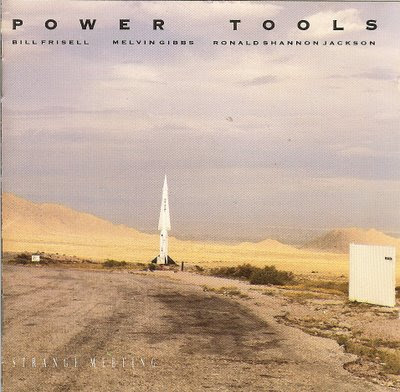
For the cover of the LP, I chose an image from Joel Sternfeld’s book, American Prospects, which would come out the same year as the record. (That book was/is in the tradition of Walker Evans American Photographs of 1938 and Robert Frank’s The Americans of 1958, and I was hoping to emphasize both the Americanness and the landscape quality of the music.) The album cover picture itself was taken seven years prior to the recording and is titled, “Roadside Rest Area, White Sands, New Mexico, September 1980.” It features the body of an old missile; a sign on corrugated fence saying “WOMEN” leading to a ladies’ room; and a view beyond of the White Sands Missile Range, a U.S. Government weapons-testing area for many years. It just seemed, with the title of the record, the music, these three guys, right…although I’d be hard-pressed to explain why. I knew Sternfeld a bit by then and he graciously gave us the image for free, or for some nominal sum.

The band went on to do one fairly brief European tour in 1988. I’d hoped to come along, and perhaps even record more, but could not make it due to my own work schedule as a freelance journalist. I had a story deadline—I can’t remember for what. I heard some real positive feedback about the tour, and have a VHS tape of four songs from one performance in Cologne, Germany: “Wolf in Sheep’s Clothing,” “Unchained Melody,” When We Go” and “Wadmalaw Island.” These last two pieces are available via youtube and I think the other two will surface in the fullness of time. Time goes by, so slowly, and time can do so much.

It’s a sad state of affairs that Island let the LP, and then the compact disc, go out of print. I called the label once to see what I could do about it and got the Kafkaesque run-around. I have no financial interest in the record (typical for my projects) but this put me in a particularly powerless position in terms of prying the thing free. Maybe I could / should re-visit the subject. The analog record sure sounds politely ferocious.

It’s also not just a little bit sad that there was no follow-up record nor no life as a band after that first tour. Bill had his own trio to feed and grow at the time (the wonderful one with Joey Baron and Kermit Driscoll if I’m remembering the timing correctly) and Shannon was increasingly drawn into a different orbit. What can I say? I’ll say it’s a shame that Melvin, Shannon and Bill did not play together again. They could have made beautiful music together.

Tuesday, April 05, 2011

Heavy Metal Be-Bop #2: Craig Taborn


I'm happy to announce that the second installment of Heavy Metal Be-Bop, my jazz/metal interview series, is live at Invisible Oranges. Once again, a big thanks to site honcho Cosmo Lee for hosting and for lending his editing and layout expertise to the project.

My guest this time around, Craig Taborn, is more or less the main inspiration behind the series, and I speak a bit about that (specifically Taborn's connection to the Gorguts universe) in the intro. I also mention Taborn's seemingly boundless metal knowledge, but I feel like I ought to note that this knowledge extends way beyond a single genre. Taborn has his iTunes hooked up to his TV, so I got a chance to check out his music library; I have to say, it might be the most diverse and comprehensive collection I've ever seen. I hope he won't mind me listing a few of the artists I spotted in there: Springsteen (Nebraska), This Heat, Thelonious Monk, Arcade Fire, Stravinsky, Sonic Youth, Henry Threadgill's Air, the Walker Brothers, Shudder to Think, Muddy Waters, Descendents. (He even had craw in there, which—as any regular DFSBP reader could guess—absolutely blew my mind. It turns out he went to college with their early-period drummer, Neil Chastain!) Looking at that list now, it doesn't scan as terribly unusual (everyone's got a world of music on their iPod these days), but the point I'm trying to make—a point hopefully illustrated in our conversation—is that Taborn is an especially deep listener; he really gets inside all of these different areas. That may be one reason so many different bandleaders call on him regularly. Dan Weiss, my first Heavy Metal Be-Bop guest, made all this explicit during a recent appearance on WKCR's Musician's Show. Listing the personnel for the new Dave Binney album, Graylen Epicenter—on which both Weiss and Taborn appear—he shouted out Taborn's insider nickname: Encyclopedia Tabes. Having spent time with the man, I assure you that it's an accurate moniker.

I hope you enjoy this installment of Heavy Metal Be-Bop. I have another interview in the pipeline, which I hope to publish soon, but I'm definitely on the lookout for future subjects. Can you think of anyone who might be able to shed light on the jazz/metal connection? If so, please let me know via e-mail or the comments.

Friday, April 01, 2011

Figureheads, up close and consecutive: John Zorn and Wynton Marsalis


Two nights in a row, two evening-length performances by figureheads, not just of jazz but of The Culture. On Wednesday, I caught John Zorn's Masada Marathon at NYC Opera, a bonus track to his participation in the ongoing Monodramas presentation there; last night, just a few blocks south, I heard Wynton Marsalis present both a quintet and a septet at Jazz at Lincoln Center. Faced with such a seemingly stark duality, one is tempted to make grand pronouncements, to write a sweeping, op-ed type of thing, to choose a side. Better to talk specifics and let the conclusions flow as they may. Bottom line: I saw two very ambitious shows by two very hard-working musicians. There were pros and cons to both. There were clear points of parallel and divergence. Following are some observations, perhaps sprinkled with the occasional conclusion.

Zorn had his huge coterie with him, diversely skilled virtuosos from the community known as downtown, players who live at the intersection between Chops and Grit—in other words, pretty much exactly where you want to reside. Drummer Ches Smith, guitarist Marc Ribot (dear God—he was so loud and so mercilessly badass, wielding twang like a weapon), cellist Erik Friedlander (whose solo set was one of the night's triumphs), pianists Uri Caine, Jamie Saft (keyboard too) and Sylvie Courvoisier. These are the kind of players you would trust in pretty much any context.

It was a little frustrating, then, to hear them deployed for roughly four hours in the service of Zorn's Book of Angels oeuvre (a subset of his ongoing Masada endeavor), which seems to me like a willfully monotonous body of work. The story goes that Zorn wrote 316 pieces "in a flash of creativity during three months in late 2004." Hearing the music, it seems like "flash of productivity" would be more accurate. By Zorn's own admission, made during a mike break late in the Marathon, these compositions are skimpy by design, meant as improvisational fodder for his super-talented friends. So in practice, it's not that surprising that they can start to seem oppressive: dancing, klezmer-meets-exotica melodies, most laid over a sly bass vamp, with the occasional unison riff in five or seven. Zorn's decision to hammer on this aesthetic for a long period (both in real time—by my count, he's issued 17 Book of Angels records, spotlighting various ensembles, many of which played Wednesday's Marathon—and over the course of the concert) baffles me somewhat. During the event, I kept wondering: Why convene so many edgy masters, many of whom are great composers in their own right, and then straitjacket them within a fairly narrow soundworld? (Maybe a better approach would've been to let each band present a bit of its own music alongside their Zorn interpretations.) It's possible that the thought is to draw attention to the players precisely because of the samey-ness/mundane-ness of the material: "Watch these improvisational superheroes turn my humble lead into marvelous gold," or something like that.

Again, there was some fantastic playing. I loved the sultry, gently surreal spy-movie vibe of the Dreamers, as well as solo turns by Caine and Friedlander that were shocking in their command of dynamics and emotional contour. And the Electric Masada finale (with guest Mike Patton) was great, pyrotechnic fun. I left, though, really feeling the Marathon aspect of the whole thing—so saturated with that patented Masada vibe that I couldn't imagine wanting to see any of these bands again anytime soon. (To be fair, though, I did spend a good portion of yesterday spinning Book of Angels discs—the Marc Ribot/Trevor Dunn/G. Calvin Weston trio record Asmodeus is a monster and highly recommended for even the Masada-averse—so maybe this stuff is more infectious than I thought.) I remember feeling the exact same way when I heard various Masada projects at Symphony Space in June of 2000.

A Wynton Marsalis show at Jazz at Lincoln Center's Frederick P. Rose Hall is oppressive in its own, totally obvious ways of course. The "Jazz, America's classical music" trappings are thick and somewhat cloying—"Welcome to the House of Swing," said Marsalis as he stepped onstage in a natty suit—and there's an aggressive upscaleness to the whole experience that's illustrated concisely in the high ticket prices. But you know all of this already. You've probably already bitched about it without ever actually experiencing it, as—I'm somewhat ashamed to admit—I have. As with John Zorn, it's easy to think you "get" Wynton Marsalis. There's so much baggage, so much zeal both for and against these men, that you forget that they're simply musicians and composers. They're also showmen, of course, and community builders, and one-man scenes. But you can, in fact, go see them play music and just let that be the thing and not worry too much about the meaning of it all.

That is the experience I had at the Wynton show. Last night, he presented first his quintet, then his septet, separated by an intermission. This wasn't just a couple sets of jazz; this was a luxurious concert experience, and I mean luxurious there not in the cheesy, "America's classical music" sense, but in the sense that the music itself was rich and deeply satisfying. The quintet, built around the beyond-sturdy bass of Carlos Henriquez, was great, a showcase for the many faces of Marsalis's writing, from daredevil Latin jazz (I wish I could remember the name of this one tune they played that featured a frantically snaking line played by Marsalis and saxist Walter Blanding) to straightforward ballad poetry. In the latter vein, one piece was a sax-less quartet, and I swear, everyone should have the experience of hearing Wynton Marsalis play an unadorned ballad in Rose Hall. For a few minutes, the whole "luxury" angle made perfect sense; plush opulence was all you could think of, and it wasn't a base opulence but an entirely wholesome one. You felt spoiled.

If the quintet set was merely very good, the septet set was dazzling. I'm not sure that I've seen a more straightforwardly enjoyable presentation of music in the past few years—in the sense that I wished everyone I knew was there with me, from my discerning-jazz-connoisseur friends (one was with me, fortunately) to my largely jazz-oblivious family and jazz-appreciating-but-on-a-case-by-case-basis fiancée. Marsalis's septet clearly works on an Ellington model—you hear that right away in the plunger-muted brass and the shrewdly deployed soloists and rich themes. But from all the knocks against Marsalis, which you may have swallowed and even parroted without really knowing the deal, you think his work is going to be MERELY traditional, MERELY retro. This was an entire set of original music, and while it did feel "classic" in some sense, it was far more stimulating than the average set of straight-ahead, head-solos-head jazz you'd hear nightly in many local clubs. Each solo felt like an event, not a chore or a mere inevitability, because it had been properly set up by the compositional material around it. Trombonist Vincent Gardner, subbing for an on-tour Wycliffe Gordon, was a particular marvel, wielding the plunger in a way that can seem old-fashioned when you hear it on your scratchy vintage recordings but that feels totally vital up close. And the two saxophonists—Wessell Anderson and Victor Goines—sounded devastating dueting on the lovers' suite "'D' in the Key of 'F.'" All of these pieces radiated with the classic jazz push-and-pull: soloist vs. ensemble. The context kept changing, not in a rapid-fire way, but in a way that kept you engaged. At all times, there was a reason to keep paying attention, and not just to hear what hotshot lick would flow out next. I left feeling energized rather than exhausted, as I had after the Zorn affair.

I really don't want to make any grand pronouncements about the experience of seeing these two figures in their respective elements over consecutive nights, though it's hard, since they both seem to stand for so much jazz-world baggage. Googling their names, I found this piece: "There are currently two dominant schools in New York City’s jazz scene. Wynton Marsalis leads the Lincoln Center’s traditionalist school while John Zorn is the cover-boy for Downtown’s avant-garde movement." Conclusion: "Who would you rather follow? I lean towards Zorn since I partially agree with what one of my high profile teachers told me: 'Marsalis has set jazz back 100 years.'" Well, I guess that settles it!

In terms of the actual experience of checking out these shows, though, micro-observations abound. You can't help but be struck by the similarities between Zorn and Marsalis onstage: For one, both soak up as much attention when they're not playing as when they are, through their hyperbolic goading of their colleagues' improvisations. You can't help but feel that Zorn could learn something from Marsalis in terms of composition: focusing on writing a select amount of patient, deep, wholesome pieces rather than dashing off hundreds of stylistically constrained sketches. On the other hand, you can't help but feel that Marsalis could learn something from Zorn re: how to exist in the world of art: opening one's self to as many connections as possible (I think of Lou Reed and Laurie Anderson, favored collaborators of late) and wielding one's influence as benevolently and expansively as possible. What I mean there is that while Zorn did admittedly confine his collaborators to the Masada oeuvre during this particular Marathon, for much of the year, he's practically a benefactor to not just these players, but a ton of other avant-garde-minded geniuses trying to find their way in the NYC scene. If he didn't play music at all, but simply ran the Tzadik label and the Stone club, he'd be a local and international hero. "Play my music on certain nights," he seems to say. "But every other night, do your own thing, and I'll support the hell out of you." Marsalis, on the other hand, seems to cloister his players up at Jazz at Lincoln Center. You don't see them really standing on their own two feet, outside of that context; when you hear their names, you think of Wynton. The same is not true of Zorn buddies like Marc Ribot. They may return to the hive when called, but they spend much of their working lives outside of it.

So maybe what I'm saying overall if you're speaking strictly on the "Who would I rather spend a lengthy evening listening to?" topic, Marsalis had the clear edge. But if you look outward re: "Whose musical empire is the saner, fairer, more benevolent and culturally nourishing one?" you have to hand it to Zorn. These figures are not in competition, of course, and as outspoken as each one is, I honestly don't think either one wants to stand for anything in particular aside from his own unique endeavors. They stand for things (uptown/downtown, tradition/iconoclasm) only because they've been extremely successful at those things, and thus they're convenient shorthand symbols. It's nice, though, to cut through the hype and the preconception and the rhetoric and just sit there in the theater and say, "What have you got for me?" I'm glad I live in a city where that's easily done.

P.S. My friend Joe, who also attended both concerts, makes a smart observation re: the Zorn show, i.e., that no one there was enjoying the music as much as he was. However hammy or hucksterish he can seem at times (to me, that is), his kid-in-a-candy-store glee is indeed endearing. You get a similar feeling from Wynton.

Wednesday, March 30, 2011

Raging against the machine: Another look at Peter Brötzmann's Machine Gun


"…an abstraction painted with a flame-thrower…"—John Corbett

"mindblasting… a smashing clanging wonderland of noise"—Thurston Moore

"The first day went over with rehearsing…, trying to find a way to get the music on tape. After all this trouble, it was a good thing to find some bars, the day/night ended with some tasty beer. Finally I had stashed all the comrades in some friends['] beds or on some ma[t]tresses, Buschi and I were left over, as usual. After some more beers we had to find a place to sleep a couple of hours, next to the club there was a building site under construction. We entered, slept a bit on some cardboard, had a beer for breakfast, went to the club, waiting for the comrades, ready to go."—Peter Brötzmann


The quotes above refer to the album Machine Gun, by the Peter Brötzmann Octet. Machine Gun is one of those agreed-upon landmarks: widely proclaimed as seminal, five stars and a crown in The Penguin Guide to Jazz Recordings, etc. Not to mention the street cred, evidenced by the Thurston Moore quote above. It's a bogeyman of a record—purportedly the most extreme free jazz there is. I remember seeing a copy in a friend's room in college and asking about it; the response I got was a pair of raised eyebrows, i.e., "Shit, man, I don't know what to tell you about that one." The Thurston Moore quote says it all: Machine Gun is a NOISE record, in the foretelling-of–No Fun Fest sense.

I've been listening to Machine Gun over the past few days, and—just like I always am when I pull out this incredible record—I've been newly struck by the fact that this "wonderland of noise" really isn't that at all. What it is, is a very early, very great example of midsize-ensemble free-jazz composition and arrangement. This recording has a thousand times more purpose and direction than anyone seems to want to admit, least of all Brötzmann, who has been perfectly happy to feed the mythology with his tales of sleeping on cardboard and beer for breakfast.

Machine Gun is not simply a document of eight men—most prominently, the stampeding reed section of Brötzmann, Evan Parker and Willem Breuker—blowing their brains out. There is a lot of that to be found on the record, and what of it there is, is majorly amplified in terms of its cacophony by the insanely in-the-red engineering. (The album was, after all, recorded in a concrete-block basement jazz club—though not in front of a live audience—in Bremen.) But what makes the "mindblasting" improv sections on Machine Gun so effective is how they're contrasted with a number of very different textures. Make no mistake: The three pieces that make up the original record, which sound beautiful on the Atavistic reissue The Complete Machine Gun Sessions, are meticulously MAPPED. There are free-jazz blowouts (Dave Burrell's "Echo" comes to mind) and then there are free-jazz compositions; the pieces on Machine Gun are the latter. (Note, for starters, Brötzmann's account of a full day of rehearsal.)

Take the title track. The signature opening section—the head, as it were—that staggered, jagged, broken-glass reed shudder, with the two drummers and the two bassists scraping up a racket underneath, only lasts about 45 seconds. Then Evan Parker begins to solo, with comparatively delicate accompaniment underneath—just one of the basses (I'm pretty sure) and the tamer of the two drummers, Sven-Åke Johansson. The fundamental principle that makes this record a compositional masterpiece in addition to a cacophonous one is already here: You blast with the full ensemble, and then you peel away layers. You plot out an arc. "Machine Gun" is like Coltrane's "Ascension" in a way, but it's a much more engaging piece of music because it's not simply BLAST-solo-BLAST-solo, etc. During Parker's solo (man, that serrated tenor sound—so beautiful and so fully formed, even in 1968), the full ensemble comes in at times to goad him, to blast him out. They're RIFFING in the classic big-band sense, that great old trick where the band will take up a momentum-maintaining theme behind the soloist. Unlike in "Ascension," the players don't politely wait till Parker is done—they rudely interrupt him. It's fantastically effective.

Fred Van Hove's piano solo begins around the 4:00 mark, and you hear something very different going on here. Again the band settles down; this time, it's Johansson and both basses swirling around busily but sensitively underneath. And right around 5:02, the riffing begins again, but this time it's different: not a full-band BLAST as before, but a quick, repeated swooping figure from only the horns. This is the kind of arrangement I love—each soloist is treated to a customized background context. Han Bennink enters eventually, clanging away on what sounds like a trash-can lid and upping the chaos. The swooping figure returns, and eventually the piece escalates into mania, but it quickly dies down. The two bassists play a tense duet at around 8:00, and then around 10:00, the band enters with a slurry, boozy roar, escalating in pitch and tempo, as though a dial were being turned up. Then Breuker solos on bass clarinet starting around 10:52, and note that he gets still another background context; I can't tell if the basses are playing, but the drummer is Bennink, not Johansson, and unlike in Parker's solo, Van Hove is on board. Eventually everyone drops out but Breuker, and after a brief unaccompanied section, he duets with Bennink for a few tense seconds.

Then, at 12:22, comes a new theme, a strident, national-anthem-sounding motif, that grapples with white noise and then exhausts itself, collapsing in a boozy heap (roughly 13:20). Then it's time for Brötzmann to solo and he gets the wildest accompaniment, centering around Van Hove and Bennink (his trusty triomates then and for years after). Intruding on his freak-out is the classic, college-football-halftime rave-up (around 15:00). Pure, shrieking noise again triumphs and the saxes fan out in the staggered, swarm-of-bee-stings formation of the piece's opening. Several unison jabs end the piece.

If it's not clear yet, what I'm trying to say is that "Machine Gun" is absolutely, positively not a mindless, aggro blowout. What it is, is a SUITE, packed with EVENTS, with contrast. "Ascension" sounds like a crude scribble in comparison. Any reader of this blog knows that I love it when jazz compositions don't tip their hand at the outset, where you are rewarded for listening through to the end of a piece (and not just with another iteration of the head). "Machine Gun" is like that—there's always something new around the corner. When you get to the fight-song rave-up at 15:00, you brighten up: "Ah, here's some new info." It's not a fussy piece of music; everyone colors outside the lines and the transitions are imprecise. But there is a roadmap. We're not dealing with, like, slash-and-burn Japanese noise here, in other words; we're dealing with big-band-style arrangement, scaled down for an eight-piece ensemble and pitted AGAINST pure abstraction. "Against" is the key. Without the contrast, this would be a boring piece, merely extreme and not exciting or built to last.

You don't hear much mention of the other pieces on the record, but they're great. And just like Brötzmann's title track, they have a lot to offer compositionally. Van Hove's "Responsible" quickly enters blowout mode, but not before a more-or-less swinging intro featuring the two bassists (one of whom is basically walking) and two drummers. Brötzmann gets out front with a brilliant chest-thumping solo on baritone, pretty much the blueprint for Mats Gustafsson's entire career. The background orchestration is looser here; Van Hove is noticeably absent, but the other horns seem to throw in commentary as they wish rather than in any sort of predetermined or conducted riff pattern. At around 3:00, there's a fascinating textural shift and we're into classic Euro free-improv mode, with small sounds prevailing: Van Hove's harplike inside-the-piano tinkering (I think that's what he's doing), Bennink's bongo drums, etc. Parker solos here, again bringing the staccato ruckus.

And then what's this? Around 4:50, the bassist on the left starts up a tense eighth-note pulse, around which Van Hove, Johansson and the bassist on the right quickly orient themselves, setting up a pensive mood. One of the saxes (I think it's Breuker) enters with this very deep ballad-like theme, a slow, swaying, elegiac sort of thing. And then around 6:00, the drummers and one bassist fire up a groovy, Latin-ish groove. See? Again, so many EVENTS here. This is through-composed music. It's wonderful and absolutely nothing like the more crudely sketched American free jazz of the time. Machine Gun is free jazz as, say, Mingus might do it, had he been so inclined. Momentum is always a concern, the skillful deployment of first this element then this one, successive textures unfolding. "Mindblasting," yes, but also thoughtful as hell.

At 6:41, what's this?!? It's another theme, a pleasant, almost mambo-like dance that instantly brings you right into a Vegas-y frame of mind. All of a sudden this band of marauding, sleeping-on-cardboard, beer-for-breakfast, spirit-of-’68 Euro-free-jazz renegades has morphed into a Rat Pack cocktail orchestra. Considering the overall picture of Machine Gun (a picture that includes 40 years of hyperbole re: this record's ULTIMATE EXTREMITY), this intrusion of chilled-out tunefulness is more shocking than any noise outburst could ever be.

Breuker's "Music for Han Bennink I"—the "I" (as in the Roman numeral) appears in the title on the LP-jacket reproduction found in the reissue but not in the new liner notes—is another riot of THEMES. This is the most meticulous piece on the record, yet it's every bit as exciting as "Machine Gun." The opening theme, consisting of a bar of seven followed by a bar of six, is total proto-jazz-punk. Listen to this alongside Little Women and you'll see what I mean. After a few seconds, the band drops out and lets Johansson groove alone for a bit. Then they reassemble, play the theme again and peter out. At the :58 mark, a spastic bridge of sorts: a quick riff, then a hit; then the quick riff again, then two hits. It's an almost proggish device (Dazzling Killmen use a very similar figure midway through "Dig That Hole", and given the avant-jazz inclinations of their rhythm section, it wouldn't shock me if the reference was an intentional one) yet delivered here in total punk, aggro manner.

Next, the horns stumble around as if in a daze and then the band lays out again, this time for a Bennink solo, which starts calm and works itself up into a righteous froth. Then at 2:55, the turbo-polka opening theme returns briefly, setting the stage for a bellowing Brötzmann solo. Note that the drummers lay out at the beginning; it's just bass and piano. Johansson enters first, setting the stage for Bennink's grand entry, a flurry of proto-blast-beat mania, at 4:19. Again there's this skillful organization, this question of who exactly will play underneath whose solo, who will enter when, etc. (Some of this organization may very well be spontaneous, but it's still a kind of arrangement/plotting.) Bennink sets off a riot in the ensemble, but it's short-lived. Right around 5:08, the texture morphs drastically into a soft, exceedingly gentle three-horn meditation. The spastic bridge is back at 5:46, followed by an opening-theme statement that's quickly blown to bits. Some genuinely fearsome improv, probably the most intense on the whole record ensues. The opening theme keeps threatening to return, but no, this is a total meltdown—the kind of thing you think you're going to hear for 40 minutes straight when you read up on Machine Gun lore.

Right around 7:12, one of the saxes cues a new theme (the fourth motif of this piece, by my count), a marching-type figure that makes a bid for the spotlight but has to grapple with not only the marauding ensemble but the opening theme, which keeps reemerging in shadow form. Chaos reigns in this section, but it's a chaos born of competing orders. An unaccompanied Van Hove solo starts around 8:13: deranged, flailing, making its way into runaway-player-piano territory before receding into ominous silence. I love it.

Thus ends the piece and the original record (the Complete edition includes alternate takes of both "Machine Gun" and "Responsible," as well as a live version of the former). I think it's clear what I'm trying to say: Machine Gun is the most thoughtful kind of barrage. Brötzmann wants noise, but he also wants a PLAN. And moreover, he wants the plans of his collaborators, as evidenced by his inclusion of pieces by Breuker and Van Hove. This entire scheme—large-ensemble blow-your-brains-out improv meets big-band smarts—of course came to full flower in Brötzmann's Chicago Octet/Tentet/Tentet+1/Tentet+2/etc., founded in the late ’90s. (You can hear the concept developing on "Fuck de Boere," from ’70, and "Alarm," from ’81.) I've lately been really digging the Tentet's inaugural release, a self-titled three-CD set on Okka Disk, which is packed full of varying compositional strategies.

What am I saying, overall? Sometimes it's good to fight the received knowledge re: a CLASSIC, and get back to it and see what's actually there. Brötzmann himself may have done much to perpetuate the image of Machine Gun, and his body of work as a whole, as a sort of macho-meltdown sort of thing, but there's way more to it than that. The fact is that he is a brilliant composer/conceptualist/bandleader/arranger, over and above his status as a leather-lunged saxophone beast. This combination of meticulousness and total abandon is why Machine Gun endures.

Saturday, March 26, 2011

Sacred scrape: Stuck on Peter Brötzmann


Photo by Peter Gannushkin/downtownmusic.net.


[After-the-fact note: In the post below, I mistakenly ID'd two recent Peter Brötzmann records on Smalltown Superjazz, Sweetsweat and Wood Cuts, as studio records; it turns out that they are very much in-concert albums. I'm not sure where I got this erroneous impression—maybe it was from the fact that the recordings sound so damn great!—but I regret not verifying the info. In any case, I think some of the points below are of general interest—e.g., that free jazz should sometimes be documented in the studio, not just on stage—so I'm going to let the post stand. Maybe this is also an interesting illustration of how foreknowledge (even faulty foreknowledge) of recording circumstances can really color the way you listen. You do your best to square the sound with the story, or something. At any rate, I apologize for the misinformation.

The important thing to note is that these records rule, and I would recommend them to any Brötzmann fan, or novice, for that matter. This all brings up an interesting point, though: Aside from the obvious early triumphs—Machine Gun, e.g.—what are the great Peter Brötzmann studio sessions? Please advise, as I'm clearly not to be trusted on the subject! For that matter, what are the great free-jazz studio sessions? (Again not counting the ’60s, since many of that period's key statements (from Spiritual Unity to Interstellar Space) were studio documents.) I think of things like Cecil Taylor's New World records from ’78, where the fidelity is just marvelous and a real contrast to the live stuff from around the same time.]


I've been listening to little other than Peter Brötzmann lately. (The new Strokes album, which I'm really digging, is an exception—review in TONY next week.) I wrote here about a Tony Malaby/Paul Motian listening jag, and about how I often find myself thusly stuck, happily, in this or that groove. I tend to know what puts me there (in this case, it was Destination Out's posting of a fine Brötzmann solo album, 14 Love Poems [Plus 10 More], preceded by a flat-out incredible Brötzmann/Andrew Cyrille duo album), and to not know what'll get me out. I'm very much okay with.

Brötzmann is one of those periodically recurring jags for me. I can tell by my hard drive that I was on another PB kick not that long ago. What that tells you is that he's one of my masters. The pantheon includes Andrew Hill, the Wipers' Greg Sage, Morbid Angel, ALL, Fred Anderson, Bill Dixon, Cecil Taylor (of course), John Fahey and a lot of others. Roscoe Mitchell is a recent addition. These are inexhaustible bodies of work. Anyway, I was thinking about how the Brötzmann jag is like the pleasurable (at least for me) part of visiting the dentist, the part where they more or less sandblast your teeth with salt water and you bleed quite a bit, but afterward you can feel new regions of your teeth that you couldn't before since they'd been obscured by build-up. Apologies for the gross simile, but it's appropriate. I think of the phrase "sacred scrape." Brötzmann has an album with those words in the title, but I haven't heard it. Still, it gets to what I'm saying. His playing is like a scouring pad—you get addicted to the sting.

We are lucky that Peter Brötzmann is extremely well documented on record. You can hear the marathon, wild live shit if you like. There's so much of it. Lately, I've been feeling the Unheard Music Series reissues Fuck de Boere (featuring a whole bunch of trombones and some deeply grimy Derek Bailey guitar) and Alarm (another large group blowout featuring some demonic Alex Von Schlippenbach piano work and a multisaxophone cast including the Reverend Frank Wright). (Note: I actually bought both of these in MP3 form from the Amazon store; it's a clunky purchasing/downloading process, but not a bad option if you really need to hear something.) I've also been thinking about how important it is for free jazz, which in the mind's eye often appears like an exclusively in-the-wild sort of thing, to sometimes be documented in the studio.

There's something beautiful about the idea of hiring engineers, meticulously setting up mikes, checking levels, etc., not so that you can document what you've been doing, but so that you can document what you are going to do, right now. And for there to be a label that sees fit to be, like, "We're going to treat this like an album, for real," and bestow upon it beautiful cover art, a track sequence, etc. It's not so much this idea that every utterance of an improviser as great and committed as Brötzmann is to be treasured; it's more that you want to have these points of contrast in the discography. For many great free players, much of their recorded oeuvre is live (think of Cecil Taylor, whose studio sessions have grown rarer and rarer over the course of his career). If they're recorded well, live albums can be great. But they can also feel sort of second-hand, i.e., you weren't in the audience that night, so the musicians weren't playing for you. You're eavesdropping. With studio records, and I'm thinking particularly of two recent Smalltown Superjazz (update your site, guys!) records, Sweetsweat and Wood Cuts, both of which document the duo of Brötzmann and Paal Nilssen-Love in gorgeous, singing, close-up fidelity, the musicians are more or less playing for you, whoever you happen to be, whenever you happen to be tuning in.

You often hear of the "sterility" of the studio, but with "just go, now" improvisers like Brötzmann and Nilssen-Love, that's not really a factor. They're used to manufacturing energy, to just starting up the engine and seeing what might result. It's a wonderfully lavish treat to hear them so clearly, on great-looking, thoughtfully programmed records (on these two albums, the moods and textures vary a lot—from hurtling and abrasive ("Burnt Sugar" on Sweetsweat) to subtle and ornery ("Knucklin" on Wood Cuts, where Brötzmann whips out his trusty tarogato)). It's not so much that these are definitive performances, more true or worthy of documentation than the zillions of live recordings you can hear these musicians on. It's that they are keepsake presentations, meant to be heard and re-heard on whatever listening medium you prefer. We need to make sure that all our great improvisers, young and old, are documented this way.

It's a different story, of course, when you can actually attend the gig yourself. Peter Brötzmann is the honoree at this year's Vision Festival, taking place from June 5 through 11. Go here for the schedule. The Brötzmann evening includes both familar settings (a quintet with Nilssen-Love and some Chicago Tentet types) and unusual ones (a duo with vibist Jason Adasiewicz, which I can't wait to hear). I'm not sure if I'll still be sandblasting my ears with Brötzmann 24/7 at that point, but there's no way I'm missing that gig. Long live the sacred scrape.

P.S. Wow—I didn't know till just now that the man has a very nice official website. There's also the great discography, which I employ religiously.

P.P.S. Forgot to mention the Chicago Tentet, other than in passing. Some of these records are great. In keeping with the theme above, I'll recommend a studio effort: Broken English, from 2000, on the great Okka Disk label. This is exemplary large-group improvising. I'm not sure what kind of premeditated scheme is at work, but the players pay close attention to dynamics, to subgroupings, to diversity of texture—the kind of things that make listening to a sizable improvising band like this pleasurable rather than numbing. (And to be fair, the Tentet can at times be numbing.)

P.P.P.S. What incredible graphic sense the man has. It blows my mind each time I go back to Brötzmann. I think the way his records look is absolutely integral to his music. (Same goes for the titles—MACHINE GUN, BALLS and a thousand other great ones—which are among the most punk, not to mention apropos, word-to-music assignations of all time.) (ONE IDEA, THREE WAYS, people!) The cover of Alarm is a masterpiece.

Monday, March 21, 2011

Ween outtake: Q&A with Eye of the Boredoms


Last night's release party for my Chocolate and Cheese book (available on Amazon starting 3/31) was a blast. I'd like to extend a sincere thank you to WORD for hosting, to Tom Kelly and Laal Shams for remedying some last-minute technical issues, to Claire Heitlinger for providing the chocolate-and-cheese refreshments, and to everyone that came out.

Two more release events are coming up soon:

Saturday, March 26, 2011 at Farley's Bookshop in New Hope, Pennsylvania. 1–4pm

Thursday, April 7, 2011 at Greenlight Bookstore in Fort Greene, Brooklyn. 7:30pm. Also appearing: fellow 33 1/3 authors Daphne Carr (Nine Inch Nails' Pretty Hate Machine), Christopher R. Weingarten (Public Enemy's It Takes a Nation of Millions to Hold Us Back) and Bryan Charles (Pavement's Wowee Zowee).

By way of a countdown to the book's official release, I thought I'd post some interesting odds and ends from my research that didn't make it to the final product. Below is an exceedingly brief interview with Boredoms mainman Yamataka Eye. I tracked down Eye due to his involvement in the little-known record Z-Rock Hawaii, a collaboration between him and Ween—with trusty producer Andrew Weiss along for the ride—that was made right around the same time as Chocolate and Cheese, i.e., somewhere between the fall of ’93 and the spring of ’94. (I remember reading somewhere that though several members of the Boredoms are credited on the record, it was only Eye that actually appeared on it—I can't find the source now, though, so don't quote me on it.)

Z-Rock isn't a great album, but it is a fun one, a meeting of the deranged, outsider-pop minds. Much of the record skews toward inscrutable yet hilarious sound collage (e.g., the immortal "Tuchus") and high-speed, drum-machine-fueled spaz punk (e.g., "Love Like Cement", where the Ween-plus-Boredoms angle really comes through). But my favorite track is "God in My Bed" (streaming above), an atmospheric spoken-word piece that plays like an account of a drug-induced meltdown thanks to a muggy drone background, commentary from a lonely trumpet, some trademark Ween slowed-down-voice action and a deeply disturbed monologue. I love the robot-malfunction "scramble" effect on the vocal at 2:06 and the genuinely creepy conclusion (3:16), which reminds me of John Goodman's climactic rant in Barton Fink: "You want my chicken? My potato salad? You want me to tell you how my day was?!?"

As far as the Eye interview, it was probably the most least profitable Q&A I've ever undertaken, in terms of usable material generated vs. effort expended. (That's just a factual statement, no disrespect intended: That's why they call it a language barrier.) When I reached out to the Boredoms camp, I was told that I could interview Eye over e-mail but that I'd need to have my questions translated into Japanese before sending. Furthermore, the answers would be sent back to me in Japanese, so I'd need to get those translated back into English. A journalistic nightmare to be sure, but I found a friend of a co-worker who was willing to help me out. When I finally got the English answers back, though, they were so brief that I didn't see any way to incorporate them into the manuscript. Oh well, it was an interesting detour in my research. Also, looking back at the Q&A, I realized I'd forgotten how much I loved Eye's answer to my last question...

/////

Eye Q&A re: Z-Rock Hawaii—August, 2009


How did the Z-Rock Hawaii project come about?
I don’t remember exactly, but I loved Ween so I was really excited when they talked to me about it.


What do you remember about working with Ween? How was the music composed and recorded? Did you actually perform in the same room with them?
I was staying at Mickey’s house. I’m pretty sure it was the house they called “The Pod." Andrew was the engineer. I don’t remember exactly how we wrote the songs, but I remember it being fun.


Were you a fan of Ween before you met them? What do you enjoy about their music?
Of course I was a fan. There’s something natural about their music. Something really laid-back and spontaneous.


Since Z-Rock Hawaii was recorded around the same time as Chocolate and Cheese, do you remember hearing anything from that album before it was released? If so, what was your opinion of the material?
Unfortunately I didn’t get a chance to listen to it back then.

Do you have any other impressions of Chocolate and Cheese? Was it influential to the Boredoms at all?
I’m not sure. I really love it, but I don’t know if it had an influence on the Boredoms.

Do you notice any general similarities between Ween and the Boredoms?
Maybe it’s that we’re all geeks? (I hope that doesn’t sound rude.)

Saturday, March 12, 2011

On acceptance: Morbid Angel, past and future


I am unreasonably excited about the forthcoming Morbid Angel album, Illud Divinum Insanus, which comes out June 7 via the godly Season of Mist label. (Details here.)

When news first started circulating, well over two years ago, that Morbid Angel was beginning work on a new album with its classic-era frontman, David Vincent (he left the band in 1996, and from 1998 through 2003, M.A. made three albums with Steve Tucker in his place), I viewed it as a chance for one of my favorite bands to get back on track. The Illud song "Nevermore," which the band debuted live in 2008, seemed to herald a return to the classic sound of records like 1993's Covenant (definitively my favorite metal record ever) and 1995's Domination, i.e., grandly majestic and deeply rooted in the power of the riff. I celebrated "Nevermore" on this blog in February of 2009, and I see now that the record was originally supposed to emerge that year—yes, it's been a hell of a wait.

In that post, I wasn't kind to the three Steve Tucker–era M.A. efforts. I wrote: "…even after giving them each many, many chances, I still found them lifeless, boring and unmemorable." Suddenly, though, I find myself coming around. It's like I'm housecleaning in advance of Illud, and I'm appreciating old furniture I hadn't given a second look to in years. I've always had a hell of a time with personnel changes—I addressed that in this post re: my favorite band, craw—and I was severely bummed when Vincent left M.A. in the mid-’90s. I was even more bummed when the first Tucker-era disc, Formulas Fatal to the Flesh, emerged in 1998. It seemed that I was watching a band that had once towered over a genre like a colossus become mired in all of said genre's tired conventions, specifically an utter lack of dynamics and faceless, non-expressive vocals.

Over the past couple of days, though, I've really been coming around to Formulas, as well as the final Tucker effort, Heretic (2003). I can still hear why I had such a problem with this run of discs upon first exposure: The fact remains that the first four Morbid Angel albums (1989's Altars of Madness through 1995's Domination) are marvels of metal songcraft—savagely intense, fantastically diverse, improbably catchy. To some death-metal die-hards, M.A. in the first Vincent phase probably even got too accessible for comfort, specifically on Domination. But I always welcomed the coherence of those records as a respite from the directionless extremity that typifies extreme metal at its worst.

What I'm coming to understand now, though, is that Morbid guitarist/mastermind (and only constant member through the band's 27-year (!) existence) Trey Azagthoth (pictured above) deliberately scaled back the accessibility and the gloss on those records. Here he is discussing Formulas upon its ’98 release:

"Domination is a digital environment, it’s a metronome, a bunch of fancy things and singing and that which has nothing to do with anything I’m into, it is a very clear sound, a little too clean, maybe a little too industrial. All that has nothing to do with what I’m wanting to do. This album, Formulas Fatal to the Flesh has no metronome, very little digital stuff, the drums are proper, as far as their mics, it's not just a bunch of samples. A lot more overhead and ambient mics. A much more living feel as opposed to a mechanical feel, which I think Domination was."

Now rhetoric isn't everything of course, but I'm definitely starting to wake up to the raw extremity of Formulas. It's a crude, ugly, relentless record that trades the meticulous arrangements of early Morbid for chaotic aggression. When detours in tempo, texture and mood do occur, they're not fluid (as on Covenant songs such as "Sworn to the Black"); they're downright awkward and even baffling. Check out where "Invocation of the Continual One" goes at 1:35:


What in the hell, right? There's definitely some genericness swirling about in other sections of the song (I still can't get with the artificiality of those multitracked "demonic" vocals), but stuff like the 1:35 breakdown is really working for me. What I'm realizing is that though Morbid Angel did streamline in the Tucker years, they never turned their backs on the intoxicating, WTF peculiarity that has always made them so fascinating. Azagthoth is simply too weird a character to ever sound normal.

Heretic hit me similarly the other day. It definitely verges on monotony, but there's enough chaos and variety to keep me interested. Plus, it features one of Morbid's most purely anthemic songs, "Enshrined by Grace":


I can't get enough of that second riff (starting at :15 or so), in which a six-beat half-time bar alternates with ten-beat blast bar. Utterly sick stuff.

I still need to revisit the middle Tucker disc, 2000's Gateways to Annihilation, but overall, I feel like I've got a new, healthier (as corny as that sounds) perspective on the impending arrival of Illud Divinum Insanus. In short, I'm not loading it down with unfair baggage, expecting it to be this messianic thing, i.e., the record that Morbid Angel should have released in 1998, had Vincent not left the fold. Instead, I think I've come to terms with the fact that since Covenant, M.A. has always been a curveball band—they go out on limbs to a degree that can make you really uncomfortable. (Witness all the weird interludes and bonus tracks that mark both Formulas and Heretic.) Their experimentation hasn't always seemed fruitful to me, but I'm learning to be thankful simply for the band's sustained ability to surprise.

Moreover, there simply isn't going to be a return to the classic Morbid Angel that captured my imagination, simply because the band's longtime drummer, Pete Sandoval, is currently sidelined with back problems—young hotshot Tim Yeung is filling in for him on Illud. (At his best—Covenant!–Sandoval is a master of injecting his own kind of stiff, eccentric funkiness into death metal drumming.) Since Sandoval has appeared on every single Morbid full-length to date, I could go and brand his absence on Illud as blasphemous (ha, considering M.A.'s satanic proclivities), but I think I'm over all that now. That would be making the same mistake I made re: the Vincent/Tucker swap. I'll do my best to take what this band gives me at face value, not in comparison with what I was hoping or expecting to receive. The fact is that Trey Azagthoth is a true visionary, one of the greatest American artists working today, and he's never made a record that was anything less than extreme, passionate and deeply fucking surreal. Long live this man's madness, and for the love of satan, bring on Illud Divinum Insanus.

Wednesday, March 09, 2011

By and for dreamers: Atheist at Santos Party House


"Smoke the weed, make the crazy metal."

Between songs at Santos Party House tonight, Atheist frontman Kelly Shaefer took a minute to shout out NYC: "Great people, great food…" "Great weed!" an audience member chimed in, and Shaefer ran with it. He described how he had smoked before the set and how he planned to afterward. Then he hit on the statement above: "Smoke the weed, make the crazy metal." A recipe of sorts. Is it really that easy? Is that where all this came from?

By "all this" I mean a seriously innovative band. Atheist's heyday was the early ’90s. They were part of the Florida death-metal scene that birthed such a scary amount of talent: Morbid Angel, Obituary, Cynic, Death, etc. I was into all that stuff growing up, but I never got around to Atheist. I checked them out a few years ago when Relapse reissued their first three full-lengths, but the recording quality of those albums (even with a fine remastering job by my friend Colin Marston) was a stumbling block for me—too muddy, not immediate enough. Sometimes you just can't hear a band through the intervening years.

But last year's reunion album, Jupiter, hit me really hard, and it brought the older records into focus for me. When I heard they were playing NYC, I was ecstatic. I wanted to hear what the new stuff would sound like alongside the old. I wanted to see if the manic energy of the albums would translate.

The show made me extremely happy. It really drove home the fact that Atheist as a band represents a kind of prog utopia. They play extreme metal but are fantastically unbounded by the style. The forces driving their music are sleek groove—gnarled and accelerated and chomping through change after change, but rooted in the cyclical and meditative—and a kind of relentless, even savage wonder and positivity. Kelly Shaefer has spoken about his pot-fueled lyric writing sessions, and that sort of "I see a universe in the palm of my hand" vibe pervades his songs. A very genuine kind of "Holy shit, I'm alive and I've got to process all these stimuli RIGHT NOW" sort of thing. Songs about alien visitation, about the enormity and awesomeness of nature. ("You call it god, I'll worship the sun / Without all her fire there won't be anyone," he sings in "Second to Sun"—streaming above—the first song on Jupiter and a definite highlight of tonight's set.) His stage presence reflects this—he headbangs plenty but he also spends a lot of time gyrating in a sort of grooved-out hippie dance, miming the contours of the songs in a graceful martial-artsy style.

Shaefer projects pure happiness and gratefulness between songs, and it was genuinely touching to see him walking back near the drum kit during the set to share energy with drummer Steve Flynn. The two worked together on Atheist's first two records (’89's Piece of Time and ’91's Unquestionable Presence) but then not again until Jupiter, which came in 2010. Before they began composing the latter, Shaefer posted the following online: "[I'm] heading to Atlanta next Friday to jam with ATHEIST drummer and my best friend Mr. Steve Flynn, this will mark the first time we have written together since 1991's 'Unquestionable Presence'. So I am curious how it will sound. I know it will be sick, there is a formula that me and Flynn have that automatically sounds like ATHEIST...so it will be fun to hear what it will sound like. And who knows? If it it goes well...?? We will see what happens." What can I say? I love this kind of camaraderie, and you can see it onstage. Flynn and Shaefer are the twin engines of the band: The former only drums live and the latter only sings, but they both compose guitar parts. It seems like an unusually collaborative process (or "formula," to use Shaefer's term), as Flynn partially explains here.

I didn't catch the names of the two live guitarists and the bassist (two of the three are apparently brand-new recruits), but they all sounded fantastic. This current Atheist incarnation (a ton of players have passed in and out of the band over the years, including bassist Roger Patterson, who died in a tragic tour-van accident in ’91) as a whole was incredibly tight and energetic, and they play with so much humanity. Thanks in large part to Flynn's deeply funky, fusion-ish beats—dig the woodblock! and the tasteful, totally non-default application of double-bass—the band never sounds like a machine, even when it's running a teched-out obstacle course. And live, the old material (some of the tracks played were "Unquestionable Presence," "Retribution," "On They Slay" and the almost Living Colour–ish groove monster "Mineral") blended beautifully with the new. As I noted in my TONY preview of the show, the Jupiter songs seem at once more spazzed-out and more catchy than the first-phase compositions. Live, pieces like "Live and Live Again" and "Faux King Christ" were a total blitz, rapid-fire sunbursts of tech worship. A lot of bands seem to want to dehumanize technical metal, to get as close as they can to the machine. Atheist puts the love back in. It's extremely soulful—not to mention fun—music, and that comes through intensely in their live show.

I kept thinking about Shaefer's weed remark: "Smoke the weed, make the crazy metal." Is it that simple? The explanation seems to gloss over the ingenious method that's at work here. ("…there is a formula that me and Flynn have," etc.) The method that lets you get outside the genre. Atheist use metal as their engine, but the chassis is all custom-built. There is nothing taken for granted in the music, least of all MOOD. Why can't metal be truly psychedelic? Not in the "Dude, let's get smoked out and see how Sabbathy we can sound" sense, but in the sense of let's get high and fucking DREAM some shit up—invent worlds. Atheist is music by and for dreamers. Born out of feverish, sweaty imagining. Shaefer, with his dudely vibe onstage, dancing through the labyrinths of these strange yet irresistible tunes. It's some kind of flower power, mixed with brotherly love. The angst is left out entirely. (Well, not entirely: The song "Fraudulent Cloth" is a deeply pissed anti-Catholic diatribe.) What you have is the pure exhilaration of the prog labyrinth. The point is that you don't even need weed anymore: the visions are all there in the sounds.

"Smoke the weed, make the crazy metal." Whatever takes you there, I say, just so long as you report back re: what you see and hear. It's not the pot cliché of glossing over the details; it's the opposite, a hyperobsession with the little nooks and crannies of the riff temples. For the like-minded few, that's bliss.