Showing posts with label Ronald Shannon Jackson. Show all posts

Sunday, October 20, 2013

Goodbye, Ronald Shannon Jackson: drummer/sorcerer

Photograph: Dani Alvarez Cañellas


Like Paul Motian, he was a drummer who became a genre. As Motian did, he established himself as a sideman to heavy players, but it was only when his pen and his bandleading instincts came into play that he truly found himself. There's clearly a thread running from Ornette Coleman's Prime Time to the Decoding Society, the band Ronald Shannon Jackson led in one form or another from 1979 up until his death yesterday at the age of 73: the sour harmonies, the ragged rubato theme statements, the sense of funk being regarded in a funhouse mirror.

But Jackson took this concept far further than Ornette ever did. I'm listening to the title track of 1981's Street Priest right now, and its weirdness is intoxicating. This is a dance band from Mars. Jackson's patented Little Drummer Boy march pattern—rushed, tense, almost antic—giving way to a theme statement that would sound exuberant if it didn't sound like it was coming off the rails, like half the band was meandering off, each player exploring his own orbit. Electric basses thrumming, Vernon Reid unspooling merciless sci-fi shred, the saxophones not squawking in that manly free-jazz way but zipping and snaking around in the upper registers. It's cacophonous but it's also whimsical, bordering on cartoonish. (For a similar sensation, see also: the Lounge Lizards.) And it's unrepentantly of its time.

I think Shannon was looking for a new kind of hip that he couldn't find elsewhere. The results were different, much more knowingly engaged with the language of free jazz, than Miles's electric experiments. (And, it must also be said that while Miles never seemed to have much time for composition, using thematic material as a mere springboard, Shannon was a true writer, a lover of themes and arrangement, a romantic with the pen.) But there's a similar sense of a bandleader wanting to tear down the walls separating art music, popular music, folk music—to cram radical ideas into a format you could wiggle around to, to square the esoteric with the earthy. The same principle is at work in Last Exit, a band to which Shannon contributed the essential soil, the backbone of the blues.

Early last year, I went through a serious RSJ obsession, which had grown out of a specific obsession with the album Power Tools (a favorite of RSJ expert Steve Smith), a fascinating collaboration with guitarist Bill Frisell and bassist Melvin Gibbs, the latter a Decoding Society mainstay. I haven't thought about RSJ or the Decoding Society much since that time, and I think that's fitting, in a way. Again, as with Motian, Jackson is an acquired taste. As drummers, the two share a certain stubbornness of aesthetic: if Motian wanted to indulge in uncomfortable sparseness or obtuse abstraction, he'd do it; if Shannon wanted to play his borderline-cornball see-saw march-funk patterns, that was what was gonna happen. But, almost as a reward for our patience, each drummer gave us an entire world of music, only obliquely related to their formative work or various outside collaborations, a brand of sorcery that could only be experienced when Motian or Shannon, respectively, was the one in charge, exerting a not-always-traceable but ever-palpable influence. (Theirs were presences that altered the physical properties of the spaces and settings in which they played.) This parallel went right down to the fascination with multiple guitars/basses, and the wizardly use of language: "Look to the Black Wall," "Owl of Cranston," "Fantasm," "Yahllah"; "Sperm Walk," "Boiling Cabbage," "Aged Pain," "Green Coronas." There's a sense in each of wanting to levitate above the stultifying normalcy that can creep into jazz, as it becomes more and more a known quantity, to reinject some of the mystery (in Motian's case) and the vibrant lunacy (in Jackson's).

I never got to see Jackson play live. I sent a few interview requests to the e-mail provided on his website and didn't hear back. But those are selfish regrets. Ronald Shannon Jackson left an enormous body of work, enough to relish and puzzle over for many lifetimes. What I really wish is that someone would undertake a Complete Decoding Society box set; too many brilliant records under RSJ's leadership are still too hard to find. No online database will get you where you need to go, RSJ-wise, but below are a few recommendations.

"Ashes," from Red Warrior (1990):


"Gossip," from Barbeque Dog (1983):


"Time Table," from Music Revelation Ensemble's No Wave (1980):


For the record, my favorite Last Exit album is Köln, which is available on Spotify. In terms of recent RSJ, there isn't much to choose from, but Wadada Leo Smith's Tabligh is outstanding. And here's some tantalizing footage from what I believe was the last RSJ live appearance, last summer in Texas. (Some valuable context here.) Drumming-wise, he sounds as good—i.e., as much a steward of the music in its delicate entirety, not just of rhythm—as I've ever heard him:


P.S. There's some relevant RSJ talk in my Heavy Metal Be-Bop interviews with Melvin Gibbs and Gentry Densley.

Wednesday, January 25, 2012

The storyteller: Ronald Shannon Jackson


Right now my listening compass points to Ronald Shannon Jackson, specifically the Decoding Society LPs Mandance (’82) and Barbeque Dog (’83). Above you'll find a contemporary performance by the band, which then featured Vernon Reid and Melvin Gibbs; the piece is "Yugo Boy" (from Barbeque Dog), which, strangely, doesn't appear on the live album sourced from this same gig.

Jackson's drumming fascinates me in general, but during this period, he really homed in on a concept and sounded as much like himself as he ever has, if that makes any sense. I love the way he fixates on these particular pet feels and juxtaposes them in a modular way. One of the feels in question is that beat you hear him playing at the beginning of "Yugo Boy." Jackson has a manic way of going at the hi-hat, just hammering on those sixteenth notes, working up to an open-cymbal release at the end of every measure; meanwhile his bass-drum foot does a stylishly simple dance. He plays these sorts of beats constantly in the ’82/’83 Decoding Society material ("Gossip," also from Barbeque Dog, is another great example), and I love the way they contrast with what the horns are doing up top, a bedrock rhythm hurtling forward as the melody takes a more leisurely stroll. It seems to me that that was the core principle of the Decoding Society: Lay down something propulsive or funky underneath and then let the song waft along in its own ethereal space.

"Yugo Boy" is a fairly static piece, rhythm-wise (though I love the way that Shannon shifts to the ride for the bass solo at 1:45 in the vid above, offering a textural twist while keeping the pulse racing), and Shannon often seemed cool with this sort of approach: picking one beat and sticking with it throughout a piece. But there are some great examples of him playing in a more suite-like style, where compositions would feature several distinct movements and his drumming would follow suit. "Alice in the Congo," the last track on Mandance, is a good example of this. He starts off with this insistent march pattern—half-time, but again with this almost hyperactive urgency to it, thanks to steadily chomping eighth notes on the hi-hat. These types of beats are a signature of the Decoding Society, and they're what give this band such a buoyant feel; lately I've been struck by the unabashed unhipness of these beats. They're so wonderfully nonvirtuosic, almost leaden, not beholden whatsoever to the tradition of fusiony flash, as exemplified by Billy Cobham or any of the other principal drummers of that movement. Shannon is more about this sort of stubborn folksiness, these beats that lope along with a stick-in-the-mud sluggishness. Again here you hear that weird foreground/background tension, the drums just cruising ahead like a determined bulldozer while the horns do their slurry, languid dance up top. And then at :58 seconds, the band snaps into a bridge-ish section and without worrying about any sort of hip transition, Shannon drops into that wired sixteenth-note hi-hat frenzy, very similar to the "Yugo Boy" beat. Then back to the march beat for a bit, and then around 1:49, when the bass solo begin, he drops way down dynamically and enters this sort of trance-swing, built on fluttering snare-drum ghost notes, tense quarter notes on the hi-hat and these darting, delicate patterns on the ride and crash cymbals. It's a beautiful textural shift.

Shannon frames each little episode in the song with its own distinct beat. When Vernon Reid's guitar solo begins at around 3:05, the leader starts kicking up a little more dust, flirting with a heavy backbeat feel, livened up with splashy fills and digressions. Then after a brief horn fanfare around 4:15, he brings back the initial parade-march beat for a bit, before segueing into this climactic build-up—a gradually accelerating snare roll that starts out (around 5:16) feeling wonderfully draggy, like an anvil tied to the feel of the nimble horn players, and builds into a super-dense buzz. Throughout "Alice in the Congo," you really feel the intertwined-ness of Shannon the composer and Shannon the drummer; he's very keen as a writer on mini set changes and as a drummer on highlighting these shifts. It's not just "Play a head; play some time; play a head"; the best of the Decoding Society pieces from this period ("Harlem Opera," which concludes Barbeque Dog, is another one in this vein that I adore) have a story to tell, and Shannon makes sure that as a drummer, he's upholding the narrative integrity. It's almost like each of these different feels that he favors (the racing sixteenth-note hi-hat stuff, the draggy march beats, the dreamy and diffuse ride-cymbal-heavy sections—a set of approaches that, along with a plodding blues feel, also staked out the rhythmic territory for Last Exit) is its own character: a puppet to be animated, an accent to assume.

With many drummers I love, I think of them as speaking in a unified voice, relating at all times to a single overarching concept, but with Shannon, it's a bit different; I love the way he slips in and out of different dialects, juxtaposes them, shuffles them, constructs a sequence and progression. It's one of the reasons his music, especially from this period, feels like a bright and colorful world that you step into. The marvelous piece titles, the unexpected set changes—it all contributes to this sense that you're sitting at the foot of a master storyteller, one who's not simply executing a style (jazz, rock, fusion, what have you), not just playing music, but bringing a scene to life in sound—decoding it, maybe, leaving its wonderment fully intact.

P.S. You can purchase various CDs and DVDs (though not the ones mentioned above) at Shannon Jackson's website. If only he were MP3-equipped…

P.P.S. I hope it isn't too long before Shannon Jackson performs in NYC. He still plays frequently in Europe; I'm seeing here that he'll be in the Ukraine (!) with a new quartet this coming April.

P.P.P.S. Destination Out has served up some choice Shannon material in the past, e.g., this post, which sparked some lively discussion, as well as a cameo from the man himself.

Saturday, January 14, 2012

Heavy Metal Be-Bop #6: Bill Laswell


I'm happy to report that Heavy Metal Be-Bop, my jazz/metal interview series, has returned from a little hiatus. The sixth installment, a Q&A with Bill Laswell, is live in abridged form at Invisible Oranges (metal is the focus here, of course) and in a greatly lengthened director's cut at the series's online home, heavymetalbebop.com. (HMB #7 is already in the can, though no promises re: how soon I'll be able to post it.)

As I mention in the intro to the Q&A, which you'll find at the links above, it's hard to discuss the jazz/metal connection without bringing up Bill Laswell; along with John Zorn, he's an elephant in the room. You'll find some Laswell talk—specifically, comments on Last Exit, the polarizing ’80s improv quartet he worked in with Peter Brötzmann, Sonny Sharrock and Ronald Shannon Jackson—in two prior HMB installments; check out Melvin Gibbs's thoughts here and Craig Taborn's here.

I'm not sure when I first heard of Bill Laswell. I remember that my teenage interest in Mick Harris's idiosyncratic dub-metal project Scorn (I still love the Evanescence LP) led me to the Laswell/Harris collaboration Equations of Eternity, and that a review in the sadly departed metal rag Rip tipped me off to Painkiller, Harris and Laswell's avant-grindcore trio with John Zorn.

As I got more into both jazz and metal though, I developed something of a distaste for Laswell. I remember being immensely excited when I first learned of the existence of 1997's The Last Wave, a trio record with Laswell, Derek Bailey and Tony Williams (!) under the collective name Arcana, and of Last Exit itself. Being a Bailey and Williams nut, as well as a Sharrock obsessive, it seemed that I couldn't go wrong with this material (not to mention Material, a Laswell project that featured guest turns from Sharrock and a bunch of other free-jazz heroes set against a backdrop of off-puttingly synthetic—for me, at least—’80s art-dance). But in the case of The Last Wave, the strange, boomy production, and in the case of Last Exit, a funk-oriented bass presence that struck me as a sore thumb, kept me on the outside. Records like these were classic examples of "On paper, this looks tailor-made for me, but I just can't get with it in the flesh."

Over time, though, I realized that I couldn't stay away. I wasn't going to let my aesthetic quibbles keep me from savoring some of Tony Williams's final recordings (the drummer died during the making of the second Arcana record, Arc of the Testimony), or an extended series of exchanges between musical heroes of mine such as Brötzmann and Sharrock. The more I sat with the Laswell discography (or at least the wings of it that intrigued me most), the more it impressed me. What I realized was that, like John Zorn, another artist whose own work I have mixed feelings about but whose curatorial/community-forging instincts I admire greatly, Laswell's greatest achievement has been his bridge-building, his willingness to forge connections between artists who never would've found each other (note Herbie Hancock and Akira Sakata's names on that Last Exit LP jacket above), or at least probably wouldn't have thought to document their meeting on record: Bailey and Williams, say, or Keiji Haino and Rashied Ali (who appeared with Laswell in a collective called Purple Trap), or Sharrock, Brötzmann and Shannon Jackson, who seem like soulmates after the fact but who, to my knowledge, hadn't played together before Laswell convened them. The Praxis project is another example; I'm not in love with the later material (oriented around Buckethead and Brain), but it warms my heart to read the personnel list for 1993's Sacrifist, which includes Bootsy Collins and Bernie Worrell alongside the dudes from Blind Idiot God. Laswell's work as an intergenre unifier is less well-documented than Zorn's (in founding Tzadik, Zorn created an invaluable umbrella entity that Laswell never managed to maintain for an extended period), but it's equally undeniable. I'm thrilled that these records exist.

And to branch out briefly into Laswell's work as a producer, the musical world owes him a great debt for helping to resurrect the career of Sonny Sharrock. Guitar and Ask the Ages are among my most treasured records, period, the two best presentations of Sharrock's heartrending magic. (Seize the Rainbow, a Laswell co-production, is an idiosyncratic keeper as well.)

Part of the fun of the Heavy Metal Be-Bop series has been interrogating some of my old aesthetic prejudices. To ignore Laswell outright would a major self-disservice. Just as I don't love all of his records, I don't agree with everything he has to say in the conversation linked above (for one, his estimation of Dave Lombardo's limited musical scope seemed overly dismissive, and even disrespectful), but I'm grateful to have had the chance to sit down with him and discuss this strange musical nexus. Tony Williams, whom Laswell knew well and worked with often, acted as a fulcrum for the conversation, and I think we ventured into a fair amount of underexplored territory re: Williams's ambitions and aesthetic goals as a rock-oriented player.

I hope you enjoy the interview. I'd like to sincerely thank Mr. Laswell for taking the time to meet with me.

Saturday, June 25, 2011

Heavy Metal Be-Bop #4: Melvin Gibbs


I'm proud to present the fourth installment of this ongoing series. Thanks as always to Cosmo Lee at Invisible Oranges for his design/layout expertise and for playing host, and thanks, of course, to the subject himself, Melvin Gibbs.

I have to say, I've rarely had more fun preparing for an interview. I knew a bit of Rollins Band back in the early-to-mid '90s, but I definitely wasn't savvy enough as a teenager to hear the outfit as a "combination of Funkadelic and King Crimson," as Gibbs brilliantly describes it. And though I may have been vaguely aware of Gibbs's presence in the group, I didn't have a clue what his history was.

Street Priest by Ronald Shannon Jackson and the Decoding Society (thanks to Steve Smith for digging this out), Seize the Rainbow by Sonny Sharrock, Strange Meeting by Power Tools, I Am a Man by Harriet Tubman, For You - For Us - For All by SociaLybrium. These are just a few of the great records Gibbs has made, and I'm still discovering more (e.g., Ellery Eskelin's Ten, which I can't wait to hear). He is a hero of a movement that doesn't have a name: postfusion, hardcore-informed, noise-embracing, funk-loving.

Currently, Gibbs works with Harriet Tubman—check out their new Sunnyside release, a 2000 live interpretation of Coltrane's Ascension with special guests—which played at Undead Jazzfest just the other night. If anyone caught the set, I'd love to hear about it via the comments. He also just completed a tour of Europe with Encryption, his trio with Vernon Reid and Ronald Shannon Jackson (you can hear an exclusive live track on the interview page at Invisible Oranges). Keep up with Gibbs via Tumblr, Bandcamp (where you can hear two full albums by recent Gibbs-led all-star projects) and Twitter.

P.S. As of this writing, two more Heavy Metal Be-Bop interviews are complete and in the queue. Stay tuned!

Monday, April 18, 2011

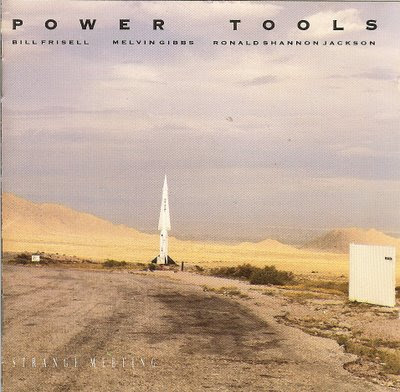
Power Tools/Strange Meeting: The Michael Mann jazz [now with producer's commentary]


UPDATE, 5.8.2011: A few days after posting this appreciation of Strange Meeting, I received a nice e-mail from David Breskin, who produced the record. He also contacted Steve Smith and he very kindly offered to a) fill us in on the details of this session, and b) correct one longstanding misconception, namely that—as mentioned below—Strange Meeting was originally intended as a quartet date with Julius Hemphill. Not true at all, it turns out!

Breskin followed up a few days later with a fascinating account of the making of the record. As you'll read below, there was nothing accidental about it; Strange Meeting was a true old-school PRODUCTION, complete with rehearsal, strategic preplanning and a real aesthetic backbone. (My sense is that there aren't a whole lot of jazz records being made this way anymore.) Breskin's text doubles as a fascinating insider's perspective on the NYC jazz scene in the ’80s. It's essential reading for any fan of that period, of Strange Meeting in particular, of the musicians involved in general, or for anyone interested in the way a producer can act as a true collaborator, setting parameters that liberate rather than constrict, ultimately yielding an ALBUM rather than just a collection of performances. Breskin's text, edited and fully approved by him, appears below my post.


"I thought Shannon’s playing might do something interesting to Bill and that Bill’s playing might do something interesting to Shannon, and that Melvin would be a perfect fulcrum and shifting counterweight: suitably fierce but appropriately subtle and supportive when need be and no road hog he. Anyway, that was my hope. I thought this could be a cool band, and Shannon always used to say, 'Nothing beats a failure but a try.' So, why not?"

—David Breskin on Strange Meeting

/////

I wrote a little while back about the idea that free jazz ought to be documented in the studio as well as onstage. Been thinking again about that the past few days, while immersing myself in Strange Meeting (Antilles), the lone officially released recording by Power Tools, the trio of Bill Frisell, Melvin Gibbs and Ronald Shannon Jackson.

I have heard from Steve Smith (who, as you can read here—scroll down to the 1987 section—regards Strange Meeting as a desert island disc and a perfect record) and other sources that this January, 1987 record date was originally scheduled to be led by Julius Hemphill. He didn't show, though—apparently due to illness—and a new scheme was quickly hatched. I'm not sure if the date was supposed to be these three gentlemen *plus* Hemphill or if one of them was called in to replace him, but at any rate, what you have here is the only in-studio meeting of Frisell, Gibbs and Jackson, and it is indeed a strange one. [NOTE: Hemphill was never a part of this date. Please see intro and addendum to this post for details.]

And really the strangest thing about it, given the aforementioned haphazardness of its organization, is how incredibly *together* it all sounds. You might expect some sort of free blowout: "Ah, fuck it—let's just improvise and roll tape." That is not what this record is at all, though. It is an honest-to-goodness full-length LP, paced as intelligently as any rock classic you could name.

You would honestly think this lineup had been together for years. All of the members contribute pieces, and the writing is more or less evenly split: three pieces by Frisell, three by Gibbs, two by Jackson, one collective jam and one cover (yes, "Unchained Melody"). This, to me, is the formula for success in jazz, and maybe even rock too, though it's much rarer. (Descendents/ALL comes to mind; their albums have always been everyone-pulls-their-weight-both-compositionally-and-instrumentally affairs.)

I'm skirting around the music itself, maybe because it's such an enigma. You can't typify what this band sounds like—you have to hear the whole record, really. Gibbs's compsitions, "Wadmalaw Island" and "Howard Beach Memoirs," just floor me. The former is a beautiful, alien quasi-ballad, held together by a Latin-ish vamp. Frisell's sublimely ’80s-ish reverb is just the right thing for it. The band sort of slinks along, doling out its energy gradually. You may never have heard Shannon Jackson play this sensitively. It's like undersea Miami Vice jazz from Pluto. And then Frisell brings out the distortion, and the poetry becomes a bit scary, almost Sharrockian. You think of synthesized seagulls, like in Don Henley's "Boys of Summer." This, to me, is the true ’80s jazz. Lush, sorta-dated-but-you-don't-care sonics mingling with heartbreak. But the real-time improvisation is right there—it's not frosted over with stiff arrangements or soupy sound.

The trio does hectic scribble just as well as it does noirish emoting. Jackson's "A Wolf in Sheep's Clothing" features a tumbling, brief, Ornette-ish head that gives way to a magical kind of clunked-out funk that only Shannon could provide. I would venture to say that his drumming is better here than it ever was in Last Exit. In that band, Shannon tends to go for the broadest gesture, either the martial, about-to-blow ramp-up or the boneheaded electric-blues beat. Here, though, he's actually playing free jazz, more or less, while also keeping the beat. Gibbs's chords jut out crudely, Frisell screams one minute, whispers the next (I tend to hate overly pedal-effected guitar, but Frisell uses pedals like a true surrealist on this record) and Jackson tumbles and exclaims. The beat is somewhere there, but it's not explicit. The band heads out the cargo hatch into space but they hold onto the line. What astounds me is that the piece is only three and a half minutes, but you get a real without-a-net free-jazz feeling in between the bookends of the heads, which themselves give off a very authentic, four-handcuffed-men-being-jostled-violently-around-a-room Ornette-head vibe. It's a true fusion of pop production practices—get in and get out quick—and free-jazz abandon. Great taste and less filling.

And this is what I mean about free-jazz sometimes jelling really well in the studio. Sometimes you don't want to hear a 30-minute live blowout. Sometimes you want to hear the chaos tastefully integrated, in a context you want to play and re-play. Sometimes limits are good.

There's so much else to love on Strange Meeting. I honestly don't know if there's a weak track. I'm spinning the collectively improvised track, "The President's Nap," right now, and as with a lot of Power Tools material, it sounds like the subtler cousin of Last Exit, not as balls-out aggressive but probably more fulfilling on a purely interactive level. Shannon starts out with one of those jaunty, Last Exity marches, Gibbs hops on the train, and Frisell tosses out waves of pure sci-fi sound. Then the whole thing tilts toward something scary and nuclear-sounding, like a parched landscape about to blow. The band is moving all at once, like a miasma in the sky, some sort of hot, creeping menace. The climaxes are hectic and—thanks in part to the outstanding recording quality—vibrantly detailed. It's not just free sound, not just noise. It's deep-listening abstraction, swirling together funk and rock and free jazz and technology and Michael Mann–ish ’80s humidity. You hear this and you feel almost embarrassed for anyone who was still chowing down on old-school, meat-and-potatoes acoustic free jazz circa ’87. This is a music of its time, the best kind in fact. There's a certain mist of cheese swirling around Strange Meeting, but the playing is so goddamn wholesome, so real and right on, that it just becomes part of the joy. It's an if-this-is-wrong-I-don't-want-to-be-right type of thing.

I could go on and on. Frisell's "Unscientific Americans" is another sci-fi Ornette-style tumble. I don't know Prime Time too well, but honestly this band sounds like what I'd *want* Prime Time to sound like, a true electrifying of the skittery, headlong O.C. vibe with none of those bummer boxy funk rhythms. Frisell is basically playing the laser gun here. The song is all the gnarlier, all the more "fuck you" because it's three minutes long. I've been spinning Strange Meeting all weekend, but I find myself appreciating it even more right now. I can't emphasize this pop/free-jazz vibe enough. It's like a not only benevolent but actually mutually beneficial ’80s-izing of avant-garde jazz. It's concise but it's not tidy. Sure it might be cool to hear this band stretch out for 40 minutes or so, but they want to play *songs*, start from coherence and then explode the universe in the time it would take to run down a bebop tune.

I wish I could stream Gibbs's "Howard Beach Memoirs" for you above. It's a parched, steely line, with so much internal poetry and narrative contour. I think of a (nonexistent) Michael Mann cowboy film, Dylan Carlson from Earth playing with a rhythm section that shifts like magma under his feet rather than plods. Frisell lets the alien spiders in after the head. Into the tech-jazz vortex. I think of those old, big, clunky, white-rimmed VHS tape boxes that snapped shut. Instead of snuffing the jazz out like some pillowy ’80s production can, the *casing* of this music, its presentation and milieu and delivery system, is friendly to the aesthetic. Shannon Jackson solos at the end of "Howard Beach," punching holes in the sky with his close-miked arena-rock toms.

And there at the end of it all is "Unchained Melody," romantic and wired all at once. Did the producer suggest it? Who knows, and who cares? You can in fact make a *record* of this music. You can trim it at the edges and not cut out what makes it tick. That way, you can listen again and again.

/////

*Sadly Strange Meeting does not appear to be available for legal download. You can, however, order a pricey autographed (!) copy direct from Ronald Shannon Jackson via his website. (There are a few Power Tools boots there as well, in addition to a bunch of intriguing Decoding Society selections.)

*Here's a nice clip of Power Tools playing Frisell's "When We Go." Check out this comment someone left: "Ronald Shannon Jackson and Bill Frisell are about a millisecond from obliterating into sun particles; some of the most visceral playing with refrain and control. Fortunately, Melvin's got the weight of the world within his thumb alone to keep the gamma rays from shooting skyward..." Nice.

*Here's Destination: Out on Strange Meeting back in ’08, featuring helpful context re: "Howard Beach Memoirs."

*Strange Meeting begs the question: What are other great fruitfully ’80s-ized (i.e., not just made in the ’80s but true products of the ’80s) avant-jazz studio recordings, albums on which the then-modern production style or record-making philosophy enhanced rather than dulled the impact of the music?

*Also: I don't know the Frisell, Gibbs or Decoding Society discographies all that well. Are there other records by any of these entities that get at the Strange Meeting vibe, or is this record really as anomalous and gemlike as it seems to be?

*Also, what do people know about the Antilles label? Of the catalog listed here, I only know the Air and Braxton records, but I'm very intrigued. What's up with that White Noise record (which features Paul Lytton)?

/////

A Few Notes on Power Tools and Strange Meeting by David Breskin
5.6.2011

I met Shannon Jackson in the summer of 1979, when I was an intern at The Village Voice. I conned Bob Christgau into letting me write some Riffs—it was hardly part of my job—but I wrote on Terje Rypdal, Bootsy Collins, Oregon and Weather Report, if memory serves. (That may be the first time Terje and Bootsy have ever been found in the same sentence, and if so, this would mark the second.) In any event, I met Shannon after one of his gigs at the Public Theater that summer—he was playing with Blood Ulmer, David Murray and I think Amin Ali was the bassist. And I went back to Providence for my senior year in college and also my last year as jazz director of WBRU (under the name “Spottswood Erving”) and Shannon and I stayed in touch in epistolary fashion, and developed a strong connection.

After college I moved to New York City in the fall of 1980 and ended up producing The Decoding Society’s Mandance and Barbeque Dog, as well as Shannon’s own “solo” drum record, Pulse, bringing along my poetic mentor from college, Michael S. Harper, to collaborate with Shannon on a few tracks. In the fall of 1981, I went on a long European tour with the band and got to know everyone pretty well, including, of course, Melvin Rufus Gibbs and Vernon Reid. I also met Bill Frisell in the early ‘80s and was absolutely wowed by his playing: I thought he might be the “Thelonious Monk of the Guitar” or something like that. I got to know Bill, grew fond of him, and in due course produced a collision between him and Vernon, Smash and Scatteration, recorded in the winter of 1984 and released in ’85. My internal code for that project was: “Mr. Rogers Meets The Wild Child” though originally that record was intended to be for a trio, with John Scofield being the third guitarist. We just couldn’t make the schedules work.

Over those years, I’d brought Bill to some Decoding Society gigs and brought Shannon to come see Bill play. They were full of mutual admiration. As different as their own music was, they are both, in a sense, country, and there was an easy camaraderie and feeling at the start. I remember Shannon saying, upon seeing Bill play for the first time, “Look here! There’s nobody, there’s nobody that plays a melody like that.” Of course, Bill had heard Shannon’s work with Cecil Taylor and with Ornette, and was really interested in what he was doing, and Bill also admired Melvin’s playing from the Decoding Society gigs and other downtown things.

I remember thinking: if Marx said he was trying to turn Hegel on his head, maybe I could turn the Jimi Hendrix Experience on its head. A very, very limited analogy, but hey, maybe the guitar player could be the pink guy and the rhythm section the darker-than-pink-guys. A powerfully inverted triangle. There was a real racial walling-off in the “avant” music community at that time—what was white, what was black, blah blah blah. I found it hateful then, and still find it so, though of course it makes perfect sense historically. Didn’t Ralph Ellison say he was an integrationist because an “integer” is a whole number? Well, I want to be in that number when the saints come marching. Anyway, that was a part of my thinking in making this project, but don’t get me wrong: it was not some kind of overdetermined racial thing—it was about the music. It’s just that I was cognizant of the larger context, and that some people would see it as somehow “strange” and that’s one reason for choosing Bill’s song as the title track, and the album cover art being what it is. Also strange, in a different sense, because Shannon’s music was so heavy (in weight) and Bill’s was so light, in the sense of ethereal and floaty. I thought this combination might create some heat-generating friction.

I came to the three of them with an idea of a cooperative trio, and making a record as a start. It was always conceived as a trio, a power trio. There was never a horn involved. I don’t know where this story about Julius Hemphill’s involvement came from—you know, that he was was sick and couldn’t make the date, and so an unplanned bare-bones trio recorded spur of the moment. That story is totally, uh, spurious. I’d met Julius at most twice: among other things, he and Michael Harper had collaborated; and for a moment there Bill toured with him in the same band as Nels Cline wouldn’t ya know it?; and Tim Berne, who I was in touch with, was close to him…so it’s not far-fetched. But there was no discussion of Julius being included. And frankly, after the rather horn-heavy Decoding Society, I specifically wanted this to be devoid of hornage, wanted it to be really open, very spacious, where the deer and the fucking antelope roam. I wanted there to be lots of room for Bill, and yet wanted this not to be one of those trio record where it feels like lead-voice-plus-rhythm-section. I just wanted to couple Bill to this deeply heavy rhythm section and see what kind of freight that train might pull. I thought Shannon’s playing might do something interesting to Bill and that Bill’s playing might do something interesting to Shannon, and that Melvin would be a perfect fulcrum and shifting counterweight: suitably fierce but appropriately subtle and supportive when need be and no road hog he. Anyway, that was my hope. I thought this could be a cool band, and Shannon always used to say, “Nothing beats a failure but a try.” So, why not?

We had one planning meeting about the date up at my apartment on 109th street, the four of us. I asked each of them to bring in three tunes. I asked them to bring in songs which would work for this group and to think of who’d be playing it, whether it was brand new material or something previously recorded. I’d heard some of Melvin’s writing in and around the Decoding Society, really liked it, and wanted him, compositionally, to be an equal partner to Shannon and Bill on the record, and not the less-famous sideman. I wanted 3 + 3 + 3 + 1 = 10 songs. Five songs a side, and song-length songs, not long jams. The last song (the +1) would be a cover, a great song but not played straight, something radically recontextualized. In the end, Shannon brought in two pieces, “Blame and Shame” and “Wolf in Sheep’s Clothing;” Bill brought in three, “When We Go” and the title track (both of which he’d released on Rambler in 1985) and the new “Unscientific Americans;” and Melvin brought in three, “Wadmalaw Island,” “A Song is Not Enough,” and “Howard Beach Memoirs.” The title of this last piece was a riff on the popular Neil Simon play (Brighton Beach Memoirs) which had opened on Broadway in 1983, running though 1986 and was made into a movie that year. Of course, the title and piece specifically refer to the Howard Beach hate-crime of December 1986, when three African-American youths were attacked by a gang of stupid young pink people in Queens. One of the victims ended up badly beaten and one ended up run-over by a car and killed while trying to escape.

If memory serves, the trio rehearsed in Shannon’s studio, I think twice, maybe thrice before the recording. I remember being at one or two of these rehearsals, because I made rehearsal notes to prepare for the recording—something I’ve always done when producing. Anyway, the point is that the project was organized and not “haphazard”: the thing was conceived, bantered about, thought out, rehearsed, and then recorded. For all we knew, this might become a real band and this was just the beginning.

For the date, I picked Radio City Studios, up there back behind the hall, in that historic building. I think I was first there watching John Zorn his “Spillane” piece in the summer of ‘86. Loved the sound of the room, the historic old-fashionedness of the place. Frisell was on that date, as well as Bobby Previte. (A zillion years later—well, fourteen—I’d re-connect with Bobby to produce his 23 Constellations of Joan Miro, but that’s another story.) Anyway, at the “Spillane” session I’d met the engineer Don Hunerberg, who I think was something like a house engineer for that room, and thought he was terrific. So when my normal wingman Ron Saint Germain was not available for Power Tools, we happily ran with Don. (Small footnote: I ended up back in the same room six months later, producing “Two-Lane Highway” for/with John Zorn, his “concerto” for Albert Collins, which also was on the Spillane record. I’d written a story on Collins for Musician magazine years before, turns out my cousin in Chicago booked him, and Melvin and Shannon also came in for that date with Zorn and Albert.) Back to Power Tools: I wanted the session to be live, and wanted no editing, no mixing, no overdubbing. It was what it was: like a primary document, like an “early” recording. I wanted the “pressure” of live performance. That band was about a certain kind of pressure….spatial pressure, temporal pressure, rhythmic pressure, tonal pressure, the pressure of personalities and personal history. I knew we could go for multiple takes of every piece, and just settle arguments that way.

Regarding the group piece: “The President’s Nap.” It happened like this: Shannon was in the studio, warming up, playing by himself, with Melvin and Bill in the room getting ready. I liked what Shannon was playing and told Don to “roll tape” though we were beginning to roll early brutal digital two-track bits, even if tape was what we had in our minds. And I just gestured to Melvin and then Bill to start playing, and they did. The piece developed a beginning, a middle, and an end, just naturally. Game, set, match. It was a free improvisation, completely unplanned and obviously untitled. I offered “The President’s Nap” as a title, given that it’d recently come out in the press—sometime in Reagan’s second term—that the President liked to take a daily afternoon journey to dreamland. Given what Reagan did while awake, perhaps this was not so harmful. The title cracked everybody up, because obviously it spins the music in a slightly comically noirish if not horrifying direction, and it stuck. (Bill’s “Unscientific Americans” was also untitled as of the session, and I suggested that title after the Roz Chast 1986 book of cartoons of the same name. Bill is something of an amateur cartoonist in his own right, and is Roz Chastian himself, it might be fairly said.)

Regarding “Unchained Melody”: yeah, not to sound Monty Pythonish about it, but that was my idea, eagerly seconded by Shannon. I didn’t want to cover a song that was part of the jazz canon and that had been covered extensively by contemporary jazz artists, or even those in our immediate past. And I was also looking for a song that I thought Bill could really just rip into, and undo. Here was a song that had been covered a gazillion times, but you know, Alex North wasn’t in the Ella Songbooks and wasn’t of any interest to Wynton and his crowd, and it wasn’t like covering yet another Monk or Wayne tune. It was a pop song (though Al Hibbler did it way back!) recorded first as a theme for a mid-‘50s prison movie, Unchained, hence the “Unchained” in the title. Of course it’s famously a love song, but I was also thinking more abstractly of the Hy Zaret lyric “and time goes by, so slowly / and time can do so much.” Ain’t it true, Shannon, Melvin and Bill? Well, you don’t have to be a musicologist to see how that sentiment might play into this record and this band. Shannon’s point of reference was the Righteous Brothers’ version. For me, it was the Willie Nelson version on his classic Booker T. Jones-produced Stardust record from 1978. I’d gone out on the road with Willie (I think in 1982) for a Musician piece, and really came to love his way with standards, and of course Shannon is as Texas as it gets, and I played Willie’s recording for him, which knocked him out. (Willie then led me to Miles Davis, and later to We Are The World—everything overlaps with everything else—but those are other stories.) Extra-elliptical aside: “Righteous Brothers” became my inside code back-up name for this band, if “Power Tools” couldn’t be used, but that would have been pretty darn “meta” at the time and I can imagine what the legal bills might have been like. Again, this would have gone against the racial stereotyping in about three ways.

Anyway, I am very much a non-musician—I pretty much don’t know anything about music from a technical standpoint—but occasionally I have an architectural or arranging idea and “Unchained Melody” was such a case. I wanted Shannon to open with solo voice, and to play the song as a march. Always loved Shannon’s way with marches and martial beats and guessed that in hundreds of covers “Unchained Melody” had never been played as a march. (And this was before the U2 cover and the Cyndi Lauper cover and before the song was widely and wildly re-popularized by the movie Ghost, which didn’t come til 1990. In 1987, “Unchained Melody” was like a great deserted town, you know a place that had been a boomtown in the ‘50s but there wasn’t anybody living there anymore: The Last Picture Show.) And after establishing the march, I wanted Bill to play the melody straight one time through, and then take it out on the next pass—but yet still perfectly melodic in that perfectly Bill way—and then for the song to devolve and dissolve, with Shannon and Melvin dropping by the wayside. In other words to take the title of the song literally, and for it all to end with Bill’s solo guitar voice and his delay. I was looking for what I call “asymmetrical equilibrium,” which is something I look for over and over in art. The little sketch for this arrangment was a “first thought / best thought” thing on piece of scratch paper.

For the cover of the LP, I chose an image from Joel Sternfeld’s book, American Prospects, which would come out the same year as the record. (That book was/is in the tradition of Walker Evans American Photographs of 1938 and Robert Frank’s The Americans of 1958, and I was hoping to emphasize both the Americanness and the landscape quality of the music.) The album cover picture itself was taken seven years prior to the recording and is titled, “Roadside Rest Area, White Sands, New Mexico, September 1980.” It features the body of an old missile; a sign on corrugated fence saying “WOMEN” leading to a ladies’ room; and a view beyond of the White Sands Missile Range, a U.S. Government weapons-testing area for many years. It just seemed, with the title of the record, the music, these three guys, right…although I’d be hard-pressed to explain why. I knew Sternfeld a bit by then and he graciously gave us the image for free, or for some nominal sum.

The band went on to do one fairly brief European tour in 1988. I’d hoped to come along, and perhaps even record more, but could not make it due to my own work schedule as a freelance journalist. I had a story deadline—I can’t remember for what. I heard some real positive feedback about the tour, and have a VHS tape of four songs from one performance in Cologne, Germany: “Wolf in Sheep’s Clothing,” “Unchained Melody,” When We Go” and “Wadmalaw Island.” These last two pieces are available via youtube and I think the other two will surface in the fullness of time. Time goes by, so slowly, and time can do so much.

It’s a sad state of affairs that Island let the LP, and then the compact disc, go out of print. I called the label once to see what I could do about it and got the Kafkaesque run-around. I have no financial interest in the record (typical for my projects) but this put me in a particularly powerless position in terms of prying the thing free. Maybe I could / should re-visit the subject. The analog record sure sounds politely ferocious.

It’s also not just a little bit sad that there was no follow-up record nor no life as a band after that first tour. Bill had his own trio to feed and grow at the time (the wonderful one with Joey Baron and Kermit Driscoll if I’m remembering the timing correctly) and Shannon was increasingly drawn into a different orbit. What can I say? I’ll say it’s a shame that Melvin, Shannon and Bill did not play together again. They could have made beautiful music together.

Sunday, March 08, 2009

Various and sundry: STATS / Mastodon / Last Exit

A few disparate musical topics to blab about this balmy Sunday evening...


STATS (above, photo by Peter Kleeman) is up and running again after a month-or-so hiatus. Very happy to be rocking in this manner once more. In two weeks' time, on March 23, we will perform as part of the hallowed Precious Metal series at Lit Lounge. Come one and all. More spring shows are in the works and new recordings are coming soon.

/////


I have heard the new Mastodon album, Crack the Skye, which officially appears 3/24. (It's already up for grabs in the file-sharing netherverse, but--strangely--sans the tour de force 13:00 album closer, "The Last Baron.") In fact, I've heard it like ten times. I'm utterly addicted to it. Though my reaction is extremely positive, I'm just a tad hesitant re: raving about it at this early stage simply because I remember having the exact same "Holy shit!" initial opinion of 2006's Blood Mountain. But after a few weeks, I remember feeling like I'd exhausted that album and that its appeal was distinctly ephemeral. Amid all the Crack the Skye buzz, though, I've been coming back to Blood Mountain (and Leviathan as well) and feeling pretty well-sated.

Anyway, re: Crack the Skye, a lot of the early press has cried, "Prog!" and I'm not going to disagree there. The album is one huge, epic mood piece, inviting all the usual BIG adjectives like "sprawling" and such. There's a wide array of dynamics, a smattering of Moog-ish keyboards and a continuation of Blood Mountain's heavy reliance on *sung*--i.e., as opposed to shrieked, bellowed or roared, as on Remission--vocals. The hooks on this record are simply monstrous. Nearly every song has at least one moment of grand-slam catchiness (behold "Divinations" and its solid-gold chorus here) and the singing sounds a good deal more natural this time around. It's very much a record of unabashed beauty, yet when the heaviness comes, it's massive and furious.

It's pretty safe to say at this point that Mastodon is a band for the ages. They may not be Yes and they may not be vintage Metallica, but at their best, they do provide some magical combination of the pleasures of both prog and epic technical metal. (Crack the Skye probably leans more toward the former pole.) They are pretty much the cream of Big (i.e., major-label) Rock these days, and I can't imagine a time when I wouldn't be extremely excited to hear a new Mastodon disc. I just hope I feel as psyched about Crack the Skye at the end of the year as I do now. That's all I'll say for now, but watch this space for more Mastodon coverage soon.

/////


Before and between my Crack the Skye intake, I have been listening exclusively to Last Exit. Throughout my listening life, there are always a ton of bands, albums, artists, periods, genres, etc. that I know at some point I'll have to check out but that I just haven't quite gotten around to. I tend to mentally refer to such a scenario as having a date with an artist.

I've had a date with Last Exit for many years. It's not that I've never heard them before. Far from it; I've had plenty exposure to them ever since a co-worker handed me a cassette dub of Headfirst into the Flames one summer during college. But I've never before really wholeheartedly embraced them like I have over the past few weeks. In many ways, I'd always considered Last Exit a dream band, boasting as it did the twin towers of guitarist Sonny Sharrock and saxist Peter Brötzmann (the latter of whom I touched on a few weeks back). But it also boasted a player who for me has long been a stumbling block, namely bassist Bill Laswell.

I could write volumes on my wariness re: a fair amount of what is often termed downtown music and especially re: two of its signature artists, John Zorn and Laswell, but I'm not in the mood to rant (nor, to be fair, have I really put in the extensive listening that would be necessary to back up my lukewarm appraisal of each man's work). I will say, though, Laswell's funk- and dub-infused improv work--not to mention his production aesthetics, e.g., on this quizzical recording--has often struck me as heavily cheesy and dated.

But after my recent Brötzmann binge, I knew that I had to reckon with Last Exit in a serious way. This recent spate of listening--which included samplings from the self-titled release, the aforementioned Headfirst, The Noise of Trouble (with a very yet awesome Herbie Hancock cameo) and the hit-and-miss yet nevertheless fascinating studio disc, Iron Path--was the first time I really felt like I was able to appreciate the band as a totality, to hear it without wishing I was hearing Sharrock and Brötzmann with a more genuinely brutal--and less hokey--rhythm section.

And whatever anyone wants to say, however violent an ensemble Last Exit was, it could also be an extremely hokey one. Laswell and Ronald Shannon Jackson often defaulted to these sproingy, two-beat, almost rockabilly-like rhythms that sounded more goofy than menacing, all but negating the savageness of what was going on up front. But again, this time around, I was trying to hear more openly, less judgmentally, and I found myself embracing these more lighthearted--and even, at times, silly--aspects of the band. Sure there's part of me that wishes they were just balls-out all the time, but there's a really special sort of quirkiness to what Laswell and Shannon do in the band that adds a satisfying variety to the improvisations.

I guess if I could sum up what I'm saying it's that I stopped viewing Last Exit as a flawed dream band and started hearing them for what they were, which is very much a product of their time. Along with the transcendent rawness of their music, there's also a kind of '80s cheese thrown into the mix, a flashy, synthetic glitz that seems to creep into almost anything Laswell touches. But just as I've come to terms with the soupy overproduction of Laswell-helmed Sharrock discs like Highlife, I'm starting to dig and accept how that aesthetic plays into Last Exit as well. Don't get me wrong: L.E. never came anywhere near the bombastic lushness of Highlife, but there's definitely an element of grandstanding, fun-loving cheese about what they do, not to mention an element of perverse playfulness, evidenced--to name two aspects--in the band's cartoonishly macho song titles ("My Balls/Your Chin," anyone?) and Shannon's cryptic avant-blues vocal outbursts.

Nowhere is *all* of this more apparent than the band's killer Frankfurt gig from '86, which is viewable in several forms on YouTube (though, sadly, no longer in the brief version so aptly tagged by Weasel Walter with the phrase "mountains of cocaine"). Note the insanely kinetic, Bon Jovi-esque camera work, which only enhances the over-the-top-ness of the music:

[Note: These two vids depict the same gig, though I believe there's little or no overlap between them. Don't hold me to that, but either way, they're in no way identical and both well worth a peep.]


The whole gamut of the band is here in these clips. First one leads off with that inimitable free-time skronk they patented, with Laswell thrumming away and Shannon skittering behind him, both expressing nervous momentum rather than any metric structure, and Sharrock and Brötzmann just teeing off on top. Then comes a horrifically brilliant Brötz solo feature, where he sounds more like a fuming dragon than a sax player. And then comes Shannon caterwauling away on some free-soul scat madness. Second clip starts off with the "mountains of cocaine" cataclysm itself, then finds its way into a wacky ride-'em cowboy stomp before kicking into some of the most disgusting death-blues imaginable. The close-ups of Sonny around 4:00 are simply priceless, and when he pulls out the slide around 4:50, what was already a puke-inducing display of badass electric rawness turns into something molten. It's thrilling and monumental. From there things descend into horseplay--Laswell's manhandling of the bass seems stilted to me--but the spell never breaks. And that's what's so special about Last Exit: The quartet's project was all about mingling the sublime with the wanky, the profound with the vulgar. They weren't what I had originally idealized them as being--namely the most uniformly fearsome band of all time--but they were brash and awesome and hilarious and staunchly unboring. Hail Last Exit (even Bill Laswell!) and damn, does all this make me wish I'd gotten a chance to see Sonny Sharrock live before he died.

PS: In my YouTube trawlings, I turned up several more excellent related vids, including two (1, 2) bootleg recordings from a 1988 L.E. gig, the first of which begins with a jaw-dropping unaccompanied stand by Sharrock. And for the truly brave, here's Carlos Santana covering Sharrock's classic "Dick Dogs" (WTF, I know). And lastly, for the die-hard Sharrock heads, behold the man gigging with his unlikeliest collaborator, flutist Herbie Mann. This one is just a glorious enigma if there ever was one: A happy, sprightly groove-jazz vibe and then Sharrock comes and just capsizes the whole thing with his frenetic panther runs. I'd heard this juxtaposition on record, e.g. Live at the Whiskey A Go Go, but viewing it is even more disconcerting.

PPS: And finally, an appropriately irreverent Last Exit interview.