Showing posts with label lars gotrich. Show all posts

Friday, February 25, 2011

Heavy Metal Be-Bop #1: Dan Weiss


I'm pleased to announce the debut of Heavy Metal Be-Bop, a new interview series dealing with the intersections of jazz and metal. Cosmo Lee, the editor of Invisible Oranges—my favorite place to read about metal on the internet—has kindly agreed to play host.

The mission statement of the series could be expressed colloquially as, What's the deal with jazz and metal? As any reader of this blog knows, the two styles form the main pillars of my music consumption. I'm far from alone here: In addition to Ben Ratliff and NPR's Lars Gotrich—both of whose jazz/metal examinations I cite in the intro to HMB #1—Phil Freeman and various others have written extensively and intelligently about both genres and the ways in which they reflect one another. In terms of this series, though, my intent is to focus on musicians—more specifically (at least for starters) jazz-loving metal musicians, and still more specifically, jazz-loving metal musicians whose work might not reflect an obvious metal influence. ("Moving beyond Naked City" might be a good subheading for the endeavor as I see it.)

The brilliant drummer Dan Weiss—who made my favorite jazz album of 2010 and who used to play in doom-metal outfit Bloody Panda—is my first guest. As you'll read, we talked jazz and metal for a while and then listened to some music together (his choices): Gorguts, Metallica, Meshuggah. Dig, especially, Weiss's attunement to the emotional trajectory of the riff. The next installment of HMB (which will post as soon as the transcribing gods will allow) is a chat with jazz pianist and scarily knowledgeable metalhead Craig Taborn. I'm psyched to have HMB out there—do let me know what you think.

P.S. I can only view it as auspicious that the Times has just published a Brad Mehldau playlist that cites Cancer Bats.

P.P.S. A few of Dan Weiss's listening selections got edited out for space, and I wanted to list them here for the record:

1) Cardiacs - various songs, including the phenomenal "Dirty Boy". Insane British "pronk" (prog-punk) band—had never heard them before. It's like King Crimson gone Rocky Horror! Weiss: "For me, this is their anthem. I think I listened to this 10 or 15 times in a row one night. It just keeps going the whole way. And the harmony is almost like Renaissance, Medieval music, the way the harmony moves. Very strange. Beautiful stuff. So weird, fuckin’ weird melody. They just lay on this; they hang on it. I love the way they lay on that."

2) Ustad Rais Khan - "Raga Marwa." Weiss drew several parallels between the complex beat cycles in Indian classical music and extreme metal. Weiss: "Classical Indian music: Could it be equated to blast-beat metal? It’s just all groove to me."

3) Miles Davis - "Directions" (live at Antibes, 1969). Weiss: "Just the way [Jack DeJohnette] opens this shit up. He’s playing as hard as he can. Hear those crashes… He’s bashin’. That kills me."

Monday, October 25, 2010

Permission: Marion Brown's genius


The Marion Brown tributes are piling up and they are fantastic, especially the personal reminiscences by Lars Gotrich and John Rogers, a great rare-record round-up courtesy of Destination: Out and Clifford Allen's typically thorough interview.

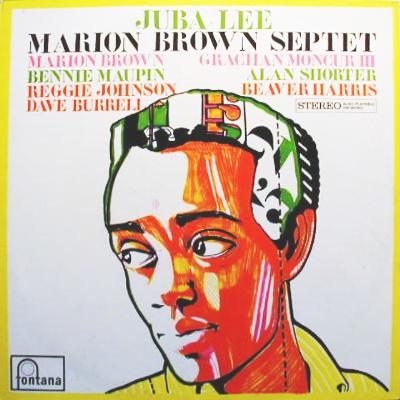
I have been on a Brown kick since the sad news hit, and I have to say that as much as I respect the thematically ambitious material that comes later, nothing hits me like his wordless mid-’60s albums, specifically those resulting from an extraordinary hot streak spanning October through December of 1966: Why Not?, Juba-Lee and Three for Shepp.

It sounds strange, but as a dedicated free-jazz fan, I'm always craving order. Go as far out as you want, but work your ass off on the organizational aspects: bandbuilding, composition, arrangement, solo lengths, sideman deployment, etc. If you're putting your name on a record, exercise some control. These records fulfill said criteria in such thrilling ways. For sheer organized-adventure quotient they are the equal of the mid-’60s Blue Note dates that more or less sum up my personal jazz ideal. (I always think of the holy trinity as Jackie McLean's One Step Beyond, Grachan Moncur's Evolution and Andrew Hill's Point of Departure.) The endlessly delightful romp known as "Spooks" (Three for Shepp) sums up these records' genius. There's freedom here, but there's also so much much economy and so much joy. These are songs you want to hear sung again and again, not merely groundbreaking expressions.

You also really hear each musician featured on these albums, not as a faint blare within a din, but as a true voice. Right now I'm checking out the aforementioned Grachan Moncur soloing on "Fortunato" (also on Three for Shepp), and I'm loving how much space he gets to stretch out and lament as he so loved to do. And Dave Burrell caressing chords underneath, with stunningly sensitive color from Beaver Harris, really one of the finest drummers of the period. (On Why Not? you hear similar sensitivity with different hues courtesy of Stanley Cowell and Rashied Ali.) It's been said time and again that Brown's is not your usual free jazz, that his music showed a greater sensitivity and openness than that of many of his peers. I don't want to drive this characterization into the ground, but I have to echo it here, simply because it's true. I like how Destination: Out put it: "Above all else, Marion Brown’s music insisted on communicating. It wanted to forge deep connections." You feel that when you're listening to these three records I've mentioned—Brown reaching out not just to his listeners but, crucially, to his collaborators as well.

"Play as long as you want; get out what you need to get out," he seems to say to his sidemen on brilliant performances such as Juba-Lee's "Iditus" (streaming at Destination: Out), which features one of the best Alan Shorter solos I've ever taken in, not to mention an awesome turn from Bennie Maupin, whom I've never really heard in such a classic-free-jazz context. Moncur is here too, and Harris, and Burrell—a real all-star team of the period. And of course the leader, just another deep, true voice in a chorus of them, but also the crucial guiding hand that—as Bill Dixon was also doing around the same time—said, "It's okay to slow down, to draw forth the feelings underneath the frenzy." That kind of permission is why these records stand out and truly endure, right up to now.

P.S. Another essential Marion Brown record is Reeds ’N Vibes, a duet session with Gunter Hampel. Poetic, spare, reflective improvisation.

Saturday, July 24, 2010

Crazy for you: Takayanagi's Mass-terpiece


Mass Hysterism: In Another Situation, a 1983 record by the late Japanese noise-guitar hellion Masayuki Takayanagi (1932–1991) is one of those albums that always going to be lurking in my attic, so to speak. I can put it away for a while, but it never goes to sleep—it's always calling me. Even if it takes a few years, I'll be back. (As an illustration of this, I obsessed over Takayanagi in a February 2007 post as well.)

It's a bashing, clanging exorcism: two electric guitars (the other played by Ikira Iijima—anyone know his other stuff?) and drum set (played by Hiroshi Yamazaki—how ’bout him?). Been checking out a lot of the earlier Takayanagi stuff from the '70s—specifically, the Archive 1 box set—and I really enjoy it, but it doesn't take me where this does. The presence of flute or sax, or Takayanagi's sparse, Derek Bailey–ish stylings, grounds the '70s music in something I already know: it's "improvised music" or it's "hyperactive free jazz." Mass Hysterism, on the other hand is an explosion. It seems almost quintessentially extreme, like the kind of thing you'd play for someone just to shock them, or to prove how masochistic your tastes really were.

But the ears adjust quickly, and you warm up to the feedback dance like a pet near the radiator. Abuse of machinery. Squalling, elevating shapes. Engines priming. Zapped technology. Screaming light. Completely undifferentiated and yet mega-eventful from moment to moment. This is a musical exercise so easily described—a FREAKOUT in the classic sense, befitting the record title—but what makes it special is the sustained nature of the performance, the diversity of the soundspace, and the frenized love the players display. Throwing themselves violently at the muse and the music, over and over and over, for something like 40 minutes. So much so that when you listen, you don't see the men, can't possibly picture them existing and deciding to do this and then, doing this. Can you imagine what it would've been like to see this live?

There's definitely a historical perspective at work, i.e., this was extreme for its time. These days, you could go to No Fun Fest, or countless similar events in basements and art spaces all over the world, and see bands like Hair Police worshipping the same ugly vibes. Also, it helps the overall mystique that info on Takayanagi is so tough to come by for the non–Japanese speaker.

What scraps of info do come through are tantalizing—see, for example, this survey of recordings by both him and sometime partner-in-crime Kaoru Abe. For one, Takayanagi seems to have been almost insufferably outspoken, intent on alienating any musician not devoted to his ultra-extreme aesthetic agenda. NPR's Lars Gotrich gives some helpful background on Mass Hysterism here, and the temporarily out-of-commission-due-to-malware-attack Destination Out has also featured compelling Takayanagi posts. I can't find any video of Takayanagi working in Mass Hysterism attack mode. There are no readily available interviews online, or step-by-step journalistic accounts of his career. (Though on the latter tip, it's important to note that as with Derek Bailey, Takayanagi did come up playing straight-ahead jazz. For whatever reason this always lends a greater gravity to free music—think of Coltrane—even if that might be dubious logic, i.e., do you really have to prove your bona fides before going off the deep end?) Just a bunch of dauntingly expensive reissues—Mimaroglu seems to have just about every one—scattershot blog posts, etc.

But for starters, all you need is Mass Hysterism: only $8 from iTunes if you're the stand-up sort, or pretty easily locatable elsewhere online if you're not picky. There are so many RIYL clichés I could—and sometimes feel compelled to—trot out when listening to this record. ("If you worship Lightning Bolt...," etc.) But does that really help anyone? Better to say: go for it.

I spun about three fourths of Mass Hysterism yesterday, and while writing this, I checked out the rest. And now I am back to the beginning. Yamazaki has unfurled his jackhammer magic carpet, and Takayanagi and Iijima are singing their apocalypse hymn. I'm not surprised at all by any of this anymore, having heard it a bunch. I'm just pleased by it. You don't have to pretend that "experimental" music is a struggle every time out, that you're some kind of freak who goes back again and again even though it hurts. Try Mass Hysterism—I think you'll like it. May it lurk in your attic for years to come.