Monday, October 25, 2010

Permission: Marion Brown's genius


The Marion Brown tributes are piling up and they are fantastic, especially the personal reminiscences by Lars Gotrich and John Rogers, a great rare-record round-up courtesy of Destination: Out and Clifford Allen's typically thorough interview.

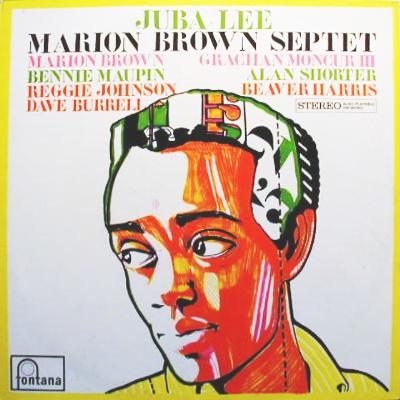
I have been on a Brown kick since the sad news hit, and I have to say that as much as I respect the thematically ambitious material that comes later, nothing hits me like his wordless mid-’60s albums, specifically those resulting from an extraordinary hot streak spanning October through December of 1966: Why Not?, Juba-Lee and Three for Shepp.

It sounds strange, but as a dedicated free-jazz fan, I'm always craving order. Go as far out as you want, but work your ass off on the organizational aspects: bandbuilding, composition, arrangement, solo lengths, sideman deployment, etc. If you're putting your name on a record, exercise some control. These records fulfill said criteria in such thrilling ways. For sheer organized-adventure quotient they are the equal of the mid-’60s Blue Note dates that more or less sum up my personal jazz ideal. (I always think of the holy trinity as Jackie McLean's One Step Beyond, Grachan Moncur's Evolution and Andrew Hill's Point of Departure.) The endlessly delightful romp known as "Spooks" (Three for Shepp) sums up these records' genius. There's freedom here, but there's also so much much economy and so much joy. These are songs you want to hear sung again and again, not merely groundbreaking expressions.

You also really hear each musician featured on these albums, not as a faint blare within a din, but as a true voice. Right now I'm checking out the aforementioned Grachan Moncur soloing on "Fortunato" (also on Three for Shepp), and I'm loving how much space he gets to stretch out and lament as he so loved to do. And Dave Burrell caressing chords underneath, with stunningly sensitive color from Beaver Harris, really one of the finest drummers of the period. (On Why Not? you hear similar sensitivity with different hues courtesy of Stanley Cowell and Rashied Ali.) It's been said time and again that Brown's is not your usual free jazz, that his music showed a greater sensitivity and openness than that of many of his peers. I don't want to drive this characterization into the ground, but I have to echo it here, simply because it's true. I like how Destination: Out put it: "Above all else, Marion Brown’s music insisted on communicating. It wanted to forge deep connections." You feel that when you're listening to these three records I've mentioned—Brown reaching out not just to his listeners but, crucially, to his collaborators as well.

"Play as long as you want; get out what you need to get out," he seems to say to his sidemen on brilliant performances such as Juba-Lee's "Iditus" (streaming at Destination: Out), which features one of the best Alan Shorter solos I've ever taken in, not to mention an awesome turn from Bennie Maupin, whom I've never really heard in such a classic-free-jazz context. Moncur is here too, and Harris, and Burrell—a real all-star team of the period. And of course the leader, just another deep, true voice in a chorus of them, but also the crucial guiding hand that—as Bill Dixon was also doing around the same time—said, "It's okay to slow down, to draw forth the feelings underneath the frenzy." That kind of permission is why these records stand out and truly endure, right up to now.

P.S. Another essential Marion Brown record is Reeds ’N Vibes, a duet session with Gunter Hampel. Poetic, spare, reflective improvisation.

Saturday, October 16, 2010

Work and the Word: Charles Burchfield at the Whitney


Song of the Telegraph Poles, Charles Burchfield, painted 1917–1952

"Listen long to the singing of the telephone poles. It sounds more weird and beautiful by moonlight… Each pole has a distinct tone. A steady throbbing sound—the poles, once trees, still are full of life which is expressed in this pulsating sound. Seems a voice from the center of the earth."—Burchfield, 1914

First: If you (1) happen to be reading this today (Saturday, October 16, 2010) or tomorrow (Sunday the 17th), and you (2) live in NYC or nearby and you (3) haven't seen the Charles Burchfield exhibit ("Heat Waves in a Swamp") that's up at the Whitney, please try to make it over there. The show closes end of day tomorrow, and according to a tour guide I overheard, these works will then be cooling out in storage for a few years.

The paintings themselves are unreal. Many of them proto-psychedelic nature scenes (created from the 1910s through the ’60s, in the vicinities of either Salem, Ohio or Buffalo, NY), where the actual stuff that's depicted—trees, rivers, stars, houses, telegraph poles, etc.—shares space with these kind of aura squiggles or visual vibrations. It's as though everything in the paintings were quivering and radiating humming sound and gleaming light. A very strange sensation to look and almost half-hear sound, and I'm not sure I can really compare it to anything.

But there's a whole other aspect to this show that helped solidify my sense that it was one of the most impressive and enveloping museum shows I've ever seen. I don't have the data in front of me (re: actual pages logged, years begun and ended, notebooks filled), but basically, Charles Burchfield kept meticulous journals his whole life and reflected ceaselessly on his work. You know that feeling of museum fatigue, when you've read your 30th wall text and you wish the curator would just shut up so you can experience the paintings on their own terms? Well, there's really no sense of that at all here, because a good 70 percent of the text in this show is by Burchfield himself.

I'm not enough of an art-historian to know how common this is, but in, say, music, there are tons of creators who talk eloquently about their work—in interviews, biographies, etc.—but not a whole lot who do so just as a matter of course, without being asked to. (Incidentally, I think this is one reason why Ethan Iverson, a true musician/critic, seems like such a blessing.) Burchfield's commentary on his work is every bit as sensitive and wondrous and insightful as the paintings themselves. To see an image like the one at the top of this blog post and then to glance over and read something like the text reproduced under it… It was like having your mind blown twice each time you walked up to a new work. I must've looked over at Laal in stunned, delighted disbelief something like 15 or 20 times.

And crucially: the marvel at coming upon an artist so intensely analytical and reflective and self-critical in method and so natural and visionary in creation. You see these paintings and they look like the breath of God—the result of some highly attuned man speaking in visual tongues. And then you see these sketches, dissecting the works endlessly; paintings completed in youth and then dug back out in middle age and augmented with huge new sections; and notes-to-self that seem mystical but are really just straightforwardly instructive, like: "Astonishment and wonder are the keynotes of this picture—Eliminate all else." And even, as my friend Kyle put it, actual emotional "glyphs," a pictorial vocabulary, i.e., weird little shapes corresponding to things like "Imbecility" or "Morbidness (Evil)" and gathered together as "Conventions for Abstract Thoughts."

It all seems almost superhuman—to both do and reflect, more or less in real time. Often these two pursuits look a lot like opposites: You're either doing or you're thinking about the doing. And that's why critics and journalists and scholars and whatever else you want to call them flock to art, and why, at least some of the time, they're welcomed (or at least tolerated!) by artists and enthusiasts, because they make explicit things about the work that the creator might not have had the time or the inclination to point out.

But man, to see that intermediary process completely obviated? It's like Martin Luther's whole "Abolish all clergy and deal directly with the Word" idea. That's what you get to do here: deal directly with the Word, alongside—of course-the Work. Because Burchfield had enough juice in him for both activities, the making and the telling, and the effect is rather mindblowing.

P.S. Metal fans: Look alive. There are quite a few paintings in this show that brilliantly reckon with blackness and storms and scary old houses and the terror of night, and if you're anything like me, you'll practically hear Sunn O))) reverberating through the museum. The texts contain many meditations on evil and sinister-ness and very metallic observations such as "I put into the sun all the devastating destroying power of that 'star' that I feel on a March sap day." YES.

Monday, October 11, 2010

Gleeful exorcism: Corrosion of Conformity at Highline Ballroom


Left to right: Woody Weatherman, Mike Dean, Reed Mullin

At last night's Corrosion of Conformity show, the reunion debate finally flatlined in my mind. (Ben Ratliff hilariously called foul nearly a year ago, but this is the kind of thing that each listener must rule for his/her self.) There's just no judging one of these things objectively, simply because the main factor at play is one's own prior experience with a given band.

There have been times, perhaps at Time Out—where reunions can seem, to those of us doing our best to make sense of the rock landscape, like a depressingly all-consuming news topic—when I've bitched about the trend. But let's be fair here: Were it not for the reunion bug, I would not have ever had the opportunity to see Slint (incredible) nor the classic Jesus Lizard lineup (the good kind of ridiculous) play live. Nor, to get to the point, would I have seen Corrosion of Conformity in its original incarnation—the trio of Mike Dean, Woody Weatherman and Reed Mullin—as I did last night.

This was a band with which I had very little experience during their heyday. I was born too late to get into their early-to-mid ’80s work, and once they hit Headbanger's Ball (with "Clean My Wounds," off 1994's Deliverance—released, oddly, on the same late-September day as Chocolate and Cheese), the whole thing had turned somewhat cheeseball and it didn't really appeal to me. (Not that it necessarily would have appealed to me had it been incredible—I was still paying a lot of attention to some not-so-great music at that time.) So the news that the version of COC that recorded 1985's "classic" Animosity album was going to be recording and touring again really didn't mean much to me at all—it registered as a second chance at something I didn't care I'd missed the first time around. I was mainly at the Highline last night to hear Keelhaul (as expressed here ad nauseum, e.g., I'm completely addicted).

I had planned on sticking around to get a feel for what COC was all about, but I didn't commit in advance to weathering the full show. Once they started playing, though, it was pretty much a settled thing: I wasn't going anywhere. Their set was absolutely masterful: one of the most sheerly enjoyable sets of heavy rock I've ever witnessed. The band was famous back in the day for epitomizing punk-metal crossover (my show buddy Nick Sakes told me how an old COC logo consisted of the Black Flag bars and name, with the "Flag" crossed out and "Sabbath" written in). Apparently, this style was somewhat groundbreaking at the time, but to me, growing up when I did, punk-metal crossover was no more or less than the thing one had to do in order to do proper justice to all of one's influences. (My friends in The Crackbabies did an outstanding job at this, by the way.)

So to me, COC's approach didn't come off as novelty. What it came off as was a celebration of the last four decades of heavy rock. I didn't hear last night's set as so much Flag plus Sabbath as Sabbath plus Bad Brains. I'm not sure if I've ever heard a metal band that sounded so comfortable playing extremely slow and extremely fast, sometimes in the same song. One minute they were slithering in a holy proto-Eyehategod sludge dance and the next they were hurtling through classic lickety-split hardcore, and the shifts sounded perfectly logical. Why not play slow and fast? Seems elementary, but it's not something that every punk band dared to explore. I can't tell you how many times I've wished that there were more Bad Brains songs like "Supertouch/Shitfit", which grinds down intermittently into that world-collapsing half-time groove, and this COC set felt like the fulfillment of that dream.

The trio's chops represented the best kind of homegrown virtuosity. The tiny Dean, on bass, plucked with his fingers, like a hardcore Geezer Butler; Weatherman, a happy, hulking caveman, dwarfed his guitar and also made it sing, coaxing out its most righteously evil intervals; and Mullin simply blazed, a ball of hair who smashed like a doom-metal pro on the slow parts and grooved just as hard during the blindingly fast sections. All three players sang as well, though Reed was the star, belting in a pinched, pained whine, kind of H.R.-ish but very melodic in its own way. There were shout-along choruses (to which the spiked-leather-jacket dudes in the pit responded in kind), but overall, the vocals were way more than just dumb-punk sloganeering. Dean brought the harsh Southern soul, very much in line with so much Dixie metal I know and love (Eyehategod, Crowbar), but totally different in his approach.

As gorgeous as the music was, though—and I do mean that: it was the true Temple of Riff, exalting both the Sloth and Cheetah—what struck me most were the smiles, the sinister glee and passion on display. Mullin could not stop beaming. He seemed to me like the eternal Freaks and Geeks–era teen, fueled by suburban home-cooking topped off by candy and soda, bashing away in the basement after (or instead of—could go either way) football practice. And Dean and Weatherman each modeled the "Holy shit" face, not an arrogant, "What I'm creating is so cool" face, but a face of religious awe re: "What can be created is so cool," what the Riff can do and the power it has. If you've played heavy music, you know this well, how the process is a kind of summoning, but a happy one—a gleeful exorcism. Often the harshest music springs from the widest smiles. You bring the devil into the room, and this makes you happy.

And to achieve this, onstage last night, the three players often had to close the circle, playing to and for each other rather than the crowd, with Dean and Weatherman turning their backs not in a Miles-ian display of defiance, but simply because that's what the ceremony requires. First and foremost, you have to honor the thing in its insular form, and then you bring it out into the light for others to see. That's just how it works, and how it was working so beautifully last night. In this nearly-Halloween season, an auspicious evil borne out of sheer fun and bro-hood. The harvest of the Riff.

And so what of reunions? As Ratliff eloquently suggested in the review linked at the top of this post, there's no such thing, in general. A live show is not an accumulation of history or a reflection of a scorecard of legitimacy. It's simply one band existing at one time within one listener's mind. And if that listener feels right about it—as I really, really did last night—then that particular reunion was right, and by extension, all of them were.

Friday, October 01, 2010

Mystery man: Paul Motian and unfair expectations


A few nights ago I attended a jazz performance that happened to not involve Paul Motian. (As expressed in a previous post, I've been listening obsessively to Motian for a while now, and over the past few weeks, there's been little else that's made a significant dent.) While taking in the aforementioned concert, I found myself mentally indulging in an unabashedly subjective, even unfair appraisal, over and over again: "This is nothing like Paul Motian! Why can't these musicians behave more like him and his sidemen?"

Crazy, I know, but within bounds, because I had attended the show in a social rather than professional capacity. Isn't it strange when you're in the presence of one artist, but your mind keeps drifting back to another? You might feel ashamed, or you might, as I did, give yourself over to it and start to hone a definition of your own aesthetic values. Why is this performance not doing it for me? What do I get from this other that the one in front of me is not providing?

What I concluded was that the missing ingredient was mystery. I had become accustomed to the idea that each note of a jazz performance was a step into the unknown. An illustrious forebear called it the sound of surprise, but how much jazz really provides that? Often we're in head-solos-head territory, swinging along predictably. Anyway, Motian actually does furnish that a lot of the time. Maybe not all the time. His diffuse, rainy-day abstractions certainly have the potential to grow predictable or even oppressive. But at their best, they're all about true exploration: unhurried and absolutely confounding.

Before beginning to write this, I was listening to the title track from the 1985 Motian quintet release Jack of Clubs on the subway. There's an ensemble head; then there's a momentum-halting drum solo; then a swirl of unaccompanied Bill Frisell; then a strange duo tangle involving Jim Pepper and Joe Lovano's saxophones. [Note: Listening back, I realized that these various sections overlap, Venn-diagram-style, so it's really: Motian solo, Motian/Ed Schuller (bass), Schuller/Frisell, Frisell/Pepper.] Just to be clear: This is the first track on the record, the initial thing the listener will hear out of the gate, and what Paul Motian wanted to do, what he felt should happen, was that the quintet should atomize into free-form solos and duos. (For a great breakdown of a similarly puzzling decision, see Chuck Klosterman's Chinese Democracy review.) If you're like me, this decision confuses and delights you, maybe in large part because you have no idea why it's happening. Did the producer second-guess Motian? ("Paul, baby, you know I think you're great, but maybe we should start off with something a little more high-energy or straight-ahead and work our way to this, no?") Did the players? It doesn't really matter; it's Motian's record, period. But as a listener, you ask these questions, and if you're a certain kind of listener—conditioned, say, by hours and hours and hours of Paul Motian—you might begin to relish them, and even to feel that a given performance is remiss for not prompting them.

Anyway, I didn't hear that mystery at the aforementioned concert, didn't feel that nagging "Why in the hell?" (as Nmperign's Bhob Rainey put it so eloquently "I listen for a kind of 'What the fuck?' and follow that"). That said, the musicians I heard live really aren't about that—they may even be the antithesis of that—so I had no reason to expect it, but nevertheless, I couldn't stop thinking about it. What to do with this? Am I imposing unfairly? I guess I'm just saying that jazz which forgoes mystery might never be able to engage me as much as jazz which indulges it, invites it, lives with it. (To get specific: Andrew Hill is probably my favorite jazz musician, and I'm starting to think Paul Motian might be a close second.) Forgive me, non-mysterians like the ones anonymized in this post, but I may continue to come to your shows distracted, staring out the window at some weird, murky sight, like the pictures in my head when I hear "Jack of Clubs."

Tuesday, September 21, 2010

Come and live with us: Magma live


"Definitely you can come and live with us

All you gotta do is help out with the chores…"
—Dirty Projectors, "Temecula Sunrise"

I thought of the line above while watching Magma at Highline Ballroom last night. The impression I kept getting, over and over, from this most idiosyncratic of old-guard progressive-rock bands (check the eye-popping facts if you haven't heard of them: French, around since ’69, built around an invented mythology and language, etc.) was of a commune: a self-sustaining civilization based on a shared commitment to beauty and, just as important, industriousness. "Definitely you can come and live with us," the furiously intricate yet highly supple jazz-rock epics (ranging in mood from the eerie to the imperious to the flat-out goofy) churned out by bandleader Christian Vander & Co. seemed to say, "but please understand that we're going to put you to work." You know those often absurd-seeming, state-sanctioned images of Communist life from China or the former Soviet Union, where everyone's happy and busy and also pretty much anonymous? That was how this incarnation of Magma—Vander (at left in the pic above) on drums and his wife, Stella (to his right), on vocals, along with a vibraphonist, a keyboardist, a guitarist, a bassist and two more singers (one male and one female)—felt to me.

But the X-factor, the thing that made it joyous and wonderful instead of creepy, was the passion of the playing. Prior to seeing this show, Magma had always seemed merely like the coolest idea to me. Anyone who spends any time digging for information about progressive rock, as I have for a good while now, eventually runs up against Magma, like some weird, impenetrable bedrock. Those lean, proggy riffs and vaguely musty fusion-isms always sounded like an appealing throwback, but the Kobaïan chant and the fact that Magma never seemed to rock in as balls-out a manner as, say, Yes, always ended up leaving me a little numb.

Live, though, you get volume, and also, crucially, you get Vander. A hulking, sweaty and frequently smiling man, he is an utter thrill to watch. Cymbals positioned high and at precarious angles, their faces nearly perpendicular to the stage. I wrote a little while back about the Vaz drummer Jeff Mooridian, and how his native position on the kit was playing snare, bass and some furious 16th-note pattern on the high hat. Vander's native territory is that perpetual staple of prog drumming, the steely, syncopated groove smashed out on the China cymbal and bass drum simultaneously, with the snare filling in the space. You really hear, in this man, the grand lineage of jazz-rock: Despite Vander's constant professions of love for Elvin Jones, what I heard was a lot of Bruford, a lot of Cobham and on the quieter passages, a lot of Tony Williams. (I've often opined that the same drummer can't really play both rock and jazz convincingly, but Vander comes about as close as anyone I've ever heard, bringing the requisite bombast for the former and a very genuine sense of touch and buoyancy, as demanded by the latter.) But, one wonders, given Magma's 1969 vintage, who was it that influenced whom?

The band played for about two hours, and yes, it was exhausting at times and hammy at others. But I was consoled by the notion of witnessing something absolutely singular. To nod to the great Rick Astley ("You wouldn't get this from any other guy"), you wouldn't get this from any other band, namely such a deep, committed demonstration of what PROG means, entirely unobscured by pop and for that matter, "classic rock." Sure you could go see the latter-day Yes (I've never had the pleasure—I'm sure it's amazing), but this is something much more grassroots, much more cult, something closer to the sublime, Zenned-out nerddom at the core of prog. It's nothing less than motivational speech in musical form: an overwhelming pageant of human achievement, i.e., "You too can accomplish such brilliance if you eat your Wheaties and practice every day." Definitely you can come and live with us, say the Vanders and their cohorts, busy erecting their otherworldly architecture—it won't be easy, but the sacrifices just might be worth it.

/////

Some background: a great 2002 interview with Christian Vander.

Monday, September 20, 2010

Listening jag: Motian, Malaby and related


For a while now, I've really enjoyed how Scott Tennent (author of the forthcoming 33 1/3 book on Spiderland and a fellow craw and Dazzling Killmen fanatic) documents and analyzes his listening habits. I thought I'd try something similar.

The guiding principle here is that I'm constantly on what I call listening jags (I've used "listening ruts" before too, but I think this works better), prolonged periods of immersing myself in the work of one artist or several related ones. Anything can trigger this: a new album release, a live show, a blog post. And once I'm off, I'm really off: For however long the listening jag lasts, I can hardly bear to hear anything other than the artist or artists in question (when listening is recreational and not work-related, that is). It's sort of like that "Once you get that taste" concept—I have a sound in my head and that's the only sound I want. Sometimes, the jags last a day, sometimes weeks; sometimes they're cyclical, e.g., I seem to find myself on an Andrew Hill jag every six months or so, and on a Cecil Taylor jag about once a year.

Anyway, I thought I'd give a little window into my current listening jag (the axis of which is the drummer Paul Motian) and how it developed.

1) I was reading this Destination: Out post on Joe Giardullo, which led me to this Giardullo interview on Paris Transatlantic by Clifford Allen. In the Q&A, Giardullo, who has often covered Paul Motian tunes, states: "That trio [Motian] had with Charles Brackeen and David Izenzon is the trio." I'm a huge fan of Motian, Brackeen and Izenzon, and while I'd heard this trio's output (one ECM record and some killer live stuff), I decided I needed to get deeper into it. So for a while I was deep into said ECM record by Motian, Dance, the live stuff linked above and another Motian ECM album, Le Voyage, which features Brackeen along with J.F. Jenny-Clark on bass.

2) I decided to go further with Motian, so I began spinning Keith Jarrett's American Quartet stuff and got especially into the album Byablue, on which most of the material is composed by Motian. I also became obsessed with the Jarrett/Haden/Motian YouTube clip discussed in my last post.

3) I delved further into the Motian discography, which led me to the ’80s albums on Soul Note, of which Steve Smith was kind enough to lend me two, Misterioso (still digesting) and the absolutely phenomenal The Story of Maryam. Both sessions feature Joe Lovano and Bill Frisell—who would of course stay on with Motian and fill out his signature trio—as well as the late saxophonist Jim Pepper and bassist Ed Schuller.

4) At this point, after I had spoken to him of my Motian jag, a generous brother-in-jazz (who shall remain anonymous) passed me a bootleg of a very recent (as in weeks ago) Motian gig at the Vanguard, which featured Frisell, and the saxophonists Mark Turner and Tony Malaby. I haven't written much about Malaby on this blog, but I truly love his playing, and I'm also a big Turner fan (as evidenced by posts on Fly and Billy Hart's quartet). This boot is a holy thing and I wish everyone could hear it.

5) At this point, a taste for Malaby sprouted as an offshoot of my taste for Motian. I recalled that the two of them appeared together on Malaby's Adobe, from 2004, so I got that and was instantly fascinated. Again, still digesting, but this record is definitely an obsession in the making.

6) I left Motian for a bit and moved further into the Malaby universe, checking out two fantastic records: last year's Voladores and Tamarindo, a Clean Feed trio date from a couple years back w/ William Parker and Nasheet Waits.

7) Then I looped back around to Motian (and Ed Schuller as well), spending a bit of time with Tim Berne's Mutant Variations.

What does all this mean? Nothing, other than that it demonstrates how my listening brain works. I have a certain sonic area in mind and I want to explore it fully. With Motian and Malaby there's something hard to pin down that binds them: this sort of ghostly, free-floating-ness. The Malaby band on Voladores is called Apparitions, and I think this fits really well re: what I'm looking for in jazz right now. I'm showing no signs of moving on from this jag: As I type, I'm already planning to load Adobe onto the iPod for the morning commute.

Monday, September 13, 2010

Three clips


Much of my recreational listening lately has centered on Chick Corea's Now He Sings, Now He Sobs; Paul Motian in the ’70s, including his trio records with Charles Brackeen and his work with Keith Jarrett; and Dave Holland's ’80s quintet albums on ECM. Blessedly, all three of these strains of brilliance can be glimpsed on YouTube.

I'm transfixed by all these above clips, especially the Jarrett/Haden/Motian one—what in God's name is Paul Motian doing here? So gloriously eccentric and unhinged from the way anyone else has ever played drums. You don't think of the guy who swung with Bill Evans at the Vanguard; you think of the great outsider jazz-percussion geniuses, from Sunny Murray all the way up to Randy Peterson. Motian's playing here, and the sound of this Jarrett trio as a whole, reminds us that free jazz is about so much more than Free Jazz, i.e., the Coltrane-and-Ayler- or even Ornette-derived stuff. So many artists have played "free" in so many different ways. There's Fire Music on one hand and then there's this whole other strain that's about ecstatic joy and fun. Those emotions are really palpable in this clip.

And speaking of different spins on free jazz, how about Roy Haynes? At the beginning of the Corea clip above, what you hear is straight-up OUT, and moreover, Haynes sounds absolutely comfortable, not to mention fantastic, in this mode. It's basically exactly the type of thing Corea would play later on with Barry Altschul and the Circle cats. There's some more of this free vibe appended to the CD reissue of Now He Sings, esp. a track called "Fragments". A tantalizing performance, since I'm pretty sure Haynes never really did anything like this again. Of course, I could be mistaken, but in all the other instances I know of Haynes recording with avant-garde-leaning figures, e.g., Dolphy and Andrew Hill, the mode was pretty much straight postbop. Does anyone know if there are any other instances of Roy Haynes playing free jazz? If so, I absolutely NEED to hear them. He sounds incredible in this vein—if you heard just a few seconds, you might think you were listening to Andrew Cyrille or another avant-garde titan.

As for the Holland, I wrote in a comment here about how this band with Steve Coleman and Kenny Wheeler represents a jazz ideal for me. This is what I said there with regard to Holland albums such as The Razor's Edge and Seeds of Time, and I stand by it: "It's not free jazz; it's not straight-ahead jazz; it's just good jazz. It swings when it needs to, grooves when it needs to, comes off the rails when it needs to. It takes neither a reverent nor a defiant attitude toward the history of the music."

Anyway, long live YouTube and its jazz-historical treasures.

Thursday, September 09, 2010

Ten strong 2010 jazz releases


I can't tell if it's an unusually great year for jazz albums, or if I'm just making more of an effort to survey what's out there. Either way, I've heard some killer recorded jazz in 2010. Here are a few full-lengths I'm really feeling. Obviously we've got a few months to go before year-end-poll time, so just consider this as an informal "Don't sleep on these" list, in no particular order apart from the fact that No. 1 is a clear favorite. (One or two of these—the honorable-mentioned Sam Newsome, e.g.—may be late-2009 releases that didn't make their way to me till after the new year.)

Anything crucial that I'm missing?

/////

1. The Cookers Warriors (Jazz Legacy Productions)

2. Weasel Walter Invasion (ugEXPLODE)

3. Harris Eisenstadt Woodblock Prints (NoBusiness)

4. Jason Moran Ten (Blue Note)

5. Geri Allen Flying Toward the Sound (Motéma Music)

6. The Bad Plus Never Stop (E1 Music)

7. Mike Pride's From Bacteria to Boys Betweenwhile (Aum Fidelity)

8. Jon Irabagon Foxy (Hot Cup)

9. John Escreet Don't Fight the Inevitable (Mythology)

10. Mario Pavone Arc Suite T/Pi T/Po (Playscape)

/////

Honorable mention:

Jeff Davis We Sleep Outside (Loyal Label)

David Weiss and Point of Departure Snuck In (Sunnyside)

Vijay Iyer Solo (ACT Music)

Louis Sclavis–Craig Taborn–Tom Rainey Eldorado Trio (Clean Feed)

Rudresh Mahanthappa and Bunky Green Apex (Pi)

Paul Motian Trio with Jason Moran and Chris Potter Lost in a Dream (ECM)

Newman Taylor Baker Drum-Suite-Life (Innova)

Sam Newsome Blue Soliloquy (self-released)

James Moody 4B (IPO)

Chris Lightcap's Bigmouth Deluxe (Clean Feed)

Amir ElSaffar–Hafez Modirzadeh Radif Suite (Pi)

Rova and Nels Cline Singers The Celestial Septet (New World)

Stéphane Furic Leibovici with Chris Cheek and Lee Konitz Jugendstil II (ESP-Disk)

Mike Mainieri Crescent (NYC)

Kurt Rosenwinkel and OJM Our Secret World (Word of Mouth)

Wednesday, September 01, 2010

The chase: craw live at the Grog Shop


[Flyer by John G.]

Every serious music lover has that one show they spend their whole life chasing, the concert they've built up in their mind as the greatest thing they ever saw. For me it was about 15 years ago. It was either ’95 or ’96 and I saw a Cleveland band called craw [sic] play in my hometown of Kansas City, Missouri. Their records were my chief obsession at that time, and the show confirmed what I'd hypothesized: that this was the best band I'd ever heard. As a devout teenage metalhead, I had grown weary of the genre's macho, dumbed-down attitudes (these were the days before "indie metal," before intellectual cred was pretty much a given within the style). In craw I found the darkness and ruthless complexity I craved, along with vocals/lyrics that seemed like the ravings of a mad scientist. Live, everything was amplified, right there in front of my impressionable face: It was like being attacked by geniuses.

So I chased craw for the remainder of their touring existence, catching something like six more shows over the next couple of years. I moved to New York and craw stopped touring. Eventually Joe McTighe, the lead singer who had so impressed me, left Cleveland, and the band quietly went extinct. By this point, the early 2000s, craw's prog-punk ethos, grafting the former style's technicality onto the latter's brutality, had become a "thing" in earnest, a genre unto itself. I couldn't relate to bands like Dillinger Escape Plan, but after a few years, when my friend Joe and I started a band called Stay Fucked, I realized that the prog-punk ethos was percolating in my backyard. So both as a musician and as a fan, I continued to chase the idea of craw.

Things got interesting around 2005. Stay Fucked was progressing and we met folks from all these other bands who had a stake in the prog-punk thing: Mick Barr, Zs, Behold… the Arctopus, Friendly Bears, Time of Orchids. We'd already known the members of Timber, Birthday Boyz and Snack Truck from college, and then we came upon others of our tribe: Archaeopteryx, Yukon, Animal, Maw, Clan of the Cave Bear, Dysrhythmia. (In 2006, I helped organize a Philadelphia festival—which bore the same name as this blog—to showcase some of this talent.) Within this community, I was a tireless evangelist, handing out burned copies of craw records like bibles. Some listened and caught the fever, but by this point, there was no craw to see live, no way to really ground the myth in fact.

Suddenly, though, there was a craw to see live. A month or so ago, I got word that the band would reunite for a one-off Cleveland show, a benefit for a friend (photographer and longtime scene booster Karen Novak). As I'd expected, Joe McTighe was not coming back to town, so the other three members of craw's final lineup (guitarist Rockie Brockway, bassist Zak Dieringer and drummer Will Scharf, the latter also of Keelhaul) would play as a trio, with Brockway doubling on vocals. I was skeptical on the latter front: McTighe's strategy had been to lay slippery, chaotic patterns over the musicians' rigorous tech-rock grid, and the idea of trying to play and sing craw at the same time seemed impossible.

Doubts or no, I knew this was something I needed to see. So this past Monday, a decade and a half after that initial Kansas City experience, here I was again chasing craw. Friends, family and fiancée all thought I was a little nuts—flying to Cleveland overnight for a show—but on the other hand, they all knew me well enough to understand that when it came to craw, I wasn't going to compromise.

I got into town at about 5:30 p.m. My kind host was my friend John, a keeper of the prog-punk flame who plays in the aforementioned Clan of the Cave Bear. He's one of the only other people I know who seems perfectly content to talk about craw (or any other extreme band you might fancy) ad infinitum. We chilled out at his place for a few minutes, grabbed a bite and then headed over to the Grog Shop, a modest-sized bar/venue (NYC people: think of Mercury Lounge) where the show was going down.

The crowd was sparse. As a pilgrim, I wanted to pay my respects to the band. Will knew I had planned on coming, but he still seemed a bit surprised that I had actually gone through with it. Rockie and Zak were shocked as well, but happy to see me—it had been something like eight years since I'd seen or talked to either one. It's always a little weird playing the role of the obsessive fan, but in my experience, if you're in a situation where you can actually converse freely with your idols, you should. And no matter how embarrassing it seems, you should tell them how much their work means to you—as I've been doing with these guys since I was a teenager. With all that out of the way, we got some good catching up in before the show. I gave Rockie and Zak some STATS CDs.

After the opening band finished, I grabbed a spot right at the front of the stage (not that there was much competition). I had planned on taking some Flipcam video, but I concluded that I didn't want to worry about documentation while watching the band. John's girlfriend, Leia, kindly offered to tape a few songs for me, but then we realized that like eight other people were filming the whole show. (I'll be sure to post some links as soon as the videos appear—I'm guessing you'll see a few on this YouTube channel.) Will had rattled off the song selection to me when Keelhaul played NYC earlier this month, but when John and I spied the set list, we were psyched to see "STRONGEST," signifying "Strongest Human Bond," one of the best songs from my favorite craw album, Lost Nation Road, and a clear favorite among my various friends who love the band.

Suddenly the sticks were clicking and it was on. I think I half-expected some kind of heavenly trumpet fanfare, but nope, this was a rock band playing to a thin crowd in a suburban-ish bar on a weeknight, a scenario that was no doubt playing out concurrently at thousands of other venues across the country. It took a bit for the magic to warm up: Opening track "Caught My Tell" (drawn, like most of the set, from craw's final album, Bodies for Strontium 90) sounded a little wobbly, and Rockie clearly had his hands full with the guitar-vocal doubling. (Overall, though, Rockie handled the challenge well: He didn't attempt to mimic Joe's delivery; instead, his hoarse, shouted style was a respectable placeholder.) "Strongest Human Bond" came next and things started to gel. The old chills brewed up inside during the midsong breakdown ("20 years later my twin is passed out on the couch"). By the third song, "Space Is the Place," I was right where I wanted to be. There were only a few of us up near the stage, including John, but were all zeroing in on the same phenomenon: that euphoric rush of volume and crazed inventiveness that only craw delivers. These songs are so ingrained in my head and heart that for all their complexity, they sound absolutely logical, absolutely fluid. I danced and screamed along.

However easy it is to dis the nostalgic impulse in general, it's ridiculous to resist it on a personal level. Specific things light us up when we're young and nothing else but those specific things can truly complete our circuits when we're older. We stay open-minded, we stay grounded, we stay rational and sane, and new stimuli flood in, but there's a unique joy that comes when we're in the presence of the old stimuli, when we chase our aesthetic ideal and there it is, intact, waiting for us.

The second half of the set is a blur to me—I was so out there and in the moment and happy. I distinctly remember the stunning skeletal-funk bass-drums breakdown in "Unsolicited, Unsavory" and how it grooved harder than it does on the record. I remember the glorious turbulence of "Divinity of Laughter" and the sleek, serrated cadences of "Is It Safe?" I remember when a fellow craw lifer—I only caught his first name, R.J.—came up onstage to help Rockie sing the classic "405" (a creepy rant about a woman who falls victim to a stalker then survives a plane crash), and how Will (who had not played on the recorded version of the song) spiced up the ominous ending with a backbeat. And I remember that I didn't want it to end.

Afterward I got to catch up some more with Zak. We went through a little craw history, talked about our mutual loves of Rush and the Mahavishnu Orchestra, and filled each other in on our extramusical lives. I have no idea when I'll see him again, or if I'll ever see craw play again, but this particular chase had been worth it. The 32-year-old me shook hands with the 16-year-old me and said, "You were right."

/////

The full set list from Monday's craw show at the Grog Shop in Cleveland:

Caught My Tell

Strongest Human Bond

Space Is the Place

Sex

Unsolicited, Unsavory (a.k.a. "Dubby")

Chop Shop

Divinity of Laughter

Flunky

Is It Safe?

Weedy Species

405

Cars
Monday, August 23, 2010

Drummer to drummer: Vaz's Jeff Mooridian, Jr.


"They've Won" by Vaz, from Dying to Meet You (Gold Standard Laboratories, 2005)


As you may have gleaned from my last post, I've been listening to a lot of Vaz lately. (For the uninitiated, Vaz is an extremely ominous Brooklyn noise-pop band, spun off from the revered and semi-defunct ’90s outfit Hammerhead.) Another recent trend is that I haven't been drumming as much as I'd like. My band is on an involuntary hiatus due to some chronic wrist soreness that's currently afflicting our bassist—not sure if it's technically tendonitis, but it's that general sort of thing—and I've had a hard time getting motivated to go play on my own. Over the past few days, though, all the Vaz intake has had a galvanizing effect: I knew I had to go in to the practice room and try to play some of this stuff.

To say that executing Vaz beats is outside my comfort zone as a drummer is a vast understatement. Slow and mid- tempos are pretty much where I excel. Even when I'm playing complex music, I like to get behind the beat and really relax in the manner of Levon Helm, Black Sabbath's Bill Ward and Jean-Paul Gaster from Clutch, and it's just not that easy to do this when you're playing at a breakneck tempo. I've always been in awe of punk players (i.e., a drummer named Alex Mooney, who played for my friends' high-school band, The Crackbabies) who can impart a sense of groove to those scampering rhythms.

When you're talking about the marriage of groove and velocity, the drummer you really need to examine is Vaz's Jeff Mooridian, Jr. (a.k.a. Deft Garlands and Bruce Museum). I've seen Mooridian play many times over the past six years or so, having shared bills with Vaz a number of times as part of both STATS and Aa. And I've gone through various periods of obsession with the Vaz discography. I don't think it's an exaggeration to call him one of the most intense drummers in the contemporary rock underground. I'm fully behind the worship of Brian Chippendale and Zach Hill, but Jeff Mooridian does something that's every bit as special.

Like Chippendale and Hill, Mooridian plays way more notes than he needs to, but I wouldn't really call him a hyperbusy player like those two. You know how Papa Jo Jones is always held up as the king of the hi-hat in jazz? There are players like that in rock too, and I always pay them special mind because the hi-hat is my favorite part of the drum kit. It might sound weird, but one drummer whose hi-hat work I really admire is Fab Moretti from the Strokes. Listen to Is This It and you will hear one man's ascetic devotion to the hi-hat—he rarely strays from it during the whole record. Anyway, Mooridian is an absolute poet of the hi-hat: He uses it to fill up as much space as possible, imparting a sense of breathless, whooshing speed.

Listen to the track above, if you haven't already. (It's from the second Vaz album, a damn-near flawless document.) It's a great summary of what Mooridian does routinely with the hi-hat, namely fixate on a two-handed 16th-note feel. You'll often hear rock drummers go for this vibe during a climactic moment, but Mooridian goes there pretty much ALL THE TIME. The two-handed 16th-note feel is the bread and butter of his drumming, and the result is that Vaz songs impart a truly unique sense of velocity.

During the verse of "They've Won" (beginning after the brutal tom-heavy intro), Mooridian goes into this absolutely ridiculous hi-hat pattern that sets the tone for the whole song. I could be wrong, but having seen him play live many times, I'm pretty sure he's not traditionally schooled in any way, and thus does not avail himself of any of the insider economy-of-motion tricks that a highly trained player might employ. I'm the same way—mostly self-taught, and thus I often probably expend twice the amount of energy that I should. All I can say is that trying to play the "They've Won" verse beat last night at the proper tempo, I almost passed out after a few bars. What really kills me about the groove, though, is not just those furious hi-hats; it's the deep-pocket RELAXATION of the bass-and-snare pattern. As hurried and frantic as the hi-hat stuff is, the bass and snare sound like they're jogging in leisurely fashion. As I learned from Alex Mooney long ago, it's not enough to be able to execute a pattern; what really connotes mastery is to be able to RELAX WITHIN a pattern.

The stuttering "chorus" pattern on "They've Won" is awesome as well: a juxtaposition of two bars of the breakneck 16th-note hi-hat stuff with two bars of an 8th-note feel. I love this kind of call-and-response drum-beat architecture—something Ed Blackwell did a lot.

Anyway, the music speaks loud and clear, so I'll leave you with that now. Jeff Mooridian, Jr. will probably never appear in a drum magazine, but he deserves to be recognized for what he does: His hi-hat poetics make him unlike any other drummer on earth. In playing twice as many notes as he needs to, he creates beats that feel not just fast but sublimely urgent. I'm going to keep trying to learn to play this stuff, and even if I can't quite get to where he is, I'm sure I'll learn something.

On the discussion front, can you think of any other poets of the hi-hat, or masters of velocity/groove?