A list of my ten favorite jazz CDs from the nearly bygone year is now posted at the Jazz Journalists Association website. An annotated log of my choices is below. Links lead to various locales (labels, artists, CD Baby, Amazon, iTunes, etc.)—in each case, I simply chose the site with the most previewable music.
1. Dan Weiss Trio - Timshel (Sunnyside)
I reviewed this record for Time Out New York back in March, and I still don't feel like I have a handle on it, which, to me, is a great thing. You can know a lot about Weiss (that he used to moonlight in the doom-metal band Bloody Panda and that he has adapted tabla techniques to the drum set) and still not scratch the surface of what makes Timshel special. This is music—jazz, I guess, but that's beside the point—of stillness and mystery and rapturous beauty. I hope I never get to the bottom of it.
2. Chris Lightcap's Bigmouth - Deluxe (Clean Feed)
There's a picture of a schmancy old car on the cover of this record, which might lead you to believe that the music inside would be gaudy. Instead, Deluxe is all subtlety: Taut, vampy rhythms undergirding a mist of saxophones. Craig Taborn's keyboards and Gerald Cleaver's drums provide lift and color. It's a lush, pillowy sound, but full of mood and intrigue. Again, I need way more time to wrap my head around this one and I can't wait to do so.
3. Harris Eisenstadt - Woodblock Prints (NoBusiness)
Drummer Harris Eisenstadt made my favorite jazz record of 2008, the West African–inspired Guewel. I think this new one—a limited-run LP release and download—is even better. Like the Lightcap, this is an extremely lush record and a tender one. It's not even close to a "drummer" record—it's basically a chamber outing, marked by a carefully chosen instrumental palette, featuring clarinet, bassoon, French horn and tuba. Eisenstadt knows exactly what he wants out of the players and he gets it—a deep sense of stateliness and composure in the ensemble passages (and there are a lot) balanced with gutsy passion from the soloists. To me, Eisenstadt is easily one of the finest young bandleaders in jazz and Woodblock Prints testifies to that fact. (P.S. I saw this entire album performed live and it was gorgeous.)
4. Jason Moran - Ten (Blue Note)
This album is bulging with magic and mastery. Over the past few weeks, I put together a lot of iTunes playlists, culling all my 2010 top-ten candidates, jazz and otherwise, for shuffled consumption. Every time a track from Ten came up, I'd stop whatever I was doing and marvel at Moran and his Bandwagoneers—their ability to convincingly express both the core of the blues and the flurry of modernism within the same piece is breathtaking. If ever an artist has done right by his teacher, Moran is making the late, great Jaki Byard proud.
5. Mike Pride's From Bacteria to Boys - Betweenwhile (Aum Fidelity)
As I noted when contributing to this invaluable From Bacteria to Boys video roundup at (((unartig))), I'd primarily understood Mike Pride up to this point as a connoisseur of the jarring gesture. Betweenwhile offers something quieter, a place to really get lost. Airy jazz filled with smoke and funk and fire and simmer. The whole album plays like a loving showcase for the talents of Pride's sidemen: the bite of altoist Darius Jones, the sumptuousness of pianist Alexis Marcelo, the patience of bassist Peter Bitenc. There's so much sublimated deep feeling in this record that no sudden movements are necessary. It's corny to talk about artists "maturing," but you can't hold Betweenwhile up to Pride's back catalog and not feel that he really and truly has.
6. The Cookers - Warriors (Jazz Legacy Productions)
There's a lot of glitz, and even cockiness, in the work of this all-star band, a pack of hardbop lifers. Billy Hart was the draw for me, but I grew to love what they all had to say: Billy Harper, Eddie Henderson, George Cables and the rest. This is about taking what went on in, say, the early- to mid-’60s and really getting inside it, luxuriating in the tried-and-true forms and the warmth of modern recording and digging into some absolutely fantastic original tunes that stick with you just like your old Blue Note favorites. This is PRO jazz, conventional jazz, but jazz driven by a pulsating heartbeat. Besides, a record that features Billy Hart is disqualified from the realm of boringness.
7. Weasel Walter Septet - Invasion (ugEXPLODE)
In a past DFSBP post, I praised the evolution of Weasel Walter's improv chops. But to make a great, replayable record, you've got to offer something extra and the Weas has done that here. Each of the five tracks has its own identity, from bouncy Mingus-gone–No Wave ("Flesh Strata") to disarmingly sensitive Company-style free play ("Cleistogamy"), and most importantly—as with the Pride record—all of the performances flaunt the gifts of Walter's supporting cast. Henry Kaiser is an absolute star here. I've never been a huge fan of his before—or, to be fair, dug too deep into his catalog—but he's spellbinding on Invasion, offering a crackly electric zone-out on "Nautilus Rising (part 1)" and eerie distended folk on "Cleistogamy," his contribution to the latter sounding more to me like Robbie Basho than Derek Bailey, Kaiser's avowed "sensei." Overall, Invasion is a great example not just of experimental music-making but of experimental RECORD-making. The compositional (yes, there is bona-fide writing/direction/structure at play here) variety, the excellent recording quality and the brilliant auxiliary musicians all add up to an album you want to hear again when it's over.
8. The Bad Plus - Never Stop (E1)
One thing I love about the Bad Plus, and about this album in particular (definitely the TBP record I've enjoyed most) is how little the band's output squares with Ethan Iverson's unfailingly perceptive and eloquent jazz criticism. After reading Iverson, you might think his band might fixate so much on its jazz-history obsession that it would have a hard time forging ahead and developing its own vibe. That is so not the case, though, and you really hear that on Never Stop. It's just a record of MUSIC, so disarmingly alive and emotive and hard-grooving and fun to listen to. The band's image has a certain archness to it that again can be misleading. You might even take a track like "Never Stop," with its pounding disco groove and twinkly melody, as a slice of ironic nostalgia. But you listen harder, to that track and to the full record, and you realize you're entirely mistaken. The Bad Plus goes straight for simplicity and directness and feeling, and if it often ends up sounding more like pop or indie rock than jazz at a given time, then so be it. For all of Iverson and his bandmates' obsession with jazz, they're thrillingly game for jettisoning its baggage (traditional swing, say, as Iverson pointed out in an interview I read or listened to but can't re-locate now) whenever it suits their compositions. A piece like "Beryl Loves to Dance" here could move anybody—it truly doesn't matter what you call it, and that's rare. It's that wide-open quality that made Never Stop one of the year's most refreshing listens.
9. Jon Irabagon - Foxy (Hot Cup)
I've spilled an insane amount of ink on this record, and Jon Irabagon in general, in 2010. A Time Out profile is here, and a much more in-depth piece is on the way via Burning Ambulance. The salient fact is that Jon Irabagon shocked me in 2009 with I Don't Hear Nothing but the Blues, and then he turned around and shocked me in a whole different way with Foxy. Instead of expressing his perverse, almost maniacal improvisational idiosyncrasies on their own weird terms, as he did on Blues, he decided to apply them to straight-ahead jazz here, and the results are, in their own way, ten times weirder. Sure, Foxy something of a gimmick, something of an endurance test, but it's also an absolute joyride. Just ask Barry Altschul.
10. Chicago Underground Duo - Boca Negra (Thrill Jockey)
Like the Moran, another album that grabbed my attention every time the iTunes roulette wheel landed on it. Like the Bad Plus, another album that orbits jazz without using it as a crutch. Like the Walter, another extremely weird release—the handiwork of an ensemble that's as resolutely unconventional as the Cookers are by-the-book—that nonetheless invites repeated listens. Rob Mazurek and Chad Taylor are going for mood, for soundscape, and they've got that part down, down, down. There's a late-night murk to this album—surely inspired by Bill Dixon, Mazurek's frequent collaborator in the years prior to his recent sad passing—that you just want to live in. But there's also that now-classic Chicago post-rock vibe, executed as appealingly as I've heard it done in quite a while. Boca Negra is a surprising blend of the stylish and the substantive.
/////
My list also included ten honorable-mention releases, many of which nearly made the top ten:
Newman Taylor Baker - Drum Suite Life (Innova)
Solo drums: unadorned and extremely tasty. Time Out preview.
Amir ElSaffar and Hafez Modirzadeh - Radif Suite (Pi)
Loosey-goosey, Ornette-ish freebop, some of the best I've heard that doesn't involve Ornette or his right-hand men. Time Out blog post.
John Escreet - Don't Fight the Inevitable (Mythology)
State-of-the-art inside/outside jazz with a good-kind-of-ridiculous supporting cast.
Tomas Fujiwara and the Hook-Up - Actionspeak (482)
A shrewdly uncategorizable statement: too elegant and meticulous for "outside"; too thorny and restless for "inside." Instead, just really good.
Fred Hersch Trio - Whirl (Palmetto)
Impossibly delicate and songful piano jazz.
Sam Newsome - Blue Soliloquy (self-released)
Ear-bending sound experiments, but with tons of feeling.
Mario Pavone: Orange Double Tenor - Arc Suite t/pi t/po (Playscape)
Another inside-outside winner, brimming with vigor and constructive quirk.
Kurt Rosenwinkel and OJM - Our Secret World (Word of Mouth)
Postfusion concertos, sleek and radiant.
Rova Sax Quartet and the Nels Cline Singers - The Celestial Septet (New World)
Draped in Rova's edgy finery, the Singers sound handsomer than I've ever heard them.
Greg Ward's Fitted Shards - South Side Story (Nineteen Eight)
Happy, hyperambitious prog-fusion-funk-jazz, spiced with charmingly ’80s-ish synths.
Wednesday, December 08, 2010
2010 jazz top ten

Friday, December 03, 2010
Tonight in Brooklyn
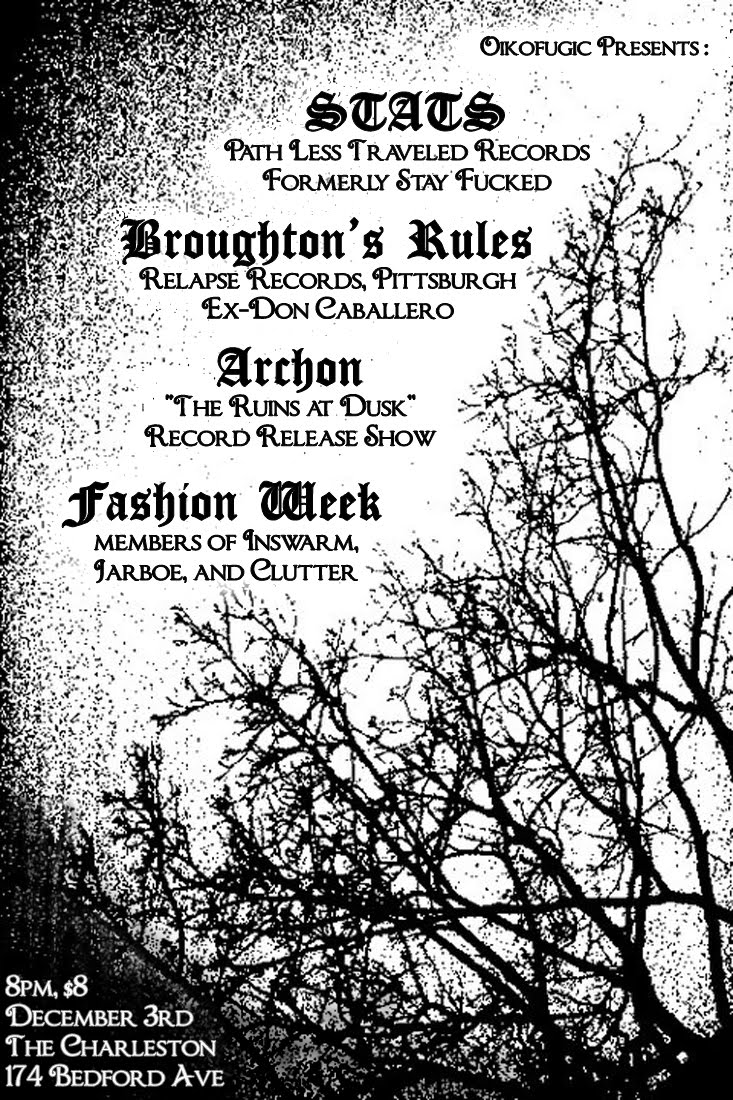
I'm currently whipping up the next DFSBP mixtape—should be a fun one. In the meantime, if you're in NYC, STATS plays tonight in Williamsburg. Here's all the relevant info:
Friday, 12/3/2010
@The Charleston, 174 Bedford Ave between N. 7th and 8th Sts
8pm, $8
*STATS
*Broughton's Rules
dreamy yet muscular rock featuring a former member of the latter-day Don Caballero
*Archon
scary, anguished slo-mo doom
*Fashion Week
featuring members of Inswarm, Clutter, Jarboe's band
[Bands are listed above latest to earliest. STATS is headlining, and our set should commence around 11:30.]
Wednesday, November 24, 2010
Thanks: NYC

Appropriately, given the date, I'm feeling thankful for a number of things. For example, how amazing it is to live in a city like New York and to be able to immerse myself in music for a living. Fact: From last Tuesday, November 16, through this past Monday, November 22, I witnessed the following four performances:
1) The Paul Motian Septet at the Village Vanguard [Tweet 1, 2]
2) Cannibal Corpse at Santos Party House [Review and pics via The Volume]
3) Paul Bley and Charlie Haden at the Blue Note [Tweet 1]
4) Bob Dylan and His Band at Terminal 5 [Review via The Volume]
There's really nothing to say but "Wow." Hope everyone has a great holiday, and I'll meet you back here soon. Still tripping out over Jeff Wagner's prog-metal tome, Mean Deviation, discussed in detail in the previous post.
Thursday, November 18, 2010
Words on music: Slint and prog metal
I've switched reading gears rather drastically since finishing James Salter's outstanding mounting-climbing-themed novel Solo Faces. Within the past couple of weeks, two music books I'd feverishly anticipated have crossed my desk, and diligent devouring has ensued.

Scott Tennent's Spiderland, part of the esteemed 33 1/3 series that will issue my book on Ween's Chocolate and Cheese next March, is a fascinating read. The premise is a simple yet, all told, extremely tricky one: Tennent sets out to demystify Slint, a band whose reputation has everything to do with the fetishization of mystery. Few Slint fans would deny that the very fact of knowing so little about them has contributed greatly to their rabidness. But Tennent's demystification is a healthy and helpful one. A large part of what he's trying to do is set the record straight on one key point: The little-known band Maurice, which contained future Slint guitarist Dave Pajo and drummer Britt Walford, played a much more formative role in shaping the eventual Slint sound than did the much better known Squirrel Bait, the pre-Slint project of Brian McMahan. Tennent pieces together the Maurice story—as far as I know, entirely untold up till now—via interviews with Pajo and the band's vocalist, Sean "Rat" Garrison, and also excavates the tale of the Languid and Flaccid, an improbably advanced grade-school band that included Walford and McMahan, along with Will Oldham's brother (and future Anomoanon leader) Ned. (An excerpt from the book dealing with the latter project is available via the 33 1/3 blog.)
This may seem like a matter of minutiae, but it's not: The point is that, contrary to popular belief, Spiderland came from somewhere; it was an album in a context, not only of Maurice but of the rest of Slint's output. As Tennent rightly points out, many Slint enthusiasts try to explain away the band's incongruous debut, Tweez, a dismissal that's both a historical and aesthetic mistake. Tennent argues passionately for what I came to realize after my adolescent devotion to Spiderland lessened enough for me to give Tweez a clear listen: The latter is a fantastic and fantastically strange record, full of inscrutable in-jokes and weird, disorienting virtuosity. Unlike Spiderland, it didn't spawn a whole genre; instead it exists as an alien world.
Tennent combines these main arguments with detailed discussions of Slint's practice and touring regimens (not to mention a stone-cold fascinating account of a formative Maurice road jaunt opening for Samhain), their obsessive attention to technical details (whether guitars were up-picked or downpicked, say), their programmatic songwriting tactics (heard most clearly on Spiderland opener "Breadcrumb Trail," which Tennent analyzes shrewdly) and their unlikely gig history (Slint debuted as a live band 24 years ago this month during an actual Sunday church mass). Walford and McMahan declined to be interviewed for the book, which is a bummer, but nevertheless, there's tons of new information here thanks to the Pajo and Garrison interviews, and to Tennent's methodical approach to tracking the band's history step-by-step. More importantly, though, there's a brave new attitude toward Slint scholarship at work. Tennent encourages his fellow Slint devotees to challenge the myths and enigmas—in some cases, very romantic ones, like the widespread and apocryphal rumor that one or more members of the band were institutionalized after the recording of Spiderland—in order that we might let a little reality into our conception of this extraordinary band. He concludes, and I think you'll agree, that even with many of the facts right at hand, there's plenty of depth left in Spiderland. For us Slint die-hards, the magic isn't dissipating anytime soon.

The other music book I've been checking out, Mean Deviation—former Metal Maniacs editor Jeff Wagner's history of progressive metal—resembles Tennent's in one crucial sense: It's sent me scurrying to the stereo. In just about every other capacity, though, this is a very different book. Tennent, in accordance with the 33 1/3 credo, focuses much of his scholarly energy on a single record, and even with all the aforementioned context, it's still a narrow project—after all, Slint officially released only 17 measly songs during its life span. Wagner's tome, on the other hand, is macro to the core, an unabashedly superficial overview of a four-decade-old genre.
I've found that the less I already know about a band discussed in Mean Deviation, the more excited I am by Wagner's text. (For example, I've read the sections on Mercyful Fate and Watchtower with much greater interest than those on Gorguts and Confessor.) And in the end, this isn't—like Tennent's book—a project with a strong sense of mission, with some greater purpose for existing outside of the fact that, well, Jeff Wagner is clearly a lifelong devotee of progressive metal—his intro speaks reverently of his personal lode-star album, Voivod's controversial Angel Rat—and he wanted to put together a sort of survey course on the genre, one that namechecked all the key bands without getting too bogged down with respect to any one. (Though I must say, the Dream Theater section I'm currently wading through is trying my patience.) This is valuable in the same way that any exhaustive yet still readable reference book is valuable: It places the spotlight on the artists rather than on the author's agenda, and it inevitably whets a listener's appetite. Right now, I've got a to-download list about 40 albums deep (from Judas Priest's Sad Wings of Destiny to Watchtower's Control and Resistance—and maybe even, if I'm feeling especially brave, Queensrÿche's Rage for Order), and no matter what any writer-about-music may tell you, that's the real objective of what we do: to breed curiosity that leads to actual first-person contact with the art in question. So, in that respect, bravo to you, Jeff Wagner—I'm definitely getting my prog-metal on this week as a result of your work.
Scott Tennent's Spiderland, part of the esteemed 33 1/3 series that will issue my book on Ween's Chocolate and Cheese next March, is a fascinating read. The premise is a simple yet, all told, extremely tricky one: Tennent sets out to demystify Slint, a band whose reputation has everything to do with the fetishization of mystery. Few Slint fans would deny that the very fact of knowing so little about them has contributed greatly to their rabidness. But Tennent's demystification is a healthy and helpful one. A large part of what he's trying to do is set the record straight on one key point: The little-known band Maurice, which contained future Slint guitarist Dave Pajo and drummer Britt Walford, played a much more formative role in shaping the eventual Slint sound than did the much better known Squirrel Bait, the pre-Slint project of Brian McMahan. Tennent pieces together the Maurice story—as far as I know, entirely untold up till now—via interviews with Pajo and the band's vocalist, Sean "Rat" Garrison, and also excavates the tale of the Languid and Flaccid, an improbably advanced grade-school band that included Walford and McMahan, along with Will Oldham's brother (and future Anomoanon leader) Ned. (An excerpt from the book dealing with the latter project is available via the 33 1/3 blog.)
This may seem like a matter of minutiae, but it's not: The point is that, contrary to popular belief, Spiderland came from somewhere; it was an album in a context, not only of Maurice but of the rest of Slint's output. As Tennent rightly points out, many Slint enthusiasts try to explain away the band's incongruous debut, Tweez, a dismissal that's both a historical and aesthetic mistake. Tennent argues passionately for what I came to realize after my adolescent devotion to Spiderland lessened enough for me to give Tweez a clear listen: The latter is a fantastic and fantastically strange record, full of inscrutable in-jokes and weird, disorienting virtuosity. Unlike Spiderland, it didn't spawn a whole genre; instead it exists as an alien world.
Tennent combines these main arguments with detailed discussions of Slint's practice and touring regimens (not to mention a stone-cold fascinating account of a formative Maurice road jaunt opening for Samhain), their obsessive attention to technical details (whether guitars were up-picked or downpicked, say), their programmatic songwriting tactics (heard most clearly on Spiderland opener "Breadcrumb Trail," which Tennent analyzes shrewdly) and their unlikely gig history (Slint debuted as a live band 24 years ago this month during an actual Sunday church mass). Walford and McMahan declined to be interviewed for the book, which is a bummer, but nevertheless, there's tons of new information here thanks to the Pajo and Garrison interviews, and to Tennent's methodical approach to tracking the band's history step-by-step. More importantly, though, there's a brave new attitude toward Slint scholarship at work. Tennent encourages his fellow Slint devotees to challenge the myths and enigmas—in some cases, very romantic ones, like the widespread and apocryphal rumor that one or more members of the band were institutionalized after the recording of Spiderland—in order that we might let a little reality into our conception of this extraordinary band. He concludes, and I think you'll agree, that even with many of the facts right at hand, there's plenty of depth left in Spiderland. For us Slint die-hards, the magic isn't dissipating anytime soon.

The other music book I've been checking out, Mean Deviation—former Metal Maniacs editor Jeff Wagner's history of progressive metal—resembles Tennent's in one crucial sense: It's sent me scurrying to the stereo. In just about every other capacity, though, this is a very different book. Tennent, in accordance with the 33 1/3 credo, focuses much of his scholarly energy on a single record, and even with all the aforementioned context, it's still a narrow project—after all, Slint officially released only 17 measly songs during its life span. Wagner's tome, on the other hand, is macro to the core, an unabashedly superficial overview of a four-decade-old genre.
I've found that the less I already know about a band discussed in Mean Deviation, the more excited I am by Wagner's text. (For example, I've read the sections on Mercyful Fate and Watchtower with much greater interest than those on Gorguts and Confessor.) And in the end, this isn't—like Tennent's book—a project with a strong sense of mission, with some greater purpose for existing outside of the fact that, well, Jeff Wagner is clearly a lifelong devotee of progressive metal—his intro speaks reverently of his personal lode-star album, Voivod's controversial Angel Rat—and he wanted to put together a sort of survey course on the genre, one that namechecked all the key bands without getting too bogged down with respect to any one. (Though I must say, the Dream Theater section I'm currently wading through is trying my patience.) This is valuable in the same way that any exhaustive yet still readable reference book is valuable: It places the spotlight on the artists rather than on the author's agenda, and it inevitably whets a listener's appetite. Right now, I've got a to-download list about 40 albums deep (from Judas Priest's Sad Wings of Destiny to Watchtower's Control and Resistance—and maybe even, if I'm feeling especially brave, Queensrÿche's Rage for Order), and no matter what any writer-about-music may tell you, that's the real objective of what we do: to breed curiosity that leads to actual first-person contact with the art in question. So, in that respect, bravo to you, Jeff Wagner—I'm definitely getting my prog-metal on this week as a result of your work.
Monday, November 08, 2010
Release me: New music from STATS

I am pleased to announce that STATS, a band I play in with guitarist Joe Petrucelli and bassist Tony Gedrich, has completed a new recording. It is called Crowned, and it comes out November 22 on CD via The Path Less Traveled Records, a great indie metal label based in Normal, Illinois. The cover art once again comes courtesy of the brilliant night photographer Remi Thornton. You can buy Crowned now as a $3 download from iTunes or Amazon, and you can listen to it here (in high-quality WAV format) via Bandcamp:
We will be celebrating this release on Monday, November 15, 2010 at Cake Shop in NYC, where we will be joined by three outstanding bands: Cheer-Accident, Inzinzac and Xaddax (the latter of which features Nick Sakes, formerly of Dazzling Killmen—DFSBP namesakes, as you might recall—Colossamite and Sicbay). The show starts at 8pm and costs $10. Listen, enjoy, and please do attend the show if you are able.
UPDATE: Go here to read a blurb about the show from The New Yorker.
Monday, November 01, 2010
Dead-ass doin' it: Phil Lynott, Nicki Minaj and other pop chameleons
Time Out New York: Do you think you can still be believable singing a sweet love song after you’ve done all that [raunchier material]—?The above was one of my favorite exchanges from a really enjoyable conversation I had with Nicki Minaj on behalf of Time Out. (Check out the full Q&A here if you have a sec.) The sentiment she's expressing—the weird dual personality that's required of a pop star, and the unflappable confidence needed to pull it off—has been ringing a bell with regard to my current listening obsession: Thin Lizzy.
Nicki Minaj: Absolutely… I’m believable at whatever I do, because I’m dead-ass doin’ it.
The other day I finally watched The Rocker, a doc about the late Lizzy frontman Phil Lynott that I'd had lying around for a while, and I found myself newly impressed by his versatility. As with Ms. Minaj, whatever he did—whether it was a nakedly sentimental love song, a streetwise picaresque or a sleazy come-on—he was thoroughly convincing. Ludicra and Hammers of Misfortune guitarist John Cobbett eloquently summed up the core paradox of the man in a fine recent Invisible Oranges interview (a quote brilliantly excerpted by Inverted Umlaut): "Phil Lynott is the ultimate lyricist for the tough guy with the broken heart."
Today I've been spinning the outstanding 1979 Lizzy disc Black Rose: A Rock Legend, and I'm somewhat shocked by the sheer variety of emotions expressed here. There's one of Lynott's classic paeans to gritty urban life ("Toughest Street in Town"), a weirdly moralistic meditation on kinky sex ("S&M"), a determinedly sappy yet utterly charming tribute to his daughter ("Sarah," see above for a mind-blowing über-lounge rendition, complete with time-lapse-aging model stand-ins), a rueful I'm-through-with-the-bottle lament ("Got to Give It Up") and a half-crazed romantic kiss-off ("Get Out of Here"). I'm not yet through the concluding title track, but I'm prepared for another left turn.
In a weird way, this wanton versatility, the sheer disregard for emotional continuity, reminds me a lot of Ween's masters-of-disguise approach to album-craft. The message is that of all great pop (from Black Rose to Chocolate and Cheese and beyond): Each song is its own universe; live in this feeling for these three minutes. And maybe when that time has elapsed, you'll be transported in an instant to somewhere completely different. It's the same chameleonic impulse that allows Nicki Minaj to sass her way through "Itty Bitty Piggy" and then dreamily croon "Your Love" in the manner of a doe-eyed teenager. As fans, we're okay with the contradiction—as long as, like the great Phil Lynott, whatever the artist in question is doing at a given moment, he or she is indeed dead-ass doin' it.
Monday, October 25, 2010
Permission: Marion Brown's genius
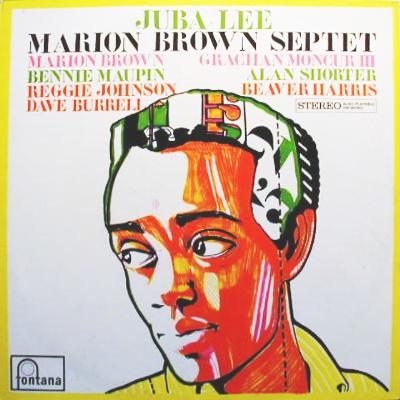
The Marion Brown tributes are piling up and they are fantastic, especially the personal reminiscences by Lars Gotrich and John Rogers, a great rare-record round-up courtesy of Destination: Out and Clifford Allen's typically thorough interview.
I have been on a Brown kick since the sad news hit, and I have to say that as much as I respect the thematically ambitious material that comes later, nothing hits me like his wordless mid-’60s albums, specifically those resulting from an extraordinary hot streak spanning October through December of 1966: Why Not?, Juba-Lee and Three for Shepp.
It sounds strange, but as a dedicated free-jazz fan, I'm always craving order. Go as far out as you want, but work your ass off on the organizational aspects: bandbuilding, composition, arrangement, solo lengths, sideman deployment, etc. If you're putting your name on a record, exercise some control. These records fulfill said criteria in such thrilling ways. For sheer organized-adventure quotient they are the equal of the mid-’60s Blue Note dates that more or less sum up my personal jazz ideal. (I always think of the holy trinity as Jackie McLean's One Step Beyond, Grachan Moncur's Evolution and Andrew Hill's Point of Departure.) The endlessly delightful romp known as "Spooks" (Three for Shepp) sums up these records' genius. There's freedom here, but there's also so much much economy and so much joy. These are songs you want to hear sung again and again, not merely groundbreaking expressions.
You also really hear each musician featured on these albums, not as a faint blare within a din, but as a true voice. Right now I'm checking out the aforementioned Grachan Moncur soloing on "Fortunato" (also on Three for Shepp), and I'm loving how much space he gets to stretch out and lament as he so loved to do. And Dave Burrell caressing chords underneath, with stunningly sensitive color from Beaver Harris, really one of the finest drummers of the period. (On Why Not? you hear similar sensitivity with different hues courtesy of Stanley Cowell and Rashied Ali.) It's been said time and again that Brown's is not your usual free jazz, that his music showed a greater sensitivity and openness than that of many of his peers. I don't want to drive this characterization into the ground, but I have to echo it here, simply because it's true. I like how Destination: Out put it: "Above all else, Marion Brown’s music insisted on communicating. It wanted to forge deep connections." You feel that when you're listening to these three records I've mentioned—Brown reaching out not just to his listeners but, crucially, to his collaborators as well.
"Play as long as you want; get out what you need to get out," he seems to say to his sidemen on brilliant performances such as Juba-Lee's "Iditus" (streaming at Destination: Out), which features one of the best Alan Shorter solos I've ever taken in, not to mention an awesome turn from Bennie Maupin, whom I've never really heard in such a classic-free-jazz context. Moncur is here too, and Harris, and Burrell—a real all-star team of the period. And of course the leader, just another deep, true voice in a chorus of them, but also the crucial guiding hand that—as Bill Dixon was also doing around the same time—said, "It's okay to slow down, to draw forth the feelings underneath the frenzy." That kind of permission is why these records stand out and truly endure, right up to now.
P.S. Another essential Marion Brown record is Reeds ’N Vibes, a duet session with Gunter Hampel. Poetic, spare, reflective improvisation.
Saturday, October 16, 2010
Work and the Word: Charles Burchfield at the Whitney

Song of the Telegraph Poles, Charles Burchfield, painted 1917–1952
"Listen long to the singing of the telephone poles. It sounds more weird and beautiful by moonlight… Each pole has a distinct tone. A steady throbbing sound—the poles, once trees, still are full of life which is expressed in this pulsating sound. Seems a voice from the center of the earth."—Burchfield, 1914
First: If you (1) happen to be reading this today (Saturday, October 16, 2010) or tomorrow (Sunday the 17th), and you (2) live in NYC or nearby and you (3) haven't seen the Charles Burchfield exhibit ("Heat Waves in a Swamp") that's up at the Whitney, please try to make it over there. The show closes end of day tomorrow, and according to a tour guide I overheard, these works will then be cooling out in storage for a few years.
The paintings themselves are unreal. Many of them proto-psychedelic nature scenes (created from the 1910s through the ’60s, in the vicinities of either Salem, Ohio or Buffalo, NY), where the actual stuff that's depicted—trees, rivers, stars, houses, telegraph poles, etc.—shares space with these kind of aura squiggles or visual vibrations. It's as though everything in the paintings were quivering and radiating humming sound and gleaming light. A very strange sensation to look and almost half-hear sound, and I'm not sure I can really compare it to anything.
But there's a whole other aspect to this show that helped solidify my sense that it was one of the most impressive and enveloping museum shows I've ever seen. I don't have the data in front of me (re: actual pages logged, years begun and ended, notebooks filled), but basically, Charles Burchfield kept meticulous journals his whole life and reflected ceaselessly on his work. You know that feeling of museum fatigue, when you've read your 30th wall text and you wish the curator would just shut up so you can experience the paintings on their own terms? Well, there's really no sense of that at all here, because a good 70 percent of the text in this show is by Burchfield himself.
I'm not enough of an art-historian to know how common this is, but in, say, music, there are tons of creators who talk eloquently about their work—in interviews, biographies, etc.—but not a whole lot who do so just as a matter of course, without being asked to. (Incidentally, I think this is one reason why Ethan Iverson, a true musician/critic, seems like such a blessing.) Burchfield's commentary on his work is every bit as sensitive and wondrous and insightful as the paintings themselves. To see an image like the one at the top of this blog post and then to glance over and read something like the text reproduced under it… It was like having your mind blown twice each time you walked up to a new work. I must've looked over at Laal in stunned, delighted disbelief something like 15 or 20 times.
And crucially: the marvel at coming upon an artist so intensely analytical and reflective and self-critical in method and so natural and visionary in creation. You see these paintings and they look like the breath of God—the result of some highly attuned man speaking in visual tongues. And then you see these sketches, dissecting the works endlessly; paintings completed in youth and then dug back out in middle age and augmented with huge new sections; and notes-to-self that seem mystical but are really just straightforwardly instructive, like: "Astonishment and wonder are the keynotes of this picture—Eliminate all else." And even, as my friend Kyle put it, actual emotional "glyphs," a pictorial vocabulary, i.e., weird little shapes corresponding to things like "Imbecility" or "Morbidness (Evil)" and gathered together as "Conventions for Abstract Thoughts."
It all seems almost superhuman—to both do and reflect, more or less in real time. Often these two pursuits look a lot like opposites: You're either doing or you're thinking about the doing. And that's why critics and journalists and scholars and whatever else you want to call them flock to art, and why, at least some of the time, they're welcomed (or at least tolerated!) by artists and enthusiasts, because they make explicit things about the work that the creator might not have had the time or the inclination to point out.
But man, to see that intermediary process completely obviated? It's like Martin Luther's whole "Abolish all clergy and deal directly with the Word" idea. That's what you get to do here: deal directly with the Word, alongside—of course-the Work. Because Burchfield had enough juice in him for both activities, the making and the telling, and the effect is rather mindblowing.
P.S. Metal fans: Look alive. There are quite a few paintings in this show that brilliantly reckon with blackness and storms and scary old houses and the terror of night, and if you're anything like me, you'll practically hear Sunn O))) reverberating through the museum. The texts contain many meditations on evil and sinister-ness and very metallic observations such as "I put into the sun all the devastating destroying power of that 'star' that I feel on a March sap day." YES.
Monday, October 11, 2010
Gleeful exorcism: Corrosion of Conformity at Highline Ballroom

Left to right: Woody Weatherman, Mike Dean, Reed Mullin
At last night's Corrosion of Conformity show, the reunion debate finally flatlined in my mind. (Ben Ratliff hilariously called foul nearly a year ago, but this is the kind of thing that each listener must rule for his/her self.) There's just no judging one of these things objectively, simply because the main factor at play is one's own prior experience with a given band.
There have been times, perhaps at Time Out—where reunions can seem, to those of us doing our best to make sense of the rock landscape, like a depressingly all-consuming news topic—when I've bitched about the trend. But let's be fair here: Were it not for the reunion bug, I would not have ever had the opportunity to see Slint (incredible) nor the classic Jesus Lizard lineup (the good kind of ridiculous) play live. Nor, to get to the point, would I have seen Corrosion of Conformity in its original incarnation—the trio of Mike Dean, Woody Weatherman and Reed Mullin—as I did last night.
This was a band with which I had very little experience during their heyday. I was born too late to get into their early-to-mid ’80s work, and once they hit Headbanger's Ball (with "Clean My Wounds," off 1994's Deliverance—released, oddly, on the same late-September day as Chocolate and Cheese), the whole thing had turned somewhat cheeseball and it didn't really appeal to me. (Not that it necessarily would have appealed to me had it been incredible—I was still paying a lot of attention to some not-so-great music at that time.) So the news that the version of COC that recorded 1985's "classic" Animosity album was going to be recording and touring again really didn't mean much to me at all—it registered as a second chance at something I didn't care I'd missed the first time around. I was mainly at the Highline last night to hear Keelhaul (as expressed here ad nauseum, e.g., I'm completely addicted).
I had planned on sticking around to get a feel for what COC was all about, but I didn't commit in advance to weathering the full show. Once they started playing, though, it was pretty much a settled thing: I wasn't going anywhere. Their set was absolutely masterful: one of the most sheerly enjoyable sets of heavy rock I've ever witnessed. The band was famous back in the day for epitomizing punk-metal crossover (my show buddy Nick Sakes told me how an old COC logo consisted of the Black Flag bars and name, with the "Flag" crossed out and "Sabbath" written in). Apparently, this style was somewhat groundbreaking at the time, but to me, growing up when I did, punk-metal crossover was no more or less than the thing one had to do in order to do proper justice to all of one's influences. (My friends in The Crackbabies did an outstanding job at this, by the way.)
So to me, COC's approach didn't come off as novelty. What it came off as was a celebration of the last four decades of heavy rock. I didn't hear last night's set as so much Flag plus Sabbath as Sabbath plus Bad Brains. I'm not sure if I've ever heard a metal band that sounded so comfortable playing extremely slow and extremely fast, sometimes in the same song. One minute they were slithering in a holy proto-Eyehategod sludge dance and the next they were hurtling through classic lickety-split hardcore, and the shifts sounded perfectly logical. Why not play slow and fast? Seems elementary, but it's not something that every punk band dared to explore. I can't tell you how many times I've wished that there were more Bad Brains songs like "Supertouch/Shitfit", which grinds down intermittently into that world-collapsing half-time groove, and this COC set felt like the fulfillment of that dream.
The trio's chops represented the best kind of homegrown virtuosity. The tiny Dean, on bass, plucked with his fingers, like a hardcore Geezer Butler; Weatherman, a happy, hulking caveman, dwarfed his guitar and also made it sing, coaxing out its most righteously evil intervals; and Mullin simply blazed, a ball of hair who smashed like a doom-metal pro on the slow parts and grooved just as hard during the blindingly fast sections. All three players sang as well, though Reed was the star, belting in a pinched, pained whine, kind of H.R.-ish but very melodic in its own way. There were shout-along choruses (to which the spiked-leather-jacket dudes in the pit responded in kind), but overall, the vocals were way more than just dumb-punk sloganeering. Dean brought the harsh Southern soul, very much in line with so much Dixie metal I know and love (Eyehategod, Crowbar), but totally different in his approach.
As gorgeous as the music was, though—and I do mean that: it was the true Temple of Riff, exalting both the Sloth and Cheetah—what struck me most were the smiles, the sinister glee and passion on display. Mullin could not stop beaming. He seemed to me like the eternal Freaks and Geeks–era teen, fueled by suburban home-cooking topped off by candy and soda, bashing away in the basement after (or instead of—could go either way) football practice. And Dean and Weatherman each modeled the "Holy shit" face, not an arrogant, "What I'm creating is so cool" face, but a face of religious awe re: "What can be created is so cool," what the Riff can do and the power it has. If you've played heavy music, you know this well, how the process is a kind of summoning, but a happy one—a gleeful exorcism. Often the harshest music springs from the widest smiles. You bring the devil into the room, and this makes you happy.
And to achieve this, onstage last night, the three players often had to close the circle, playing to and for each other rather than the crowd, with Dean and Weatherman turning their backs not in a Miles-ian display of defiance, but simply because that's what the ceremony requires. First and foremost, you have to honor the thing in its insular form, and then you bring it out into the light for others to see. That's just how it works, and how it was working so beautifully last night. In this nearly-Halloween season, an auspicious evil borne out of sheer fun and bro-hood. The harvest of the Riff.
And so what of reunions? As Ratliff eloquently suggested in the review linked at the top of this post, there's no such thing, in general. A live show is not an accumulation of history or a reflection of a scorecard of legitimacy. It's simply one band existing at one time within one listener's mind. And if that listener feels right about it—as I really, really did last night—then that particular reunion was right, and by extension, all of them were.
Friday, October 01, 2010
Mystery man: Paul Motian and unfair expectations

A few nights ago I attended a jazz performance that happened to not involve Paul Motian. (As expressed in a previous post, I've been listening obsessively to Motian for a while now, and over the past few weeks, there's been little else that's made a significant dent.) While taking in the aforementioned concert, I found myself mentally indulging in an unabashedly subjective, even unfair appraisal, over and over again: "This is nothing like Paul Motian! Why can't these musicians behave more like him and his sidemen?"
Crazy, I know, but within bounds, because I had attended the show in a social rather than professional capacity. Isn't it strange when you're in the presence of one artist, but your mind keeps drifting back to another? You might feel ashamed, or you might, as I did, give yourself over to it and start to hone a definition of your own aesthetic values. Why is this performance not doing it for me? What do I get from this other that the one in front of me is not providing?
What I concluded was that the missing ingredient was mystery. I had become accustomed to the idea that each note of a jazz performance was a step into the unknown. An illustrious forebear called it the sound of surprise, but how much jazz really provides that? Often we're in head-solos-head territory, swinging along predictably. Anyway, Motian actually does furnish that a lot of the time. Maybe not all the time. His diffuse, rainy-day abstractions certainly have the potential to grow predictable or even oppressive. But at their best, they're all about true exploration: unhurried and absolutely confounding.
Before beginning to write this, I was listening to the title track from the 1985 Motian quintet release Jack of Clubs on the subway. There's an ensemble head; then there's a momentum-halting drum solo; then a swirl of unaccompanied Bill Frisell; then a strange duo tangle involving Jim Pepper and Joe Lovano's saxophones. [Note: Listening back, I realized that these various sections overlap, Venn-diagram-style, so it's really: Motian solo, Motian/Ed Schuller (bass), Schuller/Frisell, Frisell/Pepper.] Just to be clear: This is the first track on the record, the initial thing the listener will hear out of the gate, and what Paul Motian wanted to do, what he felt should happen, was that the quintet should atomize into free-form solos and duos. (For a great breakdown of a similarly puzzling decision, see Chuck Klosterman's Chinese Democracy review.) If you're like me, this decision confuses and delights you, maybe in large part because you have no idea why it's happening. Did the producer second-guess Motian? ("Paul, baby, you know I think you're great, but maybe we should start off with something a little more high-energy or straight-ahead and work our way to this, no?") Did the players? It doesn't really matter; it's Motian's record, period. But as a listener, you ask these questions, and if you're a certain kind of listener—conditioned, say, by hours and hours and hours of Paul Motian—you might begin to relish them, and even to feel that a given performance is remiss for not prompting them.
Anyway, I didn't hear that mystery at the aforementioned concert, didn't feel that nagging "Why in the hell?" (as Nmperign's Bhob Rainey put it so eloquently "I listen for a kind of 'What the fuck?' and follow that"). That said, the musicians I heard live really aren't about that—they may even be the antithesis of that—so I had no reason to expect it, but nevertheless, I couldn't stop thinking about it. What to do with this? Am I imposing unfairly? I guess I'm just saying that jazz which forgoes mystery might never be able to engage me as much as jazz which indulges it, invites it, lives with it. (To get specific: Andrew Hill is probably my favorite jazz musician, and I'm starting to think Paul Motian might be a close second.) Forgive me, non-mysterians like the ones anonymized in this post, but I may continue to come to your shows distracted, staring out the window at some weird, murky sight, like the pictures in my head when I hear "Jack of Clubs."
Subscribe to:
Posts (Atom)