Showing posts with label The Jesus Lizard. Show all posts

Tuesday, January 21, 2014

The Jesus Lizard's essential 'Book'


The new Jesus Lizard book—titled Book, in classic Jesus Lizard fashion—is really something. I'd heard about the volume before it came out, and honestly, despite my intense fandom, it seemed at best like something I might want to flip through for a few minutes in a bookstore. I'm happy to report that I severely underestimated the concept.

Basically, Book (out 3/4/14 from Akashic) is an autobiographical coffee-table hardcover. It's beautifully illustrated with live shots from throughout the band's career, archival pics of all four members from childhood up through the 2009 reunion shows, flyers, candid Polaroids from the road, etc. There's a detailed band oral history, written by the members and other key players (Corey Rusk of Touch and Go, Steve Albini, the band's longtime booker and soundman, etc.) and presented serially, that takes you from each member's personal origin story to the band's endpoint. There are unabashedly biased notes on each LP by David Wm. Sims. (Among the revelations: He thinks Shot is the best Jesus Lizard album; he thinks Down—one of my favorites, incidentally—is the worst; and both he and Duane Denison still seem bitter over the fact that so many fans and critics dismissed their two Capitol LPs outright.) There are all kinds of great testimonials from peers (e.g., Fugazi's Guy Picciotto, Shudder to Think's Nathan Larson, Girls Against Boys' Alexis Fleisig, the great Mike Watt), critics, boosters and buds. There's a conversation between David Yow and Gang of Four's Andy Gill, who produced the final Jesus Lizard LP, Blue. There's a complete chronology of TJL live shows. Any fan will eat all this up.

But for me, what makes Book essential, is the window it provides into the innerworkings of a rock band and the camaraderie, both social and musical, that grows between the members. Interspersed within each member's narrative are testimonials from the other three re: what made him great. So we get, for example, Duane Denison's detailed run-down of why he feels David Yow was underrated as a lyricist, or a beautiful Mac McNeilly–penned tribute to his rhythm-section crony, Sims: "And that sound. It was an unmistakable mix of growl and the bite of steel that makes me think of being held in the air fifty feet high with one of David's bass strings whipping me back and forth." Anyone who's ever cultivated long-term relationships with bandmates will recognize this brand of reverence; what critics and fans say is one thing, but—at least in all high-functioning bands—the highest praise, the most perceptive appreciation always originates from within the group.

Along the same lines is my single favorite item in the whole book (p. 63, if you're following along): a sort of Jesus Lizard aesthetic manifesto by Duane Denison. Basically, this piece is him describing, modestly yet forcefully, the band's core strengths. Some examples:

"Almost all our songs were riff-driven. Finding a melodic phrase that bears repetition isn't easy, and a good riff should be repeated. Repetition creates motoric power, and a great riff should pick up momentum as it's played. That's what rock music is—energy, power, dynamics, excitement… I get fired up just writing about it! I always felt that focusing more on riffs and songs would better serve me than working on guitar solos and fancy licks. I think I was right."

"We all had a very strong sense of how we wanted our gear to sound. We had very specific tastes when it came to guitars, amps, and drums, and it wasn't quite the same as what was common at the time." [Ed.: Amen.]

"…in music, there's three kinds [of motion]: parallel, contrary and oblique. We used them all."

Equally as insightful are David Wm. Sims's frank essays on band economics. He talks about how all the members were able to buy houses after signing with Capitol, because they didn't waste money on fancy tour buses and other perks. And he walks us through the nitty-gritty of the major-label deal, discussing its various pros and cons. In the end, Sims makes it clear that he has no regrets about that chapter of the Jesus Lizard's history, or, really about anything else involving his musical career (except having once joined a band called Rapeman, a name he found abhorrent).

To me, the most poignant part of Book is the brief account of Mac McNeilly's struggle to balance family commitments with touring life, and his eventual departure from the band. Sims, on the impossibility of untangling this particular knot: "Part of me thinks we should have borne whatever career costs it would have imposed [i.e., to scale back so as to accommodate McNeilly]; another part is sure that it couldn't have worked. The more I think about it, the more turned around and sad I get. I'll never really know. Life can be like that."

Basically, Book suits the Jesus Lizard as well as, say, The Dirt suits Mötley Crüe. Because it's predominantly written by the four members, it captures their collective personally perfectly: sardonic and sometimes cynical but also deeply devoted to the art and craft of rock music, to carrying the guitar-bass-drums-vocals format forward, to adoring the underground but refusing to let it fence the band in. And, just as with much of the artwork that adorned the band's albums, shirts, flyers, etc., the visuals are all right on. (My only complaint is that Book isn't more portable—ever since I've gotten ahold of it, I've wanted to take it everywhere.) It's a satisfying period at the end of an exemplary career. Everyone I know loves the Jesus Lizard, and all those same folks are going to love Book. It's no substitute for the music, of course, but it's as compelling a companion piece as I could imagine. [Cue "Then Comes Dudley"…]

*Book info, origin story and endorsement from David Yow.

Friday, October 05, 2012

Propagandhi: CLPPR gods


I'm a little late in reporting as much, but Propagandhi has just finished a two-night NYC run, which I previewed in TONY. The Winnipeg punk band was a key DFSBP presence back in ’09, when their then-new fifth LP, Supporting Caste, topped my year-end list. I saw them live that March, and since then, I've probably listened to Caste more than any other newly released record. To put it another way, it's often that I genuinely admire an album, and say as much in print, only to file it away and forget about it. That is to say, it never earns a real place in my musical pantheon, among the records that I choose to throw on when I'm not accountable to anyone but myself. But Supporting Caste did stick around.

I haven't stopped marveling at the improbability of a band from my past—specifically a political pop-punk band that meant a lot to me during a brief teenage moment in the early ’90s where, in addition to death-metal labels like Roadrunner and Earache, I blindly trusted imprints such as Epitaph and Fat Wreck Chords with my not-so-hard-earned cash—resurfacing to completely blow my adult mind. As I discuss in the TONY piece above, Propagandhi has renovated in a serious way since the first—and up till ’09, only—record of theirs I heard, 1993's How to Clean Everything. As I indicated on Twitter last night, having just attended my second Propagandhi show in two nights, the band has become a bastion of what I like to call CLPPR (contemporary lowercase-p progressive rock), i.e., a rock band that's genuinely pushing itself—technically, ideologically, emotionally—rather than merely aping an ethos and aesthetic that broke ground 40 or so years ago (I nod here to gods such as King Crimson, Yes and Rush). Is Propagandhi still a "punk" band? In the sense that their rhythmic home base still overlaps significantly with hardcore, sure. But they belong among an elite group of contemporary rock bands—I'm not even sure whom else I should name in that regard, aside from the mighty Tool—who are forging their own universes.

Propagandhi's music tickles my tech-rock funnybone, yes, but the reason they matter to me is because they employ extreme technicality in the service of extreme emotion: a vehemently liberal political engagement, combined with a sincere soul-search/self-inventory, i.e., "How is it that one can live well and live responsibly?" I don't agree with all the band's views—at Wednesday's show, frontman Chris Hannah asked the crowd, "Did anyone watch the [air-quotes] debate? Who [air-quotes] won the [air-quotes] debate?" indicating an allegiance to the Ralph Nader–esque perspective that there's no real difference between the two parties, a position I have a hard time relating to—but I agree with their depth of feeling. It comes through in the music, and that's because even more so than conveying their radical politics, they're engaged with writing memorable songs. They're so intent on expressing their views that they've been driven to devise ever more complex, ingenious vehicles for those beliefs. The latest result is another deep, fascinating, adult progressive-rock (in the literal sense) opus. If you care about rock that pushes itself and the listener, while at the same time delivering major amounts of oomph, passion and fist-pumping user-friendliness, you need to hear Failed States. (I'd strongly recommend giving it a good, uninterrupted listen while reading along with the lyrics.)


/////

*Speaking of rock that defines progress purely in its own terms, I recently surveyed the Jesus Lizard discography for Stereogum, as part of a recurring "albums from worst to best" series on the site. I was happy to have the chance to stump for my personal favorite Lizard record, the vastly underrated Down, as well as to revisit the imperfect but still masterful Shot and to really get to know the strange gem that is Blue for the first time—not to mention to revisit the straightforward classics Head, Liar and Goat. For fun, here's a playlist of some of my favorite Jesus Lizard deep cuts:


*Lastly I need to note that one of my favorite living musicians, drummer Steve Shelton, is now blogging at The Poundry. It's been a very Shelton-centric year ’round these parts. You might recall my January rave re: the new album by Loincloth, one of Shelton's two main projects, or my May account of seeing his other band, Confessor, live for the first time at Maryland Deathfest X. I also had the opportunity to interview Steve at length in the spring for an as-yet-unpublished article—I'll link to that as soon as it's available—and I'm extremely pleased to report that on November 17, my band, STATS, will share a bill with Loincloth (playing their first-ever NYC show) at Public Assembly. Anyway, the real point here is that Steve's opinions are as distinctive as his drumming, and he's expressing them with eloquent, passionate regularity via his blog. I especially recommend his comparison of the Ozzy- and Dio-model Sabbaths, his paean to unorthodox cymbal techniques and his eclectic round-up (including both Slint and King Diamond) of the most moving live shows he's ever seen.

Wednesday, May 16, 2012

Dealbreaker: On the Black Sabbath "reunion"


If you haven't been following the saga of the latest Black Sabbath "reunion," I'll fill you in. Basically, the band's original line-up made a big fuss of announcing its re-formation last November. A press release went out, promising a new Rick Rubin–produced album due in 2012, plus a world tour. Many grumbled that Ozzy, for one, was in terrible shape and that the effort would be a wash. Personally—as I said on the radio—I was thrilled at the prospect of getting to see one of my favorite bands live, since my Sabbath obsession bloomed too late for me to catch any of their late ’90s or mid-aughts Ozzfest shows.

The whole thing went to hell this past February, though, as drummer Bill Ward went public about the un-"signable" contract that the band's management had handed him. A few months of back-and-forth followed, and yesterday, Ward finally put the matter to rest. Barring a miracle, he won't be participating in the reunion. You should click that link and read the full statement; it's really pretty wrenching. Ward tells the story of an acquaintance of his brother's, whose son was dead-set on seeing Ward perform with the band.

My heart sank when Jimmy told me about this young boy. I know this boy is going to be disappointed, and I don’t know how to amend it, other than to put my arms around the boy and tell him I love him. Sabbath fans have a voice and a face, to me you’re human, you have families and despair. You have ferocity and emotions and graciousness, and at this moment as far as I’m concerned you are also that young boy in England.

There's another intense moment near the end:

Since Spring of 2011, I’ve waited patiently and hopefully for a signable contract, you know the rest. I stand for the boy in the U.K., for the coming drum student, for all the drummers, who write their parts out and get stiffed on the publishing, I stand with the Sabbath fans chanting “Bill Ward” and asking “why?” and I stand with Tony and Geezer and Ozzy.
Of course, this is a statement of drummer's rights, for one—a "We're not gonna take it" manifesto, with haunting echoes of the late Levon Helm's decades-long vilification of Robbie Robertson for unfair royalty-royalty hogging with respect to the Band's catalog. ("…Rick [Danko]…died with his money in their goddamned pockets… People ask me about The Last Waltz all the time. Rick Danko dying at fifty-six is what I think about The Last Waltz."—This Wheel's on Fire) But it's also, as I see it, a statement of consumer advocacy: In part what Ward is saying, or at least implying, is that just as band members deemed less than essential need to stand up for their essential-ness, fans have a right to an "Accept no substitutes" policy when it comes to endeavors like this latest Sabbath reunion.

Ward has remained admirably humble throughout all this. He hasn't called for any kind of boycott of a Sabbath reunion that continues in his absence. But his frankness about his treatment by management sends an important message, i.e.: Fans want the real thing. I certainly know I do. Now, I can't say for sure what percentage of the world's Sabbath-fan population agrees with me. The band has gone through so many lineup changes over the years that maybe at this point, there's a huge swath of that community that couldn't care less who's behind the drum kit; they just want to go to a big festival and hear Ozzy sing "War Pigs" and "Iron Man." But without getting into some kind of "casual fan"/"true fan" distinction, I know for a fact that, for many, there is no "Black Sabbath reunion" without Bill Ward.

And I say this with no ill will, and in fact, quite the opposite, toward the Heaven and Hell effort of a few years back. What I loved about this reunion—which revived the incarnation of Sabbath that subbed Ozzy and Ward out for Ronnie James Dio and Vinnie Appice, respectively—was the respect it showed both the musicians and the fans. That 2.0 Sabbath was, as I've come to realize over the past few years—during which I've probably listened to The Mob Rules and The Devil You Know (two albums by the Dio/Appice line-up) as much if not more than any of the Ozzy material—(A) a great band but also (B) a different band, one deserving of the distinctive name it eventually earned. The message is simple: You change the personnel and you change the band. Anything less than the whole thing is not, in fact, the thing.

Now of course this principle doesn't apply in every case. Some bands can sub out a member and retain their essential mojo. (Though, at the moment, I'm trying and failing to think of an example of a truly great band that changed members and continued undiminished.) But—and I say this as a member of a band that's cycled through four different bassists over the course of a decade, all of whom have contributed vitally to the sound of the project at their respective juncture—sometimes, no one is expendable. The classic example is, of course, Zeppelin. As I understand it, the rest of the band didn't even think of continuing after Bonham died. You could argue that it's because his drumming was in many ways the band's central feature, but I don't think the surviving members would've reacted any differently if it had been, god forbid, Jones, Page or Plant had passed. There simply was no band once there was no Bonham. For a less prominent but equally clear-cut case, look at the Jesus Lizard. They did soldier on after original drummer Mac McNeilly left, but as David Yow has so often said, it just wasn't the same.

Now, again, Sabbath has been in many ways the polar opposite of one of these "All or nothing" ensembles. Tony Iommi has kept the band running for four decades, often with no other original members included. And I'll fully admit that as much as admire Iommi and respect his willingness to see the project through, I've still yet to warm up to (or more fairly, fully investigate) the greater part of the non-Ozzy, non-Dio Sabbath, of which there is a whole lot. But the crucial point here is that what was promised at the press conference back in November of 2011 was the original Sabbath. That's a very clear-cut thing, and you need all four members in order to deliver as promised. Sure, Ozzy's the figurehead, with Iommi probably being the second most famous in his own right of the other three, but a Ward-less "original Sabbath" reunion is simply not an original Sabbath reunion. Given the band's endlessly complicated history, no one can argue with Osbourne, Iommi and Geezer Butler's decision—assuming they go through with it, which they appear to be doing—to go ahead without Ward. But the message that Ward's sending is that fans have the right to see and hear what they were told they'd get to see and hear, namely the Osbourne/Iommi/Butler/Ward line-up.

Bill Ward, to me, is not like John Bonham, this towering colossus whose contribution to the instrument transcends his band, transcends all of rock & roll, really. But as The Drummer in Black Sabbath, he is a hero to me. When I think about his time feel on the verses of "Snowblind," that gloriously draggy slog, or the stoner's shimmy he busts out during the "War Pigs" prechorus breakdowns, or his jazzy ride-cymbal tapdance on the uptempo interlude in "Electric Funeral," I want to weep. (If you don't know the 1970 Paris footage, you need to sit down and give this your undivided attention; buckle up around 1:40, when Ward starts busting out those gut-punch fills during the stop-time section.) What he does is so natural, so perfectly integrated, so goddamn rocking, so integral to the flowing blues-metal magma that is early Black Sabbath. (For the record, Ward sounds just as good—maybe even heavier, actually—on the 2000 reunion video The Last Supper.) Money matters aside, you just can't separate Ward out and still pretend you're selling people the genuine article.

Ward's stand isn't a matter of ego; he's speaking for the fans as much himself. All he's saying is: A band is a band is a band. As the Band demonstrated, the songwriting is only a tiny piece of the puzzle. Rock & roll is about a sound, and whether or not you consciously notice every specific member's contribution at any given time, that contribution is part of your sense memory, part of the holistic DNA of these songs and albums that we so cherish. Band-dom is, in the end, what makes rock music rule, and when that's compromised, you don't just gloss over it. You make a fuss about it. You stand up for a fan's, let alone a player's, right to the genuine article. I think of the whole Funk Brothers endeavor, to bring to light all the anonymous session geniuses that served as the engine of the Motown hit machine. The last couple decades have in any many ways been a vindication of the idea that it only takes one pretty-faced/-voiced singer to make a song, as more and more of these "supporting players" are given their due (I think of ?uestlove's incessant championing of Bill Withers drummer James Gadson). You need cohesion; you need a team. And you forsake that principle at the expense of the music, the band—and, more crassly, the brand—the fans and the legacy. For an endeavor like this Sabbath reunion, a missing drummer is not merely a bummer; it's a dealbreaker.

P.S. I riffed on the Sabbath un-reunion in a TONY preview of this Saturday's Pallbearer show, written a week before this latest Bill Ward dispatch appeared.

Wednesday, November 18, 2009

Lizard music


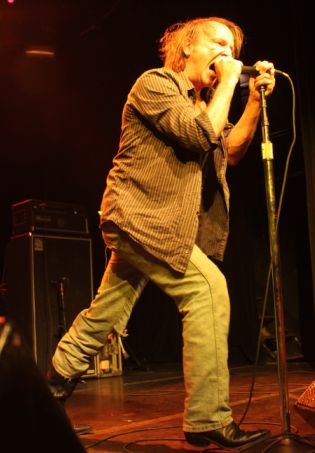
Tuesday night's Jesus Lizard show at Irving Plaza was a blast. My review -- accompanied by a slide show of excellent pics courtesy of Laal Shams, who also took the one above -- can be read over at the Volume.

/////

Bonus tracks: a Jesus Lizard set list at Brooklyn Vegan, and an interesting Ben Ratliff review of the same show I caught.

I enjoy the boldness of Ratliff's opening argument, though I've definitely done my share of griping re: bands that reunite without producing any new music. In the end, I guess I'd have to go with the old cop-out: It's a case-by-case situation. Was I happy to see the Lizard back onstage, and did I care whether they played any new material? Hell yes and hell no, respectively. On the other hand, I find it especially respectable that bands like Mission of Burma and Dinosaur Jr. have regrouped and made extremely good new albums.

What it really comes down to, I think, is whether or not you got to see the band in question the first time around. A strong case in point: Slint. Like many folks I know, I didn't have a clue who they were while they were still an active band. Their show (also at Irving Plaza) in March of '05 was a mindblower. Having said all this, it is certainly possible for a band to damage its legacy via a lackluster reunion. Judging by a late-night TV clip I recently watched, the Pixies have been doing just that for some time.