Showing posts with label ben allison. Show all posts

Monday, December 23, 2013

2013 jazz top 10

My 2013 jazz top 10 is live now at the Jazz Journalists Association site. My 2012 year-end jazz list was pretty extensive; this one is more concise, simply because I didn't spend as much time with new jazz, either on disc or out and about, as I did last year. That wasn't by design, or any indication of a large-scale shift in my tastes; jazz just wasn't as much where my listening brain was at during these past 12 months. That said: plenty of great records heard, and a handful of great shows witnessed, so let's talk about ’em.

(The Lloyd/Moran, Parks and Lonnie Smith albums aren't on Spotify; you can stream the other seven selections here.)


1. Black Host Life in the Sugar Candle Mines [Northern Spy]

I had high expectations for this record. I'd heard this band live two years back and was mightily intrigued. Life absolutely measures up. The Cleaver-as-a-leader discography is one of my favorite in contemporary jazz, and this is at least as strong a statement as Be It as I See It (discussed here). Probably stronger, because the personnel—Darius Jones, Brandon Seabrook, Cooper-Moore, Pascal Niggenkemper—is just so damn impressive. Serious kudos to Cleaver for figuring out a way to re-present the perennially underrated Cooper-Moore to the world. C-M's understated star turn on Life's concluding track, "May Be Home," is one of my favorite musical moments of the year. There's plenty of electrifying skronk on this record—some of which drags on a bit long for my tastes, that being the main reason this didn't crack my all-genres-in-play top 10—but the almost gospel-ish, soul-stirring element is what really draws me in. The quieter moments, such as the dreamy breakdown around 4:00 in "Hover," the heartbreakingly fragile "Citizen Rose" or the aforementioned "May Be Home" are pure bliss. For more on Life, see my Pitchfork review.


2. Charles Lloyd / Jason Moran Hagar's Song [ECM]

What a warm and sumptuous album this is. These two are just hanging out and playing great songs together. I'm a big fan of the Bandwagon, but I prefer Moran in a more unadorned setting, like this. There's no hook, no concept, just full engagement with the material. I'm currently revisiting one of my favorite tracks, "Bess, You Is My Woman Now," and Moran takes the most loving, unflashy solo, laying out the red carpet for Lloyd, whose presence throughout is, at the risk of sounding cliché, totally Zen-ed out. The epitome of a nothing-to-prove session. There's a little bit of modernist scrambling, but mostly this album is just songs (pop standards such as "God Only Knows" are treated as reverently as the jazz ones), with a bias toward luminous ballads. Absolutely fine by me. This is jazz you can really live with.


3. Aaron Parks Arborescence [ECM]

I would say the same of this album. I say, without shame, that both have served as cooking-dinner soundtracks for me. Is it doing a disservice to the deep beauty of Arborescence to say that it's ideal mood-setting music? I shy away from the idea of background music, but I wonder if the pianist himself would even take offense to that? He seems to really want to reach his audience here. These are mostly improvised pieces; to my ear, they're unrepentantly pretty and more classical-ish than jazzy. It's strange, but in a way, my experience of Arborescence is what I imagine the experience of The Köln Concert to be. I've never spent good time with that legendary record—no bias; I just haven't gotten around to the Jarrett solo repertoire in general—but judging by everything I've heard about Köln, Arborescence is, at least niche-wise if not style-wise, the same kind of piano record. One that, in theory, anyone could enjoy, and one that a purist might see fit to frown upon. Sometimes Arborescence is so wispy and drawn out that it almost seems to disappear, but there's real power in that ephemerality. You sit with this and you marvel at Parks's ability to simply make music, and to do so selflessly enough to make it so universal. It's hard to imagine an ear that doesn't crane toward this music as to soft morning sunlight, as mine is doing right now as I revisit it.


4. David Ake Bridges [Posi-Tone]

For me, the jazz writer of the year was Phil Freeman. He covered more of the music, in a more genuinely useful way—i.e., a way that made you want to seek out the sounds—than anyone else I read in 2013. Phil's year-end jazz round-up is essential; among the records he cited there, I got particularly into David Ake's Bridges, which I checked out a while back after reading this Burning Ambulance post. Bridges is one of those somewhat rare sessions where, going in, I'd never heard of the leader but I knew most of the other players well. The lineup is stellar—trumpeter Ralph Alessi, saxists Peter Epstein and Ravi Coltrane, bassist Scott Colley and drummer Mark Ferber—but it's what Ake, a pianist, does with the personnel that makes this album work. The compositions are maybe the tightest, most intricate and most memorable that I've heard on a jazz album this year. Ake leaves space for his sidemen to speak up—I'm listening to a great Colley solo, with commentary from Alessi, on the track "Sonomads"—but what you'll remember are these beautifully arranged, little-big-band themes, executed in a modern postbop style. Phil cited a minimalism influence, and I can definitely hear that, combined with the lusher, more meticulous end of the mid-’60s Blue Note sound—maybe a little bit of Dimensions and Extensions or The All-Seeing Eye, though Bridges is lighter in tone, funkier and more approachable, in a way that sometimes reminds me of Ravi Coltrane's own 2012 date Spirit Fiction (discussed here), which also features Alessi. Sometimes the mood gets greasier, slurrier, such as on the raucous and bluesy "Year in Review," where—as often happens on the album—the horns solo in unison. Even there, though, there's such a wonderful sense of order to this record, of a leader taking the time not only to assemble a great band but also to put together a compelling context for them to work within. I'd recommend this to any fan of well-made, composer-centric but also player-friendly small-group jazz.


5. Aaron Diehl The Bespoke Man's Narrative [Mack Avenue]

Same deal here, but in a more consciously retro idiom. As with the Aaron Parks above, I can think back to a time when I might have found a session like this—one that, God forbid, dares to hark back to that age-old connection between jazz and snappy dressing—distasteful. Now I find it to be the opposite. Anyone who writes this off due to the cover art is going to be missing on a gorgeous record. Steve Smith likened the concept here to the Modern Jazz Quartet, and he's right: That similarity is inescapable, given the piano-vibes-bass-drums instrumentation and almost obsessive polish and elegance on display in the playing and composition. But if there's retro-ness at play here, it's the most lived-in, un-gimmicky kind. There is such a nothing-to-prove quality about a piece like "Blue Nude" here; as with the Lloyd/Moran above—note that Bespoke also includes a marvelous version of "Bess, You Is My Woman Now"—Diehl just wants to play songs, to swing crisply, muse tastefully, give you a good feeling while at the same time presenting a striking portrait of who he is as a bandleader. You could hear, say, this group's reading of "Moonlight in Vermont" in passing and think it was merely "right," in the not-a-hair-out-of-place sense, but as with the MJQ, you listen closely and you're blown away by the unassuming skill, shrewdness, loving care of it all. Diehl's solo version of Ellington's "Single Petal of a Rose," burrows a little deeper; the ballads on Hagar's Song are astonishing in their unhurried composure, but this might even be more so. This record radiates love and care, for the material, yes, but also for the listener. Diehl wants to make you comfortable, not as an end in itself, but so that he can move you. The Bespoke Man's Narrative is radical in its sheer composure.


6. Matthew Shipp Piano Sutras [Thirsty Ear]

We think of Matthew Shipp as an avant-garde guy, someone on the opposite end of the spectrum from an immaculately groomed, Juilliard-trained, J@LC–anointed (complete with Wynton co-sign and Crouch liner notes) prodigy such as Diehl. And, to judge by Shipp's pugilistic stance toward the jazz maintream, he thinks of himself that way. But strip away the rhetoric and you're left with an aesthetic that's plenty approachable, plenty jazzy and, as heard on Piano Sutras, really, really satisfying. For one thing, Shipp takes the trouble to make records, as such. He's no Cecil Taylor, who for roughly the past 35 years has released almost exclusively live records, or rather others have released them. Taylor seems to have very little regard for how his music is consumed after it's made; Shipp, on the other hand, seems to only be getting better at plotting out programs that his listeners can genuinely engage with. Piano Sutras is a collection of 13 short-ish pieces. Aside from the standards, I'm not sure which are based on preconceived ideas and which were improvised on the spot, but each one seems to have a strong center and purpose—we're not just listening to Shipp jam. There are some tracks on this record that set a killer mood, that make essentially abstract, solo, sort-of-jazz piano seem like the same thing as songwriting: "Space Bubble" captures that crystalline sense of mystery that I associate with my favorite Shipp recordings (New Orbit, e.g.); "Blue Orbit" does sound like a blues, but refracted beautifully through the Shipp prism; "Cosmic Dust" comes off like a tug-of-war between Taylor and Andrew Hill. And then there are the standards, which strike me as deeply generous. I know that's a weird word to use, but the 71-second "Giant Steps" is just pure nourishing gorgeousness. "Nefertiti" is little more diffuse, but again, this is no deconstruction of, no attack on a chestnut; like the "Giant Steps," and like all great interpretations of standards, it's a celebration of the raw material. Overall, Piano Sutras is as warmly swinging as it is mad-scientist demented (see esp. "Cosmic Shuffle," which perfectly illustrates the tension between those two currents in Shipp's playing); it can be difficult, but generally, it meets you halfway. In that sense, I think Shipp has more in common with Hill than with Taylor. Thinking of Shipp as merely an iconoclast, whose output is as forbidding as his verbal critiques, does him a disservice. I like Piano Sutras because it's a record of weird solo piano that nevertheless invites you in.


7. Dr. Lonnie Smith Octet In the Beginning, Vols. 1 and 2 [Pilgrimage]

The second release from this veteran organist's own label, Pilgrimage, and the follow-up to a highly enjoyable trio set that made my jazz honorable-mentions list for 2012. Frequently, this record is the epitome of what you might estimate it to be: an exemplary soul-jazz set in the mode that Smith helped to perfect. Then, suddenly, when the leader goes off on one of his skipping-record excursions, wiggling his fingers relentlessly between two notes, or holding down a chord so long that it starts to feel like a laser beam of joy aimed at your skull, you start to realize that you're glimpsing the infinite. The band is pure fire and focus, whether the mode on display is crackling hardbop ("Turning Point"), strutting funk ("Move Your Hand," which features a beautiful Smith lead vocal) or pensive balladry ("In the Beginning"). The other soloists are generally strong; the arrangements, by saxist-flutist Ian Hendrickson-Smith; and the rhythm section—with guitarist Ed Cherry and drummer Jonathan Blake—kicks a great deal of ass. But the glory of this set is the leader himself, how hard he pushes, how, with each solo, he erases the line between music for your body and music for your spirit. You rarely hear a man so clearly convinced that his chosen instrument is a vehicle for transcendence, even salvation. Let's let Smith have the last word, via a quote from Ted Panken's informative liner notes: "I always say that the Hammond has all the elements in the world to me—the thunder and the lightning and the rainbow, the feel of the earth, the sun, the moon, the water."


8. Kirk Knuffke Chorale [SteepleChase]

I've dug cornetist's Kirk Knuffke's playing whenever I've heard him live, with bands like Ideal Bread or Merger (discussed here), as well as on recent records like Federico Ughi's self-titled quartet album, Max Johnson's Elevated Vegetation and the collaborative trio Sifter. I think Chorale is the first record I'd heard under Knuffke's own name. He's been making a bunch of cool CDs for the venerable SteepleChase label—including various collaborations with pianist Jesse Stacken—that I really need to take a closer look at, but Chorale grabbed me instantly, largely because I'm a complete sucker for anything with Billy Hart on it. Because of the unmistakable presence of Hart's drumming, its authority and weight—even when he's barely playing—he's going to be more or less a co-leader in any band in which he appears. That's definitely the case here, but Hart isn't dominating. The great thing is, no one is. Knuffke is a wonderfully patient, lyrical player, who's seemingly obsessed with the simple beauty of the line. You'll sometimes hear him going for slight timbral distortions, but mostly he's just singing, softly yet forcefully. He's not coming to the table on Chorale with a huge amount of compositional baggage. He seems to want to simply mix it up with the wonderful band he's assembled, which also includes pianist Russ Lossing and bassist Michael Formanek. What they're playing is a kind of cool-toned free jazz. In pieces like "Made," the musicians are jumping from one lily pad to the next, unbound by meter, but the interplay is so right-on—each player seeming so willing to help the others, as well as the overall sound, along. Sometimes the sound is more traditional, like on the gentle postbop dance "Standing," but the band maintains its wonderfully plush feel. Listening back now, I'm starting to hear the whole group concept of this record as an extension of Knuffke's songful cornet style, a style so self-assured that he doesn't have to raise his voice. There's not a lot of overt heat on Chorale, but the mojo bubbling beneath the surface is formidable. Like Hart, the rest of the players here know how to make their mark on a session simply by speaking clearly as themselves.
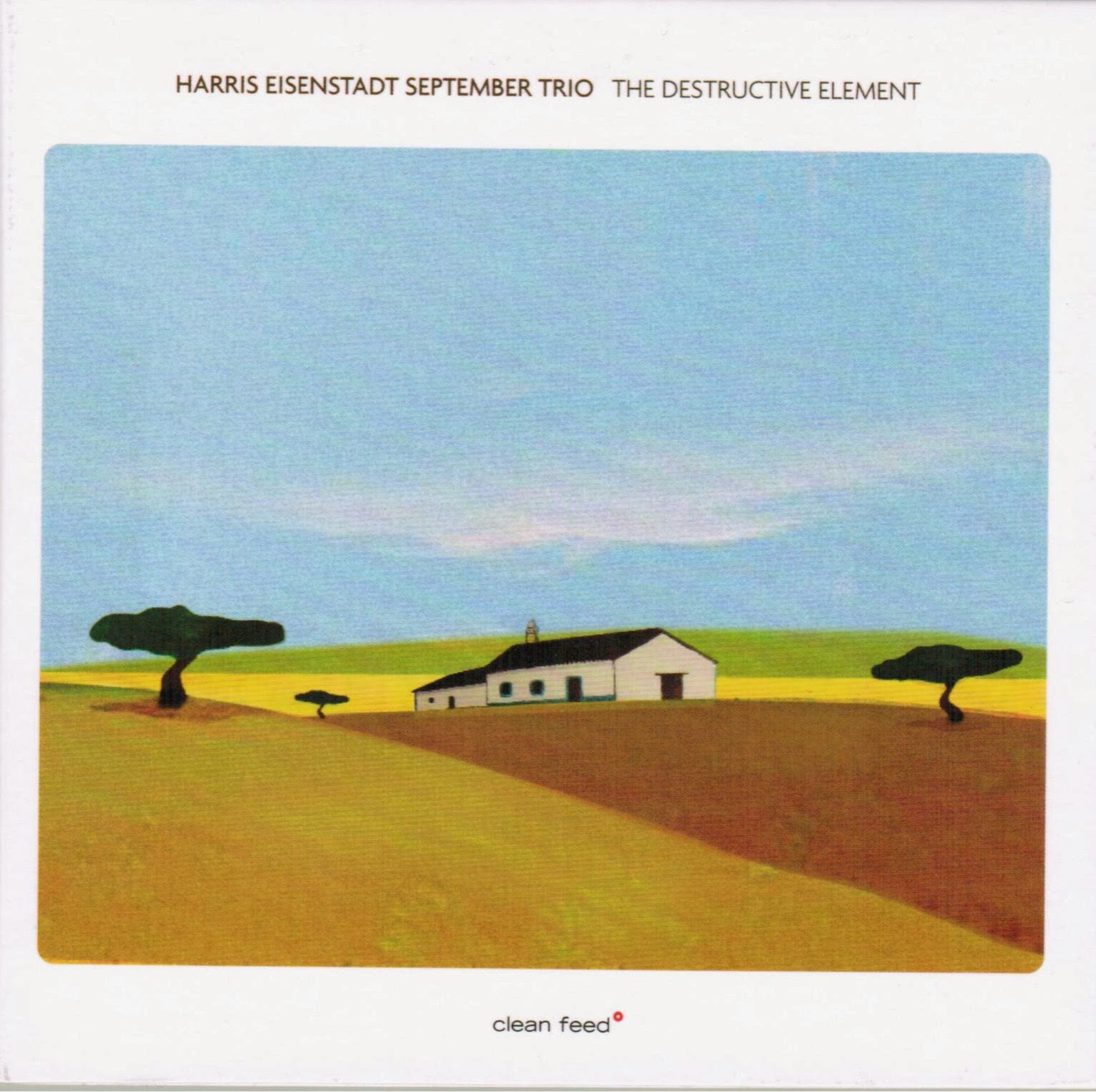


9. Harris Eisenstadt September Trio The Destructive Element [Clean Feed]

The Destructive Element is slightly heavier on the compositional emphasis than Chorale, i.e., the specific pieces here stand out as much as the overall feel, where on the Knuffke I tend to come away savoring the latter. As I indicated on last year's jazz recap, which featured a pair of new Harris Eisenstadt records (I think these were the third and fourth Eisenstadt albums that have turned up in my year-end coverage in recent years), I'm consistently impressed by this drummer-composer's ability to build bands that matter, that have something to say. A lot of jazz musicians are really fond of hatching projects, period. It's not always clear why a given composer/conceptualist feels the constant need to found their various ventures. But with Eisenstadt, I always feel like I understand why this group needs to be playing this music. That's really the case in the repertoire of the September Trio, which features two extraordinary players: pianist Angelica Sanchez and saxophonist Ellery Eskelin. I remember liking this band's self-titled 2011 debut, but I think this is better. The compositions on The Destructive Element seem to me to be Eisenstadt's love letters to his collaborators. He really seems to be working hard to give them what they need compositionally to be themselves as players. There are few things I've heard on record this year as beautiful as the ballad "Back and Forth"—Sanchez and Eisenstadt marching steadily forward as Eskelin emotes in that passion-packed yet anti-histrionic style of his. "Swimming, Then Rained Out"—an almost gospel-ish slow-burner—is another piece with the same kind of unassuming authority. All three of these players are known for venturing into various sorts of free-jazz territory, and there is a bit of hectic scramble on this record (e.g., the brief improv episodes that fall between the signpost theme statements in "Additives"). But gorgeousness is, I'd say, the chief imperative. There is so much pleasure and care and warmth and soul in these pieces—Eisenstadt working hard for Sanchez and Eskelin, and them working hard for him in turn. This isn't an all-ballads program, like they used to make back in the day, but it's definitely oriented that way, and it has the same spirit, i.e., "This is the vibe we're going to be working with, so get on board with it." I really admire that commitment, and I find myself wishing that this band would go even further in that direction on their next effort. Few working jazz groups I can think of have a more affecting, unpretentious way of singing a song together.


10. Kris Davis Massive Threads [Thirsty Ear]

This was a serious year for solo piano. In addition to Massive Threads, you've got the Parks and Shipp albums above, and a few other acclaimed discs—by Myra Melford, Bobby Avey, Geri Allen (hers was mostly solo, some duo)—that sounded intriguing to me on a first spin but that I didn't get a chance to put in good time with. This might be the most challenging of the whole crop. What I like about Massive Threads is that it sounds genuinely experimental, i.e., like a document of fresh ideas being road-tested, without coming off as ponderous. The first piece, "Ten Exorcists," is a study in what sounds like prepared-piano minimalism; I'm not sure if Davis is actually placing objects inside the piano, or simply muting the hammers with her fingers, but the net effect is something like a mini tuned-percussion orchestra. It's technically impressive, but why it works is that it sounds genuinely curious—like Davis is excited to share what she's found, rather than austerely demonstrating some rarefied technique. I feel the same of "Dancing Marlins," where she seems to really be getting down to basics with the piano, reveling in it as a sound generator, rather than an instrument with all this heavy tradition behind it. On a piece like this, she sounds almost playful, but there's clearly a heavy thought going into these exursions, as though she'd spent days and weeks homing in on a specific area of inquiry before tossing away the blueprints and hitting record. Like Craig Taborn—and I think of Massive Threads as a cousin to his Avenging Angel (discussed here), in a way—Davis is clearly a player of frighteningly advanced technique who often seems utterly ambivalent about showing it off. The idea is primary, the sense of chasing down some weird sound zone—cornering it, dissecting it, finally inhabiting it. These players are poker-faced; they can verge on Cecil Taylor's density and destabilization, but the torrential outbursts he's famous for aren't their style. With Taborn and Davis, there's more the sense that, yes, they could slay you at any moment, but they'd rather keep you, and themselves, in infinite suspense. You get on their wavelength or you turn the record off; it's that simple. As intimidating as that sounds, there's a deep, human pleasure in listening to Davis live with these ideas. "Desolation and Despair" (what a title!)—just crawling, limping along, but not maudlin or emotionally showy. She's seeking stillness on Massive Threads, just as much as she's seeking herky-jerky mobility on some of the other pieces. As with Taborn, whatever the area of inquiry, Davis is going to get to the very bottom of it, at her own pace. And that's a thrilling thing to witness.

/////

There are a bunch of other 2013 jazz records that I dug and hope to be able to spend more time with. These include the two Ethan Iverson–plus-contemporaries-and-veteran sessions (Tootie's Tempo, Costumes Are Mandatory), Tarbaby's Ballad of Sam Langford, Hush Point's self-titled debut, Dan Tepfer and Ben Wendel's Small Constructions and Dave Holland's Prism.


But the one formal honorable mention I feel like I need to make is of Ben Allison's The Stars Look Very Different Today, an album that came out recently and only made its greatest impact on me once I'd already filed my 2013 jazz ballot. I'm not sure that this one would've ended up displacing anything listed above, but I still probably would've given the matter serious thought if I'd had another couple weeks. Like Eisenstadt, Ben Allison has shown up on my end-of-year jazz list before; I loved Action-Refraction from 2011. I think Stars might be better. Allison is the kind of composer-bandleader that always seems to be heading further from jazz, per se, and nearer to his own personal soundworld. On The Stars, he's firmly in his own space. The instrumentation—Brandon Seabrook (it's great to compare his work here with that on the Black Host record, btw) and Steve Cardenas on wonderfully complementary guitars, and Allison Miller on drums—helps to give the record its individualized feel, but it's also the writing and the thrust of the performances. I've placed so much emphasis above on the idea of song. I have no problem repeating myself, because it so pleases me to hear a band zeroing in on that notion and getting it right. The songs here are magical—"Neutron Star," a sort of psychedelic roots-rock theme, is one of my favorite pieces of music of the year. There's great soloing on The Stars, but when I reflect on it, I think of a band laboring intensely in the pursuit of Allison's beautiful writing. Such that when they improvise, it's more like embellishment rather than departure. The thing is the singing of these wordless reveries, and the little mini idiom Allison has created here, this sort of folksy, funky, emotive, spacey-textured wordless pop that he's focusing on. He seems to want the instrumentation and the material to exist in perfect balance, so that you don't hear jazz, you hear these themes, and underlying them, the personal signatures of himself and his collaborators. I wish all "jazz" felt this personal, this generous, this simultaneously unfamiliar and inviting.

/////

My favorite historical releases (reissues/unearthings) of 2013 were:

Miles Davis The Bootleg Series, Volume 2: Live in Europe 1969 [Columbia/Legacy] 
Pitchfork review here.

New York Art Quartet call it art [Triple Point]
Thoughts here.


Woody Shaw The Complete Muse Sessions [Mosaic]
I'm slowly making my way through this set, and it's sounding excellent—an important document of a period (mostly ’74–’87) that's a blank spot on many jazz maps, and was on mine until not that long ago. One session that blows my mind is the December ’65 date Shaw originally recorded for Blue Note—Wikipedia says it was a demo tape; the Mosaic liners say that Alfred Lion intended to release it but backed out after he sold the company. Anyway, those five tracks are as good as you'd hope/expect given the vintage and the personnel: Joe Henderson and Joe Chambers, along with either Larry Young (on piano rather than organ, a month after the great Unity, which features Shaw and Henderson) and Ron Carter, or Herbie Hancock and Paul Chambers. I'm curious to know how Woody Shaw's general stature in jazz would look if this album had come out on Blue Note at the time it was made. Anyway, point is, it's great, and I can't wait to spend more time with this set as a whole. (Speaking of Mosaic, I really want to get my hands on that Clifford Jordan box, as well.)


/////

On the live front, my favorite jazz performances of the year were:

1.11.13
Eric Revis, Kris Davis and Andrew Cyrille at Winter Jazzfest
Thoughts here.

3.22.13
A Tribute to Paul Motian at Symphony Space
Thoughts here.

10.5.13
McCoy Tyner, Gary Bartz and Co. at the Blue Note
Thoughts here.

9.21.13
9.28.13
12.6.13
Milford Graves with, respectively, Evan Parker, John Zorn and Joe Lovano, at, respectively, the Stone, the Metropolitan Museum of Art and the Stone.
Thoughts here.

I also loved seeing Black Host at Seeds (May 29) and Roy Haynes at the Blue Note (June 27).

/////

P.S. Aside from Phil Freeman's excellent jazz round-up, linked above, I've really enjoyed perusing the latest installment of Francis Davis's annual Jazz Critics Poll (plus the always-fascinating data breakdown by Tom Hull), as well as Seth Colter Walls's Rhapsody list, and Ben Ratliff and Nate Chinen's jazz-heavy NYT top 10s.

Wednesday, November 07, 2012

The JCC at 20


I had a great time speaking with Ben Allison, Ted Nash and Frank Kimbrough for this TONY profile. The subject is the Jazz Composers Collective, which celebrates its 20th anniversary this year and is in residency at Jazz Standard this week. (The mini fest, which actually started last night, runs through Sunday.)

I loved the most recent Ben Allison record, Action-Refraction, but beyond that, I didn't know much about these musicians or their JCC cohorts when I signed on to write about them. I arrived in NYC in ’98, and during the next decade or so, I was largely focused elsewhere; for various reasons, this scene just wasn't really on my radar. Now, this body of work, much of which came out on the Palmetto label, is exactly the kind of thing I'm looking for in jazz: challenging, but listenable; eccentric, yet staunchly coherent. I'm talking about records like Allison's Riding the Nuclear Tiger and Buzz, Kimbrough's Lullabluebye, Nash's In the Loop and the Herbie Nichols Project's Strange City. (You can stream each of these LPs in full at its respective link.) Having an excuse to catch up on all this goodness in advance of the interview was a real privilege.

Tuesday, December 20, 2011

Best of 2011, part II: All genres, director's cut


Having annotated and expanded upon my year-end jazz list yesterday, I'd like to do the same for the all-genres-in-play top 10 I contributed to Time Out New York. The original list, with a brief blurb for each record I chose, is here. (I plan to discuss runners-up, singles, etc. in a separate post.)

A quick note re: streaming audio: I refuse to embed any player that's going to insert an ad before the track (or one that's going to provide substandard sound), so you're on your own for some of this stuff. I encourage you to search, sample and buy!

/////

1. Frank Ocean, Nostalgia, Ultra (self-released)

I might have slept on this record had it not been for my friend and former colleague Corban Goble, who spied it early on and made sure I gave it a fair shake. Like many, I was first seduced by "Novacane," a seductive jam if there ever was one; I loved its murk and throb, its combination of wit ("I took a seat on the ice-cold lawn / She handed me an ice-blue bong") and vulgarity ("stripper booty and a rack like, 'Wow'"), just the way it built and built and sucked you into its heavy-lidded vortex. (The entrance of that bloblike bass squelch at 1:12 still kills me.) At first, the rest of the record didn't click with me; as is often the case when I grow super-attached to a perfect single, I tend to hold the full album up to that standard, not just of quality, but of mood. I guess I was looking for 40 minutes of "Novacane."

I soon woke up, though, and realized that there was room for more than sordid, hazy, late-night/early-morning rumination in the Frank Ocean aesthetic. The whole album bloomed for me, and I know that this would be The One for This Year (there always is one, it seems). "Songs for Women," with its funky lope and aw-shucks appeal; "Swim Good," that steely, heartsick march to sea; "There Will Be Tears," a portrait of childhood grief intruding on young-adult consciousness; "American Wedding," an offhandedly brilliant riff on "Hotel California"; "Strawberry Swing," which, as solid as the Coldplay source material is, reaches a higher emotional pitch; the yearning neosoul slow jam "We All Try." I wouldn't hesitate to call this record a masterpiece. Listening back to it now, I know that it's etched itself on my heart. I believe this guy. He surprises and challenges me. Moreover, he's an extraordinary singer, reaching deep down for those wrenching peaks (the high note at 2:17 in "We All Try," the little flourish on the word "smile" at 2:08 in "Novacane").

I wasn't too big a fan of Watch the Throne, but Ocean's hook on "No Church in the Wild" slew me; this album is like that cameo writ large. So much feeling, atmosphere, poetry. I just couldn't bring myself to care much about the back story (Ocean's squabble with Def Jam), and truthfully, I didn't love Ocean's live show the way I would've liked (though damn, that new material sounds deep). In the end, the record stood alone: For me, Nostalgia, Ultra was without question the album of year.

2. Anthrax, Worship Music (Megaforce)

I had no particular expectations for this one, only mild curiosity. Anthrax was an MTV staple during my Headbanger's Ball–crazed youth, but I never cared much for them. "Got the Time," say, exuded a goofiness that turned me off; at the time, I wanted my metal stone-faced and scary. But what a joy to experience this band with fresh ears, and to hear them sounding so fired up on this comeback effort. I've since gone back and checked out their earlier material, and to me, Worship Music is stronger. What I love about it is the way the band transcends thrash; yes, that element is there, but the songs are guiding the way. When the band needs to dip into a power-metal bag, it does; same goes for grunge, or blast-beat-driven technicality. I'm just thrilled by how thoroughly this record rocks, how catchy the choruses are, how you can envision an entire arena pumping their fists in unison when you listen. (That didn't quite play out at September's Big 4 show, since the band went on at the ungodly hour of 4pm, but it was still pretty cool to see Anthrax at Yankee Stadium.)

For the most part, I'm on board with the recent art-school-ification of metal; plenty of good has come out of it. But Worship Music helps you remember that at heart, metal is a sweaty, for-the-people music—like turbocharged pop. Clarity and memorability and ROCKING-ness are not passé; those aspects of ’80s metal are still as powerful now as they were, when they're delivered with this much conviction and exuberance. There is so much youth in this record; it's exactly what a comeback album should be. And kudos to Joey Belladonna for an absolutely stellar vocal performance. He sells the hell out of this material. I think that in my youth, before I had caught the Dio bug, I wasn't prepared to appreciate his wailing, dramatic gifts. Now they make perfect sense. Can't wait for the next one from this rejuvenated powerhouse.


3. Branford Marsalis and Joey Calderazzo, Songs of Mirth and Melancholy (Marsalis Music)

See yesterday's jazz round-up.

4. Drake, Take Care (Cash Money/Universal)

I wasn't really ready for a new Drake album. I loved his last one, Thank Me Later, which placed at No. 2 on my 2010 best-of list. But after having been bombarded by his singles for so long, I was ready for a break; 2012 would've been okay with me. But then I heard that album 2 was coming right up, and I knew I'd have to give it a chance. The singles ("Headlines," "Marvin's Room") didn't move me when I heard them in isolation; it seemed to me like he was just going back to feed at the same trough, trying to duplicate the success of Thank Me Later. Then the record came out, and the early reactions were ecstatic. I didn't really get curious till I heard from Corban, who, awesomely, interviewed the man himself and reported that Take Care was his shoo-in album of the year. Time to listen.

All I can say is, "Whoa." It became clear after a first listen that whatever I didn't like about the album (a few corny lines here and there, an inflated sense of self-importance, that annoying faux–voice crack on the "…getting back to my ways" line on "Underground Kings," which I still can't stand), this thing was a real beast. Or, really, feast. So much to savor, so many shrewd guest appearances. Re: the latter, the Weeknd intro on "Crew Love" feels like a laser-beam of tortured (torturous?) emotion (and this from someone who isn't yet a Weekend true believer); and when I heard the Andre 3000 verse in "The Real Her" for the first time, I was straight-up shocked by its charm and effectiveness. A typically badass Rick Ross on "Lord Knows," whoever that is free-associating in a weird robot voice at the beginning of "Buried Alive Interlude" (I'm not sure it's Kendrick Lamar, who guest-raps on the track). And what to say about the fact that that's Stevie effing Wonder playing harmonica on "Doing It Wrong," elevating an already masterful song to an all-time-great level? Drake is helping me to understand something that I'm sure hip-hop devotees have known for years, even decades: that a great album in the genre is like an expertly curated revue, with multiple voices cycling in and out and everyone playing their own niche role.

As I listened repeatedly, the singles fell perfectly into place among the other tracks. Heard in context, "Headlines" and "Marvin's Room," even "Make Me Proud," which not only sounded unimpressive but downright bad to me when I heard it prior to the full record, all became new favorites. (Same goes for the Rihanna-abetted title track, wooden on a first listen but seductive and magical now.) The record is long, but only one song ("Cameras") really seems cuttable to me. I love that Drake is as committed as he is to the LP format, to making full-length sonic movies. The individual highlights of Thank Me Later might top those on Take Care, but in terms of an epic experience, there's no competition: Take Care is a world unto itself, a true journey, well worth taking in full—and repeatedly.

5. Deceased, Surreal Overdose (Patac)

Speaking of epic. Like Anthrax, another band I'd been dimly aware of since teenhood. I'd always taken Deceased for a stalwart but ultimately second-rate death-metal outfit. This album set me right in a major way. In its own way, it's as joyous and triumphant, as diverse and anthemic and rousing as Worship Music.

What drew me into Surreal Overdose is the man at the heart of Deceased: One King Fowley, who handles both drums and vocals in the studio (just vocals live). I strongly urge you to check out Fowley's first-person history of the band at the Deceased site. You'll get a sense there of the sheer delight this man takes in metal; as I discussed in a recent Time Out NY preview, he comes off as a truly kind, friendly guy (an impression I confirmed when I met him in person at the Brooklyn Deceased show back in October), and for all the darkness of the music, you can hear that good-natured-ness in Deceased.

Fowley treats his songs like mini pageants of horror. They're constructed around these gorgeous, theatrical riffs that make you feel like you're in the middle of some kind of thrilling gothic play. And Fowley plays the ghastly ringmaster so well, somehow conveying wonderful narrative flourishes even while growling vomitously. I know very little about the Grand Guignol, but the impression I have of it is similar to the feeling I get from Deceased: It's pure, gory, agonizing horror treated as stylized entertainment. You suspend your disbelief to get into songs like "Cloned (Day of the Robot)" and you actually feel moved by Fowley's borderline-cartoonish narratives.

There's something staunchly adolescent about his viewpoint (killer robot clones), but also something deadly serious: In "Kindred Assembly," "In the Laboratory of Joyous Gloom" and "Dying in Analog," Fowley is discussing topics like senility, depression and death in a very real and disturbing way. On Surreal Overdose, he's talking about emotional horror, not just the kind that involves scary monsters. The music perfectly mirrors these psychodramas; it has a real scope and sweep to it. Surreal Overdose isn't a death metal album at all; there's none of that stone-facedness to it. It's vivid, alive, varied, truly gripping. Even listening back to it now, I'm shocked by its conviction, its intensity and its sheer fun. Surreal Overdose is one of the most honest and ambitious (not to mention entertaining) works of art, musically or otherwise, that I encountered in 2011. Deceased sounds nothing like Anthrax but both take their jobs seriously: They're here to provide (and achieve) escape, pure and simple, not to wallow in inscrutable experimentalism. Long live crowd-pleasing, unabashedly theatrical metal, whatever the scale.


6. Gerald Cleaver’s Uncle June, Be It as I See It (Fresh Sound New Talent)

See yesterday's jazz round-up.

7. The Strokes, Angles (RCA)

Ripping on the Strokes has became a sport, and for those who feel like playing, the band makes it pretty easy. They're still given to whining and in-fighting in interviews, in that way that always invites those age-old "Oh, great, the famous rock & rollers are complaining again" sentiments. And there these finger-wagging notions floating around about how the Strokes should have been the ones playing a farewell show this year, not LCD Soundsystem (a band I simply cannot get into). To a degree, I can understand all this: There's something about the Strokes that can feel wimpy, spoiled, tedious.

But the thing is, they are still unbelievably good at what they do, which is creating these three-minute wonders—full of hidden surprises and endlessly scrutinizable, yet completely streamlined. It's like prog ambition mixed with garage-rock cool. In this vein, "Under Cover of Darkness" is one of the most emblematic, and best, songs the band has ever written. Yes, there are bad songs on Angles, a fact I perhaps glossed over in my Time Out review of the record. At this point, I find the languid "You're So Right" nearly unlistenable, and while I respect the curveball nature of it, the drum-less interlude track "Call Me Back" is a real buzzkill, given where it falls in the album.

Just about every other song on Angles, though, I either like very much ("Macchu Picchu," "Metabolism") or straight-up love ("Under Cover of Darkness," "Two Kinds of Happiness," the breakdown of which is like a fireball of rock, "Taken for a Fool," another song that belongs on the Strokes short list, the ridiculously fun and groovy "Gratisfaction" and "Life Is Simple in the Moonlight," one of the best chilled-out songs the band has ever issued, not to mention the source of my favorite guitar solo of 2011). In this material, the band isn't telling us much (anything?) we don't already know about them, but they are reaffirming that they're still around, and however much they claim to not enjoy being a band, their output is still the gold standard for stripped-down, attitude-heavy, pop-friendly NYC rock. I love these guys, and while Angles isn't their best, it's not even remotely a disappointment.

8. Disma, Towards the Megalith (Profound Lore)

Ah, Disma. This isn't the Anthrax/Deceased crowd-pleasing/entertaining sort of metal at all. Nor is it the introspective, inscrutable art-metal thing either. What this is, is the brutal thing, the kind of metal that satisfies your desire to be flattened by a cold, unfeeling sonic steamroller. Towards the Megalith is hands-down the heaviest album I heard all year, the sickest, the grossest. The whole thing just drips with slime and rotting vegetation. The music is pure attack, pure lumbering menace, even when the tempos are fast. And dear God, those vocals. Craig Pillard is perhaps the best low death-metal growler I've ever heard. He very literally sounds like a monster, and not a comical one. (A great side effect of Megalith has been that it's sent me back to Pillard's old band, Incantation, which has since become a serious obsession in its own right.) As conventional as it is, this music is actually scary.

The secret weapon here might actually be the production. Towards the Megalith sounds full and loud and clear. The drums actually sound real. For all the putrid-ness of the music, there's a big, round pleansantness to the way it's rendered on tape. You really sink into this album. There have been weeks this year where I've wanted to listen to nothing else. It invites you even as it repulses you, freaks you out. Re-spinning it now, I'm again totally sucked in by its unholy girth and crunch. You feel the weight of the ages in this; it's primordial and massive and it swings like a motherfucker. In terms of death metal at large, Megalith is not really anything new, but it does feel like something perfected, a revisitation of an old sound, with all fat stripped away and with all intensity heightened. It's like a new model of an old car: The basic design is the same, but all the little quibbles you might've had with the old model don't apply here. In terms of what it's trying to achieve—a sensation of suffocating heaviness and unrelenting brutality—Towards the Megalith is essentially a perfect album.

9. New Zion Trio, Fight Against Babylon (Veal)

See yesterday's jazz round-up.

10. Ben Allison, Action-Refraction (Palmetto)

And once again, see yesterday's jazz round-up.

Monday, December 19, 2011

Best of 2011, part I: Jazz


Since I didn't annotate the 2011 top 10 I submitted to the Jazz Journalists Association (and Francis Davis's annual Jazz Critics Poll), I thought I'd provide some commentary here. For each entry, I've either linked to a purchase page or embedded a streaming player that allows you to click through and buy MP3s. Thank you to the publicists and musicians who have submitted music to me this year; I've done my best to keep tabs on it all, and as usual, I've had a blast.

1.Branford Marsalis/Joey Calderazzo Songs of Mirth and Melancholy (Marsalis Music)

As you can see from my 2011 jazz halftime report, published back in June, this one grabbed me early on. Now that the year is winding down, I'm happy to report that it didn't let go. There's no embeddable stream of this record, but I implore you to sample it here, especially the tracks "Endymion," "Face on the Barroom Floor" and "La Valse Kendall." When mentioning my interest in this album to friends, I've received a few raised eyebrows, which pains me. As I discuss in a Time Out NY preview of Marsalis January 9, 2012 "A Duo of Duos" gig at Jazz at Lincoln Center (during which he'll perform with both Calderazzo and Harry Connick, Jr., the latter of whom won't be singing), Marsalis's celebrity still overshadows his art. It's a trite point at this stage, but the prejudices persist: He's the saxophone player your mom likes.

And I'm not trying to say that moms wouldn't love Songs of Mirth and Melancholy. But what I am trying to say is that this is an extremely deep record. There's so much grace and poetry to this session. I don't know enough about the connections between jazz and chamber music (or chamber music itself) to know how unprecedented Songs is, but I can't think of another jazz recording I've heard that mixes raw beauty and virtuosic refinement the way this album does. I like Marsalis's quartet with Calderazzo just fine, but in the end, it is an updating of a known quantity (post-Coltrane small-group jazz); this, on the other hand, feels like new terrain to me, or at least extremely underexplored terrain. Again, if you're a Branford skeptic, please spend some time with this album and let me know what you think. I can't imagine you won't be at least a little surprised and impressed with what you hear.

Three quick notes:

A) Strangely, the opening track on here, "One Way," a whimsical, rompy, bluesy type piece, does very little for me; if it weren't for this quibble, Songs might have beat out Anthrax for the No. 2 spot on my TONY all-genres-in-play top 10 list.

B) Purchasing this record digitally from Amazon is a good idea, because you get a meaty 16-plus-minute bonus track, "Eternal."

C) The Marsalis Music YouTube channel is streaming a series of making-of vids.

2. Gerald Cleaver's Uncle June Be It as I See It (Fresh Sound New Talent)

Again, I kept coming back to this record. There's a tenderness and a lushness to Clever's writing that I just adore.—at times, the colors and emotions remind me of Andrew Hill's big-band classic, A Beautiful Day. I've always enjoyed Cleaver's drumming, but after spending time with this record, I'm most excited by him as a bandleader. (As I witnessed a little over a week ago, there's more where this came from!) He's writing rich, painterly music and putting it before improvisational geniuses like Craig Taborn. Don't miss this one. Here's one of my favorite tracks:


I should note here that as with the Marsalis disc, the opening track of Be It as I See It, the noisy, backbeat-driven stomp "To Love," doesn't grab me. I like the contrast between this and the more delicate material that makes up the bulk of the session, but I found myself wanting to skip it on repeated listens (and believe me, there were many).

3. New Zion Trio Fight Against Babylon (Veal)

This one came out of nowhere and knocked me on my ass. The idea—a jazz/reggae hybrid—did not entice, and I'd never quite clicked with the work of bandleader Jamie Saft before. I never imagined that this record could be so patient or mysterious. As I indicated in my TONY top 10, there's a methodical languidness here that could slow your metabolism. Listening to this album, and I recommend playing it in its entirety while driving or cooking or engaging in some other focused activity, is like going swimming in a murky ocean filled with jellyfish, both gorgeously iridescent and subtly menacing. It's such a trip to hear jazz bass pro Larry Grenadier get all trancey on the riffs, and drummer Craig Santiago blows me away with his taste and precision. As for Saft, all I can say is that this record is an absolute piano feast. He isn't playing jazz and he isn't playing reggae; this one is closer to classical music, but really he's just playing wide-open music, flowing in the moment. The track below isn't my favorite from the record, but it's the only one streaming on Bandcamp. Go to the Veal site to order MP3s or a CD.


4. Ben Allison Action-Refraction (Palmetto)

I've largely slept on Ben Allison's work in the past; even though this one is a covers record, I can still say that it's converted me into a bona fide fan. Before hearing this, I wasn't familiar with any of the songs (aside from a Monk piece) that Allison and his band interpret here (including works by Donny Hathaway, Samuel Barber and PJ Harvey), but that turned out to matter very little. The band really savors these melodies, delivers them on silver platters, tweaking them a bit but never engaging in any sort of pat "deconstruction" or irreverence.

If there's a twist here, it's in the fascinating make-up of the band, which includes Jason Lindner on both piano and sci-fi synths, the wonderfully fluid guitarist Steve Cardenas (and on two tracks the noise-courting daredevil Brandon Seabrook), the grittily passionate reedist Michael Blake (a player I'd heard of for years without really checking out) and the alternately sensitive and pummeling drummer Rudy Royston (whom I knew from JD Allen's fine trio). The players really draw you into these songs, especially the Hathaway ("Someday We'll All Be Free"), which is like this swelling vortex of melody. Covers records are always in danger of feeling gimmicky, superfluous or just plain boring. This one holds my attention straight through, though, and keeps me coming back. It's a motley assemblage of pieces turned into something cohesive by the magic of meticulous arrangement and smart curation. Plus, the textures (keyboards, guitars, etc.) feel contemporary without giving you that pesky sense of jazz musicians trying too hard to convey that they're down with rock. You can stream (and buy!) the record via this handy embed:


5. Honey Ear Trio Steampunk Serenade (Foxhaven)

Like the New Zion disc, this one hit me pretty much out of nowhere. I'd heard a bit of drummer Allison Miller's work, but saxist Erik Lawrence and bassist Rene Hart were new names to me. This is a really special saxophone trio, brimming with guts and tension, but also with a love for the songfulness of jazz. The level of ambition isn't the same, but part of me wants to compare this to something like Henry Threadgill's Air—a more accessible version, let's say. But there's a similar drive to create a true group sound, to make variety a priority, to mingle the harsh with the pretty. As with the Allison, there's a contemporary sheen to this one, expressed via Hart's electronic effects and Miller's scrap-metal-style percussion, but again, it feels honest and ungimmicky. Overall, this album is just a very strong statement of purpose; Honey Ear Trio clearly wants to be a proper band, not just a steadily gigging saxophone trio. They're taking in rock, reggae, maybe a little electronica, freebop, Aylerish catharsis, Paul Motian Trio openness and producing something diverse but not scattershot. As with the aforementioned JD Allen Trio, there's also a welcome drive to make this music work on record—not just to play, but to edit, to make each track feel like a concise song rather than a meandering jam. I'm excited to hear more from this band. Here's a track:


6. Jeremy Udden's Plainville If the Past Seems So Bright (Sunnyside)

There seems to be a movement brewing of pastoral, song- and melody-driven jazz. Some of the tracks on the Allison get at that vibe, and in a TONY preview on saxist Jeremy Udden's Americana-infused Plainville band, I also cited projects by bassists Eivind Opsvik and Chris Lightcap. (Another group in this vein that intrigues me is Bryan and the Aardvarks.) For me, If the Past Seems So Bright crystallized this whole trend; in its own unassuming way, it seemed like a definitive statement. Some of the rockier, brasher material on here (the very Neil Young–ish "Leland") didn't gel for me, but when this band is speaking in its own voice, such as on the stunning opening track "Sad Eyes," I find it absolutely mesmerizing. As on the Allison record, Plainville is singing songs without words, in which the improvisational accents humbly serve the melody. The dreamy, rootsy prayers on here can really cut into you; again, we're talking about ungimmicky fusion, where the material and not the stylistic conventions are calling the shots. Here's "Sad Eyes" (though I'm having a hard time not embedding "Thomas," which gets me every time):


7. Bill McHenry Ghosts of the Sun (Sunnyside)

I'd be lying if I said I wasn't a tad disappointed by the fact that the first new Bill McHenry–led small-group album in four years (he has put out other records in the interim, including joint ventures with Ben Monder and John McNeil) was a collection of outtakes, pieces recorded during the same sessions that produced 2007's Roses. But after spending good time with this one, I realized that it would be pointless to resist its charms; Roses was such an enchanting record, and this is more of the same. The band is a dream: Monder, bassist Reid Anderson, and yes, the dearly departed Paul Motian. Crazily, the album came out one day before Motian's death. No one record could serve as a Motian epitaph, but there was a mystery and wonder about Ghosts that made it feel like a worthy final statement, a perfect summation of how he'd passed his strange, flickering, mirage-like torch to a younger generation. McHenry clearly got what Motian was about (and vice versa) just about as well as anybody, and this record's curious mixture of haunting beauty ("Ms. Polley") and insidious chaos ("William III") seemed as indicative of the drummer's aesthetic values as of the leader's. The track I haven't been able to get out of my head is "La Fuerza" (since I myself had to look this up, I might as well share that it means "power" or "might"):


8. Craig Taborn Avenging Angel (ECM)

Speaking of mystery… This is most definitely a major statement from a complicated, hard-to-pin-down artist, and that's likely what you're seeing it pop up on so many top 10 lists. (Steve Smith, Nate Chinen, Ben Ratliff and Seth Colter Walls all included it in their all-genres-in-play round-ups, and it topped David Adler's jazz list) I spent a ton of time with this album, both in the immediate wake of my Heavy Metal Bebop interview with Taborn, and beyond. At times, Avenging Angel seemed so daunting—like you would've have to intimately know every significant piano statement of the last several hundred years, and a lot more than that, to truly grasp it—that it exhausted me. And admittedly, there is a ton here to digest, but there's also an almost sacred kind of beauty here—lonely and remote. I'll defer to my TONY preview from June, in which I likened one track ("This Voice Says So") to "stepping out of a spaceship onto an ice planet." You always feel like you're grasping for another metaphor here, because the music is so vast-seeming, almost inhumanly patient and genre-impervious. Virtuosic, sure, but that's almost beside the point; Avenging Angel seems to go beyond mere virtuosity into some kind of alien realm of higher intelligence. It's not a record you'll pull out every day, or even every year, but you can't deny that it's some kind of awesome benchmark. No stream for this one, but you can hear some tracks at the ECM site.

9. Wadada Leo Smith's Organic Heart's Reflections (Cuneiform)

Another mammoth statement, though more in sheer length than in daunting-ness. As I've learned over the past few years, Leo Smith is by far the most accessible of the AACM giants, and maybe the most sheerly pleasurable. I loved the 2008 Golden Quartet disc, Tabligh, but this might be my favorite Wadada album yet, a sprawling set of avant-leaning funk, with an emphasis on the funk. I have never heard drummer Pheeroan akLaff drop such fat, greasy beats as he does here; right from the start of this two-disc behemoth, he's sliding and swaggering. Smith's electric work in this vein will always be indebted to Miles, but the vibrancy and clarity of the textures he conjures in his large-ensemble work are absolutely his own. This record is just swimming in swirls of guitar, keyboard, brass; it's a blissed-out soup of color. And it's got a real flow to it; balancing the backbeat passages are these rubato ruminations, free-floating texture pieces that show off the chamber-style improv know-how of players like keyboardist Angelica Sanchez and bassist John Lindberg. This is definitely one of those "Play it for a friend who's wary of avant-garde jazz" records. There's a lot of adventure here, but little abrasiveness; Wadada has been on a real roll lately (abetted by the stalwart Cuneiform label), and what he seems to be aiming for is the kind of experimentalism where you can shed the facade of stone-faced imposing-ness and just get down to feeling, moving, emoting. Your samples are at Amazon.

10. TIN/BAG Bridges (MabnotesMusic)

Like New Zion and Honey Ear, another very pleasant 2011 jazz surprise. I had heard the two members of TIN/BAG before (trumpeter Kris Tiner in Empty Cage Quartet, and guitarist Mike Baggetta at the head of his own bands), and I may have even sampled a bit of this duo in the past. But it was instantly clear to me that this one was going to make a stronger impression than anything I'd heard previously. As with Honey Ear Trio, TIN/BAG is taking pains to speak in its own language, and the tongue they've honed is a very subtle and distinctive one. You've only got trumpet and guitar here, and there's very little effort made to fill up the empty spaces. This is intimate music, more cozy than lonely—much more modest in scope than, say, the Marsalis/Calderazzo. The two play together beautiful, with Tiner's pillowy lines dancing over Baggetta's plush, chiming notes. Their work is almost unfailingly beautiful, but it's not merely polite; there's a sense of real daring to the project—stripping all distractions away and making the most of what's left. (There are references to yoga in the liner notes, which makes perfect sense when you hear the record.) There are no drums here, of course, but in a way, you could view this band as a descendant of the Frisell/Motian/Lovano trio. There's a similar willingness to step out into the abyss, with only the warm, beating heart of song to guide you. The quietude of Bridges can really pull you in if you let it. Hear for yourself:


/////

In the interest of concision, and so as not to dilute the list of truly standout releases above, I'll name just four honorable mentions:

Jerome Sabbagh with Ben Monder and Daniel Humair I Will Follow You (Bee Jazz)

Some very focused and engaging freeform trioism. Some prior thoughts in the 2011 halftime report. (Interestingly, Paul Motian subbed for Humair at the NYC release party for this album in April, and subsequently hired Sabbagh and Monder for a week at the Vanguard in September; I'm kicking myself that I didn't make it out to hear them.) Stream it here.

Matana Roberts Coin Coin Chapter One: Gens de Couleur Libres (Constellation)

A deeply ambitious and at times straight-up harrowing statement. I've been following the Coin Coin project since around 2006, when I profiled Roberts for TONY (sadly, I can't locate the piece in the online archives at the moment), and I'm glad to see it finally starting to get a proper documentation. From Ellington to Roach to Mingus to the Sharrocks—Roberts is taking it all in. Stream it here.

Ellery Eskelin Trio New York (Prime Source)

Harris Eisenstadt September Trio (Clean Feed)

Two featuring the saxist Ellery Eskelin, a perpetual sleeper fave of mine, whom I never feel like I've investigated fully enough. I'm happy with my TONY preview of Trio New York, in which I contrasted this new group—featuring organist Gary Versace and none other than Gerald Cleaver on drums—with Eskelin's previous signature trio, the Andrea Parkins/Jim Black band. Hear some samples here.

Eisenstadt, who topped my 2008 jazz top 10 with Guewel and ranked again in 2010 with Woodblock Prints, made another strong showing with a disc featuring Eskelin and Angelica Sanchez (who might be the MVP of Wadada's aforementioned Heart's Reflections). As usual with Eisenstadt, you're getting something abstracted yet focused, something beauty-forward, settings that confer deep respect for his bandmates. I'm looking forward to spending more time with this one, and I hope the project continues. Hear samples at Amazon.

/////

I listed just two reissues: the landmark Miles Bootleg Series set, which I reviewed for Pitchfork, and the exemplary International Phonograph, Inc., edition of Julius Hemphill's fun, raw, expansive, eclectic opus Dogon A.D.

/////

And finally, here's my chronological list of best 2011 live shows (as with the list of recordings above, only jazz was in play), outfitted with links to coverage.

J.D. Allen's VisionFugitive, conducted by Butch Morris at Le Poisson Rouge
(Winter Jazzfest) - January 7
(feat. Gregg August, Rudy Royston)

Dan Weiss Trio at Cornelia Street Café - January 10
(Thomas Morgan, Jacob Sacks)

Wayne Shorter Quartet at the Town Hall - February 9
(Danilo Pérez, John Patitucci, Brian Blade)

Wynton Marsalis Quintet/Septet at Frederick P. Rose Hall - March 31
(Quintet: Walter Blanding Jr., Dan Nimmer, Carlos Henriquez, Ali Jackson; Septet: Victor Goines, Wessell Anderson, Vincent Gardner, Marcus Roberts, Reginald Veal, Herlin Riley)

The Bad Plus with Joshua Redman at the Blue Note - April 21

Matthew Shipp/Darius Jones at Jazz Standard - April 27

Ari Hoenig Group at Smalls - June 20
(Gilad Hekselman, Shai Maestro, Orlando Le Fleming)

Tarbaby with Oliver Lake at Le Poisson Rouge (Undead Jazzfest) - June 23

Bill McHenry Quartet at Village Vanguard - November 11
(Orrin Evans, Eric Revis, Andrew Cyrille)

Gerald Cleaver's Black Host at Cornelia Street Café - December 10
(Darius Jones, Cooper-Moore, Brandon Seabrook, Pascal Niggenkemper)

Wednesday, June 22, 2011

Halftime report: 10 strong 2011 jazz releases


Last week, several top jazz writers took a minute to survey the year in recorded jazz thus far. (The Undead Jazzfest, which starts tonight—TONY preview here, full schedule here—serves as a handy peg, dividing the calendar more or less in half.) Here's a 25-strong list from Jim Macnie, and 25 plus change from Patrick Jarenwattananon.

To some, these midyear round-ups might seem like overkill; you may even question the value of the ubiquitous year-end polls. But I'm with Jim, who defended the practice in his own wry way ("We all love our horse races and we all love our listicles."). As for me, I'm just really happy that so much jazz is still being recorded and released on albums, and I'm doubly happy that so much of it is being sent to me. As a fan, it's only natural to want to celebrate the bounty and take stock, whether that's yearly, biyearly or daily.

In that spirit, here's an alphabetical list of 10 2011 jazz releases I'm digging. (For reference, here's my 2010 midyear list.) I try to get into a zen frame of mind re: such lists, i.e., not to choose but to be chosen. Great records exude a subtle magnetism and they keep pulling you back. You can't always identify them on the first spin, but they call to you. Playing them, there's a perpetual sense of unfinished business. They are unknowable or at least elusive. That doesn't rule out straightforward appeal, but there has to be something drawing you back. These have all had that effect on me.

Ben Allison Action-Refraction
(Palmetto)
This is a record of covers (plus one original). Most of the pieces are new to me (or, like Monk's "Jackie-ing," only vaguely familiar), so I came to them fresh. I just love the sound of the band: funky and sassy and full, and with a rock edge (e.g., on P.J. Harvey's "Missed"), though not trying too hard to mimic rock, which can be a major red flag. My favorite tune is a reading of Samuel Barber's "St. Ita's Vision," which has a psych-happy, retro-synth sheen that—as I suggested in a Time Out NY preview—puts me in a Clockwork Orange frame of mind. You can stream the whole album on Allison's site.

Gerald Cleaver's Uncle June Be It As I See It (Fresh Sound)
If I remember correctly, I received this album right after I finished compiling my best-of-2010 lists. I recall liking it then, but I was worried it would get lost in the shuffle as the year wore on. Fortunately, that hasn't come to pass; this one is a keeper. Don't let the noisy opener, "To Love," throw you: This a sensitive, gently colorful record. The second piece, "Charles Street Sunrise," absolutely knocks me down with its chamberish beauty—like something off Andrew Hill's A Beautiful Day. Some tracks thrive on chaotic vocal overdubs and other programmatic content (alluding to Cleaver's family history), but the sweet ones are the ones that grab me. Like the Allison, the whole disc is streaming online via Cleaver's Bandcamp page. Check out "Fence & Post: Statues/UmbRa," which features a breathtaking Craig Taborn piano solo. (I should also nod respectfully to Out of This World's Distortions, a deep new Aum Fidelity effort from Farmers by Nature, Cleaver and Taborn's trio with William Parker.) I caught a nice live set by this band at Cornelia Street Café a few months back; hope Cleaver takes Uncle June to the stage again soon.

Eric Harland Voyager, Live by Night
(Sunnyside)
This one originally came out last year, but apparently Sunnyside is reissuing it in July. The disc showed up in the mail a few days ago and it instantly caught my ear: fiery, chops-forward postbop (in the second-great-Miles-quintet vein) with a great sense of pacing (check out the solo "intermezzos" from pianist Taylor Eigsti). Lots of swagger here and a whiff of hotshot fusion, via Julian Lage's guitarwork. Hadn't heard too much of Harland before (I remember seeing him with Don Byron's Ivey-Divey trio a few years back, subbing for Billy Hart, who in turn subbed for him during the second half of the set), but he's been front and center this year, via this record and the cool James Farm collective. Wish I could've caught that latter group live this past weekend.

Ari Hoenig Lines of Oppression (Naive)
Speaking of hotshot fusion… I saw this band live at Smalls this past Monday and was floored, as I have been by Hoenig & Co. in the past. You should go hear them (Hoenig, bassist Orlando Le Flemming and guitarist Gilad Hekselman, with one of several pianists—the other night it was the marvelous Shai Maestro) in the flesh, but this record gives you a good taste. This band plays tricky, unapologetically flashy daredevil jazz that brims over with the joy of challenge. (I think of my math-rock survey, and the idea of the obstacle course.) Each player always goosing the other. This isn't really about subtlety as much as high-wire interactivity, and I can see it turning some people off, but for me it feels like watching great college basketball or something—a constant rush. Very catchy tunes too, most of them Hoenig originals. Check out some samples at Amazon ("Arrows and Loops" will not leave my brain) and a recent live set via Soundcheck.

Honey Ear Trio Steampunk Serenade
(Foxhaven)
Another one that blindsided me. Had heard of drummer Allison Miller before, but had not checked out much of her work. Saxist Erik Lawrence and bassist Rene Hart were totally new to me, though. This cooperative trio plays like a dream, subcategories be damned. Something about the way they operate reminds me of Old and New Dreams, not that there's anything Ornette-ish about the music, but I get a sense of free-jazz-informed players working in a kind of autumnal mode, embracing that tradition as well as meat-and-potatoes swing and soul, all at once. They groove when they want (hinting at reggae, electronica, rock), fray at the seams when they want, always exuding a loose, gracious vibe. I get a strong Dewey Redman sensation from Lawrence (apparently a longtime sideman type dude who works with Levon Helm, among others)—tender yet never too far from a grizzly-bear outburst. I can't imagine a debut record sounding more assured than this. Stream here. (Let me say that it's great to see jazz artists embracing the excellent Bandcamp platform—it's the best way to go.)

Branford Marsalis and Joey Calderazzo Songs of Mirth and Melancholy (Marsalis Music)
Darius Jones and Matthew Shipp released a killer classical-inflected duo disc, Cosmic Lieder, earlier this year, and they sounded even better live. But this sax/piano session, on which the classical element is an even bigger factor, is the one I can't stop playing. I'm not an expert on Branford's music (I will say that I've been digging Crazy People Music majorly of late), but I have some sense that it's the norm for him to be preoccupied with classical repertoire/vibe (see the Branford piece in Ben Ratliff's The Jazz Ear). This CD takes that and runs with it: There is a Brahms piece here, but moreover, the whole thing is dripping with stately elegance, way more reminiscent of chamber music than jazz. The poise and lyricism heard on pieces like "The Bard Lachrymose" and "Endymion" really gets me—it's pretty, yes, but it's something way more than that: almost prayerful. Simply put, I know of no other record that sounds like this. For me, it's one of the biggest surprises of 2011. Some samples here.

Jerome Sabbagh/Ben Monder/Daniel Humair I Will Follow You (Bee Jazz)
As with the Harland, this is another one whose release date is a bit vague. Apparently, it originally came out in 2010, but I definitely didn't receive it last year, and moreover, I remember a CD-release party (with Paul Motian in for Humair) going down only a month or so ago. (Speaking of, did anyone catch that show? I was dying to see it, but couldn't get there.) Anyway, a lot of what's here is free jazz. It isn't Free Jazz, however; it's lunar-landscape free jazz, WTF free jazz, free jazz that isn't afraid to get weird, without getting dense or loud or heated, or signifying "freedom" in any of the obvious ways. Ben Monder is a good person to have in your band if you want to go down this road (see Bloom, with Bill McHenry). So is Humair, a veteran French drummer who I only remember hearing alongside Steve Lacy, not to mention Sabbagh, a beautifully supple tenor player who often works in a boppier mode. If you like your improvisation textural and hear-a-pin-drop sensitive, with no conventions taken for granted—along those lines, the Frisell/Motian/Lovano trio isn't a bad reference point, though this might even venture deeper into innerspace—you will love this CD. Check out samples here.

Wadada Leo Smith's Organic Heart's Reflections
(Cuneiform)
Speaking of the unfinished business mentioned above, I can't wait to get back to this one. This release is a monster: two robust CDs' worth of new music for a 14-piece band. Wadada has been on a serious roll in recent years; Tabligh from 2008 was a particular favorite. Heart's Reflections really ups the ante, though, re: its treatment of Wadada's patented current mode of marrying the funky and the meditative. In terms of those respective poles, two supporting players nearly steal the show: Drummer Pheeroan akLaff (sounding downright nasty) and keyboardist Angelica Sanchez (grabbing me even more here than she did on her recent solo album, A Little House). There's definitely some electric Miles here, as is often the case with Wadada, but he's busted into a whole new realm with this wide-spectrum project. Gorgeously recorded and every bit as essential as Tabligh or other great later-period Wadada efforts such as the self-titled Golden Quartet debut and the Jack DeJohnette duo America (both on Tzadik). Destination: Out has a preview; Amazon has samples of each track.

Craig Taborn Avenging Angel
(ECM)
It's probably best that I saved this for last, and maybe even that I didn't have access to it before I interviewed Mr. Taborn on the topic of metal a few months back. Simply put, this album is spellbinding and mystifying. Maybe it's that I just don't know the reference points that would unlock it, but I've noticed other reviewers regarding it with a kind of perplexed awe (check out Ratliff's take). By way of an illustration, here's a bit of my TONY preview: "At their best, these performances function like environments: Listening to 'This Voice Says So,' which builds gradually from an ethereal three-note theme, feels like stepping out of a spaceship onto an ice planet—vast and iridescent, but with a lurking malevolence. 'Glossolalia' takes elegant ascending lines and scrambles them into the sonic equivalent of Web-browser error code." What I'm trying to express is that you can't access this record via genre (jazz, classical, whatever); for me, it only made sense when I dropped the frameworks and just listened, when I let the sound pictures happen. I've spun it countless times, and it has retained an unknowable quality, as well as a powerful intrigue—the most I could really ask of a record. You really should hear it. Add Taborn's solo show at the Rubin last week to the list of gigs I was very bummed not to be able to attend. I read a few dropped-jaw accolades (Macnie, Panken), but I'm yearning for a fuller description. Anyone?

/////

Five honorable mentions: Sir Roland Hanna Colors from a Giant's Kit (was planning on including this in the above, but it slipped my mind—you need this record; beyond masterful/gorgeous solo piano, again with a strong classical flavor); Matana Roberts Coin Coin Chapter One: Gens De Couleur Libres (some thoughts via TONY); Shane Endsley and the Music Band Then the Other (playful yet state-of-the-art 21st-century quartet jazz; Taborn also in great form here); Matthew Shipp Art of the Improviser (heavy-duty two-disc set, one trio and one solo); Tin/Bag Bridges (haven't spent good time with this trumpet/guitar duo set, but I love what I've heard; check it out on Bandcamp).