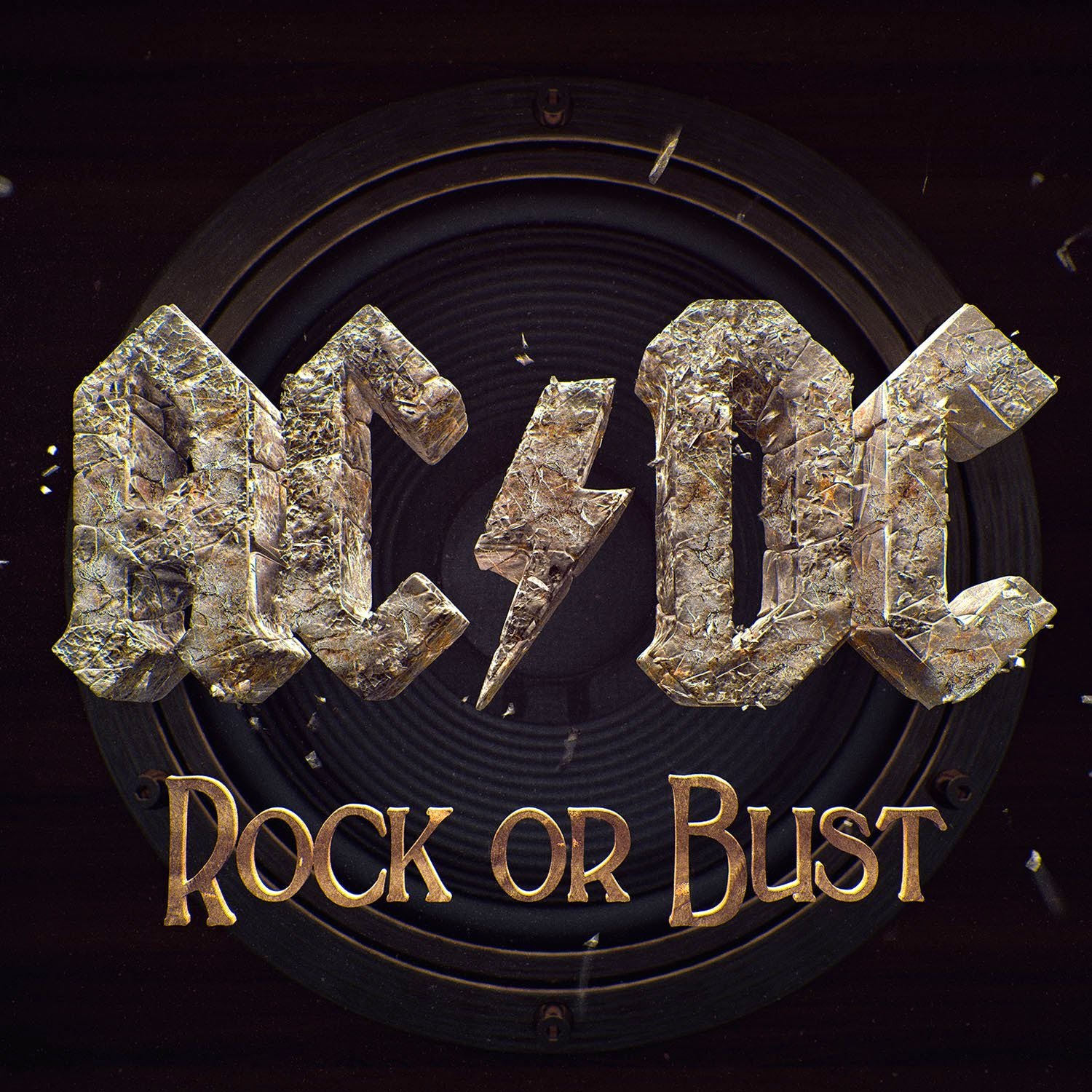
Yesterday, I headed into work with the notion that I'd set aside some time for D'Angelo's Black Messiah, the inescapable Event Album of the moment. I did end up playing that record through—and digging it quite a bit; I'm looking forward to further spins soon—but I didn't get around to it until the evening. That's because another recent release monopolized my attention: AC/DC's Rock or Bust.
It sounds sort of ridiculous, but yesterday was the day I realized AC/DC was awesome. I know; I know. The rest of the world has known this for, what, something like 40 years. But my response to Rock says something about the way I tend to approach rock, specifically canonical rock. For a long time, I've made a distinction—really relevant to no one other than me—between Classic Rock and rock I consider classic. It's not that I don't trust the canon; it's just that I feel an obligation to see/hear for myself why something is great. In recent years, I've come to look at the canon as a sort of I'll-get-around-to-it checklist. Some event—ranging from a splashy reissue campaign all the way down to me happening to catch a song on the radio—causes me to pay close attention to an artist or band I've known in a superficial, for lack of a better term "ambient" way (i.e., their music is simply a part of the air I breathe, as a music fan of my general age and demographic), to take a deep, personal dive into their sound, and all of a sudden I realize why that legendary-by-consensus artist or band commands the attention and acclaim that they do.
This has happened countless times during the past 20 years or so of my listening life. Bands/artists I knew only as a radio staples (Zeppelin, Sabbath, Floyd) or generally agreed upon poet-geniuses (Young, Cohen, Dylan, Morrison, Mitchell, Springsteen, Marley, Costello) or pop-cultural touchstones (Steely Dan) or my parents' faves (The Beatles, CSNY, Creedence) or even simply vaguely familiar names (The Band, Thin Lizzy, America, The Stooges, The Buzzcocks, Captain Beefheart, The Minutemen) suddenly become three-dimensional to me. Their greatness shifts, in my mind, from something that I've heard others proclaim, to something that I believe and understand. I grew up mainly as a fan of the underground—metal, punk, post-hardcore, indie rock, etc.—walling myself off, as I suspect many teenagers do, to what they see as Everyone Else's Music. I still love a majority of what I loved then, some of it as fiercely as I did, but thankfully, I've chucked—as any sensible listener eventually does—the idea that obscurity has anything to do with quality. Underground music can be great or it can be terrible, and the same goes for the canonical stuff.
Frequently, I find that the canon is absolutely on the money. Darkness on the Edge of Town? Yeah, it's fucking great. Again, something everyone else either already knew for themselves, or took on good faith from a trusted source. I guess for me, it's the "trusted source" part I dispense with. I can't stand at the back of the queue and take the word of someone further up the line; I have to wait till I get there myself and hear it with my own ears. This methodical, or maybe more accurately, stubborn approach to the classics is probably why I still have so many gaps in my knowledge of Classic Rock. Every year, I move a couple names from that mental file cabinet to the one labeled "rock that's classic," i.e., rock that I truly believe, based on firsthand experience and attention, to be great. Everyone has their own theory of listening, and this is mine: I don't think the canon is wrong; I just don't mistake its value judgments for my own. (Nor do I, for that matter, buy its narrow-minded binaries concerning the supposed mutual exclusivity of certain styles.) And thus: huge, gaping blind spots. I've never heard Exile on Main Street or Who's Next or Purple Rain all the way through, to name three examples off the top of my head. Do I doubt their greatness in the slightest? Of course not. I just haven't gotten there yet.
So in the past, AC/DC has fallen into that ambient category I described above. As with my exposure to Zeppelin prior to the point when I took a deep, full-catalog Zep-dive a few years back, I've known AC/DC's output only in a greatest-hits sort of way, which, I've found, is essentially meaningless. Knowing a band via the tyranny of Classic Rock Radio is to almost un-know them, i.e., the listener is actually at a disadvantage when it comes to true appreciation. You grow so numb to the charms of those 5 or 10 songs (in AC/DC's case, "TNT," Dirty Deeds," "You Shook Me…," "Back in Black," etc.) that you develop a kneejerk reaction to the band in question, a reaction that's easy to mistake for an informed opinion. "AC/DC, sure, yeah—I know them. Stop right there; no need to say anything more."
So maybe, as in the case of Van Halen two years back, what I needed in order to begin the process of true AC/DC familiarization, to start myself on the path of loving this band rather than simply being aware of them, was a new album to consider. I often find that new music by an old band can help in this regard. This is probably because I feel like I can come to the latest record fresh. I don't have to listen through all the noise of the canon, the hyperbolic praise that calcifies around a consensus-classic album over the years and tends to obscure the music itself; you start to think of what the critics have said rather than what the artist(s) said, and that is no good at all.
My interest in AC/DC in general and Rock or Bust particular has been slowly building. I heard Eddie Trunk spin some righteous AC/DC deep cuts a few months back; I followed the respectively insane and sad personal sagas of drummer Phil Rudd and guitarist Malcolm Young; I enjoyed typically perceptive and informed Rock reviews by Adrien Begrand and Ben Ratliff; and I gave lead single "Play Ball" an idle spin. I sought out the record itself on Spotify after its release, but when I didn't find it there, I set the matter aside and then promptly got swept away in year-end-list madness.
So, circling back, yesterday I walked into work with every intention of queuing up Black Messiah, both out of a sense of duty and out of a sense of genuine interest. And just as I was sitting down, my friend/colleague Josh Rothkopf, an outstanding film critic who also happens to be one of the sharpest and most well-informed rock fans that I know, asked me if I'd checked out the new AC/DC album. I said I hadn't, thanked him for the reminder and promptly clicked into his iTunes folder after booting up my computer.
And there it was. The glory of AC/DC. A sound I knew but didn't know. A sensation I'd registered but hadn't processed. We talk of simplicity, but we can really only know it in the moment. For the past several years, I've appreciated a ton of frill-less, anti-evolutionary music in the extreme-metal sphere, from Asphyx to Obituary. It may be that, as the aforementioned Ratliff review suggests, there is no more quintessential contemporary rock music than AC/DC's. The pleasures of their rock are so plain to hear that they're easy to miss. All of us who grew up on Classic Rock Radio (shudder) are used to taking this kind of supposedly "surface"-level brilliance, expertise, mastery for granted.
But hitting Play on Rock or Bust's opening track, titled—what else?—"Rock or Bust," I felt AC/DC for the first time. (Maybe, in the immortal White Men Can't Jump parlance, I finally heard them, whereas before I'd been merely listening.) There's something to the way the musicians introduce themselves here. The guitars enter at 0:00 (I assume that Angus and Stevie Young are playing in unison, but we could easily be hearing one of them doubletracked), sounding out a half-time riff, one of those post–"Custard Pie" stompers that AC/DC execute just about as convincingly as The Masters, punctuated with chasms of dead space; then Rudd's drums come in at 0:05, not shattering the silence so much as flicking it aside; guitar-left starts to add a little rhythmic pick chug on the quarter notes, barely perceptible but crucial to the building momentum; bassist Cliff Williams stirs in the bluesy eighth-note throb at 0:10, as the guitars switch to a minimalist B-section lead, repeated exactly four times; the original riff returns at :19, and vocalist Brian Johnson jumps in, on the "and" of beat 2, howling out a "Heeeeey-yeah!" And very soon, AC/DC, their entire glorious whole, is rocking. Sure, further flourishes enter the mix: Rudd's brilliant snare/crash accents on the 4 during the chorus (0:51, for example), beginning right as those patented gang-style AC/DC backing vocals enter; a squealy Angus lead-guitar line (1:01); an added guitar accent on the verse, echoing Rudd's aforementioned beat-4 smash (1:10, for example); a little one-beat turnaround shimmy at 1:15; a righteous Angus solo, segueing into a stylish coda riff (2:36); three final full-band jabs, and a classic four-stroke "dump" roll from Rudd. Johnson provides the running meta-commentary: "We like to shake you down / Know what we're talkin' 'bout / We turn the amps up high / The crowd's gonna hit the sky."
And so forth: Nothing happens and everything happens. This is a familiar idea in rock appreciation: A so-called smart listener/critic attunes to so-called base pleasures and instructs their readership to do the same. But we condescend to a song like "Rock or Bust" at our peril. A job, any job, really can't be done better than AC/DC do theirs on this song, during these 3 methodical, outrageously pleasurable minutes. You pick apart the mechanics; you marvel. You turn your brain off; the thing runs like a dream. Art is the concealment of art, yes. But AC/DC's art isn't exactly concealed; it's just so geared toward the conveyance of pleasure ("The crowd's gonna hit the sky," etc.) that all their slick little moves, their skillful pacing devices, cohere into to a single feeling: that of rightness. A purposeful march toward fun and groove. You toil away in the lab, i.e., practice room, for 40 years so that you can emerge with something that sounds this natural. Obsessiveness channeled into pure relaxation and composure. The driving principle behind a lot of jazz, no? And like AC/DC, jazz musicians often grow deeper and more assured, paradoxically more relaxed and more commanding, as they age. It isn't that AC/DC don't care about chops. There's as much technical geekery in "Rock or Bust" as in many Rush songs. It's just that their chops are deployed to a different end—some meticulously choreographed Rockettes kick-line sort of thing. The music is so drilled, so obsessed over down to its tiniest detail, that you can listen with complete ease. You know you're in good hands—the best hands.
And Rock or Bust holds the listener tightly in those hands for 35 exhilarating minutes. I'll spare you and myself the close read of the other 10 tracks; the whole album is a fucking blast, one self-explanatory, form-mirrors-content song after another ("Rock the Blues Away," "Got Some Rock and Roll Thunder"), songs that have no meaning, no purpose unless you happen to be listening—no, hearing; no, rocking, really and truly, which is to say, bodily, not just in some headcentric, "appreciation" sort of way—to them at that precise moment, in which case they have only meaning, all purpose.
And so the millions who know and love Back in Black and all the rest utter a collective, "Duh," and I say, "Yeah, I know; I'm late to this party, but I needed to arrive on my own schedule." And on to the next, as the Canon slowly and steadily becomes my own.

