Showing posts with label revenge. Show all posts

Friday, December 18, 2015

2015 in review


This year, I often felt like I was sneaking new music in. I started a new job, put out a record and saw a two-decade obsession finally bear fruit. Honestly, there wasn't all that much room for anything else. But as I look back through the year's releases, I see quite a few that made an impression.

Genre pretty much went out the window, which is the way it ought to be. Last night, my wonderful girlfriend, Alex, and I spent some time sharing our current pop obsessions, which seem to be everyone's current pop obsessions. I love all the songs making the rounds: "Hotline Bling," "The Hills," "Here" (the latter is probably the single of the year for me). Bieber's "Sorry" is another in-the-air favorite that will not leave my brain. I did file jazz, metal and general-purpose year-end lists for various polls, but looking back, none of them feel definitive to me. That orderly, fenced-off approach doesn't reflect how music fits into my life. The other night, some friends and I sat around spinning vinyl ranging from the latest Sheer Mag 7" (my album of the year, even though it isn't an album) to the new Fleetwood Mac Tusk reissue, the stellar Laddio Bolocko box set and, just because, Bob Dylan's Infidels. It's all sitting by my turntable, along with a ton of other records that captivated me at one point or another recently: Sonny Rollins's The Bridge, the Eagles' One of These Nights, Keelhaul's Triumphant Return to Obscurity, Pat Metheny's 80/81, Blue Öyster Cult's Tyranny and Mutation, Roky Erickson's The Evil One, Joni Mitchell's Hejira, the Stooges' Fun House, etc. (I'm proud to say that the craw set and STATS LP are there too.) Music.

It's all in play at all times. It has to be a free space. In that spirit, here are some of the records that I enjoyed this year, that happened to come out this year, in no particular order—10 of them will eventually make up my Pazz and Jop ballot. Links to Bandcamp only, because that's where online music really lives

Krallice Ygg Huur (self-released)
This record to me is pure astonishment. It's my favorite thing Krallice has ever done—and that's saying a lot because I love much of their prior work, especially the self-titled debut and 2011's Diotima—and one of my favorite things that either Mick Barr and Colin Marston have ever done, which is saying even more. (Close call with Annwn and Skullgrid, respectively.) The amount of musical information here is staggering, as is the confidence and majestic flair with which it is rendered. This is art music, plain and simple, the vanguard of contemporary composition, that happens to be transmitted in a format we might refer to in shorthand as metal.

Sheer Mag II (Wilsuns/Katorga)
Probably the release I really and truly felt the most of any that came out in 2015. It's a four-song EP, but as an aesthetic statement of purpose, it's as weighty as any album I heard this year. The soul, the smarts, the wounded swagger. This is just pure rough rock-and-soul attitude filtered through an at times dauntingly complex sophisto-pop aesthetic. And vocals to melt your heart and cut through whatever distraction might be unfairly monopolizing your spirit on a given day. This just kicks so, so, so much ass.

Henry Threadgill Zooid In for a Penny, in for a Pound (Pi)
Zooid just keep pushing. One of the most insular bands on earth, and one of the most fascinating to stand outside of and cast one's listening gaze upon. I heard this music at Roulette a year ago, and it seemed like a new high bar for the group. The album completely does the set justice. So much beautiful detail, either when the band is cooking in its trademark oblique-chamber-funk mode or stripping back for mini sonic dioramas of curious detail and staunch refinement. Oddities and wonders abound, and they're only amplified by heightened attention. When you put on a Zooid record, you listen, and you listen to the members of Zooid listening, each playing their part in Threadgill's imaginative wonderland.

Mayday Parade Black Lines (Fearless)
Not a new band, but a new one to me. Mainstays of the Warped Tour scene and exponents of an emo offshoot that's near and dear to my heart and probably best exemplified by Say Anything's 2004 masterwork, …Is a Real Boy. Hugely passionate and anthemic pop-oriented rock music with a belt-to-the-rafters theatrical bent and an undercurrent of showy self-laceration. This album is totally, knowingly over-the-top and, if you're as into this sound as I am, eminently replayable.

Milford Graves and Bill Laswell Space / Time • Redemption (TUM)
I saw these two play duets at the Stone last year, and the chemistry was lacking. They find a groove on this album simply by coexisting. This is basically an ambient release, elevated above the mundane by the primeval thump of one of the mightiest and most mysterious percussionists on earth, and Laswell's melodic and textural know-how, which can blur into wallpaper-ism but here seems subtle and right and soothing and benevolent. To me, this is a logical sequel to Sonny Sharrock's Guitar (one of my very favorite records of all time), and not just because a) there's a track named for Sonny here and b) Laswell produced Guitar. Mystical, swirling, churning tone baths. 

Jeff Lynne's ELO Alone in the Universe (Columbia)
I'm not an ELO completist, but I aspire to be one someday. Jeff Lynne's lifelong project, i.e., crafting Beatlesque pop music of limitless accessibility that doesn't apologize for its sly surreality and lyrical eccentricity, is a worthy one, and judging by this album, and by the outstanding live show I saw at Irving Plaza last month, he's still operating at a very high level. There are a handful of songs here ("When I Was a Boy," "One Step at a Time") that feel like future greatest hits, which, given the depth the ELO greatest-hit pool, is really saying something.

Stanley Cowell Juneteenth (Vision Fugitive)
I spent a fair amount of time with this one but it didn't feel like anywhere near enough. I hear Juneteenth as a cousin of Dave Burrell's breathtaking 1979 solo-piano version of Windward Passages, one of those albums where a pianist translates the vast orchestral universe inside their head to the keys. This feels like a magnum opus for Cowell and an important reminder that this giant continues to do great, vital work. Further thoughts here.

Voice Coils Heaven's Sense (Shatter Your Leaves)
Another EP that delineates an entire sonic world. This, like the Krallice record, seems to me to be a state-of-the-art example of not exactly where music is at this moment, because nothing else really sounds like Heaven's Sense, but of a sort of speculative future of music, where pop could end up if diligence and wisdom and higher instincts prevailed. Demanding, yes, but so sensuous and pleasurable and coherent at the same time. There are hooks in "An Atrium" that have run through my head for days. If you consider yourself a fan of so-called progressive music of any kind, or of pop that aims at a kind of ethereal complexity and sweeping and refined emotional heft—I'll throw out Kate Bush and Yes as two inadequate touchstones—you must, must, must hear this. The descriptor "haunting" has been drained of most of its meaning, but it applies here.

Mary Halvorson Meltframe (Firehouse 12)
Another release with a kind of fierce beauty and interiority to it, but while the Voice Coils EP is all about high-wire ensemble dazzlement, this is stripped back and close to the bone. A simple description of what Meltframe is—meditation on and deconstruction of melody—feels way too clinical. This is an album that sings with emotion. A personal language on a common instrument, spoken plainly—sort of the rule for how all jazz ought to feel but rarely does. All the approaches to the gorgeous and carefully selected source material work equally well: harsh, subdued, dense/effects-heavy, sparse/unadorned or one melting gradually into the other.

Tau Cross Tau Cross (Relapse)
A debut album that sets forth a strikingly well-formed band concept. Shades of Killing Joke, Motörhead, recent Prong and, yes, mid-to-late-period Voivod (that band's Michel "Away" Langevin is Tau Cross's drummer). Gloom-painted postpunk–meets-thrash-meets–hard rock with outstanding hooks and tons of variety; surprisingly, the folky tracks work as well as the ragers. Rob "The Baron" Miller's impassioned delivery brings real grizzled pathos. Further thoughts here.

Black Star Riders The Killer Instinct (Nuclear Blast)
The group that began life as the Band Once Again Known as Thin Lizzy but Without Phil Lynott is now, thankfully, rolling up their sleeves and doing it the hard way: forging ahead and making new music. This album sounds like it could have been made anywhere from about 1983 through 1989, but no one for whom music like this—hook-forward, arena-scaled, cheese-oblivious hard rock—holds any appeal is going to care about its "relevance." This album completely, wholeheartedly rocks. The Riders pay homage to Lizzy, yes, but really they're just honoring the tough-guy songwriting tradition in general; there's just as much Bon Jovi in here, and that's fine by me. Fantastic songs—well, on the first half of the album, at least—and a frontman, Ricky Warwick, who's easy to believe and root for.

Title Fight Hyperview (ANTI-)
There's apparently some sort of subgenre-oriented skin-shedding going on with this record—hardcore-gone-shoegaze, I believe—but since I'm not familiar with Title Fight's past work, I'm taking this at face value. Hyperview is simply a lush and enveloping melodic indie-rock album, undergirded with post-hardcore muscle and glistening with a melancholy emotional mist. The color field of guitars and the raw-throated cries that burst out from beneath them lead to a kind of mood-drunkenness that's a pleasure to get lost in. It helps that the songs themselves are as strong as the atmosphere.

Jack DeJohnette Made in Chicago (ECM)
As I indicated here, the quintet heard on this album has evolved considerably since they recorded this album at the Chicago Jazz Festival in 2013, but Made in Chicago still holds up as a supergroup effort that capitalizes on every bit of its enormous potential. The stars here, and I think Mr. DeJohnette would agree, are Muhal Richard Abrams, Roscoe Mitchell and Henry Threadgill, and the presence of a master drummer-leader who also happens to be one of the best listeners in jazz only makes their contributions—both as composers and improvisers—sound that much sweeter (or nastier or more otherworldly, depending on the moment). Not just great artists sharing the stage, but the sound of a group aesthetic crystallizing, and the stage being set for future wonders.

Laddio Bolocko Live and Unreleased 1997–2000 (No Quarter)
Post-hardcore colliding with funk, free jazz, sound collage and psychedelia in a totally organic way. The prog impulse channeled into fiercely danceable body music, fueled by one of the greatest drummers of our time, Blake Fleming, who I first came to know through the illustrious and incredible Dazzling Killmen. I'd always felt that I hadn't quite gotten the complete picture regarding this band from its earlier No Quarter compilation, The Life and Times of…, and this release confirms it. A heady barrage of archival material, some quizzical and fragmented, some gorgeously dialed in and fleshed out. (I adore the groove-science "Afrostructure" series, which falls somewhere in between these two poles.) The final stretch of this sprawling set, with the studio version of the two-part cosmic-groove-prog opus "How About This For My Hair?" and a live set from Slovenia that's so intense it feels like it could leave scars (but is also wonderfully subdued and sensitive in spots), is the reason why archival releases like this are essential to the musical ecosystem: to bring to light bygone marvels you never knew existed.

Sonny Rollins Quartet With Don Cherry Complete Live at the Village Gate 1962 (Solar)
Speaking of bygone marvels. We maybe had a clue with this one in the form of Our Man in Jazz, but did we really know the enormity of what went down until now? 

Blind Idiot God Before Ever After (Indivisible)
BIG share Laddio Bolocko's NYC-via–St. Louis trajectory, as well as their wide-open conception of what rock-based post-hardcore music can sound and feel like. Another Laswell production, and a balletic, rumbling behemoth of a comeback album. Everything about Before Ever After sounds to me like an improvement on the already-intriguing formula that BIG advanced on their late-’80s/early-’90s work. Can't wait to see where they go from here.

Revenge Behold.Total.Rejection (Season of Mist)
J. Read is like a gigantic mutant rat that leaps out of the darkness, chomps on your leg and refuses to unclench its jaws as you flail about in agony. The man is a driven psychopath behind the drums and one of metal's truest, most original underground voices. On days when I lose faith in the idea of metal, grow weary with its self-straitjacketing conventions, I can still reach for a Revenge album—and specifically this, which is easily the band's most compelling record to date—and feel something. Pure, seething soul and fire, and the deft commingling of chaos and precision. Just when you think this album is a total blastbeat blur, it snaps back into focus with a skull-rattling rawk breakdown or cave-prog precision attack. If you want to know my "metal album of the year," it's a tie between this and Ygg Huur—despite what my ballot says below; again, feelings change and evolve, which is why polls are just arbitrary snapshots in time—albums that represent two very different extremes of "extreme metal" that actually feel, you know, extreme. Further thoughts here.

The Bad Plus and Joshua Redman The Bad Plus Joshua Redman (Nonesuch)
This album didn't top my 2015 jazz ballot, but if I were casting said vote right now instead of a few weeks back, it probably would. The Bad Plus Joshua Redman is a near-perfect record, an exemplary illustration of everything we already know the Bad Plus does well—at this point, their sonic fingerprint is as instantly recognizable as that of, say, the Who—given a smart tweak/kick-in-the-ass via the presence of a contemporary tenor-saxophone master. This quartet was already great four years ago, but here, there's a sense of shared purpose that feels hard-earned through hours and hours spent together onstage. Instantly memorable compositions, performances that move with convincing emotional purpose and with utmost concern for the musical material at hand, whether it's crisp, refined and determinedly melodic or sprawling, choppy and, well, determinedly melodic. Jazz always needs more song-focus, more band-focus, and the Bad Plus keep showing us how handsomely those philosophies can pay off. Here, they have some very able assistance. Not really measuring by length here, but this is the 2015 "epic" for me.

Interlude:
So yes, maybe I'm getting in a small dig at Kamasi Washington's The Epic there (and also, more explicitly, in the Stanley Cowell blurb linked above). The Epic certainly wasn't an album I disliked, but nor was it was one I connected with on any deep level. I heard glossy, tastefully updated retro bombast with strong melodies, some truly ass-kicking post-Coltrane/turbo-bop moments and long stretches of not-much-happening. I'd hold up any of the jazz albums listed above as far better examples of "where jazz is at" than The Epic any day. But then again…

Kendrick Lamar To Pimp a Butterfly (Top Dawg / Aftermath / Interscope)
The Kamasi-wave wasn't really about Kamasi. It was about Washington's role in this thorny masterpiece, which topped every poll both because of its sociopolitical urgency in a year where the topics Lamar dealt with on To Pimp… were not only impossible to ignore but impossible not to despair over, and because, well, it was an enthralling LP, period, a searing self-interrogation that balanced every menacing boast with a choked-up sniffle. Everyone seemed to want to tell me that the album I just described was actually D'Angelo's Black Messiah. I didn't quite connect with that one, either, but I believed every last second of this.

Iron Maiden The Book of Souls (Parlophone/Sanctuary)
Same goes for this. I like Iron Maiden, which seems weird to say, since they're a band beloved by their fan base in an uniquely rabid way and ignored by pretty much everyone else. Honestly, I just don't know the catalog that well, but The Book of Souls was an instant "yes, please" for me. I love the way the visceral, bottom-heavy production sound combines with Bruce Dickinson's heroic yet endearingly strained-sounding vocals, and I love how itself this band remains, how committed they sound to this thing called metal that is really, for them, simply Iron Maiden Music. Like the Black Star Riders album, The Book of Souls rocks in a timeless way. I didn't once make it through the entire LP in a single sitting, but whenever I checked in with it—from archetypal single "Speed of Light" to that hammy yet genuinely touching 18-minute finale, "Empire of the Clouds"—I felt uplifted and inspired.

Weather Report The Legendary Tapes 1978–1981 (Legacy)
This hits me in a similar way: a supremely confident band, doing its thing. As a group, Weather Report had a strange magic—virtuosic daredevilry, yes, but also festive melody and childlike wonder and a certain kind of zany party-prog verve. None of the truly great acts that we label as "fusion" (ahem…) really sounded anything alike, and this release helps us see Weather Report for the style-transcendent anomaly that they were, and adds to the welcome hoopla surrounding the Jaco documentary release (and my own private hoopla surrounding a recent deep immersion in the Jaco–Joni Mitchell collaboration).

Morgoth Ungod (Century Media)
Deactivate brain. Rage. Repeat. (For those who related to this, as well as my Obituary and Asphyx gushing over the years, you need to hear Ungod.)

Kirk Knuffke Arms and Hands (Royal Potato Family)
This cornet specialist continues to record in all kinds of interesting contexts, bringing fresh ideas to each situation. I agree with the core mission statement of Arms and Hands—that bringing together Bill Goodwin and Mark Helias was a fantastic idea. (Lamplighter, another 2015 Knuffke session featuring Goodwin, is also well worth your time, and from what I've read and the samples, this sounds awesome.) Another example of jazz-as-personal-sonic-signature, in personnel, mood, repertoire.


Update, 12/28/15:
David S. Ware / Apogee Birth of a Being (Aum Fidelity)
Heart-burstingly passionate trio music—perhaps the single most convincing document of post-Ayler free jazz I've heard—from 1977, reissued here with extra material. Apogee, a working band with Cooper-Moore (then Gene Ashton) on piano and Marc Edwards on drums, is, to me, every bit as compelling as Ware's later, better-known quartet with Matthew Shipp, William Parker, etc. Massive.

Update, 12/29/15
Killing Joke Pylon (Spinefarm)
The only reason this one wasn't on here before is that I hadn't yet had a chance to spend good time with it. As with ELO, I'm not a Killing Joke completist, but I aspire to be one. I adored KJ's 2010 album, Absolute Dissent, but sort of slept on 2012's MMXII. I need to go back and remedy that, because this new one is another monster. Menace, beauty, relentless momentum, enthralling texture. Few bands can conjure such a pervasive, well-shaded sensation of gloom.

Update, 12/30/15
Elder Lore (Armageddon Shop)
Whoo boy, does this thing kick ass. A few people (one being my friend and former colleague Steve Smith) had tipped me off to Lore during the course of the year, but I didn't really dig in till just now. I'll reprise a line I just tweeted, because it sums up my thoughts well: This is like recent Mastodon gone full prog, with vastly better production. I'm still digesting this, but it seems to me that the quality of the songwriting on Lore matches the enormous ambition on display here, which is sort of insane given how high these guys are clearly aiming.

Jaco 
A documentary that aims for and achieves definitive status via its smart balance of the personal and the musical. Watching this, you feel like you're seeing Jaco from all sides. Moving and insightful testimony from collaborators (Peter Erskine, Joni Mitchell, Wayne Shorter, et al.) and confidants (Bill Milkowski's contribution is particularly valuable). Breathtaking footage. A complicated life, dealt with sensitively yet unflinchingly.

Update, 12/31/15
Napalm Death Apex Predator — Easy Meat (Century Media)
Namechecked below but deserves a special shout-out. What I love about newer Napalm Death is, paradoxically, how clean it sounds. The current incarnation of this band is miles away from state-of-the-art extremity; by comparison, the Revenge album above makes 2015 Napalm (at least the recorded version) sound like Chuck Berry. But I'm fascinated by the way they've refined their craft for maximum accessibility and coherence, while remaining committed to speed and abrasiveness, and a genuine sense of purgative rage, embodied by Barney Greenway. You can hear everything that's going on in this music, and there's great care taken in the composition, pacing, mood. Extremity isn't really the issue: Napalm Death is, at this point simply, a great, adventurous rock band.

P.S. Phil Freeman's guide to the ND discography is essential for those of us who know bits and pieces of the band's long, complicated history but not the whole thing.

*****

The nitty-gritty

2015 Jazz Ballot (with regard to this poll)
1. Milford Graves and Bill Laswell Space/Time • Redemption (TUM)
2. Jack DeJohnette Made in Chicago (ECM)
3. Henry Threadgill Zooid In for a Penny, in for a Pound (Pi)
4. Mary Halvorson Meltframe (Firehouse 12)
5. The Bad Plus and Joshua Redman The Bad Plus Joshua Redman (Nonesuch)
6. Stanley Cowell Juneteenth (Vision Fugitive)
7. Wadada Leo Smith and John Lindberg Celestial Weather (TUM)
8. Kirk Knuffke Arms and Hands (Royal Potato Family)
9. Jon Irabagon Behind the Sky (Irabbagast)
10. John Zorn Inferno (Tzadik)

2015 Metal Ballot (with regard to this list)
1. Revenge Behold.Total.Rejection (Season of Mist)
2. Black Star Riders The Killer Instinct (Nuclear Blast)
3. Iron Maiden The Book of Souls (Parlophone/Sanctuary)
4. Tau Cross Tau Cross (Relapse)
5. Blind Idiot God Before Ever After (Indivisible)
6. Krallice Ygg Huur (self-released)
7. Morgoth Ungod (Century Media)
8. Royal Thunder Crooked Doors (Relapse)
9. Napalm Death Apex Predator — Easy Meat (Century Media)
10. Embodied Torment Liturgy of Ritual Execution (New Standard Elite)

10 Best Shows I Saw in 2015
1/13 - Celebrating Charlie Haden (The Town Hall)
2/13 - John Zorn, Steve Coleman, Milford Graves + Marc Ribot, Trevor Dunn, Tyshawn Sorey (Village Vanguard)
2/26 - Xylouris White (Bowery Ballroom)
3/15 - Charles Lloyd Quartet (Village Vanguard)
5/10 - Morpheus Descends (Saint Vitus)
6/11 - Feast of the Epiphany + Travis Laplante (IBeam)
6/20 - Dead Moon + Borbetomagus (Pioneer Works)
6/29 - Rush (MSG)
8/21 - Krallice (The Stone)
10/5 - Jack DeJohnette’s Made in Chicago (Cornell University)

With a special honorable mention for Ayahuasca, Godstopper, Couch Slut and Pyrryon at BRIEFCASEFEST 2015.

SONGS/2015

Sunday, December 08, 2013

Milford Graves and J. Read: blacksmiths of now

Sometimes appreciation takes the form of disbelief. You know a musical phenomenon from recordings, and you seek it out in person, assuming that you'll be able to better process it. But somehow, it makes even less sense live, and you come away loving and appreciating it—and the musician behind it—all the more.

Over the past two nights, I've seen shows featuring, respectively, two of my favorite living drummers. Friday: Milford Graves, in duo with Joe Lovano at the Stone; Saturday: James "J." Read, with the Alberta metal band Revenge at Saint Vitus. In each case, I felt like I was witnessing the end point of a certain methodology of percussion, the ultimate expression of what a human being interacting with the instrument can accomplish—not just physically, but spiritually. Both performances employed what Morbid Angel guitarist Trey Azagthoth has referred to as "engulfingness," the fact of overwhelming the listener in an attempt to project/engender a feeling in an unusually deep way, almost as if the musician casting spells on the listener.


Friday's show was my third Milford Graves performance this year, and my second in the intimate confines of the Stone. Each of these gigs has been a duo show with a saxophonist: Evan Parker, John Zorn (part of the Metropolitan Museum of Art takeover) and Lovano. This last one was by far the best, in terms of rapport and, I guess I'd say, sheer amount of ground covered. Graves and Lovano dug deep almost immediately; as soon as the performance began, you sensed that each one was delighted by the other, wanted to give his partner all his heart and might, and to help him along to a place he hadn't yet been. To be fair, this sense of spiritual conveyance was stronger in one of the two directions, namely from Graves to Lovano, and I think Lovano would've fully admitted that. At the end of one of what I believe was the first piece, the saxophonist said, to the audience but just as much to himself, "Milford Graves, the greatest musician alive." (It may have been "…the greatest musician on the planet," but it was something with that kind of certainty to it.) I think everyone in the Stone would've agreed with him. I've rarely witnessed such obvious gratitude and reverence—manifested as gleeful ecstasy—as what was radiating from Joe Lovano on Friday night.


After seeing the Evan Parker duo a couple months back, I compared the phenomenon of Milford Graves performing in a small room to a weather event. His technique has the effect of changing the climate of the room, conjuring otherworldly states with sound and vibration. I'm frustrated with my language here, with the way I'm falling back on lofty, abstract description to convey a very tangible sensation. But in a way, that shortcoming on my part is the best tribute I could pay this musician and his art—an admittance that you can't know it any other way than to make a pilgrimage to it, to be in its presence. When watching Graves on Friday, when taking in that worship of wood and metal and hide—I don't want to misquote Professor Graves, but after one piece, he made reference to the negative effect the weather was having on his drum heads ("animal skin" was the phrase he used, I believe)—I found myself thinking of the enormous gulf between knowing a musician's signature sound from recordings and knowing it live, what a chasm there is between those two understandings. I thought about how the divine rumbles of, say, John Bonham and Elvin Jones would only ever be, for me, shadows of their real selves. (I saw Jones live one time, but I wasn't prepared then to really absorb what I was witnessing.) But I know the Milford Graves sound—or at least I can say that I have known it during those moments when I've been in its presence. I don't think it's possible to take an experience like that with you.

You watch the movements—the strange inverted grip Graves favors with his left hand; the way he rests the butt of the stick that strikes the ride cymbal on the floor tom; the way he mutes that cymbal with the shaft of the stick, creating these weird phasing effects—and it doesn't really bring you any closer to assimilating the benevolent barrage you're hearing and, just as importantly, feeling. When Graves plays, you're being, in a sense, battered by sound, but it's a restorative battering—like a particularly forceful, bracing massage. You feel like you're being swooped up in a cyclone, almost discerning its cycles, its near-regularity, but never grasping it—you're chasing after a meter, but as my friend Ben Young likes to put it, you can never quite pinpoint where "1" is. You knew Lovano was right in this place with the audience; the moments when he was playing seemed almost secondary to the moments during which he was silent, simply dancing, almost convulsing along with Graves's torrent. He was caught in that Milford Graves tractor beam, held in that grip of that enormous, polyvalent sound and vibration, soaking up its energy. We know that Graves is really a healer by trade, and when you hear him live, that fact is unimistakable. It's drumming as a gesture of spiritual restoration. We also know of Graves's fondness for hoisting fellow musicians on his back; this is what he does, figuratively, for the audience each time he plays: "I've got this. Let me carry you. Let me take you somewhere."


James Read wants to take you somewhere as well. With Graves, it's waves of love radiating from the kit; with Read it's beams of pure hate. Like pretty much all the projects he's been involved with, his current main outlet, Revenge, revolves around that idea that metal ought to be, first and foremost, an expression of filth, violence, seething rage. All of Revenge's songs sound exactly the same. You listen to them on record, and it's a malicious blurt. I've loved Read in that setting—specifically Revenge's Victory.Intolerance.Mastery LP, and various releases by Axis of Advance and Blood Revolt—but as with Graves, what he projects on the kit isn't something you can really take with you.

At Saint Vitus, Read played a beat-up old double-bass kit, borrowed for the night from the great Jim Roe (a veteran death-metal drummer best known for his work on the classic early Incantation LPs and performing last night with Mausoleum). From the first quick blast of his soundcheck, I knew that I was right to be in the front row. There was something extraordinary emanating from the kit and I wanted to soak it up fully.

Extreme-metal drumming often seems like an entirely different discipline than rock drumming—in a weird way, it can be a much less powerful, less full-body-engagement activity, especially where constant blastbeats are in play. (The classic phenomenon is that you'll see players barely tapping the snare drum in an attempt to reach absurd b.p.m. levels.) This is not the case with Read. You can't see him play and not think of a beast or a whirlwind, some superhuman exertion/expression. You hear his signature style on record—a glorious slopfest marked by supremely hectic blasts; thudding, caveman-style midtempo breakdowns; and these absurdly blurred, audacious tom rolls, which sound like a drum-machine malfunctioning—and you wonder if its bestial power is the result of some trick of production. You don't understand how any human could play that way, could interact with a drum kit to produce such disorientation, such savagery.

But Read is 100% the real thing. At Saint Vitus, between songs, I heard one guy in the front row go, "Fuck Neil Peart; he's the guy," or somesuch, pointing at Read. A comment like that is obviously a pointless apples vs. oranges non-comparison, but I knew exactly what the dude meant. Seeing Read is, like seeing Graves, an experience of disbelief. And as with Graves, Read is most definitely playing lead drums; in Revenge, there are two other musicians onstage—players stage-named Vermin on guitar-vocals and Haasiophis on bass-vocals—and what they do is impressive. (Vermin's rabidly trilling solos are a frequent perverse delight.) But you're at a Revenge show to see and feel the fury of James Read. Few players ride the line of chaos and control like this guy. Sometimes, his barrage, the insane jumble of toms and double-kicks, sounds completely arrhythmic—not to make too tidy a comparison, but at the speeds and density levels Read favors, what he does can sound strangely similar to what we think of as the free-jazz percussion tradition that Graves epitomizes.

Whereas Graves wants to buoy his audience, though, Read wants to flatten them. His projects all have this heavy militaristic bent; the man performs wearing camo pants, after all. The intent could not be any more obvious, but as anyone who's ever sat behind a kit can tell you, sheer aggression isn't going to get you very far. J. Read likes to frame what he does as anti-technique—see this amazing interview: "Ive [sic] been attacking the drum kit for over 10 years because drums are the most crushing instrument," etc.—but like Graves, this musician has obviously figured out a way to break through some sort of physical and sonic barrier when it comes to playing the instrument. The feeling I get from his playing is similar to the one that Zach Hill's drumming on the early Hella recordings gives me, that of a player who's almost angry at the idea that four-limb percussion has a threshold, this sense of "Why can't I just make more sound come out of this thing we call a drum set," and willing that more-ness to be so.

Revenge frames itself as anti-fun, anti-exhilaration, anti-uplift, and that's all good and well, but to me, great drumming is always a celebratory event. I'm sure J. Read would hate to hear me say this, but I find what he does just as inspiring as Graves's healing barrage. There is such ghoulish theater to Read's performance style—the way he headbangs violently as he plays, or fixes his eerie, unblinking stare on the audience during the slow parts—but he is, in the end, a part of the great tradition of percussive artists who take us elsewhere when they play, who heal us through extreme devotion and will to this primal art. Like Graves's, Read's technique is absolutely his own—I was struck, for one, by how close by he positions the ride cymbal, so that his entire arm is basically covering its surface and he's striking the outer edge. I would absolutely love to sit behind him as he plays, to really see what's going on with those vomitous rolls of his. But I sense that, even if I could closely monitor everything that was going on visually, I'd still come away baffled.

With players like this, the quantifiable fact of their performances is only ever a small portion of the story. You've been in the presence of this elemental phenomenon, the fact of these musicians interacting with their instrument, and for that time, maybe, you understood, you felt the totality of their expression and made some tenuous connection between what they were doing and how it made you feel. But you can't bottle that sensation. You come away with this sort of dumbfounded reverence, almost as if you were leaving a magic show. But unlike with magic, where you know there's some fundamental illusion at play, there's something comforting about the fact that yes, that drumming was in fact real—those performers are using the same humble materials you have access to.

I'm tempted to call these experiences in the presences of masters like Graves and Read transportive, but really, while they are happening, they do not take you elsewhere. Rather they make you feel more there, right in that place where you are, than you ever have. It's not a sensation of escaping one's immediate circumstance; it's a sensation of knowing it completely, and being blissfully happy that you're in the presence of an artist who could help you achieve that knowingness. I envy those that got to hear my late drumming heroes live—the Bonhams, the Jones and Williamses—but on the flip side, I'm so grateful for these audiences with the ones who still walk the earth. These poets of the go-for-broke now moment. These madmen who, like a blacksmith heating metal, supercharge the present so that they can make it malleable, bend it to their will. Whatever the emotional objective—be it love in Graves's case or hate in Read's—the point is the drive behind it. Take the now; make it yours.

Sunday, May 26, 2013

Life-affirming vent: Maryland Deathfest XI


When I ran into Fred Pessaro (Invisible Oranges / Brooklyn Vegan) at Maryland Deathfest on Saturday afternoon and asked him how he was doing, he flashed a weary grin and said, "Grinding." I knew what he meant, having covered the festival last year. When you're on assignment at an event like this (four days, ten or so hours apiece), you enter a strange state—half concentration, half exhaustion. You know that if you slow down, you'll more or less collapse, but since you're on the job slowing down isn't an option, anyway. You become the fest and the fest becomes you.

Don't get me wrong; I had a blast at MDF last year. I tried to line up some "official" coverage for this year's fest, but it didn't pan out. I considered cancelling my trip altogether, but when my friend Tom (a knowledgeable and open-minded listener, though not particularly a metal fan) offered to come along, I changed my mind. I attended MDF XI as a "civilian."

That meant that I didn't have to sweat completism. I would've loved to have been in Baltimore Thursday night for Bolt Thrower, Cobalt and Deiphago, among others, but it didn't work out schedule-wise. Similarly, it would've been cool to stick around for the Sunday offerings such as Pentagram, Venom, Manilla Road, etc., but I chose to give my body/ears a break and head back to NYC today. (If you're looking for exhaustive coverage, by the way, make sure to check in with Fred at IO.)

I'm typically not very good at cutting losses when it comes to decisions like this. I get pretty spoiled-brat-ish about show/festival attendance; as much as the aforementioned grind can be grueling, the all-in approach appeals to me. I hate feeling like I've missed something. But I've got a great summer of shows ahead (can't wait for Cannibal Corpse + Napalm Death + Immolation on June 5, and for Milford Graves night at The Vision Festival a week later), so I'm at peace with my two-day MDF 2013 jaunt.

In the end, my experience of the fest boiled down to six sets—three per day on Friday and Saturday. I saw plenty more than that, but as any devoted festivalgoer knows, when you're at an event like this, there are sets you watch and there are sets you live. For me, these were the latter.

Convulse (Friday)


In many ways, Convulse was a quintessential presence at MDF. There about five different subcamps of fest attendees, those who show up looking for their doom, black-metal, "trad" metal, grindcore or death-metal fixes. I'm not saying these interests don't overlap; plenty of fans are just looking to soak it all up. But I'd venture to say that most come into the fest with a bias. For me, that bias is death metal, specifically, the death metal of my youth. My experience of the festival is sort of like watching one of the Relapse Records compilations that my teenage self used to pore over (1993's Corporate Death, e.g.) come to life.

Convulse, a Finnish band, appeared on that very comp, though I don't remember paying much attention to them at the time. As many bands do, they played what I think of as a "communion" set at MDF XI. Some bands come to the fest to launch a proper comeback; some never went away; and some are just starting out. Then there's a whole other class of bands: acts who turn up in Baltimore for a kind of ceremonial reason. Typically, these are bands that broke up long ago, after putting out one or two minor classics, cult-favorite releases valued by subgenre die-hards but rarely cited outside those circles. In most cases, these bands have never had a chance to greet their respective cults; what acclaim there is has been posthumous. They show up at MDF, then—usually in makeshift lineups featuring only one or two vintage-period members—in a kind of high-five capacity. (Convulse's fellow Finns Demigod did much the same at MDF X and were equally awesome.) "Thank you for not forgetting us," these sets say. "The music we made then still means something to us, and we're thrilled that you feel the same."

Convulse doesn't fit this bill exactly. They are, in fact, staging a comeback, with a new EP already out and an LP promised for this year. But that's not what their MDF set was about. There may have been new material sprinkled in; I'm not familiar enough with their catalog to know for sure. The focus, though, was on World Without God, originally released in 1991 and reissued by Relapse in 2010. It's telling that even though Convulse put out another record back in the day1994's Reflections, a strange and compelling hybrid of death metal and groovy rock—the band's merch offerings consisted entirely of WWG shirts, and copies of the album on CD and vinyl. (Since I do most of my death-metal listening on either my iPod or my work computer, I held out for the iTunes option.)

The material on WWG is, in the grand scheme of things, fairly run-of-the-mill. This is genre music, i.e., the kind of death metal that only a death-metal die-hard needs to hear. (I'm sure the same could be said of, say, any number of generic yet great '50s hardbop sessions.) Its ingredients are simple: an overall feeling of doomy menace; simple, lumbering riffs; midtempo hardcore beats; the occasional low-velocity blastbeat or 6/8 thrash breakdown; standard-issue Cookie Monster vocals. No curveballs; no fuss. The entire value of this music lies in what you bring to it.

I happen to love this style, and thus I adored Convulse's set. It was a "by the tribe, for the tribe" affair. Even if they didn't know the particular songs, the audience knew every move by heart—blast, break, lumber, repeat—and reveled in the frill-less-ness. The band was tight; fists were raised and horns were thrown, love hurtling back and forth between audience and band. Everyone was there for the same purpose: to exalt this 20-year-old formula that we still can't get enough of.

The band played at 5pm on one of the two outdoor stages. The sun was shining; my Maryland Deathfest experience was just beginning. Convulse was playing beautifully streamlined, classically styled death metal. It hit me like great rock 'n roll.

Benediction (Friday)


Much of what I wrote above also applies to Benediction—the broad concepts, if not the details. Unlike Convulse, Benediction, another classic-period death-metal group, never disbanded. Since their 1990 debut, they've put out a respectable five full-lengths. But their profile in the States is pretty low. I'm not sure exactly how many times they've toured here since the early/mid ’90s, if at all, but I don't think it's been many. Like Convulse's MDF appearance, this felt like a one-off communion gig.

It was a gloriously fun show. So much personality. Benediction is from Birmingham, England—"Where heavy metal was fawkin' invented," noted vocalist Dave Hunt (you might know him as V.I.T.R.I.O.L. from Anaal Nathrakh) early in the set, displaying a little hometown Black Sabbath pride, as he well should—and their brand of death metal is uniquely U.K.-ish in the sense that, say, the Exploited are U.K.-ish. It's raw, strident, beery and willfully obnoxious. The fact that guitarists Darren Brookes and Peter Rew, and bassist Frank Healy all look like they'd been around the block a couple thousand times apiece doesn't hurt the image. As Hunt put it, "Benediction is the most punk band ever to be a death-metal band."

As far as I know, Benediction played a career-spanning set, but you wouldn't have known it—the material was all of a piece. The formula was as stripped down as Convulse's, but the energy was different—more tough, gruff, hard-nosed; less doom and atmosphere and more rock. Hard-charging and anti-flash, with a lot of pit-fueling midtempo chugging. Hunt, an all-around great frontman with an awesome gurgly, spit-flecked roar, had an old-school showman's way of introducing Brookes, Rew and Healy (all original members, as I understand it) each time they'd play a little unaccompanied passage, and it was enormously charming. I loved seeing these grizzled death-metal lifers getting their proper due. Can't wait to dig into the Benediction catalog.

Carcass (Friday)


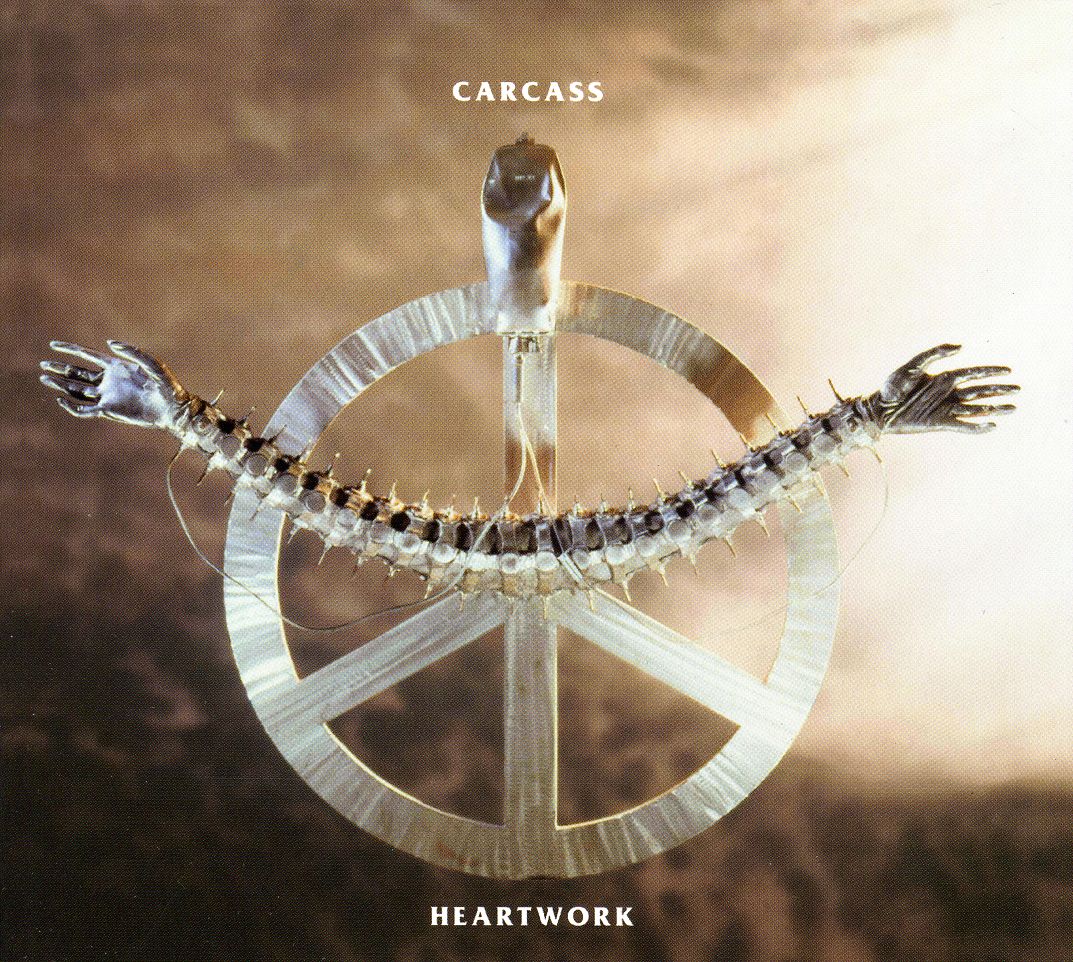
Whatever I'm describing above, Carcass is in many ways the opposite of it. For more than 20 years, they've embodied a certain strain of progressiveness in death metal. And I don't mean the delirious techiness of, say, Gorguts or Necrophagist. Carcass's achievement was something different: They streamlined death metal, whittled its edges to sharp, gleaming points, while at the same time aerating it, letting in all kinds of nourishing "outside" influences from the greater world of rock. As any fan could tell you, their 1993 album Heartwork is a masterpiece of outward-looking death metal. It keeps one foot in the genre, but it makes no secret of the fact that it values brisk, economical, wickedly catchy songwriting more than maintaining an allegiance to certain style.

So when Carcass took the MDF stage on Friday, against a backdrop of fancy video screens, it was clear that true rock stars had arrived. I was wondering how the death-metal die-hards at MDF would embrace the flash and polish of the Heartwork material, but I quickly realized that my skepticism was silly. One great thing about MDF is how all-embracing most of the fans are. I mentioned subgenre-loyal factions above, and that's a very real phenomenon, but in the end, the attendees are lovers of metal, full stop, who embrace a doom 'n roll supergroup Down (Saturday's headliner) just as warmly as a determinedly underground old-school death-metal act, a mournful doom-death crew or a fiendish black-metal band.

People went apeshit for Carcass and rightly so. I'm most familiar with Heartwork and its predecessor, 1991's Necroticism--Descanting the Insalubrious, and the band played plenty of material from those LPs. I'm pretty sure the balance of the set focused on their two prior records, which I'm looking forward to spending more time with. So this was an all-classics affair, and everyone seemed to know every word. The performance was, to my ears, very nearly flawless. The band plays with incredible flair. The current Carcass lineup, which has a new album due out later this year, consists of cofounders Jeff Walker (bass, vocals) and Bill Steer (guitar), along with two new recruits. I was a little bummed when I heard that Michael Amott (whose melodic shred was a key component of both Necroticism and Heartwork) wasn't involved in the current Carcass reunion, but once the set started, that became a complete non-factor. Guitarist Ben Ash and drummer Daniel Wilding fit perfectly into the mix.

On Twitter, I described Carcass post-set as extreme metal's Thin Lizzy, a comparison I stand by. They're a death-metal band with the flair (I keep coming back to that word) and polish of that almighty Irish rock force, my gold standard when it comes to the elusive rock 'n roll quality I think of as "tastiness." Sure, there are the surface similarities—the soaring dual-guitar ballet, the charismatic frontman doubling on bass—but there's also a spiritual one. Thin Lizzy were so good that they rock while almost seeming to relax. Carcass is the same way. The chops are simply a fact of what they do. There's no struggle, only a kind of gleaming fierceness. Maybe the best word for their presentation is pro. In the wake of the performance I witnessed, I could not be more psyched for the upcoming Carcass full-length, Surgical Steel. The current incarnation of this band is laying waste without breaking a sweat.

Broken Hope (Saturday)


And still another face of death, as it were. Chicago's Broken Hope were a band I'd had a vague awareness of in the '90s, but I'd always thought of them as a second-rate Cannibal Corpse or somesuch—gore-fixated, brutal, basic. I was intrigued to hear about their reunion last year; it seemed like a well-plotted reboot rather than a nostalgia trip. (The 2010 suicide of former vocalist Joe Ptacek adds a sad, poignant wrinkle to the narrative.) I approached their set yesterday with mild interest; I figured I'd check out a few songs and wander off if they didn't grab me, which, in the end, is a pretty typical MDF experience.

From the first few seconds, this band sucked me in like a tractor beam. With all due respect to Suffocation, who played an absolutely ripping set at Saint Vitus back in April and who have released my favorite metal album of 2013 so far, this Broken Hope set might have been the single tightest, most powerful, most no-nonsense set of death metal I've ever seen. This band is a coiled spring. Unlike Convulse, whose vibe was friendly and almost casual, Broken Hope were in full-on attack mode. Vocalist Damian Leski is a beast of a human, a hulking yet agile man whose sole purpose in life seems to be to do what he did yesterday evening: growl himself redfaced over mercilessly gnarled and punishing blastbeats and slams.

And my God, were those blastbeats and slams tasty. This band is a hyper-efficient riff factory, churning out part after part after glorious part. The music was like lifeblood for the mosh pit. People were going absolutely crazy during this set, myself included. The pit became a single heaving organism. I remember one dude kept sort of stumbling around in this cartoonish "death-metal zombie" trance, and I knew exactly what he was feeling. This brand of death metal sums up what is meant by infectious. The way this music was gripping people, affecting them, seeming to alter their metabolism, literally enthralling them, seemed to me very analogous to how great dance music functions. I think of that silly scene in Good Will Hunting where Matt Damon speaks of the music "just owning you." That is what was going on here.

No other time during my two days at MDF XI, or at last year's fest, or at any other death-metal show I've been to, have I seen band and crowd so symbiotically amped during a show. Sure, the energy was feral, with a whiff of beatdown-ism. (Leski comes from the punishing school of death-metal frontmen, those for whom the goal is to make the crowd—or, more specifically, "You sick motherfuckers!"—feel thoroughly brutalized. George "Corpsegrinder" Fisher from Cannibal Corpse puts a sort of cuddly spin on that formula; Leski, on the other hand, was a downright scary presence.) But the sense of release was weirdly wholesome. Overall, the set was what great metal is supposed to be, a seething purge.

And in focusing on the energy/vibe aspects of the set, I don't mean to take anything away from the craft of the music. What I loved about Broken Hope is that they rode that fine line of technicality and brutality so skillfully. Riffs shuffled constantly and took all kinds of unexpected twists, but the parts always cycled enough times that you could internalize their contours and precision-headbang to your heart's content. The force of the playing was dizzying. Serious kudos are due to drummer Mike Miczek, who slammed with more force and control than any other blastbeat-oriented player I heard a MDF XI.

This band is an absolute machine. If you have the slightest affinity for the so-called brutal school of death metal, the kind that thrives on the juxtaposition of swirling technicality and pit-fueling slam riffs, you need to see the current incarnation of Broken Hope. (They're coming out with a new album soon, so expect touring to follow.) I can barely describe the feeling of joy they left me with. I was glowing.

Melvins (Saturday)


I was ready for a break after Broken Hope. I just wanted to sit down and process and let the brutalized-but-ecstatic feeling linger. But it was not to be. Melvins had struck me as sort of an odd band out at Deathfest. They've never fit into "metal," per se; their aesthetic has always been too bizarre, too expansive. At their best, they can lay waste to any sort of rock-oriented subgenre-ism. (In particular, they make the endless factionalism of extreme metal—"We play death/doom," "We play blackened death," "We play stoner sludge"—which was definitely on display at Deathfest, seem a little absurd; there's nothing wrong with specializing in a style, but it's good to be reminded that not all heavy music exists in some tiny little box.) And that is what happened last night. The band, operating in its double-drummer quartet lineup, put on a clinic in the art of omni-dimensional rock— crushing harder just about every other band I saw over the weekend, but doing so with such staunchly eccentric style.

You cannot put the Melvins in a box, but they will happily show up at your box of choice (in this case, the death-metal realm), set up camp and lay waste. I'm sometimes guilty of taking the Melvins for granted; then I see them live and remember that they are very likely the greatest rock band (and I mean that in the broadest sense, from "rock 'n roll" all the way up to extreme metal) of our time. The force of the current lineup is absolutely withering. They started slow and agonizing with "Hag Me," and from there, it was on: Classic after classic. "Hooch," "Night Goat," Revolve," "With Teeth," "Honey Bucket," "Anaconda." The drive of these songs, their groove, their engine, their melody, their full-spectrum rock-ness. It is all embodied in the particular qualities of Buzz Osborne and Dale Crover, each of whom is the best in the world at what he does. Is there any frontman on earth with Buzz's range, his force and drama and sheer personality? Is there any drummer who can match Dale's hulking precision, his combination of brontosaurus weight and ingenious design? The authority of this set was totally mesmerizing. Having seen Melvins play five or so times since 2006, I can say that they're only getting fiercer as an onstage unit. If you care even slightly about any kind of "hard" rock music, you must, must see them as soon as you can, and then again at every opportunity after that.

Revenge (Saturday)


I was thinking about sticking around to see the Sunday offerings at MDF, but this set swayed me the other way. I knew that nothing was going to top it, in terms of sheer intensity. In that sense, I got exactly what I was hoping for from Revenge.

I've been into this band for a few years now. I had a serious "What in God's name...?" epiphany when I stumbled on 2004's Victory.Intolerance.Mastery in a extreme-metal-loving co-worker's iTunes folder a couple years back. I had never heard such world-swallowing filth in my life—a tornado of vomitous negativity, just, like, pure barf music, with vocals that alternated between a typical hellish shriek and what sounded like the grunting of a human-pig hybrid. And my God, the drumming of James "J." Read... I had never heard anything so simultaneously raw and commanding, so rickety yet controlled. Neck-snapping blasts, Neanderthal midtempo grooves and these tumbling, hold-on-for-your life rolls, all executed on a set that sounded like it had been fished out of the garbage—dead toms, clangy cymbals. I felt like I had found some sort of ideal that I never knew I was looking for. It was the polar opposite of sanitized extreme metal drumming. It was, I felt, one of the most purely punk drum-set performance I'd ever heard.

I sought out Read's work in various other contexts and was never disappointed. Axis of Advance—as filthy-sounding as Revenge, but with a sort of dystopic sci-fi conceptual bent—hit me just as hard, and after some initial puzzlement, I grew to love Blood Revolt (his collaboration with Primordial's A.A. Nemtheanga) too. I still need to get familiar with his earlier band, Conqueror, and the first couple Revenge records, but you get the point: Read is one of my favorite instrumentalists on the planet.

I was almost scared to see Revenge live. Scared, on one hand, by how violent I knew the crowd was going to be, and scared too that their set might not live up to the gross majesty of the recordings. I needn't have worried on the latter count. Live, the band gives off an identical sensation to that of their recordings: ungodly, pedal-to-metal recklessness; pure bestial chaos; pick your metaphor. It was mayhem.

I wish I could've watched Read from behind the drum kit—I could only see his hair and his scowling, wide-eyed face for most of the set—so I could check out exactly how he executes those patented rapid-fire rolls of his. I did get to marvel at his blastbeat technique. Blastbeats are a tough racket: typically, you either see a puny technique, or one that's so strong and virtuosic that it seems machinelike. Read's method is his own. He's absolutely smashing the kit, and he's in total command, but he still maintains a certain roughness. I'm really at a loss to describe how he does what he does behind the drums. It's like he's found a way to perfect and harness a sound/style (a sense of chaos, really) that typically results from a drummer playing just at the edge of his/her ability. He's not struggling, but he maintains the feeling of struggle, harnesses it.

You don't remember Revenge songs, as a rule, either on record or live. What you do remember are parts. Dirgey intros, headlong blasts with trilly, demented solos from Chris "Vermin" Ross, also of Axis of Advance and Blood Revolt, skull-rattling midtempo rockouts. Ross and bassist Tim "Haasiophis" Grieco are integral to the music, but it's really Read's show. As Profound Lore's Chris Bruni put it in a Tweet, his performance is a display of "pure hatred." I'm not sure there is a more possessed musician in extreme metal. Judging by interviews I've read—see here and here—Read seems like a reticent, difficult guy. He's clearly a man following his own muse, and judging by some allusions to skinhead culture in those Q&As, possibly some sort of ethically questionable ideology. I've heard rumors, but I don't want to throw any specific terms out there unsubstantiated. Does anyone happen to know exactly what's up with Read's politics? Would be curious to know if he's ever made an overt statement.

Anyway, I've gotten off track here. The chaos pouring off the stage definitely seeped into the crowd. The audience vibe during this set definitely didn't feel like the relatively run-of-the-mill catharsis that went down during, say, Broken Hope's set. I was up in front of the pit, and I'd look back behind me and see some dude just catapult forward as though he'd been hurled; one guy was inexplicably swinging a garbage bag; people seemed to regress into this feral state. But then at the same time, I'd see people just beaming in a sort of blissful disbelief. That's sort of the state I found myself in, like, "How can this be so fantastically intense, so full-on"? It was fascinating to watch Revenge after the Melvins, to see two bands so good at two completely different things. Revenge is a special band. I'm not going to lie and say I pull out their records all that much, but there's a certain kind of cleansing power that I associate with them—analogous to taking a really stiff shot or inhaling menthol. It really is the furthest I've ever heard metal go in terms of a certain kind of animal lawlessness. It's not just they're the fastest or the noisiest or the most bewildering. It's that they're the most… heathenish, maybe? It's a sound that radiates pure disgust, and they completely own it, both on record and, I'm happy to report, onstage.

/////

A few additional thoughts:

Repulsion (Friday): I respect this band's place in the history of death/grind, but I've never really been able to get with the undifferentiated rawness. I liked the good-natured bent of their MDF set, though. Scott Carlson and Matt Olivo are funny guys, and their M.O. is just to crank it up and rip. Their devotion to pure primitiveness makes more sense when it's couple with their everydude stage presence.

Down (Saturday): I still think this supergroup adds up to less than the sum of its parts, i.e., I'm a much bigger fan of all these guys' past and present work outside of Down—Pantera, Eyehategod, Crowbar, Corrosion of Conformity—than I am of this band. But I respect the M.O. of the project: a bunch of veteran metal gods who happen to be tight bros getting together to worship the Sabbath and the sweet leaf. They were a nice comedown after the insanity of Revenge, and I'm always up for some nice, inspirational Phil Anselmo banter. I almost felt myself getting choked up when he started talking about how proud his late ex-bandmate Dimebag Darrell would've been to look out into the sea extreme-metal die-hards he saw before him.

Ihsahn (Saturday): I caught about 15 minutes of this set, rushing over shortly before Revenge finished. (The MDF schedule typically avoids blatant overlap between stages, but these sets went down at almost exactly the same time.) Ihsahn, frontman of legendary Norwegian black-metal band Emperor—not being a huge fan of the subgenre, I don't know their records all that well; they're on my list—now plays a kind of epic, super-polished prog-metal. It was a serious trip moving right from the feral insanity of Revenge to the dramatic, super-choreographed presentation of Ihsahn and his bandmates, who came off like some sort of Warped Tour boy band onstage. At that point in the night, I was completely overloaded from the consecutive Broken Hope–Melvins–Revenge assault and couldn't really take in any more fresh info. I'm not sure I'm fully on board with the slickness of the Ihsahn presentation (it reminds me a bit of fellow Norwegians Shining, who haven't quite clicked with me for similar reasons), but I'm intrigued by the material. Looking forward to learning more.

The Obsessed / Weedeater (Saturday): I have mixed feelings re: a certain brand of what I'll call "lifer" doom, a subscene that seems to revolve entirely around the concept of dues-paying, of hard-living men whose extremely basic music gets elevated to the realm of the poetic thanks mainly to the admittedly romantic notion that they've been around a long time, grinding it out in the trenches. I do in fact admire what Scott "Wino" Weinrich does in general. I particularly love the Hidden Hand record Mother Teacher Destroyer, as well as his recent solo "folk" record, Adrift. But I found what I heard of his MDF XI set with the Obsessed to be pretty stultifying, and I felt the same about the Saint Vitus set (also feat. Wino) that I caught last year at MDF X. I love a whole lot of super-basic, anti-evolutionary metal—Obituary being a primo example—but the Obsessed just seemed like a lifeless rehash of the post-Sabbath doom concept. To say that they merely paled in comparison to Melvins would, I think, be too generous. Maybe it's just a function of how much Sabbath means to me, but I think we need to hold the doom movement to a higher standard—the throwing together of a couple bluesy, generically "dark" riffs does not make for a great song, and the presence of grizzled elders, respectable as their devotion to their craft may be, does not necessarily confer true gravity onto a set of music. Sabbath is the highest sort of poetry, not just a set of stylistic moves repeated ad nauseum. Honoring that legacy is a tall order. (For me, one band making a serious go of it these days would be Pallbearer.)

I felt much the same about Weedeater. I'm a huge fan of Eyehategod, but I'm conflicted re: this whole Southern-sludge mythos that celebrates the self-abuse of figures like Mike IX Williams (EHG) and "Dixie" Dave Collins (of Weedeater, Buzzov*en), as though that somehow makes their music truer. The bottom line is that Eyehategod is a great band because they've devoted years to the perfection of their sludge-punk craft. They play together as well as any other heavy-rock band in the world. With Weedeater, on the other hand, I got the sense that the entire point of the band is to fuel and glorify Collins's substance-abuse habit. He made a point of showily chugging whiskey between every song, and the band's merch table had a hand-lettered sign posted that said something to the effect of "We need drugs, weed, pills—please." Is that not just a tad pathetic, maybe? I get the perverse appeal of that sort of attitude, but for me, the music just didn't hold up. Abuse drugs if you like, sure, but don't use that as a stand-in for making great art happen. Weedeater's brand of sludge is crustier and edgier than that of the Obsessed, and while I saw the appeal in Collins's deranged-hobo stage presence, the riffs and the feel just weren't drawing me in.

/////

I'll just say in conclusion that MDF is a really special festival. I'll treasure memories of all six of the sets covered in detail above. There's something magical about joining up with one's tribe, as it were. I realize that I don't fit the description of the typical metalhead in a lot of ways, but I still feel the same primal, blood-deep connection to this music that I did when I was 14. I relish those moments when the music takes over and I just have to rush the stage, headbang, dance, throw some energy back in return, surrounded by a pack of die-hards, responding to the exact same deep-seated impulses. I can only imagine how great it must feel for the practitioners, for a band like Broken Hope who's been waiting a good 20 years to greet its public, to come face-to-face with a mirror, an audience who lives and breathes for this music in much the same way they do. Genres can be limiting factors, but they can also be tent posts to really around. We don't know why we respond on a molecular level when we hear those low, growling tones, those zombified riffs of bands like Convulse, but they call to us; we regress into some deep trance. A dark zone, in a sense, a celebration of animal ferocity, but also, it must be said, a place of bliss, of release, where you can revel in the volume and the force, witness a creative act that seems to give voice to every aggressive feeling you've had to suppress, sublimating those emotions into an entirely non-violent, life-affirming vent.

As I indicated in my recent Immolation review, the craft of death metal is a craft of love, purely its own reward. Maybe it's easier to feel that in the presence of, say, Convulse or Broken Hope or Benediction—bands who took pains to thank the crowd profusely at every opportunity—than standing before a hate-spewing band like Revenge. But it's all one phenomenon. Let's not pretend this is a game of misery, people; metal is fun.