*A review of an awesome four-band death-metal bill, featuring DFSBP faves Cannibal Corpse and Morbid Angel.
*A write-up of an excellent new oral history of the band King's X, with whom I've become fairly obsessed within the past year or so.
Showing posts with label Cannibal Corpse. Show all posts
Showing posts with label Cannibal Corpse. Show all posts
Sunday, March 17, 2019

Thursday, December 11, 2014
2014 top 10, plus
Since I've been covering music for Time Out New York, going on eight years now, I've been compiling year-end top-10-albums lists for print and/or online. This year, Time Out won't be running individual lists; in their place is this aggregate best-2014-albums rundown, chosen by and featuring contributions from various folks at Time Out Chicago and Time Out L.A., as well as me and my NYC colleagues Sophie Harris and Andrew Frisicano. A similarly styled best-2014-songs list is coming soon.
You can read a few of my blurbs in the general list linked above, but I thought I'd go ahead and publish my own personal, all-genres-in-play top 10 on DFSBP. This will likely be the same list I'll submit to Pazz and Jop, and any other general poll I happen to participate in. For readability's sake, as well as for my own sanity, I'm going to try to keep the blurbs here to a more manageable length than those on the 2014 jazz top 10 I posted recently.
One note re: the content, echoing what I wrote here: For me, the day-to-day experience of music is about songs. The records I return to most frequently are, simply, the ones packed most densely with songs I want to return to. The LPs below were extremely useful to me in 2014. I'm not trying to reduce them to some sort of service role, i.e., boiling down their value to how well they happened to integrate into my life; I'm just trying to drive home the idea that for me, directness, concision and memorability have become more and more focal, at least in terms of my recorded-music listening (a totally different phenomenon, I should stipulate, from the live-music experience). The following albums, crammed with great songs, already feel like old friends. Listen along via this 30-song Spotify playlist, drawn from the top 10 and honorable mentions below, and spiced up with a few of my favorite stand-alone 2014 singles.
10. White Lung Deep Fantasy (Domino)

This is simply a great, super-vigorous punk album that rocks like hell and features an extremely specific, consistent group dynamic. Anne-Marie Vassiliou's drums are a minimalist flattening force (kick-snare-kick-snare, ad infinitum), and Mish Way's vocals are a throaty rallying cry, somehow casual and urgent at the same time. The short songs are lousy with hooks. And guitarist Kenneth William is working out of a completely different playbook than any other rock guitarist I can think of: His lines sparkle rather than sear, spraying micro-detailed melodic glitter all over Deep Fantasy. William's lead line from roughly :48 through 1:05 in "Snake Jaw" is probably the most riotously awesome bit of musicianship I heard on an album released this year.
9. Run the Jewels Run the Jewels 2 (Mass Appeal)

As I indicated in my Run the Jewels 2 blurb for the aforementioned Time Out list, it was difficult to separate this record from its context, namely a year of race-centric tragedy, outrage and protest. And yes, that context does give the album, specifically Killer Mike's contributions, a special kind of added resonance. But Run the Jewels 2 is simply an excellent hip-hop LP, period, full of thoughtfulness, silliness, badassery, raunch and a general feeling of conscientious engagement. El-P's verses are outstanding, though the album really takes off when his harsh, dense, super-funky beats fuel Killer Mike's rhymes, as on "Lie, Cheat, Steal"; Mike's tongue-twisting "Like, who really run this? / Like, who really run that man that say he run this?" episode on that track is the apex of this brilliant—and, crucially, brilliantly entertaining—work of politicized art. P.S. I found the discussion surrounding Run the Jewels 2 to be nearly as crucial as the album itself; this NPR Microphone Check interview is essential, especially the section concerning the X-rated "Love Again."
8. Mark Turner Lathe of Heaven (ECM)

This is the album that topped my jazz-only 2014 albums list. Extensive thoughts here (scroll down to No. 1).
7. Mitski Bury Me at Makeout Creek (Double Double Whammy)

Mitski played what was maybe the single best live set I saw all year—a solo performance (loud, heavily distorted electric guitar and voice) at Brooklyn Night Bazaar on Halloween. She's excellent as the singer of Voice Coils (guitarist-composer Sam Garrett's fascinating, sui generis prog-pop sextet), but her solo material hit me in a more visceral way: The combination of sing-songy hooks and merciless severity, the latter of which came through not as much in lyrics and delivery as in weighty yet intangible presence, floored me. Bury Me, which features many of the songs Mitski performed in that live set, hits me just about as hard. It's not as harsh, concise or unrelenting as her live show—though the beginning of "I Don't Smoke" gives a good idea of what the set I caught sounded like—but it's just as assured and compositionally sound. There is so much fierce emotion packed into this record, emotion that's matched by the tightness and integrity of the actual songs. Any artist that could craft two alt-pop songs as simultaneously catchy and unsettling, and as different from one another, as "Townie" and "I Don't Smoke" is someone I'm going to pay serious attention to from now on. (Hear/buy on Bandcamp.)
6. Cloud Nothings Here and Nowhere Else (Carpark)

As I wrote of Here in the Time Out list, this is an album with simple, straightforward indie-rock appeal. Because it's so stylistically familiar, it's easy to mistake for something average. But it's no small feat to craft a record this structurally sound, executed with such genuine, unpolished feeling. Insanely catchy songs that rock like hell. Half the time, I have no idea what the term "indie rock" even refers to, but when I hear Here, I think I know: scrappy underdog passion and outpouring of heart, pop smarts mixed with punk abandon. Here and Nowhere Else is as about good as this kind of music gets. "I'm Not Part of Me," discussed here, is such a jam.
5. Juan Wauters N.A.P. North American Poetry (Captured Tracks)

Juan Wauters's set at Baby's All Right back in February, around the time this record came out, was another highlight of my showgoing year. I've been a Wauters fan since he and his old band the Beets stopped by Time Out to play unplugged in 2011. N.A.P. fulfills every promise of the Beets' best moments. In this brilliant 2011 Beets profile, my former colleague Jay Ruttenberg described Wauters as a "nutter with a Cheshire-cat grin." That grin has only grown subtler and deeper with time; Juan Wauters's deadpan is both inscrutable and absurdly charming. (N.A.P. opens with a sort of talk-sung Spanish-folk-sounding preamble, "Let Me Hip You to Something," which begins, stunningly, "I don't like you / You're a fool / Let me hip you to something.") Here, the Uruguay-born singer-songwriter channels his droll sense of humor into a stubbornly laid-back, almost meandering album of heavily accented folk-pop, the kind of music that reminds you that being punk means, simply, being yourself. Wauters is incredibly good at being himself, and as demonstrated here, at writing deceptively casual, ramshackle pop ditties like "Sanity or Not" and "Lost in Soup." But he goes further on N.A.P., accessing more tender and vulnerable emotional zones. The quiet yearning and plainspoken soul-searching in the song "Water" breaks my heart: "Woke up early, feel that itch / What am I doing now in this niche? / Do I belong? / Who is it that I am?" (You have to hear Wauters sing this, of course.) Not bad for a nutter!
4. La Dispute Rooms of the House (Better Living)

As I've written on DFSBP before, I have a thing for the brand of ’90s (or ’90s-inspired) post-hardcore that's sometimes referred to as emo. Emo is one of the most nerdily taxonomized subgenres I can think of; I can't keep up, honestly. But I know when I hear something that mashes on my emo pleasure buttons, like Cossack (scroll down to the bottom of this post) or On the Might of Princes (RIP Jason Rosenthal) or La Dispute. What a serious album this is—that is to say, it takes itself very seriously, and as well it should, because it's hugely moving and substantial. A novelistic narrative, expressed through Jordan Dreyer's sort of talk-yelped vocals and the band's expertly controlled post-hardcore mini epics. I'm not sure how well I follow the overall story, but the emotions—regret, bitterness, fear, nostalgia, fondness, hope—come through loud and clear. Such a fierce and sturdy piece of art, the kind that makes you feel like you're attending a church you can really believe in. Sad and harrowing and raucous and rocking—in a flailing and convulsing yet tightly drilled sort of way—and just brilliant. This was the best out-of-nowhere discovery I made in 2014, i.e., an album by a decently well-established band that I knew absolutely nothing about prior to this. If you like your post-hardcore—hell, your rock, period—weighty and dramatic, and convincingly so, you need to hear this.
3. Alvvays s/t (Polyvinyl)

Another album with a super-sturdy emotional character, though in a completely different way. As I wrote in the mixtape post, Alvvays zeroes in on the best of indie/twee culture and turns it into something profound. "Archie, Marry Me" is an absolutely extraordinary single, and the rest of this album just about lives up to that absurdly high standard. Heady fumes of bookish, post-adolescent emotion, distilled into songs that zip and skip along ("Adult Diversion," "Atop a Cake") or lope and mope in pensive bliss ("Ones Who Love You," the exquisite album closer "Red Planet"). If Here and Nowhere else is indie rock done simply, magically right, Alvvays is the same, but for indie pop. Yep, you've heard this sound before, and nope, you haven't heard it done this well. I must have listened to this full album something like 40 times straight through in 2014, and I'm still obsessed.
2. Antemasque s/t (Nadie Sound)

Another one that got endless spins. Played this damn thing over and over and over. Spilled a lot of ink on it too: see here. I'm so glad Omar and Cedric are back and tapping into the song vibe with renewed vigor.
1. Future Islands Singles (4AD)

They owned the year and, yep, they absolutely deserved it. Some thoughts here and here. An artful and moving piece of work. And so consistent! I love literally every song on this record, though "Spirit" and "A Song for Our Grandfathers" are megajams for the ages. Anyone who saw Future Islands on Letterman and wrote them off as a mere collection of quirks needs to sit with this album, get a whiff of its deep consistency, confidence and composure, honed via years of touring. Future Islands were ready for their close up.
/////
Honorable mentions:
FREEMAN s/t (Partisan)
Here, via Partisan Records, is the bio I wrote for Aaron Freeman, the former Gene Ween, in conjunction with FREEMAN, the self-titled debut by his new band. FREEMAN has its own character—resolutely chill, optimistic, ominous, trippy, tough—but in terms of the inevitable comparison, I honestly think this one ranks up there with the best of Ween. Also, in terms of the exorcising-personal-demons songwriting canon, "Covert Discretion" is a new masterpiece. That track is the standout, but the record feels sharp and inspired all the way through. Given that I worked on the promo campaign for FREEMAN, I don't feel right listing it in an official capacity, but if that hadn't been the case, it very likely would've appeared on the above list. P.S. FREEMAN, the band, is extraordinary live; see them if you can.
Cannibal Corpse A Skeletal Domain (Metal Blade)
Eyehategod s/t (Housecore)
Obituary Inked in Blood (Relapse)
In 2013, my metal consumption centered on new records by old bands. That trend continued this year. No need to make any grand proclamations about the current state of the scene; this pattern surely says more about my own personal tastes than it does metal at large. There's something about established b(r)ands, like those whose names you see above, that really moves and engages me.
These three albums all document bands simply being themselves. As discussed in a DFSBP post last week, for Cannibal Corpse, that means further refining their current Corpsegrinder-era style. These guys are besting themselves with every release, and that's inspiring to see/hear.
For Obituary, "refining" might be a misleading term. As I've written here before, this band's M.O. is decidedly anti-evolutionary; their mission is to obey their initial primal imperative, the adolescent root of their metal. From a recent interview with drummer Donald Tardy, one of the most hard-grooving, gloriously human drummers in all of metal: "It’s not like we worked for years on getting our sound; the sound came naturally because of the instruments that Trevor [Peres] plays, and just my style of drumming." (I also love this Tardy quote from Terrorizer: "Obituary isn't reinventing the wheel. We'll leave that to the other bands that play technical and crazy and try to go beyond themselves with every record. With us, we knew that fans needed Obituary to be Obituary. They don't need us to change; they just need some solid music.") So Obituary does what it does what it does, etc. The shifts between albums are miniscule—mainly matters of production style, or a difference in lead-guitar approach (while riffmaster Peres has been an Obituary fixture—and thank God for that—the band has featured several different lead players over the years).
In the case of Inked, the production was a bit of a sticking point for me at first. The band funded this album via Kickstarter—yes, I was a proud contributor; I got a shirt and a camouflage Obituary beer coozie for my troubles—and recorded it themselves. Overall, the sound is excellent: loud, mean and unfussy. But the drum production in particular took some getting used to. I almost wish the band had brought in an outside producer to help them capture Tardy's kit, because the sound is pretty confounding: super loud, uniform, seemingly synthetic kick drums, the kind that if they aren't triggered/hit-replaced—as Tardy insists in the Metal Underground interview linked above—they might as well be, paired with really rickety-sounding, near pitch-less toms. I'm nitpicking, sure, but the snare and cymbals sound so good, so live, that it really puzzles me that they couldn't achieve a natural, well-blended representation of the whole kit. But you know what? After I listened for a while, I basically stopped caring. This is another very, very good Obituary album. The riffs are memorable, Kenny Andrews's lead guitar is tastefully (read: minimally) integrated, John Tardy's throat sounds as raw and anguished as ever, and the band's patented Southern stomp is in full effect. The sense of groove on this album is straight-up monstrous, and since that's the main criteria by which I judge any Obituary release, I'll set aside my drum-nerd griping and state for the record that Inked in Blood flat-out rules.
Speaking of Southern stomp, the Eyehategod record is stunning. It's not as punishing as the band's masterpiece, 1993's Take as Needed for Pain (maybe the most disgustingly weighty album I've ever heard in my life), but as a portrait of what this band does, the elegance with which it juggles putridity with real wit and swagger, the way it greases each riff—and my God, are there a lot of good ones on here—with that special N'awlins spice rub, Eyehategod is an absolutely marvelous document. (Sorry, I know food metaphors are cheesy, but EHG's music just has a certain kind of rib-sticking appeal that's hard to convey in sonic terms alone.) Such a shame, then, that it doubles as a memorial for drummer Joey LaCaze, who died last summer. Thankfully, he appears on the entire record—and damn, does he ever appear, his inimitable dancing-through-the-muck groove enlivening every track; check that funky-as-hell LaCaze drum break, leading into a masterful lowdown shimmy, at 2:10 in "Worthless Rescue." But how sad that he isn't around to tour with his EHG brothers during a time in their career when they're getting more deserved acclaim (here's Ben Ratliff on the band's outstanding Brooklyn show from earlier this year) than ever before. Let's be thankful for what we have: Eyehategod is heaven for anyone who's ever loved this band. Incidentally, I'd highly recommend Noisey's admirably comprehensive, multipart NOLA-metal doc, Life, Death and Heavy Blues from the Bayou, to any fan of EHG or the scene that birthed them.
RVIVR Bicker and Breathe (Rumbletowne)
Erica Freas Tether (One Brick Today)
What's this? Another masterpiece from the band that made my favorite album of 2013, and an equally impressive solo dispatch from one of its key members? RVIVR's Bicker and Breathe EP embodies everything I loved about The Beauty Between. Erica Freas, represented here with "Goodbyes" and "The Sound," is one of the most galvanizing singer-songwriter-performers on earth today, and Bicker offers further proof. And as Tether, her wise, calmly heartbreaking latest solo EP, demonstrates, she's every bit as riveting in acoustic mode. (Hear/buy on Bandcamp: Bicker and Breathe / Tether.)
/////
More 2014 faves:
Shorties re: 14 other new LPs and 4 archival releases (jazz excluded; shouted out three of those at the bottom of this post) that I loved this year
Battle Trance Palace of Wind (New Amsterdam)
Battle Trance's Travis Laplante is a genuine contemporary NYC visionary. You might remember him from Little Women; Battle Trance, his four-tenor-saxes quartet, is equally extreme, but more about meditation than catharsis, or maybe the zone where meditation becomes catharsis, or vice versa. Experimental music as sustained, prayerful zone-out. Hear this album, and see Battle Trance live at all costs. (Hear/buy on Bandcamp.)
Lana Del Rey Ultraviolence (UMG)
A slow deluge of concentrated atmosphere, via a caricature that the artist born Elizabeth Grant has gradually fleshed out into a complex pop persona. Ultraviolence both lays on its doomed-starlet psychodrama super thick (the title track) and makes fun of its narrator's (or narrators'?) narcissistic self-mythology ("Brooklyn Baby").
Internal Bleeding Imperium (Unique Leader)
Another great new record by an old metal band, whose specialty is a vile, unrelenting and unmistakably New York–y sort of hardcore-infused death metal, where the slow/fast juxtaposition is key. Kudos to Bill Tolley for his idiosyncratic (splash cymbals! tambourine!), unpolished, super-groovesome drumming.
Kayo Dot Coffins on Io (The Flenser)
Depending on how you look at it, Kayo Dot either made the moodiest, most decadent pop album of 2014, or the sleekest, most listenable prog album of 2014. A profoundly weird band—led by Toby Driver; like Travis Laplante, another contemporary NYC visionary—that continues to grow ever more confident, and comfortable with its shapeshifting M.O. (Hear/buy on Bandcamp.)
Mastodon Once More ’Round the Sun (Reprise)
Mastodon furthers its pop metamorphosis—shorter songs, huger hooks—with outstanding results. This album is obviously a totally different animal than, say, Remission, but it's completely satisfying on its own terms. "The Motherload" is one of my favorite songs of 2014, and most of the others are catchy as hell too.
Bob Mould Beauty and Ruin (Merge)
"I Don't Know You Anymore" is another one of my favorite songs of the year; "The War" is almost as good. I've been moderately into Hüsker Dü for a while, but I didn't become a serious Mould nut until I heard 2012's Silver Age; this album is stylistically similar and maybe even better. More loud, masterfully melodic rock music from one of the contemporary masters of the form. P.S. I also read Mould's memoir this year, and I highly recommend it.
Karen O Crush Songs (Cult)
A sad, small, deliberately sketchy album with substantial heartbreaking potency. More on K.O. here.
Nude Beach 77 (Don Giovanni)
NYC's best straight-up rock/roll band trades hook-crazed immediacy for a more patient, lived-in sound on a good-all-the-way-through double LP. A rare example of "maturity" without tedium. God, these guys write classic-sounding songs.
Psalm Zero The Drain (Profound Lore)
Two more CNYCVs (see Battle Trance and Kayo Dot above), Charlie Looker (ex–Extra Life / Zs) and Andrew Hock (ex-Castevet) join forces, producing what is, to my ears, the most compact, listenable and gut-wrenchingly affecting album in their sizable joint discography. (Hear/buy on Bandcamp.)
Raspberry Bulbs Privacy (Blackest Ever Black)
Speaking of gut-wrenching. Maladjusted midtempo goth-noise-punk filth from yet another CNYCV: Bone Awl drummer turned Raspberry Bulbs mastermind Marco del Rio. P.S. This record grooves like hell. (Hear/buy on Bandcamp.)
Say Anything Hebrews (Equal Vision)
Max Bemis proves he's still the king of confessional emo-gone-Broadway brain-/heartspew.
Sia 1000 Forms of Fear (Monkey Puzzle)
The triumph of the megawatt human voice—many writers, myself included, overuse the word "soar" when describing music, but Sia's vertiginous vocal leaps on tracks like "Chandelier" and "Eye of the Needle" actually seem worthy of the term—and an eccentric pop mind that refuses to let fame compromise her weirdness or vulnerability.
The War on Drugs Lost in the Dream (Secretly Canadian)
Pastel roots-pop bliss, with all the gloss and pathos of the best ’80s dad rock. "Red Eyes" in particular is an instant classic.
Yusuf Tell ’Em I'm Gone (Columbia/Legacy)
Still need to spend more time with this one, but have heard enough to know that Cat Stevens remains the archetypal pop/folk/soul troubadour.
*****
Reissues/archival:
Crosby, Stills, Nash and Young CSNY 1974 (Rhino)
The real monsters of folk. Ragged roots-rock glory disguised as ego-/drug-fueled supergroup excess. More here.
Demilich 20th Adversary of Emptiness (Svart)
Inspired death-metal surrealism. More here.
Bob Dylan The Bootleg Series, Vol. 11: The Basement Tapes Complete (Columbia/Legacy)
Finally, the Bootleg Series, after winding through Dylan's career in circuitous, Dylan-y fashion, gets around to the trove we've all been waiting for. Have barely scratched the surface of this, but I can tell that the vibes are thick, the camaraderie deep and the mood often refreshingly light.
Led Zeppelin reissues (Atlantic)
The best rock music, dusted off (but not scrubbed clean) and sounding huge and incredible. We're up through Houses of the Holy now—get on board if you're not already, okay?
You can read a few of my blurbs in the general list linked above, but I thought I'd go ahead and publish my own personal, all-genres-in-play top 10 on DFSBP. This will likely be the same list I'll submit to Pazz and Jop, and any other general poll I happen to participate in. For readability's sake, as well as for my own sanity, I'm going to try to keep the blurbs here to a more manageable length than those on the 2014 jazz top 10 I posted recently.
One note re: the content, echoing what I wrote here: For me, the day-to-day experience of music is about songs. The records I return to most frequently are, simply, the ones packed most densely with songs I want to return to. The LPs below were extremely useful to me in 2014. I'm not trying to reduce them to some sort of service role, i.e., boiling down their value to how well they happened to integrate into my life; I'm just trying to drive home the idea that for me, directness, concision and memorability have become more and more focal, at least in terms of my recorded-music listening (a totally different phenomenon, I should stipulate, from the live-music experience). The following albums, crammed with great songs, already feel like old friends. Listen along via this 30-song Spotify playlist, drawn from the top 10 and honorable mentions below, and spiced up with a few of my favorite stand-alone 2014 singles.
10. White Lung Deep Fantasy (Domino)
This is simply a great, super-vigorous punk album that rocks like hell and features an extremely specific, consistent group dynamic. Anne-Marie Vassiliou's drums are a minimalist flattening force (kick-snare-kick-snare, ad infinitum), and Mish Way's vocals are a throaty rallying cry, somehow casual and urgent at the same time. The short songs are lousy with hooks. And guitarist Kenneth William is working out of a completely different playbook than any other rock guitarist I can think of: His lines sparkle rather than sear, spraying micro-detailed melodic glitter all over Deep Fantasy. William's lead line from roughly :48 through 1:05 in "Snake Jaw" is probably the most riotously awesome bit of musicianship I heard on an album released this year.
9. Run the Jewels Run the Jewels 2 (Mass Appeal)
As I indicated in my Run the Jewels 2 blurb for the aforementioned Time Out list, it was difficult to separate this record from its context, namely a year of race-centric tragedy, outrage and protest. And yes, that context does give the album, specifically Killer Mike's contributions, a special kind of added resonance. But Run the Jewels 2 is simply an excellent hip-hop LP, period, full of thoughtfulness, silliness, badassery, raunch and a general feeling of conscientious engagement. El-P's verses are outstanding, though the album really takes off when his harsh, dense, super-funky beats fuel Killer Mike's rhymes, as on "Lie, Cheat, Steal"; Mike's tongue-twisting "Like, who really run this? / Like, who really run that man that say he run this?" episode on that track is the apex of this brilliant—and, crucially, brilliantly entertaining—work of politicized art. P.S. I found the discussion surrounding Run the Jewels 2 to be nearly as crucial as the album itself; this NPR Microphone Check interview is essential, especially the section concerning the X-rated "Love Again."
8. Mark Turner Lathe of Heaven (ECM)
This is the album that topped my jazz-only 2014 albums list. Extensive thoughts here (scroll down to No. 1).
7. Mitski Bury Me at Makeout Creek (Double Double Whammy)
Mitski played what was maybe the single best live set I saw all year—a solo performance (loud, heavily distorted electric guitar and voice) at Brooklyn Night Bazaar on Halloween. She's excellent as the singer of Voice Coils (guitarist-composer Sam Garrett's fascinating, sui generis prog-pop sextet), but her solo material hit me in a more visceral way: The combination of sing-songy hooks and merciless severity, the latter of which came through not as much in lyrics and delivery as in weighty yet intangible presence, floored me. Bury Me, which features many of the songs Mitski performed in that live set, hits me just about as hard. It's not as harsh, concise or unrelenting as her live show—though the beginning of "I Don't Smoke" gives a good idea of what the set I caught sounded like—but it's just as assured and compositionally sound. There is so much fierce emotion packed into this record, emotion that's matched by the tightness and integrity of the actual songs. Any artist that could craft two alt-pop songs as simultaneously catchy and unsettling, and as different from one another, as "Townie" and "I Don't Smoke" is someone I'm going to pay serious attention to from now on. (Hear/buy on Bandcamp.)
6. Cloud Nothings Here and Nowhere Else (Carpark)
As I wrote of Here in the Time Out list, this is an album with simple, straightforward indie-rock appeal. Because it's so stylistically familiar, it's easy to mistake for something average. But it's no small feat to craft a record this structurally sound, executed with such genuine, unpolished feeling. Insanely catchy songs that rock like hell. Half the time, I have no idea what the term "indie rock" even refers to, but when I hear Here, I think I know: scrappy underdog passion and outpouring of heart, pop smarts mixed with punk abandon. Here and Nowhere Else is as about good as this kind of music gets. "I'm Not Part of Me," discussed here, is such a jam.
5. Juan Wauters N.A.P. North American Poetry (Captured Tracks)
Juan Wauters's set at Baby's All Right back in February, around the time this record came out, was another highlight of my showgoing year. I've been a Wauters fan since he and his old band the Beets stopped by Time Out to play unplugged in 2011. N.A.P. fulfills every promise of the Beets' best moments. In this brilliant 2011 Beets profile, my former colleague Jay Ruttenberg described Wauters as a "nutter with a Cheshire-cat grin." That grin has only grown subtler and deeper with time; Juan Wauters's deadpan is both inscrutable and absurdly charming. (N.A.P. opens with a sort of talk-sung Spanish-folk-sounding preamble, "Let Me Hip You to Something," which begins, stunningly, "I don't like you / You're a fool / Let me hip you to something.") Here, the Uruguay-born singer-songwriter channels his droll sense of humor into a stubbornly laid-back, almost meandering album of heavily accented folk-pop, the kind of music that reminds you that being punk means, simply, being yourself. Wauters is incredibly good at being himself, and as demonstrated here, at writing deceptively casual, ramshackle pop ditties like "Sanity or Not" and "Lost in Soup." But he goes further on N.A.P., accessing more tender and vulnerable emotional zones. The quiet yearning and plainspoken soul-searching in the song "Water" breaks my heart: "Woke up early, feel that itch / What am I doing now in this niche? / Do I belong? / Who is it that I am?" (You have to hear Wauters sing this, of course.) Not bad for a nutter!
4. La Dispute Rooms of the House (Better Living)
As I've written on DFSBP before, I have a thing for the brand of ’90s (or ’90s-inspired) post-hardcore that's sometimes referred to as emo. Emo is one of the most nerdily taxonomized subgenres I can think of; I can't keep up, honestly. But I know when I hear something that mashes on my emo pleasure buttons, like Cossack (scroll down to the bottom of this post) or On the Might of Princes (RIP Jason Rosenthal) or La Dispute. What a serious album this is—that is to say, it takes itself very seriously, and as well it should, because it's hugely moving and substantial. A novelistic narrative, expressed through Jordan Dreyer's sort of talk-yelped vocals and the band's expertly controlled post-hardcore mini epics. I'm not sure how well I follow the overall story, but the emotions—regret, bitterness, fear, nostalgia, fondness, hope—come through loud and clear. Such a fierce and sturdy piece of art, the kind that makes you feel like you're attending a church you can really believe in. Sad and harrowing and raucous and rocking—in a flailing and convulsing yet tightly drilled sort of way—and just brilliant. This was the best out-of-nowhere discovery I made in 2014, i.e., an album by a decently well-established band that I knew absolutely nothing about prior to this. If you like your post-hardcore—hell, your rock, period—weighty and dramatic, and convincingly so, you need to hear this.
3. Alvvays s/t (Polyvinyl)
Another album with a super-sturdy emotional character, though in a completely different way. As I wrote in the mixtape post, Alvvays zeroes in on the best of indie/twee culture and turns it into something profound. "Archie, Marry Me" is an absolutely extraordinary single, and the rest of this album just about lives up to that absurdly high standard. Heady fumes of bookish, post-adolescent emotion, distilled into songs that zip and skip along ("Adult Diversion," "Atop a Cake") or lope and mope in pensive bliss ("Ones Who Love You," the exquisite album closer "Red Planet"). If Here and Nowhere else is indie rock done simply, magically right, Alvvays is the same, but for indie pop. Yep, you've heard this sound before, and nope, you haven't heard it done this well. I must have listened to this full album something like 40 times straight through in 2014, and I'm still obsessed.
2. Antemasque s/t (Nadie Sound)
Another one that got endless spins. Played this damn thing over and over and over. Spilled a lot of ink on it too: see here. I'm so glad Omar and Cedric are back and tapping into the song vibe with renewed vigor.
1. Future Islands Singles (4AD)
They owned the year and, yep, they absolutely deserved it. Some thoughts here and here. An artful and moving piece of work. And so consistent! I love literally every song on this record, though "Spirit" and "A Song for Our Grandfathers" are megajams for the ages. Anyone who saw Future Islands on Letterman and wrote them off as a mere collection of quirks needs to sit with this album, get a whiff of its deep consistency, confidence and composure, honed via years of touring. Future Islands were ready for their close up.
/////
Honorable mentions:
FREEMAN s/t (Partisan)
Here, via Partisan Records, is the bio I wrote for Aaron Freeman, the former Gene Ween, in conjunction with FREEMAN, the self-titled debut by his new band. FREEMAN has its own character—resolutely chill, optimistic, ominous, trippy, tough—but in terms of the inevitable comparison, I honestly think this one ranks up there with the best of Ween. Also, in terms of the exorcising-personal-demons songwriting canon, "Covert Discretion" is a new masterpiece. That track is the standout, but the record feels sharp and inspired all the way through. Given that I worked on the promo campaign for FREEMAN, I don't feel right listing it in an official capacity, but if that hadn't been the case, it very likely would've appeared on the above list. P.S. FREEMAN, the band, is extraordinary live; see them if you can.
Cannibal Corpse A Skeletal Domain (Metal Blade)
Eyehategod s/t (Housecore)
Obituary Inked in Blood (Relapse)
In 2013, my metal consumption centered on new records by old bands. That trend continued this year. No need to make any grand proclamations about the current state of the scene; this pattern surely says more about my own personal tastes than it does metal at large. There's something about established b(r)ands, like those whose names you see above, that really moves and engages me.
These three albums all document bands simply being themselves. As discussed in a DFSBP post last week, for Cannibal Corpse, that means further refining their current Corpsegrinder-era style. These guys are besting themselves with every release, and that's inspiring to see/hear.
For Obituary, "refining" might be a misleading term. As I've written here before, this band's M.O. is decidedly anti-evolutionary; their mission is to obey their initial primal imperative, the adolescent root of their metal. From a recent interview with drummer Donald Tardy, one of the most hard-grooving, gloriously human drummers in all of metal: "It’s not like we worked for years on getting our sound; the sound came naturally because of the instruments that Trevor [Peres] plays, and just my style of drumming." (I also love this Tardy quote from Terrorizer: "Obituary isn't reinventing the wheel. We'll leave that to the other bands that play technical and crazy and try to go beyond themselves with every record. With us, we knew that fans needed Obituary to be Obituary. They don't need us to change; they just need some solid music.") So Obituary does what it does what it does, etc. The shifts between albums are miniscule—mainly matters of production style, or a difference in lead-guitar approach (while riffmaster Peres has been an Obituary fixture—and thank God for that—the band has featured several different lead players over the years).
In the case of Inked, the production was a bit of a sticking point for me at first. The band funded this album via Kickstarter—yes, I was a proud contributor; I got a shirt and a camouflage Obituary beer coozie for my troubles—and recorded it themselves. Overall, the sound is excellent: loud, mean and unfussy. But the drum production in particular took some getting used to. I almost wish the band had brought in an outside producer to help them capture Tardy's kit, because the sound is pretty confounding: super loud, uniform, seemingly synthetic kick drums, the kind that if they aren't triggered/hit-replaced—as Tardy insists in the Metal Underground interview linked above—they might as well be, paired with really rickety-sounding, near pitch-less toms. I'm nitpicking, sure, but the snare and cymbals sound so good, so live, that it really puzzles me that they couldn't achieve a natural, well-blended representation of the whole kit. But you know what? After I listened for a while, I basically stopped caring. This is another very, very good Obituary album. The riffs are memorable, Kenny Andrews's lead guitar is tastefully (read: minimally) integrated, John Tardy's throat sounds as raw and anguished as ever, and the band's patented Southern stomp is in full effect. The sense of groove on this album is straight-up monstrous, and since that's the main criteria by which I judge any Obituary release, I'll set aside my drum-nerd griping and state for the record that Inked in Blood flat-out rules.
Speaking of Southern stomp, the Eyehategod record is stunning. It's not as punishing as the band's masterpiece, 1993's Take as Needed for Pain (maybe the most disgustingly weighty album I've ever heard in my life), but as a portrait of what this band does, the elegance with which it juggles putridity with real wit and swagger, the way it greases each riff—and my God, are there a lot of good ones on here—with that special N'awlins spice rub, Eyehategod is an absolutely marvelous document. (Sorry, I know food metaphors are cheesy, but EHG's music just has a certain kind of rib-sticking appeal that's hard to convey in sonic terms alone.) Such a shame, then, that it doubles as a memorial for drummer Joey LaCaze, who died last summer. Thankfully, he appears on the entire record—and damn, does he ever appear, his inimitable dancing-through-the-muck groove enlivening every track; check that funky-as-hell LaCaze drum break, leading into a masterful lowdown shimmy, at 2:10 in "Worthless Rescue." But how sad that he isn't around to tour with his EHG brothers during a time in their career when they're getting more deserved acclaim (here's Ben Ratliff on the band's outstanding Brooklyn show from earlier this year) than ever before. Let's be thankful for what we have: Eyehategod is heaven for anyone who's ever loved this band. Incidentally, I'd highly recommend Noisey's admirably comprehensive, multipart NOLA-metal doc, Life, Death and Heavy Blues from the Bayou, to any fan of EHG or the scene that birthed them.
RVIVR Bicker and Breathe (Rumbletowne)
Erica Freas Tether (One Brick Today)
What's this? Another masterpiece from the band that made my favorite album of 2013, and an equally impressive solo dispatch from one of its key members? RVIVR's Bicker and Breathe EP embodies everything I loved about The Beauty Between. Erica Freas, represented here with "Goodbyes" and "The Sound," is one of the most galvanizing singer-songwriter-performers on earth today, and Bicker offers further proof. And as Tether, her wise, calmly heartbreaking latest solo EP, demonstrates, she's every bit as riveting in acoustic mode. (Hear/buy on Bandcamp: Bicker and Breathe / Tether.)
/////
More 2014 faves:
Shorties re: 14 other new LPs and 4 archival releases (jazz excluded; shouted out three of those at the bottom of this post) that I loved this year
Battle Trance Palace of Wind (New Amsterdam)
Battle Trance's Travis Laplante is a genuine contemporary NYC visionary. You might remember him from Little Women; Battle Trance, his four-tenor-saxes quartet, is equally extreme, but more about meditation than catharsis, or maybe the zone where meditation becomes catharsis, or vice versa. Experimental music as sustained, prayerful zone-out. Hear this album, and see Battle Trance live at all costs. (Hear/buy on Bandcamp.)
Lana Del Rey Ultraviolence (UMG)
A slow deluge of concentrated atmosphere, via a caricature that the artist born Elizabeth Grant has gradually fleshed out into a complex pop persona. Ultraviolence both lays on its doomed-starlet psychodrama super thick (the title track) and makes fun of its narrator's (or narrators'?) narcissistic self-mythology ("Brooklyn Baby").
Internal Bleeding Imperium (Unique Leader)
Another great new record by an old metal band, whose specialty is a vile, unrelenting and unmistakably New York–y sort of hardcore-infused death metal, where the slow/fast juxtaposition is key. Kudos to Bill Tolley for his idiosyncratic (splash cymbals! tambourine!), unpolished, super-groovesome drumming.
Kayo Dot Coffins on Io (The Flenser)
Depending on how you look at it, Kayo Dot either made the moodiest, most decadent pop album of 2014, or the sleekest, most listenable prog album of 2014. A profoundly weird band—led by Toby Driver; like Travis Laplante, another contemporary NYC visionary—that continues to grow ever more confident, and comfortable with its shapeshifting M.O. (Hear/buy on Bandcamp.)
Mastodon Once More ’Round the Sun (Reprise)
Mastodon furthers its pop metamorphosis—shorter songs, huger hooks—with outstanding results. This album is obviously a totally different animal than, say, Remission, but it's completely satisfying on its own terms. "The Motherload" is one of my favorite songs of 2014, and most of the others are catchy as hell too.
Bob Mould Beauty and Ruin (Merge)
"I Don't Know You Anymore" is another one of my favorite songs of the year; "The War" is almost as good. I've been moderately into Hüsker Dü for a while, but I didn't become a serious Mould nut until I heard 2012's Silver Age; this album is stylistically similar and maybe even better. More loud, masterfully melodic rock music from one of the contemporary masters of the form. P.S. I also read Mould's memoir this year, and I highly recommend it.
Karen O Crush Songs (Cult)
A sad, small, deliberately sketchy album with substantial heartbreaking potency. More on K.O. here.
Nude Beach 77 (Don Giovanni)
NYC's best straight-up rock/roll band trades hook-crazed immediacy for a more patient, lived-in sound on a good-all-the-way-through double LP. A rare example of "maturity" without tedium. God, these guys write classic-sounding songs.
Psalm Zero The Drain (Profound Lore)
Two more CNYCVs (see Battle Trance and Kayo Dot above), Charlie Looker (ex–Extra Life / Zs) and Andrew Hock (ex-Castevet) join forces, producing what is, to my ears, the most compact, listenable and gut-wrenchingly affecting album in their sizable joint discography. (Hear/buy on Bandcamp.)
Raspberry Bulbs Privacy (Blackest Ever Black)
Speaking of gut-wrenching. Maladjusted midtempo goth-noise-punk filth from yet another CNYCV: Bone Awl drummer turned Raspberry Bulbs mastermind Marco del Rio. P.S. This record grooves like hell. (Hear/buy on Bandcamp.)
Say Anything Hebrews (Equal Vision)
Max Bemis proves he's still the king of confessional emo-gone-Broadway brain-/heartspew.
Sia 1000 Forms of Fear (Monkey Puzzle)
The triumph of the megawatt human voice—many writers, myself included, overuse the word "soar" when describing music, but Sia's vertiginous vocal leaps on tracks like "Chandelier" and "Eye of the Needle" actually seem worthy of the term—and an eccentric pop mind that refuses to let fame compromise her weirdness or vulnerability.
The War on Drugs Lost in the Dream (Secretly Canadian)
Pastel roots-pop bliss, with all the gloss and pathos of the best ’80s dad rock. "Red Eyes" in particular is an instant classic.
Yusuf Tell ’Em I'm Gone (Columbia/Legacy)
Still need to spend more time with this one, but have heard enough to know that Cat Stevens remains the archetypal pop/folk/soul troubadour.
*****
Reissues/archival:
Crosby, Stills, Nash and Young CSNY 1974 (Rhino)
The real monsters of folk. Ragged roots-rock glory disguised as ego-/drug-fueled supergroup excess. More here.
Demilich 20th Adversary of Emptiness (Svart)
Inspired death-metal surrealism. More here.
Bob Dylan The Bootleg Series, Vol. 11: The Basement Tapes Complete (Columbia/Legacy)
Finally, the Bootleg Series, after winding through Dylan's career in circuitous, Dylan-y fashion, gets around to the trove we've all been waiting for. Have barely scratched the surface of this, but I can tell that the vibes are thick, the camaraderie deep and the mood often refreshingly light.
Led Zeppelin reissues (Atlantic)
The best rock music, dusted off (but not scrubbed clean) and sounding huge and incredible. We're up through Houses of the Holy now—get on board if you're not already, okay?
Tuesday, December 02, 2014
Delivering the death metal: A new Cannibal Corpse LP

The death-metal band Cannibal Corpse released a new album this past September: A Skeletal Domain, their 13th LP. As with the prior two Corpse records, 2012's Torture and 2009's Evisceration Plague, it took me a second to come around to ASD. What typically happens is that I register the fact of the album release without really registering its considerable significance to me, a serious Corpse fan. I spin the record once, half-listening and thinking, "Yep, another Cannibal Corpse album" (you'll often read this sort of dismissive phraseology applied to the Corpse; Brooklyn Vegan recently wrote that ASD was "notable simply for being Another Cannibal Corpse Record"), and then I move on. Some weeks or months later, I think to myself, "Wait a minute, a new Cannibal Corpse album?!" Then I load the record onto my iPod, and the serious engagement begins. This time around, it took a couple tries. Even after I started listening closely, I wasn't crazy about ASD. But within the past week or so, something has clicked: I've been spinning ASD obsessively, and I'm now thinking it might be the best Corpse disc of them all.
As I've discussed here before, Cannibal Corpse turned a corner with 2006's Kill. In my opinion, that's when the latter-day incarnation of the band—fronted by George "Corpsegrinder" Fisher, who replaced founding vocalist Chris Barnes back in 1995—really got their shit together and began cranking out truly elite product worthy of their elder-statesmen status within the death-metal realm. I believe that, taken together, Kill, Evisceration Plague, Torture and A Skeletal Domain are the best that contemporary death metal has to offer. Not necessarily the most challenging or the most innovative, or the most extreme or harsh or thought-provoking or unsettling or what have you, but simply the best. This is death metal that perfectly balances technicality and brutality, chaos and catchiness. These are albums you can play all the way through, again and again, full of songs that sound great on record or onstage. Like most great music, the recent Cannibal Corpse output is music you can use.
A veteran band besting themselves with each album. Not just upholding a standard but pushing. This is not a common phenomenon. As evidenced by the Brooklyn Vegan quote above, it's not the sort of career arc that's going to gain you much respect outside your own die-hard fan base. But death metal is, at its core, an insular art form. I recently stumbled across a making-of documentary dealing with The Wretched Spawn, the Corpse album that preceded Kill. There are many beautiful moments here, many of them dealing with the idea of the fan/band symbiosis, and the members' gratitude at being able to do what they love for a living. At 32:45, drummer Paul Mazurkiewicz says, "That's our job: delivering the death metal." Fisher follows him up: "This music is everything to me. It's given me so much, and the fans have given me, and all of us, more than we could ever give back. But we try to give back."
I'm still somewhat iffy on mid-period Corpse, the years between when Fisher joined the band and Kill. But when I've heard each of the prior three Corpse records, I've heard exactly what Mazurkiewicz and Fisher describe above. A band giving back, delivering the death metal. Professionals doing their job. ASD upholds this standard. There is so much craft and care and love, and so little bullshit, on this record. Barnes-era Cannibal Corpse had a certain seedy grime to it. (Yesterday, I stumbled across this incredible 1994 soundboard boot, which captures that lineup in its prime.) Corpsegrinder-era Corpse, on the other hand, is all about the fury, the relentlessness, the onrushing mincing machine that is the band's riff factory / nervous system: guitarists Rob Barrett and Pat O'Brien, and bassist Alex Webster, the Corpse's three principal songwriters.
Like the last couple Corpse discs, ASD actually improves as it goes on, growing steadily more demented and adventurous. The first three tracks are total anthems—clear future live staples. The title track and "Headlong Into Carnage" up the speed and intensity and breakneck Corpsegrinder word-munching to near-absurd levels. "Icepick Lobotomy," probably my current favorite track on the record, shows off two of late Corpse's signature moves: the agonizing doom breakdown (:33) and the thrilling uptempo 6/8 rock-out (2:00). "Vector of Cruelty" is one of the grooviest songs in the band's discography, orbiting around this sort of cruising midtempo feel, while "Asphyxiate to Rescuscitate" is one of the most manic and mathy, frantically juggling five- and seven-beat clusters. The last track, "Hollowed Bodies," starts off with a needling blast-beat riff that harks back to the Barnes-era heyday of 1994's The Bleeding, and goes on to effortlessly juggle tempos and feels—there's no last-track curveball here; just more Corpse-y excellence.
Basically, you finish the album and you want to play it again. There's no drop-off. ASD is just the latest example of Cannibal Corpse giving back, delivering the death metal. There's no ceremony about it. The next chapter is built in. You know the next LP will arrive in two or three years and you know it will be humbly outstanding. You know the casual spectators will take it for granted. You know the fans will show up to the concerts. You can count on this reliable cycle, and though you might grow temporarily numb to it, you know that when you hear what the Corpse does next, you will remember why they are at the forefront of their genre, 26-plus years after they started. It's a simple matter of releasing quality product. Of evolving without losing the thread. Of balancing immediacy and cleverness. Of doing their work lovingly and with full commitment. Art and craft, craft and art. Job, done; death metal, delivered. Fans, like this one, happy as hell.
Tuesday, February 12, 2013
Rolling up their sleeves: Suffocation and the pleasures of death-metal conservatism

One of the chief constants throughout my listening life has been death metal. I first got into the style in roughly 1993, via Morbid Angel, whose masterpiece, Covenant, turns 20 in a few months. For a long time, I maintained a sort of mental hierarchy re: death metal as a whole, which went something like: "There's Morbid, and then there's everyone else." While I still adore that band, and worship their inspired, wildly erratic take on the subgenre, my perspective on death metal has changed a lot throughout the past two decades. These days, I seem to be more interested in consistency and longevity, a kind of dogged devotion to craft, than anything else. Bands that once seemed workmanlike now appear remarkable. Several times over the past few years, I've found myself off on one of my extreme listening jags, so immersed in, enamored of and acclimated to the work of a single death-metal band that I can barely stand to hear a note of anything else. In late 2011, it was all about first Obituary, then Immolation; last summer, it was Cannibal Corpse; currently, it's Suffocation.
I'm pretty sure I first heard this band on the 1993 Roadrunner comp At Death's Door II, a landmark purchase for me at the time, the album that introduced me to staples of my extreme-metal listening diet both then (Disincarnate, Fear Factory) and more recently (Cynic, Gorguts). I'm pretty sure, as well, that the Suffocation track in question ("Prelude to Repulsion," from their 1993 sophomore LP, Breeding the Spawn) didn't make much of an impression. It's only in recent years that I've developed an obsession with Suffocation. Blood Oath, from 2009, piqued my interest in a major way, but it's the brand-new Pinnacle of Bedlam that's really sent me over the top.
The MetalSucks review of this album is dead-on and highly recommended. I can definitely relate to the initial skepticism that Sammy O'Hagar cops to in that write-up. For those not up to speed, here's the gist: There's been a bit of drama/upheaval in the Suffocation camp over the past year or so. Drummer Mike Smith, a staple of the Long Island band's lineup since their 1990 demo (and a musician whom Heavy Metal Be-Bop readers might remember from the Damión Reid installment), left the band on bad terms last year. Then, the news dropped that vocalist Frank Mullen, a charter member and one of death metal's most charismatic frontmen, would no longer be a permanent part of the band's touring incarnation. (Suffocation played with a fill-in growler at last summer's Obscene Extreme fest.)
That Pinnacle of Bedlam is extraordinarily good—one of the finest LPs, and maybe even the finest LP, that Suffocation has released—tells you something about the way this band operates, and tangentially about the M.O. shared by the truly great veteran death metal acts, including the aforementioned Immolation, Cannibal Corpse and Obituary. With help from Spotify, I've been binging on the Suffocation discography over the past week or so—seven full-lengths (including Pinnacle) and two EPs—and what really stands out is the steadiness, the determination with which this band has progressed. As with, say, Immolation, you won't find any wild departures in the Suffocation discography; you'll find a band laying out a primitive yet competent blueprint on its early releases—compare these two bands' seminal releases, Dawn of Possession and Human Waste, respectively, which came out within a few months of one another in 1991—and slowly but surely honing that into something truly fearsome, absolutely airtight. There are no accidents in the Suffocation discography, just a gradual perfection of a craft, namely death metal marked by fiendishly complex yet ever-headbangable riffage, assaultively growl-barked vocals and the juxtaposition of jackhammer blastbeats and churning, mosh-commanding breakdowns. It's a style so iconic that if one is showing up late to the Suffocation party, as I did, it can be easy to mistake them for a generic death-metal band. In reality, they wrote much of the blueprint for a certain subcategory of the genre and have proceeded to cling to that blueprint like Super Glue. Pinnacle of Bedlam is, then, simply their latest, greatest dispatch. There's no real need to play-by-play it (though, for those that might be concerned, I will specify that Smith's replacement, Dave Culross, absolutely smokes here); it's an effing Suffocation record, and it's worthy of their legacy, which is saying a ton. Overall, it feels a bit speedier, more technical, more straight-up overwhelming than its predecessor, Blood Oath, for those keeping track. From a more general perspective, though, this is the key takeaway: If you enjoy Suffocation as much as I do, Pinnacle of Bedlam will make you ridiculously happy, as it has me.
I mentioned Morbid Angel above, and they're relevant to this discussion mainly as a counterexample. In 1989's Altars of Madness, they released one of death metal's indisputable early benchmarks. The next two records saw the band straining against the style's essential underground-ness, seeing how far they could push the, for lack of a better term, professionalism of the style, and in the process, arriving at what I consider to be the single greatest death-metal album of all time (not to mention my favorite metal album, full stop): 1993's Covenant. But as anyone who read their interviews around that time could tell you, Morbid Angel was never content to be just a death metal band. They spoke with arrogant indifference re: "the scene," and in a way, they had earned the right to. Band mastermind Trey Azagthoth was, and as far as I'm concerned, still is, one of the great oddball visionaries of contemporary rock-based artistry, a guy who has seemed to draw more inspiration over the years from video games and motivational speakers than he has from other music, let alone from a narrowly defined subgenre such as death metal. It's that kind of outside-the-box thinking that makes possible a masterpiece like Covenant—and its flawed but still excellent follow-up, 1995's Domination—but that also breeds a kind of precarious eclecticism. Longtime DFSBP readers might recall me tying myself in knots trying to defend Morbid Angel's widely reviled, industrial-leaning 2011 comeback LP. As with any gonzo departure of that nature, the true test of its value is whether or not the record's allure outlasts the controversy that it incites, and the truth of the matter is that, for me, the record in question (Illud Divinum Insanus) has not measured up in that regard. After my initial flurry of probably meta-contrarian interest—i.e., born more out of hating on the haters than out of my own genuine positive feeling toward what I was hearing—I haven't felt the desire to spin the thing a single time.
I've meandered way off course here, but I promise there's a Suffocation-related point mixed in with all this. And that point is this: There is no Covenant in the Suffocation discography—no genre-transcending ultra-masterpiece—but by the same token, there is also no Illud Divinum Insanus—no pointlessly baffling head-scratcher. As with the Immolation catalog, what you get listening to the Suffocation oeuvre front-to-back is a respectable but not-quite-there early phase followed by an unbroken string of staggering rippers. In other words, once these bands have found their respective zones, they've stayed right dead in the center of them, making small tweaks but not seeming to feel any great need to change up the formula, to attempt experiments or departures—hence what I said above re: workmanlike-ness, a certain humble craftsmanship that, in my listening experience anyway, seems to thrive as strongly in death metal as it does anywhere else in contemporary music. (To my ears, Suffocation really hit its stride, which persists to this day, on its third LP, 1995's Pierced from Within; my recall of the Immolation catalog isn't super-fresh at the moment, but I seem to remember that their own third LP, 1999's Failures for Gods, marked the beginning of their all-killer phase.)
Sure, there's deviation within the Suffocation catalog from 1995 until now. Some of that has to do with personnel. Much like Cannibal Corpse, Suffocation has shuffled members frequently over a 25-year existence. Among the current lineup, Mullen is the only consistent original member, with guitarist Terrance Hobbs coming in a close second; as far as I know, only these two have appeared on every Suffocation release. Guitarist Guy Marchais apparently cofounded the band, but he had departed by the time of the demo and wouldn't record with them until 2004's Souls to Deny (an LP that marked the band's return after a five-year hiatus); Smith, meanwhile, didn't play on Pierced from Within or the next Suffocation release, ’98's Despise the Sun EP. All this is inside baseball, though. For the non–nerdily obsessive, the point is that Suffocation has maintained a certain monolithic quality level for the better part of the past two decades. To these ears, the Cannibal Corpse discography has been spottier—I'd maintain that they peaked on 1994's The Bleeding and then again with 2006's Kill, and haven't looked back—but the principle is the same: In a sense these bands are tried-and-true brands as much as they are artistic entities. Personnel changes; production styles change (you can especially hear that in the Suffocation discography; spin Pierced from Within alongside Suffocation's absolutely massive-sounding self-titled 2006 record for a quick lesson in how drastically the recorded presentation of extreme metal has shifted over time). But the core aesthetic is unwavering. Fans of bands like Suffocation, Cannibal Corpse and Immolation don't need to worry about their heroes fancying a surprise, an experiment, a departure. Sure, you'll get the odd quasi-curveball: an instrumental track from Cannibal, the occasional clean-toned guitar passage / whispered-not-growled vocal from Immolation, a ballad-like intro from Suffocation (e.g., on the mindblowingly good "Sullen Days" from Pinnacle of Bedlam). But what you won't get is the album-length WTF moment.
On paper, this might seem tedious, but in practice, speaking from a fan's perspective, it's actually pretty damn delightful. You know these bands are going to slay, both on record and onstage. (I haven't caught Immolation yet—can't wait for this in June—though I can vouch for the live awesomeness of both Cannibal Corpse and Suffocation, the latter of whom I saw at Maryland Deathfest last year.) In that sense, they're critic-proof. An outsider might roll their eyes at yet another Cannibal Corpse, Immolation or Suffocation record, but as long as these bands are recording, there will never come a time when the die-hards will not rabidly swarm one of these releases, record-industry downfall be damned. It seems like a silly stat to point out, but I couldn't help but be impressed by the whopping 56 Amazon reviews, most of them raves, for Suffocation's Souls to Deny. What that number tells you is that there is a real audience for this stuff, that fans appreciate consistency, that so-called artistic evolution can sometimes be overrated. Sometimes, you just want a band that delivers. There's something touching about this sort of closed-circuit artist-audience relationship. I'm sure it exists in other subgenres too—perhaps in the jam-band scene, another sphere regarded by "the outside world" with indifference or outright scorn, but one that enjoys serious, unwavering fan support.
It's this relationship, upheld year-in, year-out—and in the case of veteran bands like Suffocation, decade-in, decade-out—that keeps me coming back to death metal, 20 years after I first discovered it. The kind of longevity these bands embody isn't an empty one; it isn't mere "hanging around." Sure, just like any other genre, death metal has its wild aberrances—those acts like, say, Gorguts or Death, who successfully attempt some insanely ambitious stylistic makeover, as well as your Morbid Angels, who clip the hurdle as they're attempting to leap over it—much as it has its sticks-in-the-mud. I won't name names, but I can think of a handful of death-metal bands who have been around just about as long as Suffocation and who don't interest me in the slightest. Yes, Suffocation may be reading from a recipe at this point, but the recipe yields something absolutely delicious—it's no longer novel, but nor, if you have a taste for it, does it ever really get old. Death metal may not embody the media-friendly sexiness of black metal—the latter's often tedious trappings of supposed real-life anguish, its absurd/enthralling pageantry, its deliberately taxing lo-fi-ness/experimentalism; as is probably clear, I've never really warmed up to that subgenre. But what death metal offers, at its best, is the rolling up of sleeves. Vein-popping virtuosity applied to pure baroque artistry. Hyper-ambitiousness within a formally conservative framework. Craft. Sweat. Head-down devotion. It makes me so happy.
/////
Here's a quick Suffocation sampler, touching on all five albums from the new Pinnacle of Bedlam back through 1995's Pierced from Within. If you like what you hear, I recommend giving each of these records a good, concerted listen. Effigy of the Forgotten and Breeding the Spawn—from ’91 and ’93, respectively—have their primitive charms as well. (Interestingly, the band has made a habit of re-recording tracks from the subpar-sounding Breeding throughout their later career, a practice that seems to tie into my impression of them as perfectionist craftsmen; Pinnacle concludes with one of these: "Beginning of Sorrow.")
/////
P.S. Here's a great new interview with Terrance Hobbs, via Phil Freeman at Burning Ambulance.
Tuesday, June 19, 2012
Baroque riff serration: In praise of late Cannibal Corpse

In 2001, Gary Giddins wrote:
"Let's be bold: The David S. Ware Quartet is the best small band in jazz today. I realize that I will almost certainly hear another quartet, or trio or quintet or octet, this week or next, that will make me want to backpedal. But every time I see Ware's group or return to the records, it flushes the competition from memory."I loved this proclamation when I first read it—the definitiveness of it, the employment of critical license (whatever that might be) to say, "This thing that I think simply is so." Over the past week or so, I've been feeling like making a similar statement re: the realm of metal (specifically death metal, though I'm comfortable with the "extreme" qualifier):
Cannibal Corpse is the best band in extreme metal today.
Some of my greatest musical pleasures over the past few years have involved reengaging with bands I'd previously thought I'd apprehended entirely and moved on from. (One biggie would be Obituary; I also recently awakened to the glories of Immolation, though in the latter case, I was starting from scratch.) Cannibal Corpse definitely falls into that category. Growing up as a death-metal fan, I was blinded by my love for Morbid Angel. Around the time of their 1993 masterpiece, Covenant, Morbid had reached peak arrogance. I remember reading interviews with them where they'd dismiss the entire genre of death metal with a sneer, and simply state, in so many words, "We are the best, the only, practitioner of this music that matters." At the time, and for many years afterward, I tended to agree. I listened to a lot of other death metal in the early-to-mid ’90s—Deicide, Obituary, Cannibal Corpse, Disincarnate, etc.—but when I wasn't spinning Morbid records (Covenant and Domination, in particular), it was like I was taking a break. I agreed completely with their self-assessment; Morbid's output did in fact sound 1000 times richer and more distinctive to me than all the rest. They had the most memorable songs ("God of Emptiness," "World of Shit," "Nothing But Fear," "Dawn of the Angry," etc.—all still some of my favorite metal tracks, "extreme" or otherwise), the most outlandish personalities (Trey Azagthoth, the death-metal guitarist who dared to thank not only Anthony Robbins but characters from Street Fighter II in his liner notes) and, on Covenant at least, the most brutal, immediate, uncanned production. Other death metal, to me, was really a competent and—since I happened to be an insatiable metalhead at the time—moderately effective fulfillment of a certain set of conventions: blast beats, growling, lyrical and visual garishness, etc.
I should say, though, that Cannibal Corpse's fourth album, 1994's The Bleeding—an album that A) contains songs such as "Fucked With a Knife" and "Stripped, Raped and Strangled" and B) was purchased for me at Streetside Records in Overland Park, KS, by my mother as a reward for attending a Jewish Sunday-school retreat—deserves an honorable mention in that regard. No, it wasn't Covenant, but it was, and still is, an uncommonly varied, well-crafted and enjoyable set of death-metal songs, about three fourths of which I can still sing the riffs from on command ("Staring Through the Eyes of the Dead" features one of the grooviest death-metal riffs you'll ever hear, while the title track boasts a head-smackingly simple yet completely unshakable low-to-high caveman guitar part). I had the three prior Cannibal Corpse albums as well, but they all seemed to pale in comparison to The Bleeding. I didn't spend enough time with the debut, Eaten Back to Life, to develop a real bond with it, and aside from the immortal "Hammer Smashed Face," which, as everyone knows, appears in Ace Ventura: Pet Detective, 1992's Tomb of the Mutilated and 1991's Butchered at Birth seemed to have little to offer than shock. Simply put, the playing wasn't that good, especially on Tomb; the band just sounded thin and flimsy to me: a rickshaw in comparison with the unstoppable tank that was Morbid Angel. And the production was simply godawful. Really all there was to fixate on was the unspeakable offensiveness of the song titles ("Entrails Ripped from a Virgin's Cunt," e.g.) and the absurdly low cavebeast growl of frontman Chris Barnes.
I now realize that in this era—again, as demonstrated particularly well on The Bleeding—Cannibal Corpse had one of the more impressive guitar tandems in extreme metal: Jack Owen (who later went on to play in Deicide) and Rob Barrett (who rejoined the band in the mid-aughts and still plays with them). But my real loyalty was with Barnes—along with Deicide's Glen Benton, probably my favorite non-Azagthoth death-metal "character" (and that's how I thought of these guys then, like action figures or something, because I never got to see any of these bands like at the time; my exposure to them was entirely through reading Metal Maniacs, Rip and various smaller fanzines). Barnes was/is an affable, pot-loving dude with a terrifying presence/delivery and a sick, sick mind. (I should say here that I really like Undead, the new album by Barnes's still-thriving post-Cannibal band Six Feet Under.) In the latter regard, the Tomb of the Mutilated chapter in Precious Metal is well worth your time.
Anyway, so right about the time I started drifting away from my first phase of die-hard death-metal fandom in favor of what I'll call, for lack of a better term, a wide variety of "indie" music (ranging from craw and Dazzling Killmen to Hoover, Fugazi, June of 44, Karate—whom I just listened to last night and found to be awesome—Slint, Tortoise and what seems like 100 others), Chris Barnes left Cannibal Corpse. I remember hearing Cannibal's first post-Barnes, post-Bleeding release, 1996's Vile, and feeling crestfallen. It seemed to me that just as Morbid Angel did when they first split from classic-era frontman David Vincent (who's been back with the band since the mid-aughts)—read more about my gradually evolving opinion on Morbid's post-Vincent period here—Cannibal Corpse had backpedaled into generic-ness, a state of contentment re: simply executing a subgenre rather than defining or expanding it. I didn't give Vile much of a chance at the time; after all, as described above, I was fixated on other styles, other avenues of underground, rock-based intensity. But all the same, I knew that the time had come to take a break from caring all that much about what the Corpse was up to.
Flash forward a decade, to 2006's Kill. Somehow this record ended up crossing my desk at Time Out New York—"somehow" is probably a bit of a stretch; I probably heard about the album and sought it out for nostalgia's sake—and I remember being straight-up shocked by how tight, aggressive and musically ambitious it was. Kill was still, in its way, a relatively straightforward death-metal statement, but unlike Vile (and again, I'm still basing my statements on that record on my contemporary opinion; I've yet to go back and revisit it, and I really need to), it sounded ferocious, overwhelming, utterly state-of-the-art—even progressive, which is a description I'd never thought I'd use with respect to the Corpse. I suddenly realized that a band I'd condemned to second-rate-ness was nothing of the sort.
I'm still playing catch-up re: their discography between The Bleeding and Kill—four full-lengths, from 1998's Gallery of Suicide to 2004's The Wretched Spawn, all featuring vocalist George "Corpsegrinder" Fisher, who's still in the band and who at this point has been with them a lot longer than Barnes was—so it's hard for me to pinpoint exactly what went down between the Corpse and me. Did I just happen to reawaken to the glories of death metal right around the time that they put out Kill? Or was Kill really a major quantum leap for them? Again, I haven't really spent good enough time with those ’98–’04 releases to answer that accurately—aside from the records themselves, which I've got a date with, the awesome and exhaustive Corpse documentary Centuries of Torment is a good source to consult—but I will venture that Kill was an important chapter marker in the Cannibal Corpse saga. For one, it marked the return of Rob Barrett, who had played on both The Bleeding and Vile, and secondly, it was the band's first collaboration with producer Erik Rutan, best known to many as the guitarist-vocalist-mastermind of Hate Eternal, but best known to me as the auxiliary guitarist in Morbid Angel around 1996 and the composer of some of the strongest, most moving material on Domination.
To bring things up to date, this past March, Cannibal Corpse released Torture, their 12th proper LP and their third in a row with Rutan at the helm; that's the album cover you see at the top of this post. It is an absolutely outstanding record, a leading contender for the best metal album I've heard in 2012. (And, like the previous two, it sounds gloriously crisp, full and alive.) It's had the effect of rendering me completely addicted to this latest Corpse renaissance; for the past week or two, aside from various obligatory, assignment-related (and, I should mention, not remotely unenjoyable!) listening and some choice pop (Gotye! Carly Rae Jepsen!), the only records I've voluntarily subjected my ears to are Torture, Kill and the record that falls between them, 2009's Evisceration Plague. I'm starting to feel that this trilogy (for now, at least; hopefully, the Corpse will continue to release excellent records for years to come) represents the peak of what I value in contemporary death metal. Artists such as the ones I mentioned above, Cannibal Corpse included, defined the genre in the late ’80s/early ’90s, and after that initial burst, the genre seemed to calcify, to cease its rapid evolution (a few freak outcroppings like Death excepted). But hearing these records, I can definitively state that late-stage death metal has become its own beast.
Cannibal Corpse may have a relatively limited sonic domain. In other words, their progression doesn't entail obvious face-lifts such as those you might see in the work of, say, Mastodon—the kind of facelifts, I'm slowly realizing, that may elicit a bunch of Oohs and Aaahs off the bat but that don't really amount to all that much in the end. But on the micro level, since the early ’90s Cannibal Corpse has evolved as impressively as just about any rock band I can think of. Most prominently, their work now has a kind of tech-forward giddiness that it never had in the early ’90s, a delight in acrobatic precision. At the same time, though, the band has retained that essential caveman edge that made classic Corpse jams like "Stripped, Raped" so much fun. And though I still don't think that Fisher is as distinctive or compelling a frontman as Barnes, his sheer power and almost comical relentlessness perfectly fits the steroidal direction the band has taken on Kill and the two subsequent releases.
I mentioned "tech-forward giddiness" above. At the end of the day, my favorite thing about these three Corpse records, and about most metal that's dear to my heart, is the sheer quality and quantity of RIFF. Just about every song on these albums features some kind gonzo stunt riff, repeated enough times and articulated clearly enough that it sticks in your mind's ear like melted chewing gum. These are the kinds of riffs that you hear once, and you're like, "What in the fuck was that?!?" Then you hear them a second time and you're like, "Oh, hell yes." Like many of my favorite rock bands, Cannibal Corpse boasts multiple songwriters; in the current incarnation, all members except for Fisher—Barrett, guitarist Pat O'Brien, bassist Alex Webster and drummer Paul Mazurkiewicz—are writing, and there's a sense in which they're trying to outdo each other, to see who can achieve the perfect balance of complexity and catchiness. (And let's not forget variety; Evisceration and Torture feature some colossally heavy slow songs—"Evisceration Plague," "Scourge of Iron"—that perfectly complement the uptempo burners.) Not every track succeeds in both respects, but very few songs on any of these three albums feels anything less than ragingly committed.
Watch a feature-length Corpse vid like Global Evisceration and you'll see that what they really are, in the end, is a fan's band. You'll rarely hear from a group that seems to have a better appreciation of the privilege of making a living playing underground music, and along with that appreciation comes a very high personal standard. In Global Evisceration, you'll hear the band talking about set lists, and how they always make an effort to play at least one song from every one of their albums during their headlining gigs. Their records aren't just obligatory merch items; the band is committed to building a quality catalog, both because that's just what long-running bands ought to be doing and because it makes for killer, jukebox-style live shows.
To go back to the Morbid Angel example: It's been a long, slow process, but in the end, I've had to admit to myself that Morbid's 2011 "comeback" effort isn't ultimately a very good album (nor is it total crap either, though!). A cool diversion, maybe, but it says a lot that the band isn't paying it much mind live; when I saw them at Deathfest last month, they were great, but they did not behave like a band that was terribly proud of their newish album. They played two songs from Illud Divinum Insanus, squashed in the middle of what was essentially a greatest-hits set. Cannibal Corpse, it could be argued, simply doesn't have as many "hits" as Morbid does; they didn't produce a trilogy of early albums as world-beating as Altars of Madness, Blessed Are the Sick and Covenant. But if you were to ask me who was the more vital band today, at this very moment, I would say Cannibal Corpse without hesitation. As you can hear on Torture, Cannibal is a band that is as psyched to be crafting straightforwardly fulfilling death metal as their fans are to consume it. And if they're not evolving in immediately obvious ways, they've taken huge steps when it comes to the details. In terms of not only speed and precision, but also re: sheer exhilaration of riff and the ability to bottle that lightning into fully coherent songs—that latter part being, again, the ultimate criteria by which I judge most metal I listen to—I don't think there's a better active-duty extreme-metal band in existence.
Here are five great tracks from the Torture/Evisceration Plague/Kill trifecta. (I hesitate to say they're my "favorites" because there are very few selections on these records that I don't unequivocally love.) I encourage you to buy these albums, because they really benefit from a proper-fidelity listen.
"Intestinal Crank" (Torture):
Key riff sequence begins at :30; it consists of two 5/4 groupings, each with a straightforwardly pounding beginning and a cool flourish at the end. The first time around, that flourish is just a little squiggle, but the second time (listen specifically at :43), it's grotesquely elongated, a writhing, trilling worm of a pattern. (Also, can't beat that five-beat stomp during the intro, a fave device in late-period Cannibal Corpse.)
/////
"Beheading and Burning" (Evisceration Plague):
Note esp. the irregularly squealing eel of a 9/4 riff that begins at :32. (There's something about the current Corpse guitar method that always gets me thinking along serpentine lines.) The squealing eel comes back in a mutated form around :59 (this time, the riff's in 10/4, I think) and then spirals out into proggy delirium. Some death metal wants to suffocate you, but this style is all about the quick, exacting slice.
/////
Make Them Suffer (Kill):
A classic Corpse fist-pumper here, maybe the catchiest track of their late period. So many tasty details in the early part of the song, including the drama-heightening guitar break at :28, but what really gets me is the whole breakdown section, which starts in earnest around 1:25. You get this neck-snapping, almost rappish slam riff, followed by the rapidly jostling 1-2-3-4 "Make them suffer!" repeated accent. That sequence returns again after the 2:00 mark, preceded as before by a weird groaning, squiggling variation (around 2:10). From 2:17, it's just head-kick after head-kick, till you're flattened.
/////
Rabid (Torture):
These three albums all have gems buried deep within the tracklists. The chugging, filigree-choked pattern that starts around :15 into "Rabid" (the 11th track out of 12 on Torture) makes me deliriously happy. It just. Keeps. Going. Unspooling into total madness. In these riffs, I hear the kind of friendly competition that inevitably arises in a multi-songwriter band. Each composer is constantly on the hunt for the sickest riff, the one that will send the other members, not to mention the listener, reeling. The section is both completely excessive and impossible to forget.
/////
Scalding Hail (Evisceration Plague):
Nothing too fancy here; just a textbook late-Corpse slammer. But then you get another ecstatic squigglefest around :25 seconds. I love how this band crams so many wrinkles into such a small amount of musical space, and how each one is so starkly audible. Yes, Cannibal Corpse is a technical band, but you'd never describe them as "tech metal." What they really are is a turbocharged thrash band—in the current issue of Decibel magazine, Alex Webster says something to the effect of "If you don't hear Slayer in Cannibal Corpse, you're not listening hard enough"—forever fixated on ingeniously baroque riff serration. You always know they're going to come back around to these patterns, give you another crack at them, and give them another chance to worm their way into your brain.
Wednesday, November 24, 2010
Thanks: NYC

Appropriately, given the date, I'm feeling thankful for a number of things. For example, how amazing it is to live in a city like New York and to be able to immerse myself in music for a living. Fact: From last Tuesday, November 16, through this past Monday, November 22, I witnessed the following four performances:
1) The Paul Motian Septet at the Village Vanguard [Tweet 1, 2]
2) Cannibal Corpse at Santos Party House [Review and pics via The Volume]
3) Paul Bley and Charlie Haden at the Blue Note [Tweet 1]
4) Bob Dylan and His Band at Terminal 5 [Review via The Volume]
There's really nothing to say but "Wow." Hope everyone has a great holiday, and I'll meet you back here soon. Still tripping out over Jeff Wagner's prog-metal tome, Mean Deviation, discussed in detail in the previous post.
Tuesday, February 10, 2009
Morbid tales
 I'm sure everyone's got their own personal list of most-anticipated albums of '09, but there's really only one record I'm dying to check out, and that would be the forthcoming Morbid Angel LP. No street date is set, though the official site tells us this: "The band continue to work on the new album slated for a possible late 2009 release."
The real story here is that this record--which, in accordance with the band's alphabetical album-titling system, is almost certain to bear a name beginning with "I"--will be the first Morbid record since 1995's Domination to feature frontman David Vincent (at left). I know a lot of people were psyched on the first two Vincent-less MA records, Formulas Fatal to the Flesh (I know, right?!) and Gateways to Annihilation, but even after giving them each many, many chances, I still found them lifeless, boring and unmemorable. Morbid's 1986-1995 incarnation is one of the greatest RIFF bands in the history of metal and decently competent vocals (from Steve Tucker) aside, these later discs just didn't cut it in the songwriting department. None of the parts seemed to stick.
The outstanding news is that the band seems to be back on the ball. Morbid has been playing a song from the as-yet-untitled new record live, and it seems to actually measure up to the band's impossibly high early-to-mid-'90s standard. (Covenant *is* the best death-metal album ever made--probably the best that ever will be made. That's not up for debate, as far as I'm concerned. Domination isn't quite as blisteringly ferocious, but it's still a very fine and enduring effort.) There are a whole bunch of versions of "Nevermore" floating around; these five allow you to triangulate (that word isn't really valid when referring to more than three pieces of data, but you see what I mean) an extremely full and clear picture of what the track is all about:
[This first one--sorry, can't get the embed code to work--was officially endorsed by Morbid guitar wizard Trey Azagthoth, via his MySpace page.]
["You know, someone was askin' me the other day, 'So Vincent, what's goin' on with the new Morbid Angel album?'"]
[featuring Vincent's introduction of new Morbid guitarist Destructhor--also of Zyklon and 1349--and a really, really weird and nonsensical monologue about being a member of the "extreme elite," which I take to mean the Morbid Angel fan base]
[This one and the following vid feature phenomenally clear sound quality.]
Note the extremely catchy initial riff, which seems to come straight out of the Domination playbook, and the funny operatic vocal bridge, which nods to "God of Emptiness" and other grandiose Morbid breakdowns. A very sound--and in spots, fast as hell--composition that very naturally inhabits the classic Morbid vibe without trying too hard to ape it. It's as though the band is picking up right where it left off when Vincent departed after Domination, and completely ignoring the three interim albums, which is totally fine by me. (No songs from the non-Vincent records were played either time I saw Morbid live, in--I think--'05 and '06; again, totally cool by me.) Ol' Dave (or Evil D as he's called in his side gig with the Genitorturers, the S&M-metal band led by his wife--also apparently the project for which he forsook Morbid in the first place) looks pretty buffoonish these days with his pentagram-emblazoned nylon t-shirt and dyed-black hair (see above again), but musically, he's still got it happening. I cannot wait to hear what I really feel is going to be a return to form for one of the greatest metal bands of all time (and one of my personal favorite bands, period).
/////
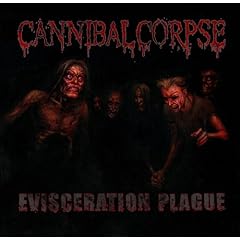
In other classic-death-metal news, the unstoppable Cannibal Corpse has recently anted up with the respectably fearsome Evisceration Plague (the title track--actually one of my least-favorite songs on the record--is streaming here). It's no Kill--the downright unbelievable 2006 effort that completely blew my mind and thoroughly decimated my perception of the Corpse as a fun yet fairly workmanlike, unimaginative and technically mediocre death-metal band--but it's still a lean, badass effort. And in keeping with the recent Cannibal Corpse trend of issuing documentaries--I'll say it again: Centuries of Torment is supremely rad, a sentiment shared by the Times' Ben Ratliff--Evisceration Plague comes equipped with a highly entertaining making-of DVD. Could the Cannibal dudes be any more unassuming or fun to watch? I think not. (Fun fact: Like Kill, Evisceration Plague was produced by Mr. Erik Rutan, Morbid Angel's second guitarist--and a killer backup songwriter--during the Domination era.)
/////
Lastly, wish Hexa luck with their British tour, and read Calvin Tomkins awesome newish collection of profiles, Lives of the Artists.
Subscribe to:
Posts (Atom)