Showing posts with label max roach. Show all posts

Sunday, August 07, 2022

'Out Front' @ Pitchfork

Honored to delve into my favorite jazz album, and one of my favorite albums, period, for Pitchfork's Sunday Review. 

In researching this piece, I went back to the tape of a Booker Little tribute broadcast I co-hosted on WKCR 89.9 FM back in 2001. Phil Schaap told me something incredible about Out Front on air that day that I've never heard elsewhere — I've decided to share the excerpt on YouTube in the hopes that other fans of Booker Little and this record might find it interesting.

Sunday, January 08, 2017

Man of (more than) words: Thank you, Nat Hentoff

"'Man of Words' is, I'm told by Booker [Little], dedicated to this writer. Whether the dedication is pejorative or not, the piece may indicate. Actually, it is Booker's description of the writing process. One begins with an appallingly blank sheet of paper and a few ideas. The writer is seldom positive about how the piece will develop, and after rereading what he's already done, he's spurred — sometimes — to go forward. Eventually, a high (or a crisis) point is reached when the writer know he's solved the problem and the piece will work out. The rest is embellishment, resolution or exhortation. Although there has been a considerable amount of fiction writing about music, such as Thomas Mann's Doctor Faustus, this work to my knowledge is one of the rare examples of a musician describing writers in musical terms. Booker's performance is an impressive display of sustained invention — and sustained clarity of line and feelings." —Nat Hentoff, from the liner notes to Booker Little's Out Front
I'm not a Nat Hentoff expert. Outside of his extensive liner-notes catalog, which any jazz fan knows well, I can't say I'm that familiar with his body of work. But I have to put down a quick note of gratitude for the series of recordings he produced in the early '60s for the Candid label — and more specifically for Out Front, which is simply my favorite jazz album of all time. It's very possible that this masterpiece would not have existed without Hentoff.  Also from the liner notes:

"I had been impressed by Little's playing, first on records and then in a series of night club appearances with Max Roach, because of his strong-lined lyricism and highly individual, thoughtful conception. His originals and arrangements for Roach were also uniquely free of ornamentation and were directly emotional. Finally, I asked Booker to write and organize an album of his own with complete choice of side men. The result is the fullest realization so far on records of Booker's scope as a writer and a player."
And, as Little would die only six months after sessions for this album concluded, at the shockingly young age of 23, Out Front would stand for all time as that fullest realization of what he was capable of. (Booker Little and Friend, a.k.a. Victory and Sorrow, the one post–Out Front studio LP Little made under his own name, is a strong record but not, to my ears, the immortal classic that Out Front is.)


To me, it says a lot that Little would dedicate a piece to Hentoff. Let alone a piece of such profound emotional depth. "Man of Words" is, simply, a complete and utter killer, a dirge-paced shot of pure pathos. (Any experienced writer will know well that feeling of facing, as Hentoff puts it, "an appallingly blank page," and though I can't say that a writer's private anguish is the first thing I think of when I hear the piece, I find it pretty damn fascinating that Little felt so moved as to musically illustrate that sensation!)

Phil Schaap once told me that Little learned he had terminal illness between the two sessions that produced Out Front (on March 17 and April 4, respectively, of '61). "Man of Words" was, perhaps unsurprisingly, recorded at the latter of the two. Is that terrifying moment at 3:45, where the band rests and Little fills the resulting abyss with two searing yelps — absolutely one of the handful of most intense musical events I've ever beheld on a record — really an embodiment of what the trumpeter perceived to be the writer's fear and uncertainty? Or is it a cry for help in the face of his own impending mortality? A little of both? Either way, I mean, Jesus... you don't hear that kind of crushingly naked emotion captured on tape that often.

(N.B. Little's own words from Hentoff's liners: "My own feelings about the direction in which jazz should be are that there should be much less stress on technical exhibitionism and much more on emotional content, on what might be termed humanity in music and the freedom to say all you want." A-fucking-men, sir.)

The rest of the album is, of course, a masterpiece. "Moods in Free Time" is staggering and, in my mind, basically unparalleled as an example of episodic small-group composition and arrangement. Another mega-dirge section in this piece inspiring a volcanic Eric Dolphy eruption, one of his most violent on record. And Roach's monumentally badass drum break leading back into the head. Just a phenomenally assured and personal sound oozing out of every pore of this recording. I thank Hentoff from the bottom of my heart for clearing a path by which this creative act could occur and be documented for all time.

And of course the rest: Charles Mingus Presents Charles Mingus, We Insist! Max Roach's Freedom Now Suite, The Straight Horn of Steve Lacy, Cecil Taylor and Buell Neidlinger's New York City R and B, Jaki Byard's Blues for Smoke, the fascinating Newport Rebels comp. Nat Hentoff was right there in the mix at this crucial jazz moment. I'm not trying to elevate his role above that of the musicians; I'm just saying that his behind-the-scenes role was pivotal. He clearly believed in what was going down in jazz, specifically in the mecca of NYC, at that time, and he wasn't going to let potential masterworks slip through the cracks. (I doubt very much that many others were lining up to arrange carte blanche record dates for, say, Cecil Taylor and Steve Lacy in 19-freakin'-60.)

So, yes, critic, columnist, commentator, "man of words," call Nat Hentoff what you will. But it's clear that he was a guy who made serious real-world moves on behalf of the art that he so dearly loved. And for that, we all owe him big time.

Tuesday, July 19, 2011

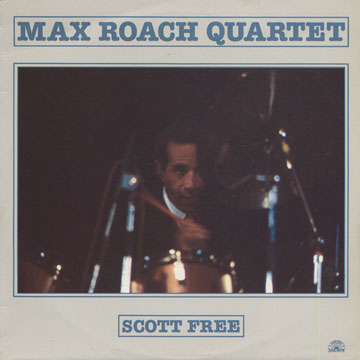
On record: Max Roach's Scott Free


One good reason to try out Spotify if you're on the fence: From what I can tell, the majority of the Black Saint and Soul Note catalogs are accessible via the service. For those unfamiliar with these imprints, a good analogy would be if all the great ’60s jazz labels (Blue Note, Riverside, ESP, Verve, etc.) were combined into two linked entities. In the Black Saint/Soul Note heyday—roughly the mid-’70s through the mid-’90s—everybody who was anybody recorded for label bosses Giacomo Pelliciotti and Giovanni Bonandrini. (I'll just throw out Andrew Hill, Bill Dixon, Sam Rivers, Steve Lacy, Paul Motian, Dewey Redman and Anthony Braxton as a random sampling.) In short, the combined BS/SN holdings are one of greatest jazz troves there is—easily up there with, say, the Blue Note or ECM catalogs. (Now that I think about it, I realize how important a strong visual aesthetic was/is to the success of Blue Note and ECM; BS/SN have many things, but this is not one of them.)

The availability of BS/SN on Spotify was a nice coincidence, given that my first order of listening business after Sunday's Odean Pope show was to study up on the Pope discography. Aside from his substantial work as a leader—I've been digging into the early trios on Moers as well as the wealth of Saxophone Choir material—he made a long string of ’80s Soul Note dates as part of Max Roach's quartet (or at times, with the strings-augmented double quartet).

I sampled a few of these today and enjoyed them all. But one date, 1984's Scott Free, stood way out from the pack. I cannot express to you how killer this album is. If you are a fan of gritty, pianoless freebop in the Ornette—or to cite another BS/SN ensemble, Old and New Dreams—mold, you have to hear it. There is just so much fire and abandon in this album. Pope and Roach make for a seriously punk jazz dream team—they're respectful players and great listeners, but they're always game to get their hands dirty.

One reason I bring up Ornette and his cronies is that Scott Free feels a lot like a Don Cherry Blue Note album. Like those stone-cold classics—especially the glorious Complete Communion—Scott Free is something of a suite: essentially a single 40-minute piece split in half. There's not as much thematic material to chew on as in the Cherries—the very solid motifs that are there were written by the Roach quartet's trumpeter, Cecil Bridgewater—but there are just as many changes of scenery, which is something I'm always looking for in jazz. (Pope's septet delivered a lot of that at Iridium the other night) For example, you hear traditionally outfitted solos throughout the course of the record—horn plus rhythm section—but you also hear a duo, as well as unaccompanied turns by Roach, bassist Tyrone Brown and Pope.

Part one of "Scott Free" (the work bears the same title as the album) starts off with some frenetic head action—very Ornette/Cherry-ish in its simultaneous tightness and barely-contained-ness—and quickly moves into a brief yet hardy avant-funk episode, with Roach working the backbeat and both Pope and Bridgewater wailing away. Then Bridgewater solos over a midtempo swing groove. Right here is when the brainmelting began for me: Bridgewater returns to the theme around the 7:00 mark, and seconds later, Roach explodes into a hurtling tempo. It's Pope's turn to solo and he just wants to get ugly, blowing with maximum brawn and heft and total punk rawness. This is the best of ’80s jazz right here: Unlike in a ’60s recording, the sound is totally dry and unromanticized, like the glare of cheesy stage lights, and the players are just going for it. This is honestly one of the most thrilling improvisational passages I've ever heard. There's no point in describing it—you just need to hear it. Max Roach, bebop king/innovator, squaring off with a total live-wire tenor. I love the Shepp and Taylor duets as much as the next guy, but this is the sound of a working band, of players building off a common language, a repertoire, starting at the top and just blasting off. I love the sound of it.

I won't go play-by-play through the rest of this (though I'm tempted to narrate the unfailingly tough and swinging, not to mention beyond-poetic, Roach solo near the end of part one, and the steely, wounded, blues-drenched, ecstatic, speaking-in-tongues unaccompanied Pope statement near the beginning of part two, the latter of which gives way—in a mindblowing display of good taste—to a Tyrone Brown solo with a laid-back Roach on brushes chugging along underneath). If you seek the grit and the fire and the surging jazz energy, presented with pro studio fidelity, just trust me and check this out. It's pure punk lava and you will not be sorry. Scott Free is what you want to hear in every sense: (1) An old-time master (Roach) at the helm. (2) An honest-to-god working band. (3) Young, hungry sidemen. (4) Great, non-invasive production—where the drums sound so loud and crisp and unglamorous. People tell you jazz languished in the ’80s, you shove Scott Free at them and tell them to shut it.

There's all kinds of other overlooked vintage Roach on Spotify, including several other Soul Note quartet dates (I dug Pictures in a Frame and In the Light), and some considerably weirder stuff, like the absolutely baffling It's Christmas Again (recorded just days/weeks after Scott Free, and featuring the quartet along with guests like Lee Konitz and Tony Scott), on which the band's funky improvisations serve as the backdrop to a polemical poetry reading (vocalized, I'm pretty sure, by Roach, but not, I'm pretty sure, written by him) that has less to do with Santa Claus than with a harsh reminder of racism and its role in America's founding. Then there's the weighty/classy Members, Don't Get Weary, a near-heartbreaking 1968 postbop quintet set with heavy sidefolk Charles Tolliver, Gary Bartz, Stanley Cowell and Jymie Merritt.

If you decide to sign up for Spotify, check all of this out, and if you haven't yet made up your mind, you can always buy a download of Scott Free for—I really can't believe this to be true—a measly $1.78 on Amazon. (They still haven't figured out how to price jazz albums with only a few long tracks.)

Lastly, in the course of writing this post, I've discovered that someone has uploaded video of an entire 1989 Roach quartet show to Dailymotion (a.k.a. second-rate YouTube). If you'll excuse me, I'm going to go check that out right this second.

Monday, June 23, 2008

Louis headstrong, etc.

First:

As an addendum to the Steely Dan post below, you MUST read this outstanding time capsule from Entertainment Weekly, wherein Donald Fagen returns to "[His] Old School," Bard, and reveals all you ever wanted to know about the Dan's undergraduate origins--yes, that includes Chevy Chase's drumming tenure with an early edition of the band. Someone should write a book about how many bands have been spawned out of a complex love/hate relationship with a college: This reads like Vampire Weekend circa 40 years ago!

*****


Not to be crass, but I can't say I was ever a huge fan of George Carlin, who passed away yesterday. But I am in the process of becoming a huge fan of Louis C.K., who posted a great Carlin tribute on his website today. And if Carlin could seem a little stilted at times, well at least he inspired the efforts of Mr. C.K. (Mr. K? I'm not sure how to render that.)

Laal and I caught LCK at Carolines last night and it was goddamn hysterical. (One thing I'm learning very rapidly is that if you shell out to see a big-name comedian like LCK or Daniel Tosh, who I mentioned in a previous post, you *will* laugh and you *will* enjoy yourself. The latter is not always true for bands, even if you love them. Maybe I just don't know enough about stand-up, but it's hard to imagine seeing a proven name like these guys put on a lackluster live set.) Laal had first turned me onto him a while back with this poetically simple yet hilarious--that's funny I'm saying that b/c LCK spent a sizable chunk of his set last night bitching about how people overuse the world "hilarious," e.g., "Do you know who I saw yesterday? Lisa! It was *hilarious*"--bit on the futility of trying to explain things to kids. And then during last winter's Stay FKD tour Tony had his un-iPod crammed with plenty of LCK.

Anyway, there's absolutely NOTHING avant-garde, "progressive," experimental or anything like that about Louis CK. Seeing him is like seeing a really badass straight-ahead jazz group that completely obeys genre conventions while simultaneously just destroying you with effortless flair. He's from the Regular Guy Bitching school of comedy, namely his act consists of gripes about everyday life--last night he sounded off on how lame and boring white people are, how insipid the conversations he overhears at Starbucks are, how annoying it is to call an American company and reach a Pakistani operator, etc. (My favorite bit: After complaining about how terminally annoying his three-year-old daughter can be, he's like, "Yeah, she can pretty much go fuck herself.")

So these are powerfully mundane topics, but LCK's secret is that he manages to project that *white-hot rage*--entirely irrational but no less overpowering--that all of us feel on a daily basis when we find ourselves in annoying situations. He basically gives voice to that inner scream of anguish we experience when we spill food all over ourselves, or trip on the sidewalk, or suffer any other day-to-day indignity. It's kvetching elevated to genius status, really, because there's you feel a constant empathy. Some guy in the back was screaming, "Tell 'em, Louis!" after every joke, and though he was totally disrupting the show, that pretty much approximated my inner monologue as well.

*****

Lastly, on the Cecil Taylor-and-drummers tip (discussed two posts back), I had a real moment with the Taylor/Max Roach duo disc, "Historic Concerts," the other day (actually the moment was technically with the second disc of the two in the set, each of which features a continuous 40-minute juggernaut). I had never truly connected w/ this release back in the day when I first heard it while researching a story on the 2000 reunion concert at Columbia (reviewed here by Ben Ratliff). But coming back to it, it made so much sense; it may be one of my favorite Cecil discs period. Once Max dispenses with his loopy gongs, vibraslap and güiro, he just starts burning in free time on the kit. For some reason, I had remembered his playing as being so much more straight-ahead, but there are many moments on this disc where if I heard it blind, I'd immediately think of a more bullish, martial Andrew Cyrille. There is one passage of overt swinging near the end and Cecil responds with absolute glee. As for the rest of Taylor's performance, let's just say that people fall over themselves to point out passages where his "tender" side comes out, but I've never heard him play anything even remotely as quietly beautiful as some of the calmer moments on this session. It's straight-up balladic at times, connecting directly with a great Roach quote from the Mandel book:

"I remember that time in his loft on Chambers Street, prior to our first Columbia concert. I said, 'Cecil, we've talked about a lot of things, but is there anything you feel you'd like to hear from me?' And he said, 'Yes, come to think of it. Most people don't know when I'm playing a ballad.' I said, 'Ok, why don't you give me some ideas.' So he went to the piano and played himself, Cecil Taylor. It was beautiful, but it was still Cecil. It was still in that complex range where I could just play out on it, or bash on it, or lay out, or do something very simple. It just *worked*.'"

You'll hear that on this record. (Cough, go here, cough, via Vanish Yourself.)