Showing posts with label paal nilssen-love. Show all posts

Wednesday, February 22, 2017

'Interstellar Space' at 50


New at Rolling Stone, my 50th-birthday tribute (measured from date of recording, not release) to one of my favorite albums, Interstellar Space. Features fresh input from Ravi Coltrane, Jack DeJohnette, Peter Brötzmann, Nels Cline, Ingrid Laubrock and others, as well as archival thoughts from the late, great Rashied Ali — a big thanks to everyone who took the time to speak with me.

Please check out this DFSBP bonus track, the complete transcript of my interview with Louie Belogenis, who has a couple of choice quotes in the piece but who shared so much more wisdom and insight regarding Coltrane's artistry in general and Interstellar Space in particular.

Few quick addenda:

*Here's the original Rolling Stone review of Interstellar Space, by Stephen "Hammer of the Gods" Davis, for anyone who's interested.

*I wanted to delve a bit further into the shadowy pre-Interstellar history of sax/drums duets in jazz but didn't want to veer too far off course. In addition to Ali's mention of undocumented duos with Archie Shepp (cited in my 2003 Rashied interview for All About Jazz, a Q and A I quote frequently in the new piece), there's this tantalizing passage in the book that comes with Revenant's Holy Ghost Albert Ayler box. The speaker is Mr. Milford Graves, discussing Ayler's visits to his apartment in East New York, Brooklyn. The time frame isn't specified, but my educated guess is that the below would have taken place around 1965, when the two were working together most frequently:

"We played a lot of duets at my house — just the two of us. The things that we did when he came over to my house aren't on any records; people hear the records and they don't hear the real Albert Ayler — the Albert Ayler who's relaxed when he's not around a major audience for which he's going to have to play something that people will dig, or play a tune he has recorded so he can sell some records." 

*Along similar lines, we also have, of course, the brief Coltrane / Art Taylor duet that commences about 30 seconds into "Countdown," as well as this epic Trane / Roy Haynes showdown from Newport '63 (thanks to Ben Ratliff and his essential Coltrane: Story of a Sound for the tip-off on the latter, which is sort of hiding in plain sight; there's more great Ratliff-on-Trane in this 2001 Times piece):


Not to mention the Interstellar-style duet that erupts between Trane and Ali around 3:20 into "Offering," recorded just a week before Interstellar itself:


*Here's a short list of other sax/drums recordings I love — either old favorites or albums I've discovered while working on the RS piece. There's a nice, long list up on the Free Jazz Blog (though now out of date, since new ones are surfacing all the time, e.g., Rich and Carson Halley's brand-new The Wild — thanks to Derek Taylor and Dusted for the tip-off — which I can't wait to check out in full):

Sunny Murray / Arthur Doyle, Dawn of a New Vibration
Sunny Murray / Sabir Mateen, We Are Not at the Opera 
Essential 2000s-era Sunny Murray, shaggy, swinging and sublime, on these two. Doyle and Mateen — both of whom double on flute — know what's up and of course hold their own next to the gentle giant.

Fred Anderson / Robert Barry, Duets 2001
Fred Anderson / Steve McCall, Vintage Duets
The former is maybe my single favorite sax/drums album next to Interstellar itself — a sort of freebop infinity, relaxed but never casual. The McCall set, recorded back in 1980, is a deep Chicago document.

Milford Graves / David Murray, Real Deal
David Murray / Jack DeJohnette, In Our Style (Fred Hopkins appears on some tracks)
Milford Graves / John Zorn, 50th Birthday Celebration, Vol. 2
Two of the best representations of Milford Graves on record, with two very different, very well-matched partners, as well as a fun, gutsy Murray/DeJohnette dust-up.

Denis Charles / Jemeel Moondoc, We Don't
Pure infectious exuberance as a Caribbean-born '60s survivor meets a loft-era alto wizard circa '81. Charles's roughly contemporary duos with clarinetist Peter Kuhn, featured on disc 2 here, are also excellent.


Peter Brötzmann / Paal Nilssen-Love, Wood Cuts
Paal Nilssen-Love / Joe McPhee, Tomorrow Came Today (McPhee plays pocket trumpet on some tracks; reissued as part of the Candy box set)
Peter Brötzmann / Shoji Hano, Funny Rat/s series
Pick your poison, really, when it comes to Brötz drum duets — I must have them all! — but I've gotten good mileage out of Wood Cuts and the third Funny Rat/s disc with the incredible Hano. Nilssen-Love and pretty much anyone, doing pretty much anything, is going to be worth your close attention, and the McPhee here is no exception.

Willem Breuker / Han Bennink, New Acoustic Swing Duo (Breuker also plays clarinets)
Kaoru Abe / Hiroshi Yamazaki, Jazz Bed

Two of the earliest, not to mention most wildest, entries in the sax/drums canon, with the Bennink/Breuker being recorded all the way back in late '67 (thanks to Ben Young for the tip-off). The Abe/Yamazaki, recorded in '71, is just so goddamn raw/real.

Paul Flaherty / Chris Corsano, The Beloved Music

Paul Flaherty / Randall Colbourne, Bridge Out!
Speaking of raw/real, here be Flaherty and Corsano, the standard bearers of the punk offshoot of the sax/drums monolith. Flaherty/Colbourne is a subtler yet just as compelling combo.

Jimmy Lyons / Andrew Cyrille, Burnt Offering

Jimmy Lyons / Andrew Cyrille, Something in Return
Cecil Taylor Unit blood brothers getting down to serious business.

Dewey Redman / Ed Blackwell, Red and Black in Willisau

Ornette blood brothers doing same.

Kid Millions / Jim Sauter, Fountain

Keeping the tradition moving. Molten noisejazz lava with surprising sensitivity. See also: Sauter's duet with Weasel Walter on this 2014 WW improv sampler, on which he also goes toe-to-toe with Marshall Allen and Marco Eneidi.

Jon Irabagon / Mike Pride, I Don't Hear Nothin' but the Blues
Another contemporary spin. Obsessive, insular and just downright perverse at times.

What are your favorites?

Saturday, March 26, 2011

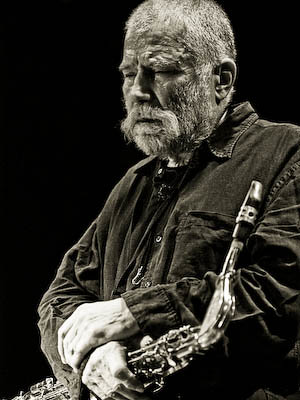
Sacred scrape: Stuck on Peter Brötzmann


Photo by Peter Gannushkin/downtownmusic.net.


[After-the-fact note: In the post below, I mistakenly ID'd two recent Peter Brötzmann records on Smalltown Superjazz, Sweetsweat and Wood Cuts, as studio records; it turns out that they are very much in-concert albums. I'm not sure where I got this erroneous impression—maybe it was from the fact that the recordings sound so damn great!—but I regret not verifying the info. In any case, I think some of the points below are of general interest—e.g., that free jazz should sometimes be documented in the studio, not just on stage—so I'm going to let the post stand. Maybe this is also an interesting illustration of how foreknowledge (even faulty foreknowledge) of recording circumstances can really color the way you listen. You do your best to square the sound with the story, or something. At any rate, I apologize for the misinformation.

The important thing to note is that these records rule, and I would recommend them to any Brötzmann fan, or novice, for that matter. This all brings up an interesting point, though: Aside from the obvious early triumphs—Machine Gun, e.g.—what are the great Peter Brötzmann studio sessions? Please advise, as I'm clearly not to be trusted on the subject! For that matter, what are the great free-jazz studio sessions? (Again not counting the ’60s, since many of that period's key statements (from Spiritual Unity to Interstellar Space) were studio documents.) I think of things like Cecil Taylor's New World records from ’78, where the fidelity is just marvelous and a real contrast to the live stuff from around the same time.]


I've been listening to little other than Peter Brötzmann lately. (The new Strokes album, which I'm really digging, is an exception—review in TONY next week.) I wrote here about a Tony Malaby/Paul Motian listening jag, and about how I often find myself thusly stuck, happily, in this or that groove. I tend to know what puts me there (in this case, it was Destination Out's posting of a fine Brötzmann solo album, 14 Love Poems [Plus 10 More], preceded by a flat-out incredible Brötzmann/Andrew Cyrille duo album), and to not know what'll get me out. I'm very much okay with.

Brötzmann is one of those periodically recurring jags for me. I can tell by my hard drive that I was on another PB kick not that long ago. What that tells you is that he's one of my masters. The pantheon includes Andrew Hill, the Wipers' Greg Sage, Morbid Angel, ALL, Fred Anderson, Bill Dixon, Cecil Taylor (of course), John Fahey and a lot of others. Roscoe Mitchell is a recent addition. These are inexhaustible bodies of work. Anyway, I was thinking about how the Brötzmann jag is like the pleasurable (at least for me) part of visiting the dentist, the part where they more or less sandblast your teeth with salt water and you bleed quite a bit, but afterward you can feel new regions of your teeth that you couldn't before since they'd been obscured by build-up. Apologies for the gross simile, but it's appropriate. I think of the phrase "sacred scrape." Brötzmann has an album with those words in the title, but I haven't heard it. Still, it gets to what I'm saying. His playing is like a scouring pad—you get addicted to the sting.

We are lucky that Peter Brötzmann is extremely well documented on record. You can hear the marathon, wild live shit if you like. There's so much of it. Lately, I've been feeling the Unheard Music Series reissues Fuck de Boere (featuring a whole bunch of trombones and some deeply grimy Derek Bailey guitar) and Alarm (another large group blowout featuring some demonic Alex Von Schlippenbach piano work and a multisaxophone cast including the Reverend Frank Wright). (Note: I actually bought both of these in MP3 form from the Amazon store; it's a clunky purchasing/downloading process, but not a bad option if you really need to hear something.) I've also been thinking about how important it is for free jazz, which in the mind's eye often appears like an exclusively in-the-wild sort of thing, to sometimes be documented in the studio.

There's something beautiful about the idea of hiring engineers, meticulously setting up mikes, checking levels, etc., not so that you can document what you've been doing, but so that you can document what you are going to do, right now. And for there to be a label that sees fit to be, like, "We're going to treat this like an album, for real," and bestow upon it beautiful cover art, a track sequence, etc. It's not so much this idea that every utterance of an improviser as great and committed as Brötzmann is to be treasured; it's more that you want to have these points of contrast in the discography. For many great free players, much of their recorded oeuvre is live (think of Cecil Taylor, whose studio sessions have grown rarer and rarer over the course of his career). If they're recorded well, live albums can be great. But they can also feel sort of second-hand, i.e., you weren't in the audience that night, so the musicians weren't playing for you. You're eavesdropping. With studio records, and I'm thinking particularly of two recent Smalltown Superjazz (update your site, guys!) records, Sweetsweat and Wood Cuts, both of which document the duo of Brötzmann and Paal Nilssen-Love in gorgeous, singing, close-up fidelity, the musicians are more or less playing for you, whoever you happen to be, whenever you happen to be tuning in.

You often hear of the "sterility" of the studio, but with "just go, now" improvisers like Brötzmann and Nilssen-Love, that's not really a factor. They're used to manufacturing energy, to just starting up the engine and seeing what might result. It's a wonderfully lavish treat to hear them so clearly, on great-looking, thoughtfully programmed records (on these two albums, the moods and textures vary a lot—from hurtling and abrasive ("Burnt Sugar" on Sweetsweat) to subtle and ornery ("Knucklin" on Wood Cuts, where Brötzmann whips out his trusty tarogato)). It's not so much that these are definitive performances, more true or worthy of documentation than the zillions of live recordings you can hear these musicians on. It's that they are keepsake presentations, meant to be heard and re-heard on whatever listening medium you prefer. We need to make sure that all our great improvisers, young and old, are documented this way.

It's a different story, of course, when you can actually attend the gig yourself. Peter Brötzmann is the honoree at this year's Vision Festival, taking place from June 5 through 11. Go here for the schedule. The Brötzmann evening includes both familar settings (a quintet with Nilssen-Love and some Chicago Tentet types) and unusual ones (a duo with vibist Jason Adasiewicz, which I can't wait to hear). I'm not sure if I'll still be sandblasting my ears with Brötzmann 24/7 at that point, but there's no way I'm missing that gig. Long live the sacred scrape.

P.S. Wow—I didn't know till just now that the man has a very nice official website. There's also the great discography, which I employ religiously.

P.P.S. Forgot to mention the Chicago Tentet, other than in passing. Some of these records are great. In keeping with the theme above, I'll recommend a studio effort: Broken English, from 2000, on the great Okka Disk label. This is exemplary large-group improvising. I'm not sure what kind of premeditated scheme is at work, but the players pay close attention to dynamics, to subgroupings, to diversity of texture—the kind of things that make listening to a sizable improvising band like this pleasurable rather than numbing. (And to be fair, the Tentet can at times be numbing.)

P.P.P.S. What incredible graphic sense the man has. It blows my mind each time I go back to Brötzmann. I think the way his records look is absolutely integral to his music. (Same goes for the titles—MACHINE GUN, BALLS and a thousand other great ones—which are among the most punk, not to mention apropos, word-to-music assignations of all time.) (ONE IDEA, THREE WAYS, people!) The cover of Alarm is a masterpiece.