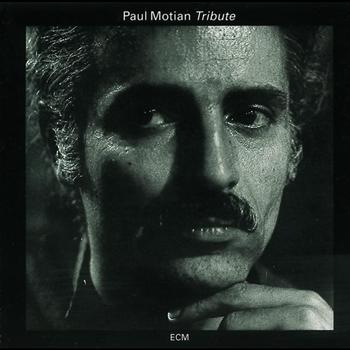
Paul Motian passed away yesterday at the age of 80. I wrote a brief remembrance for the TONY blog.
In looking back over my writings on Motian—and there were quite a few, especially from the last year or so, during which time I'd grown particularly obsessed with his work, and, fortunately, had the chance to see him live a few times—it occurred to me that verbalizing my feelings about his playing presented a particularly constructive challenge. More so than the work of many (probably most) musicians, what he did defied explanation. Even yesterday, when I heard the news and collected my thoughts, I was thinking, "How do I express what he meant, what he was up to all that time?"
He inspired me to look outside music, for one. Reflecting on the 2005 Frisell/Motian/Lovano record I Have the Room Above Her in 2009, I wrote:
"It's an aqueous record. You will probably not ever find a more convincing display of slippery, nonmetrical jazzmaking. This music floats and is *about* floating. I'm thrilled by the swirly weightlessness… It just hangs there, or drifts there, or flows there, or whatever air or water metaphor you want to apply. It's unmoored music."
Re-reading that, it's almost as though I'm saying you can't describe Motian's work in anything but elemental terms. His great achievement was to restore the wonder to jazz, the mystery. As I mentioned in the TONY write-up, there was a deep historical reverence to what he did—he would constantly repay his debts to Monk, Bird, etc. by performing their work—but there was nothing pat about his approach to repertory. He was always looking for the mystical element, the place where he could pierce convention and let weirdness whoosh in. There was no affect, though, no pretense of struggle; he just seemed to be searching for the most relaxed, human way to play the drums, a state of being where you could work in a given style (jazz) without letting it control you, without letting its calcified methods obscure the warmth and the magic at its core.
Listening to Paul Motian was, for me, remembering that jazz could really be—and not just in an aphoristic way—about constant surprise. Especially as a drummer, I relished the sense of bafflement his playing imparted. The logic behind what he was doing, the "Why?" of it was rarely clear to me (a phenomenon that other writers have eloquently described—see, for example, the end of this recent Ben Ratliff review). All I knew was that Motian never went on autopilot; he responded honestly, directly, instantaneously, at the risk of sounding obtuse, awkward, or, on the other end of things, at the risk of sounding utterly weightless. He was a ghost of a drummer, phantomizing the music. At his best, he seemed to bring everyone (players like Tony Malaby and Ben Monder, who played in a Motian band I caught in 2008) into this mindset, to slow down their metabolism, to resensitize and hypnotize them. Sitting there, inscrutable behind his ever-present sunglasses, he'd swing the watch in front of your eyes and you were entranced, even scared a little by the sensation of anti-gravity. He'd proceed up the route ahead of you, confiscating the road signs, and you were that much more attuned to each little signal.
Again, I've veered off into mystical territory, but Motian had/has that effect. As I reflected in October of 2010, I grew more or less addicted to the flavor of mystery that his music provided. So much so that I found myself unfairly criticizing jazz that didn't provide that, jazz that wasn't even trying to. Re: how another musician or band would even begin to deliberately imitate Motian's style, or the style of his groups, is beyond me. Players like the aforementioned Malaby and Monder—as well as Bill McHenry, who also played with Motian quite a bit—have clearly internalized something of his trance-jazz imperative, lessons about how even when playing, say, a standard, an improviser should never lose sight of the great beyond.
He may be gone, but I don't think his aesthetic values will slip away. He was gracious (and smart) enough to constantly collaborate with younger musicians—read this beautiful homage by Jerome Sabbagh—so there are many possible torchbearers, who have the good sense to honor what he was about without trying to reconstitute it.
Goodbye to a great dreamer of jazz, a conjurer of the sticks, cymbals, drumheads. Thank you for showing us the floating world.
/////
*Hear Motian's music all day (Wednesday, 11/23/11) on WKCR.
*My favorite Paul Motian record is The Story of Maryam, from 1984. It's on Spotify, so why not give it a shot? (Have you ever, in your life, heard anything like "Owl of Cranston"? Jesus…)
*The Motian chapter in Ben Ratliff's The Jazz Ear—readable in original Times incarnation here—is essential: reverent, but also funny. Ratliff clearly relishes the eccentricity of Motian's personality, as well as that of his musicianship. I love this observation dearly:
"I have heard him call a room full of people, at one time, 'man.' (As in 'Hey, thanks for coming, man!')"
*The Inconstant Sol archive contains two fantastic bootlegs of Motian's short-lived ’70s trio with Charles Brackeen and David Izenzon. I recommend this one.
*Ted Panken and Howard Mandel have each posted illuminating archival interviews with Motian.

