This coming weekend marks the live debut of a new band I'm in called Skryptor. The lineup consists of Tim Garrigan on guitar, David McClelland on bass and myself on drums, playing music we've written as a group, plus (so far) one cover.
This is a significant project for me, and not just because I'm excited about how the songs are shaping up. If my 15-year-old self could somehow read the first paragraph of this post, his mind would be blown. Tim (formerly of Dazzling Killmen, You Fantastic! and other projects) and Dave (also of craw) are musicians I've looked up to for more than two decades. It's no exaggeration to say that the music each of these men helped to create in the early '90s significantly influenced the direction of my life from that point on — as a musician, I consider myself to be a product of an unofficial movement they were each an integral part of: progressive Midwestern post-hardcore, if you want to put a name on it (see also: Season to Risk, Colossamite, Cheer-Accident and many others). I've collaborated with both of them before — with Dave in the band Bat Eats Plastic (originally known as Today) and with Tim backing him in his solo singer-songwriter work — but never at the same time, and never as what I'd consider to be a mature (or at least maturing) musician who has significant experiences and ideas of his own to bring to the table.
For a little preview of the music — concise yet complex instrumental rock that falls somewhere between prog and punk, and sounds (to me, at least) not all that much like anything any of the three of us have done before — check out the clips posted on our Facebook page.
Here's all the info on our first two shows, taking place in Kingston, NY, on Saturday and in Queens on Sunday. Joining us for both will be the awesome Xaddax, featuring Tim's old Dazzling Killmen bandmate Nick Sakes. Ultraam — a psych-meets-jazz improv band featuring members of Mercury Rev, Luna and Trans Am — will top the Kingston bill and maniacal local avant-death-metalists Pyrrhon (featuring onetime DFSBP contributor Doug Moore) will headline in Queens. More info below and at the FB event pages I've linked to.
*There is a new Aa album coming out in November on the Brooklyn label Fire Talk. I've been working with this band on and off for something like 11 years, and my collaboration with founding member Aron Wahl stretches back even further. In the past, I've played more of a sideman role in Aa, but this time out, I'm more creatively invested: I helped to compose and arrange the music on ZebrAa along with current ringleader John Atkinson, fellow longtime/sometime member Mike Colin and more recent recruit Julian Bennett Holmes. John and Mike are old friends, and Julian a newer one — it's been a pleasure honing this body of work live and in the practice room with these guys during the past few years. I feel that songs like first single "Trash Hits" (see below) add meaningfully to an already rich catalog. There is talk of an NYC record-release show in December, so stay tuned.
*Also out in November, via the venerable, long-running Skin Graft label, is a new deluxe reissue of Dazzling Killmen's Face of Collapse, one of my favorite albums, full stop. (As mentioned previously on DFSBP,the LP's centerpiece, "In the Face of Collapse," is the song that inspired this blog's name.) I'm proud to have contributed a new oral history of the record to the package, a document that draws on interviews I conducted with all four band members earlier this year. Both collectively and individually, these men — Blake Fleming, Tim Garrigan, Darin Gray and Nick Sakes — are musical heroes of mine. If you're not familiar with their work, Face of Collapse is the place to start. Preview and preorder the new edition at Bandcamp.
Related: I'm working with Tim in a new-ish band called Skryptor, also featuring David McClelland of craw. We've got a good amount of music written — which, I'm excited to say, sounds very little like anything any of us have done with our other projects — and I hope we'll be performing before too long. More news when I have it.
*I also contributed interview-based liner notes to two other recent releases: the Cookers' The Call of the Wild and Peaceful Heart on Smoke Sessions and the Jim Black Trio's The Constant on Intakt. I love both of these groups and would have been tuning in to either album as a fan even if I weren't involved behind the scenes, so these gigs were an absolute pleasure.
*It was a thrill to attend and review Cat Stevens' first NYC show in 40 years on behalf of Rolling Stone. A truly legendary artist who, I was happy to find, can still astonish in the live setting.
*Likewise, I loved speaking with Maynard James Keenan about music, comedy, family, the military and many other topics touched on in his upcoming biography, A Perfect Union of Contrary Things.
Beyond that, I've been working hard at the day gig; spending time with my wonderful girlfriend, Alex (and watching her awesome company grow); listening to tons of Crowbar (with a bit of Meshuggah, Asphyx, Immolation and Entombed breaking things up); studying music (ear training, keyboard, etc.) with my friend and bandmate Nick; reading Raymond Chandler; running regularly; and cooking more than I ever have in my life, thanks in large part to the easily recommendable Blue Apron.
As this blog nears its 10th anniversary, I'd just like to say thanks to anyone still tuning in, regularly or irregularly. Your attention and encouragement are greatly appreciated.
The previous post was about my reaction to the craw-centric events of the past few days. All I wrote there applies to my experiences of the Cleveland and NYC shows, which surpassed any and all expectations. (Go here for photo and video evidence.) But I left Saint Vitus last night with a different feeling, call it a community awareness, a sense of how an intense, bizarre and uncompromising underground band can become a portal to a shared feeling of transcendence.
I saw so many fans moved on such a deep level by these performances, both those who had seen the band back in the day and those who never got the chance. I saw band members giddy with disbelief at finally getting the reception they'd always deserved but rarely ever got before. I saw a mutual celebration of the enduring art that craw created, honed and perfected with painstaking effort all those years ago. I saw 75 minutes of classic songs, performed with pure spirit fire and channeled through a frontman who radiates a raving, possessed intensity. I saw sublime musical terror of exactly the sort I remember witnessing when I was a teenager—and all while standing within inches of some of my dearest, oldest KC friends (shouts to Drew, Kyle and Jeff), who saw craw with me the first time around, and my NYC blood brothers, who have loved the band's records for years but hadn't seen them play.
It was all just beyond magical. In particular, I want to thank Drew (a.k.a. Remi Thornton) for coming along for the ride and taking some brilliant pictures; Northern Spy and Aqualamb for all their hard work on the box set; my friends and STATS bandmates Joe and Tony (and constant comrade / special guest Nick) for sharing the stage with me at Saint Vitus; the Great Iron Snake, Murderedman and Black Black Black for their great opening sets; the Grog Shop and Saint Vitus for being such gracious hosts; Esra Y., Ron K., John P. and Georgia Z. for the CLE hospitality; Brad Cohan, Evan Harms and all the other writers who previewed the shows; new friends Patrick W. and Rob H. for their enthusiasm and fellowship; all the kind, gracious fans I met at both shows; and of course Chris, Rockie, Neil, Zak, Dave, Joe and Will for playing (and screaming) their asses off. I also want to thank Torsten Meyer for the following video. (More documentation of both shows coming soon.)
Lastly, I want to thank Pyrrhon vocalist and writer extraordinaire Doug Moore for putting together the below article on the band, a fine piece featuring insightful commentary from craw's Joe McTighe. The piece was slated to run before the shows, but did not go live as planned. I reproduce it here for posterity, and as a complement to the wealth of articles found here.
"Meet Craw, the Greatest '90s Noise-Rock Band You've Never Heard"
by Doug Moore
[See the end of this post for context.]
In many ways, the story of the '90s-era Cleveland bandcraw
is a classic tale of monastic devotion and unrewarded work. But it's
also a triumph of stubborn individualism, a "toxic cultural stiff-arm,"
as vocalist Joe McTighe put it in an email interview. Though
unrecognized in their time, the band's four albums constitute a vital
piece of the bedrock from which modern underground metal and hardcore
now proceed. A new deluxe reissue from the Brooklyn labels Northern Spy
and Aqualamb, 1993–1997, aims to bring this influence to light.
Craw
emerged from a fertile period in the American rock underground. At the
end of the '80s, when the band formed on the campus of Case Western
Reserve University, many of the barriers that had previously constrained
rock's artistic expansion had fallen. Weird stylistic mutations like
post-punk, No Wave, math rock and thrash metal thrived via DIY recording
and touring methods. Eventually, these styles began to interbreed.
One
byproduct of this mix was a frightening expanse of shifting time
signatures, blaring amps, shrieking chords and yowling singers, known
variously as post-hardcore and noise rock. Many of the bands that
first explored it—the Jesus Lizard, Melvins, Today Is the Day,
Neurosis, Helmet—achieved surprising renown. And most of these acts
shared bills with craw.
But comparing craw even to
these oddballs does a disservice to the specificity of their sound: a
staggering, weaving keen-roar; a relentless improvisational churn, by
turns sinister and poignant, anthemic and ambiguous. Their music
combined metal heft and layered noise; jazz chords and compound rhythms;
insane structural ambition; and McTighe's swerve-throated antisinging,
in which he incanted elliptical yarns informed by contemporary science,
politics and literature, leavened with snark. (Asked what contemporary
writers best capture craw's lyrical concerns, McTighe responds: "Pynchon
in Gravity's Rainbow and some of what J.G. Ballard wrote. Both
writers create worlds in which the social systems overwhelm and
transform the individuals inhabiting them.")
In order
to achieve the technical mastery required to execute their staggeringly
detailed songs, craw subjected themselves to a brutal discipline. They
practiced together incessantly, sometimes daily, while living in
privation and working crappy jobs to get by. The gritty details of these
gigs would creep into McTighe's lyrics; a gutter-cleaning job that both
McTighe and guitarist David McClelland held inspired the 12-minute epic
"Days in the Gutter/Nights in the Gutter."
Craw's
efforts produced three dizzyingly inventive '90s LPs, but never
translated into a large following. Their demanding approach—too feral
for hipsters, too shredding for punks, too ragged for metalheads, too
smart and weird for virtually everyone—made them difficult to market,
and thus difficult to sustain. The lengthy tours craw undertook were
especially taxing; McTighe remembers his frustration well: "At the time I
romanticized it as doing my bit in the marketplace of ideas. This
self-delusion continued until poorly attended shows burst that bubble."
By the time craw connected with renowned art-metal label Hydra Head for 2002's Bodies for Strontium 90, the exhausted band had begun to drift apart. The members went their separate ways shortly after its release.
Craw's
grueling run won them scattered but devoted admirers, though. Among
them was noise-rock prime mover and recording legend Steve Albini, who
worked on their first three albums. ("They never imitate," said Albini
of craw in a 1997 interview. "Other bands imitate them.") Also in Craw's
corner were the artist Derek Hess, who provided them with album cover
and flyer illustrations; and Hydra Head label boss, and former leader of
acclaimed avant-metal outfit Isis, Aaron Turner. "Their appeal was
pretty black and white—people either fell in love with it or just
didn't know what to do with it," says Turner of the band.
But craw's biggest fan is almost certainly the Brooklyn-based writer and
musician Hank Shteamer, who admits that he's tipped into full-on
obsession at times. "In terms of my own listening, I hold these albums
up alongside the work of John Coltrane, Led Zeppelin and other
acknowledged masters," says Shteamer of craw. He first encountered them
in the mid-'90s while growing up in his native Kansas City, and has
since become their unofficial historian and chief public advocate.
Frustrated
by craw's lack of critical recognition, Shteamer recently recruited the
indie record labels Northern Spy, Aqualamb and Hydra Head for a
crowdfunded campaign to reissue Craw's first three albums as 1993–1997,
a vinyl box set with a companion oral history. Thanks in part to the
success of the release, craw will play two reunion shows—one at the
Grog Shop in their native Cleveland on March 11th, another at Brooklyn's
Saint Vitus on March 12th, with both shows featuring all seven members
who appeared in various combinations on the band's four albums.
Craw
have reappeared in a heavy music landscape that makes their prescience
obvious. Freewheeling stylistic alchemy has become commonplace;
dissonance and dense rhythms have infected every corner of the metal
world; wild dynamic shifts garner applause rather than confusion. In
short, metal has become highbrow, just like craw. Even McTighe's lyrical
themes—technology run amok, the invasive creep of surveillance and
corporate power—now scan as predictive, though their author credits
his found sources ahead of his own foresight.
Both
Shteamer and Turner agree that craw would more readily find fans today,
and this consensus was part of the impetus for Shteamer's reissue
campaign. But ultimately, such questions are immaterial to the band's
members and always have been. They were concerned solely with pursuing
their wild, withering vision—a purity for which their struggles were a
small price to pay. And those struggles produced the kind of memories
that nobody would give up.
"We got the songs," says
McTighe of his years in craw, "The songs that are part of us by choice
and by repetition, the songs that were ignored by most yet received as
gospel by a few fanatics, songs that are a challenge for us to play
well, songs that remind us of our time together—petty bickering as
well as genuine friendship, songs that also remind us of the people we
met on the road—the freaks, the outcasts, those beyond the pale, those
with whom we immediately recognized as fellow travelers, those that
helped us when we didn't expect help and those that took the air out of
our tires (literally and otherwise), the songs around which our lives
were shaped for many years."
Joe McTighe and Will Scharf of craw, with the author in background. Photo: Remi Thornton
I have often called craw my favorite band. To declare something one's favorite anything is a forceful but not all that evocative statement—one that holds little meaning for anyone who isn't saying it. Yesterday, though, sitting on the floor in a rehearsal space in a dingy building behind a lumber yard in Cleveland, watching and listening to craw rehearse for their shows tonight in town at the Grog Shop and tomorrow at Brooklyn's Saint Vitus, I felt like I had a better sense of exactly what I've meant by that all these years.
We speak of being "moved" by music, or any kind of art. That is to say, we're taken somewhere. Sometimes that transport is gentle, a subtle and gradual conveyance. Other times, it's more urgent. To some degree, any heavy music is transportive—exposure to extreme volume, way beyond the cacophony of, say, an average urban commute, has a certain automatic effect. But what I realized about craw's music yesterday, as vocalist Joe McTighe howled and grimaced over writhing stop-start cadences, monumental swells and catharses, and perversely shimmying riffs, is that it is essentially unbearable. It elicits in me a kind of full-spirit wince, a masochistic thrill.
It is so harsh and unrelenting, but also so full of naked feeling and twisted insight. Their creations are fanatical, fantastical, so bizarrely outside the realm of what so much other music, even heavy music in craw's general aesthetic ballpark, would ever think to attempt. It is a private, insular art, so clearly in service, first and foremost, to its creators' obsessive vision. It doesn't care if you're listening, and yet its self-presentation is, for all its complexity, immaculate. It is a hyperarticulate shriek, so stupendously apart from the notion that music is meant to accompany anything, even, say, stereotypical metal behaviors such as headbanging or moshing. You don't do anything in its presence except for behold it, and, in my case—and I've seen this reaction in a few others—sort of tremble before it, fascination mingling with fear. That feeling is the closest thing to the sublime that I have known in art—it's the same for me now as it was 20 years ago.
And having seen the 2016 incarnation of craw up close, I can tell you that the magic is intact. I'm happy to report that this band—bands, really, since craw is performing this weekend in at least two equally brilliant but completely different lineups—can still pin you against the wall. Consider this an invitation to come experience the feeling for yourself:
To any Cleveland or NYC folk who might be reading this, I hope you will join us this weekend for two special craw reunion shows in support of the recent box-set release. If you plan on attending, I recommend purchasing advance tickets via the links below:
These shows will feature music from all four of the band's studio LPs, performed by all seven members who appeared on those albums. Plus some special surprises!
These will be the first craw shows of any kind since 2010, the first with vocalist Joe McTighe since 2002, and the first with several of the ex-members since 1994–95. The Saint Vitus show will be craw's first live appearance on the East Coast since 1997.
There will be plenty of merch available, including box sets, new T-shirts and signed prints of the above poster, designed for the occasion by the awesome Derek Hess.
Today marks the release of the new Kickstarter-funded craw box set on Northern Spy Records (designed by Aqualamb), as well as the digital release of the individual remastered albums that make up the set. It makes me happy beyond words to see this music back out there in the world.
Tiny Mix Tapes (review) Noisey (feature) New York Times (1993–1997 included in the 2015 Holiday Gift Guide; scroll down to the Music section, Pop & Jazz)
Received physical proofs for the 200-page bound books that will come packaged with the upcoming craw vinyl box set. Contents include a complete, previously unpublished oral history of the band, newly proofed lyrics, tons of photos and ephemera, etc.
Couldn't be happier to see this dream project—20 years in the making, all in all, and my eat/sleep/breathe obsession for the past couple years—become a reality. Thank you to all Kickstarter backers, Aqualamb and Northern Spy. (And to Ben Young for crucial inspiration.)
Just wanted to share some exciting news re: the craw reissue…
The box set, titled 1993–1997, will be out 12/11/15 from Northern Spy, with design by the fine folks at Aqualamb. Go here for preorders, and to read a detailed description of the release.
Craw will be playing two special reunion shows in support of the release. All seven ex-members of the band will be present at each show, performing material from all four of their studio albums in rotating lineups. This has never happened before and most likely won't happen again. These will be the first craw shows of any sort since 2010, the first craw shows featuring vocalist Joe McTighe since 2002 and the first featuring the band's classic five-piece configuration since 1997.
Friday, 12/18/15 The Grog Shop; Cleveland, OH
Info/tickets here
Saturday, 12/19/15 Saint Vitus; Brooklyn, NY
Info/tickets here
I'm generally superstitious about announcing events before they come to pass, but now seems like the right time to mention that on Monday, July 20, I'll be starting a new full-time job as a senior editor at RollingStone.com. I'm thrilled and grateful for the opportunity.
I leave behind a dream job (a series of them, really) at Time Out New York, a publication where I spent 10 great years. I'm tempted to shout out all my TONY friends and former colleagues, who helped make the past decade of my working life exceedingly rewarding, challenging and fun, but I'm worried I'll leave out a crucial name or two.
Best just to say a heartfelt thanks to all those folks, as well as everyone else I've worked with during this time: publicists, bookers, artists and just about anyone who devotes their life to the business of music in NYC. It's been wonderful collaborating with you, and even though my new job will have more of a national focus, I look forward to furthering those relationships as time goes on.
I'll still be checking out as much music as possible, live and recorded, and covering it whenever and however I can—including, as always, on DFSBP. Once I'm settled in, I'll post my new work e-mail address for anyone who might want to get in touch. Please feel to get in touch via e-mail: hank [dot] shteamer [at] rollingstone [dot] com.
*****
With help from my partners at Northern Spy and Aqualamb, I'm hard at work on my Kickstarter-funded dream project, the craw box set. I'll post any major updates concerning the release here, but you can also keep tabs on all craw-related matters via Facebook.
*****
My own band STATS, in which I play drums and share vocal and composition duties with my dear friends Tony Gedrich (bass) and Joe Petrucelli (guitar), will release a new LP, Mercy—our debut full-length—via New Atlantis Records on August 8, 2015. Go here for more info; stream a track here; and stream a different track and read an interview here. If you listen, please listen loud.
1) I'm thrilled to report that the second Craw Kickstarter campaign, complete as of June 2, has met and exceeded its funding goal. The good people at Northern Spy and Aqualamb, the members of Craw, and myself are already hard at work on the vinyl box set, which will be out later this year. (Above is a subject-to-change rendering of the 100-page, Aqualamb-designed book of photos and lyrics that will accompany the set.) A big thanks to any DFSBP readers who pledged, helped to spread the word or simply gave the campaign a look. Stay tuned!
2) On May 1, I spent more than three hours talking with Milford Graves, a longtime musical hero of mine, at his home in Jamiaca, Queens. A big thanks to Red Bull Music Academy—and my editor there, Todd Burns—for posting an extra-lengthy Q&A drawn from this conversation.
3) I've spent much of this past week on the road with Psalm Zero. Thanks to all bookers, bands (especially the unrelenting Massachusetts noise-rock quartet Livver) and friendly folks who helped to make this trip fun and fruitful. I enjoyed all the shows, but I'd like to single out BRIEFCASEFEST in Toronto on Friday as particularly great experience. Was absolutely floored by the local bands Godstopper and Ayahuasca, each of whom specializes in a unique strain of proggy, melodic post-hardcore that really struck a chord with me, as well as our NYC comrades Couch Slut (a stunningly intense and unsettling band; I'm still reeling) and Pyrrhon (a band that pushes technical death metal into a zone of pure info-overload mania).
Thus concludes my stint working with PZ. I'd like to thank the band's co-leaders, my friends Charlie Looker and Andrew Hock, for a challenging, rewarding experience. They're both extremely creative, prolific and uncompromising musicians, and I can't wait to see what they do next, both together and separately. For the curious, here's a video of a show I played with Psalm Zero in April. If you're not familiar with the band, I firmly believe that their 2014 debut, The Drain (which I wasn't involved in, to be clear), is a new classic of dark, heavy, forward-thinking rock.
Update: I'm thrilled to report that the second Craw Kickstarter has reached and exceeded its goal. The box set will be out later this year from Northern Spy. Our fund-raiser is still live through Tuesday, June 2, at 9pm EST; go here to preorder the music in both vinyl and digital formats.
In March of 2014, I launched a Kickstarter campaign with the goal of reissuing three records by Craw, my favorite band of all time, in a limited-edition vinyl box set. I did as much research as I could, but I was in over my head. This was the gesture of a fan, not of someone who had any idea what it meant to put out records. I counted on my enthusiasm for the project to carry me through, and while I failed to meet the financial goal I set, I was thrilled with the response.
On Monday, May 4, I'm relaunching this effort. (I will add the link here as soon as the new campaign is live.) The basic objective is the same: to reissue Craw's first three albums, all out of print for roughly 20 years, as a limited-edition vinyl box set. But the details are very different.
Much of the constructive criticism I received re: the first campaign was that my numbers were off—the asking price for the box set was simply too high. At the time, since I had put so much work into the campaign, I wasn't really interested in hearing feedback. I believed in the project, and I was devoted to my original vision. But after the fund-raiser ended and I was able to take a step back, I could see that the numbers were in fact flawed. Because of what one commenter referred to as "the economics of scale," producing 300 copies of the set rather than the intended 100 would greatly lower the per-unit price. Still, though, I wasn't sure I was ready to get back on the Kickstarter merry-go-round—as anyone who has launched a fund-raiser on that or any other platform could tell you, it's a rewarding but somewhat draining experience. For a while, I was very close to relaunching a digital-only reissue effort, obviously a drastically less costly endeavor. This seemed like the most direct route to my true goal, which is to properly situate Craw in the discussion surrounding progressive, aggressive underground rock music (post-hardcore, left-field metal, math rock, art rock, noise rock, what have you; all are inadequate to describe this band, but they're as close as one can get when speaking in shorthand), to get the sounds in people's ears and let the records speak for themselves, which I knew they would.
But vinyl was the holy grail all along. To reissue out-of-print albums on vinyl, especially in a collector-friendly, properly annotated, handsomely designed box set (Triple Point's Ben Young specializes in previously unreleased music, but aesthetically, something like call it art is the gold standard for me), is to restore the dignity of the music in question, to say, "For whatever reason, or combination of reasons, these sounds, so laboriously, lovingly crafted, have been overlooked. Let's re-present and reexamine these great works."
Enter Northern Spy, a label I've been a fan of for quite some time. I am extremely grateful to the men that run this label, Adam Downey and Tom Abbs, for saying to me, "Let's give this another shot." And not only another shot, but a better shot. We've been working on the figures for the past few months, and they look good. Craw Kickstarter 2.0 won't be a slam dunk, but I hope and believe that it will feel more like a free-throw attempt than the half-court desperation shot that was the first campaign. If we succeed, the Craw box set will become part of a beautiful, boundless catalog of avant-garde music, encompassing artists as diverse as John Butcher and Shilpa Ray, Chicago Underground Duo and the USA Is a Monster, as well as those who are closer to home and, in some cases, personal friends and collaborators: Seaven Teares, Zs, Aa. Much like Craw were, Northern Spy is bigger than genre. Way bigger.
Also on board this time around, handling design and a custom liner-notes booklet, is Aqualamb. Owners Johnathan Swafford, a former resident of Craw's birthplace of Cleveland, and Eric Palmerlee are musicians and artists with strong ideas about the value of packaging and presentation. Their business is dignifying the music they release with gorgeous 100-page softbound books—not booklets, actual books. I know they will make the Craw box look and feel so much richer than it would have otherwise.
And then there is the music itself. I've been at this a long time—"this" meaning loving music and spreading the word however I can. Craw's music is simply on another plane for me. As any reader of this blog will understand, I love all kinds of music, in all kinds of ways. And generally, I have no interest in quantifying that love. But this is a special case: I've loved Craw's music for longer, and with more intensity, than any other music. Sure, the fact that Craw are an impossibly obscure band feeds into my vehemence, but I don't love this music because it's obscure. I love it because it's eerie, mesmerizing and shockingly intense, because it's as heavy as any music I've ever heard, but in totally counterintuitive ways. I love it because it's sinister yet sad, unhinged yet rigorous, insanely complex yet strikingly coherent. I love it because it feels true and profound to me.
I've spent so many late nights and early mornings dreaming of the day when people would have a chance to hear what I hear in this music, working to get the details of these two campaigns right. This new effort feels more solid. With the last campaign, my heart was in the right place, which is a significant detail, but the logistics weren't in order. This time, with the help of Northern Spy, Aqualamb and my good friend and musical collaborator David McClelland—Craw guitarist, cowriter and cofounder—I'm confident that they are. This work has not been burdensome, because the music continues to bear the weight I place on it. I go back to it, year after year, and the feeling is the same.
The poster you see above advertises the first Craw show I saw, in Kansas City, MO, on April 21, 1995. It would not be an exaggeration to say that that show changed my life. After all, I'm sitting here, writing this, 20 years later. If you enjoy this blog, or any of the words I've written, or music-related content that I've produced, or music that I've made, I would be extremely grateful if you would simply take a look at the Kickstarter page when it goes live. Watch the video, read the text, get to know the campaign, see what we're trying to do, keep up with the effort on Facebook. Donate if you're interested; spread the word if you're so inclined. Your attention would mean so much to me.
*On Friday, I made my debut as the live drummer for Psalm Zero. I love this band, and I'm honored to be working with them. Friday's performance marked my first time using a double kick pedal at a show. As a metal fan, I've enjoyed double-bass drumming for 20-odd years, but as a player, I come more out of the post-hardcore tradition—and later the Zeppelin/Sabbath lineage—where single-pedal performance reigns. Rehearsing over the past few months, it's been nice to complete this circuit, so to speak, and help bring songs from The Drain, PZ's excellent 2014 album, to life.
Our next show is April 15, opening for Liturgy at Saint Vitus. (Friday's show was also at Vitus, and I should mention that it's a serious thrill to perform on a stage where I've seen so many of my metal heroes play.)
*I've also had a blast playing live with A. Rex & J. Rex, a rock & roll band co-led by my friend and Time Out New York colleague Andrew Frisicano, over the past ten months or so. Our next show is April 29 at Black Bear.
*My primary musical project, STATS—in which I handle drums and some vocals, and share composition duties—is currently in its 13th year of activity. We've recorded plenty during that time, but we've never released a full-length album. That changes this year with the late-summer/early-fall release of Mercy, a 40-minute set recorded in the summer of 2013, via the awesome New Atlantis label. I can't wait to share this music, the latest document of my ongoing collaboration with two of my best friends: guitarist Joe Petrucelli and bassist Tony Gedrich. Heavy, structurally ambitious prog-punk, now with more vocals! More news on this soon.
*I'm thrilled to be relaunching my 2014 Craw Kickstarter project in early May with the help of Northern Spy Records. Full update here. More news via Facebook.
*Two recent Time Out interviews that I was really happy to land: Jason Moran on the 80th anniversary series he curated for the Village Vanguard, during which I saw that amazing Charles Lloyd performance I raved about previously; and Antonio Sanchez on his fascinating solo-drums score for Birdman. It was a pleasure speaking with each of these gentlemen.
*I profiled one of my favorite drummers, Slint's Britt Walford, for Modern Drummer. The piece isn't online, but the issue is out now.
*Two recent "classic rock" primer pieces for GQ, on—surprise, surprise—Sabbath and Zeppelin. As anyone who knows me well will tell you, I'm constantly finding excuses to rattle on about one or the other of these bands during my daily life, so it was healthy for me to have these outlets.
Please do me favor and watch the 1969 Danmarks Radio performance linked at the end of the Zeppelin piece. For years, I've hunted in vain for Zeppelin footage that's not plagued by excessive Plant/Page-centricity and/or stupidly ADD-ish editing, i.e., footage where one can actually Watch Bonham Slay. This video is the holy grail. The Bonham-focused bit from 4:00–4:20 is heart-stopping.
The Craw Kickstarter campaign has ended, and we've failed to meet the goal. Still, we received over $17,000 in pledges—a truly incredible sum. Again, a huge thank you to everyone who helped us get as far as we did.
My enthusiasm for this music, and my determination to help resurface it, is not going anywhere. We're already strategizing a more feasible relaunch of this project, so please stay tuned. In the meantime, why not listen to some Craw?
The Craw Kickstarter campaign is now live. To anyone reading this, I'd be very grateful if you could click over to the page, watch the video and have a look around. Whether or not you're inclined to pledge, please share this link with anyone who might be interested. Pardon the brevity here, but I've left it all on the field, so to speak—everything you need to know about this project, you'll find at the link above. Sincere thanks to anyone who has already pledged or helped to shine a light on this endeavor.
I'm days away from launching a Craw-related project I've dreamed about for years. Watch this Facebook page, and this very blog, for updates.
P.S. The first music review I ever published outside my middle-school paper, on Craw's Map, Monitor, Surge (CLE Magazine). This inaugurated a longstanding tradition of editors mangling the spelling of my last name in print.
Over the past week or so, Pitchfork has been polling readers, staffers and contributors re: their favorite albums from the years 1996 through 2011, i.e., the 15-years-and-counting lifespan of the site, via a project called the People's List. My friend and former TONY staffer Colin St. John tipped me off to the project—check out his own list and commentary—and after a little procrastination, I began frantically compiling my top 100 in time for yesterday's deadline. You can view my list here, and those of other Pitchfork writers here.
Lists of this nature are strange; that fact is well established. They are strange because when it comes to such a vast and vastly diverse art form as music or movies or books, consensus is pretty damn near impossible. Phil Freeman wrote passionately and persuasively on this topic last January, with regard to his feelings of alienation from the Kanye-obsessed hordes of fellow Pazz and Jop voters. In one sense, I do not share Phil's feelings; I really enjoyed My Beautiful Dark Twisted Fantasy (the consensus critical pick for best album of 2010), and I included it on both my year-end top 10 list, and this most recent 15-year-spanning list. On the other hand, when I view friends' and colleagues' contributions to the People's List—here's a typically well-rounded one from another FAFTS ("friend and former TONY staffer"), Corban Goble—I can't help but feel a little apart from the Conversation at Large.
Again, this not out of hostility or reactionary-ness re: what I'll call the Indie-Rock Canon that has cohered during this Pitchfork lifespan (and which has in recent years expanded to included hip-hop/R&B—both mainstream and underground—as well as certain strains of metal, electronica, experimental music, etc.). I included quite a few records in that zone, including three Strokes albums, a bunch of Will Oldham selections, LPs by Sleater-Kinney, Elliott Smith, Dinosaur Jr., Battles, Dr. Octagon, Deerhoof and Sia, and a few more. And I like a lot of the other consensus faves, albums by Radiohead (I haven't listened to OK Computer in a good while, but I got really into it in college), Joanna Newsom (Ys is a beautiful, epic album), Built to Spill (ditto re: Keep It Like a Secret), Modest Mouse (the first song on The Lonesome Crowded West destroys me, but on the whole, I like This Is a Long Drive… better; didn't realize that was from ’96—probably should've included it!), Yeah Yeah Yeahs, White Stripes, Japandroids, Fucked Up, Wavves, the Flaming Lips, Animal Collective and on and on. But it would've been disingenuous for me to include any of those latter albums on my top 100, because none of them has captured my heart and mind the way that, say, Colossamite's Economy of Motion (to pick one great yet largely off-the-radar album from my list) has. So my list is simply what it is, all that it really could be, i.e., a totally subjective catalog of normalcies, idiosyncrasies and, in some cases, by virtue of what is not included, blind spots, one very major one being hip-hop.
Over the past couple years, I've definitely tuned in to hip-hop more than I had in the previous decade. But I'm still no expert, and that's much of the reason why even in the case of a lot of rap I know I like (Ghostface, Outkast, Eminem), I didn't include those records; I simply haven't put in the time that in and of itself is an indication of love for an artwork. That is to say, when compiling my year-end best-of lists each December, I try not to overthink them, i.e., I simply reflect back on what I spent the most time voluntary listening to throughout that time period. In other words, you don't pick your favorites; they pick you. Last year, the Frank Ocean was a no-brainer, as was the Francis and the Lights the year before that, and the Propagandhi the year before that (speaking of Supporting Caste, which came in at No. 5 on my People's List ballot, I've started to think of this as an all-time-great album, certainly the best new record I've heard since I started to work as a full-time writer-about-music). These are simply the newly released albums that demanded my sustained attention, obsession, care, zeal, etc. during this time period. And that is all I have tried to do with this 1996–2011 list: catalog, in hasty digest form, that sustained attention over these past 15 years. I speak for no one other than myself, which is why I prefer to consider lists of this sort as lists of "favorites" rather than reflections of some monolithic "best"-ness. Taken as honest reflections of a single person's tastes, they become a whole lot less threatening and a whole lot more fun. Coming upon a list like Colin's and Corban's, where in the case of about half the selections, I know them only by title or maybe a lone track, is a chance to know more. Conversely, if even one person who checked out my picks was inspired to take a first listen to John Fahey's Georgia Stomps, Atlanta Struts and Other Contemporary Dance Favorites (in TONY, I said: "During five lengthy ruminations, in which original and public-domain
material mingles with Ellington, Artie Shaw and Bola Sete, you hear the
haunted, heartbreaking sweep of American music as filtered through a
single encyclopedic mind"), Tim Berne's The Shell Game, or anything by craw [sic], Keelhaul or Cheer-Accident, that would make me extraordinarily happy.
And that possibility, of turning someone on to something new, or inspiring them to reconsider something they thought they knew fully, is really the only reason I can see for this whole writing-about-art thing to exist in the first place. These albums speak for themselves, but for some reason, the babble of history drowns them out and we have to dig them up and praise them and let them reiterate what it is they have to teach us. Which brings me to Colin's final point, i.e., what are the sleeper 1996–2011 picks, the great albums, in any style, yet uncovered by any of the participants in this hive-mind People's List exercise? I'd be grateful for any readers' comments.
P.S. I'm already kicking myself over the purely accidental omission of Boys Life's Departures and Landfalls. I did include a record by the related Farewell Bend (Brandon Butler and John Rejba were in both bands), but Departures is a true all-time fave ’round these parts. And all of the following were records I intended to include but had to cut to get myself down to a nice, round 100:
William Parker Clarinet TrioBob's Pink Cadillac The OctagonNothing But Change Cannibal CorpseEvisceration Plague June of 44Tropics and Meridians Behold… the ArctopusSkullgrid YukonMortar Territory Band–2 [Ken Vandermark] Atlas Dan Weiss TrioTimshel Obituary Darkest Day Charred Walls of the Damned Charred Walls of the Damned Ornette Coleman Sound Grammar Axis of Advance Obey
Also a shout-out to Nicki Minaj's mixtape Beam Me Up, Scotty, a shrewd selection by Corban that I totally forgot about.
P.P.S. The 1996 cut-off point was interesting for me, as it comes just a few years after the release dates of some of my favorite records of all time, albums that surely would've ended up near the top of the list had the initial year parameter been, say, 1993: two more masterpieces by craw (craw and Lost Nation Road), Morbid Angel's Covenant, Face of Collapse by Dazzling Killmen, Slip by Quicksand, Helmet's Betty, Death's Symbolic and many more.
P.P.P.S. There isn't a whole lot of jazz or improvised music on this list. I'd attribute that to a couple of factors: I didn't start listening to jazz seriously till about 1999, and much of my jazz attention up through about 2005 was devoted to playing catch-up, i.e., schooling myself on the music's vast recorded history, a project that still persists: I'd estimate that older, non-contemporary jazz still accounts for about two thirds of my current jazz intake. Also, I'd say that on the whole, album-oriented lists favor song-based, i.e., largely non-improvisatory, music. It's a silly generalization to make, I know—I'm already second-guessing it—but it's the best way I can think of to account for the fact that there's nothing by, say, Joe McPhee, Wadada Leo Smith, Steve Lacy, Evan Parker, Henry Threadgill, Bill Dixon, Cecil Taylor or Anthony Braxton on my list. All of these artists have meant a lot to me over the past 15 years, but my high estimations of their work have formed from a composite impression of live performances I've seen, records I've heard new and old, interviews I've conducted and just a general kind of "living with" the work and attendant philosophies of figures such as these. But on the other hand, the jazz records I did include—albums by Andrew Hill, Tim Berne, the Bad Plus and others—are all albums I've savored in much the same way as the mostly rock-oriented selections on my People's List ballot: via repeated, sustained, voluntary attention. I'd like to hear folks' thoughts re: great 1996–2011 jazz records I might have overlooked; I'm sure there are hundreds, if not thousands, especially from the period before ’05, when keeping up with current jazz releases wasn't yet part of my job.
P.P.P.P.S A running list of other worthy records from this time period, listed as I think of them:
Henry ThreadgillWhere's Your Cup? Anthrax Worship Music The Raconteurs Broken Boy Soldiers Weezer Pinkerton One Day as a Lion One Day as a Lion Björk Medúlla Xiu Xiu The Air Force Coptic Light EP and LP
P.P.P.P.P.S Here's a great, jazz-heavy list by Destination: Out's Jeff Golick. Wadada Leo Smith's Tabligh is one of many shrewd selections here.
Via Pitchfork, here's my review of the new Unsane album, Wreck.
My current thoughts on Unsane tie into a post I wrote last November on the veteran death-metal band Obituary. I enjoyed both of these groups in high school, but my enthusiasm for each was lukewarm; back then I was looking for something more ambitious, and neither quite fit the bill. Unsane was up against craw, Dazzling Killmen and other purveyors of extreme post-hardcore, while Obituary competed against the mighty Morbid Angel.
It's telling that none of that competition really exists anymore. Craw and Dazzling Killmen have broken up, and while Morbid Angel persists, I feel okay admitting that none of their future releases are likely to affect me as much as Covenant did back in '93. In the Unsane review, I referred to them as the tortoises of the NYC noise-rock scene, and Obituary have played a similar role in the Florida death-metal movement. Each has barely progressed since the early '90s; instead they've both chosen to simply dig in and micro-refine over a steady stream of albums.
This is the kind of achievement that's easy to overlook. (It's also the kind of achievement that's not always praiseworthy: A "tortoise" band only seems continually respectable if their current work feels as true and from-the-gut as their vintage material.) What I've realized recently is that, for me, unchanging-ness is no longer a knock in and of itself. And Unsane has certainly endured its share of knocks on just that count; Pitchfork's reviews of its previous two records, Visqueen and Blood Run, were not kind. If I feel that a band continues to mean what they're doing over time, and if what they're doing sounds good to me, I'm completely okay with that essentially anti-evolutionary approach. This flies in the face of that whole "Better to burn out than it is to rust" concept. There's a third alternative there: Keep driving the same car, but make sure it stays polished. I'm not an expert on, say, Motörhead, but I think they've followed the same principle.
What I'm saying in short is that I still believe Unsane. They don't surprise me, but I like the feeling they give me. The dire-ness does not feel forced. Not every band has to "progress." Sometimes progression really means diffusion. Take, say, Mastodon. I enjoy their latest record just fine, but it doesn't have that "Holy shit…" quality. It feels almost casual, in comparison with a back catalog (Remission, e.g.) that at its best has felt deadly serious. That's the risk of evolving, I guess. (And it's worth keeping in mind that records are not always these sacred texts, removed from reality; sometimes they're just a collection of songs to play live. Another thing Unsane and Obituary have in common is that they're both hard-touring bands who continue to kick ass live precisely because they don't mess with the formula onstage or in the studio.)
For me, the real takeaway is that there's no one right way to play it. Longevity is the first priority, and if a band can hang around and still make vital, enjoyable records 20-odd years after it started, I have no problem with the fact that those records sound pretty much exactly the same in the macro sense. (Nor, I should make clear, do I have a problem with progression and evolution; the trick, though, is how to accomplish that without forsaking intensity and conviction.) I've listened to the entire Unsane discography over the past week or so, and while I was barely surprised at all, I rocked out pretty much nonstop. Now, later in life, that means more to me than it did. I don't think it's that my aesthetic palate has dulled; I think it's that I appreciate the raw craftsmanship of rock more. Pick a style and churn it out. That's good enough for me.
P.S. For more on these themes, see last December's Immolation post.
I've been reading an essay by John Jeremiah Sullivan—you can find it in the excellent Pulphead—about caves in the South that contain wondrous Native American paintings and artifacts, so old and disconnected from recorded history that no one really has any idea what they mean. Not to get dramatic, but I find myself thinking about the video above, a 1996 performance by the now-defunct Cleveland band craw [sic], as a similarly momentous find.
For a long time, I've relied on oral history—or more accurately, my own rambling recollections and paeans—to transmit my feelings about this band, and how hard they smacked my teenage consciousness, crater-ing deeper than any other art that bombarded me during that extremely impressionable time. I've bored countless friends (not to mention my wife) with the minute details, the descriptions, even pantomime of the band members' stage movements. Folks have listened patiently, humored me, to a degree. "You don't understand," I would say, shaking my head, "how good they were." (Prior to this, there were craw videos on YouTube, but not of "classic" vintage.)
That's not to say that after watching the above video, the level of my devotion to this musical entity will seem any more clear. It's just YouTube; it's just some old clip; it's just five guys on a stage, seen and heard through the veil of 16 years, during which heavy underground rock music has changed immeasurably, though, I would argue, evolved maybe not that much at all. But at least I can say, "There they are. That is more or less what I witnessed, standing a foot away, as a 15-, 16-, 17-year-old. That is what consumed me and made me so impossibly happy," in the way that only a deep connection with a marvelous human creation can. That is what I spent hours puzzling over. That is what made me say, "This is the benchmark. Anything else that comes along will have to reckon with it."
I have no idea how it will appear or sound to you. Maybe you'll be intrigued. If so, I implore you to track down the record that features this song. It's called Lost Nation Road, and it is my favorite record, full stop. If not, I don't begrudge you. It's just a YouTube clip. It isn't, objectively, some momentous excavation, something awe-inspiring dredged up from the dirt, some link to a lost civilization. To me, though, it's a big deal.
My friend Dave (the guitarist you see on the left in the video) e-mailed me a link to this video and another one from the same show, and I clicked on them while I was at the office today. I watched for a few seconds, but I knew I had to turn them off, wait till I could really engage. I felt this weird rush of something, nostalgia, I guess. I felt hyperactive, like I wanted to tell everyone I knew, but worried, also, that my enthusiasm wouldn't be matched. In the end, that is the reason for this blog you're reading, so I can enthuse and enthuse and not bore my friends and loved ones.
So anyway, the video is above. If you're interested in hearing more about craw, I'll be happy to talk (or e-mail) your ear off any day of the week. If it doesn't grab you, I totally understand. But in my tiny corner of the internet, this is some holy-grail shit.
[Update, December 2018: I've created a slightly revised/updated version of this survey as a Spotify playlist, which you can stream just below.]
/////
The other week, a cool gentleman I'd just met through a mutual friend asked me an interesting question. "What is math rock?" he queried, after learning that I play in a band that has often been categorized as such. I started in on a meandering spiel about how the term commonly referred to a distillation and refinement of the heaviest, most rhythmically off-kilter aspects of classic ’70s prog—i.e., those that relied on odd time signatures, thus requiring meticulous counting, hence "math"—that flourished in the early ’90s via bands like Don Caballero. I wanted to paint a clearer picture, though, so I offered to make an explanatory mix. The very next day, the aforementioned mutual friend was intrigued enough to ask after said compilation, and so I set about putting together a track list.
What I realized is that I wanted to represent not simply Math Rock, dictionary-defined as such, but also math rock, namely my own personal canon of rock music that triggers certain pleasure centers in me and greatly influences my aesthetics as a musician and listener. (Jeff Wagner's great Mean Deviation makes a similar distinction re: Progressive Metal and progressive metal.)
There's no simple way to boil down what unifies all the below selections in my mind. Foremost, they're great songs—with or without words—songs that infect you and won't leave you alone, that loop inside your head and your body whether or not you invite them in. Brainstorming re: this introductory note, I came up with "the simultaneity of disorientation and groove; the divine herky-jerk."
What it's really about is building OBSTACLE COURSES, or RIDES of some sort. You as a player/composer set up these hurdles to jump over, cones to weave around, along with your collaborators. And you have a fantastically great time doing so. And you listen back as objectively as you can and you shave down the self-indulgence and the off-the-wall-ness just enough so that there's a song there, not just a bunch of parts or pointless challenges. And the magical result is that it's as fun to listen to as to play. You're delighting as you're confounding both yourself and the listener, essentially—that is the trick. And you do in a sense flaunt the fact that you're confounding; you may even feel a little proud of that fact. But you do not forsake the ROCK in the name of the MATH, hence my title.
This thing, this math rock, takes many forms, but I always know it when I hear it. The recognition of the fellow obstacle course builder, whether that's Jimmy Page or Hella's Zach Hill. There are such architects in all sorts of genres. I think the ur-text for this whole vibe is the "Dances of the Young Girls" section of Stravinsky's Rite of Spring. In jazz, Tim Berne frequently communes with the math-rock muse, as you can hear on the head-spinning yet infectious tunes he has written for, say, his Hard Cell band. ("Hard Cell," from The Shell Game, almost made the cut for this mix, and something from Feign probably should have, now that I think about it.) The robojazz strategies of Fieldwork, heard as well in the solo work of members Vijay Iyer and Steve Lehman—all probably informed in some way or another by Steve Coleman—are also worthy of mention in this context.
But what we mainly have here is rock of some form or another. In some cases, the math is out front, with the rock lurking in the background; in others, it's the opposite. The trained math-rock radar picks it all up—because it's addicted, really. It's not that unusual: You want to groove but you also want a little brain-teaser to chew on. I think all these tracks provide both services expertly. Besides that, many of my favorite bands of all time are represented. I hope you enjoy. Fellow math-rockers (or even Math Rockers), what tracks would you have chosen if asked to define the form?
P.S. My most treasured math-rock text not included here is the mighty "Close to the Edge" by Yes. It's simply too long to incorporate into any sensible mix, but if you're not familiar with the piece, I suggest you get yourself to that point—it's breathtaking. For a quick taste, go here, skip to 5:45 and prepare to get STUNG.
P.P.S. You may notice that many widely acclaimed outfits commonly branded "mathy" are not included here. This is either because (a) I don't know their catalogs well enough to intelligently excerpt them (Magma, Meshuggah, Converge or Botch, say), (b) despite earning my basic respect, their output doesn't move me in the same way as what's below (Dillinger Escape Plan, say, who often seem to me to be forsaking the SONG in favor of the OBSTACLE COURSE), or (c) their material touches on what I'm getting at below but seems best considered in its very own headspace (Mick Barr, say, whose early work with Crom-Tech and Orthrelm might have fit on here but whose, IMHO, best work—ANNWN, say—really doesn't at all).
P.P.P.S. I had attempted to include YouTube streams for ease of track sampling, but the embeds weren't rendering properly. It's a small loss really: Download the MP3s for the full "Math? Rock!" experience.
P.P.P.P.S. Many of the artists featured below gave me the go-ahead to post their work. Most of the parties I haven't consulted are either (a) defunct, (b) megahuge or (c) both. If any band or label takes issue with the dissemination of their work in this capacity—or if you'd simply like to me to include an alternate purchasing link—please drop me a line at hshteamer [at] timeoutny [dot] com.
/////
The tracks:
1. The Beatles - "Happiness Is a Warm Gun" from The Beatles (1968)
This song has baffled and delighted me since I first heard it in college (way, way too late). There's a hypnotic groove happening in the first verse, but then the fun begins. What exactly is going on during the slow interlude that begins at :45? The guitar and bass/drums seem to exist as different tectonic plates, sliding past each other, interacting only warily. The "I need a fix" section continues in this vein; you hear repetition, some sort of predictable reoccurring cadence, but it really isn't there. And then, the math-rock explosion that is the "Mother Superior jumped the gun" refrain. I keep trying to count it and then realizing I'd rather not. [I couldn't resist: I'm hearing it as one bar of 6/8 plus one bar of 6/4, followed by one bar of 6/8 and one bar of 7/4.] All I know is that it's dislocating, jagged/delightful, brazen, badass. Who taught this riff to Ringo and how the hell did they explain it? Did he get it right away or did he have to live with it a bit? People often brand the seven-beat verse of "All You Need Is Love" as the classic example of the Beatles' incidental mathiness, but to me, it's definitely this bit right here. Afterward, dig how the "Mother Superior" part falls away, replaced by an easy singsong vibe. But you're still left with the feeling of dislocation that prevails in the song's midsection.
*****
2. Thin Lizzy - "Look What the Wind Blew In" (1971) from Thin Lizzy
What does this band, one of rock's greatest aerodynamic cruising machines, have to do with math rock? On the whole, not all that much, but this is something different—there's a definite herky-jerky-ness at play in this track—keenly singled out by STATS bassist Tony Gedrich from amid the baffling mixed bag that is Thin Lizzy's just-reissued self-titled debut—a kind of proggish zaniness beneath the swagger. Listen to the incessantness of the rhythms, the way they jerk you around and how good it feels. Why does the intro riff need to stab at you exactly six times, and why does the subsequent PUNCH accent (:05) sound so destabilizing and so thrilling? And what about that little techy flourish/micro-riff at :29, a true nugget of proto–Math Rock? Or the ray-gun guitar trill at :51? Or the prancing bass-drums interplay underneath the guitar solo, signaled by Phil Lynott's little laugh? The real capper is the workout/meltdown that begins at 2:21, after the false re-start. Man, to be a fly on the wall when Lynott was teaching this to his bandmates. (I assume he wrote it since he gets credit for the full song, but you can't be sure.) Magnify this and you have prog, fusion, Math Rock, all of it. It is some of the most gleeful virtuosity I have ever heard in a rock song. And it's all in the service of what, at heart, can be enjoyed as a straight-up jukebox burner—a perfect balance of the math and the rock.
*****
3. King Crimson - "Larks' Tongue in Aspic, Part I" from Larks' Tongue in Aspic (1973)
I'm sure a greater prog-head than I could tell you EXACTLY when the math-rock impulse became self-conscious, when the proto-tech-metalhead first reared its head, when such geekouts became not just aspects that were written incidentally into songs but the actual focus of said songs. To me, though, this early-’70s period of King Crimson is really where that whole agenda officialized itself, to the point that I'd call KC the first real Math Rock band. Categories and lineages aside: The riff that explodes in at 1:00 into this excerpt is really one of THE classic tech facemelters of all time, the kind of thing you anachronistically hear after years of checking out, say, ’90s and 2000s era Math Rock (as I did) and say to yourself, "Ohhhhhhhh, so this is where all this madness came from!" Things get funkier after the tempo change at 2:20, but the obstacle course is never far off. Rush famously labeled its "La Villa Strangiato" (which dates from five years later) as an "Excercise in Self-Indulgence," and the mania of "Larks' Tongue, Part I," its sheer ADD-ness, definitely points ahead to that piece, as well as "YYZ." Obviously this was a slippery slope in the making, a sort of invitation for every high-minded rock band to try their hand at crafting an athletic instrumental. But all that really isn't the fault of Robert Fripp & Co. "Sorry for partying," they might rightly reply.
*****
4. The Mahavishnu Orchestra - "Birds of Fire" from Birds of Fire (1973)
How much did John McLaughlin's Mahavishnu Orchestra influence King Crimson, and progressive rock in general, a friend of mine wondered in an e-mail the other day? It's a damn good question. The first Mahavishnu album—1971's The Inner Mounting Flame—is, if nothing else, a math-rock album. It's fusion, sure, but there's a revelry in jaggedness and fury that's very ahead of its time. Whatever the hell you call it, it's essential. As is its follow-up, Birds of Fire. The title track is almost a rewrite, maybe even a betterment, of Flame's opener, "Meeting of the Spirits," featuring another one of the immortal Destabilizer vamps, a true infectious agent, the kind that—in Mahavishnu-land—violinist Jerry Goodman typically handled in tandem with bassist Rick Laird, and which breaks out here at :42. McLaughlin loved to lay these vamps down and then SHRED mercilessly over them, in graceful, dancing fashion but always with an eye toward the face-melt. (For all his mystical, flowy-shirt-wearing peace-and-love-ness, he's always been a cocky, heavyweight-champion guitar hero.) During his solo, the band just lays it down as he climbs higher and higher, and after, they demonstrate one of the key Mahavishnu tricks, the restatement of the theme between improv passages, which reorients the ear splendidly. At 2:49, we're off on a very Rushlike and borderline-goofball prog journey, introduced by yet another shred-flourish, and then Billy Cobham's graceful double-bass pistons lead us back to the Destabilizer. You'll hear Self-Indulgence in the ensuing jam, but you'll also hear those titular Birds of Fire. This is math rock as cosmic communion, wherein trippiness and deadly virtuosity are perfectly balanced. Later, those two paths would diverge, so much so that you really don't hear bands these days who sound both this heady and this shreddy.
*****
5. Led Zeppelin - "For Your Life" from Presence (1976)
Hearing this song for the first time, as part of an in-depth exploration of the Zeppelin catalog that I undertook a few years back, was like stumbling upon El Dorado. Were these monsters of the arena also ur-math-rockers? (I should have known from hearing mega-math jams like "The Ocean" on classic-rock radio, but I hadn't yet put the pieces together.) The opposite of King Crimson's willful eggheadedness, Zeppelin's math tendencies are intimately interwoven with their MONSTER GROOVE tendencies. The initial riff here is a bit of a demon to count, and probably not even worth the trouble. Just feel the loping, lazy HANG of it all, how it soothes even as it destabilizes and baffles the must-find-the-one beat sense. And then the obstacle course winds its way to RIFF SECTOR II at about 2:07. Oh, and what's this fun little counting game, wherein the final rifftag repeats an extra few times during the final repetition, JUST BECAUSE? And then, what's this crazy, proto–"Paradise City" coda? Bonham's drumming demeanor is fantastically unperturbed throughout the whole labyrinth. The imperative is the groove and he's right on it. Robert Plant too: As the earth moves beneath him, he simply screams, moans and raps the blues as usual. His is a commendable effort, and not one to be minimized. When the singer carries on as if nothing's wrong, the math and the rock can truly become ONE (one reason why instrumental math rock can often sound like it's painted into a nerdy corner). There's insanity like this throughout the Zeppelin catalog. Might I also recommend "Nobody's Fault but Mine"? Pay special attention to the bass/drum-accents insanity that commences around 2:20. In two words: holy shit.
*****
6. Rush - "Cygnus X-1" from A Farewell to Kings (1977)
A track like this is an almost laughably comprehensive illustration of why Rush is the ultimate geek band. Moreover, Rush's influence on Math Rock is just right there on the surface, here and in a thousand other places. But "Cygnus X-1" merits inclusion on this mix simply because of the inimitable way its math ROCKS. The initial bass riff, introduced by Geddy Lee around 1:20, is math rock at its most elemental: self-conscious but not bogged down in tech. Yeah, there's a counting game going on—the end of the riff bangs once, then twice, then three times, over consecutive iterations. But there's also a showbiz-y swagger to the whole thing, especially when first Neil Peart's drums and then Alex Lifeson's guitar enter the fray. Once all three are playing together, beginning at about 2:25, there's this near-cheesy pride to the whole thing: "This is our obstacle course, and we are going to NAIL IT for you right this minute." It's the kind of passage that, as a Rush fanatic, you can simultaneously adore AND understand to be exactly the kind of exercise that has caused so many to pejoratively brand the band as nerds entertaining other nerds. But, crucially, we've got a song happening here, not just a workout. The gates open into a classic Rush overture at about 2:56, and theme after theme comes pouring out, virtuosity and catchiness mingling perfectly, until we arrive at the TECH MONSTER at 3:37, consisting of a bar of 6/8 and a bar of 5/8. You hear sci-fi; you hear machines churning irregularly; you hear math; you hear rock. You are math-rocking, verily… and you're not even halfway through the song. It's all about the grandiose-prog-leavened-with-happy-pop-rock for the next few minutes. Then some very "Larks' Tongue"–like ascending doom PUNCHES around 7:00, and then the calm before the mathstorm. Lee and Peart throw out some staccato blasts as Lifeson builds the tension. And at 8:21, the floodgates open. You will not hear a more breathtaking demonstration of the math-rock ethos than this brutally balletic tech-eruption: If you're not spazzing out along with this, you may want to move on to another area of musical inquiry.
*****
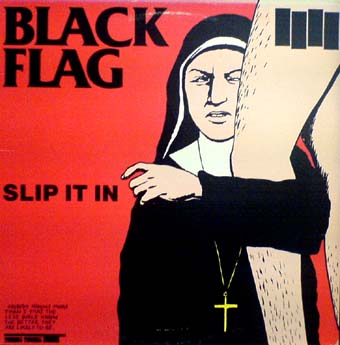
7. Black Flag - "Obliteration" from Slip It In (1984)
So we move from prog to what's SUPPOSEDLY its polar-opposite genre, punk. But as any SST enthusiast could tell you, that's absolute bullshit. Late-period Black Flag, for example, WAS prog, just a particularly raw, frayed version of it. Take this phenomenally queasy instrumental, a maze of strange accents and monomaniacal "reboots" (wherein Greg Ginn incessantly brings back that initial note series as if to imply that, "No, we are not, in fact, making any compositional progress; we are staying right the fuck here."). There are guitar-solo moments, but that is not what this track is about. This track is about making you sit through something, to endure these mind-numbing math workouts. What do they mean, other than sheer mind-sickness? You don't need Henry Rollins caterwauling about alienation and perverse desires to get you to that Black Flag headspace. "Obliteration" is the map of Greg Ginn's twisted mind, and it's both horrifying and magnetic.
Bill Stevenson took what he learned drumming in Black Flag (that's him on "Obliteration"), brought it back to his already secretly techy proto-pop-punk vehicle, Descendents, found kindred closet-fusionists in new bandmates Stephen Egerton and Karl Alvarez, and proceeded to tech the fuck out. I loved the Descendents as a teen, but I didn't grasp the entirety of their achievement until the aforementioned Tony, after witnessing an early show by Stay Fucked (the previous incarnation of STATS), asked if we were fans of the instrumental Descendents material. I knew the immortal "Theme", of course, but I had never heard "Uranus" till he played it for me. Good God, this is an exhilarating piece of music. There's the prog and there's the punk, perfectly mingled. Don't let anyone sell you that half-assed narrative about punk being inherently anti-virtuosic. Tech-ing out, or if you prefer, math-ing it up, as the Descendents do here, was just about the punkest thing that any band could've done at this time juncture. "Uranus" is the sound of Mahavishnu Orchestra divided by Black Flag multiplied by way too much coffee. This is last song on the last Descendents album, but Stevenson, Egerton and Alvarez would continue their Mission to Math as part of ALL (the band, not the album). ALL's Allroy Saves and Allroy's Revenge and the track "Birds" (from the otherwise spotty Percolater) are all crammed full with prog-punk manna, and Egerton has been continuing this line of inquiry over the past couple years with Slorder.
*****
9. Voivod - "Experiment" from Dimension Hatröss (1988)
To me, Dimension Hatröss is where you hear Voivod's storied techy brilliance in full flower. Before I'd heard the band (which I hadn't before a few years ago), I had this idea of them in my brain as some cyborg-metal beast, with a jagged, mechanized sound to match their jagged, mechnized image. In truth, Voivod as a whole is a lot goofier (thanks largely to vocalist Snake) and more straightforward (I'm referring specifically to the recent spate of albums since Snake's return) than I'd imagined they would be. But during their late-’80s golden era, as discussed previously on DFSBP, they found a way for lyrics, artwork and music to all tell the same techy tale at the same time. The opening seven-beat riff of "Experiment" (:39) is something I absolutely cannot shake. It doesn't seem so ingenious first but it just gets in there and churns and infects. It IS math rock, the groove plus the disorientation, and here the late, great Voivod guitarist Denis "Piggy" D'Amour uses the vamp as a launch pad for some schizo texturizing over top. Behold the shaggy sound pictures he's painting around 1:20—they're really not un-SST-like at all; Ginn and Egerton likely approved if they heard this then. (This illustrates another bullshit genre barrier: Metal IS punk IS prog. They are all welcome under my math-rock big top.) A classic math-rock pause at 1:45 leads into the song's breakneck prog-thrash midsection, during which Snake pilots the Voivod spaceship, finding logic in its arcane daredevilry. The opening riff returns at 4:50, offering a crucial breather amid the tech-metal hurricane, and assuring that you feel turned on, plugged in, engaged even as you're overwhelmed. There's that simultaneity again, the shared trait of all the best math rock.
*****
10. Metallica - "…And Justice for All" from …And Justice for All (1988)
It's funny: The one member of Metallica who's notoriously inaudible on …And Justice for All, bassist Jason Newsted, would go on to join Voivod after extracting himself from the maw of the behemoth. He was just settling into his Metallica gig back in ’88, but you can bet that he was giving Dimension Hatröss some serious spin-time all the same. In any event, he had his own tech to contend with. It wouldn't be quite right to classify any Metallica album other than Justice as a math-rock album, or a prog-rock album for that matter, but the record ought to show that Justice itself is, in fact, both of these things. The way it weaves EPIC TECH together with UNIVERSAL SONG is just a miracle. It's one of the best albums… full stop. On the title track, Kirk Hammett lays out one of this trademark florid overtures, into which the rest of the band bursts intermittently. Now check out what happens next: this deranged series of march accents that begins at :45 and repeats just twice. You're absolutely bewildered and you have no time to think, so it's best to rewind that section about 100 times before moving on because the math continues to unfurl relentlessly in its wake. Rush-y accents, unmoored from the composition at large, steward us to the gate of Math Manor, and suddenly Lars Ulrich is hammering out the template, riffing on a classic math-rock archetype, that of the theme and variation, the two-part riff that does X thing this many times on one iteration and then this many times on another. (The opening "Cygnus X-1" bass riff builds on the same principle.) So it's "boom-boom-KAH boom-boom-KAH / DERRR ner-ner-ner" followed by the shorter "boom-boom-KAH / DERRR ner-ner-ner." Like all great math-rock riffs, it's a mantra: Catchiness and complexity are one solid intermingled thing. Like McLaughlin, like Lifeson, like Ginn, like Piggy, Hammett indulges in a little solo grandstanding over top before the monomaniacal hive mind returns. The ensuing verse needs no annotation—it is what makes this both math and rock, after all. It is simply Metallica switching gears (as it has so brilliantly and for so long, right up to the great Death Magnetic) from the techy and florid to the straightforwardly flattening. But as with the Thin Lizzy track, there are these little tweak-out episodes, little bits and pieces of sinewy math stuck between the teeth of the larger song structure: the jagged little pick-up at 2:30, the skyrocket run at 2:41, reprised and doubled at 2:52. And the way the chorus climbs and climbs, elongating gloriously on its last triumphant segment. All of these aforementioned thorns, which at first seem aberrant, become familiar as the composition repeats, and thus is math alchemized into song. (Even that spastic march from the intro returns in a smoothed-out version at 6:22.) It's almost hilarious how even as Metallica was solidifying its reputation for drink and debauchery around this time, it was constructing these marvelous, insanely demanding sound labyrinths. (You really get a sense of that contrast in this live version of the tune.) During the final verse-chorus go-round, all the familiar thorns are there, but many of them are tweaked slightly—e.g., the pick-up from 2:30, which gets doubled when it reappears around 8:05—continuing the theme/variations trend. You're still enthralled after nearly ten minutes, and, magically, you remember every little oddball wrinkle as though it were a bubblegum-pop chorus.
And right around the same time, elsewhere on the West Coast, Melvins were busy perfecting the math-rock short form. Ozma is a hive of complexity, a maze of harrowing tightness the likes of which Buzz and Dale would never again attempt. But thank God they did once. "Oven" is a true destroyer—brief, baffling and somehow deeply evil-seeming. The beginning features a counting game that echoes "Cygnus X-1": a standard intro followed by first two, then one, then three accent punches, i.e., "chocka-digga chocka-digga b-KANG b-KANG / chocka-digga chocka-digga b-KANG / chocka-digga chocka-digga b-KANG b-KANG KANG." But there's none of that snazzy showmanship vibe that you pick up on in the Rush. This is pure, mean randomness, sans pleasure or style. Buzz & Co. aren't so much showing you what they can do as what they can do TO YOU. The brief "verse" imparts a sense of anthemic regularity, but then the bottom drops out again, via an extended, fantastically unsettling drums-and-vocals interlude driven by Dale Crover's zombified syncopation. Again, I would give anything to know how this bit was composed—did Buzz write the drum part and teach it to Dale, or did Dale devise it himself? It's just a huge "WHY?" slapped in the middle of the song. The ensuing kick-in feels like a release, but as with the intro, the band doesn't afford you the comfort of straight repetition: a swaggering doom riff loops yet resolves differently each time: first with jackhammer accents that lead into a pause, then with a jarring kind of truncation, and finally with a segue back into the intro. But here again there's a change in scenery: the "chocka-digga" loops twice and then, inexplicably, four times with one extra concluding PUNCH. There's constant destabilization here, but also enough thematic material that there's actually a rug there to pull out from under you. "Oven" tests just how far you can push the math without forsaking the rock, and provides its own answer: Precisely THIS far.
*****
12. Slint - "Pat" from Tweez (1989)
The same year Buzz and Dale were wreaking wanton doom-tech violence in the Northwest, Slint was busy answering their own mathy muse. This is ground zero for the fluid, introspective, emotive Math Rock, the kind people often mean when they use that term, with clean-toned guitars, bulbous, full-bodied bass and heavy emphases placed on brooding textures and overall crypticness. (Along these lines, I think of bands like Dianogah or June of 44, but you can take your pick. Anyone know much about A Minor Forest? I'd like to get better acquainted.) But "Pat" is weirder and slipperier than anything it may have influenced. This is, truth be told a loopy piece of fusion. A supple, twinkly intro, a Speak & Spell–style invocation and then an outburst of Berklee School of Music soloistic pizzazz, likely courtesy of Dave Pajo. At this point (1:00), the Exercise in Self-Indulgence commences: a slinky yet thorny jazz-rock jam—like a post-prog mutation of the Ren & Stimpy theme—featuring drummer Britt Walford's thudding, big-band-ish four-on-the-floor groove. In pieces like this, Slint exhibited an almost hysterical kind of eccentricity. Taking in the core jam-out of "Pat," you want to both (a) howl with laughter and (b) turn to your friend and ask, "What in the living fuck is happening?" And the band is way too poker-faced for you to get any kind of read on what you're SUPPOSED to think. Is this parody of snazzed-out fusion or a mutant, postpunk example of same? What it really is, is the illogic and the drive, the joy and the math, cohabitating blissfully.
*****
13. Breadwinner - "Tourette's" from The Burner
[The Burner is a compilation spanning 1990–1992; I believe this track dates from 1990.]
Some 600 miles east, Breadwinner was busy mashing together evil-tech math rock, à la Melvins, and more whimsical, WTF? math rock, à la Slint—I have no idea who actually influenced whom; I'm just following the chronology of releases here—to create its own brand of magnetic disorientation. There a savagery to this track, highlighted by the relentless trebliness of the sound palette (that tin-foil guitar tone, very SST-ish, as well as the absurdly high-pitched snare drum), but there's also a goofiness, a kind of left-field funk that makes me think of this band as the Faith No More or Living Colour of Math Rock. After a sort of Minutemen-play-thrash-metal kick-in, the trio makes its way to a daunting accent thicket, about 20 seconds in length, a kind of choreographed stumble that would mean nothing were it not sandwiched between such memorable sections. The second of those is a riotous groove outburst that, strangely, transports me directly to late-’90s MTV, and the surprisingly fusiony pop-metal of bands like 311. (Don't believe me that 311 fits somewhere on the math-rock continuum? Sample this Breadwinner breakdown alongside "Come Original" and make sure you let the latter play through to the righteous prog interlude at 2:23.) Now I'm not saying Breadwinner actually influenced any of the more well-known alt-rock bands mentioned above or vice versa, but I am saying that, to me, there's a similar spirit of impish virtuosity-as-loopiness at work here, of presenting the math-rock impulse as a kind of recreational impulse. (In that respect, they're right in line with Zeppelin; there's a definite Zep quality, directly relatable to "For Your Life," in the last 30 seconds or so of "Tourette's," wherein Breadwinner drummer Chris Farmer—still, apparently, engaged along similar lines—stomps, unperturbed and Bonham-like, through the riff labyrinth.) On "Tourette's," Breadwinner is definitely building an obstacle course for their own enjoyment. That it retains its fundamental song-ness so well despite its dizzying structure (and that it's so goddamn fun to listen to) is the reason it bears inclusion here.
We remain in the South long enough to check out another fascinatingly inscrutable band, one that takes rhythmic disorientation about as far as it can go while still somehow fulfilling song criteria. As with Robert Plant, Confessor's Scott Jeffreys performs an invaluable function: He pretends that what he's singing over isn't a steaming morass of mathy insanity, but rather some sort of hyperemotional, lighters-in-the-air anthem. As strange and (to some) distasteful as his contribution is, he gives the whole endeavor a purpose. And what exactly is that endeavor? That endeavor is a delightful "What if?" What if you took Sabbath and tech-ified it beyond recognition—gazed at it in the pieces of a broken mirror, picking through every last asymmetrical shard. That is what Confessor does to riffs, mainly thanks to the hyperevolved drumming of Steve Shelton (previously discussed on DFSBP), an innovator, a visionary and a very, very sick man. All the irregular seams are (purposefully) showing in this music, and they're not quite seams: They're actually as important as the riffs they combine. Neither element (the irregular seams or the riffs) takes precedence, though, and this is what gives Confessor its unique power to both baffle and delight. "Seems like nothing's clear to me / I can't find my mind," sings Jeffreys at the outset of the song, and you know exactly what he means, having been pelted mercilessly with lurching prog-doom for 30 seconds straight. And then this strange refrain emerges, an actual chorus, operatic—as though Jeffreys is singing for Journey and not Confessor. What must it have been like for a vocalist to surf these choppy riff waters? The time straightens out around 1:30, but you can hear Shelton hungrily eyeing the bar lines, ready to chomp right through them. The asymmetry mounts and by 2:36, you're deep in CONFESSOR LAND: Look to the right and there's a weirdly limp bass-drum-and-cymbal-catch punch (2:38); look left and there's a terrifying flurry of toms and double bass (2:41). (There is something so fantastically CRUNCHY about this music—it's like getting ground up in gears, and Jeffreys is right there with you.) A gnawing, uncathcartic guitar solo, and then, at 3:35, there's that opening riff again, but Shelton isn't about to let you off the hook—he stomps and rumbles all over it, yielding a bulbous mutation of the song's intro. So there's that key principle again: the memorability combined with the disorientation. Just enough ground to stand on before it's yanked out from under you. Right up through the end of the song, Shelton pounds the riff like a demented blacksmith, demonstrating that a good one (riff, that is) can take a massive beating and still sound like itself. (Check out drum-cam footage of Shelton playing "Alone" here, and check out more astounding math metal via Loincloth, Shelton's instrumental band with Confessor bassist Cary Rowells and Breadwinner guitarist Pen Rollings.)
*****
15. Carbonized - "Night Shadows" from Disharmonization (1993)
And what exactly is this? On tour a few years back, the members of Stay Fucked (the previous incarnation of STATS) wondered the same thing during a tour when we found Disharmonization on tape at a truck stop in God knows where (I wanna say the Southwest). I recall a combo of bafflement and fascination at this inscrutable Swedish band, and how it peaked as this track came on. Primitive death & roll at the outset—nothing special—a foreboding, almost postpunky bass break and then, HUH?!? The math emerges out of the murk. I adore this riff passionately (the one that starts at :25): a bouncy, herky-jerky, pinball riff—almost like math rock executed by Devo. The guitar and bass keep up the pattern as the drummer spirals off into rudimentary-blast-beat territory, while the singer moans unintelligibly. And then, here's Devo again at about 1:00, with a goofball, almost disco-y version of the pinball riff. Just like with Confessor, the approach here is to utilize all parts of the pig, so to speak, to subject a single math-ed out riff to as many dissections and recontextualizations as you can dream up. After bringing the primitive-death-metal vibe back for a sec, the band then hairpin-turns into loungey swing, a gimmicky remote-control sort of move that might've sounded surprising back in ’93 but now seems a little tedious. But then the permutation game begins again, and a tripped-out eerie-carnival version of the death-metal riff emerges. The song begins to puree: thrash, lounge, a few precious seconds of THE HOLY PINBALL RIFF, distorted version of lounge. By the end, you will be scratching your head; you may even be fantastically annoyed by the band's offbeat humor. But you will not forget "Night Shadows." All its obtuse parts are too skillfully woven together, too hard to shake, too songlike. Since that first encounter, the pinball riff has haunted my dreams.
*****
16. Hoover - "Electrolux" from The Lurid Traversal of Route 7 (1994)
"Electrolux" is a mantra, nine beats long. It has no obtuse parts. It has one part. It is one of the greatest bass lines I have ever heard, played by one of my favorite bassists, Fred Erskine (later of the Crownhate Ruin and June of 44). This bass line IS math rock. It IS the embrace between the disorientation and the groove. It is a thing of gorgeousness. There are, of course, dynamic shifts: the bass alone, sproingy and wet; the bass and the drums; the bass and the rhythm guitar; the full crashing OCEAN of Dischord post-hardcore. What can we do with this riff, the band asks? We can pause at the end of every repetition, leaving only the hi-hat, or a chiming guitar, or the clicking of drum sticks on the edge of the snare; we can divide the eighth beat of the measure in two, and punch out a pair of bass and bass-drum accents, like a stuttered period (this latter move begins around 2:00). We can remove the guitar, de-note-ify the bass line and drag it out into a zoned-out drool (2:14), a head-rattling throb. On a self-titled posthumous EP, Hoover would offer a dub remix of "Electrolux." It was entirely unnecessary. This song is its own remix, its own artful run-down of all the possibilities of this riff, a hymn to math. Hushed, then loud and screaming with horns and scribbling guitar. Fred Erskine is always there, plucking out the riff all the while. How long can we do this, he asks? No one has an answer, so they keep doing it. My favorite permutation is at 6:13: I imagine the bass like some sort of animated thing, its neck twisting cartoonishly as Erskine wrenches out the string bend at the end of the first measure. And then that aforementioned stuttered period again at the end of the second. Something new; something old. Hooking your ear and then surprising it, or vice versa. That's the triumph of math rock at its finest, e.g., "Electrolux."
*****
17. Dazzling Killmen - "Blown (Face Down)" from Face of Collapse (1994)
And here we begin with another mantra in nine, the hypnotic intro of Dazzling Killmen's "Blown (Face Down)." There's almost a chilled-out quality to the groove here, but it's mixed with an underlying menace: The guitar (muscle) drops out cyclically, like breathing, leaving only bass and drums (bone). The throb and the jangle continues into the verse, and then, a queasy guitar break (:58), a sound of alarm, of a nightmare. There is a terror to Dazzling Killmen that I treasure, a sensation that something is either very wrong or about to go very wrong. As with "Electrolux," this track is all about the build, the accrued weight of a vamp pressing down on you, guiding you toward a spastic climax. Here, it comes quick and merciless, signaled with just four swift accents (2:32): a relentless, irregularly hammering rhythm, a classic math-rock obstacle course, a roller-coaster. You're definitely not the one driving. That's another key Dazzling Killmen trait: the feeling that you're being dragged somewhere, whether you want to go or not. An atmospheric interlude brings you right to the brink: this ungodly horror movie HANG, just a cloud of dread, which breaks through at about 3:48 and leads back into quick final reprises of the verse, chorus and roller-coaster break. Major respects to vocalist Nick Sakes (who later went on to the equally outstanding bands Colossamite and Sicbay and who now lives in Brooklyn and works in the raw, ferocious XADDAX) for narrating this twisted journey. Listen around 5:00 how he drops into a concerned mutter before working his way up to a veins-bulging-in-the-throat shriek. Revisiting this song, I keep thinking the TRAPPINGS of metal, Cannibal Corpse song titles, say, such as "Death Walking Terror," and how everything about THIS piece of music expresses those sensations a thousand times more intensely than ACTUAL METAL. I've argued this point for years, and I'll reiterate it here: The most extreme math rock of the early-to-mid-’90s, namely Dazzling Killmen and their friends and contemporaries craw [sic]—whom you'll hear from in just a minute—found a way to move PAST metal, to retain what was still intense about it, but to plumb new depths of torment, anguish and pure voices-in-my-head insanity. Don't get me wrong, I loved, love and will always love metal, but this stuff just takes everything I value about that genre and pushes it further. To me, it's simultaneously the most harrowing and satisfying music in the world.
*****
18. craw - "405" from craw (1994)
And this whole aforementioned obsession all began with this song right here. (I'll spare some of the details, since they're recounted in previous craw posts here and here.) I was something like 14 or 15. I brought craw's self-titled debut home from Best Buy (of all places), sat down in front of the stereo, and THIS came out. I know… What in the living shit? This was my first exposure to the divine herky-jerk, the glorious turbulence that I've spent the rest of my life as a listener and musician chasing. The first 50 seconds of this song amount to a mini masterpiece of tension-building. I don't care who you are: You can hear the madness and the brilliance here. Start Stop Start Stop StartStopStartStop Start. When will it end? Do I want it to end? How are they counting this? What was that weird chant thing at the beginning? And the vocals: tranced-out, mumbling, sinister. And then strangely offhand: "It. Was. Like. I. Committed a crime-or-something." Then, flip the switch and ON (:51), the whole thing firing at once. It's a true sensory flood, this kick in. The vocal first a whine then a tortured yowl. The second guitar chiming, sounding a deranged counter-narrative. The whole thing lurching and stomping, sometimes headlong, and sometimes with that classic math-rock gear-grinding roughness, as with the teeth-pulling, five-staggered-accents-played-three-times interstice at 1:09. An absolute DEAD STOP at 1:26. And an ascent to utter insanity at 1:35. "And when it took off / I knew it was going down." "405" is a story about a plane crash, but even if you don't know that, you feel it. You're jarred and rattled to bits, with savage purpose. It's not some cut-and-paste job—it's a song, by god. A hush arrives (2:10), and a heavy-lidded build. The breakneck plane-crash riff now recast as a trudge—rising, rising. And the barely audible croon that you still feel like an icy hand. Martial cymbal rolls. And then: explosion (4:12). It's like snakes crawling all over you. Don't want to get too literal with this description: It's all plain to hear. And then a spent, exhausted decrescendo. I've never gotten over my initial exposure to this. Abstraction is great (as I'd later find when the free-jazz bug bit me), but nothing beats this kind of merciless, channeled frenzy. It's both wanton and utterly calculated, and that is its triumph—that is what I'm trying to get across about all this music. As a composer, you control the environment so totally that the listener feels terror and overwhelmedness but also a marvel. You enter a tower and it's so tall you can't even see to the top. You're dizzied by it. But you know that every detail up to the steeple has been considered, thought through, painstakingly rendered. You don't know what it's even used for. You want to stay inside it, find other ones like it. You crave that mixture of disorientation mixed with the comfort of a higher logic, however inscrutable. I guess it really is a religious thing.
[Note: The haunting cover above is by Stephen Kasner, who later went on to work with avant-metal bigwigs such as Sunn O))), Isis and James Plotkin's Khlyst. Apparently, he's currently in need of financial assistance due to medical travails—details here.]
*****
19. Shudder to Think - "Gang of $" from Pony Express Record (1994)
And now we move to something entirely other: math rock not as torment, but as sass. You have four musicians here, and on the verses they sound like they're playing in at least three different bands: the rhythm section just sort of loping along in a holding pattern, guitarist Nathan Larson perversely hurling paint at the canvas and singer Craig Wedren working a sort of preening glam vibe. The aggregate effect is nearly impossible to get a read on, but then something magical happens: At :33, all these mismatched gears somehow click into place. There's a little alt-rock build-up and all the players sync up for these tug-of-war accents, as if they'd just discovered on the fly that they do in fact have something in common. And then on to a soaring chorus (:44). And it's all instantaneous and bewildering, this transition from a happening to a song. In about 30 seconds, two decades of prog and about as many years of glammy rock have been shoehorned into this new mutant aesthetic. This band made no sense to me whatsoever when I heard them as a teenager, but when I revisited Pony Express Record in my 20s, it gelled beautifully before my ears. This track is a true math-rock manifesto in that it stubbornly refuses to pick a side re: songiness or mathiness. Both elements are primary. It's nigh unheard-of. (Don't sleep on the math meltdown that starts around 2:15: It's a great example of a very weird ’90s period where math-rock impulses were intertwining with alt-rock impulses. Think of great, mathy hits such as Soundgarden's "Outshined" or "March of the Pigs" by Nine Inch Nails, or of Meantime-era Helmet.)
Don Caballero, to me, is the band that best exemplifies what people tend to mean when they say math rock: In other words, they are the gods of capital-M, capital-R Math Rock. That's not to say that there's anything staid or conventional about them, just to say that they were ripped off more than any other band in this vein and thus that they retroactively seem like genre flag-wavers. Lineage aside, Don Caballero was, in their mid-’90s incarnation, an absolutely spectacular band. What this track shows you is that they were also a jam band of sorts—note use of lowercase here as well. They take these riffs and sort of roll through them, let them breathe, hammer at them from all sides. Listen to the gorgeousness of this recording: the full meaty bass and drums, the spidery guitars, trancing out on a five-beat pattern. The beginning of this track is like a Rush-ian overture, laying out the basic themes. There's the moody intro, then a crunchy, disjointed riff in 11 (:24), punctuated by a triumphant, fan-fare-ish breakdown (:45). And then it's back into the 11 riff (:48), but faster and more insistent. And then a variation of the moody intro (:57), consisting of a 12-beat riff (five plus seven). As I'm typing all this, I realize it's ludicrous, because it seems like the math-rock cliché: all counting and no soul. But listen to the groove and the sweat and the passion here. It's banging on the calculators with all your heart and muscle until they explode. It's having a blast jumping hurdles, running the obstacle course. It's the joy of sports, basically. A seven-beat riff (1:16) leads back into the moody intro. And listen to these gorgeous, funky hangs that the rhythm section rocks out on starting at 1:36. The funk is in the math, make no mistake. You have to groove, even if you're counting. Rush knew that; Zeppelin knew that; Mahavishnu knew that; and Don Cab most certainly knows it. The guitar harmonics swarm in around 2:30. And drummer Damon Che is having the time of his life grooving out on this, a true descendant of John Bonham and Billy Cobham. Holding down the FAT-BOTTOM-NESS of the groove, but also tattooing it with bell-of-the-ride-cymbal busy-ness. And the ray of shining light, the breakdown around 3:46. Don Cab's "Kashmir." They give you the pleasure of the rock for about six seconds before the mindfuckery begins anew, but it's enough. You've been math-rocked.
Cheer-Accident is an absurdly diverse, entirely uncategorizable band, but on this album, they embraced a certain kind of uniformity. For much of Not a Food, they're mainly concerned with math-rocking. As "Nutrition" begins, you can immediately detect a raw, lumbering menace in the groove—the sum of an air-tight band as viewed through the Steve Albini prism. Listen to that raw mutant-Zeppelin vibe going down at :45. I've gushed so often, both on DFSBP and verbally to anyone who will listen, about Thymme Jones's drumming, but I'd've done better to just play them the section of "Nutrition" that begins at 1:29. This pattern disturbs my sleep, invades my waking and dreaming life, not to mention my drumming life. I cannot shake it, these three stabbing accents followed by the little tag of solo drums, featuring Jones's patented mega-swung hi-hat dance. I'd like to hear an ambitious rapper build a track off of a sample of this section. And then hear how it becomes heavier and more menacing the QUIETER it gets, this math mantra, with the uneasy guitar snaking over top. This, to me, is the sound of the rock underground in the ’90s: sickly and yet propulsive. It's Chicago; it's Louisville; it's Kansas City. It's Touch and Go and Skin Graft and Quarterstick and all the rest. I could trance out on this all day. Jones switches to the ride for a sec; the bass is off on its own vibe. By 2:35, the volume is back, and just listen to how utterly Zeppelin-y this sounds before the groove atomizes again. The next section (2:43) is a dizzy-er, a true obstacle, but dig how Jones is stewarding the groove. Your head is spinning but it's also bobbing. You never lose the rhythmic thread, even as the piece ratchets up to its insane climax (4:21). And here's the mutated HANG from 1:29 back again for a sec (4:40)—a kind of mini-reprisal that's a favorite Cheer-Accident technique. (See also "Even Has a Half-Life" from the same C-A record, as well as a number of tracks discussed above, e.g., the Confessor tune—the imperative being: you bring it back, but you fuck with it… but not TOO much.) "Nutrition" runs you through the math-rock wringer but it implants that microchip of memorability into your brain. The patterns don't just wash over you; they stick.
Tool is, I guess, the world's most famous math-rock band. It's a fact that used to frustrate me a bit, because I'd play people craw and they'd be like, "It sounds like Tool." And I'd be like, "Well, yeah, sort of, but... NO." It's just that age-old conundrum of a band simplifying an underground trend enough that it can speak to the masses and then seeming to have this retroactive sway over everything that actually influenced IT. Anyway, that is all pretty irrelevant, simply because Tool is an outstanding band in their own right, and at their very best, such as on this song, they exemplify the finest math-rock fusion of disorientation and accessibility/song-iness. The intro to "The Grudge" isn't unlike the intro to Don Cab's "Stupid Puma," that being a muted, low-down vamp in five, but it's obviously Tool-ized, meaning tribal-ized, industrial-ized, glossified in a sci-fi sort of way. The vocal entry counters beautifully with the rhythmic undergirding. And then stabbing accents (1:13) and a miniclimax, followed by quiet (1:20) and an extrapolation of the opening riff, with the bass playing over top in a pattern that I hear as six, then four (1:22), and the drums entering soon after, spelling out a pattern of seven, then three. And then the proper verse, which demonstrates Tool's almost incredible bridging of the math-rock obstacle-course and pop idioms. Maynard crooning over this riff in ten (1:45), which sounds impossibly groovy and inevitable and non-count-y. And this is why Tool is huge: They jar but they do so subtly and beneath the song, in a sense. You can listen up top and just drift, or you can listen below and geek out and count and you are satisfied either way. The suppleness with which this band grooves is really something: It's not a post-Zeppelin-ish pounding. It's not really rocking at all. It's this sort of liquid murk: the bulbous bass and Danny Carey's supple drumming, marked by the absence of the snare (i.e., the snare itself is deactivated on the snare drum). The effect is such that when the music "kicks in," it's not this sort of literal rocking. It's more of a soft, ugly, awkward clanking (2:40). And with Maynard in full voice over top, it's just breathtaking and scary. We're still in a ten-beat pattern here, but that's totally irrelevant. Thanks to the vocals, we're in an exorcism or incantation. Tool at its best is a ritual, and that's what's going on here. I think of Matt Damon's sarcastic "The music just owns you" remark in Good Will Hunting, but really that's what's going on here, these insane disorienting vamps building and building until they're not disorientating; they just are. Not math, just music, in other words. And there's so much more to the song. The kick-in at 3:52 is inexpressibly beautiful. Again, it's a post-Zeppelin vibe, but it doesn't sound like Zeppelin. This band has its own way of rocking, something that's very, very rare. Thin, angry, mechanized and with this absolute MONSTER of a vocalist chanting songful mania over top. How can sound so powerful, so well-matched to this strange, strange band? I'll say straight up that all Tool is not this good. Some of it is, but not all of it. If it was, though, they would be absolutely one of the most riveting rock bands of all time. I'm just so, so into the melding of complexity and depth in this song, its simultaneous inducements of bewilderment and mantric comfort. Is that a five against three happening when the counter-rhythm comes in at 7:36? Does it matter, when Adam Jones's guitar sounds so transcendent? And finally, there is no fan of progressive rock music that could deny the thorny badassery of the outro. "The Grudge" is, simply, a perfect song.
*****
23. Mastodon - "Where Strides the Behemoth" from Remission (2002)
Another very, very popular band, and one whose pre-fame material seems to strike a greater chord in me than the later, more "mature" stuff. There's some sick shit on Leviathan, but Remission is my favorite, simply because it's an absolute riff machine, occasionally in a near-math-rock vein. "Where Strides the Behemoth" is a favorite along these lines, a masterpiece of jarring, sci-fi riffery funneled into bruising song form. That first riff is like a math-rock stun laser: two bars of six and one of four (the latter zooming along in a 16th-note feel), adding up to a "normal" 16, but you still feel that roller-coaster math exhilaration. (Interestingly, it's the opposite trick from what's going on in the Tool: making the normal feel weird rather than vice versa.) Drummer Brann Dailor is just... I can't even say. It's astonishing what he does here. The busy-ness of Damon Che, with a nod to the fluidity of Billy Cobham and a liberal peppering of metallic double bass. It's just huge. Right around :40, another tech explosion, as gnarled and anthemic as the opening riff, with the guitar, voice and snare drum hitting together on those first three stabs, like stakes through the heart of the song, and this seven-beat TAIL (:42), during which the guitarists slide down the frets with a kind of disgusting beauty, wrenching and labored and poetic and heroic. The six-six-four pattern repurposed then as kind of dumb, almost hardcore-ish chant (:57). And then the patented Mastodon squiggly-prog breakdown (1:34)—they seem to use it in every damn song—with Dailor writhing underneath, the whole band sounding like a steroidal Mahavishnu Orchestra and pushing every prog/fusion/math-rock pleasure button there is. Clean guitars and rumbling bass, and then just rumbling bass, building up to sheer MATH-METAL NIRVANA (1:56). This stomping, churning, lopsided riff monster, first eight beats then seven. The band just rages over the hurdles. Throw in the towel—you're done, destroyed.
*****
24. Keelhaul - "Cruel Shoes" from Subject to Change Without Notice (2003)
Speaking of done and destroyed. This first riff is really one of the mightiest and stickiest ever composed. My bandmates and I bat this thing back and forth like a secret handshake. It's un-sheddable. It is the math-rock MASTER TEXT. It's the Zeppelin and the Sabbath filtered through the prog filtered through the sweat and gristle of Black Flag filtered through… I could keep going and even parse it rhythmically, but it's just so obviously a mind-destroyer. Listen and learn. Listen to way drummer Will Scharf tapdances through it, so that you feel the bottom but also the destabilization. It's like an anti-gravity chamber, thanks to him. And note that the part itself is constructed in this classic theme-and-variations style, i.e., A B A Bprime, with the Bprime sporting this grotesquely elongated tail. If your riff-tastes are anything like mine, this is one of those true forget-me-nots, never-leave-yous. It's just there: monolithic and gnarled and happy-making, anytime. The latter is the key here: I grin ten miles wide any time I hear this. I run faster on the treadmill. I make stupid guitar faces, induced by this steamroller of doom. And by :30 Keelhaul is already onto another vibe entirely, an anguished post-hardcore churn in five, punctuated by two brutally elegant flourishes (1:01)—one pointing up and one pointing down—a sequence that's sneakily beefed up 250% (i.e., played one extra full time plus one half) at 1:25. And then we're into the diabolical obstacle course, a breakneck riff in seven (1:29), played by the guitar first before the whole band jumps on it in a ferocious dogpile. Then the same sequence—lull followed by dogpile—begins anew at 1:51, and this time Scharf drives a single snare thwack (1:58) through the heart of the song before the kick-in. (I think Bonham would've been proud of the deadly economy of this thwack.) The churn continues: a crunchy little dynamic downshift at 2:14 that Scharf turbo-rolls all over and then an exquisite rhythmic tag (2:28), half boogie rock and half math metal, that signals the onset of a new section (2:33), a lopsided, Humpty Dumpty outro in three. Scharf plays along nicely for a bit, and then out comes the madman swing (2:43), like Bonham reborn as Elvin Jones. The breakneck vamp continues; the band drops out; Scharf pounds out a few bars; and silence. A disorienting, pleasureful riot, an utterly waste-laying riot, this song.
*****
25. Hella - "Women of the ’90s" from The Devil Isn't Red (2004)
Again here, it's all about the drums, and specifically the right foot of Zach Hill, pounding at warp speed like a haywire sewing-machine needle. I read an outstanding Modern Drummer article on Hill from, I think, 2006, where he talked about how he practiced on a super-big bass drum (maybe 26") and then scaled down to a smaller one (maybe 22") for recording sessions, and how, in his words, he could skip around on the latter "like a hummingbird." That really stuck with me, and here, you can hear why. This is hummingbird drumming, top-heavy drumming (I mean top timbrally, as in the snare drum, and as in higher-pithced sounds)—a Zach Hill specialty, and that really stands out among my favorite drumming, because so much of the latter is lazy-giant drumming, bottom-heavy, explicitly Bonham-derived drumming. I don't know what can really be said about what Hill is doing here: It's simply astounding. Darting in and out of Spencer Seim's gnarled riffery like, yes, a hummingbird. It's like a kid playing on a jungle gym, such is the joy and exhilaration in navigating the math-rock obstacle course, and that time-tested tension of having one instrument vamp and the other go batshit on top. This is the kind of music that makes me wish there was more of a clear continuum, that folks (that's artists, critics, fans, whomever) didn't get tripped up so often on labels, genres, generations, movements, cover art, whatever. What I'm saying is that it has to be understood that where the spirits, the lifebloods of prog (King Crimson, say) and fusion (Mahavishnu, say) ended up is not in some lame-ass latter-day "Prog" or "Fusion," of which there is plenty, but in music like THIS, where the exhilaration and the sheer defiant PUNKishness shines through. This music comes directly from that music, and it is just as vital and hungry as that music was when it was in its infancy. You have to stay ahead of the curve and see these styles not as they are aped by later generations, but as they are broken down and ingested and recombined and revitalized. (Again, it's the same theme that Jeff Wagner discusses in his prog-metal book: "Progressive Rock" vs. progressive rock.) Anyway, yes, "Women of the ’90s," one of my very favorite Hella tunes. That first riff, where it's like your ears are caught in a lawnmower, and you and the band alike are writhing around like maniacs but it feels so fast and fun and cathartic. What is the twisted passage that begins at :38, other than a madman's obstacle course? Set the hurdles up, run the course, have a blast, spaz the fuck out. A reflective section (1:00) that would sound very Slint-y if Hill were willing to settle down. But he's not. Seim and Hill invite the chaos in, and they have the balls to let go (1:29) without really letting go. The jaws open and they clamp shut. Listen around 2:20. Seim is playing a sort of folk song. Hill is scribbling over it with neon sound crayons. There's no conclusion or resolution. The song wriggles itself out, but like all the other tunes here, it has deployed its grappling hooks. You'll not shake it, despite all the hecticness and mania.
I discussed crunchiness re: Confessor, that sensations of getting ground up in the irregular gears of math-rock riffs, and how wonderful it feels. In the extreme-metal realm, Meshuggah is a band that doles out this sensation by the truckload. As mentioned in my intro, I've still got some catching up to do re: that justly renowned outfit, but I do hear their holy crunch reflected in the music of Necrophagist. This song, "Seven," grinds you up and spits you out in handsome fashion: true mechanized math. With Hella you've got the human-ness of Zach Hill, the actual chaos, the accidental-ness of something being played live. Here it's all cold, merciless machinery. That first riff is such a gem: a sci-fi dance; an armored tank advancing towards you to flatten you yet it's so beautiful you don't want to move. First played for maximum lurch and then back-beat-ized (:08) for maximum groove. Definite jungle-gym riff, one which the whole band gets to climb all over. Sheer death-metal chaos ensues, and then that patented Necrophagist cyber-thrash (:50), the guitars tapping out elegant Morse code, man-machine messages of technological infinity, the spiritual within the computerized binary. And hark! At 1:55, there—in the background of the guitar solo—is the grand recontextualization we've seen so much and greeted so happily: The initial riff, returned, and stomped over at double time, but still totally recognizable. Like an old cyborg friend whom you met not two minutes ago but whom, it seems, you've known for cyber-years. Then the Morse code, the tech-jackhammer, and finally the return of the intro, as if it weren't tattooed on your brain. Pure robot-funk sickness, driven home by a final bass squiggle. There's such a thrill in the humanized math, as you hear in Carbonized (where the math is clumsy and borderline incompetent but all the more potent for it), or in Black Flag (where it stumbles around, nauseated) or in Don Cab (where it's smooth and throbbing and nuanced) or in Hella (where it's hyperactive and splatterpainted). But there's another side to it and Necrophagist is that: the exaltation of the machine.
You heard Battles guitarist Ian Williams on Don Cab's "Stupid Puma," at which juncture he was still fully committed to tranced-out, jammed-out fusion metal, later to be known as Math Rock. By the time of "Tras," his priorities had changed quite a bit. When I interviwed Battles in 2007, the members were quick to ward off "Math Rock" as "the m-word," fingers brandished in the sign of the cross. That cerebral fun-vampire is nowhere to be found here—this track is all groove, a dance-floor piledriver—but you can still feel his residue. Just like Hoover's "Electrolux," this is a vamp in nine that first destabilizes you and then starts looping round and round in your circulatory system. There's the methodical build that would seem didactic if it weren't so perfectly effective: guitar one enters; guitar two enters; bass drum and hi-hat enter; (right around the :30 mark) toms enter, and BOOM. The groove is on. Little twinkly electronic sounds up top; Stanier shuffling Clyde Stubblefield–like on the snare. It's the dance floor of the future, Again, yes, the music OWNS you. As much as the band members would like to convince you otherwise, this is in fact math rock, which relies on the combination of disorientation and propulsion. The first-principle paradox that drives the whole endeavor home. Instead of spacing out the hurdles irregularly, though, in this particular obstacle course, the interval remains steady. You lurch, but in perfect cyclical math rhythm until the song is done.
Another irregular vamp that becomes a mantra, an unstable yet stable canvas over which the guitars can paint. (Wielding one of those guitars, incidentally, is Hunter Hunt-Hendrix, now well known as the leader of the new-black-metal crew Liturgy.) This opening riff is such a poem, with its slow death-blues-dirge churn. Two pick up notes and then two chiming responses. Then two more pick up notes and just one chiming response. And then the agonizing drag-out of a triplet. And then a bar of sweet, gritty resolution. The drums come in and swing the whole thing, swaying to-and-fro like a mournful elephant. The crucial stop-time section (1:30) with the tastefully destabilized accents. And then settling into a steadier rhythm in three, letting the guitars and bass swirl and paint. The sad, breakneck prog-fusion-core, escalating in speed at 2:38. The vocals whooshing around underneath like an evil wind. And the math intrudes with jutting accents (3:22) that knock you in the gut and steal your breath. A snowstorm climax. Almost too much poetry and pathos in this music, driven by a kernel of mathiness and pushed into postprog bliss. No need to return to the intro, just some last hanging guitar chimes and you can't believe that five minutes have gone by. (birthday boyz, old friends of mine from college and beyond, are now Survival. Not sure what the status of this band is, but if they ever reemerge, they will lay waste, I am certain. History of the boyz is here—click the main screen when you're done blissing out to the emo-math-trance ritual that is "Triumph of the Good"—and an old DFSBP appreciation is here.)
A flurry of happy, spastic mania. The engine is the math, deployed in service of progressive-minded, punk-fueled post-hardcore. The lurch and crunch of guitar one, the insistent siren-like whining of the other, the machine-gun hit-hats. Starting at about :22, this precarious human tornado dislodges and rolls down a hill, thudding irregularly but in perfect recurring rhythm. A pause and then a kick-in (:32), but as with the Tool track, it isn't that easy. All the parts from the previous riffs, scrambled and recombined. An impossible kind of busy-ness, settling down finally into a head-bobbing slam (1:00), thriving on the juxtaposition between the respective guitars' low crunch and high twinkle. I love the hang that starts around 1:26. This absurdly long note series, answered after an uncomfortable pause by a single splatting note (1:30). A world-swallowing fill (1:43) and the already fantastically gnarled kick-in section multiplies exponentially in busy-ness, the riff now not rolling down a hill but hurtling over it, but with the original material still showing through underneath the dust cloud. Again, it's that sense of recasting, recontextualizing, complicating but still retaining that original hook. My bandmates and I first heard this song in the live setting in (I think) 2006, when we were randomly booked on the same bill with Yukon. When this section commenced, our eyes bugged out cartoonishly. That what-in-the-living-shit? sensation is entirely preserved in this recording. Listen to drummer Nick Podgurski's ballsy and improbable insertion of stick clicks (hear one instance at right about 1:49) into the runaway spaz-groove. There's just so much energy and exhilaration in this section, the twin spirits of off-the-wall virtuosity and careful songcraft mingling, like there was never any need for them to be at odds. You've never heard such a coherent blur. It gets you coming and going.
*****
30. The Flying Luttenbachers - "The Elimination of Incompetence" from Spectral Warrior Mythos, Volume 1 (2006)
You can find "The Elimination of Incompetence" on a few different Luttenbachers records—all available from ugEXPLODE—but this version is my favorite. Luttenbachers leader Weasel Walter classifies his hymns to the math-rock god as "brutal prog," and that's basically dead-on, but the word "fun" needs to be injected into the mix as well. This is hard (both in texture and hard to play) music, but it's also gleeful music, a happy kind of sci-fi obstacle course. There's no way it isn't a blast to wage musical warfare in this fashion, the same way it's a blast to navigate the cones, jump over the walls, traverse the monkey bars, etc. As a listener, you marvel at the architecture of it all, as themes return, mutate, deform, re-form. You're caught up in the whirlwind from the first second, but that opening six-note pattern is going to stick in your head, by god. And those stabbing accents around 1:00, with the blast-beat sprinting underneath. And the ten-note gnome dance (1:21)—front-to-back then back-to-front—like cells quivering frantically in a petri dish, or rather a cartoon rendering of same, a mingling of cold science and fantastical whimsy. At the 2:00 mark, a furious scramble of the initial six-note theme and the stabbing accents with the blast-beat underpinning. And then what could be thought of as Movement II: throttling full-band accents, echoed almost comically by single-note stabs. You hear these call-and-response flights and you think of the proverbial mad-scientist conductor, frizzy white hair sprouting out of his head. You think of sinister-ness combined with perverse delight. Weasel Walter, the band's leader, is snatching both band and listener away here, strapping them into the roller-coaster and ignoring all speed regulations. Seconds of chaos (3:55), pummeling riff dances in groups of six, and then, the linchpin reprisals: the call-and-response zaniness (about 4:40); then the initial six-note theme (slowed down to a grotesque crawl and accelerated precariously); the stabbing accents. A throw-everything-against-the-wall-and-see-what-sticks outro and an inconclusive ending. What a marvelous riff blender this song is: You feel completely winded from all the hyperactive motion, but even in your dazed state, you remember those little details. The formula has been pureed, but somehow those few riff nuggets remain intact. Again, that same core math-rock paradox: You poke, prod and even decimate an idea, but somehow that idea comes out seeming all the stronger for it. All those trials don't obscure the idea; they strengthen it.
[Let me state for the record that the above-discussed Flying Luttenbachers track features two guitarists not spotlighted in this mixtape but nevertheless deserving of huge props with respect to this general area of music-making: Mick Barr, whom I've mentioned in my intro, and Ed Rodriguez, formerly of Iceburn and the phenomenal Colossamite (with Dazzling Killmen's Nick Sakes; the two also worked together in the different-but-equally-great Sicbay) and now of Deerhoof.]
*****
31. Archaeopteryx - "Scuba Gooding, Jr." from Dreamt Sniper (2006)
The math-rock impulse, stripped down to pure, shirtless muscle. An obstacle course barely disguised as a song, but with such poetic coherence. Just bass (the oft-aforementioned Tony Gedrich, now of STATS) and drums (Ben Greenberg, of a thousand other bands; now playing solo guitar as Hubble) and a few snake-charming riff hunks. An in-media-res false start. And then listen to the glorious fuzz of the bass re-intro (:12) and the brute, walls-caving-in, what-in-the-living-shit-is-happening-to-me drum entry (:16). A devastator (to allude to one of this band's many previous monikers) of a riff: six beats (four played, two rested), then seven, leading into a groovy math dance (:56), played three times in a low register and once in a high register. A breathtaking stop-time section (1:11), punctuated with stick clicks. It's all about the poetry of the math and the fun of it and the balls of it and the shagginess of it. A geeked-out, steroidal, punk-infused communion with Zeppelin and just about everyone that comes before in this mixtape. The place where the because-we-can impulse reaches its truest, most pleasure-giving expression, where to witness the obstacle course being run is as wonderful as to run it one's self. The tiny details you only notice the 100th time you listen (or maybe that you only feel under the skin): e.g., when the main riff returns after the break (about :46), it's got an extra two (I think) microbeats woven into it, so instead of ba-na-na-NAH / ba-NA-na-na-na-na na-nah (as it is the first time around), it's now ba-na-na-NAH / ba-NA-na-na-na na-nah na-na-nah. Shit you don't have to notice, but that you can obsess over if you do, like one of those "What's different about these two pictures?" puzzles. And then, suddenly (1:28), a vertiginous drop-off into zombie doom, a headspace entirely MINUS math, longer than the entire "song" itself up to this point. Those monster riffs you heard before aren't going anywhere, though: They're stuck with you and you with them.
Behold… the Arctopus, the brainchild of Colin Marston (maybe now better known for Krallice or Dysrhythmia than for this project) and Mike Lerner, is the locus at which the chops-forward fusion impulse comes into full, chrome-plated, metallic flower. If while listening to Archaeopteryx, you're offroading in a mud-splattered monster truck, here you're hurtling through the cosmos in a gleaming spacecraft, dodging asteroids and blasting enemy ships. The overture to this song is a splatter of riffs, hurled at your windshield relentlessly and without warning. (You relish the odd breather moment, such as the majestic riff-pinnacle at :33.) There's a certain Luttenbachers-ness to the whole affair (appropriate, since Weasel Walter has since signed on as the drummer of Behold… the Arctopus), which really comes through when the song reboots with the reprise of the drum intro at :52, a tiny compositional peg to grab onto, a respite from the relentless onrush of ALL NEW information, and then another reprisal: the groovy, almost punkish space-stomp (1:00) from the opening section. Micromotifs emerge (at 1:27, a set of seven cymbal accents—four then three—which returns about ten seconds later) and recede, momentum lurches and you feel totally scrambled, teched-out once that majestic riff-pinnacle from :33 returns at 2:09, but you've absorbed and digested more than you think. A gorgeous drum-less space trance ensues, tapped out on Lerner's guitar and Marston's Warr-guitar (a sort of hybrid guitar-bass). And out of nowhere, a bona fide riff (2:43), a mathy hymn, contrasting the busy-ness of all that came before, a meaty branch to latch on to, not just a twig, and—to me—it's here that this bizarre soundweb transmogrifies into SONG. Suddenly there's momentum, purpose to the whole endeavor, purpose that floods backward to the opening section. As if to drive home that evolution, an honest-to-god guitar solo erupts out of the tech-metal petri dish, As though the Robocop suit opened up and Eddie Van Halen stepped out. The interstellar warfare begins anew at 4:12, with a slamming, lopsided riff that the band seems almost miraculously content to vamp on—prodding and poking it but leaving it structurally intact. And then, at 4:45, what sounds to me like a Luttenbachers homage—hushed accents responding to the blaring chaos that preceded them—and a classic Arctopus-ian outro, wherein the guitars vamp it up and drummer Charlie Zeleny drum-geeks out in splendidly busy fashion. Note, though, the all-important tying up of loose ends, as Zeleny alludes to his intro pattern at 4:58. I love this track because it shows just how far you can push the envelope of mathed-out chaos while still preserving the precious eggshell of SONG.
*****
33. Extra Life - "Blackmail Blues" from Secular Works (2008)
If "Canada" is a calculator meltdown that gradually accrues SONG-ness, "Blackmail Blues" is the opposite: an elegant song that mutates into a thicket of asymmetrical rhythm. I wouldn't claim I could count the rumbling riff that kicks in at :49 (driven by Tony Gedrich's bass and Caley Monahon-Ward's violin), but I can feel its onrush, the fact of its moving in a single direction. (There's a Tool-ish murk to this section, teased out by the combination of the monolithic bass and the snare-deactivated drums.) It's like a tide of lava, terrible and wondrous. It is the magma of the math. Bandleader-composer Charlie Looker enters on lead vocals, spelling out trancey curlicues of melody. I think of some sort of dervish dance. You grow up in a certain remote village and you learn to flail yourself about in exactly this microdetailed way, perfectly logical yet inscrutable to the outside observer. The ebb and flow of this mad rush and the "Spare me, spare me" interludes. And the Zeus-like lightning bolts that are drummer Ian Antonio's China cymbal and hi-hat accents (4:35). The dervish dance simplifies, expands, contracts, and Looker's chant soars and curlicues, stuttering on certain syllables, and you wonder where it's all headed. The stuttering intensifies through the sixth minute, and then it occurs to you that the vocal is part of the equation, game to tech-out in the math mud with the instruments, not just soar above them (as, say, Scott Jeffreys might in Confessor). At 7:45, the raft goes over the falls, as Looker's voice aligns with the instruments in a harrowing, relentless counting game. Just raw syllables, staggered bass/drum thuds, a treacherous web of criss-crossed rhythm. You can't fathom it, so you just let it happen to you, and that submission points the way to rapture.
*****
34. Cynic - "The Unknown Guest" from Traced in Air (2008)
There's more sheer technical ecstasy to be found here—ground up in the gears and you're loving it. Heart-on-sleeve emoting mingles with rhythmic mathiness on Traced in Air with a rare gracefulness. Fade in on a choppy vamp, with all kinds of filigree to distract you from its 4/4-ness, and then the tech-trance ensues. The stop-start pattern that makes up the verse (:40): like a hypnotist's arc-ing watch face, but with frames missing; strobed-out and stuttered. There is something so satisfying to me about these glue-y rhythms, these choreographed spasms, punctuated by flowery fusion. With the notes spiraling up to an ecstatic realm, where the robot-voice dance with the death-metal voice vomit (1:18). Strange architecture to navigate, such as the riff tower that springs up suddenly at 1:31. Unabashed sci-fi-ness, cosmos-touching, hand-of-God type of shit. And again, as on the Arctopus track, Eddie Van Halen hurtles out of the void in the form of Cynic guitarist Paul Masvidal, spewing out a lead as soulful as the Delta blues (2:46). This is math, and it's also rock. It's the cold and it's the warmth. Yes, technical ecstasy. It is a song sung by robots rigged to feel deeper than we.
I include this not to imply that the band I play in with guitarist Joe Petrucelli and bassist Tony Gedrich is any sort of evolutionary endpoint re: the math-rock continuum, but merely to say that we are one possible output yielded via the input and digestion of the aforementioned. (During various songwriting sessions, we've named in-progress riffs in honor of many of these bands.) I love all the music discussed above—and, though our tastes diverge considerably, so, it seems safe to say, do my bandmates—and "Guthy Renker" is a good summary of what we've come up with to date. I'm not going to lie: The track is here not just for demonstration purposes but also because I think it's badass, not to mention a good example of the simultaneity of disorientation and groove discussed incessantly above. I hope you like it. If so, you can purchase Crownedhere on CD or here in MP3 form.
*****
So now you know what "math rock" means to me. What do you think of when you think of this term or this overall aesthetic territory? What should have been included? (I'm especially interested in folks' recommendations re: antecedents, i.e., material from the ’70s or earlier—classical music is mega-welcome—that seems to point the way toward this general area of rockcraft.) What should have been left off? This is an entirely personal canon—again, I might as well have pegged this as "35 songs I love"—and I welcome alternate definitions. Thanks for reading/listening.