Showing posts with label cooper-moore. Show all posts

Thursday, June 27, 2019

He Did the Number: Cleve Pozar, 1941-2019


Cleve Pozar: "I Did the Number"

In July of 2008, Cleve Pozar was driving around his tiny hometown of Eveleth, Minnesota, smoking a cigarette and contemplating mortality. He wasn't sick at the time, just reflective, recounting the strange, improbable life's journey that had taken him far from this city of just under 4,000 — first, in the early '60s, to the contemporary-classical hotbed of Ann Arbor, Michigan, then home to future legends such as Robert Ashley; then to New York, where musicians like Bill Dixon were busy realizing new and unprecedented visions of what jazz could be; then to Boston, where he plotted and produced a personal masterwork, the private-press early-'70s LP known simply as Cleve Solo Percussion; and eventually back to NYC, where, for decades, he would align his consuming interest in Afro-Cuban percussion (specifically, late in life, the Batà tradition) with his expertise as a master builder and engineer, forging a sort of DIY musical laboratory that few who did not visit him at home would ever get to behold.

He concluded with this statement:

"When I'm lying there dying, I can say, well, what the hell, man… I did the number."

There was nothing morbid about the observation — on the contrary, Cleve seemed, as he pretty much always did, totally at peace, punctuating his mini monologue on the idea of doggedly pursuing one's personal life's mission to the fullest, from day to day, decade to decade, until the very end, with a quintessentially Cleve-ian conspiratorial grin. Having just heard the sad news of Cleve's recent passing from my friend Will Glass — a musicians' advocate at the Jazz Foundation of America, which aided Cleve greatly in his later years, as well as an accomplished percussionist himself, who studied extensively with Cleve — I can take a little solace in hoping, and having every reason to believe, that the above turned out to be true.

The video at the top of the post — drawn from many hours of footage that I and my former wife Laal Shams shot of Cleve around that time for a prospective documentary, and edited by my friend Dan Scofield — captures not just Cleve's "I did the number" speech, which starts around the 3:20 mark, but also, more importantly, his signature combination of childlike enthusiasm and dead-serious commitment ("If I have to go through a concrete wall, I don't care; I'm going there."). Please watch in full-screen for best results.

We see him putting the finishing touches on a wooden drum he built himself; demonstrating one of his ingenious electronic-percussion set-ups; improvising with saxophonist Darius Jones (a brilliant musician 30 years his junior); bantering good-naturedly with his extremely supportive mother, Fran (who was kind enough to invite a curious stranger in her home for a couple days so that he could get a sense of the environment that could have produced an individual as sui generis as Cleve); and sitting beside his longtime friend and collaborator Cooper-Moore, a kindred spirit who characterizes Cleve as "an improviser in life" who "understands tools and materials." (The video also features commentary from key early Pozar collaborators such as Bob James — with whom Cleve performed extensively in Ann Arbor, including once with Eric Dolphy, and with whom he made the fascinating, daringly abstract ESP album Explosions — David Horowitz and Ed Curran, as well as his son, Mingus, and cousin Janice.)

I first came to know Cleve's work via the record library at WKCR, where I came across two of his LPs, Cleve Solo Percussion and Good Golly Miss Nancy, an utterly remarkable Bill Dixon–produced Savoy set (released under Cleve's birth name of Robert F. Pozar and featuring none other than Jimmy Garrison on bass) that combined nimble, intensely interactive avant-chamber-jazz with cutting-edge electro-acoustics. Encouraged by my friend and mentor Ben Young, who provided me with a copy of Let's Try It Again, a CD of Batà-infused jazz that Cleve self-released in the late '90s, I continued to research and later write about Cleve, including in one fateful 2007 post on this very blog, where I inquired as to Pozar's current whereabouts.

Several months after posting that query, I received a brief e-mail:

>From: Cleve Pozar
>To: Hank Shteamer
>Subject: Cleve
>Date: Sat, 18 Aug 2007 17:31:11 -0700 (PDT)
>
>Cleve pozar is Bob pozar.I am Cleve.

It couldn't have been more than a week or two later that I was sitting in a coffee shop in Fort Greene with Cleve, listening with amazement as he recounted the entire tale of his extraordinary life and, to my delight, still very much ongoing work. He soon gave me a tour of his makeshift home studio, in the unfinished basement of a friend's nearby brownstone, where he kept not only his drum kit, but his ingenious electronic Batà set-up, which you can see him playing here, and in many other YouTube videos that he would later self-produce and post intermittently, as he subsequently moved all over the country to stay with family in his later years.


Cleve generously allowed me to trail him to and from gigs, shadow him as he practiced, and eventually follow him all the way to Eveleth, where he showed me around, pointing out the world's largest free-standing hockey stick (which you'll see in the first video above) and taking me to the mines where his father, an accomplished engineer, used to work. He even helped me salvage a couple of cracked cymbals, sawing thin holes in them to prevent further damage, a process that's also documented in the video up top.

Cleve would eventually leave New York for good. I believe the last time I saw him was in 2012, after he gave a stunning solo concert at Brooklyn's Firehouse Space, a new live interpretation of Cleve Solo Percussion — a suite of enveloping, evocative electroacoustic pieces realized via live looping, which he had ingeniously adapted to contemporary instruments. You can watch the full video the performance here, with huge gratitude again to Dan Scofield, who was on hand to document the night:

 
Cleve Pozar - Live @ The Firehouse Space - March 11, 2012

As with pretty much everything Cleve did, the Cleve Solo Percussion revival was a marvel not just of creativity but of will — as Cleve himself noted, no earthly barrier or limitation of practical reality was ever going to stop him from fulfilling his wildest sonic fantasies. If ever there was a man who, at that moment of reckoning, had earned the right to say he had accomplished everything he intended, forged his own path without compromise, explored his passions to the fullest — in short, "did the number" during his time on Earth — that man was Cleve Pozar. I am honored to have known him.

/////

*Of all those who loved, assisted and collaborated with Cleve during the time that I knew him, none had his back more consistently than Adam Lore, the tirelessly devoted label owner and scholar behind 50 Miles of Elbow Room. Adam's interview with Cleve on the subject of Cleve Solo Percussion, complete with a bonus excerpt from a contemporaneous live performance by Cleve and Cooper-Moore (then known as Gene Ashton) is essential reading.

*As is my friend Clifford Allen's typically comprehensive 2009 Pozar piece for All About Jazz.

*You can download a couple excerpts of Cleve's work, including a track from the long-out-of-print, generally impossible-to-find Miss Nancy LP, here, via a post by WFMU's Scott McDowell.

*Finally, here, with gratitude to Jason Gross at Perfect Sound Forever, is a series of excerpts from my original conversations with Cleve, covering various aspects of his life and work.

As might be apparent from the above, I have much more on file, including hours of interview and performance video, as well as audio of an afternoon-long WKCR radio program that Cleve and I collaborated on in 2008. The documentary project itself has been on hold for some time, due to the mundane realities of time and budgetary constraints, but I hope to be able to share some of this material in the future. In the meantime, I hope that the videos above stand as a fitting memorial to this man's ebullient genius. I miss you already, Cleve — so long, and thank you for everything.

Thursday, August 02, 2018

Two New Yorks, one epic night: BarrSheaDahl's 10th Anniversary Special Large Ensemble + Alan Braufman's 'Valley of Search'

My ears are still ringing from the second of two shows I saw tonight, a 10th-anniversary improv blowout by the trio known as BarrSheaDahl (consisting, respectively, of MickKevinTim) and 12 of their closest friends. The glorious happening they staged at Bushwick's Market Hotel was something like a post-jazz/noise/metal version of Ascension, or maybe more accurately, Free Jazz: five guitar-bass-drums trios situated throughout the room and playing a loosely structured 47-minute piece governed by a simple yet ingenious Tim Dahl score, consisting of a series of timed cues.

So, for example, one trio would play alone for around five minutes, then another would either join it or take its place. At other times, you'd hear only the guitars, or only the basses. Sometimes the entire 15-member ensemble would rest. Or (more frequently) blare forth in a single writhing mass. You would roam around the room, shifting your focus, paying special attention to, say, the way the relaxed yet focused drumming of Oran Canfield (an excellent local mainstay mainly known for his work in the bands Child Abuse and Chaser) contrasted with the full-bore blasting of Nandor Nevai, or the way guitarist Brandon Seabrook's furious right-hand trilling differed from Colin Marston's more fractured attack.

Mostly, though, you were just soaking in the spectacle, the density, the cacophony, the microdetail, the spatial disorientation, the "happening"-ness of it all. It was, at times, literally painful (on the ears); it was simultaneously joyous. I wasn't the only one seen grinning with a sort of dazed disbelief. To me, the event felt like one big toast, an homage to a scene, a community, a movement that has taken shape during the past decade or so in New York. It is a collective without a name, without even a unified purpose other than a sort of absolute conviction and a kind of roll-up-your-sleeves aesthetic extremity. There is no one sound, one background, one intent. There is only the sense that none of these musicians really belong anywhere else, so they might as well band together. (I wrote a bit about this loose community a few years back as well, after hearing Krallice at the Stone.)

I'm talking, in part, about the specific participants in tonight's event: clockwise from the center, those would be, taken by trio and listed as guitarist, bassist, drummer, respectively, Barr, Shea and Dahl; Ava Mendoza, Erik Malave and Nevai; Seabrook, Evan Lipson and Walter; Marston, Shayna Dulberger and Canfield; Kevin Hufnagel, Johnny DeBlase and Shayna Dunkelman. Among these musicians are current and former members of Child Abuse, Krallice, the Flying Luttenbachers, Dysrhythmia, Xiu Xiu, Orthrelm, Lydia Lunch's band, Pyrrhon, Seabrook Power Plant, Behold... the Arctopus, Cellular Chaos, Coptic Light and on and on. Some images from the event:


And the circle extends ever outward from there. I'm proud to call myself a member of this loose, unofficial confederacy, having shared bills with these musicians' various projects and in some cases even collaborated with them, for roughly the past 15 years.

Tonight's event was far from definitive, in terms of being a summation of these players' activities. But it was sort of a marker in time, a statement that yes, something has been built here in NYC that is distinct from what was built here in decades' past. It has no catch-all name (No Wave or Energy Music or 2001 Rock Revival or any of the others we know from the history books), not yet at least. It's a scene still in the making. But as tonight's event reaffirmed, its roots are deep and intertwined, stretching from Saint Vitus to the Stone to the late, great Death by Audio to all those defunct mid-2000s spaces whose names I can't remember. Yet another chapter in the continuing saga of American DIY.

And earlier in the evening, in downtown Manhattan, I caught a glimpse of another New York, via a combination concert and talk celebrating the recent reissue of Valley of Search, a 1975 album by the alto saxophonist Alan Braufman. I'd only done a quick needle drop on the album before catching the show, so I was coming in mostly fresh. But as soon as I entered WNYC's Greene Space, where the gig took place, I felt right at home.

Braufman's band, which featured pianist Cooper-Moore from the original album, along with bassist Ken Filiano and drummer Andrew Drury, were in the midst of a surging free-jazz invocation when I arrived. I've had the good fortune of seeing Cooper-Moore and Ken Filiano play many times, but I was struck anew by their intensity and precision, and by the poise and tastefulness of Drury, who I've caught in a few different contexts over the years. But the real surprise was Braufman himself, a player who was entirely new to me before I got wind of this reissues. His playing was extremely forceful yet full of song, clear and radiant and agile and proud, with hints here and there of the familiar free-jazz "scream" but refusing to lean on mere aggression as a crutch.


And best of all, the band's churning improvisation gave way at several points to Braufman's catchy, ingenious themes. Repetitive, folk-like, minimal, but extremely nourishing. The perfect launch pads for further excursions into more open territory. This was a music clearly redolent of Pharoah (of whom Braufman spoke reverently during an illuminating post-concert talk — moderated by my friend and fellow writer Clifford Allen, who wrote the liner notes to the new edition of Valley of Search, and also featuring Braufman's nephew Nabil Ayers, the man responsible for the reissue), of Coltrane, at times perhaps of Ayler, but it very clearly represented a '70s aesthetic as opposed to a first-wave '60s one. It's hard to put my finger on what the distinction there is, but there was a sense of that initial spark of '60s being reined in, sublimated, refined, so that the end product was perhaps more song-driven, more streamlined. (Hear for yourself when the band, with the additional of the outstanding young saxophonist James Brandon Lewis, plays National Sawdust on Friday.)

I'm generalizing of course, and these are minor distinctions, really, but I really felt like I was being transported back to a time and place. And, as Braufman and Cooper-Moore laid out during the talk — and as Patrick Jarenwattananon explains in his excellent Bandcamp Daily piece on Valley of Search — that time was the mid-'70s, when you could still rent an entire multi-story loft downtown for around $500, and the place was 501 Canal Street. There was no heat. Braufman pointed out that during the winters, the warmest place on the floor he shared with the late, great David S. Ware (who around that time was one third, along with Cooper-Moore and the great drummer Marc Edwards, who was in attendance tonight, of a trio called Apogee) was inside the refrigerator. They would cook up brown rice and vegetables, one pot for the entire week, and simply live the music, day in and day out. They had firsthand access to the giants of an earlier generation: Miles, Mingus, Rahsaan, Sam Rivers. To hear Cooper-Moore and Braufman tell it, it was hand-to-mouth but it was also heaven. (Cooper-Moore asked Braufman at one point the rhetorical question of why he put up with all the hardship, and answered it with the obvious assertion that it was, in so many words, for the sake of the music.)

And all of that joy and struggle is in the music, the same way the sort of keyed-up, frenetic, boiling-over, polyglot insanity of the New York of the past decade or so was in the BarrSheaDahl jam/exorcism/sound-mass. A great divide separates these two New Yorks — the latter performance, for example, felt distinctly post-punk, while the former was more like an echo of free jazz's original Edenic moment. But both events were manifestations of the strange artistic Petri dish that this city is and has been for decades upon decades. (I'm reminded of Off the Wall, Calvin Tomkins' excellent book on Robert Rauschenberg and his circle — Cunningham, Cage, Jasper Johns and so many others — a chronicle of a whole other New York school that flourished in the '50s and '60s.)

Every era, seemingly, has its project(s). It's not a unified, directed thing — though as tonight's BarrSheaDahl event, or certain pivotal group shows described in the Tomkins book, for example, demonstrates, sometimes you do have these moments of dedicated convergence. It's more like this sort of self-sustaining ecosystem operating within, either in harmony with or in opposition to or a mixture of both, the larger struggle and grind of this insane and wonderful place. Tonight these moments, these movements criss-crossed, overlapped, cross-pollinated — and not just in my mind; indeed, the poet and consummate scenester Steve Dalachinsky, in the words of Steve Smith, "as consistent an indicator of a high-quality concert experience as any I have found during 20 years of concertgoing in New York," could be seen digging the sounds of Braufman's band and then a few hours later walking around the BarrSheaDahl happening wide-eyed and giddy, as we all were.

Two New Yorks, two generations, two worlds converging. Or maybe they were one and the same.

Friday, June 06, 2014

Suspension of self: Mick Barr and Marc Edwards


Last year, I wrote about the jazz/metal intersection for The Daily Note. One of my case studies was the Mick Barr / Marc Edwards duo. By that time, I'd seen Barr play many times—with Orthelm, Ocrilim, Krallice and various other projects—and caught at least one show by Edwards, in collaboration with Weasel Walter (I believe it was the 2011 Death by Audio performance that ended up on Solar Emission), so I had good sense of each player. At least one of their duo sets up to that point was on YouTube, so I spent plenty of time with that document as well. In short, I did my best to get close to the music.

Last night, I saw the Barr/Edwards duo live for the first time, standing front-and-center at Saint Vitus, and I realized that before that, I hadn't been anywhere near it. I'm doing my best to recall it now, after an intense night of music that also featured sets by Many Arms and Dysrhythmia (respective leaders in the zones of what you might reductively call punk fusion and prog metal), and again, I don't feel like I'm anywhere near it. Last year, I wrote about the nowness of witnessing, respectively, Milford Graves and J. Read. To have your mind around those players, fully, you do, literally, have to be there, as the saying goes. I think it is the same for Mick and Marc.

There is this cliché of finding common ground. With Barr and Edwards, what they do is something closer to finding common purpose. Their backgrounds are distinct, tied to their respective ages and geographies—Mick coming of age in the Connecticut and D.C. hardcore/post-hardcore scenes of the early-to-mid-’90s, and Marc in the jazz avant-garde of early ’70s Boston and New York. Edwards made his name with Apogee, a sadly underdocumented trio with David S. Ware and Gene Ashton (later known as Cooper-Moore), brilliantly recollected by Cooper-Moore here and heard on Ware's outstanding debut, Birth of a Being, recorded in ’77 and released in ’79. (Cooper-Moore shares a priceless account of the group's appearance at the Village Vanguard, opening for none other than Sonny Rollins, at Rollins's invitation. "For you see, we had the endorsement of the master… We mounted the stage as if it were a spacecraft, and blasted off.") Barr came into his own with Crom-Tech, an insular prog-punk duo that famously wowed Ian MacKaye and the rest of the D.C. underground.

Edwards, along with Ware, eventually worked his way to Cecil Taylor's band, a collaboration documented on the mighty Dark to Themselves, from ’76. (As Edwards told me on a postshow chat last night, Birth of a Being was sort of the afterlife of Apogee; the band was most active in the early ’70s, and it reunited post–Dark to Themselves to record what would become Ware's debut.) Barr cofounded Orthrelm, which reached its apex with the 2005 minimalist-metal opus OV. Edwards was born, in ’49, more than 25 years before Barr, but the players' trajectories, their respective pursuits of free jazz and extreme post-hardcore/-metal—musics built on intensity and endurance—were leading them to a very similar place. These underground movements aren't quite unified—the crowd at Saint Vitus last night wasn't the same crowd I'll see next week at the Vision Festival, give or take a few fellow overlappers—but the two scenes have, thankfully, become entirely simpatico.

Barr and Edwards have developed a shared language, or more accurately, they've discovered—after being introduced by Weasel Walter, a key facilitator and catalyst of this new jazz/metal moment, as well as an integral participant in it—that they had each arrived separately at a variation on the same dialect. As Mick told me last year, the purpose and method of their duo is clear and straightforward: "I think we’ve done three shows now or four, and every time it’s basically the same thing; we just play a solid 20 minutes to a half-hour, and afterwards, I always feel like I got my ass kicked."

And so it was last night, yielding an experience (probably closer to 45 minutes, on this particular occasion) that I wished afterward and still wish now that I could bottle. Edwards epitomizing a style of free drumming that I think of as coaxing or conjuration, enacting what is more or less a perma-roll around the kit. (You can hear him engaging with both blast-beat-centric metal and what I hear as a very specific sort of ’65–’66 free-jazz approach—think of the undulating, rubato sweet spot between Elvin Jones on Sun Ship and Rashied Ali on Interstellar Space. But in the end, Marc Edwards isn't playing style; he's playing drums.) Employing a loose grip, allowing for the multi-attack strokes that are his signature, and using a double kick pedal to add extra density. (The latter is a recent addition to the Edwards arsenal; Marc told me that after spending roughly four decades as a single-pedal drummer, he made the transition to double kick after seeing Bay Area the extreme-free-jazz duo Ettrick play.) Edwards knows when to add in a gut-punching crash cymbal / bass-drum bash for punctuation, but mostly he's all about the snowball effect, the gradual accruance or invocation of a primal rumble that's maximalist (in terms of the sheer density of notes) and minimalist (in terms of the overall effect) at the same time. Barr is after something similar. His famous cyborg-level picking and fretting chops yield a firehose of sonic information.

The agreement between the two players seems to be, simply, faith in endurance. It's not just some sort of athletic act, what they do, but nor is a self-important "spiritual" exercise. Very plainly, and without making a fuss of it, when Marc Edwards and Mick Barr play duo, they're showing you that there's no distinction between these two pursuits once you reach a certain level. You work for decades to hone what we call chops; then you find a sympathetic partner and enter this free space, this lingua franca of—do we call it avant-garde? I think there's a language pretty well established at this stage, so maybe it's better to say that you willingly step into a kind of DIY sublime, where the extreme volumes and densities of niche styles such as post-hardcore and free jazz blur together, and steadily and deliberately and mostly without pause, you're conjuring and nurturing a vibration. I think of a rubber-band ball being assembled in fast motion or a wave form gradually increasing in amplitude. Whatever the metaphor, it's about starting somewhere, hitting the ground, as it were, and just maintaining, stoking, pushing, pushing, whipping this musical whitewater into a glorious, room-engulfing froth. It's harsh, yes, but also benevolent, loving.

There were several brief pauses in last night's set, and a few of what I'd call chapters. During one segment, Edwards shifted to more of a fractured fusion groove on the bass, snare and ride—as heard here—ceasing the multi-strokes for a period and opening up space in the music. Barr responded shrewdly, using his volume knob to bring his sound in and out. But on the whole, the set was a sort of sonic static—and I mean "static" descriptively, with no pejorative connotation—a statement of either relentless macro-level sameness or infinite micro-level variety.

It's a gift to step into that space with two players this accomplished. Afterward, as I'm doing now, you might step back and ponder the marvel of the circumstance, the years and miles and communities and struggles—all the facts of life in underground music, the way it stubbornly plants itself and endures, cultivates a small, devoted following and persists with a more or less willfully oblivious or even antagonistic relationship to the wider world of art—that brought Mick Barr and Marc Edwards to share a stage at a metal bar in Greenpoint. But there, in that time, in their presence, you're just communing with what they're conjuring. The contrast with say, a work day spent in front of the computer, is total: a welcome blizzard after a day of dry, blazing heat. You don't ever want it to stop, and that feeling persists when it's over. You carry it with you, a seemingly superhuman, yet ultimately so humble and generous, musical act such as this. It doesn't matter what you call it—jazz, metal, improv, minimalism; what's important is the net effect, for listener and—I expect—performer: a temporary and very deliberate suspension of self.

P.S. Videos of Barr/Edwards in action: 2011, 2013 and (wow, just discovered this!) last night.

P.P.S. Went looking for new/recent Edwards recordings last night after the show and came across this late 2013 release, Sakura Sakura (3 variations). Just bought it; can't wait to check it out. Solar Emission, linked above, is highly recommended.

Friday, October 19, 2012

Go see the world: David S. Ware and ELEW


The past couple days have brought startling news from the jazz world:

First, last night's announcement of David S. Ware's passing at the relatively young age of 62, circulated by Patricia Parker and reported by various sources, including Peter Hum's blog.

Second, the publication on Wednesday, via Do the Math, of what can only be called a manifesto from the self-dubbed Rockjazz piano star Eric Lewis (who performs as ELEW). It's a remarkable piece of writing. AccuJazz.com dubbed it "really engrossing straight talk"; I'd second that and add that it's also stupendously witty.

It seems odd to link word of a death with any other bit of information; I hope I don't sound crass in that regard. At the same time, I'd be lying if I said that the two figures didn't converge in my mind when I heard about Ware. Let me explain:

When I think about Ware, I think about beautiful music: e.g., an intimate Brooklyn solo concert I had the privilege to attend in March of 2010 (released last year on Aum Fidelity as one half of Organica), or my favorite Ware record, 1979's Birth of a Being, as far as I know the only officially released document of the collective trio known as Apogee, with pianist Gene Ashton (later to be known as Cooper-Moore; read his fascinating reminiscences re: the group—including an account of opening for a band led by Ware's friend Sonny Rollins at the Vanguard—a little more than halfway the page here) and drummer Marc Edwards (still kicking ass in NYC on a regular basis). Respect to Ware's celebrated quartets of the ’90s and aughts, but this early release has captured my imagination more than any other DSW release. To my ears, it's probably the single greatest document of second-wave free jazz. Happily, a blogger has uploaded it to SoundCloud; the pleasures of this music, that heartbreaking, hymnal, post-Ayler lyricism, which gradually splinters apart, like a homey cottage in the path of a tornado, are plain:


But when I think about David S. Ware, I also think about what it means to have a career in jazz. The discussion of how musicians operating in this genre can make a decent living while retaining integrity is a constant one, which seems to flare up about once a year at least. (See also: another recent post by Peter Hum.) While I doubt that Mr. Ware was a particularly wealthy man in the grand scheme of things, certainly it's fair to say that he was one of the more visible jazz musicians of his generation (maybe "peer group" would be more accurate). I don't think I'll ever forget this Gary Giddins assertion, via a July, 2001 installment of his Weather Bird column in the Voice:

"Let's be bold: The David S. Ware Quartet is the best small band in jazz today. I realize that I will almost certainly hear another quartet, or trio or quintet or octet, this week or next, that will make me want to backpedal. But every time I see Ware's group or return to the records, it flushes the competition from memory."

I didn't know enough about the state of jazz in July of 2001 to particularly agree or disagree with Giddins's assertion, but I admired the ballsiness of the statement. (Looking back on the period now, I'd probably give the nod to Tim Berne's then-nascent Hard Cell band, later to be expanded into Science Friction.) But whatever my own feelings about Ware's music, I had an understanding that he was something like the Michael Jordan of this world of Vision Festival–affiliated NYC free jazz that I was just then starting to discover, the member of that crew who had achieved some measure of niche-transcending fame. Around that time, I remember visiting the apartment of a not particularly jazz-fixated friend and spotting a copy of Ware's 1998 Columbia debut, Go See the World, in his CD collection. It was only later that I came to understand how exactly it was that Ware had achieved this name-brandedness, which began to snowball around 1994, thanks in large part to the passionate advocacy of current Aum Fidelity boss Steven Joerg, then working at the Homestead label. (Brad Cohan's 2011 interview with Joerg is a valuable primer on all this: "The idea of signing the Ware Quartet was a bit of a stretch, but I convinced [Homestead]," says Joerg. "The first record we did—Cryptology—ended up being the lead review in Rolling Stone.") I have a memory of Ware's 1999 Columbia record, Surrendered, as being a bit tamer, but listening back to the two now, I realize that both were/are marvelous anomalies, HTGMLPCFJRs! (honest-to-God major-label post-Coltrane free-jazz records, i.e.) I look forward to getting better acquainted with these albums.


I can't speak to the nitty-gritty details of Ware's Columbia signing; it would be fascinating to read an interview with the A&R rep who was responsible for that deal. [Update: Mark Stryker informs me it was none other than Branford Marsalis! I had no idea. Peter Hum points the way to this valuable document: "Branford said don't change a thing," says Ware. Given that Wynton figures into the ELEW saga, it makes me wonder how many jazz success stories of the past 20 years or so don't include the Marsalises in some respect.] But details aside, and whatever the net effect of this episode on the Ware's quality of life then and later on, one has to marvel at and respect the fact that DSW busted through a glass ceiling in a certain respect. Obviously the scale is vastly smaller, and the analogy is iffy due to the fact that unlike Cobain & Co., Ware's signing did not pave the way for a whole wave of like-minded indie artists, but it's hard not to see Go See the World as the Nevermind of American free jazz, a record that mainstreamed, or at least attempted to, an inherently underground aesthetic without masking its essential rawness—and a record that even celebrated that rawness. It seems to me, in other words, that Ware succeeded in the marketplace without compromising in the slightest, that Go See the World is more or less the next record his band would've made for Aum Fidelity had Columbia not stepped in. If you think about it, that's pretty damn cool.

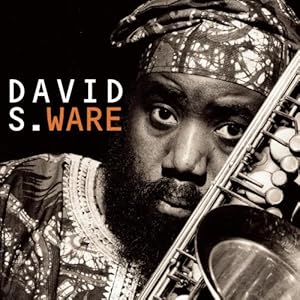
So when I say I linked Ware and Eric Lewis in my mind, what I mean is that, having just read Lewis's disarmingly candid account of how he forged a thriving career in music—proceeding at first through conventional jazz channels and then later fashioning an arena-ready aesthetic built around improv-heavy covers of well-known rock songs—I couldn't help thinking about how these two figures might have regarded one another. Ware's circle was obviously not the same one (i.e., the Wynton Marsalis orbit) that Lewis occupied before rebranding himself—and if you've read the piece, you know that I mean that phrase very literally—as ELEW. But these are obviously two extraordinarily skilled musicians who labored for years over their respective brands of jazz and managed—again, each in their own respective ways—to carve out a place for themselves in the jazz-unfriendly marketplace. (And even Ware, whether consciously or not, was a brand: It's hard to look at the album cover above and argue that there wasn't some image-building going on there.)

I'm not making any value judgment here. I haven't heard enough of ELEW's music (really, just a cover of "Mr. Brightside" at a Jazz Foundation of America event a few years back) to give an informed opinion on it, and my knowledge of Ware's work in the ’90s and 2000s is spotty as well. But it is fascinating to think of these two figures, both "stars" in a certain sense, one of whom won a degree of fame (and even a major-label deal) working in one of the most seemingly "difficult" subgenres in American music, i.e., post-Coltrane free jazz, without altering his core values in the slightest, and the other, who strategically retooled his entire aesthetic, grafting his love for and command of jazz onto a commercially viable "hook" and succeeding beyond just about any contemporary jazz musician's wildest dreams (touring with Josh Groban, etc.). There is no right path. Ware seemed entirely in love with his artistic pursuit, and Lewis, in his own way, seems to be in love with his. Yes, in the latter case, art intermingles more straightforwardly with commerce, but as anyone who has ever tried to make a living at anything creative (writing, ahem) could tell you, it pretty much has to at one point or another, so why not be open about that fact?

Again, I'm not advocating for the ELEW model, nor am I criticizing it. I'm simply stating that it seems to have worked for him, in the sense that he appears to be happy and fulfilled doing what he does, over and above the fact that he's making a good living doing it, and that that is in many ways the definition of success. Ware succeeded too, in that he reached many more listeners than 99 percent of the other free-jazz musicians who have ever lived. Think of the great John Tchicai, who passed away recently at the age of 76. I don't have encyclopedic knowledge of his work (I will say that I adore the early New York Art Quartet works), but I feel comfortable asserting without verifying it first that Tchicai never landed the lead review in Rolling Stone—or, for that matter, toured with Josh Groban. Everyone loves an unsung hero, but sometimes it's worth thinking hard about the players, like Ware and Lewis, who have "made it," and about why and how they did: how much, i.e., was due to their own deliberate efforts, as in the case of Eric Lewis reimagining himself as ELEW; how much was due to tireless advocates, e.g., Steven Joerg in Ware's case; how much was due to the conditions of the marketplace during a given period, etc. As jazz fans, we're bred to be suspicious of success, of visibility, etc., and certainly many of the music's brilliant statements, especially since the ’70s have been made underground, as it were, but we should celebrate the fact that certain artists in the field have managed to climb a little higher, to position themselves a little closer to the popular sphere, to go see the world, as it were. As Lewis suggests, there are lessons to be learned even from Kenny G.

I don't mean to reduce Ware's sad passing to an occasion for soapboxing; all I mean to say is that, with Lewis's fascinating career arc on my mind, I couldn't help but muse a bit on art-and-commerce as it pertains to jazz. May DSW rest in peace, and may ELEW continue to thrive on his own terms.

Sunday, December 11, 2011

Living, letting live: Gerald Cleaver's Black Host


Photo: Juan-Carlos Hernández

This past Saturday night I heard Black Host, a new project led by drummer Gerald Cleaver, at Cornelia Street Café. (The band was concluding a five-night mini tour of NYC, during which it had stopped by three other local venues.) What drew me in was partly my recent interest in Cleaver-led projects (his latest album, Be It As I See It, is a stunner) but the personnel—Darius Jones on alto, Brandon Seabrook on guitar, Pascal Niggenkemper on bass and the mighty Cooper-Moore on piano—was also a major factor.

Throughout the evening's two sets, I kept thinking about the make-up of the band, or more accurately, the fact that in jazz bands are often made, period, custom-built for each gig or recording session. Of course there are exceptions, groups like the Bad Plus that have impressed me precisely because they don't conform to this "leader plus the auxiliary players he or she happens to have convened for the night" model. I kept thinking about the fact that even once players have established themselves, not just as improvisers but as bandleaders and conceptualists, they can still appear in other people's projects, without any sense of it being beneath them. If you happen to be a jazz bandleader—it helps to live in New York and have a decent budget—you can actually assemble your dream group.

It's an obvious fact, one of the first principles of modern jazz, really, that personnel is fluid, but watching Black Host last night, I was re-struck by the special-ness, the vast potential of that idea. Say you're Gerald Cleaver, a great drummer and an experienced bandleader; you can think to yourself, I'd like to put together a project that includes four other established players, bandleaders in their own right: Cooper-Moore (one-time leader of Triptych Myth, multi-instrumental legend), Jones (increasingly prominent leader of a trio and quartet), Seabrook (leader of the punk-jazz force Seabrook Power Plant) and Niggenkemper (I'm not as familiar with his work, but his PNTrio has two CDs out). You can write some engaging music to fuel the enterprise; then, best of all, you can wind the whole thing up and watch it go.

(In rock, the band-building process typically happens once, right at the start. Personnel might shift, of course—guitarist Joe Petrucelli and I founded STATS roughly a decade ago, and we've worked with four different bassists during that time—but really what you're looking for is fixed membership.)

In the case of Black Host, you were hearing what happens when this process pays off, when you draft various players for a project and they get along outstandingly. What I love about this whole phenomenon is how, due to the x-factor of improvisation, a bandleader can't know in advance exactly how his recruits are going to interact. At Cornelia, I was struck specifically by the Cooper-Moore/Seabrook connection. There was one episode, I think it was during the second set, when C-M took a particularly wild solo (one of many that found his fingers, and forearms, scampering across the keyboard, summoning a riot of notes—chaotic and yet fully coherent, tasteful and related to the piece at hand) and lighted upon this violent, trilling figure. Seabrook looked up, clearly transfixed by the pattern, and then began to mimic it, employing the turbo-picking right hand that serves him so well when playing banjo in the Power Plant. The two men, a pianist in his mid-sixties and a guitarist in his mid-thirties were engaged in maniacal game of Hot Potato.

At other points I recall Cooper-Moore watching Seabrook or Niggenkemper solo with obvious glee, clearly fascinated by their ingenuity (throughout the evening, Seabrook was sampling various passages, particularly Jones's saxophone lines, with a small tape recorder and playing them back through his guitar pick-ups; other times he'd toss out razor-toothed ninja stars of notes, like the final flourish in John McLaughlin's epic riff at the end of Miles's "Right Off," from A Tribute to Jack Johnson—one iteration of McLaughlin moment I'm referring to comes right at 18:49 here; and during Niggenkemper's solo intro to one piece, the bassist held some kind of metal bowl, or maybe an aluminum pan?, against the strings to produce a fruitfully abrasive texture). It struck me in these moments that by convening various players, you're not just inviting them to play together, but also to listen to one another, to simply be together for that segment of time. (This fifth straight night of performance seemed like just the right juncture to savor the new relationships within Black Host: The players were comfortable together, but still a bit in awe of one another, still full of wonder.)

Darius Jones contributed his trademark combination of volcanic passion and laserlike focus. As impressive a bandleader as he is, I was struck last night by what a model collaborator he is as well. During the written portions—particularly during the second piece in the first set, a staggeringly gorgeous ballad that I immediately wanted to hear again as soon as it was over—he served Cleaver's vision, articulating the melodies with total clarity and a complex sensation of harsh sweetness—like honey with an underlying pungency—the tenderest notes paradoxically seeming the most effortful. And during the improvised portions, Jones served the hive mind, the collectively settled-upon direction of the music. Sometimes he led, delivering a full-on burry blare; other times, he sat back and reveled in the mayhem, grinning, cheering even, homing in on the Cooper-Moore/Seabrook firestorm, and doling out brief punctuation phrases. Like Cooper-Moore, Jones is a model onstage listener; you feel what others are playing more deeply while watching him respond to it. And that goes back to my point above: As a bandleader, in bringing players together, especially players like these, ones with huge personalities, you're creating this little society, a forum for new relationships to develop. I know Jones has a history with Cooper-Moore, but I'm not sure how much either player has worked with Seabrook, or whether any of the three had previously played with Niggenkemper but there was a very clear sense of camaraderie to Black Host, and one thing that fascinated me was how out of the spotlight Cleaver, the man with the plan, was. In light of what was going on up front, his drumming was a subtle glue.

You did feel his guiding hand in the written material, of course. There was a lot of variety to it. Unlike on Be It As I See It, which features short, chamber-music-like episodes, here the focus was on lengthy pieces that set up an atmosphere and explored it. The opening piece of the first set featured a subtle funk backbeat, with other instruments swirling on top; then came the remarkable ballad I mentioned above, a truly poetic song without words—not unlike "Charles Street Sunrise" from Be It—and a more hectic, uptempo piece. The second set was both harsher and more abstract. I remember some patient, drawn-out melodies and others that were more jagged—weird little sound shapes played in unison by Jones and Seabrook. I remember both hurtling uptempo swing and moments of pure, out-of-time weightlessness. Overall there was just enough shape and contour to hold the enterprise together, but Cleaver had left a lot of room for the spontaneity. I remember that the second set ended with all players partaking of a collective freak-out: Jones barking harshly, Seabrook wringing staticky squeals out of his tape-player/pick-up apparatus, Cooper-Moore leapfrogging his hands across the keyboard. Cleaver stood behind his kit, pressing a stick vertically into the head of his floor tom and threading it up through his fist (a technique I've seen before and experimented with myself but that I know of no proper name for), taking in the whole enterprise stoically yet attentively.

This was the kind of "It's alive!" moment that I've been trying to describe here. As a jazz bandleader in a forum like this, you're composing and preparing, yes; like the host of a dinner party, you're cooking, cleaning, stocking the fridge with beverages, making sure you've got enough place settings, etc. You're probably micromanaging a bit throughout the evening, especially during those first crucial, perhaps tense moments when the guests start to arrive. But at a certain point, you're letting go, allowing your friends to make of the evening what they will. There's a certain joy in seeing the preparations pay off as you expected; someone loves a particular dish that you labored over, say. But what makes you proudest is watching the guests socialize, seeing unexpected new friendships blossom in real time. You've ceded control; now the personalities themselves are in charge.

Again, this is not some shocking revelation; by and large, it's the way jazz works. But it doesn't always work as well as it did in Black Host, where you could see the players reveling in these new relationships. (Clearly, it didn't hurt that they'd been sharing stages for four nights already.) At this point, as an artist, you haven't just assembled a cast to execute your vision; you've founded a little village, a self-sufficient community with a vision of its own. Once it's humming along with its own momentum, you cease to be a leader, per se. At that point, you're just living, and letting live.

Tuesday, June 14, 2011

Studio visit: Milford Graves on record


In a March post, I attempted to make the point that free jazz ought to be documented in the studio from time to time. The only problem was that the Peter Brötzmann albums I chose as examples were actually live recordings. I stand by my argument, however, and it's because of albums like Real Deal and Beyond Quantum, sessions from, respectively, 1991 and 2008 featuring the drummer Milford Graves.

I've been on a Milford Graves kick over the past few days, incited by an interview subject who named Graves's 1976 LP Babi as an all-time favorite. Checking out that record, it was easy to see the appeal: It is as unhinged and raw a free-jazz document as you will find. Like Graves's many ESP-Disk recordings (I happened to catch some great material from 1964's The Giuseppi Logan Quartet on WKCR the other day as part of a Don Pullen profile), it sounds DIY, punk. There's something romantic about that. The legend of free jazz hinges on ideas of subversion and underground-ness. We like to think of these sorts of recordings as having been made hastily and cheaply—or in the case of Babi, a live album, almost incidentally, i.e., the music would have raged on whether or not the tape recorder was rolling. Graves's ESP sessions were mostly (all?) recorded in the studio in NYC, but there's nothing meticulous about them. The resulting documents are more or less the polar opposite of the kinds of gorgeously warm and balanced albums being made for Blue Note nearby at Rudy Van Gelder's New Jersey studio.

Despite all the financial shadiness surrounding ESP, fans of this music—myself included—tend to be glad that those mid-’60s records exist. We should also be happy, though, that many of the artists in question, e.g., Mr. Graves, have survived/thrived long enough to take advantage of more sophisticated recording technology. Just like with old, scratchy blues recordings sourced from 78s, we fetishize the thin, sometimes borderline crappy sound on those old ESPs, hold it up as a badge of authenticity, forgetting that no free jazz actually sounded like that in the flesh. You want to hear a Milford Graves album? Get Real Deal, a duet recording with David Murray recorded in the decidedly non–historically sexy year of 1991, or Beyond Quantum, a 2008 trio album with Anthony Braxton and William Parker. (Both are available as Amazon downloads via the links above.)

I can't express to you the sheer beauty of these recordings—not just the performances, but the SOUND. On Real Deal, Milford Graves sounds like the wind and the rain. He sounds like he's worshiping the drum kit, its glorious range of timbres. I'm listening to the first track right now, and it sounds heartbreakingly alive. The recording is wonderfully three-dimensional: You have the ride cymbal over in the left channel, the toms and bass drum closer to the center along with Murray's tenor, the hi-hat slightly to the right of those. I don't think I've ever heard another drummer paint with his kit the way Graves does, coax as much nuance out, and a musician like that deserves to be heard in a warm and resonant document like this, without that obfuscating aspect of rawness—obfuscating not just in the sense that detail is lost, but in the sense that it invites you to impose upon it a kind of punk romanticism. The romanticism is all there in the drums, though—you don't need an invitation to heap on your own baggage.

In short, free jazz deserves the studio treatment just as much as any other music. Sure it's a style built on rawness and spontaneity, but with the truly great musicians like Graves, you're going to get that no matter what. Why not hear him in glorious hi-fi? Here is a sample of Beyond Quantum—skip to around 1:50 for a taste of what I'm talking about:


I love that the ESP records exist (The New York Art Quartet is a particular fave), that Babi survives. But in terms of what I would take to a desert island, it's the pro-shot stuff, so to speak, where the music brings the heat and the recording soaks up the whole range of frequencies. Interstellar Space, anyone? Recorded at the aforementioned Van Gelder facility, not at some no-name Times Square facility or at a gig with a room mic. These Graves records are part of that illustrious tradition. Like many of the recordings in, say, the Aum Fidelity catalog—I've been very impressed recently by the new Planetary Unknown, with David S. Ware, Cooper-Moore, the aforementioned William Parker and Muhammad Ali—they're about museum-quality preservation, not DIY mythmaking. Artists of this caliber deserve such treatment. It is, I would venture to say, the real deal.

P.S. ECM is another label that has long understood the value of superior sound quality and studio documentation. You won't hear the full range of a Paul Motian performance on any other label. (See I Have the Room Above Her.) Speaking of which, I wrote about a handsome new studio-recorded Craig Taborn solo disc on ECM in this week's Time Out New York.