Showing posts with label Peter Brotzmann. Show all posts

Friday, June 23, 2023

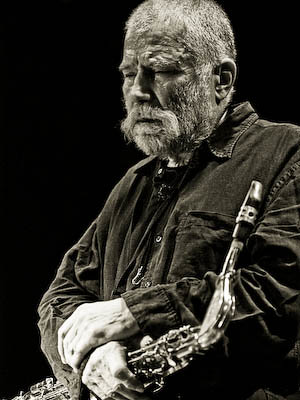
Peter Brötzmann interview, 2011

I'm reading reports that Peter Brötzmann has died. I haven't seen an official announcement, but his frequent collaborator Ken Vandermark has posted about it, which I'll take as confirmation of this terrible news.

I just want to say that his music has meant so much to me. He was a part of some of the most powerful sonic happenings I've ever heard live or on record. I've written a fair amount about him on this blog over the years. I was also fortunate enough to interview him a couple of times. The below is a conversation that originally ran on the Time Out New York blog in June of 2011, ahead of his appearance at the Vision Festival that year. I reached him via phone at home in Wuppertal, where he had recently performed, and he was so much fun to talk to — thoughtful, dryly funny and surprisingly warm. I'm posting this here for posterity, since it's long gone from the TONY site. 

Thank you for everything, Peter Brötzmann. 

Saturday, November 03, 2018

Lately (11/3/2018)

*I can't stop listening to Peter Brötzmann and Heather Leigh's new Sparrow Nights (out now on the prolific and consistently impressive Austrian label Trost), which I wrote up for Rolling Stone's weekly new-release column (scroll down to near the bottom). So many improv releases are simply recordings of gigs, and those have their place, but as I've written on here before, this music also deserves the proper studio treatment. The Brötzmann/Leigh duo, which I had the pleasure of hearing live in 2017 and which now qualifies as a proper band after several years of consistent performance and live recording, receives that here. I haven't heard, and probably never will hear, every Peter Brötzmann album, but I've heard a whole bunch of them, and for me, this one without question ranks near the top of the pile. Heart-wrenching and achingly desolate music — some kind of spooky ambient blues that sounds like it could go on forever, and maybe has been. It feels like Brötzmann has been waiting decades for a collaborator who could help him zero in on this particular zone of his playing.

Note: for background and context, I highly recommend this 2016 video interview with the duo.

*There is a major new Charles Mingus live box set out. For somewhat obvious reasons (e.g., no jazz artist enjoys Coltrane's level of quasi-religious icon-hood, which only seems to increase with time, a topic explored in depth in Ben Ratliff's masterful Coltrane book), this hasn't been remotely as well-publicized as, say, Coltrane's "Lost Album," but honestly it's probably afforded this listener even greater musical pleasure. My RS review goes into the reasons why.

*Clutch have been one of my favorite bands for going on 25 years. I reviewed their new album a little while back, but I'm glad I was also able to see a show on their current tour, because, as has always been the case, you can never get the full Clutch story from the records. This piece is my heartfelt tribute to a personal fave that I'm happy to say has become a bona fide institution.

Wednesday, June 07, 2017

The wandering healer: Peter Brötzmann live with Heather Leigh

Peter Brötzmann and Heather Leigh at Issue Project Room / June 7, 2017


It seems a little strange to say it, given the man's reputation and overall aesthetic, but what I'm sitting here thinking about now — marveling at, really — less than hour after the end of a Peter Brötzmann performance at Issue Project Room, is the man's generosity. In demeanor, he gives nothing: a trim, aloof man with an almost let's-get-this-over-with bearing. But in sound, he gives all.

Tonight's concert was a duo with Heather Leigh, a pedal-steel player and Brötzmann's partner on recent albums such as 2015's Ears Are Filled With Wonder and the newly released Sex Tape. I've seen Brötzmann many times; this might have been the first occasion where a drummer wasn't present. [Note, 6/8/17: Not quite true. I do remember catching an astonishing Brötzmann / William Parker duo gig at Tonic, which this list tells me was in April 2001.] I came in wondering if the music would somehow feel spare, lacking. Fortunately, the moment took over and all concerns dissipated — the musicians quickly got to work and held a concept aloft for roughly an hour.

The music, thanks in part to Leigh's gorgeously enveloping sound, sometimes chiming and delicate, other times overdriven, menacing and bubbling over with dark, ashy timbres, had a quality of hovering, as though a great craft were slowly taking off from the stage and hanging just above the ground. If Leigh provided the music's subtle thrust, Brötzmann was the exhaust, the residue of its liftoff, the dirt it displaced, the shards of ice that danced around it. The combination of the two was at times like hearing a man roaring into a waterfall: both sounds deafening but the saxophone (and later clarinet and tarogato) seeming somewhat buried within the vibrating din of the amplified strings. But there was an unperturbed quality to Brötzmann's phrases, a peace within the violence — though he roared, he stood still and did not visibly exert. His sound was as powerful as I've ever heard it — as gut-stabbingly true and poignant, as redolent of earth and sweat — but there seemed to be a new quality of balance taking hold, a resignation at once to press on through an imposing sound field that sometimes drowned him out and to surrender to its mass.

Not to say that Leigh seemed oblivious in the slightest. There was actually an extreme sensitivity at work, a sense of the players swapping foreground and background roles. As the music unfolded and Brötzmann traded the manly might of the tenor for the wobbly, sometimes fragile-sounding clarinet and haunting, reedy tarogato, Leigh would always recede at just the right moment to open a space for her partner, inviting Brötzmann to metaphorically lean in close, blessing the audience with a taste of the milder end of his gifts, his private-sounding murmurs, like a man telling himself a story beside a hearth. And then worrying a phrase, shaking his mouth back and forth over the mouthpiece to sort of wobble the sound, building back up into a growl or a gnash.

Brötzmann sets can sometimes feel like pure, bullheaded exertion, but this one had a quality of deep reflection. It was like the two were singing one hour-long dirge or elegy — an almost raga-like form, now that I think about it — with many peaks and valleys. There was a sense of bearing down on a single idea, sweating through the effort of concentration and focus. And Brötzmann, standing so still but producing such a massive, human noise and depth of expression. His is a sonic presence on the order of Milford Graves where, yeah, sure, you can listen to it all kinds of ways, in whatever medium you choose, but unless you're in the room with it, you aren't really hearing it. Words like "cry" or "shriek" seem to bounce off its true essence like rubber bullets off iron; what's there in the sound is nothing you can say succinctly. It's something you take in slowly, a warm, harsh, even caustic sort of mist; a blinding yet restorative light that feels truer and truer as both the man making it ages and the world around him becomes faster, more distracted/distractable, more violent and insane.

There was a brief encore, with Brötzmann playing celebratory figures, what seemed to me an explicit evocation of one of his (and us New Yorkers') patron saints, Albert Ayler. Truth had already long since marched in, had seeped into every corner of Issue's imposing, cavernous space, but during this brief coda, he graciously made his ancestral connection clear, an homage and a well-wishing. Ayler's prophet days were indelible but so brief. Peter Brötzmann by contrast has led a long and rich life. In his old age, he's something akin to a wandering healer, coming to town and, simply, without ceremony, filling each space he visits with a kind of raw grace, an unceremonious yet transcendent blast from the guts. Framed with Leigh's contributions, I heard that sound tonight — that old friend to my ears and spirit — in a new way. Wiser, almost, possibly more benevolent, but with as much fight as ever. Make no mistake, Peter Brötzmann is at a rare peak, and when he's gone, there will not be another like him.

/////

*I'm proud of this lengthy 2011 Brötzmann Q&A. Whatever his manner might indicate, the man is a joy to converse with.

*And I thank Brötzmann for his vital and generous contributions to my Interstellar Space piece earlier this year.

Wednesday, February 22, 2017

'Interstellar Space' at 50


New at Rolling Stone, my 50th-birthday tribute (measured from date of recording, not release) to one of my favorite albums, Interstellar Space. Features fresh input from Ravi Coltrane, Jack DeJohnette, Peter Brötzmann, Nels Cline, Ingrid Laubrock and others, as well as archival thoughts from the late, great Rashied Ali — a big thanks to everyone who took the time to speak with me.

Please check out this DFSBP bonus track, the complete transcript of my interview with Louie Belogenis, who has a couple of choice quotes in the piece but who shared so much more wisdom and insight regarding Coltrane's artistry in general and Interstellar Space in particular.

Few quick addenda:

*Here's the original Rolling Stone review of Interstellar Space, by Stephen "Hammer of the Gods" Davis, for anyone who's interested.

*I wanted to delve a bit further into the shadowy pre-Interstellar history of sax/drums duets in jazz but didn't want to veer too far off course. In addition to Ali's mention of undocumented duos with Archie Shepp (cited in my 2003 Rashied interview for All About Jazz, a Q and A I quote frequently in the new piece), there's this tantalizing passage in the book that comes with Revenant's Holy Ghost Albert Ayler box. The speaker is Mr. Milford Graves, discussing Ayler's visits to his apartment in East New York, Brooklyn. The time frame isn't specified, but my educated guess is that the below would have taken place around 1965, when the two were working together most frequently:

"We played a lot of duets at my house — just the two of us. The things that we did when he came over to my house aren't on any records; people hear the records and they don't hear the real Albert Ayler — the Albert Ayler who's relaxed when he's not around a major audience for which he's going to have to play something that people will dig, or play a tune he has recorded so he can sell some records." 

*Along similar lines, we also have, of course, the brief Coltrane / Art Taylor duet that commences about 30 seconds into "Countdown," as well as this epic Trane / Roy Haynes showdown from Newport '63 (thanks to Ben Ratliff and his essential Coltrane: Story of a Sound for the tip-off on the latter, which is sort of hiding in plain sight; there's more great Ratliff-on-Trane in this 2001 Times piece):


Not to mention the Interstellar-style duet that erupts between Trane and Ali around 3:20 into "Offering," recorded just a week before Interstellar itself:


*Here's a short list of other sax/drums recordings I love — either old favorites or albums I've discovered while working on the RS piece. There's a nice, long list up on the Free Jazz Blog (though now out of date, since new ones are surfacing all the time, e.g., Rich and Carson Halley's brand-new The Wild — thanks to Derek Taylor and Dusted for the tip-off — which I can't wait to check out in full):

Sunny Murray / Arthur Doyle, Dawn of a New Vibration
Sunny Murray / Sabir Mateen, We Are Not at the Opera 
Essential 2000s-era Sunny Murray, shaggy, swinging and sublime, on these two. Doyle and Mateen — both of whom double on flute — know what's up and of course hold their own next to the gentle giant.

Fred Anderson / Robert Barry, Duets 2001
Fred Anderson / Steve McCall, Vintage Duets
The former is maybe my single favorite sax/drums album next to Interstellar itself — a sort of freebop infinity, relaxed but never casual. The McCall set, recorded back in 1980, is a deep Chicago document.

Milford Graves / David Murray, Real Deal
David Murray / Jack DeJohnette, In Our Style (Fred Hopkins appears on some tracks)
Milford Graves / John Zorn, 50th Birthday Celebration, Vol. 2
Two of the best representations of Milford Graves on record, with two very different, very well-matched partners, as well as a fun, gutsy Murray/DeJohnette dust-up.

Denis Charles / Jemeel Moondoc, We Don't
Pure infectious exuberance as a Caribbean-born '60s survivor meets a loft-era alto wizard circa '81. Charles's roughly contemporary duos with clarinetist Peter Kuhn, featured on disc 2 here, are also excellent.


Peter Brötzmann / Paal Nilssen-Love, Wood Cuts
Paal Nilssen-Love / Joe McPhee, Tomorrow Came Today (McPhee plays pocket trumpet on some tracks; reissued as part of the Candy box set)
Peter Brötzmann / Shoji Hano, Funny Rat/s series
Pick your poison, really, when it comes to Brötz drum duets — I must have them all! — but I've gotten good mileage out of Wood Cuts and the third Funny Rat/s disc with the incredible Hano. Nilssen-Love and pretty much anyone, doing pretty much anything, is going to be worth your close attention, and the McPhee here is no exception.

Willem Breuker / Han Bennink, New Acoustic Swing Duo (Breuker also plays clarinets)
Kaoru Abe / Hiroshi Yamazaki, Jazz Bed

Two of the earliest, not to mention most wildest, entries in the sax/drums canon, with the Bennink/Breuker being recorded all the way back in late '67 (thanks to Ben Young for the tip-off). The Abe/Yamazaki, recorded in '71, is just so goddamn raw/real.

Paul Flaherty / Chris Corsano, The Beloved Music

Paul Flaherty / Randall Colbourne, Bridge Out!
Speaking of raw/real, here be Flaherty and Corsano, the standard bearers of the punk offshoot of the sax/drums monolith. Flaherty/Colbourne is a subtler yet just as compelling combo.

Jimmy Lyons / Andrew Cyrille, Burnt Offering

Jimmy Lyons / Andrew Cyrille, Something in Return
Cecil Taylor Unit blood brothers getting down to serious business.

Dewey Redman / Ed Blackwell, Red and Black in Willisau

Ornette blood brothers doing same.

Kid Millions / Jim Sauter, Fountain

Keeping the tradition moving. Molten noisejazz lava with surprising sensitivity. See also: Sauter's duet with Weasel Walter on this 2014 WW improv sampler, on which he also goes toe-to-toe with Marshall Allen and Marco Eneidi.

Jon Irabagon / Mike Pride, I Don't Hear Nothin' but the Blues
Another contemporary spin. Obsessive, insular and just downright perverse at times.

What are your favorites?

Sunday, August 10, 2014

Somewhere we've never been: Farmers by Nature at ShapeShifter Lab


The debate over the now-infamous "Sonny Rollins" New Yorker piece continues. I'm not going to get into what I think of the original article, or the points made by its various supporters and detractors, or even Sonny's own response, mainly because I think both the incident and its aftershocks are beside the point. That point being: music ("jazz," or what have you) as an actual human practice, happening now, in real time—rather than an idea to be lobbed about abstractly.

I bring up the Sonny business mainly because I read Justin Moyer's jazz-bashing response in The Washington Post yesterday, and then went out to see a very satisfying night of what you might call jazz—the Aum Fidelity–backed double-record-release bill of Darius Jones and Matthew Shipp and the Farmers by Nature trio (Craig Taborn, William Parker and Gerald Cleaver, pictured above, left to right) at ShapeShifter Lab; and a trio set by Travis Laplante, Mick Barr and Nick Podgurski in a Clinton Hill living room, part of the Home Audio series. One of Moyer's points ("There’s not much difference between a screechy performance by avant-garde saxophonist Peter Brötzmann from 1974 and one from 2014") stuck with me—the idea being that "free jazz" always sounds the same. I've seen enough supposedly free performances to know that, when it comes to the post-Coltrane/Ayler tradition, at least, "free" can indeed refer to a well-rehearsed script. I happen to love Peter Brötzmann—’74, ’14, whenever—and I think he's a much better listener/collaborator and more diverse performer than he's given credit for. But yes, you go to see him, and you know that a certain flavor of ornery, macho catharsis is going to be part of the deal.

But I take issue with the idea that actual freedom, actual improvisation, is a myth, and that, to cite another one of Moyer's points, improvisation is overrated as a rule. Again, I agree with him in the macro sense. Moyer writes, "…the fact that music is improvised doesn’t make it great." Amen to that—I think the idea of improvisation (or any other philosophical construct that informs music's creation or performance, be that serialism, or graphic scores or Conduction, or what have you) being presented as an inherent virtue of that given piece of music is b.s. I'm really only interested in the result, and very often songs, or more generally, compositions, are what I'm after. As a metalhead, I love riffs; as a jazz guy, I love melodies—Ellington, Mingus, Andrew Hill, etc.; as a lifelong pop fan, I love hooks.

But, in some cases, improvised music appears before you as a kind of miracle. Watching Farmers by Nature last night, I felt like I was witnessing the honest-to-God creation of something out of nothing. It wasn't free jazz, or any other kind of calcified thing. It wasn't self-important about its method. It was just an honest shot at doing what improvisers ought, ideally, to do every time, which is not simply to empty your closet of every idea you might have stuffed in there, but to deal with the moment, with its possibility, and to listen, really listen, to what your collaborators have to say, and concern yourself with supporting those ideas, as well as the overall continuity, as fragile as a bubble, of the collective statement.


The set had a real elegance of design to it. Parker started out solo, and the other two slowly built up a kind of murky groove, rising out of nothingness. From there, over roughly an hour, the music visited roughly six or seven different zones, like track demarcations on an album. Each proceeded logically from the one before, and never arrived till the group had fully explored the prior area of inquiry. I remember an episode of fractured funk, with Taborn and Cleaver clanking out jagged accents, completing each other's sentences; an exquisitely chill section that felt almost like placid bossa nova; a couple of frenzied Taborn flights, where he came off like a short-circuiting cyborg, juxtaposing single, percussive notes from different registers of the keyboard; a long unaccompanied Cleaver solo that took full advantage of some expert tom-tom tuning—the drum kit was really singing, in the melodic sense—and ramped up to torrential density; and maybe most profound of all, a section featuring Parker on arco. I don't think I've ever heard a double bass cry out with such grain and elegy and deep feeling as it did last night in Parker's hands. Taborn accompanied with superhuman restraint, serving up quiet yet extremely resonant chords.

So, yes, sensitivity and restraint are a big part of why this music succeeded. But as I attempted to describe above, the group raged plenty as well. I think what impressed me so much was, again, this sense of continuity, of each player's—and the trio's, as a collective unit—awareness of the overall arc. Too often, long sets of improvised music follow a predictable quiet-loud-quiet shape. This felt more like a suite, with each movement taking on its own special mini contour. The band went for the climax when it was there, but they never milked it. Intensity was only one color on the palette. And the same goes for the hierarchy of the music, as it were. For long stretches, the band played in a way that seemed totally collective, i.e., sans soloist, almost in the way that groups like the Necks improvise. But, as with the varied dynamics, collectivity was just one strategy. During plenty of other moments, the more traditional soloist-plus-accompanists concept was very much at play. Each of the three players starred in turn.

Most amazing to me, though, was how the moment, the actual spontaneous unfolding circumstance, seemed to drive the set, as much as the will of any one player, or even of the trio as a whole. I'm thinking, for example, about how Gerald Cleaver's smallest cymbal—the size of a splash, but with a more ping-y, less tinny sound than I've often heard out of splashes—turned out to be something like a central character during the last 10 or 15 minutes of the set. Throughout the performance, Cleaver moved this cymbal around the kit—sometimes it was perched on its own stand to his right, sometimes it was resting on the hi-hat stand above those cymbals or on the floor tom or snare. So, in the middle of one such transfer, Cleaver happened to drop this little cymbal. He reached down beside the bass drum and picked it up, and then he went to put it back on its original stand to his right. But this act became, in and of itself, a sort of tic or weird fixation. He didn't just replace the cymbal and go on playing the full kit. He began obsessively, continuously spinning the cymbal around on the stand, eliciting a faint little creak. The other players didn't seem to directly respond, but as Cleaver turned the cymbal around and around, it was almost like he was drawing the accumulated momentum of the set down into a final moment—draining the water from the tub, funneling the creative material out of the air. Taborn and Parker gradually quieted, and Cleaver was striking the still-spinning cymbal with a wire brush, almost inaudibly. He stopped spinning it and continued whacking the brush into the air, engaging in movement but producing essentially no sound. And that was the end of the set.

I trust that none of the above episodes, the high-intensity Taborn solos, the Parker arco feature, the concluding Cleaver small-cymbal mini drama, were planned. Befitting their group name, the three musicians actually were harvesting moments, turning them over, wringing out all their potential. The overall result didn't sound anything like any stereotypical idea of "free jazz," or any other style of improvised music I can think of. But at the same time, it wasn't alien; it felt fully logical, narrative, directed, harmonious, complete. The set lasted for exactly the right amount of time, and for the band to have played a single note after the ending would've felt (to me, at least) superfluous. This Farmers by Nature set wasn't great because it was improvised; it was great because of, as I've attempted to describe, the brilliance of the various individual moments and the coherence of the overall form. At the same time, I think the set's uniqueness, the fact that what happened last night hasn't happened before and won't happen again, was part of its immense appeal. We shouldn't fetishize the means of production—how something was made, or according to what principle—but when something truly special arises from a certain method, or lack of method, it's good to remember that, yes, that method has potential. It is absolutely no guarantee—not whatsoever—but improvisation can, under certain circumstances, take both players and audience somewhere they've never been. Last night's Farmers by Nature set reaffirmed that fact for me. As always, I'll be staying tuned.

/////

P.S. My focus on the Taborn/Parker/Cleaver performance isn't intended to slight the other sets I saw last night. Both were fierce and beautiful. Darius Jones and Matthew Shipp burrowed ever further into the special kind of poignant, stormy melancholy—doled out in three- or four-minute chunks, the so-called Cosmic Lieder of their album titles—they've been creating as a duo for the past few years. And Travis Laplante and Mick Barr, both scarily extreme, virtuosic and idiosyncratic musicians, unleashed their respective aesthetic selves, but with no sense of autopilot whatsoever, building something collective and response-based, with help from Nick Podgurski's expertly tension-ratcheting percussion, moving imperceptibly from sparseness to brutal density. A hell of a night all around.

Saturday, January 14, 2012

Heavy Metal Be-Bop #6: Bill Laswell


I'm happy to report that Heavy Metal Be-Bop, my jazz/metal interview series, has returned from a little hiatus. The sixth installment, a Q&A with Bill Laswell, is live in abridged form at Invisible Oranges (metal is the focus here, of course) and in a greatly lengthened director's cut at the series's online home, heavymetalbebop.com. (HMB #7 is already in the can, though no promises re: how soon I'll be able to post it.)

As I mention in the intro to the Q&A, which you'll find at the links above, it's hard to discuss the jazz/metal connection without bringing up Bill Laswell; along with John Zorn, he's an elephant in the room. You'll find some Laswell talk—specifically, comments on Last Exit, the polarizing ’80s improv quartet he worked in with Peter Brötzmann, Sonny Sharrock and Ronald Shannon Jackson—in two prior HMB installments; check out Melvin Gibbs's thoughts here and Craig Taborn's here.

I'm not sure when I first heard of Bill Laswell. I remember that my teenage interest in Mick Harris's idiosyncratic dub-metal project Scorn (I still love the Evanescence LP) led me to the Laswell/Harris collaboration Equations of Eternity, and that a review in the sadly departed metal rag Rip tipped me off to Painkiller, Harris and Laswell's avant-grindcore trio with John Zorn.

As I got more into both jazz and metal though, I developed something of a distaste for Laswell. I remember being immensely excited when I first learned of the existence of 1997's The Last Wave, a trio record with Laswell, Derek Bailey and Tony Williams (!) under the collective name Arcana, and of Last Exit itself. Being a Bailey and Williams nut, as well as a Sharrock obsessive, it seemed that I couldn't go wrong with this material (not to mention Material, a Laswell project that featured guest turns from Sharrock and a bunch of other free-jazz heroes set against a backdrop of off-puttingly synthetic—for me, at least—’80s art-dance). But in the case of The Last Wave, the strange, boomy production, and in the case of Last Exit, a funk-oriented bass presence that struck me as a sore thumb, kept me on the outside. Records like these were classic examples of "On paper, this looks tailor-made for me, but I just can't get with it in the flesh."

Over time, though, I realized that I couldn't stay away. I wasn't going to let my aesthetic quibbles keep me from savoring some of Tony Williams's final recordings (the drummer died during the making of the second Arcana record, Arc of the Testimony), or an extended series of exchanges between musical heroes of mine such as Brötzmann and Sharrock. The more I sat with the Laswell discography (or at least the wings of it that intrigued me most), the more it impressed me. What I realized was that, like John Zorn, another artist whose own work I have mixed feelings about but whose curatorial/community-forging instincts I admire greatly, Laswell's greatest achievement has been his bridge-building, his willingness to forge connections between artists who never would've found each other (note Herbie Hancock and Akira Sakata's names on that Last Exit LP jacket above), or at least probably wouldn't have thought to document their meeting on record: Bailey and Williams, say, or Keiji Haino and Rashied Ali (who appeared with Laswell in a collective called Purple Trap), or Sharrock, Brötzmann and Shannon Jackson, who seem like soulmates after the fact but who, to my knowledge, hadn't played together before Laswell convened them. The Praxis project is another example; I'm not in love with the later material (oriented around Buckethead and Brain), but it warms my heart to read the personnel list for 1993's Sacrifist, which includes Bootsy Collins and Bernie Worrell alongside the dudes from Blind Idiot God. Laswell's work as an intergenre unifier is less well-documented than Zorn's (in founding Tzadik, Zorn created an invaluable umbrella entity that Laswell never managed to maintain for an extended period), but it's equally undeniable. I'm thrilled that these records exist.

And to branch out briefly into Laswell's work as a producer, the musical world owes him a great debt for helping to resurrect the career of Sonny Sharrock. Guitar and Ask the Ages are among my most treasured records, period, the two best presentations of Sharrock's heartrending magic. (Seize the Rainbow, a Laswell co-production, is an idiosyncratic keeper as well.)

Part of the fun of the Heavy Metal Be-Bop series has been interrogating some of my old aesthetic prejudices. To ignore Laswell outright would a major self-disservice. Just as I don't love all of his records, I don't agree with everything he has to say in the conversation linked above (for one, his estimation of Dave Lombardo's limited musical scope seemed overly dismissive, and even disrespectful), but I'm grateful to have had the chance to sit down with him and discuss this strange musical nexus. Tony Williams, whom Laswell knew well and worked with often, acted as a fulcrum for the conversation, and I think we ventured into a fair amount of underexplored territory re: Williams's ambitions and aesthetic goals as a rock-oriented player.

I hope you enjoy the interview. I'd like to sincerely thank Mr. Laswell for taking the time to meet with me.

Wednesday, August 03, 2011

Three kinds of love: The Pentagram doc


Last Days Here, a new documentary about a rock & roll singer named Bobby Liebling, brought me to tears and beyond. Broadly, it is a story about metal, specifically a doomy, post-Sabbath band from the D.C. area called Pentagram. Pentagram, with the wild-eyed Liebling at the mic, brushed up against fame in the ’70s but never attained it. Metal crate-digger types rediscovered the band in the early aughts, and they've since attained some pretty heavy-duty underground cachet.

But as I said, Last Days Here is only broadly about metal. It's really a love story. More specifically, it's a catalog of love's various incarnations: an emotional connection between friends, romantic partners or family members, a spiritual connection between a fan and an artist, a borderline-divine connection between humankind and this thing we call music. The film chronicles the way these noble forces wage war on the self-pitying, self-destructive urges that prey on us daily.

Yes, as the film openly—and, at times, revoltingly—acknowledges, Bobby Liebling is a drug addict. He is a recidivist, a chronic user, someone we might all feel compelled to write off. Someone who has perhaps written himself off. But, the film argues, he is not beyond hope, beyond uplift.

I don't want to spoil the details, but this is a film about a man teetering on the brink, falling down into the chasm and clawing his way back up. Now in the grand scheme of things, a junkie rock singer attempting to resurrect his career might seem like a petty struggle. But there is some of Liebling in all of us, us who get down, who get bleak and dark, but who remember all our blessings, our blessings of family, of partners who look out for us every day of our lives, of friends who would do anything to see a smile on our faces, of sweet, holy art, that takes us outside of ourselves and shows us something loud, overwhelming, glorious. Whether you love metal or not, you will see in this film what it means to love metal, to exalt in its spectacle, its satanic pantomime, its delicious gloom.

The film is about Liebling and his comeback road, yes, but it's also, crucially, about the nonperformers, the behind-the-scenes folks such as Sean "Pellet" Pelletier (that's him with Liebling in the clip above), a Philly-based metal booster who has made it his life's work to ensure that his favorite band (Pentagram, of course) get its due. As you'll see in the film, "above and beyond" doesn't even begin to describe the lengths to which Pellet goes to assist Liebling, but he does it all with a smile: Everything he gives to metal, the music gives back a hundredfold.

This movie will depress you; it will frustrate you and make you want to tear your hair out. It will also make you rejoice in your life's blessings, especially if metal happens to be one of those. The arc of Liebling's story isn't necessarily unpredictable, but it's nevertheless magical to watch it unfold. I wept openly at the end, sympathizing with just about every character onscreen, from the beleaguered Pellet to Liebling's clear-eyed companion Hallie and his perennially doting parents. Last Days Here turns "behind the music" into something truly profound and inspirational. It's a cautionary tale, a love story and a rock doc all in one. You have to see it.

There's a great new Pentagram album on Metal Blade called Last Rites. Check out some samples and pick up a copy here.

/////

On the jazz side of things, I just checked out Solider of the Road, a very well-done documentary on another hardened lifer, Peter Brötzmann. It may not contain the revelations of Last Days Here—to be fair, its subject is far more level-headed and sane—but it's a sharp portrait of an artist I treasure.

I especially enjoyed the insights into Brötzmann's complex relationship with his German-ness, as well as the commentary from his master collaborators such as Han Bennink. The live footage looks and sounds gorgeous, and the interviews are intimate and revealing.

Soldier of the Road is a pretty straightforward—even low-key—work, without much of a narrative arc, but if you're a Brö fan, you should definitely check it out. You can learn more about the film and order a DVD copy here. (Don't be scared off if you're a U.S. consumer—my DVD arrived just days after I placed an order.)

Tuesday, June 14, 2011

Studio visit: Milford Graves on record


In a March post, I attempted to make the point that free jazz ought to be documented in the studio from time to time. The only problem was that the Peter Brötzmann albums I chose as examples were actually live recordings. I stand by my argument, however, and it's because of albums like Real Deal and Beyond Quantum, sessions from, respectively, 1991 and 2008 featuring the drummer Milford Graves.

I've been on a Milford Graves kick over the past few days, incited by an interview subject who named Graves's 1976 LP Babi as an all-time favorite. Checking out that record, it was easy to see the appeal: It is as unhinged and raw a free-jazz document as you will find. Like Graves's many ESP-Disk recordings (I happened to catch some great material from 1964's The Giuseppi Logan Quartet on WKCR the other day as part of a Don Pullen profile), it sounds DIY, punk. There's something romantic about that. The legend of free jazz hinges on ideas of subversion and underground-ness. We like to think of these sorts of recordings as having been made hastily and cheaply—or in the case of Babi, a live album, almost incidentally, i.e., the music would have raged on whether or not the tape recorder was rolling. Graves's ESP sessions were mostly (all?) recorded in the studio in NYC, but there's nothing meticulous about them. The resulting documents are more or less the polar opposite of the kinds of gorgeously warm and balanced albums being made for Blue Note nearby at Rudy Van Gelder's New Jersey studio.

Despite all the financial shadiness surrounding ESP, fans of this music—myself included—tend to be glad that those mid-’60s records exist. We should also be happy, though, that many of the artists in question, e.g., Mr. Graves, have survived/thrived long enough to take advantage of more sophisticated recording technology. Just like with old, scratchy blues recordings sourced from 78s, we fetishize the thin, sometimes borderline crappy sound on those old ESPs, hold it up as a badge of authenticity, forgetting that no free jazz actually sounded like that in the flesh. You want to hear a Milford Graves album? Get Real Deal, a duet recording with David Murray recorded in the decidedly non–historically sexy year of 1991, or Beyond Quantum, a 2008 trio album with Anthony Braxton and William Parker. (Both are available as Amazon downloads via the links above.)

I can't express to you the sheer beauty of these recordings—not just the performances, but the SOUND. On Real Deal, Milford Graves sounds like the wind and the rain. He sounds like he's worshiping the drum kit, its glorious range of timbres. I'm listening to the first track right now, and it sounds heartbreakingly alive. The recording is wonderfully three-dimensional: You have the ride cymbal over in the left channel, the toms and bass drum closer to the center along with Murray's tenor, the hi-hat slightly to the right of those. I don't think I've ever heard another drummer paint with his kit the way Graves does, coax as much nuance out, and a musician like that deserves to be heard in a warm and resonant document like this, without that obfuscating aspect of rawness—obfuscating not just in the sense that detail is lost, but in the sense that it invites you to impose upon it a kind of punk romanticism. The romanticism is all there in the drums, though—you don't need an invitation to heap on your own baggage.

In short, free jazz deserves the studio treatment just as much as any other music. Sure it's a style built on rawness and spontaneity, but with the truly great musicians like Graves, you're going to get that no matter what. Why not hear him in glorious hi-fi? Here is a sample of Beyond Quantum—skip to around 1:50 for a taste of what I'm talking about:


I love that the ESP records exist (The New York Art Quartet is a particular fave), that Babi survives. But in terms of what I would take to a desert island, it's the pro-shot stuff, so to speak, where the music brings the heat and the recording soaks up the whole range of frequencies. Interstellar Space, anyone? Recorded at the aforementioned Van Gelder facility, not at some no-name Times Square facility or at a gig with a room mic. These Graves records are part of that illustrious tradition. Like many of the recordings in, say, the Aum Fidelity catalog—I've been very impressed recently by the new Planetary Unknown, with David S. Ware, Cooper-Moore, the aforementioned William Parker and Muhammad Ali—they're about museum-quality preservation, not DIY mythmaking. Artists of this caliber deserve such treatment. It is, I would venture to say, the real deal.

P.S. ECM is another label that has long understood the value of superior sound quality and studio documentation. You won't hear the full range of a Paul Motian performance on any other label. (See I Have the Room Above Her.) Speaking of which, I wrote about a handsome new studio-recorded Craig Taborn solo disc on ECM in this week's Time Out New York.

Thursday, June 02, 2011

In full: An interview with Peter Brötzmann


About a month ago, I spent one and a half hours on the phone with Peter Brötzmann (from midtown Manhattan to Wuppertal, Germany). I've carried on in recent posts about my intermittent addiction to this man's music. For about a decade now, his sound has functioned for me like a somewhat exotic favorite cuisine: not something I'm always in the mood for, but when I am, I won't settle for anything else.

Mr. Brötzmann was a delight to talk to. (At this point, I'd like to extend a hearty thank you to Patricia Parker at Arts for Art for setting up the interview, which was Time Out New York–backed and timed to Brötzmann's June 8 appearance at Vision Festival XVI.) It would be somewhat absurd to expect a creator of extreme and often violent music to also express these qualities in conversation, but it didn't seem out of the question that Brötzmann might be a bit brusque or no-nonsense. Actually, he was unfailingly warm, totally unhurried, funny, reflective, occasionally profane. In short, I got a constant "I'm talking to a really good guy" vibe throughout our interview. It made me wonder why I hadn't read more interviews with the man before. After all, he tours the world regularly; you'd think that press folks would get curious and request Q&As. Whatever the case may be, I felt completely elated during and after this experience. I almost always enjoy the interview process, but this one seemed to be in a class of its own.

I feel that the results will be of interest to Brötzmann fans, which is to say that they were/are of interest to me, i.e., I learned a lot about him and clarified a lot more. Just to cite one example, I've always been fascinated by Brötzmann's inimitable verbal sense (Nipples! Balls! Hairy Bones!), and he spoke candidly about this:

"If you take Balls or Nipples, the sexual side of the music, you have it in rhythm & blues as much as you can. It's very important, and was and still is for me."


That's just a small snippet. If you have a chance, please check out the interview and let me know what you think. If you're new to Brötzmann, I suggest starting with the profile piece that the conversation fueled.

I should mention that this Brötzmann interview was just one component of an NYC-jazz package created for the Time Out New York website by myself and my esteemed colleague Steve Smith, whom you might know as @nightafternight. In addition to a calendar of the top jazz shows for the coming summer, you'll find our thoroughly subjective list of 25 essential New York jazz icons of the present moment. (DFSBP regulars might be able to guess who my No. 1 pick was, a pick at which Steve and I each arrived at independently.) As with the Brötzmann materials, I welcome any feedback regarding this list. I had a blast working on it, but it was definitely an eye-opener in terms of my own biases and blind spots.

P.S. I encourage all Brötzmann fans to visit his new shared web home, Catalytic Sound, where you can buy records direct from the artist.

Wednesday, March 30, 2011

Raging against the machine: Another look at Peter Brötzmann's Machine Gun


"…an abstraction painted with a flame-thrower…"—John Corbett

"mindblasting… a smashing clanging wonderland of noise"—Thurston Moore

"The first day went over with rehearsing…, trying to find a way to get the music on tape. After all this trouble, it was a good thing to find some bars, the day/night ended with some tasty beer. Finally I had stashed all the comrades in some friends['] beds or on some ma[t]tresses, Buschi and I were left over, as usual. After some more beers we had to find a place to sleep a couple of hours, next to the club there was a building site under construction. We entered, slept a bit on some cardboard, had a beer for breakfast, went to the club, waiting for the comrades, ready to go."—Peter Brötzmann


The quotes above refer to the album Machine Gun, by the Peter Brötzmann Octet. Machine Gun is one of those agreed-upon landmarks: widely proclaimed as seminal, five stars and a crown in The Penguin Guide to Jazz Recordings, etc. Not to mention the street cred, evidenced by the Thurston Moore quote above. It's a bogeyman of a record—purportedly the most extreme free jazz there is. I remember seeing a copy in a friend's room in college and asking about it; the response I got was a pair of raised eyebrows, i.e., "Shit, man, I don't know what to tell you about that one." The Thurston Moore quote says it all: Machine Gun is a NOISE record, in the foretelling-of–No Fun Fest sense.

I've been listening to Machine Gun over the past few days, and—just like I always am when I pull out this incredible record—I've been newly struck by the fact that this "wonderland of noise" really isn't that at all. What it is, is a very early, very great example of midsize-ensemble free-jazz composition and arrangement. This recording has a thousand times more purpose and direction than anyone seems to want to admit, least of all Brötzmann, who has been perfectly happy to feed the mythology with his tales of sleeping on cardboard and beer for breakfast.

Machine Gun is not simply a document of eight men—most prominently, the stampeding reed section of Brötzmann, Evan Parker and Willem Breuker—blowing their brains out. There is a lot of that to be found on the record, and what of it there is, is majorly amplified in terms of its cacophony by the insanely in-the-red engineering. (The album was, after all, recorded in a concrete-block basement jazz club—though not in front of a live audience—in Bremen.) But what makes the "mindblasting" improv sections on Machine Gun so effective is how they're contrasted with a number of very different textures. Make no mistake: The three pieces that make up the original record, which sound beautiful on the Atavistic reissue The Complete Machine Gun Sessions, are meticulously MAPPED. There are free-jazz blowouts (Dave Burrell's "Echo" comes to mind) and then there are free-jazz compositions; the pieces on Machine Gun are the latter. (Note, for starters, Brötzmann's account of a full day of rehearsal.)

Take the title track. The signature opening section—the head, as it were—that staggered, jagged, broken-glass reed shudder, with the two drummers and the two bassists scraping up a racket underneath, only lasts about 45 seconds. Then Evan Parker begins to solo, with comparatively delicate accompaniment underneath—just one of the basses (I'm pretty sure) and the tamer of the two drummers, Sven-Åke Johansson. The fundamental principle that makes this record a compositional masterpiece in addition to a cacophonous one is already here: You blast with the full ensemble, and then you peel away layers. You plot out an arc. "Machine Gun" is like Coltrane's "Ascension" in a way, but it's a much more engaging piece of music because it's not simply BLAST-solo-BLAST-solo, etc. During Parker's solo (man, that serrated tenor sound—so beautiful and so fully formed, even in 1968), the full ensemble comes in at times to goad him, to blast him out. They're RIFFING in the classic big-band sense, that great old trick where the band will take up a momentum-maintaining theme behind the soloist. Unlike in "Ascension," the players don't politely wait till Parker is done—they rudely interrupt him. It's fantastically effective.

Fred Van Hove's piano solo begins around the 4:00 mark, and you hear something very different going on here. Again the band settles down; this time, it's Johansson and both basses swirling around busily but sensitively underneath. And right around 5:02, the riffing begins again, but this time it's different: not a full-band BLAST as before, but a quick, repeated swooping figure from only the horns. This is the kind of arrangement I love—each soloist is treated to a customized background context. Han Bennink enters eventually, clanging away on what sounds like a trash-can lid and upping the chaos. The swooping figure returns, and eventually the piece escalates into mania, but it quickly dies down. The two bassists play a tense duet at around 8:00, and then around 10:00, the band enters with a slurry, boozy roar, escalating in pitch and tempo, as though a dial were being turned up. Then Breuker solos on bass clarinet starting around 10:52, and note that he gets still another background context; I can't tell if the basses are playing, but the drummer is Bennink, not Johansson, and unlike in Parker's solo, Van Hove is on board. Eventually everyone drops out but Breuker, and after a brief unaccompanied section, he duets with Bennink for a few tense seconds.

Then, at 12:22, comes a new theme, a strident, national-anthem-sounding motif, that grapples with white noise and then exhausts itself, collapsing in a boozy heap (roughly 13:20). Then it's time for Brötzmann to solo and he gets the wildest accompaniment, centering around Van Hove and Bennink (his trusty triomates then and for years after). Intruding on his freak-out is the classic, college-football-halftime rave-up (around 15:00). Pure, shrieking noise again triumphs and the saxes fan out in the staggered, swarm-of-bee-stings formation of the piece's opening. Several unison jabs end the piece.

If it's not clear yet, what I'm trying to say is that "Machine Gun" is absolutely, positively not a mindless, aggro blowout. What it is, is a SUITE, packed with EVENTS, with contrast. "Ascension" sounds like a crude scribble in comparison. Any reader of this blog knows that I love it when jazz compositions don't tip their hand at the outset, where you are rewarded for listening through to the end of a piece (and not just with another iteration of the head). "Machine Gun" is like that—there's always something new around the corner. When you get to the fight-song rave-up at 15:00, you brighten up: "Ah, here's some new info." It's not a fussy piece of music; everyone colors outside the lines and the transitions are imprecise. But there is a roadmap. We're not dealing with, like, slash-and-burn Japanese noise here, in other words; we're dealing with big-band-style arrangement, scaled down for an eight-piece ensemble and pitted AGAINST pure abstraction. "Against" is the key. Without the contrast, this would be a boring piece, merely extreme and not exciting or built to last.

You don't hear much mention of the other pieces on the record, but they're great. And just like Brötzmann's title track, they have a lot to offer compositionally. Van Hove's "Responsible" quickly enters blowout mode, but not before a more-or-less swinging intro featuring the two bassists (one of whom is basically walking) and two drummers. Brötzmann gets out front with a brilliant chest-thumping solo on baritone, pretty much the blueprint for Mats Gustafsson's entire career. The background orchestration is looser here; Van Hove is noticeably absent, but the other horns seem to throw in commentary as they wish rather than in any sort of predetermined or conducted riff pattern. At around 3:00, there's a fascinating textural shift and we're into classic Euro free-improv mode, with small sounds prevailing: Van Hove's harplike inside-the-piano tinkering (I think that's what he's doing), Bennink's bongo drums, etc. Parker solos here, again bringing the staccato ruckus.

And then what's this? Around 4:50, the bassist on the left starts up a tense eighth-note pulse, around which Van Hove, Johansson and the bassist on the right quickly orient themselves, setting up a pensive mood. One of the saxes (I think it's Breuker) enters with this very deep ballad-like theme, a slow, swaying, elegiac sort of thing. And then around 6:00, the drummers and one bassist fire up a groovy, Latin-ish groove. See? Again, so many EVENTS here. This is through-composed music. It's wonderful and absolutely nothing like the more crudely sketched American free jazz of the time. Machine Gun is free jazz as, say, Mingus might do it, had he been so inclined. Momentum is always a concern, the skillful deployment of first this element then this one, successive textures unfolding. "Mindblasting," yes, but also thoughtful as hell.

At 6:41, what's this?!? It's another theme, a pleasant, almost mambo-like dance that instantly brings you right into a Vegas-y frame of mind. All of a sudden this band of marauding, sleeping-on-cardboard, beer-for-breakfast, spirit-of-’68 Euro-free-jazz renegades has morphed into a Rat Pack cocktail orchestra. Considering the overall picture of Machine Gun (a picture that includes 40 years of hyperbole re: this record's ULTIMATE EXTREMITY), this intrusion of chilled-out tunefulness is more shocking than any noise outburst could ever be.

Breuker's "Music for Han Bennink I"—the "I" (as in the Roman numeral) appears in the title on the LP-jacket reproduction found in the reissue but not in the new liner notes—is another riot of THEMES. This is the most meticulous piece on the record, yet it's every bit as exciting as "Machine Gun." The opening theme, consisting of a bar of seven followed by a bar of six, is total proto-jazz-punk. Listen to this alongside Little Women and you'll see what I mean. After a few seconds, the band drops out and lets Johansson groove alone for a bit. Then they reassemble, play the theme again and peter out. At the :58 mark, a spastic bridge of sorts: a quick riff, then a hit; then the quick riff again, then two hits. It's an almost proggish device (Dazzling Killmen use a very similar figure midway through "Dig That Hole", and given the avant-jazz inclinations of their rhythm section, it wouldn't shock me if the reference was an intentional one) yet delivered here in total punk, aggro manner.

Next, the horns stumble around as if in a daze and then the band lays out again, this time for a Bennink solo, which starts calm and works itself up into a righteous froth. Then at 2:55, the turbo-polka opening theme returns briefly, setting the stage for a bellowing Brötzmann solo. Note that the drummers lay out at the beginning; it's just bass and piano. Johansson enters first, setting the stage for Bennink's grand entry, a flurry of proto-blast-beat mania, at 4:19. Again there's this skillful organization, this question of who exactly will play underneath whose solo, who will enter when, etc. (Some of this organization may very well be spontaneous, but it's still a kind of arrangement/plotting.) Bennink sets off a riot in the ensemble, but it's short-lived. Right around 5:08, the texture morphs drastically into a soft, exceedingly gentle three-horn meditation. The spastic bridge is back at 5:46, followed by an opening-theme statement that's quickly blown to bits. Some genuinely fearsome improv, probably the most intense on the whole record ensues. The opening theme keeps threatening to return, but no, this is a total meltdown—the kind of thing you think you're going to hear for 40 minutes straight when you read up on Machine Gun lore.

Right around 7:12, one of the saxes cues a new theme (the fourth motif of this piece, by my count), a marching-type figure that makes a bid for the spotlight but has to grapple with not only the marauding ensemble but the opening theme, which keeps reemerging in shadow form. Chaos reigns in this section, but it's a chaos born of competing orders. An unaccompanied Van Hove solo starts around 8:13: deranged, flailing, making its way into runaway-player-piano territory before receding into ominous silence. I love it.

Thus ends the piece and the original record (the Complete edition includes alternate takes of both "Machine Gun" and "Responsible," as well as a live version of the former). I think it's clear what I'm trying to say: Machine Gun is the most thoughtful kind of barrage. Brötzmann wants noise, but he also wants a PLAN. And moreover, he wants the plans of his collaborators, as evidenced by his inclusion of pieces by Breuker and Van Hove. This entire scheme—large-ensemble blow-your-brains-out improv meets big-band smarts—of course came to full flower in Brötzmann's Chicago Octet/Tentet/Tentet+1/Tentet+2/etc., founded in the late ’90s. (You can hear the concept developing on "Fuck de Boere," from ’70, and "Alarm," from ’81.) I've lately been really digging the Tentet's inaugural release, a self-titled three-CD set on Okka Disk, which is packed full of varying compositional strategies.

What am I saying, overall? Sometimes it's good to fight the received knowledge re: a CLASSIC, and get back to it and see what's actually there. Brötzmann himself may have done much to perpetuate the image of Machine Gun, and his body of work as a whole, as a sort of macho-meltdown sort of thing, but there's way more to it than that. The fact is that he is a brilliant composer/conceptualist/bandleader/arranger, over and above his status as a leather-lunged saxophone beast. This combination of meticulousness and total abandon is why Machine Gun endures.

Saturday, March 26, 2011

Sacred scrape: Stuck on Peter Brötzmann


Photo by Peter Gannushkin/downtownmusic.net.


[After-the-fact note: In the post below, I mistakenly ID'd two recent Peter Brötzmann records on Smalltown Superjazz, Sweetsweat and Wood Cuts, as studio records; it turns out that they are very much in-concert albums. I'm not sure where I got this erroneous impression—maybe it was from the fact that the recordings sound so damn great!—but I regret not verifying the info. In any case, I think some of the points below are of general interest—e.g., that free jazz should sometimes be documented in the studio, not just on stage—so I'm going to let the post stand. Maybe this is also an interesting illustration of how foreknowledge (even faulty foreknowledge) of recording circumstances can really color the way you listen. You do your best to square the sound with the story, or something. At any rate, I apologize for the misinformation.

The important thing to note is that these records rule, and I would recommend them to any Brötzmann fan, or novice, for that matter. This all brings up an interesting point, though: Aside from the obvious early triumphs—Machine Gun, e.g.—what are the great Peter Brötzmann studio sessions? Please advise, as I'm clearly not to be trusted on the subject! For that matter, what are the great free-jazz studio sessions? (Again not counting the ’60s, since many of that period's key statements (from Spiritual Unity to Interstellar Space) were studio documents.) I think of things like Cecil Taylor's New World records from ’78, where the fidelity is just marvelous and a real contrast to the live stuff from around the same time.]


I've been listening to little other than Peter Brötzmann lately. (The new Strokes album, which I'm really digging, is an exception—review in TONY next week.) I wrote here about a Tony Malaby/Paul Motian listening jag, and about how I often find myself thusly stuck, happily, in this or that groove. I tend to know what puts me there (in this case, it was Destination Out's posting of a fine Brötzmann solo album, 14 Love Poems [Plus 10 More], preceded by a flat-out incredible Brötzmann/Andrew Cyrille duo album), and to not know what'll get me out. I'm very much okay with.

Brötzmann is one of those periodically recurring jags for me. I can tell by my hard drive that I was on another PB kick not that long ago. What that tells you is that he's one of my masters. The pantheon includes Andrew Hill, the Wipers' Greg Sage, Morbid Angel, ALL, Fred Anderson, Bill Dixon, Cecil Taylor (of course), John Fahey and a lot of others. Roscoe Mitchell is a recent addition. These are inexhaustible bodies of work. Anyway, I was thinking about how the Brötzmann jag is like the pleasurable (at least for me) part of visiting the dentist, the part where they more or less sandblast your teeth with salt water and you bleed quite a bit, but afterward you can feel new regions of your teeth that you couldn't before since they'd been obscured by build-up. Apologies for the gross simile, but it's appropriate. I think of the phrase "sacred scrape." Brötzmann has an album with those words in the title, but I haven't heard it. Still, it gets to what I'm saying. His playing is like a scouring pad—you get addicted to the sting.

We are lucky that Peter Brötzmann is extremely well documented on record. You can hear the marathon, wild live shit if you like. There's so much of it. Lately, I've been feeling the Unheard Music Series reissues Fuck de Boere (featuring a whole bunch of trombones and some deeply grimy Derek Bailey guitar) and Alarm (another large group blowout featuring some demonic Alex Von Schlippenbach piano work and a multisaxophone cast including the Reverend Frank Wright). (Note: I actually bought both of these in MP3 form from the Amazon store; it's a clunky purchasing/downloading process, but not a bad option if you really need to hear something.) I've also been thinking about how important it is for free jazz, which in the mind's eye often appears like an exclusively in-the-wild sort of thing, to sometimes be documented in the studio.

There's something beautiful about the idea of hiring engineers, meticulously setting up mikes, checking levels, etc., not so that you can document what you've been doing, but so that you can document what you are going to do, right now. And for there to be a label that sees fit to be, like, "We're going to treat this like an album, for real," and bestow upon it beautiful cover art, a track sequence, etc. It's not so much this idea that every utterance of an improviser as great and committed as Brötzmann is to be treasured; it's more that you want to have these points of contrast in the discography. For many great free players, much of their recorded oeuvre is live (think of Cecil Taylor, whose studio sessions have grown rarer and rarer over the course of his career). If they're recorded well, live albums can be great. But they can also feel sort of second-hand, i.e., you weren't in the audience that night, so the musicians weren't playing for you. You're eavesdropping. With studio records, and I'm thinking particularly of two recent Smalltown Superjazz (update your site, guys!) records, Sweetsweat and Wood Cuts, both of which document the duo of Brötzmann and Paal Nilssen-Love in gorgeous, singing, close-up fidelity, the musicians are more or less playing for you, whoever you happen to be, whenever you happen to be tuning in.

You often hear of the "sterility" of the studio, but with "just go, now" improvisers like Brötzmann and Nilssen-Love, that's not really a factor. They're used to manufacturing energy, to just starting up the engine and seeing what might result. It's a wonderfully lavish treat to hear them so clearly, on great-looking, thoughtfully programmed records (on these two albums, the moods and textures vary a lot—from hurtling and abrasive ("Burnt Sugar" on Sweetsweat) to subtle and ornery ("Knucklin" on Wood Cuts, where Brötzmann whips out his trusty tarogato)). It's not so much that these are definitive performances, more true or worthy of documentation than the zillions of live recordings you can hear these musicians on. It's that they are keepsake presentations, meant to be heard and re-heard on whatever listening medium you prefer. We need to make sure that all our great improvisers, young and old, are documented this way.

It's a different story, of course, when you can actually attend the gig yourself. Peter Brötzmann is the honoree at this year's Vision Festival, taking place from June 5 through 11. Go here for the schedule. The Brötzmann evening includes both familar settings (a quintet with Nilssen-Love and some Chicago Tentet types) and unusual ones (a duo with vibist Jason Adasiewicz, which I can't wait to hear). I'm not sure if I'll still be sandblasting my ears with Brötzmann 24/7 at that point, but there's no way I'm missing that gig. Long live the sacred scrape.

P.S. Wow—I didn't know till just now that the man has a very nice official website. There's also the great discography, which I employ religiously.

P.P.S. Forgot to mention the Chicago Tentet, other than in passing. Some of these records are great. In keeping with the theme above, I'll recommend a studio effort: Broken English, from 2000, on the great Okka Disk label. This is exemplary large-group improvising. I'm not sure what kind of premeditated scheme is at work, but the players pay close attention to dynamics, to subgroupings, to diversity of texture—the kind of things that make listening to a sizable improvising band like this pleasurable rather than numbing. (And to be fair, the Tentet can at times be numbing.)

P.P.P.S. What incredible graphic sense the man has. It blows my mind each time I go back to Brötzmann. I think the way his records look is absolutely integral to his music. (Same goes for the titles—MACHINE GUN, BALLS and a thousand other great ones—which are among the most punk, not to mention apropos, word-to-music assignations of all time.) (ONE IDEA, THREE WAYS, people!) The cover of Alarm is a masterpiece.

Sunday, March 08, 2009

Various and sundry: STATS / Mastodon / Last Exit

A few disparate musical topics to blab about this balmy Sunday evening...


STATS (above, photo by Peter Kleeman) is up and running again after a month-or-so hiatus. Very happy to be rocking in this manner once more. In two weeks' time, on March 23, we will perform as part of the hallowed Precious Metal series at Lit Lounge. Come one and all. More spring shows are in the works and new recordings are coming soon.

/////


I have heard the new Mastodon album, Crack the Skye, which officially appears 3/24. (It's already up for grabs in the file-sharing netherverse, but--strangely--sans the tour de force 13:00 album closer, "The Last Baron.") In fact, I've heard it like ten times. I'm utterly addicted to it. Though my reaction is extremely positive, I'm just a tad hesitant re: raving about it at this early stage simply because I remember having the exact same "Holy shit!" initial opinion of 2006's Blood Mountain. But after a few weeks, I remember feeling like I'd exhausted that album and that its appeal was distinctly ephemeral. Amid all the Crack the Skye buzz, though, I've been coming back to Blood Mountain (and Leviathan as well) and feeling pretty well-sated.

Anyway, re: Crack the Skye, a lot of the early press has cried, "Prog!" and I'm not going to disagree there. The album is one huge, epic mood piece, inviting all the usual BIG adjectives like "sprawling" and such. There's a wide array of dynamics, a smattering of Moog-ish keyboards and a continuation of Blood Mountain's heavy reliance on *sung*--i.e., as opposed to shrieked, bellowed or roared, as on Remission--vocals. The hooks on this record are simply monstrous. Nearly every song has at least one moment of grand-slam catchiness (behold "Divinations" and its solid-gold chorus here) and the singing sounds a good deal more natural this time around. It's very much a record of unabashed beauty, yet when the heaviness comes, it's massive and furious.

It's pretty safe to say at this point that Mastodon is a band for the ages. They may not be Yes and they may not be vintage Metallica, but at their best, they do provide some magical combination of the pleasures of both prog and epic technical metal. (Crack the Skye probably leans more toward the former pole.) They are pretty much the cream of Big (i.e., major-label) Rock these days, and I can't imagine a time when I wouldn't be extremely excited to hear a new Mastodon disc. I just hope I feel as psyched about Crack the Skye at the end of the year as I do now. That's all I'll say for now, but watch this space for more Mastodon coverage soon.

/////


Before and between my Crack the Skye intake, I have been listening exclusively to Last Exit. Throughout my listening life, there are always a ton of bands, albums, artists, periods, genres, etc. that I know at some point I'll have to check out but that I just haven't quite gotten around to. I tend to mentally refer to such a scenario as having a date with an artist.

I've had a date with Last Exit for many years. It's not that I've never heard them before. Far from it; I've had plenty exposure to them ever since a co-worker handed me a cassette dub of Headfirst into the Flames one summer during college. But I've never before really wholeheartedly embraced them like I have over the past few weeks. In many ways, I'd always considered Last Exit a dream band, boasting as it did the twin towers of guitarist Sonny Sharrock and saxist Peter Brötzmann (the latter of whom I touched on a few weeks back). But it also boasted a player who for me has long been a stumbling block, namely bassist Bill Laswell.

I could write volumes on my wariness re: a fair amount of what is often termed downtown music and especially re: two of its signature artists, John Zorn and Laswell, but I'm not in the mood to rant (nor, to be fair, have I really put in the extensive listening that would be necessary to back up my lukewarm appraisal of each man's work). I will say, though, Laswell's funk- and dub-infused improv work--not to mention his production aesthetics, e.g., on this quizzical recording--has often struck me as heavily cheesy and dated.

But after my recent Brötzmann binge, I knew that I had to reckon with Last Exit in a serious way. This recent spate of listening--which included samplings from the self-titled release, the aforementioned Headfirst, The Noise of Trouble (with a very yet awesome Herbie Hancock cameo) and the hit-and-miss yet nevertheless fascinating studio disc, Iron Path--was the first time I really felt like I was able to appreciate the band as a totality, to hear it without wishing I was hearing Sharrock and Brötzmann with a more genuinely brutal--and less hokey--rhythm section.

And whatever anyone wants to say, however violent an ensemble Last Exit was, it could also be an extremely hokey one. Laswell and Ronald Shannon Jackson often defaulted to these sproingy, two-beat, almost rockabilly-like rhythms that sounded more goofy than menacing, all but negating the savageness of what was going on up front. But again, this time around, I was trying to hear more openly, less judgmentally, and I found myself embracing these more lighthearted--and even, at times, silly--aspects of the band. Sure there's part of me that wishes they were just balls-out all the time, but there's a really special sort of quirkiness to what Laswell and Shannon do in the band that adds a satisfying variety to the improvisations.

I guess if I could sum up what I'm saying it's that I stopped viewing Last Exit as a flawed dream band and started hearing them for what they were, which is very much a product of their time. Along with the transcendent rawness of their music, there's also a kind of '80s cheese thrown into the mix, a flashy, synthetic glitz that seems to creep into almost anything Laswell touches. But just as I've come to terms with the soupy overproduction of Laswell-helmed Sharrock discs like Highlife, I'm starting to dig and accept how that aesthetic plays into Last Exit as well. Don't get me wrong: L.E. never came anywhere near the bombastic lushness of Highlife, but there's definitely an element of grandstanding, fun-loving cheese about what they do, not to mention an element of perverse playfulness, evidenced--to name two aspects--in the band's cartoonishly macho song titles ("My Balls/Your Chin," anyone?) and Shannon's cryptic avant-blues vocal outbursts.

Nowhere is *all* of this more apparent than the band's killer Frankfurt gig from '86, which is viewable in several forms on YouTube (though, sadly, no longer in the brief version so aptly tagged by Weasel Walter with the phrase "mountains of cocaine"). Note the insanely kinetic, Bon Jovi-esque camera work, which only enhances the over-the-top-ness of the music:

[Note: These two vids depict the same gig, though I believe there's little or no overlap between them. Don't hold me to that, but either way, they're in no way identical and both well worth a peep.]


The whole gamut of the band is here in these clips. First one leads off with that inimitable free-time skronk they patented, with Laswell thrumming away and Shannon skittering behind him, both expressing nervous momentum rather than any metric structure, and Sharrock and Brötzmann just teeing off on top. Then comes a horrifically brilliant Brötz solo feature, where he sounds more like a fuming dragon than a sax player. And then comes Shannon caterwauling away on some free-soul scat madness. Second clip starts off with the "mountains of cocaine" cataclysm itself, then finds its way into a wacky ride-'em cowboy stomp before kicking into some of the most disgusting death-blues imaginable. The close-ups of Sonny around 4:00 are simply priceless, and when he pulls out the slide around 4:50, what was already a puke-inducing display of badass electric rawness turns into something molten. It's thrilling and monumental. From there things descend into horseplay--Laswell's manhandling of the bass seems stilted to me--but the spell never breaks. And that's what's so special about Last Exit: The quartet's project was all about mingling the sublime with the wanky, the profound with the vulgar. They weren't what I had originally idealized them as being--namely the most uniformly fearsome band of all time--but they were brash and awesome and hilarious and staunchly unboring. Hail Last Exit (even Bill Laswell!) and damn, does all this make me wish I'd gotten a chance to see Sonny Sharrock live before he died.

PS: In my YouTube trawlings, I turned up several more excellent related vids, including two (1, 2) bootleg recordings from a 1988 L.E. gig, the first of which begins with a jaw-dropping unaccompanied stand by Sharrock. And for the truly brave, here's Carlos Santana covering Sharrock's classic "Dick Dogs" (WTF, I know). And lastly, for the die-hard Sharrock heads, behold the man gigging with his unlikeliest collaborator, flutist Herbie Mann. This one is just a glorious enigma if there ever was one: A happy, sprightly groove-jazz vibe and then Sharrock comes and just capsizes the whole thing with his frenetic panther runs. I'd heard this juxtaposition on record, e.g. Live at the Whiskey A Go Go, but viewing it is even more disconcerting.

PPS: And finally, an appropriately irreverent Last Exit interview.

Wednesday, February 18, 2009

Delicate sound of Gunter, etc.


Just got home from a late concertgoing night. Head on over to The Volume--the new Time Out New York music blog--to read my account of free-jazz demilegend Giuseppi Logan's comeback gig at Bowery Poetry Club. (My preview is in this week's TONY.) Hint: Logan may have headlined, but he was hardly the main event. Veteran German polyinstrumentalist Gunter Hampel (above) absolutely SLAYED on vibes, bass clarinet and flute (sometimes two simultaneously) in the opening slot. Hampel's a player I've long heard *of* but actually heard only a little, something I'm going to have to majorly rectify soon.

This continues my current German-jazz obsession: Don't know what set this off exactly, but I've listened to nothing but Peter Brötzmann over the past few days. The discography is legendary and voluminous, but I'm actually most pysched about latter-day Brötz, including the Paal Nilssen-Love duo Sweetsweat (on Smalltown Superjazz, which is rapidly becoming one of the most interesting jazz labels on the planet) and the Marino Pliakas/Michael Wertmüller trio Full Blast (originally on Jazzwerkstatt, now available from Atavistic), as well as a few of the Tentet recordings, including Broken English on Okkadisk.

And there's just no messing with a matchup this heavy (not to mention unlikely). There are a thousand drummers who play free in their sleep, but you can tell here that Nasheet Waits is actually feeling his way to that point; it's not "autopilot free"--he's getting there in a very honest, hard-won way:


/////

Just finished and highly recommended: John Feinstein - Tales from Q School.