Friday, June 28, 2013

Congratulations, Richard Davis


In honor of today's big news—Richard Davis has been named a 2014 NEA Jazz Master!—I'm posting a 2010 episode of WKCR's Jazz Profiles program that I curated/hosted with my friend Russell Baker. (Context here.) You'll hear a career-spanning selection of Richard Davis music, as well as excerpts from an interview I conducted with Mr. Davis a few weeks before the show originally aired. The running time is roughly three hours. To listen, please use the Streampad player at the bottom of the page; parts I, II and III of the Richard Davis show are the first three files in the playlist.  

You can download the three parts of the show here:

Richard Davis - WKCR - I
Richard Davis - WKCR - II
Richard Davis - WKCR - III

P.S. Please pardon the poor audio quality of the interview segments—the phone connection was iffy. I'm pretty sure I've decoded all of what Richard said, so e-mail me if you have any specific questions.


Friday, June 21, 2013

Listening from both sides: fan vs. critic


Had some nice catch-up chats with other writers at the Jazz Journalists Association Awards this past Wednesday. (Shout-outs to David Adler, Nate Chinen, Patrick Jarenwattananon, Laurence Donohue-Greene, Ethan Iverson, Ted Panken and Howard Mandel.) My conversation with Nate got me thinking, as I often have been recently, about Black Sabbath and my changing relationship to their new album, 13, discussed in the last DFSBP post.

Nate, always good with a provocative inquiry, asked me what I thought of 13. He knew well that for a writer and fan of my disposition, that was no simple question. I told him that I really liked it and then I began rambling about, among other things, how I'd come to know and love the record as a fan (i.e., having moved far beyond the supposedly objective "critic" stage, in this case). I've been thinking about that concept as it pertains to my profession, and I wanted to share a few thoughts here.

I've written on DFSBP before about how a key moment for me in my daily/weekly process of music consumption is the point at which I load a record onto my iPod for outside-the-office use. For the vast majority of music I consume in a work capacity, I'm perfectly content to listen in a controlled environment—my desk at Time Out NY, say. I listen to the degree that I need to in order to complete the task at hand, and then I set the album aside. Sometimes I'll go back to the record in question; sometimes not. This isn't intended to be a cynical revelation; just an admission of the fact that there's often just not time or brain bandwidth available to devote to careful second, third, fourth, etc., listens to a given work. Obviously this varies according to the assignment. If I'm writing an extended review, I'll do everything I can to listen as many times I can, and in as many settings as I can, in the time allotted.

What I'm saying, though, is that when I'm "on assignment," I'm looking at music in a certain way. I'm making notes; I'm building an argument bit by painstaking bit. The process sometimes takes weeks, or even longer if I'm working toward a far-off deadline. If I'm lucky, I'm able to synthesize my scattered, sometimes cryptic notes into a coherent piece, one I feel I can stand behind, one that—and I guess this is key; it's a lot harder than it sounds—accurately sums up how I feel about the work at hand.

What I end up with when I write a review is a public record of my consumption of a given album. But it's important to note that in many cases, there's a whole other side to that consumption. Re-enter 13. I was fortunate to have the chance to review this record in a visible forum. I had a wonderful time working on that piece for Pitchfork, and I'm happy with the review as it was published. At the same time, it's important to note the sort of jettisoning that took place once the review went live. You blast off carrying a certain amount of cargo—the music, for one, and also the materials of your writer's preparation. Upon publication, you get rid of the latter, and you're left with the music itself. Sometimes you may choose to jettison that, too; as stated above, you might not go back to it.

Sometimes, though, in rare and beautiful cases, you jettison those writer's materials—and more abstractly the "responsibility" of having to form coherent, verbally expressed thoughts, of having to, in some respect, justify how you feel. At this point, you can just be a fan. You can rock out; you can engage with the music on the street, in the car, in the company of friends and loved ones. You're no longer playing the hermit's game. The music has, in a crucial sense, entered your life. You're coexisting with the music in question rather than dissecting it. You have begun to, as it were, let it be.

For me, this only happens a precious few times per year. Much of the music I consume in my free time is old music—just catching up on this or that. But sometimes, a new record just catches fire for whatever reason, leads you into that blessed fan zone described above, that place where you can take off your "person who's paid to coherently express their opinions about things" hat and just love unconditionally—or if not unconditionally, at least without concern for backing up your feelings with anything but other feelings. You feel how you feel, and that's that, and nothing anyone says or writes or Tweets or blogs can invalidate that.

All this is to say that for the past couple weeks, I've been right in that zone with 13. Do I still have some lingering critic-y "issues" with the record? Maybe. But that perspective means very little to me now. I'm in another place with it, hanging out on Planet Enjoyment, in a phase of "I'm just happy this exists and I don't want to think too much more about it." Do I think 13 is a great record, in the long run? Fortunately, in publishing my review, I've relieved myself of the obligation to further address that question or even pay it any mind. The album is working for me right now. I'm playing it practically on repeat in various settings. I'm grooving to it, singing along to it, air-drumming. In short, I'm doing what fans are supposed to do when confronted with worthy new music. (I had a similar experience at this year's Maryland Deathfest; as I wrote on this blog, to be there not on official assignment was thrilling; in the moment, it was about pure love instead of any kind of "processing.")

Does this mean that the reviewer perspective, the consideration of music in an "official" capacity is somehow less true? I really don't think so. I think there's something very valuable in having to gather up your thoughts and present them formally. It's a mental exercise—one that takes a lot of discipline—and it's fun to go through that process, to pay witness to others doing the same and to engage in whatever kinds of stimulating back-and-forth might arise from that discourse. At the same time, though, I think it's vital to make time to take off that thinking cap, as it were, to get to a place where feeling is all that matters. As I imply above, you can't force that; it's not every record that's really worth loving in that way—or rather, to get away from the idea of music's inherent worth, which is a bit bogus, it's not every record that strikes every writer/fan that way. Again, that transformation, that shift from head-focused, "person-on-assignment" consideration to heart-focused, "civilian" passion is a profound thing. It definitely entails a sense of relief—as though you've known someone only in the office and then you have a drink with them and realize you can just drop all the formality and hang with them like a friend.

While I think that critical, on-the-record consideration of an artwork is just as valid as deep-feeling fan consideration of same, I think the former is often incomplete without the latter. Especially in the case of a band like Black Sabbath, which has such a devoted following stretching back four decades, any view of the record that doesn't take into account what it feels like to be a fan, either passionately supporting or rejecting the music at hand, can't really be said to be complete. It's important to remember that just because it might be someone's profession to comment on something, that doesn't make the fan's perspective any less authoritative. On the contrary, it's us, the "media" who are on the outside, who have to justify why we're even here at all. The fans will always have their place at the table, just by virtue of their love for and support of the artists. When an artist looks out into the crowd at a packed show, by and large, he or she isn't staring into the faces of critics, you know? I think that's something everyone writing about music needs to keep in mind. You may a be a great writer and/or a great thinker, but if, when you get down to it, about 98% of this pursuit—the real "Why you do what you do" at the heart of it all—isn't coming from your fan's heart, I'm wary of your perspective.

Speaking for myself, I like to think of these two states of being as symbiotic. I love devising and expressing formal statements, and I also love just letting the words and the arguments and the reasoning go. People say that writing about music spoils music, and maybe in some isolated cases, that's true—I've felt that way when out on assignment at certain live shows, for example. But ideally, it's just a regimented prelude to more loose, organic relationship with an artwork. When you've gone through that process, listened from both sides, as it were—as I have this year with 13, with RVIVR's The Beauty Between and, in a slightly different way, since I didn't write about it in a formal setting, Suffocation's Pinnacle of Bedlam—you feel a deep closeness to that music. It's a complex feeling, and it's one that I love.

P.S. One sub-point to the one(s) I'm trying to make above: While we, as reviewers, might be obligated to couch our opinions in definitive, absolute language, it's pure fallacy that published reviews (esp. timely day-of-release ones) represent some sort of final word. If other music writers are anything like me, we second-guess ourselves constantly, and I think that's healthy. In other words, ideally, publishing one's thoughts on an album isn't the end point of one's relationship with that album; it's just a best-we-can-do ante-up, to be revised constantly—if only in one's own mind—in the days, weeks and even years to come.

Monday, June 10, 2013

Recently, again


*Black Sabbath review at Pitchfork. It's been a bumpy ride, but the new Sabbath album is finally here. I'm thankful that I had the space to muse on it at length. I'll echo Stereogum's Michael Nelson, who graciously shouted out my piece in his write-up of the new "God Is Dead?" video, and point out that the discourse surrounding this record has been especially lively. I disagree with Ben Ratliff and Adrien Begrand's evaluations, but they both make solid, compelling points—Ratliff re:, e.g., the oft-overlooked "insane party" aspect of Sabbath 1.0; Begrand re:, e.g., the tough-to-beat sturdiness of Iommi and Butler's last go-round with Ronnie James Dio under the Heaven and Hell moniker.

For a true expert opinion, I highly recommend Steve Smith's NYT Popcast discussion with Ratliff. I doubt there are many commentators covering 13 who have a more detailed working knowledge of Sabbath's entire history than Steve; I'd like to offer a special note of thanks to Steve for abetting my own last-minute crash course re: Sabbath's shadowy non-Ozzy, non-Dio years. I'm still immersed in those seven LPs, trying to make sense of the weird, divergent sprawl. For starters, I'm beginning to feel like Born Again and Headless Cross are both real keepers.

P.S. Phil Freeman's review went live after I published the round-up above, but that's well worth a look too. Again, I'm not on board with every one of his points—e.g., while I do hear Brad Wilk deliberately playing it safe, I (thankfully) don't think there's oppressive ProTools looping/"gridding" going on here; you can hear the patterns/fills fluctuating throughout the songs, in ways that you wouldn't if all the drum tracks on 13 were subject to a ruthless, industry-standard cut-and-paste job—but this is a very sharp evaluation with a provocative conclusion.

*Milford Graves preview at Time Out New York. I've had Milford on the brain lately, largely due to call it art. The lineup for Wednesday's Lifetime Achievement showcase—opening night of Vision Festival 18—is insane; I can't wait.

*Black Flag preview at Time Out New York. As Ben Ratliff has eloquently noted, in another thinkpiece/Popcast combo, the current bifurcated reunion is insane. When I interviewed Greg Ginn last July, he was playing to near-empty rooms with his Royal We project, which I caught twice (once at Iridium, of all places) over the course of a week. The situation is somewhat different now. I look forward to seeing how it all goes down.

Wednesday, May 29, 2013

Recently


*NYC Metal package at Time Out New York. This one's been gestating a long time; I'm really happy with how it turned out. Don't miss the portrait gallery—featuring exclusive shots of Immolation, Ross the Boss, Colin Marston, the dudes of Saint Vitus and many more—and the equally wide-ranging Spotify playlist.

*Black Host review at Pitchfork. This is a fascinating record and a very worthy follow-up to Gerald Cleaver's prior bandleading date, Be It As I See It, discussed in brief here. As a point of comparison, here are some thoughts on a Black Host live gig I caught in December of 2011.

*The 100 Greatest Drummers of Alternative Music at Spin. This one's close to my heart. I came of age, both as a listener and as a drummer, during the ’90s "alternative" era; I learned to play drums, and appreciate them, from people like John Stanier, one of 16 artists I blurbed for this list. (Others I wrote about include Greg Saunier, Brian Chippendale, Blake Fleming, Drumbo, Tomas Haake, Bill Ward, Han Bennink, etc.) I was part of the nomination process, but I didn't have final say re: who was included—three names you'd see on there if the latter had been the case: Tony Williams, Bill Bruford, Mac McNeilly. Still, I can always get behind a good rethink of a given canon. Among the drummers I didn't blurb, the ones that mean the most to me here are: Dale Crover (likely my personal No. 1 among this field; balletic brontosaurus), Chuck Biscuits (the punisher; Black Flag, sure, but my God, his Danzig work…), Britt Walford (a beautifully weighty and creative player whose talents are too often overlooked), Lombardo (beast), Che (mythical creature), Copeland (ultimate style-ist), Canty (post-hardcore poet), Stevenson (prog-punk champion).

*Giorgio Moroder interview at Red Bull. I had a pleasure speaking with this wise and charming man. Didn't know his work so well going in; relished the chance to study up. For the uninitiated, I highly recommend this comprehensive Moroder mixtape.

Sunday, May 26, 2013

Life-affirming vent: Maryland Deathfest XI


When I ran into Fred Pessaro (Invisible Oranges / Brooklyn Vegan) at Maryland Deathfest on Saturday afternoon and asked him how he was doing, he flashed a weary grin and said, "Grinding." I knew what he meant, having covered the festival last year. When you're on assignment at an event like this (four days, ten or so hours apiece), you enter a strange state—half concentration, half exhaustion. You know that if you slow down, you'll more or less collapse, but since you're on the job slowing down isn't an option, anyway. You become the fest and the fest becomes you.

Don't get me wrong; I had a blast at MDF last year. I tried to line up some "official" coverage for this year's fest, but it didn't pan out. I considered cancelling my trip altogether, but when my friend Tom (a knowledgeable and open-minded listener, though not particularly a metal fan) offered to come along, I changed my mind. I attended MDF XI as a "civilian."

That meant that I didn't have to sweat completism. I would've loved to have been in Baltimore Thursday night for Bolt Thrower, Cobalt and Deiphago, among others, but it didn't work out schedule-wise. Similarly, it would've been cool to stick around for the Sunday offerings such as Pentagram, Venom, Manilla Road, etc., but I chose to give my body/ears a break and head back to NYC today. (If you're looking for exhaustive coverage, by the way, make sure to check in with Fred at IO.)

I'm typically not very good at cutting losses when it comes to decisions like this. I get pretty spoiled-brat-ish about show/festival attendance; as much as the aforementioned grind can be grueling, the all-in approach appeals to me. I hate feeling like I've missed something. But I've got a great summer of shows ahead (can't wait for Cannibal Corpse + Napalm Death + Immolation on June 5, and for Milford Graves night at The Vision Festival a week later), so I'm at peace with my two-day MDF 2013 jaunt.

In the end, my experience of the fest boiled down to six sets—three per day on Friday and Saturday. I saw plenty more than that, but as any devoted festivalgoer knows, when you're at an event like this, there are sets you watch and there are sets you live. For me, these were the latter.

Convulse (Friday)


In many ways, Convulse was a quintessential presence at MDF. There about five different subcamps of fest attendees, those who show up looking for their doom, black-metal, "trad" metal, grindcore or death-metal fixes. I'm not saying these interests don't overlap; plenty of fans are just looking to soak it all up. But I'd venture to say that most come into the fest with a bias. For me, that bias is death metal, specifically, the death metal of my youth. My experience of the festival is sort of like watching one of the Relapse Records compilations that my teenage self used to pore over (1993's Corporate Death, e.g.) come to life.

Convulse, a Finnish band, appeared on that very comp, though I don't remember paying much attention to them at the time. As many bands do, they played what I think of as a "communion" set at MDF XI. Some bands come to the fest to launch a proper comeback; some never went away; and some are just starting out. Then there's a whole other class of bands: acts who turn up in Baltimore for a kind of ceremonial reason. Typically, these are bands that broke up long ago, after putting out one or two minor classics, cult-favorite releases valued by subgenre die-hards but rarely cited outside those circles. In most cases, these bands have never had a chance to greet their respective cults; what acclaim there is has been posthumous. They show up at MDF, then—usually in makeshift lineups featuring only one or two vintage-period members—in a kind of high-five capacity. (Convulse's fellow Finns Demigod did much the same at MDF X and were equally awesome.) "Thank you for not forgetting us," these sets say. "The music we made then still means something to us, and we're thrilled that you feel the same."

Convulse doesn't fit this bill exactly. They are, in fact, staging a comeback, with a new EP already out and an LP promised for this year. But that's not what their MDF set was about. There may have been new material sprinkled in; I'm not familiar enough with their catalog to know for sure. The focus, though, was on World Without God, originally released in 1991 and reissued by Relapse in 2010. It's telling that even though Convulse put out another record back in the day1994's Reflections, a strange and compelling hybrid of death metal and groovy rock—the band's merch offerings consisted entirely of WWG shirts, and copies of the album on CD and vinyl. (Since I do most of my death-metal listening on either my iPod or my work computer, I held out for the iTunes option.)

The material on WWG is, in the grand scheme of things, fairly run-of-the-mill. This is genre music, i.e., the kind of death metal that only a death-metal die-hard needs to hear. (I'm sure the same could be said of, say, any number of generic yet great '50s hardbop sessions.) Its ingredients are simple: an overall feeling of doomy menace; simple, lumbering riffs; midtempo hardcore beats; the occasional low-velocity blastbeat or 6/8 thrash breakdown; standard-issue Cookie Monster vocals. No curveballs; no fuss. The entire value of this music lies in what you bring to it.

I happen to love this style, and thus I adored Convulse's set. It was a "by the tribe, for the tribe" affair. Even if they didn't know the particular songs, the audience knew every move by heart—blast, break, lumber, repeat—and reveled in the frill-less-ness. The band was tight; fists were raised and horns were thrown, love hurtling back and forth between audience and band. Everyone was there for the same purpose: to exalt this 20-year-old formula that we still can't get enough of.

The band played at 5pm on one of the two outdoor stages. The sun was shining; my Maryland Deathfest experience was just beginning. Convulse was playing beautifully streamlined, classically styled death metal. It hit me like great rock 'n roll.

Benediction (Friday)


Much of what I wrote above also applies to Benediction—the broad concepts, if not the details. Unlike Convulse, Benediction, another classic-period death-metal group, never disbanded. Since their 1990 debut, they've put out a respectable five full-lengths. But their profile in the States is pretty low. I'm not sure exactly how many times they've toured here since the early/mid ’90s, if at all, but I don't think it's been many. Like Convulse's MDF appearance, this felt like a one-off communion gig.

It was a gloriously fun show. So much personality. Benediction is from Birmingham, England—"Where heavy metal was fawkin' invented," noted vocalist Dave Hunt (you might know him as V.I.T.R.I.O.L. from Anaal Nathrakh) early in the set, displaying a little hometown Black Sabbath pride, as he well should—and their brand of death metal is uniquely U.K.-ish in the sense that, say, the Exploited are U.K.-ish. It's raw, strident, beery and willfully obnoxious. The fact that guitarists Darren Brookes and Peter Rew, and bassist Frank Healy all look like they'd been around the block a couple thousand times apiece doesn't hurt the image. As Hunt put it, "Benediction is the most punk band ever to be a death-metal band."

As far as I know, Benediction played a career-spanning set, but you wouldn't have known it—the material was all of a piece. The formula was as stripped down as Convulse's, but the energy was different—more tough, gruff, hard-nosed; less doom and atmosphere and more rock. Hard-charging and anti-flash, with a lot of pit-fueling midtempo chugging. Hunt, an all-around great frontman with an awesome gurgly, spit-flecked roar, had an old-school showman's way of introducing Brookes, Rew and Healy (all original members, as I understand it) each time they'd play a little unaccompanied passage, and it was enormously charming. I loved seeing these grizzled death-metal lifers getting their proper due. Can't wait to dig into the Benediction catalog.

Carcass (Friday)


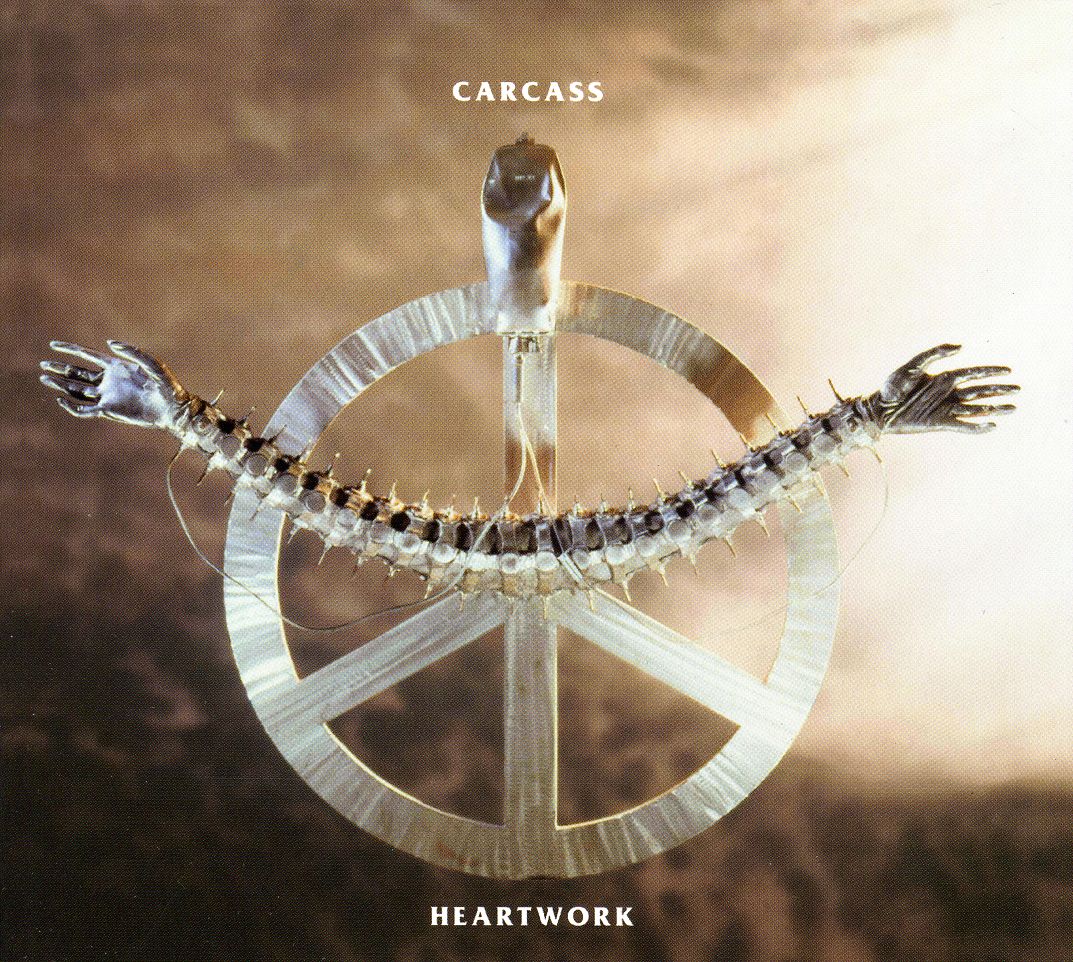
Whatever I'm describing above, Carcass is in many ways the opposite of it. For more than 20 years, they've embodied a certain strain of progressiveness in death metal. And I don't mean the delirious techiness of, say, Gorguts or Necrophagist. Carcass's achievement was something different: They streamlined death metal, whittled its edges to sharp, gleaming points, while at the same time aerating it, letting in all kinds of nourishing "outside" influences from the greater world of rock. As any fan could tell you, their 1993 album Heartwork is a masterpiece of outward-looking death metal. It keeps one foot in the genre, but it makes no secret of the fact that it values brisk, economical, wickedly catchy songwriting more than maintaining an allegiance to certain style.

So when Carcass took the MDF stage on Friday, against a backdrop of fancy video screens, it was clear that true rock stars had arrived. I was wondering how the death-metal die-hards at MDF would embrace the flash and polish of the Heartwork material, but I quickly realized that my skepticism was silly. One great thing about MDF is how all-embracing most of the fans are. I mentioned subgenre-loyal factions above, and that's a very real phenomenon, but in the end, the attendees are lovers of metal, full stop, who embrace a doom 'n roll supergroup Down (Saturday's headliner) just as warmly as a determinedly underground old-school death-metal act, a mournful doom-death crew or a fiendish black-metal band.

People went apeshit for Carcass and rightly so. I'm most familiar with Heartwork and its predecessor, 1991's Necroticism--Descanting the Insalubrious, and the band played plenty of material from those LPs. I'm pretty sure the balance of the set focused on their two prior records, which I'm looking forward to spending more time with. So this was an all-classics affair, and everyone seemed to know every word. The performance was, to my ears, very nearly flawless. The band plays with incredible flair. The current Carcass lineup, which has a new album due out later this year, consists of cofounders Jeff Walker (bass, vocals) and Bill Steer (guitar), along with two new recruits. I was a little bummed when I heard that Michael Amott (whose melodic shred was a key component of both Necroticism and Heartwork) wasn't involved in the current Carcass reunion, but once the set started, that became a complete non-factor. Guitarist Ben Ash and drummer Daniel Wilding fit perfectly into the mix.

On Twitter, I described Carcass post-set as extreme metal's Thin Lizzy, a comparison I stand by. They're a death-metal band with the flair (I keep coming back to that word) and polish of that almighty Irish rock force, my gold standard when it comes to the elusive rock 'n roll quality I think of as "tastiness." Sure, there are the surface similarities—the soaring dual-guitar ballet, the charismatic frontman doubling on bass—but there's also a spiritual one. Thin Lizzy were so good that they rock while almost seeming to relax. Carcass is the same way. The chops are simply a fact of what they do. There's no struggle, only a kind of gleaming fierceness. Maybe the best word for their presentation is pro. In the wake of the performance I witnessed, I could not be more psyched for the upcoming Carcass full-length, Surgical Steel. The current incarnation of this band is laying waste without breaking a sweat.

Broken Hope (Saturday)


And still another face of death, as it were. Chicago's Broken Hope were a band I'd had a vague awareness of in the '90s, but I'd always thought of them as a second-rate Cannibal Corpse or somesuch—gore-fixated, brutal, basic. I was intrigued to hear about their reunion last year; it seemed like a well-plotted reboot rather than a nostalgia trip. (The 2010 suicide of former vocalist Joe Ptacek adds a sad, poignant wrinkle to the narrative.) I approached their set yesterday with mild interest; I figured I'd check out a few songs and wander off if they didn't grab me, which, in the end, is a pretty typical MDF experience.

From the first few seconds, this band sucked me in like a tractor beam. With all due respect to Suffocation, who played an absolutely ripping set at Saint Vitus back in April and who have released my favorite metal album of 2013 so far, this Broken Hope set might have been the single tightest, most powerful, most no-nonsense set of death metal I've ever seen. This band is a coiled spring. Unlike Convulse, whose vibe was friendly and almost casual, Broken Hope were in full-on attack mode. Vocalist Damian Leski is a beast of a human, a hulking yet agile man whose sole purpose in life seems to be to do what he did yesterday evening: growl himself redfaced over mercilessly gnarled and punishing blastbeats and slams.

And my God, were those blastbeats and slams tasty. This band is a hyper-efficient riff factory, churning out part after part after glorious part. The music was like lifeblood for the mosh pit. People were going absolutely crazy during this set, myself included. The pit became a single heaving organism. I remember one dude kept sort of stumbling around in this cartoonish "death-metal zombie" trance, and I knew exactly what he was feeling. This brand of death metal sums up what is meant by infectious. The way this music was gripping people, affecting them, seeming to alter their metabolism, literally enthralling them, seemed to me very analogous to how great dance music functions. I think of that silly scene in Good Will Hunting where Matt Damon speaks of the music "just owning you." That is what was going on here.

No other time during my two days at MDF XI, or at last year's fest, or at any other death-metal show I've been to, have I seen band and crowd so symbiotically amped during a show. Sure, the energy was feral, with a whiff of beatdown-ism. (Leski comes from the punishing school of death-metal frontmen, those for whom the goal is to make the crowd—or, more specifically, "You sick motherfuckers!"—feel thoroughly brutalized. George "Corpsegrinder" Fisher from Cannibal Corpse puts a sort of cuddly spin on that formula; Leski, on the other hand, was a downright scary presence.) But the sense of release was weirdly wholesome. Overall, the set was what great metal is supposed to be, a seething purge.

And in focusing on the energy/vibe aspects of the set, I don't mean to take anything away from the craft of the music. What I loved about Broken Hope is that they rode that fine line of technicality and brutality so skillfully. Riffs shuffled constantly and took all kinds of unexpected twists, but the parts always cycled enough times that you could internalize their contours and precision-headbang to your heart's content. The force of the playing was dizzying. Serious kudos are due to drummer Mike Miczek, who slammed with more force and control than any other blastbeat-oriented player I heard a MDF XI.

This band is an absolute machine. If you have the slightest affinity for the so-called brutal school of death metal, the kind that thrives on the juxtaposition of swirling technicality and pit-fueling slam riffs, you need to see the current incarnation of Broken Hope. (They're coming out with a new album soon, so expect touring to follow.) I can barely describe the feeling of joy they left me with. I was glowing.

Melvins (Saturday)


I was ready for a break after Broken Hope. I just wanted to sit down and process and let the brutalized-but-ecstatic feeling linger. But it was not to be. Melvins had struck me as sort of an odd band out at Deathfest. They've never fit into "metal," per se; their aesthetic has always been too bizarre, too expansive. At their best, they can lay waste to any sort of rock-oriented subgenre-ism. (In particular, they make the endless factionalism of extreme metal—"We play death/doom," "We play blackened death," "We play stoner sludge"—which was definitely on display at Deathfest, seem a little absurd; there's nothing wrong with specializing in a style, but it's good to be reminded that not all heavy music exists in some tiny little box.) And that is what happened last night. The band, operating in its double-drummer quartet lineup, put on a clinic in the art of omni-dimensional rock— crushing harder just about every other band I saw over the weekend, but doing so with such staunchly eccentric style.

You cannot put the Melvins in a box, but they will happily show up at your box of choice (in this case, the death-metal realm), set up camp and lay waste. I'm sometimes guilty of taking the Melvins for granted; then I see them live and remember that they are very likely the greatest rock band (and I mean that in the broadest sense, from "rock 'n roll" all the way up to extreme metal) of our time. The force of the current lineup is absolutely withering. They started slow and agonizing with "Hag Me," and from there, it was on: Classic after classic. "Hooch," "Night Goat," Revolve," "With Teeth," "Honey Bucket," "Anaconda." The drive of these songs, their groove, their engine, their melody, their full-spectrum rock-ness. It is all embodied in the particular qualities of Buzz Osborne and Dale Crover, each of whom is the best in the world at what he does. Is there any frontman on earth with Buzz's range, his force and drama and sheer personality? Is there any drummer who can match Dale's hulking precision, his combination of brontosaurus weight and ingenious design? The authority of this set was totally mesmerizing. Having seen Melvins play five or so times since 2006, I can say that they're only getting fiercer as an onstage unit. If you care even slightly about any kind of "hard" rock music, you must, must see them as soon as you can, and then again at every opportunity after that.

Revenge (Saturday)


I was thinking about sticking around to see the Sunday offerings at MDF, but this set swayed me the other way. I knew that nothing was going to top it, in terms of sheer intensity. In that sense, I got exactly what I was hoping for from Revenge.

I've been into this band for a few years now. I had a serious "What in God's name...?" epiphany when I stumbled on 2004's Victory.Intolerance.Mastery in a extreme-metal-loving co-worker's iTunes folder a couple years back. I had never heard such world-swallowing filth in my life—a tornado of vomitous negativity, just, like, pure barf music, with vocals that alternated between a typical hellish shriek and what sounded like the grunting of a human-pig hybrid. And my God, the drumming of James "J." Read... I had never heard anything so simultaneously raw and commanding, so rickety yet controlled. Neck-snapping blasts, Neanderthal midtempo grooves and these tumbling, hold-on-for-your life rolls, all executed on a set that sounded like it had been fished out of the garbage—dead toms, clangy cymbals. I felt like I had found some sort of ideal that I never knew I was looking for. It was the polar opposite of sanitized extreme metal drumming. It was, I felt, one of the most purely punk drum-set performance I'd ever heard.

I sought out Read's work in various other contexts and was never disappointed. Axis of Advance—as filthy-sounding as Revenge, but with a sort of dystopic sci-fi conceptual bent—hit me just as hard, and after some initial puzzlement, I grew to love Blood Revolt (his collaboration with Primordial's A.A. Nemtheanga) too. I still need to get familiar with his earlier band, Conqueror, and the first couple Revenge records, but you get the point: Read is one of my favorite instrumentalists on the planet.

I was almost scared to see Revenge live. Scared, on one hand, by how violent I knew the crowd was going to be, and scared too that their set might not live up to the gross majesty of the recordings. I needn't have worried on the latter count. Live, the band gives off an identical sensation to that of their recordings: ungodly, pedal-to-metal recklessness; pure bestial chaos; pick your metaphor. It was mayhem.

I wish I could've watched Read from behind the drum kit—I could only see his hair and his scowling, wide-eyed face for most of the set—so I could check out exactly how he executes those patented rapid-fire rolls of his. I did get to marvel at his blastbeat technique. Blastbeats are a tough racket: typically, you either see a puny technique, or one that's so strong and virtuosic that it seems machinelike. Read's method is his own. He's absolutely smashing the kit, and he's in total command, but he still maintains a certain roughness. I'm really at a loss to describe how he does what he does behind the drums. It's like he's found a way to perfect and harness a sound/style (a sense of chaos, really) that typically results from a drummer playing just at the edge of his/her ability. He's not struggling, but he maintains the feeling of struggle, harnesses it.

You don't remember Revenge songs, as a rule, either on record or live. What you do remember are parts. Dirgey intros, headlong blasts with trilly, demented solos from Chris "Vermin" Ross, also of Axis of Advance and Blood Revolt, skull-rattling midtempo rockouts. Ross and bassist Tim "Haasiophis" Grieco are integral to the music, but it's really Read's show. As Profound Lore's Chris Bruni put it in a Tweet, his performance is a display of "pure hatred." I'm not sure there is a more possessed musician in extreme metal. Judging by interviews I've read—see here and here—Read seems like a reticent, difficult guy. He's clearly a man following his own muse, and judging by some allusions to skinhead culture in those Q&As, possibly some sort of ethically questionable ideology. I've heard rumors, but I don't want to throw any specific terms out there unsubstantiated. Does anyone happen to know exactly what's up with Read's politics? Would be curious to know if he's ever made an overt statement.

Anyway, I've gotten off track here. The chaos pouring off the stage definitely seeped into the crowd. The audience vibe during this set definitely didn't feel like the relatively run-of-the-mill catharsis that went down during, say, Broken Hope's set. I was up in front of the pit, and I'd look back behind me and see some dude just catapult forward as though he'd been hurled; one guy was inexplicably swinging a garbage bag; people seemed to regress into this feral state. But then at the same time, I'd see people just beaming in a sort of blissful disbelief. That's sort of the state I found myself in, like, "How can this be so fantastically intense, so full-on"? It was fascinating to watch Revenge after the Melvins, to see two bands so good at two completely different things. Revenge is a special band. I'm not going to lie and say I pull out their records all that much, but there's a certain kind of cleansing power that I associate with them—analogous to taking a really stiff shot or inhaling menthol. It really is the furthest I've ever heard metal go in terms of a certain kind of animal lawlessness. It's not just they're the fastest or the noisiest or the most bewildering. It's that they're the most… heathenish, maybe? It's a sound that radiates pure disgust, and they completely own it, both on record and, I'm happy to report, onstage.

/////

A few additional thoughts:

Repulsion (Friday): I respect this band's place in the history of death/grind, but I've never really been able to get with the undifferentiated rawness. I liked the good-natured bent of their MDF set, though. Scott Carlson and Matt Olivo are funny guys, and their M.O. is just to crank it up and rip. Their devotion to pure primitiveness makes more sense when it's couple with their everydude stage presence.

Down (Saturday): I still think this supergroup adds up to less than the sum of its parts, i.e., I'm a much bigger fan of all these guys' past and present work outside of Down—Pantera, Eyehategod, Crowbar, Corrosion of Conformity—than I am of this band. But I respect the M.O. of the project: a bunch of veteran metal gods who happen to be tight bros getting together to worship the Sabbath and the sweet leaf. They were a nice comedown after the insanity of Revenge, and I'm always up for some nice, inspirational Phil Anselmo banter. I almost felt myself getting choked up when he started talking about how proud his late ex-bandmate Dimebag Darrell would've been to look out into the sea extreme-metal die-hards he saw before him.

Ihsahn (Saturday): I caught about 15 minutes of this set, rushing over shortly before Revenge finished. (The MDF schedule typically avoids blatant overlap between stages, but these sets went down at almost exactly the same time.) Ihsahn, frontman of legendary Norwegian black-metal band Emperor—not being a huge fan of the subgenre, I don't know their records all that well; they're on my list—now plays a kind of epic, super-polished prog-metal. It was a serious trip moving right from the feral insanity of Revenge to the dramatic, super-choreographed presentation of Ihsahn and his bandmates, who came off like some sort of Warped Tour boy band onstage. At that point in the night, I was completely overloaded from the consecutive Broken Hope–Melvins–Revenge assault and couldn't really take in any more fresh info. I'm not sure I'm fully on board with the slickness of the Ihsahn presentation (it reminds me a bit of fellow Norwegians Shining, who haven't quite clicked with me for similar reasons), but I'm intrigued by the material. Looking forward to learning more.

The Obsessed / Weedeater (Saturday): I have mixed feelings re: a certain brand of what I'll call "lifer" doom, a subscene that seems to revolve entirely around the concept of dues-paying, of hard-living men whose extremely basic music gets elevated to the realm of the poetic thanks mainly to the admittedly romantic notion that they've been around a long time, grinding it out in the trenches. I do in fact admire what Scott "Wino" Weinrich does in general. I particularly love the Hidden Hand record Mother Teacher Destroyer, as well as his recent solo "folk" record, Adrift. But I found what I heard of his MDF XI set with the Obsessed to be pretty stultifying, and I felt the same about the Saint Vitus set (also feat. Wino) that I caught last year at MDF X. I love a whole lot of super-basic, anti-evolutionary metal—Obituary being a primo example—but the Obsessed just seemed like a lifeless rehash of the post-Sabbath doom concept. To say that they merely paled in comparison to Melvins would, I think, be too generous. Maybe it's just a function of how much Sabbath means to me, but I think we need to hold the doom movement to a higher standard—the throwing together of a couple bluesy, generically "dark" riffs does not make for a great song, and the presence of grizzled elders, respectable as their devotion to their craft may be, does not necessarily confer true gravity onto a set of music. Sabbath is the highest sort of poetry, not just a set of stylistic moves repeated ad nauseum. Honoring that legacy is a tall order. (For me, one band making a serious go of it these days would be Pallbearer.)

I felt much the same about Weedeater. I'm a huge fan of Eyehategod, but I'm conflicted re: this whole Southern-sludge mythos that celebrates the self-abuse of figures like Mike IX Williams (EHG) and "Dixie" Dave Collins (of Weedeater, Buzzov*en), as though that somehow makes their music truer. The bottom line is that Eyehategod is a great band because they've devoted years to the perfection of their sludge-punk craft. They play together as well as any other heavy-rock band in the world. With Weedeater, on the other hand, I got the sense that the entire point of the band is to fuel and glorify Collins's substance-abuse habit. He made a point of showily chugging whiskey between every song, and the band's merch table had a hand-lettered sign posted that said something to the effect of "We need drugs, weed, pills—please." Is that not just a tad pathetic, maybe? I get the perverse appeal of that sort of attitude, but for me, the music just didn't hold up. Abuse drugs if you like, sure, but don't use that as a stand-in for making great art happen. Weedeater's brand of sludge is crustier and edgier than that of the Obsessed, and while I saw the appeal in Collins's deranged-hobo stage presence, the riffs and the feel just weren't drawing me in.

/////

I'll just say in conclusion that MDF is a really special festival. I'll treasure memories of all six of the sets covered in detail above. There's something magical about joining up with one's tribe, as it were. I realize that I don't fit the description of the typical metalhead in a lot of ways, but I still feel the same primal, blood-deep connection to this music that I did when I was 14. I relish those moments when the music takes over and I just have to rush the stage, headbang, dance, throw some energy back in return, surrounded by a pack of die-hards, responding to the exact same deep-seated impulses. I can only imagine how great it must feel for the practitioners, for a band like Broken Hope who's been waiting a good 20 years to greet its public, to come face-to-face with a mirror, an audience who lives and breathes for this music in much the same way they do. Genres can be limiting factors, but they can also be tent posts to really around. We don't know why we respond on a molecular level when we hear those low, growling tones, those zombified riffs of bands like Convulse, but they call to us; we regress into some deep trance. A dark zone, in a sense, a celebration of animal ferocity, but also, it must be said, a place of bliss, of release, where you can revel in the volume and the force, witness a creative act that seems to give voice to every aggressive feeling you've had to suppress, sublimating those emotions into an entirely non-violent, life-affirming vent.

As I indicated in my recent Immolation review, the craft of death metal is a craft of love, purely its own reward. Maybe it's easier to feel that in the presence of, say, Convulse or Broken Hope or Benediction—bands who took pains to thank the crowd profusely at every opportunity—than standing before a hate-spewing band like Revenge. But it's all one phenomenon. Let's not pretend this is a game of misery, people; metal is fun.

Wednesday, May 15, 2013

'call it art': The vindication of the NYAQ


The New York Art Quartet isn't a household name. Even among my fellow free-jazz enthusiasts, they're still something of a cult-favorite group. That seems a little odd, because the three principal members, saxophonist John Tchicai (R.I.P.), trombonist Roswell Rudd and drummer Milford Graves, have all made major marks in the roughly 48 years since the NYAQ first disbanded. But the fact remains: In the shorthand history of free jazz, you're talking about Ornette, Trane, Cecil, Ayler, Sun Ra, etc.

I've always thought this was a bit of a shame. I've loved the NYAQ's self-titled ESP debut for a long time; to me it's a core-collection free-jazz document. I haven't spent as much time with the follow-up, Mohawk, but it's sounded great when I've sampled it, and the 35th Reunion album is also surprisingly sturdy.

There have been stirrings in the NYAQ camp over the past couple years. First came the Cuneiform release Old Stuff, an archival set that features Tchicai and Rudd with a different rhythm section (including the great Louis Moholo), and then, more recently, the mothership landed: call it art, a new five-LP box set from Triple Point Records.

Some readers of this blog are likely familiar with Ben Young. I will say up front that he is a friend of mine and also a mentor, dating back to my early college days at WKCR. I will follow that by saying that he is absolutely exemplary scholar and advocate of jazz in general—and of free jazz specifically. You might recall the Albert Ayler box he put together for Revenant, or Dixonia, which set a benchmark for Bill Dixon research. Having only cracked open call it art, his latest project, last night, I feel comfortable saying that it's a new pinnacle in the Ben Young oeuvre, and a cause for celebration for anyone who's ever felt that the NYAQ deserves a lot more recognition than they've gotten.

What we have in this set is a trove of unreleased NYAQ recordings. Some are outtakes from the studio sessions we already know, but others are live tapes, either in a concert or radio setting. I'm only on the second LP so far, but the music is divine (and, for the record, the sound quality is excellent, rivaling that of The New York Art Quartet and Mohawk); I already feel my passion for this group reigniting in a serious way.

Speaking of passion for the NYAQ, the book that comes with the set—and though not book-length, per se, it is a book, meaty and hardbound—is a phenomenal work. I mentioned the term "advocate" above, and what we have in these liner notes is a passionately argued advocacy of the NYAQ's central (i.e., rightful) position in the development of free jazz. It is a setting straight of the record, in a sense, but more importantly, this essay is a tying-together of many different threads, an exegesis of the entire scene surrounding this group. As anyone who knows Tchicai, Rudd and Graves's histories could tell you, the NYAQ did not come together in a vacuum; it grew directly out of, e.g., Rudd's so-called School Days collaboration with Steve Lacy (the famed Monk repertory band); the New York Contemporary Five, which included Tchicai along with Archie Shepp and Don Cherry; and the Bill Dixon–Archie Shepp Quartet, which ended up roping in both Tchicai and Rudd. Young's essay takes us through the entire musical history of each NYAQ member, touching not just on the aforementioned groups but also on activities that will be news to all but the most die-hard enthusiasts of these great men. For example, I knew that Milford Graves came up playing Latin jazz, but I had no idea that he led his own group (the Milford Graves Latin Jazz Quintet) in the early ’60s which (A) included a young Chick Corea and (B) appeared at Town Hall in support of Cal Tjader and Herbie Mann. In this booklet, you'll see not only a photograph of the band, but an advertisement for the concert. The research is that deep.

It isn't just facts that we get. We get a case, as it were, an argument about what exactly it was that made the NYAQ special, revolutionary even. I love this observation: "We would want Ornette Coleman's music of the Eisenhower administration to be Free Jazz's big bang, but finally his new style was still wearing a suit that belonged to an older Jazz pattern." Nothing against Ornette, whatsoever, but this is absolutely true. When you're talking about the freedom of jazz, you're talking about the rhythmic explosion—not necessarily some incendiary meltdown, but the literal freeing up of the time, which was a post-Ornette occurrence. The Cecil Taylor–Jimmy Lyons–Sunny Murray group, captured live in those brilliant 1962 recordings, is a major next step, and as Young points out, so is the Ayler–Gary Peacock–Murray band heard on 1964's Spiritual Unity. But the NYAQ was onto something different, something subtler. This is how Young puts it:

"The NYAQ's perfection of the New Thing impulse depended on omitting Ayler's thrust. Where Ayler played strong lines to lead his band, the NYAQ floated translucent phrases into a bubbling pool that diffused attention."

What Young seems to be getting at here is that there's more than one free-jazz paradigm. We've come to know and love the so-called "energy music" designation, but we've also learned that it's been a double-edged sword in the long term, this notion of free-jazz as some sort of quasi-religious expressionism, some heroic shout to the heavens that inevitably takes at least an hour to exhaust itself. I'm not taking aim at Ayler or Trane here. I'm just taking issue with the idea that free jazz has to be very obviously cathartic to be great.

Enter the NYAQ. I'm not sure I can do better than the "bubbling pool" designation above. Their music has this sort of unsettled but also sublimely unhurried quality. It wiggles; it tests the water; it pauses; it digresses. There truly is no leader. There is a ton of space. The music can be fast or slow. The constant, though, is a sense of deep listening, of non-autopilot improvisation, of working together in a very real kind of freedom, a freedom which, crucially, encompasses the freedom not to conform to a clichéd Free Jazz orthodoxy, which, even back then, was already crystallizing. You hear musicians conversing in this music, searching, exploring what their instruments can do, and how their aesthetic personalities can interact: Graves's fragmented yet remarkably supple flow; Rudd and Tchicai's vocal-like unspoolings, thoughtful and spare. There's an amazing sense of patience and delicacy to this music that is not the same as tentativeness. It's simply a taking of time, even when the music is, so to speak, cooking. (And thanks to Graves, it does very often dance in its own abstractly buoyant way.) I know what Young means when he speaks of the NYAQ "omitting Ayler's thrust." It's thanks to this omission that this music has aged beautifully. Hearing it now, you don't hear any of that ’60s-ness that's so often spoken of, in many cases rightfully so, when, say, Ayler or late Coltrane comes up, the sense of free jazz as the soundtrack to widespread social unrest. The NYAQ weren't screaming; they were probing.

The music I have on right now is from record 1 of the set. It's a recording of Rudd's "Rosmosis," made live on 12.31.64 at Judson Hall on W. 57th St. during the Four Days in December concert series. Any student of free jazz has likely heard of this series, presented by the Jazz Composers' Guild. (The NYAQ played on the last of the four bills, along with Sun Ra; 12/28 featured bands led by Cecil Taylor and Bill Dixon; 12/29 paired Paul Bley with the Jazz Composers' Guild Orchestra, led by Carla Bley and Mike Mantler; and 12/30 included the Archie Shepp Quartet and The Free Form Improvisation Ensemble.) But did any of us have any idea that this material had been recorded? It's amazing what a work of scholarship like call it art does; it brings this history—which previously seemed shadowy, mythic, unattainable—right to your door. And it isn't just the sounds; we also get reproductions of Rudd and Tchicai's scores, letters sent between the members of the group, period advertisements, stunning photographs.

I could say more about this set, but as I've indicated, I'm still very much in the process of digesting it. It was important to me to record my initial awe, though. Given the price, call it art is obviously a connoisseur's piece, but if you are one of those connoisseurs, someone for whom either the NYAQ or the early history of free jazz matters, I feel absolutely assured in informing you that you need to get your hands on this set. Ben Young's Albert Ayler box delved deeper into the life and work of a widely recognized genius; call it art, on the other hand, reclaims from relative obscurity a music that was every bit as game-changing, and—now, almost 50 years on from its making—still has the power to arrest, to induce wonder, to make you marvel at its wit, its dexterity, its inquisitiveness, its sense of play and wonder, its living optimism. This is a vindication.

/////

*Learn more about call it art and Triple Point Records here.

*Rudd and Graves will perform together, along with frequent NYAQ affiliate Amiri Baraka (featured prominently on call it art), at The Vision Festival on June 12, 2013.

Friday, May 03, 2013

HMB: Black Magic


Via the Red Bull Music Academy website, here's a new essay on the jazz/metal intersection—a lab report drawn from my ongoing Heavy Metal Be-Bop research. (A print version appeared in The Daily Note, a free paper that circulates in NYC for the duration of the RBMA's May tenure.) By way of an online bonus track, I interviewed Mick Barr, who's discussed extensively in the article. Thanks to Piotr Orlov, Sam Hockley-Smith and Todd Burns for their help in bringing these pieces to life.

UPDATE: The extended cut of the Barr interview is now live at heavymetalbebop.com.

Thursday, April 25, 2013

James Salter: A connoisseur's pleasure


Here, via TONY, is my review of the new James Salter novel. That is a cool thing to type! Cool that I was able to write it up, yes, but far cooler that the novel exists, period. I do not "follow" very many writers, not because I'm not interested, but because following music as closely as I do is pretty time-consuming. I tend to stick with the sure bets. For me, Salter is one of those.

A friend passed me a copy of Light Years about ten years ago. I enjoyed it, but I'm not sure I was really ready to appreciate it. A few years ago, I brought A Sport and a Pastime with me on a U.S. tour that my band did. That novel tore me up, haunted me. It is a beautiful book—obsessive, sensuous and, in a way, terrifying. I used to love Henry Miller, but in my personal canon, Salter has supplanted him as the go-to guy for searing insight—the writer who x-rays most thoroughly what drives us, what we keep hidden, what we choose to show and to whom. He strives for truth and, equally, for beauty.

On the latter point (beauty, and by this I mean, the handsomeness of the prose), there's a good bit of discussion in an in-depth New Yorker profile of Salter that ran recently. In that piece, Salter's core brilliance, his fashioning of exquisite sentences was portrayed as a double-edged sword: both the thing he's revered for and the thing that's overshadowed what other gifts he might possess. (Storytelling, for example, which is there in spades in All That Is.) Even Salter himself, in the piece, says something to the effect of "I want to get away from the 'writer of great sentences' thing," referring to All That Is. This notion of a writer's reputation apparently preoccupies Salter, as it does Nick Paumgarten, the writer of the piece. The article is titled "Why James Salter Matters," but in a way, it takes pains to explain why he doesn't matter as much as he should, delving into all the reasons why someone might not want to read him, or why his work isn't held in higher esteem. (For example: His characters are overprivileged and underpoliticized, oblivious.)

As a reader, a literal consumer of Salter, his reputation doesn't matter that much to me. Yes, I proselytize on behalf of his work, but to me, reading Salter is a selfish, connoisseur's pleasure. I can pick up his books and know that a more or less absolute writerly integrity will confront me. I don't often read other writers and feel jealousy, and that's not exactly what I feel when I read Salter. But I feel a rightness from his composition—maybe more than from that of any other writer I know—combined with a self-conscious yet undeniably engaging sort of music. If you are willing to take the plunge with him, he will carry you sturdily through the books. I recommend the ones I've read (Light Years, A Sport and a Pastime; the harrowing and underrated Solo Faces; Last Night, his most recent short-story collection; the astonishingly good memoir Burning the Days, which I'm devouring now) about as highly as I could recommend any books.

I know they are not for everyone. An astute Amazon reviewer writes "Salter's novels are case studies of what I'd call male mythology." Absolutely, they are. For as long as I can remember, I've loved these kinds of books. I'm not necessarily what I'd call a man's man (never been great at sports, though I'm a halfway decent squash player!), but my tastes in certain areas definitely skew that way. I love steak and BBQ (I come from the Midwest), and I love books about men in conflict—with themselves, with each other, with their environment. Faulkner is probably my favorite novelist—you can't do much better when it comes to the tortured-manhood thing. I love Cormac McCarthy. I recently read Bernard Malamud's The Natural, James Dickey's Deliverance and Robert Penn Warren's All the King's Men in quick succession. You get the point. Salter's book aren't the same, but in a way they are: It's that mythology thing, a sense that you have to tackle the big questions.

All That Is does that in a fascinating way. As other reviewers have noted, its main character is not heroic. (He's not the mountain climber of Solo Faces or even the sensual, almost Dean Moriarty–ish dynamo of A Sport and a Pastime.) In fact he's vain, even an outright asshole at times. But Salter sticks with him, doggedly. We sit in on every one of his triumphs and failures, and we make of it what we will. The book has no moral, but it is filled with tacit lessons. It's both uneventful and fantastically intense. It is classic Salter. I can't wait to read it again.

P.S. Don't miss this fantastic GQ profile.

Sunday, April 07, 2013

Doing better: RVIVR's The Beauty Between


This coming week brings two NYC visits from Olympia's RVIVR, resulting in three shows: a free NYU gig on Tuesday, 4/9 and a pair on Saturday, 4/13—daytime at Saint Vitus and nighttime at Union Pool. Here, via TONY, is my preview of the shows.

Every year, there are a few records that attain a certain kind of escape velocity—a speed, momentum, prominence—which propels them out of the mundane realm of Records I'm Writing About into the realm of Records I Love. (Or put another way, it's Records I'm Listening To For/At Work vs. Records I Bother To Bring Home, Put On My IPod, etc.) I've learned to pay close attention to these transitions, in part because it makes year-end-list writing a whole lot easier. Ideally, my top 10 for a given year consists entirely of records like this—records that have, in a sense, chosen me, rather than the other way around. There are only a small handful of 2013 releases in the running so far, among them Voivod's Target Earth, Suffocation's Pinnacle of Bedlam and the new RVIVR record, The Beauty Between. I don't really think bands deserve pats on the back for cultivating specific kinds of nostalgia, for zeroing in on a given well-established sound, but in this case, I'm not sure that's what RVIVR is doing. I can only speak for myself, how their music strikes my ears, and when I hear them, I think of a certain strain of melodic punk that flourished right around 1994, i.e., the year where my sporadic interest in that style very likely peaked. I cited both Avail and Face to Face in the aforelinked preview, but to get really specific, I'm really talking about songs like this one:


RVIVR isn't necessarily going after the same thing, but I hear something similar in their music—a sense of conviction, of determination to, in some cosmic sense, do better, improving the self and in the process, improving your community. More so than Avail, RVIVR is very much a political band, cultivating a queer-friendly, anti-macho environment at their shows and speaking out against sectors of the punk scene where such inclusiveness isn't thriving. (Learn more via this interview with RVIVR coleader Matt Canino.) But like all the truly great political bands—Fugazi is foremost in my mind—RVIVR finds a way to say what they need to say while keeping it all about the music. Loving a band's message, in other words, doesn't guarantee that you'll love their songs. RVIVR knows that hooks, passion and smart, witty writing—the ingredients in any effective anthem—are just as important.

The Beauty Between is filled with such anthems, to a near-unbelievable extent. Often I accept an album as generally "good," when what I really mean is that I like three or four tracks on it very much. TBB is a totally different case. The entire thing feels sturdy, engaged; you never get the sense that RVIVR are taking their collective eye off the ball. There's just such a feeling of a band really getting it right, for itself and for its supporters, of positive, focused effort. For me, TBB epitomizes the kind of punk that's all about trying—and by that I mean thinking and feeling and doing and working to the best of one's ability. The band's dual-singer-guitarist set-up perfectly encapsulates that. As I say in the TONY piece, there's a sense throughout that Canino and Erica Freas are engaged in a friendly kind of duel—a competition to see who can throw down with the most passion, who can sing out in the rawest and most cathartic way. But, since it's music and not sport, everyone wins.

I'm tempted to recommend a few favorites ("LMD," "Wrong Way/One Way," "Ocean Song" and the track that first sucked me in, "Spider Song"), but to me, this record is a single piece. It doesn't give you the emotional space to want to skip tracks. To my ears, it's a near-perfect example of its style. If you're anything like me, you'll hear it as both familiar and highly unusual—i.e., you'll recognize its pedigree immediately, but you'll have a tougher time processing how it could sound so solid, so convincing, so natural. I cannot wait to hear these songs live.

Thursday, March 28, 2013

Here come the -tions: Incantation & Co.


Via Time Out New York, a report on a noteworthy death-metal serendipity. Namely, Incantation, Suffocation and Immolation are all playing NYC shows soon. The fact that each "-tion" has a killer new (well, technically "recent" and "imminent" in the respective cases of Incan and Immo) album out sweetens the deal considerably.

You might recall me gushing over Suffocation and Immolation. I'm currently in the throes of an Incantation obsession. As with those others, they have a discography stretching back more than two decades. The Incantation catalog differs from those of Suffocation and Immolation in a couple important ways: First, the band has shuffled key members (specifically vocalists and drummers) many times over the years. While Suffocation and Immolation have both cycled through a few drummers, I'm pretty sure each has retained the same frontman for their entire duration: Frank Mullen and Ross Dolan, respectively. In Incantation's case, though, you get a very different sound depending on whether, e.g., Jim Roe or Kyle Severn is behind the kit, or whether, e.g., Craig Pillard or Daniel Corchado is at the mic. I used to feel like the band's early-’90s line-up (which featured Roe and Pillard, along with Incantation's sole constant member, guitarist and now-vocalist John McEntee) was by far their strongest. Studying the discography over the past couple months, though, I can say that all of the Incantation full-lengths are, in their own ways, great death-metal records.

It sounds obvious, but it's important to note: Maybe more so than the other two groups discussed here, this band's stock-in-trade is the riff—they seem to never tire of the fundamental joy found in rocking out on some trilly uptempo or lumbering downtempo motif, cycling through it relentlessly, trancing out on the statement and re-statement, snowballing intensity. And the way you know that Incantation's records are all good—I can vouch for seven out of the eight of them; I haven't yet heard 2002's Blasphemy—is that the quality of their riffcraft simply doesn't waver. They remain as devoted to this dark art, the heartbeat of metal as far as I'm concerned, on 2012's Vanquish in Vengeance as they were on their first LP, 1992's absolutely monstrous Onward to Golgotha. That latter record represents another key distinction separating Incantation from Suffocation and Immolation: McEntee & Co. emerged more or less fully formed. Effigy of the Forgotten and and Dawn of Possession, the respective debuts by Suffocation and Immolation, are good records, but both bands would go on to blow them out of the water as their discographies progressed. Onward, on the other hand, remains the Incantation gold standard. It's a disgustingly heavy record, a quality stemming both from its often-praised (and justly so) production, which sounds both enormous and strangely muffled, and its stunning confidence. Right from that point, this band has known exactly what it wanted to be. I haven't heard the early Incantation demos, which I'd imagine demonstrate some sort of progression that leads logically to Onward, but by the time of LP No. 1, the band had their proverbial shit entirely together.

That said, Vanquish in Vengeance, the latest Incantation dispatch, just might be my favorite album of theirs. As many reviewers have noted, it lacks that thick, suffocating atmosphere of the early records, but to me, sonic qualities like that are important yet ultimately beside the point; i.e., they're to be appreciated but not fetishized. In other words, criticizing a band for going after a clearer production style, a truer representation of what they actually sound like, rather than deliberately hiding behind some sort of illusory veil, strikes me as b.s. I generally want to hear extreme-metal bands sounding as big and full as possible—as long as that size/girth doesn't come at the expense of all organic-ness—and as far as Incantation is concerned, Vanquish in Vengeance represents a new pinnacle in those areas. It sounds like a band playing in a room together at top volume, something you can't say of very many death-metal records. It also happens to feature some of the catchiest, most memorable songs the band has written. (I'm especially partial to "Invoked Infinity," "Ascend Into the Eternal" and "Profound Loathing," but I highly recommend the entire album.) Overall, there's a vigor to Vanquish that can't be faked, a sense of a band proudly reaffirming its seniority in the scene, really owning its authority and longevity. Despite all the member changes, the Incantation b(r)and name—much like those of Suffocation and Immolation, as well as Cannibal Corpse, Obituary and, in a different but related style, Napalm Death and Brutal Truth—remains a mark of top quality, of honorable, undiluted old-school death-metal values. It's this sustained commitment that keeps me coming back to the -tions and various other legacy acts. As long as they're playing, I won't stop caring.