Showing posts with label Jack Dejohnette. Show all posts
Showing posts with label Jack Dejohnette. Show all posts
Sunday, June 21, 2020
Heavy Metal Bebop Podcast: Jack DeJohnette
Honored to present this conversation with a true legend (recorded last summer, well before COVID-19). Listen via Apple Podcasts, Spotify or Podbean. Enjoy!

Wednesday, December 21, 2016
Best of 2016
So many records! So many lists...
This year, I have voted (or will vote) in at least three different year-end polls, Rolling Stone's metal survey; Francis Davis' esteemed annual Jazz Critics Poll; and the Village Voice's annual everything-in-play poll, which is apparently no longer called Pazz and Jop. I may share each of those lists (my jazz ballot is here), but honestly they seem to matter less to me than a more intuitive survey, an honest recap of what new music has entered my bloodstream, so to speak, which is a very different thing than me, either at the time I cast my ballot or at some earlier date, deeming a certain record worth of mention in some "official" regard.
Just as an example: I really enjoyed Beyoncé's Lemonade, both the film and the music. It's clearly a consensus album-of-the-year favorite, as it damn well should be. It's an intensely provocative, passionate, just all-around striking statement from pop's most dominant star. But aside from the incredible "Don't Hurt Yourself" — I'm still thinking about that ferocious VMAs performance — this is not a record that I've spent a lot of recurring personal time with since its release. That's no knock on the record; it's just the truth. There's a difference, in other words, between an album being "in the air" and in heavy rotation on my iPod.
In these list situations, you can call out the in-the-air picks, either because that's honestly what you spent all year listening to or because you feel obligated to aim at some kind of (false) universality. Yes, a record may have owned "the" year, but did it own yours? These kinds of lists too often read like mere checklists of Albums That People Were Talking About. If we're going to do this at all, we might as well get honest and idiosyncratic.
Some of the pertinent questions for me are: What new music did you listen to when you had the luxury of free choice? What did you go back to, sometimes again and again? Will those albums mean anything to you in a year, or five, or 10? That last part is, I believe, truly impossible to reckon with — there are really only like five new records from the past 10 years or so that have entered my personal canon in that way, Propagandhi's Supporting Caste probably being at the top of that list — but the other questions are fairly easily answered, maybe with the help of some notes.
Here are 15 new releases that have mattered a lot to me this year, in the ways outlined above, with a bunch more "bonus track" picks afterward. There's no ranking here: I picked the records I wanted to focus on and then, over a few days, wrote the below entries in an intuitive order, blurbing each as I felt like it.
40 Watt Sun, Wider Than the Sky (Radiance)
Singer-songwriter and 40 Watt Sun leader Patrick Walker started out playing doom metal and has slowly shed the trappings of genre like a wandering hermit gradually phasing out of society at large. His music stands alone and stands firm at this point, a kind of epic, transportive dirge-rock, methodical, entirely resistant to anything less than a complete kind of engagement. I feel a deep and almost dangerous sense of surrender when I really let this music in, so strong is its emotional pull, so raw and true is the feeling at its center, so ancient-seeming and wisdom-filled is Walker's gift for writing and singing melody. No other music I heard this year came anywhere close to this record in terms of this kind of gravity, potency, just realness. The most direct way I can put it is that Wider Than the Sky is unspeakably beautiful, a true gift. At this point, I basically can't put it on and not feel instantly transported and awed. Take 16 minutes and listen to "Stages," or more accurately, let it happen to you, and then take the time to savor each of the other songs on its own. They're each almost too much to reckon with any other way.
Deftones, Gore (Reprise)
A totally different sound, but I would place this album on a similar plane as the 40 Watt Sun. I'm awed by how completely this band commits to a mood on Gore and sustains it throughout the course of the album. Deftones, a band that came of age in the '90s, are working with fairly simple, time-tested, quintessentially of-that-era concepts here — the juxtaposition of swimming, swooning atmosphere and torrential crunch-rock climax, explored by everyone from Smashing Pumpkins to Slint. That said, I completely buy both this album's sense of dreamy entreaty and and its fearsome payoffs; it all feels true to me. Like Wider Than the Sky, Gore is a joy to surrender to, to swim in, in large part because the great majority of these songs boast gorgeous, instantly indelible Chino Moreno vocal hooks. I should note that I'm not a Deftones lifer — for whatever reason, I wasn't paying attention in the '90s, when this band was really on the ascent — and it almost makes me respect them even more that I could step into albums like Gore and its predecessor, 2012's Koi No Yokan, with little prior knowledge and be completely blown away. How many other bands are still operating at this level of conviction and excellence more than 20 years after their debut album?
If this does not move you, we have very different tastes:
Meshuggah, The Violent Sleep of Reason (Nuclear Blast)
Another legacy band that I only came around to fairly recently. It's hard for me to tell whether this album was really that much better than the Meshuggah albums that came before it, or if I'm just indulging in latecomer's bias, but having worked my way through their full discography just a couple months back, I truly believe that Meshuggah hasn't released a better — i.e., more ferocious, overwhelming, sheerly gigantic — album than Violent Sleep. A definitive album from a justly legendary band. Further thoughts here and on the RS metal list.
Crying, Beyond the Fleeting Gales (Run for Cover)
No 2016 album surprised or delighted me more than this. Like Gore, Beyond thrives on juxtaposition — between the delicate and the bombastic — but instead of Gore's shimmering dreamstate, this album achieves a kind of manic, candy-colored immediacy. Some sort of wild fusion of indie-pop delicacy and Big '80s Rock flash. A sound that can at first seem borderline absurd but makes more and more harmonious sense the more time you spend with the album. Elaiza Santos' gorgeously precise vocal melodies and disarmingly plainspoken lyrics bring what could be a relentlessly loopy album down to earth, adding a crucial sincerity to the band's weird stylistic mash-up. This is an absolutely insane, ecstatic, wonderful album that I've had on repeat for weeks and weeks. Absolutely, without question the best "new band discovery" I've made this year.
Esperanza Spalding, Emily's D+Evolution (Concord)
I see an affinity between this and the Crying LP just in the sense of aesthetic precision: both that band and Esperanza Spalding are aiming at something very specific, idiosyncratic and ambitious. Every time I put this on, I'm shocked by how many ideas are just spilling out of this thing. I paid less attention that I should've to Spalding's prior records, but this one just grabbed me right away. The extremely ballsy "Good Lava," easily one of the year's most audacious tracks, comes off as a fusion of Fishbone and Shudder to Think (in other words, it's basically heaven-sent to my ears). And then that sort of prog-alt-rock madness mingling with '70s-Joni prog-jazz-folk on tracks like "Earth to Heaven." (If it's not abundantly clear, I'm determined to make "prog" mean something again, way beyond genre — what I really mean is music that strives, reaches, and isn't afraid to show it.) Heartbursting hooks spilling out on "One," delivered with shocking vocal poise and command. You (or at least I!) simply do not hear this kind of virtuosity and vision in any kind of contemporary pop very often. There's a huge difference between the sort of "promising talent" that Spalding was portrayed as in the media just a few years ago and the awe-inspiring aesthetic dynamo she has grown into. This is an album that challenges you to forget genre entirely and just listen. What you're rewarded with is something shockingly advanced, absolutely singular and profoundly engaging.
The Hotelier, Goodness (Tiny Engines)
This album is a new obsession for me; I barely feel like I've scratched its surface. But I feel comfortable calling Goodness a major achievement on the order of the Spalding, a triumph of young musical vision in its boundless prime. People call it emo, or punk, or what have you. All those things make sense but I'm no taxonomist. What I hear here is extremely thoughtful, deeply felt rock music, made by a band that's clearly invested in putting it all in there: emotions, intellect, words, sensations. A deep kind of personal truth. I can see why these "emo" bands (another one that comes to mind is La Dispute, an incredible band, also currently in its aesthetic prime, with a somewhat similar stylistic approach) inspire such fierce devotion in their fans. They're working incredibly hard to capture ideas and feelings, crafting these sort of album-length audio movies, complete with spoken-word passages, acoustic interludes, an overwhelming sense of elegiac beauty and almost scarily liberated catharsis. I'd guess I'd call it something like sophisto-punk, what I hear on Goodness, an illustration of how a DIY aesthetic can grow up to a kind of glorious young-adulthood, retaining its wonder and its desperation but marrying those elements to unflashy virtuosity, dynamic command and real literary clout. (See: the astonishing "Soft Animal" with its unforgettable shouted refrain, pitched between triumph and desperation: "Make me feel alive/Make me believe that I don't have to die.") Honestly, what this record, again after limited exposure, really reminds me of is Bruce Springsteen, at the peak of his visionary-American-rock phase (Darkness on the Edge of Town, say). The Hotelier is after something vast and magical and their abilities seem absolutely up to the task. As someone with a bone-deep connection tp this kind of emo/indie-rock/what-have-you (shout-out to Boys Life, Giants Chair and other '90s KC legends), I feel with a pretty fierce certainty that there's genius all over this album.
Asphyx, Incoming Death (Century Media)
There's a lot above about artists with major scope of vision, and the flipside of that is this kind of arresting myopia. Asphyx want exactly one thing, to blow you out of the water, and even after the departure of their drummer/co-founder, the esteemed Bob Bagchus, they're still managing to further that mission. I put this record on and feel nothing but white-hot conviction and mastery. The voice of Martin Van Drunen is not the expression of something so small and puny as "death metal"; it's the sound of a true life's purpose, amplified and and projected and vomited forth. Metal, like any other style, can basically be about anything (shout-out to Gorguts' outstanding, proudly enlightened Pleiades' Dust), but for Asphyx, it's about colossal girth, steamrolling momentum, overwhelming disgust. Real destroyer-of-worlds shit — whether that's in the form of a tidal-wave-in-slo-mo dirge like "The Grand Denial" or a rotten-rawk rager like "It Came From the Skies" — and no one does this better than they do. Every album is better than the last, ergo Incoming Death is my favorite Asphyx album right now.
Vijay Iyer and Wadada Leo Smith, A Cosmic Rhythm With Each Stroke (ECM)
Lots of talk about lifers above, and the now 75-year-old WLS of course qualifies. He shows off new facets of his genius on this record, a fact that's sort of staggering given how much music he's been releasing during the past decade or so. A Cosmic Rhythm is about hush and communion and coexistence — in the macro sense, the record is essentially an album-length ballad — with Iyer (mostly) playing the role of master texturalist, laying out these sorts of sparkling sonic environments for Smith to explore. Smith's breath and vulnerability and imperfection contrast movingly with Iyer's subtle, carefully wrought creations. To me, the most fascinating moments here are when Iyer either augments the acoustic piano with electronics — as on "All Becomes Alive," where he layers lyrical keyboard work over a dubbed-out bass throb — or switches over altogether — as on "Notes on Water," where he achieves a wonderfully murky, pealing sound on Rhodes. A Cosmic Rhythm is not an album you (or at least I) dip into casually, but when I've put it on and really had the time to submerge in it, I've been totally fascinated and enthralled. Long live the WLS renaissance. (Awesome to see this duo live on Monday at Harlem Stage, by the way; I loved how they reprised motifs from the album but took many of these pieces somewhere entirely new. The Iyer/Smith duo, spun off from their outstanding work together in Smith's Golden Quartet, now feels to me like a true and proper band.)
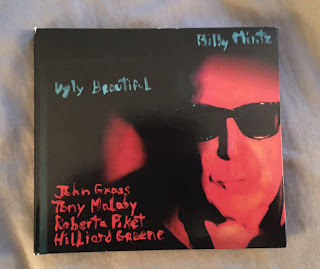
Billy Mintz, Ugly Beautiful (Thirteenth Note)
It's hard for me not to get a little ax-grind-y when I talk about Billy Mintz, once of my favorite living drummers and bandleaders and a good candidate for the title of most underrated jazz musician on the planet. Ugly Beautiful should be a critically adored Jazz Event Album, on the order of Iyer/WLS above; instead, it's practically invisible. At this moment, I can't turn up a single Google result for it, which is actually pretty depressing. As with most Thirteenth Note discs, no press push on this one, just a quiet roll-out. I ordered it after spotting it buried deep in a Downtown Music Gallery newsletter a couple months back. (If you're interested, and you should be, I'd suggest e-mailing or calling DMG, or dropping a line to Thirteenth Note, whose website hasn't been updated in a while.)
Simply put, Ugly Beautiful is an opus — more than two hours of music, spread across two discs. And it takes about that long to show off every worthy facet of Mintz's extremely broad, subtle and idiosyncratic talent. I wrote a while back about Mintz's "jazz infinity," as expressed on this disc's 2013 predecessor, simply called Mintz Quartet, the way he unfussily embraces the full spectrum of the so often pointlessly factionalized genre. Ugly Beautiful, featuring the incredible cast of John Gross and Tony Malaby on saxes, Roberta Piket (Mintz's wife and frequent collaborator) on piano and various keyboards, and Hilliard Greene on bass, is an even more potent illustration of this principle. There is just so much going on here: smeary, free-time, Paul Motian–y dirge ("Angels"), raging/rollicking inside/outside postbop ("Dit," "Relent"), stunningly precise yet beautifully laid-back neo-Tristano-ism ("Flight"), arrestingly somber ballad miniatures ("Vietnam," "Dirge"), borderline psychedelic groove pieces driven by Piket's expressive keys ("Umba," "Tumba"). And all powered by Mintz's phenomenally deep, drum sound. This man, who will turn 70 next year, has a groove that rumbles up from the earth, the way Elvin Jones' did; that bends time, the way Motian's did. I just get such an earthy, elemental feeling of authority from the way he interacts with the instrument and drives a band. And the fact that he wrote all this music (some pieces are reprised from earlier releases) makes this whole package even more stunning. I would like nothing more than to be able to embed a track here, but that's not possible, so I will just say: seek this out. And for God's sake, get hip to Billy Mintz; this great Shaun Brady Jazz Times profile from 2015 is a great place to start.
[Note: I've heard from Robert Piket that Ugly Beautiful only got a soft release this year via Downtown Music Gallery — stay tuned for a proper roll-out in 2017!]
Darkthrone, Arctic Thunder (Peaceville)
Speaking of earthy, elemental authority. I have not rocked out harder to any album this year. I love super-technical, nerd-out metal, but on the flip side, as ought to be clear from my short-listing of the Asphyx record, I also adore the raw, turn-off-your-brain-and-let-loose shit. I spent a good deal of time a few months back immersed in the Celtic Frost discography, and Arctic Thunder was a great follow-up to that phase. Lifers' mastery combined with a deeply ingrained don't-give-a-fuck-ness. This record is just so nasty and single-minded and, on the sly, intelligent in its composition. You don't just land by accident on this many profoundly awesome riffs. More on this one at RS.
Metallica, Hardwired ... to Self-Destruct (Blackened)
If I have an Album of the Year, it's probably this one. As predicted here, whatever reservations I may have had about this one at the outset have basically melted away — I've found something to love about every track here, even "Murder One" and "Am I Savage?," both of which sounded like duds at first but now work just fine for me in context. There's just so much great writing and convincing execution here. I don't think there's another album listed above where I could sing a part from every track on command, and for a song-focused listener such as myself, that's a very attractive feature. For all their niche "thrash" affiliation, Metallica's chief objective is the composition and delivery of Sturdy, Memorable Mainstream Rock Music. In this pursuit, they have succeeded handsomely on Hardwired. This album is not going to change the world the way the Black Album did, but if my reaction is any indication, this album has warmed the heart of a many a longtime fan — no small achievement for a band of Metallica's stature. I mean, goddamn, these songs! "Atlas, Rise!," "Moth Into Flame," "Confusion," "Here Comes Revenge" and, sweet Jesus, the utterly phenomenal "Spit Out the Bone," which I'd rank with their true classics. This album just fucking rules.
[Warning: The music video below is, sadly, horrendous. I recommend ignoring all visual content and focusing solely on the song.]
The Snails, Songs From the Shoebox (self-released)
The costumed, unassuming alter ego of the mighty Future Islands (who made my fave album of 2014) — sort of: the bands share two members, singer Samuel T. Herring and bassist William Cashion, both of whom perform under aliases here. But Herring's voice and conviction are unmistakable, even on a song called, accurately, "Barnacle on a Surfboard (Barnacle Boogie)." This is ostensibly a party album, driven by boogie-friendly lead-sax lines and taut, dance-punky rhythms. But as the album progresses, the songs just keep getting better: the hooks sharper, the emotional content more urgent. "Streets Walkin'" gives me more of classic-Fugazi feeling than anything I've heard since that band broke up, and soon after comes the driving, ecstatic twofer of "Tea Leaves" and "Flames," songs that, taken together, illustrate why Herring is one of the great frontmen on earth right now. (The chorus of the latter is utterly feral and insane.) And then the band winds things down with another sweet party jam in "Snails Christmas (I Want a New Shell)." A deceptively casual album with surprising punch, affect and staying power. (See also: Rolling Stone review.)
Sheer Mag, III and Compilation (Wilsuns)
Oh, what to do with you, Sheer Mag? They keep putting out these perfect four-song EPs that hit me harder than any full-length in sight. Their 2015 release, II, contained my favorite music of that year, and the same is true of III. I don't even want to think about how intense my obsession will become once they finally put out a proper LP (supposedly next year). Several times this year, sometimes in an attempt to get friends to accompany me to the two incredible Sheer Mag shows I saw in 2016, I've called them the best band in America. They make what is, for me, perfect rock/pop/soul music without an ounce of filler. Their songs are shrines to the enduring power of crunching, soaring, fiercely harnessed guitar, yearning vocals, cruising beats and a sort of elusive quality of toughness, authenticity, pathos. I weep thinking about the riffs in "Can't Stop Fighting," "Worth the Tears" and ... deep breath ... the mind-meltingly great "Nobody's Baby." I am always on the lookout for rock and roll that feels right and true to me, and though I often have to turn back the clock for that (Thin Lizzy, Black Sabbath and, lately, .38 Special), with Sheer Mag, I can have it all right here, right now. The EP is four tracks of grooving, snarling perfection that I can't not dance and sing to whenever they come on. This music does what I want all music, really of any kind, to do: (to paraphrase Ween) takes me away to some other land. (For the record, the Compilation LP reissues III, II and those EPs' only slightly less-incredible 2014 counterpart, I, on a single 12-inch — a must-buy for those, like me, who simply cannot stop playing this shit and are tired of flipping the 7-inches on the turntable.)
Bob Mould, Patch the Sky (Merge)
This guy, the 56-year-old master of the defiant three-minute pop-punk-before-it-had-a-name anthem, just won't stop pushing. So much passionate, authentic, driving, furiuosly hooky rock here. The style of Patch the Sky is similar to that of his last two, the equally excellent Silver Age and Beauty and Ruin, but Patch the Sky has a sort of weird, bold production sheen to it, with the vocals sitting oddly in the mix. The overall sonic picture perplexed me a little at first, but my hang-ups disintegrated as I played this thing over and over — and then bought it on vinyl and played it still more. I don't have anything deep to say here: Bob Mould just fucking rocks, OK? Especially with his current trio — feat. Jason Narducy and Jon Wurster — which, let's face it, is probably the best band he's ever been a part of. I'm absolutely a Hüsker Dü fan, but for me, this new stuff is where it's at. This music has a single-minded purpose, a rugged, sturdy excellence, that I find extremely appealing. No real surprises here, just wall-to-wall Mouldian quality, baby.
Jack DeJohnette / Ravi Coltrane / Matthew Garrison, In Movement (ECM)
This trio, with Ravi Coltrane and Matthew Garrison, has been playing NYC sporadically for the past few years, and I've been meaning to go check them out. After hearing this, their debut album, I'm kicking myself, because they really and truly slay, and in ways I wouldn't have expected. The opening version of "Alabama" here, which builds gradually from poetic wash to steely churn — dig Garrison's nasty fuzz bass — is one of the only John Coltrane covers I've ever heard that comes close to honoring the gravity of the original. And everything the band plays feels similarly unexpected yet right-on: from the lyrical, almost electronica-like dance of "In Movement" and "Two Jimmys" (which seem like a continuation of the sort of trance-jazz-drift aesthetic heard on '70s DeJohnette albums like New Directions) to the nasty, atmospheric funk of "Serpentine Fire" and the pristine palate cleanser "Soulful Ballad (2)." A veteran drummer in his prime, jamming out on some loose but stimulating and compellingly varied material with two strong-voiced younger players. This is every bit as good as last year's more high-profile Made in Chicago, and I hope this renewed DeJohnette/ECM hot streak continues.
/////
Here are a bunch of others (27 28 29 30 31 32 33 selections plus three archival bonus cuts) that I really dug. On any given day, many of these could've ranked in the upper tier above, or vice versa. Bandcamp links only b/c you know where to look otherwise.
Jason Moran, The Armory Concert (Yes)
A great, wide sweep of virtuosity and invention, with clearly delineated moods and, for all its experimentalism, a showman's versatility and verve. (In light of those qualities, the whole album strikes me as a clear hat-tip to Jaki Byard and, just maybe, to the perennially underrated genius Dave Burrell.) Shockingly accomplished yet warmly approachable.
Mitski, Puberty 2 (Dead Oceans)
This record hasn't yet completely stolen my heart the way Bury Me at Makeout Creek did in 2014, but harsh, true, white-hot — in other words, quintessentially Mitskian — songs abound here ("My Body's Made of Crushed Little Stars" — wow...). I sense her work will only get better and more fearsome from here...
Gorguts, Pleiades' Dust (Season of Mist)
The Luc Lemay renaissance continues. Another singular work of passion and thinkin'-person's-metal genius from this international treasure. (See also: Rolling Stone metal list.)
Descendents, Hypercaffium Spazzinate (Epitaph)
Not the best Descendents album, but a very good, worthy one, with some songs (classic Bill Stevenson heart-renders like "Without Love" and "Spineless and Scarlet Red") that I just could not shake. (See also: Rolling Stone feature, these awesome live-in-studio versions.)
Ethan Iverson, The Purity of the Turf (Criss Cross)
The ever-exemplary Iversonian project of showcasing his jazz heroes in new and flattering-but-not-fawning lights continues. (Here, the honoree / guest star is Ron Carter, with the magisterial Nasheet Waits on drums.) A scrappy, engaging, idiosyncratic trio record that's every bit as good as the ones he's made with Albert "Tootie" Heath.
Wakrat, Wakrat (Earache)
A batshit yet surprisingly sturdy first effort from a killer new math/prog/punk band fronted by Rage Against the Machine bass lord Tim Commerford. Some admirably frenetic energy at work here, as well as some honest-to-God killer, hook-filled songwriting. This album was majorly slept-on and deserved way more attention than it got. (See also: RS interview — it was a blast to talk to Tim and to see him play earlier this year with Prophets of Rage.)
Masabumi Kikuchi, Black Orpheus (ECM)
Slo-mo solo sorcery from the late master/enigma. I didn't throw this record on often, but when I gave myself time/space to immerse, I fell in deep.
Warfather, The Grey Eminence (Greyhaze)
Another completely and sadly slept-on record. Familiar style (intricate but accessible Morbid Angel–esque death metal from Steve Tucker, that band's former and current frontman/bassist/songwriter); near-flawless execution.
Joyce Manor, Cody (Epitaph)
I wish I'd loved this whole thing as much as I adore opening track "Fake ID," but there's a plainspoken poetry, and no shortage of hooks, running throughout this brief, scrappy album — the high-school-essay counterpart to the Hotelier's emo master's thesis? — that keeps me coming back. Joyce Manor come off like slackers, but they're pros at this emo/punk/pop shit.
Peter Evans Quintet, Genesis (More Is More)
Just fucking wild and inspired.
Crowbar, The Serpent Only Lies (eOne)
Not necessarily the gold-standard Crowbar record — I have to say: the aggressively Pro Tools–ed drum production on this and their other recent albums really bums me out, esp. in contrast to the raw, enormous sound they achieved on albums like Sonic Excess in Its Purest Form and Lifesblood for the Downtrodden — but the majority of these songs are great (let's hear it for the incredible "Embrace the Light") and very much up to the Kirk Windstein Standard, a statement I don't make lightly. (See also: Rolling Stone feature, DFSBP thoughts.)
Battle Trance, Blade of Love (New Amsterdam)
Seeing this monumental work live is a non-negotiable musical must. This keepsake is the next best thing.
Andrew Cyrille, The Declaration of Musical Independence (ECM)
Delicacy and idiosyncrasy by the pound from another (i.e., like Mintz, DeJohnette) elder drum master, who has found inspiration and refuge on ECM, a label that's really been outdoing itself in recent years. What a weird band Cyrille assembled here — Bill Frisell, Ben Street and the wild card Richard Teitelbaum on piano and electronics— but everyone commits fully and it all works beautifully, yielding a patient, wispy, tactile sound. I'll be going back to this one, for sure. (For the record, I dug the Cyrille / Bill McHenry duo on Sunnyside plenty, but this one lingered longer.)
Husbandry, Fera (Aqualamb)
Bold, progressive, melodic heaviness of a sort you just don't hear a lot of these days. (Shout-out to my youth.) Exceedingly rare blend of virtuoso band and vocal dynamo who can really and truly sing. If bands like Shudder to Think, Into Another and Quicksand get you going, you have to hear this. (PSA: I'm thrilled to report that my band STATS will share a killer bill with Husbandry and the esteemed Blind Idiot God at Saint Vitus on 2/15/17.)
Todrick Hall, Straight Outta Oz (Self-released)
A DIY Lemonade response that, while it didn't aim at the imposing gravity and depth of the original, still told a poignant autobiographical tale via a diverse set of instantly memorable pop songs (with full visual accompaniment to boot). I would love to see this thing onstage. Probably the capital-P Pop album I went back to most this year. (See also: Stephen Daw's great Rolling Stone feature.)
Jasmine Lovell-Smith's Towering Poppies, Yellow Red Blue (Self-released)
Outside-the-box jazz that's tuneful and melodic and accessible — doesn't seem like an outlandish concept, but it's pretty rare these days. A tremendously assured band (their last one was great too) that wears its authority lightly: bright, joyful, handsomely orchestrated chamber-bop that anyone could dig.
Paal Nilssen-Love Large Unit, Ana (PNL)
Free jazz meets Brazilian music for a raucous, rollicking avant-blowout. It's awesome to see this improv heavyweight putting forth such a strong, coherent vision as a big-bandleader/composer.
Aluk Todolo, Voix (The Ajna Offensive)
Darkly psychedelic instrumental jam rock. Wild-eyed guitar/bass/drums music that writhes, sprawls, throbs, convulses and hurtles ever-forward. Metal/prog/fusion/whocaresjustlisten.
Leonard Cohen, You Want It Darker (Sony)
As much as I dig what I know of Bowie's work, I don't (yet) have a strong personal relationship with his canon, Blackstar included. But Cohen's death hit me hard. You can't hear this and not feel the gravity of the End, and hear the resounding echo of a life really and truly lived to the last.
Virus, Memento Collider (Karisma)
More noir-ish "what in the living fuck..." goth-prog-rock from Czral and his band of Norwegian lunatics. So far out in left field, and yet sounding so relaxed, confident and complete within itself. Step into the black flux.
Bobby Kapp and Matthew Shipp, Cactus (Northern Spy)
A blessed intergenerational jazz meeting. Call it "free" if you must — something like "organic" sounds more right to me. Recording quality/presence are beyond A+; performances are curious and ever-engaged.
Mary Halvorson, Away With You (Firehouse 12)
Vanguard improvising, visionary composition — often strikingly weird but as with the Lovell-Smith above, never willfully obscure — and serious group unity. A hell of a working band captured in peak form.
Defeated Sanity, Disposal of the Dead // Dharmata (Willowtip)
An utterly demented band challenging itself to a friendly game of split-personality disorder. Half resolutely vomitous caveman-death; half hyperactive, dorked-out extreme prog. This album (or these two mini albums) brim with wild-eyed, for-the-love-of-the-craft glee. Can't wait to see what these maniacs do next.
Mannequin Pussy, Romantic (Tiny Engines)
Loud, raw, heart-spilling grunge that often reaches cataclysmically confessional peaks. These high-order punk tantrums are frequently unhinged but never sloppy or haphazard.
Sorcery, Garden of Bones (Xtreem)
Pure serrated-edge riff-barf from old-schoolers who eat this style (1991-y Swedish death metal) for breakfast, lunch and dinner. Think of them as Asphyx's keg-party counterpart: equally single-minded, but with more rawk abandon and diabolical mirth. I loooooved their 2013 comeback album, Arrival at Six, and though I haven't spent as much time with Garden of Bones, I can attest to the fact that it's another shaggily hulking bruiser. Why can't every metal album sound this nasty?
The Primitive, The Primitive EP (self-released)
More supremely rawking death metal, and an immensely charming (seems like a silly descriptor for a release of this nature, but go figure — this stuff is basically like no-nonsense blues to me at this point) labor of love from unsung drum hero Jim Roe, best known for his work on early Incantation classics like 1992's utterly disgusting-in-a-good-way (thanks in large part to Roe) Onward to Golgotha. In his current project the Primitive, Roe handles vocals and every instrument, and goddamn, this man is a pro. Alternately lumbering, charging nastiness with a deep, organic feel — extreme metal that maintains its connection to the dark, rich soil of rock and fucking roll. Shades of his Incantation work here, but this stuff has its own vibe. (Note: This is one of two EPs Roe put out this year under the Primitive handle; see also Founded in Hell, as well as Legion of Gore, an impressive two-song EP by veteran Cleveland band Terror that features Roe behind the kit — anything this guy does is worth savoring.)
Incantation, XXV (self-released)
Speaking of Incantation ... No Jim Roe here, but this vinyl-only 25th-anniversary set is nonetheless essential for any fan. This band's early work is undisputed canon, but as discussed here, core members John McEntee and Kyle Severn have surged back in recent years with a series of huge-sounding, gorgeously imposing LPs. This cool comp, which looks backward in terms of repertoire but showcases the band's current lineup exclusively, features one new song, some re-recorded old stuff and one side's worth of excellent live recordings.
Erica Freas, Patient Ones (Don Giovanni)
Coffeeshop-punk profundity from one of my favorite living songwriters. Fresh versions of some recent classics from last year's incredible Tether EP, as well as delicately devastating new songs. Freas is a movement unto herself. (See also: this Somnia record that I still need to catch up on.)
Diarrhea Planet, Turn to Gold (Infinity Cat)
As with the Mitski, this one didn't level me and own my year in quite the way I hoped it would based on my feelings for their last one. But these guys are still delivering the maximal-rock party-punk goods with serious panache.
Richard Sears Sextet feat. Albert "Tootie" Heath, Altadena (Ropeadope)
Either this one flew seriously under the radar, or I just missed it entirely. Would've been a strong contender for my jazz top 10 if I'd heard it in time. That said, I'm grateful to The New York City Jazz Record and Phil Freeman for the review in their December issue, which tipped me off. After one listen, I'm seriously impressed: a diverse, thoroughly engaging and surprisingly progressive little-big-band suite that reminds me of something Wayne Shorter might have put together in mid-'60s. A very natural blend of buoyant hardbop and a darker, freer postbop sound. Tootie is of course outstanding, and this might be the most ambitious setting I've heard him in; great follow-up to the ongoing Iverson/Street chapter of his brilliant six-decade career.
The Cookers, The Call of the Wild and Peaceful Heart (Smoke Sessions)
The latest dispatch of pure class and fire and soul — they just keep getting better — from one of my favorite bands on the planet, in any genre. Ineligible for me jazz-poll-wise b/c I worked on the liner notes (a huge honor), but I was a die-hard fan before that and would be all over Call regardless. If you dig 'em already, you'll love this; if you aren't yet hip, get it immediately. (Check out the EPK too.)
Voivod, Post Society (Century Media)
Latest dispatch from a veteran band in the midst of an unlikely new golden age. I've had my moments with the classic stuff, but it's in the post-Piggy era, from 2013's Target Earth forward, that I've really become a Voivod fanatic. A shining example of a band carrying on and, improbably, thriving after a core member's death. Absolutely cannot wait for the next LP.
Dysrhythmia, The Veil of Control (Profound Lore)
Take the time to really engage with this band and they're never going to disappoint you. The sort of communal interband Venn-diagram flowering that continues among Dys, Gorguts (see above), Krallice (see also 2016 dispatches Hyperion and the brand-new Prelapsarian), Behold ... the Arctopus (see Cognitive Emancipation), etc. has been such a glorious thing to watch up close. Drink in the rigor and the intrigue and the muscle-prog majesty on Veil — the latest brilliant chapter in the ever-unfolding Kevin Hufnagel / Colin Marston metal-vanguard multiverse.
Plus three on the archival tip:
Peter Kuhn, No Coming, No Going — The Music of Peter Kuhn 1978–79 (NoBusiness)
Squawking, swinging, shimmy-ing '70s loft jazz at its finest, via clarinetist Kuhn and his extraordinary band of like-minded ramblers, including trumpeters Toshinori Kondo and Arthur Williams, bassist William Parker and the late marvel Denis Charles on drums. The full disc of Kuhn/Charles duos is a thing of wild beauty. Check it.
Herbie Mann, Live at the Whisky 1969: The Unreleased Masters (Real Gone)
Still wading through this one, but what a heady bit of Sonny Sharrock lore, to say nothing of the rest of the band. We all know about the standout jazz-gone-rock/pop/funk revolutions of the day, but Mann was a badass in his own right — playing what he wanted to play, hiring who he wanted to hire, posing with his shirt off and just getting the fuck down. Kudos to him for turning Sonny — and Linda, on a couple tracks! — loose. It's beautiful to think of this and the Mann-produced Black Woman as part of the same weird hippie-jazz idiom. Wonder what the backstage hang was like?
Miles Davis, Freedom Jazz Dance, The Bootleg Series, Vol. 5 (Sony/Legacy)
Like the Dylan Bootleg Series, the Miles one just keeps digging up more and more from the periods you long ago thought were exhausted. On paper, this almost seems like a parody of a box set — complete session reels for Miles Smiles, band chatter and all — but I mean, this is Miles fucking Smiles we're talking about. I've only given this one concerted listen, but I got serious fly-on-the-wall goosebumps hearing this legendary day in the studio unfold in real time.
/////
Postscript: Five perfect pop (etc.) songs, 2016
Will leave you with this rawk monster from Dunsmuir. Glad tidings, and thanks as always to anyone readin'! -HS
This year, I have voted (or will vote) in at least three different year-end polls, Rolling Stone's metal survey; Francis Davis' esteemed annual Jazz Critics Poll; and the Village Voice's annual everything-in-play poll, which is apparently no longer called Pazz and Jop. I may share each of those lists (my jazz ballot is here), but honestly they seem to matter less to me than a more intuitive survey, an honest recap of what new music has entered my bloodstream, so to speak, which is a very different thing than me, either at the time I cast my ballot or at some earlier date, deeming a certain record worth of mention in some "official" regard.
Just as an example: I really enjoyed Beyoncé's Lemonade, both the film and the music. It's clearly a consensus album-of-the-year favorite, as it damn well should be. It's an intensely provocative, passionate, just all-around striking statement from pop's most dominant star. But aside from the incredible "Don't Hurt Yourself" — I'm still thinking about that ferocious VMAs performance — this is not a record that I've spent a lot of recurring personal time with since its release. That's no knock on the record; it's just the truth. There's a difference, in other words, between an album being "in the air" and in heavy rotation on my iPod.
In these list situations, you can call out the in-the-air picks, either because that's honestly what you spent all year listening to or because you feel obligated to aim at some kind of (false) universality. Yes, a record may have owned "the" year, but did it own yours? These kinds of lists too often read like mere checklists of Albums That People Were Talking About. If we're going to do this at all, we might as well get honest and idiosyncratic.
Some of the pertinent questions for me are: What new music did you listen to when you had the luxury of free choice? What did you go back to, sometimes again and again? Will those albums mean anything to you in a year, or five, or 10? That last part is, I believe, truly impossible to reckon with — there are really only like five new records from the past 10 years or so that have entered my personal canon in that way, Propagandhi's Supporting Caste probably being at the top of that list — but the other questions are fairly easily answered, maybe with the help of some notes.
Here are 15 new releases that have mattered a lot to me this year, in the ways outlined above, with a bunch more "bonus track" picks afterward. There's no ranking here: I picked the records I wanted to focus on and then, over a few days, wrote the below entries in an intuitive order, blurbing each as I felt like it.
40 Watt Sun, Wider Than the Sky (Radiance)
Singer-songwriter and 40 Watt Sun leader Patrick Walker started out playing doom metal and has slowly shed the trappings of genre like a wandering hermit gradually phasing out of society at large. His music stands alone and stands firm at this point, a kind of epic, transportive dirge-rock, methodical, entirely resistant to anything less than a complete kind of engagement. I feel a deep and almost dangerous sense of surrender when I really let this music in, so strong is its emotional pull, so raw and true is the feeling at its center, so ancient-seeming and wisdom-filled is Walker's gift for writing and singing melody. No other music I heard this year came anywhere close to this record in terms of this kind of gravity, potency, just realness. The most direct way I can put it is that Wider Than the Sky is unspeakably beautiful, a true gift. At this point, I basically can't put it on and not feel instantly transported and awed. Take 16 minutes and listen to "Stages," or more accurately, let it happen to you, and then take the time to savor each of the other songs on its own. They're each almost too much to reckon with any other way.
Deftones, Gore (Reprise)
A totally different sound, but I would place this album on a similar plane as the 40 Watt Sun. I'm awed by how completely this band commits to a mood on Gore and sustains it throughout the course of the album. Deftones, a band that came of age in the '90s, are working with fairly simple, time-tested, quintessentially of-that-era concepts here — the juxtaposition of swimming, swooning atmosphere and torrential crunch-rock climax, explored by everyone from Smashing Pumpkins to Slint. That said, I completely buy both this album's sense of dreamy entreaty and and its fearsome payoffs; it all feels true to me. Like Wider Than the Sky, Gore is a joy to surrender to, to swim in, in large part because the great majority of these songs boast gorgeous, instantly indelible Chino Moreno vocal hooks. I should note that I'm not a Deftones lifer — for whatever reason, I wasn't paying attention in the '90s, when this band was really on the ascent — and it almost makes me respect them even more that I could step into albums like Gore and its predecessor, 2012's Koi No Yokan, with little prior knowledge and be completely blown away. How many other bands are still operating at this level of conviction and excellence more than 20 years after their debut album?
If this does not move you, we have very different tastes:
Meshuggah, The Violent Sleep of Reason (Nuclear Blast)
Another legacy band that I only came around to fairly recently. It's hard for me to tell whether this album was really that much better than the Meshuggah albums that came before it, or if I'm just indulging in latecomer's bias, but having worked my way through their full discography just a couple months back, I truly believe that Meshuggah hasn't released a better — i.e., more ferocious, overwhelming, sheerly gigantic — album than Violent Sleep. A definitive album from a justly legendary band. Further thoughts here and on the RS metal list.
Crying, Beyond the Fleeting Gales (Run for Cover)
No 2016 album surprised or delighted me more than this. Like Gore, Beyond thrives on juxtaposition — between the delicate and the bombastic — but instead of Gore's shimmering dreamstate, this album achieves a kind of manic, candy-colored immediacy. Some sort of wild fusion of indie-pop delicacy and Big '80s Rock flash. A sound that can at first seem borderline absurd but makes more and more harmonious sense the more time you spend with the album. Elaiza Santos' gorgeously precise vocal melodies and disarmingly plainspoken lyrics bring what could be a relentlessly loopy album down to earth, adding a crucial sincerity to the band's weird stylistic mash-up. This is an absolutely insane, ecstatic, wonderful album that I've had on repeat for weeks and weeks. Absolutely, without question the best "new band discovery" I've made this year.
Esperanza Spalding, Emily's D+Evolution (Concord)
I see an affinity between this and the Crying LP just in the sense of aesthetic precision: both that band and Esperanza Spalding are aiming at something very specific, idiosyncratic and ambitious. Every time I put this on, I'm shocked by how many ideas are just spilling out of this thing. I paid less attention that I should've to Spalding's prior records, but this one just grabbed me right away. The extremely ballsy "Good Lava," easily one of the year's most audacious tracks, comes off as a fusion of Fishbone and Shudder to Think (in other words, it's basically heaven-sent to my ears). And then that sort of prog-alt-rock madness mingling with '70s-Joni prog-jazz-folk on tracks like "Earth to Heaven." (If it's not abundantly clear, I'm determined to make "prog" mean something again, way beyond genre — what I really mean is music that strives, reaches, and isn't afraid to show it.) Heartbursting hooks spilling out on "One," delivered with shocking vocal poise and command. You (or at least I!) simply do not hear this kind of virtuosity and vision in any kind of contemporary pop very often. There's a huge difference between the sort of "promising talent" that Spalding was portrayed as in the media just a few years ago and the awe-inspiring aesthetic dynamo she has grown into. This is an album that challenges you to forget genre entirely and just listen. What you're rewarded with is something shockingly advanced, absolutely singular and profoundly engaging.
The Hotelier, Goodness (Tiny Engines)
This album is a new obsession for me; I barely feel like I've scratched its surface. But I feel comfortable calling Goodness a major achievement on the order of the Spalding, a triumph of young musical vision in its boundless prime. People call it emo, or punk, or what have you. All those things make sense but I'm no taxonomist. What I hear here is extremely thoughtful, deeply felt rock music, made by a band that's clearly invested in putting it all in there: emotions, intellect, words, sensations. A deep kind of personal truth. I can see why these "emo" bands (another one that comes to mind is La Dispute, an incredible band, also currently in its aesthetic prime, with a somewhat similar stylistic approach) inspire such fierce devotion in their fans. They're working incredibly hard to capture ideas and feelings, crafting these sort of album-length audio movies, complete with spoken-word passages, acoustic interludes, an overwhelming sense of elegiac beauty and almost scarily liberated catharsis. I'd guess I'd call it something like sophisto-punk, what I hear on Goodness, an illustration of how a DIY aesthetic can grow up to a kind of glorious young-adulthood, retaining its wonder and its desperation but marrying those elements to unflashy virtuosity, dynamic command and real literary clout. (See: the astonishing "Soft Animal" with its unforgettable shouted refrain, pitched between triumph and desperation: "Make me feel alive/Make me believe that I don't have to die.") Honestly, what this record, again after limited exposure, really reminds me of is Bruce Springsteen, at the peak of his visionary-American-rock phase (Darkness on the Edge of Town, say). The Hotelier is after something vast and magical and their abilities seem absolutely up to the task. As someone with a bone-deep connection tp this kind of emo/indie-rock/what-have-you (shout-out to Boys Life, Giants Chair and other '90s KC legends), I feel with a pretty fierce certainty that there's genius all over this album.
Asphyx, Incoming Death (Century Media)
There's a lot above about artists with major scope of vision, and the flipside of that is this kind of arresting myopia. Asphyx want exactly one thing, to blow you out of the water, and even after the departure of their drummer/co-founder, the esteemed Bob Bagchus, they're still managing to further that mission. I put this record on and feel nothing but white-hot conviction and mastery. The voice of Martin Van Drunen is not the expression of something so small and puny as "death metal"; it's the sound of a true life's purpose, amplified and and projected and vomited forth. Metal, like any other style, can basically be about anything (shout-out to Gorguts' outstanding, proudly enlightened Pleiades' Dust), but for Asphyx, it's about colossal girth, steamrolling momentum, overwhelming disgust. Real destroyer-of-worlds shit — whether that's in the form of a tidal-wave-in-slo-mo dirge like "The Grand Denial" or a rotten-rawk rager like "It Came From the Skies" — and no one does this better than they do. Every album is better than the last, ergo Incoming Death is my favorite Asphyx album right now.
Vijay Iyer and Wadada Leo Smith, A Cosmic Rhythm With Each Stroke (ECM)
Lots of talk about lifers above, and the now 75-year-old WLS of course qualifies. He shows off new facets of his genius on this record, a fact that's sort of staggering given how much music he's been releasing during the past decade or so. A Cosmic Rhythm is about hush and communion and coexistence — in the macro sense, the record is essentially an album-length ballad — with Iyer (mostly) playing the role of master texturalist, laying out these sorts of sparkling sonic environments for Smith to explore. Smith's breath and vulnerability and imperfection contrast movingly with Iyer's subtle, carefully wrought creations. To me, the most fascinating moments here are when Iyer either augments the acoustic piano with electronics — as on "All Becomes Alive," where he layers lyrical keyboard work over a dubbed-out bass throb — or switches over altogether — as on "Notes on Water," where he achieves a wonderfully murky, pealing sound on Rhodes. A Cosmic Rhythm is not an album you (or at least I) dip into casually, but when I've put it on and really had the time to submerge in it, I've been totally fascinated and enthralled. Long live the WLS renaissance. (Awesome to see this duo live on Monday at Harlem Stage, by the way; I loved how they reprised motifs from the album but took many of these pieces somewhere entirely new. The Iyer/Smith duo, spun off from their outstanding work together in Smith's Golden Quartet, now feels to me like a true and proper band.)
Billy Mintz, Ugly Beautiful (Thirteenth Note)
It's hard for me not to get a little ax-grind-y when I talk about Billy Mintz, once of my favorite living drummers and bandleaders and a good candidate for the title of most underrated jazz musician on the planet. Ugly Beautiful should be a critically adored Jazz Event Album, on the order of Iyer/WLS above; instead, it's practically invisible. At this moment, I can't turn up a single Google result for it, which is actually pretty depressing. As with most Thirteenth Note discs, no press push on this one, just a quiet roll-out. I ordered it after spotting it buried deep in a Downtown Music Gallery newsletter a couple months back. (If you're interested, and you should be, I'd suggest e-mailing or calling DMG, or dropping a line to Thirteenth Note, whose website hasn't been updated in a while.)
Simply put, Ugly Beautiful is an opus — more than two hours of music, spread across two discs. And it takes about that long to show off every worthy facet of Mintz's extremely broad, subtle and idiosyncratic talent. I wrote a while back about Mintz's "jazz infinity," as expressed on this disc's 2013 predecessor, simply called Mintz Quartet, the way he unfussily embraces the full spectrum of the so often pointlessly factionalized genre. Ugly Beautiful, featuring the incredible cast of John Gross and Tony Malaby on saxes, Roberta Piket (Mintz's wife and frequent collaborator) on piano and various keyboards, and Hilliard Greene on bass, is an even more potent illustration of this principle. There is just so much going on here: smeary, free-time, Paul Motian–y dirge ("Angels"), raging/rollicking inside/outside postbop ("Dit," "Relent"), stunningly precise yet beautifully laid-back neo-Tristano-ism ("Flight"), arrestingly somber ballad miniatures ("Vietnam," "Dirge"), borderline psychedelic groove pieces driven by Piket's expressive keys ("Umba," "Tumba"). And all powered by Mintz's phenomenally deep, drum sound. This man, who will turn 70 next year, has a groove that rumbles up from the earth, the way Elvin Jones' did; that bends time, the way Motian's did. I just get such an earthy, elemental feeling of authority from the way he interacts with the instrument and drives a band. And the fact that he wrote all this music (some pieces are reprised from earlier releases) makes this whole package even more stunning. I would like nothing more than to be able to embed a track here, but that's not possible, so I will just say: seek this out. And for God's sake, get hip to Billy Mintz; this great Shaun Brady Jazz Times profile from 2015 is a great place to start.
[Note: I've heard from Robert Piket that Ugly Beautiful only got a soft release this year via Downtown Music Gallery — stay tuned for a proper roll-out in 2017!]

Darkthrone, Arctic Thunder (Peaceville)
Speaking of earthy, elemental authority. I have not rocked out harder to any album this year. I love super-technical, nerd-out metal, but on the flip side, as ought to be clear from my short-listing of the Asphyx record, I also adore the raw, turn-off-your-brain-and-let-loose shit. I spent a good deal of time a few months back immersed in the Celtic Frost discography, and Arctic Thunder was a great follow-up to that phase. Lifers' mastery combined with a deeply ingrained don't-give-a-fuck-ness. This record is just so nasty and single-minded and, on the sly, intelligent in its composition. You don't just land by accident on this many profoundly awesome riffs. More on this one at RS.
Metallica, Hardwired ... to Self-Destruct (Blackened)
If I have an Album of the Year, it's probably this one. As predicted here, whatever reservations I may have had about this one at the outset have basically melted away — I've found something to love about every track here, even "Murder One" and "Am I Savage?," both of which sounded like duds at first but now work just fine for me in context. There's just so much great writing and convincing execution here. I don't think there's another album listed above where I could sing a part from every track on command, and for a song-focused listener such as myself, that's a very attractive feature. For all their niche "thrash" affiliation, Metallica's chief objective is the composition and delivery of Sturdy, Memorable Mainstream Rock Music. In this pursuit, they have succeeded handsomely on Hardwired. This album is not going to change the world the way the Black Album did, but if my reaction is any indication, this album has warmed the heart of a many a longtime fan — no small achievement for a band of Metallica's stature. I mean, goddamn, these songs! "Atlas, Rise!," "Moth Into Flame," "Confusion," "Here Comes Revenge" and, sweet Jesus, the utterly phenomenal "Spit Out the Bone," which I'd rank with their true classics. This album just fucking rules.
[Warning: The music video below is, sadly, horrendous. I recommend ignoring all visual content and focusing solely on the song.]
The Snails, Songs From the Shoebox (self-released)
The costumed, unassuming alter ego of the mighty Future Islands (who made my fave album of 2014) — sort of: the bands share two members, singer Samuel T. Herring and bassist William Cashion, both of whom perform under aliases here. But Herring's voice and conviction are unmistakable, even on a song called, accurately, "Barnacle on a Surfboard (Barnacle Boogie)." This is ostensibly a party album, driven by boogie-friendly lead-sax lines and taut, dance-punky rhythms. But as the album progresses, the songs just keep getting better: the hooks sharper, the emotional content more urgent. "Streets Walkin'" gives me more of classic-Fugazi feeling than anything I've heard since that band broke up, and soon after comes the driving, ecstatic twofer of "Tea Leaves" and "Flames," songs that, taken together, illustrate why Herring is one of the great frontmen on earth right now. (The chorus of the latter is utterly feral and insane.) And then the band winds things down with another sweet party jam in "Snails Christmas (I Want a New Shell)." A deceptively casual album with surprising punch, affect and staying power. (See also: Rolling Stone review.)
Sheer Mag, III and Compilation (Wilsuns)
Oh, what to do with you, Sheer Mag? They keep putting out these perfect four-song EPs that hit me harder than any full-length in sight. Their 2015 release, II, contained my favorite music of that year, and the same is true of III. I don't even want to think about how intense my obsession will become once they finally put out a proper LP (supposedly next year). Several times this year, sometimes in an attempt to get friends to accompany me to the two incredible Sheer Mag shows I saw in 2016, I've called them the best band in America. They make what is, for me, perfect rock/pop/soul music without an ounce of filler. Their songs are shrines to the enduring power of crunching, soaring, fiercely harnessed guitar, yearning vocals, cruising beats and a sort of elusive quality of toughness, authenticity, pathos. I weep thinking about the riffs in "Can't Stop Fighting," "Worth the Tears" and ... deep breath ... the mind-meltingly great "Nobody's Baby." I am always on the lookout for rock and roll that feels right and true to me, and though I often have to turn back the clock for that (Thin Lizzy, Black Sabbath and, lately, .38 Special), with Sheer Mag, I can have it all right here, right now. The EP is four tracks of grooving, snarling perfection that I can't not dance and sing to whenever they come on. This music does what I want all music, really of any kind, to do: (to paraphrase Ween) takes me away to some other land. (For the record, the Compilation LP reissues III, II and those EPs' only slightly less-incredible 2014 counterpart, I, on a single 12-inch — a must-buy for those, like me, who simply cannot stop playing this shit and are tired of flipping the 7-inches on the turntable.)
Bob Mould, Patch the Sky (Merge)
This guy, the 56-year-old master of the defiant three-minute pop-punk-before-it-had-a-name anthem, just won't stop pushing. So much passionate, authentic, driving, furiuosly hooky rock here. The style of Patch the Sky is similar to that of his last two, the equally excellent Silver Age and Beauty and Ruin, but Patch the Sky has a sort of weird, bold production sheen to it, with the vocals sitting oddly in the mix. The overall sonic picture perplexed me a little at first, but my hang-ups disintegrated as I played this thing over and over — and then bought it on vinyl and played it still more. I don't have anything deep to say here: Bob Mould just fucking rocks, OK? Especially with his current trio — feat. Jason Narducy and Jon Wurster — which, let's face it, is probably the best band he's ever been a part of. I'm absolutely a Hüsker Dü fan, but for me, this new stuff is where it's at. This music has a single-minded purpose, a rugged, sturdy excellence, that I find extremely appealing. No real surprises here, just wall-to-wall Mouldian quality, baby.
Jack DeJohnette / Ravi Coltrane / Matthew Garrison, In Movement (ECM)
This trio, with Ravi Coltrane and Matthew Garrison, has been playing NYC sporadically for the past few years, and I've been meaning to go check them out. After hearing this, their debut album, I'm kicking myself, because they really and truly slay, and in ways I wouldn't have expected. The opening version of "Alabama" here, which builds gradually from poetic wash to steely churn — dig Garrison's nasty fuzz bass — is one of the only John Coltrane covers I've ever heard that comes close to honoring the gravity of the original. And everything the band plays feels similarly unexpected yet right-on: from the lyrical, almost electronica-like dance of "In Movement" and "Two Jimmys" (which seem like a continuation of the sort of trance-jazz-drift aesthetic heard on '70s DeJohnette albums like New Directions) to the nasty, atmospheric funk of "Serpentine Fire" and the pristine palate cleanser "Soulful Ballad (2)." A veteran drummer in his prime, jamming out on some loose but stimulating and compellingly varied material with two strong-voiced younger players. This is every bit as good as last year's more high-profile Made in Chicago, and I hope this renewed DeJohnette/ECM hot streak continues.
/////
Here are a bunch of others (
Jason Moran, The Armory Concert (Yes)
A great, wide sweep of virtuosity and invention, with clearly delineated moods and, for all its experimentalism, a showman's versatility and verve. (In light of those qualities, the whole album strikes me as a clear hat-tip to Jaki Byard and, just maybe, to the perennially underrated genius Dave Burrell.) Shockingly accomplished yet warmly approachable.
Mitski, Puberty 2 (Dead Oceans)
This record hasn't yet completely stolen my heart the way Bury Me at Makeout Creek did in 2014, but harsh, true, white-hot — in other words, quintessentially Mitskian — songs abound here ("My Body's Made of Crushed Little Stars" — wow...). I sense her work will only get better and more fearsome from here...
Gorguts, Pleiades' Dust (Season of Mist)
The Luc Lemay renaissance continues. Another singular work of passion and thinkin'-person's-metal genius from this international treasure. (See also: Rolling Stone metal list.)
Descendents, Hypercaffium Spazzinate (Epitaph)
Not the best Descendents album, but a very good, worthy one, with some songs (classic Bill Stevenson heart-renders like "Without Love" and "Spineless and Scarlet Red") that I just could not shake. (See also: Rolling Stone feature, these awesome live-in-studio versions.)
Ethan Iverson, The Purity of the Turf (Criss Cross)
The ever-exemplary Iversonian project of showcasing his jazz heroes in new and flattering-but-not-fawning lights continues. (Here, the honoree / guest star is Ron Carter, with the magisterial Nasheet Waits on drums.) A scrappy, engaging, idiosyncratic trio record that's every bit as good as the ones he's made with Albert "Tootie" Heath.
Wakrat, Wakrat (Earache)
A batshit yet surprisingly sturdy first effort from a killer new math/prog/punk band fronted by Rage Against the Machine bass lord Tim Commerford. Some admirably frenetic energy at work here, as well as some honest-to-God killer, hook-filled songwriting. This album was majorly slept-on and deserved way more attention than it got. (See also: RS interview — it was a blast to talk to Tim and to see him play earlier this year with Prophets of Rage.)
Masabumi Kikuchi, Black Orpheus (ECM)
Slo-mo solo sorcery from the late master/enigma. I didn't throw this record on often, but when I gave myself time/space to immerse, I fell in deep.
Warfather, The Grey Eminence (Greyhaze)
Another completely and sadly slept-on record. Familiar style (intricate but accessible Morbid Angel–esque death metal from Steve Tucker, that band's former and current frontman/bassist/songwriter); near-flawless execution.
Joyce Manor, Cody (Epitaph)
I wish I'd loved this whole thing as much as I adore opening track "Fake ID," but there's a plainspoken poetry, and no shortage of hooks, running throughout this brief, scrappy album — the high-school-essay counterpart to the Hotelier's emo master's thesis? — that keeps me coming back. Joyce Manor come off like slackers, but they're pros at this emo/punk/pop shit.
Peter Evans Quintet, Genesis (More Is More)
Just fucking wild and inspired.
Crowbar, The Serpent Only Lies (eOne)
Not necessarily the gold-standard Crowbar record — I have to say: the aggressively Pro Tools–ed drum production on this and their other recent albums really bums me out, esp. in contrast to the raw, enormous sound they achieved on albums like Sonic Excess in Its Purest Form and Lifesblood for the Downtrodden — but the majority of these songs are great (let's hear it for the incredible "Embrace the Light") and very much up to the Kirk Windstein Standard, a statement I don't make lightly. (See also: Rolling Stone feature, DFSBP thoughts.)
Battle Trance, Blade of Love (New Amsterdam)
Seeing this monumental work live is a non-negotiable musical must. This keepsake is the next best thing.
Andrew Cyrille, The Declaration of Musical Independence (ECM)
Delicacy and idiosyncrasy by the pound from another (i.e., like Mintz, DeJohnette) elder drum master, who has found inspiration and refuge on ECM, a label that's really been outdoing itself in recent years. What a weird band Cyrille assembled here — Bill Frisell, Ben Street and the wild card Richard Teitelbaum on piano and electronics— but everyone commits fully and it all works beautifully, yielding a patient, wispy, tactile sound. I'll be going back to this one, for sure. (For the record, I dug the Cyrille / Bill McHenry duo on Sunnyside plenty, but this one lingered longer.)
Husbandry, Fera (Aqualamb)
Bold, progressive, melodic heaviness of a sort you just don't hear a lot of these days. (Shout-out to my youth.) Exceedingly rare blend of virtuoso band and vocal dynamo who can really and truly sing. If bands like Shudder to Think, Into Another and Quicksand get you going, you have to hear this. (PSA: I'm thrilled to report that my band STATS will share a killer bill with Husbandry and the esteemed Blind Idiot God at Saint Vitus on 2/15/17.)
Todrick Hall, Straight Outta Oz (Self-released)
A DIY Lemonade response that, while it didn't aim at the imposing gravity and depth of the original, still told a poignant autobiographical tale via a diverse set of instantly memorable pop songs (with full visual accompaniment to boot). I would love to see this thing onstage. Probably the capital-P Pop album I went back to most this year. (See also: Stephen Daw's great Rolling Stone feature.)
Jasmine Lovell-Smith's Towering Poppies, Yellow Red Blue (Self-released)
Outside-the-box jazz that's tuneful and melodic and accessible — doesn't seem like an outlandish concept, but it's pretty rare these days. A tremendously assured band (their last one was great too) that wears its authority lightly: bright, joyful, handsomely orchestrated chamber-bop that anyone could dig.
Paal Nilssen-Love Large Unit, Ana (PNL)
Free jazz meets Brazilian music for a raucous, rollicking avant-blowout. It's awesome to see this improv heavyweight putting forth such a strong, coherent vision as a big-bandleader/composer.
Aluk Todolo, Voix (The Ajna Offensive)
Darkly psychedelic instrumental jam rock. Wild-eyed guitar/bass/drums music that writhes, sprawls, throbs, convulses and hurtles ever-forward. Metal/prog/fusion/whocaresjustlisten.
Leonard Cohen, You Want It Darker (Sony)
As much as I dig what I know of Bowie's work, I don't (yet) have a strong personal relationship with his canon, Blackstar included. But Cohen's death hit me hard. You can't hear this and not feel the gravity of the End, and hear the resounding echo of a life really and truly lived to the last.
Virus, Memento Collider (Karisma)
More noir-ish "what in the living fuck..." goth-prog-rock from Czral and his band of Norwegian lunatics. So far out in left field, and yet sounding so relaxed, confident and complete within itself. Step into the black flux.
Bobby Kapp and Matthew Shipp, Cactus (Northern Spy)
A blessed intergenerational jazz meeting. Call it "free" if you must — something like "organic" sounds more right to me. Recording quality/presence are beyond A+; performances are curious and ever-engaged.
Mary Halvorson, Away With You (Firehouse 12)
Vanguard improvising, visionary composition — often strikingly weird but as with the Lovell-Smith above, never willfully obscure — and serious group unity. A hell of a working band captured in peak form.
Defeated Sanity, Disposal of the Dead // Dharmata (Willowtip)
An utterly demented band challenging itself to a friendly game of split-personality disorder. Half resolutely vomitous caveman-death; half hyperactive, dorked-out extreme prog. This album (or these two mini albums) brim with wild-eyed, for-the-love-of-the-craft glee. Can't wait to see what these maniacs do next.
Mannequin Pussy, Romantic (Tiny Engines)
Loud, raw, heart-spilling grunge that often reaches cataclysmically confessional peaks. These high-order punk tantrums are frequently unhinged but never sloppy or haphazard.
Sorcery, Garden of Bones (Xtreem)
Pure serrated-edge riff-barf from old-schoolers who eat this style (1991-y Swedish death metal) for breakfast, lunch and dinner. Think of them as Asphyx's keg-party counterpart: equally single-minded, but with more rawk abandon and diabolical mirth. I loooooved their 2013 comeback album, Arrival at Six, and though I haven't spent as much time with Garden of Bones, I can attest to the fact that it's another shaggily hulking bruiser. Why can't every metal album sound this nasty?
The Primitive, The Primitive EP (self-released)
More supremely rawking death metal, and an immensely charming (seems like a silly descriptor for a release of this nature, but go figure — this stuff is basically like no-nonsense blues to me at this point) labor of love from unsung drum hero Jim Roe, best known for his work on early Incantation classics like 1992's utterly disgusting-in-a-good-way (thanks in large part to Roe) Onward to Golgotha. In his current project the Primitive, Roe handles vocals and every instrument, and goddamn, this man is a pro. Alternately lumbering, charging nastiness with a deep, organic feel — extreme metal that maintains its connection to the dark, rich soil of rock and fucking roll. Shades of his Incantation work here, but this stuff has its own vibe. (Note: This is one of two EPs Roe put out this year under the Primitive handle; see also Founded in Hell, as well as Legion of Gore, an impressive two-song EP by veteran Cleveland band Terror that features Roe behind the kit — anything this guy does is worth savoring.)
Incantation, XXV (self-released)
Speaking of Incantation ... No Jim Roe here, but this vinyl-only 25th-anniversary set is nonetheless essential for any fan. This band's early work is undisputed canon, but as discussed here, core members John McEntee and Kyle Severn have surged back in recent years with a series of huge-sounding, gorgeously imposing LPs. This cool comp, which looks backward in terms of repertoire but showcases the band's current lineup exclusively, features one new song, some re-recorded old stuff and one side's worth of excellent live recordings.
Erica Freas, Patient Ones (Don Giovanni)
Coffeeshop-punk profundity from one of my favorite living songwriters. Fresh versions of some recent classics from last year's incredible Tether EP, as well as delicately devastating new songs. Freas is a movement unto herself. (See also: this Somnia record that I still need to catch up on.)
Diarrhea Planet, Turn to Gold (Infinity Cat)
As with the Mitski, this one didn't level me and own my year in quite the way I hoped it would based on my feelings for their last one. But these guys are still delivering the maximal-rock party-punk goods with serious panache.
Richard Sears Sextet feat. Albert "Tootie" Heath, Altadena (Ropeadope)
Either this one flew seriously under the radar, or I just missed it entirely. Would've been a strong contender for my jazz top 10 if I'd heard it in time. That said, I'm grateful to The New York City Jazz Record and Phil Freeman for the review in their December issue, which tipped me off. After one listen, I'm seriously impressed: a diverse, thoroughly engaging and surprisingly progressive little-big-band suite that reminds me of something Wayne Shorter might have put together in mid-'60s. A very natural blend of buoyant hardbop and a darker, freer postbop sound. Tootie is of course outstanding, and this might be the most ambitious setting I've heard him in; great follow-up to the ongoing Iverson/Street chapter of his brilliant six-decade career.
The Cookers, The Call of the Wild and Peaceful Heart (Smoke Sessions)
The latest dispatch of pure class and fire and soul — they just keep getting better — from one of my favorite bands on the planet, in any genre. Ineligible for me jazz-poll-wise b/c I worked on the liner notes (a huge honor), but I was a die-hard fan before that and would be all over Call regardless. If you dig 'em already, you'll love this; if you aren't yet hip, get it immediately. (Check out the EPK too.)
Voivod, Post Society (Century Media)
Latest dispatch from a veteran band in the midst of an unlikely new golden age. I've had my moments with the classic stuff, but it's in the post-Piggy era, from 2013's Target Earth forward, that I've really become a Voivod fanatic. A shining example of a band carrying on and, improbably, thriving after a core member's death. Absolutely cannot wait for the next LP.
Dysrhythmia, The Veil of Control (Profound Lore)
Take the time to really engage with this band and they're never going to disappoint you. The sort of communal interband Venn-diagram flowering that continues among Dys, Gorguts (see above), Krallice (see also 2016 dispatches Hyperion and the brand-new Prelapsarian), Behold ... the Arctopus (see Cognitive Emancipation), etc. has been such a glorious thing to watch up close. Drink in the rigor and the intrigue and the muscle-prog majesty on Veil — the latest brilliant chapter in the ever-unfolding Kevin Hufnagel / Colin Marston metal-vanguard multiverse.
Plus three on the archival tip:
Peter Kuhn, No Coming, No Going — The Music of Peter Kuhn 1978–79 (NoBusiness)
Squawking, swinging, shimmy-ing '70s loft jazz at its finest, via clarinetist Kuhn and his extraordinary band of like-minded ramblers, including trumpeters Toshinori Kondo and Arthur Williams, bassist William Parker and the late marvel Denis Charles on drums. The full disc of Kuhn/Charles duos is a thing of wild beauty. Check it.
Herbie Mann, Live at the Whisky 1969: The Unreleased Masters (Real Gone)
Still wading through this one, but what a heady bit of Sonny Sharrock lore, to say nothing of the rest of the band. We all know about the standout jazz-gone-rock/pop/funk revolutions of the day, but Mann was a badass in his own right — playing what he wanted to play, hiring who he wanted to hire, posing with his shirt off and just getting the fuck down. Kudos to him for turning Sonny — and Linda, on a couple tracks! — loose. It's beautiful to think of this and the Mann-produced Black Woman as part of the same weird hippie-jazz idiom. Wonder what the backstage hang was like?
Miles Davis, Freedom Jazz Dance, The Bootleg Series, Vol. 5 (Sony/Legacy)
Like the Dylan Bootleg Series, the Miles one just keeps digging up more and more from the periods you long ago thought were exhausted. On paper, this almost seems like a parody of a box set — complete session reels for Miles Smiles, band chatter and all — but I mean, this is Miles fucking Smiles we're talking about. I've only given this one concerted listen, but I got serious fly-on-the-wall goosebumps hearing this legendary day in the studio unfold in real time.
/////
Postscript: Five perfect pop (etc.) songs, 2016
Will leave you with this rawk monster from Dunsmuir. Glad tidings, and thanks as always to anyone readin'! -HS
Sunday, February 28, 2016
DFSBP archives: Beaver Harris

As WKCR—the world's greatest jazz broadcasting outlet and the place where I learned much of what I know about this art form that I love—continues to struggle with its online-streaming rights, I present a digital version of one of the most enjoyable shows I helped to organize there: a 2000 tribute to drummer-composer William "Beaver" Harris.
The role I played in this show was a background one. Glo Harris, the show's principal host and key architect, clearly had the whole thing covered. I can't recall exactly how the program came about, but I remember Phil Schaap mentioning to me—then an eager, inexperienced student broadcaster—that he had a project I might be interested in. I believe Glo, who had been married to Beaver, had approached Phil about putting together a radio show in her late husband's honor. At some point, Phil graciously handed me the reins. I engineered the show, talked on-air a bit and may have had some input into what musical selections were played—at that time, I was a huge fan of Beaver's work on the 1976 Steve Lacy–Roswell Rudd album Trickles—but this was Glo's brainchild, and the warmth and sincerity of the finished product is a testament to her enduring love for Beaver, both as a man and a musician.
Wade Barnes, the late drummer, educator and NYC jazz torchbearer, is a genial and insightful presence in parts I and II of the broadcast, and the supporting cast only snowballs from there. I still remember sitting in the main WKCR control room, then housed in Riverside Church, as master after master materialized, either on the phone or in person. Part III features an Andrew Cyrille call-in, and Rashied Ali and Grachan Moncur III drop by in Part IV, joined later by impromptu call-in guest Jack DeJohnette. Like Glo, they all clearly admired this man as a player and loved him as a human being. Their stories flesh out a career that's sadly underrepresented in the official discography.
Beaver Harris is a fascinating figure, and this program makes a compelling case for just how underrated and little understood his genius was, and still is. You'll hear Barnes discuss the "from ragtime to no time" ethos that guided Harris's work, and the concept wasn't just a clever phrase: whatever the idiom, Harris played with command and coherence. As a sideman, on Trickles, on various Albert Ayler and Archie Shepp recordings, on lesser-known sessions with Chet Baker and Lee Konitz, Ken McIntyre, and Rudolph Grey's Blue Humans, he was explosive (always wielding that slashing China cymbal) or supportive, as the moment demanded. He danced and pummeled with equal skill and flair.
As a leader or co-leader, on marvelous and almost completely overlooked albums such as 1976's In: Sanity (featuring Dave Burrell), 1984's A Well Kept Secret (featuring Don Pullen) and Thank You For Your Ears (recorded '84, released '98), he was even better. He wasn't just a drummer; he had a sonic and conceptual vision, which he aptly labeled "360 Degree." It was eclectic (those steel drums!), inclusive and fantastical. One of his pieces, "African Drums," even became a sort of out-jazz standard, recorded by Shepp and David S. Ware.
Beaver Harris made his mark. Start here and go forth:
Beaver Harris tribute - WKCR - April 19, 2000, pt. I
Beaver Harris tribute - WKCR - April 19, 2000, pt. II
Beaver Harris tribute - WKCR - April 19, 2000, pt. III
Beaver Harris tribute - WKCR - April 19, 2000, pt. IV
Download the broadcast at the links above, or stream via the blue bar at the bottom of the page.
Thank you again to Glo Harris for putting together this incredible program, and to Phil Schaap for making the introduction.
/////
Other Beaver Harris resources:
*Clifford Allen's valuable career overview
*1987 WKCR interview re: Ayler (go here and scroll down)
*1983 live recording with Sam Rivers and steel-drummer Francis Haynes, who also appears on In: Sanity and A Well Kept Secret
*1975 live footage with Archie Shepp and Chet Baker
Incidentally, the broadcast above led, either directly or indirectly, to my later interviews with Moncur, Ali and Cyrille.
Friday, December 18, 2015
2015 in review

This year, I often felt like I was sneaking new music in. I started a new job, put out a record and saw a two-decade obsession finally bear fruit. Honestly, there wasn't all that much room for anything else. But as I look back through the year's releases, I see quite a few that made an impression.
Genre pretty much went out the window, which is the way it ought to be. Last night, my wonderful girlfriend, Alex, and I spent some time sharing our current pop obsessions, which seem to be everyone's current pop obsessions. I love all the songs making the rounds: "Hotline Bling," "The Hills," "Here" (the latter is probably the single of the year for me). Bieber's "Sorry" is another in-the-air favorite that will not leave my brain. I did file jazz, metal and general-purpose year-end lists for various polls, but looking back, none of them feel definitive to me. That orderly, fenced-off approach doesn't reflect how music fits into my life. The other night, some friends and I sat around spinning vinyl ranging from the latest Sheer Mag 7" (my album of the year, even though it isn't an album) to the new Fleetwood Mac Tusk reissue, the stellar Laddio Bolocko box set and, just because, Bob Dylan's Infidels. It's all sitting by my turntable, along with a ton of other records that captivated me at one point or another recently: Sonny Rollins's The Bridge, the Eagles' One of These Nights, Keelhaul's Triumphant Return to Obscurity, Pat Metheny's 80/81, Blue Öyster Cult's Tyranny and Mutation, Roky Erickson's The Evil One, Joni Mitchell's Hejira, the Stooges' Fun House, etc. (I'm proud to say that the craw set and STATS LP are there too.) Music.
It's all in play at all times. It has to be a free space. In that spirit, here are some of the records that I enjoyed this year, that happened to come out this year, in no particular order—10 of them will eventually make up my Pazz and Jop ballot. Links to Bandcamp only, because that's where online music really lives
Krallice Ygg Huur (self-released)
This record to me is pure astonishment. It's my favorite thing Krallice has ever done—and that's saying a lot because I love much of their prior work, especially the self-titled debut and 2011's Diotima—and one of my favorite things that either Mick Barr and Colin Marston have ever done, which is saying even more. (Close call with Annwn and Skullgrid, respectively.) The amount of musical information here is staggering, as is the confidence and majestic flair with which it is rendered. This is art music, plain and simple, the vanguard of contemporary composition, that happens to be transmitted in a format we might refer to in shorthand as metal.
Sheer Mag II (Wilsuns/Katorga)
Probably the release I really and truly felt the most of any that came out in 2015. It's a four-song EP, but as an aesthetic statement of purpose, it's as weighty as any album I heard this year. The soul, the smarts, the wounded swagger. This is just pure rough rock-and-soul attitude filtered through an at times dauntingly complex sophisto-pop aesthetic. And vocals to melt your heart and cut through whatever distraction might be unfairly monopolizing your spirit on a given day. This just kicks so, so, so much ass.
Henry Threadgill Zooid In for a Penny, in for a Pound (Pi)
Zooid just keep pushing. One of the most insular bands on earth, and one of the most fascinating to stand outside of and cast one's listening gaze upon. I heard this music at Roulette a year ago, and it seemed like a new high bar for the group. The album completely does the set justice. So much beautiful detail, either when the band is cooking in its trademark oblique-chamber-funk mode or stripping back for mini sonic dioramas of curious detail and staunch refinement. Oddities and wonders abound, and they're only amplified by heightened attention. When you put on a Zooid record, you listen, and you listen to the members of Zooid listening, each playing their part in Threadgill's imaginative wonderland.
Mayday Parade Black Lines (Fearless)
Not a new band, but a new one to me. Mainstays of the Warped Tour scene and exponents of an emo offshoot that's near and dear to my heart and probably best exemplified by Say Anything's 2004 masterwork, …Is a Real Boy. Hugely passionate and anthemic pop-oriented rock music with a belt-to-the-rafters theatrical bent and an undercurrent of showy self-laceration. This album is totally, knowingly over-the-top and, if you're as into this sound as I am, eminently replayable.
Milford Graves and Bill Laswell Space / Time • Redemption (TUM)
I saw these two play duets at the Stone last year, and the chemistry was lacking. They find a groove on this album simply by coexisting. This is basically an ambient release, elevated above the mundane by the primeval thump of one of the mightiest and most mysterious percussionists on earth, and Laswell's melodic and textural know-how, which can blur into wallpaper-ism but here seems subtle and right and soothing and benevolent. To me, this is a logical sequel to Sonny Sharrock's Guitar (one of my very favorite records of all time), and not just because a) there's a track named for Sonny here and b) Laswell produced Guitar. Mystical, swirling, churning tone baths.
Jeff Lynne's ELO Alone in the Universe (Columbia)
I'm not an ELO completist, but I aspire to be one someday. Jeff Lynne's lifelong project, i.e., crafting Beatlesque pop music of limitless accessibility that doesn't apologize for its sly surreality and lyrical eccentricity, is a worthy one, and judging by this album, and by the outstanding live show I saw at Irving Plaza last month, he's still operating at a very high level. There are a handful of songs here ("When I Was a Boy," "One Step at a Time") that feel like future greatest hits, which, given the depth the ELO greatest-hit pool, is really saying something.
Stanley Cowell Juneteenth (Vision Fugitive)
I spent a fair amount of time with this one but it didn't feel like anywhere near enough. I hear Juneteenth as a cousin of Dave Burrell's breathtaking 1979 solo-piano version of Windward Passages, one of those albums where a pianist translates the vast orchestral universe inside their head to the keys. This feels like a magnum opus for Cowell and an important reminder that this giant continues to do great, vital work. Further thoughts here.
Voice Coils Heaven's Sense (Shatter Your Leaves)
Another EP that delineates an entire sonic world. This, like the Krallice record, seems to me to be a state-of-the-art example of not exactly where music is at this moment, because nothing else really sounds like Heaven's Sense, but of a sort of speculative future of music, where pop could end up if diligence and wisdom and higher instincts prevailed. Demanding, yes, but so sensuous and pleasurable and coherent at the same time. There are hooks in "An Atrium" that have run through my head for days. If you consider yourself a fan of so-called progressive music of any kind, or of pop that aims at a kind of ethereal complexity and sweeping and refined emotional heft—I'll throw out Kate Bush and Yes as two inadequate touchstones—you must, must, must hear this. The descriptor "haunting" has been drained of most of its meaning, but it applies here.
Mary Halvorson Meltframe (Firehouse 12)
Another release with a kind of fierce beauty and interiority to it, but while the Voice Coils EP is all about high-wire ensemble dazzlement, this is stripped back and close to the bone. A simple description of what Meltframe is—meditation on and deconstruction of melody—feels way too clinical. This is an album that sings with emotion. A personal language on a common instrument, spoken plainly—sort of the rule for how all jazz ought to feel but rarely does. All the approaches to the gorgeous and carefully selected source material work equally well: harsh, subdued, dense/effects-heavy, sparse/unadorned or one melting gradually into the other.
Tau Cross Tau Cross (Relapse)
A debut album that sets forth a strikingly well-formed band concept. Shades of Killing Joke, Motörhead, recent Prong and, yes, mid-to-late-period Voivod (that band's Michel "Away" Langevin is Tau Cross's drummer). Gloom-painted postpunk–meets-thrash-meets–hard rock with outstanding hooks and tons of variety; surprisingly, the folky tracks work as well as the ragers. Rob "The Baron" Miller's impassioned delivery brings real grizzled pathos. Further thoughts here.
Black Star Riders The Killer Instinct (Nuclear Blast)
The group that began life as the Band Once Again Known as Thin Lizzy but Without Phil Lynott is now, thankfully, rolling up their sleeves and doing it the hard way: forging ahead and making new music. This album sounds like it could have been made anywhere from about 1983 through 1989, but no one for whom music like this—hook-forward, arena-scaled, cheese-oblivious hard rock—holds any appeal is going to care about its "relevance." This album completely, wholeheartedly rocks. The Riders pay homage to Lizzy, yes, but really they're just honoring the tough-guy songwriting tradition in general; there's just as much Bon Jovi in here, and that's fine by me. Fantastic songs—well, on the first half of the album, at least—and a frontman, Ricky Warwick, who's easy to believe and root for.
Title Fight Hyperview (ANTI-)
There's apparently some sort of subgenre-oriented skin-shedding going on with this record—hardcore-gone-shoegaze, I believe—but since I'm not familiar with Title Fight's past work, I'm taking this at face value. Hyperview is simply a lush and enveloping melodic indie-rock album, undergirded with post-hardcore muscle and glistening with a melancholy emotional mist. The color field of guitars and the raw-throated cries that burst out from beneath them lead to a kind of mood-drunkenness that's a pleasure to get lost in. It helps that the songs themselves are as strong as the atmosphere.
Jack DeJohnette Made in Chicago (ECM)
As I indicated here, the quintet heard on this album has evolved considerably since they recorded this album at the Chicago Jazz Festival in 2013, but Made in Chicago still holds up as a supergroup effort that capitalizes on every bit of its enormous potential. The stars here, and I think Mr. DeJohnette would agree, are Muhal Richard Abrams, Roscoe Mitchell and Henry Threadgill, and the presence of a master drummer-leader who also happens to be one of the best listeners in jazz only makes their contributions—both as composers and improvisers—sound that much sweeter (or nastier or more otherworldly, depending on the moment). Not just great artists sharing the stage, but the sound of a group aesthetic crystallizing, and the stage being set for future wonders.
Laddio Bolocko Live and Unreleased 1997–2000 (No Quarter)
Post-hardcore colliding with funk, free jazz, sound collage and psychedelia in a totally organic way. The prog impulse channeled into fiercely danceable body music, fueled by one of the greatest drummers of our time, Blake Fleming, who I first came to know through the illustrious and incredible Dazzling Killmen. I'd always felt that I hadn't quite gotten the complete picture regarding this band from its earlier No Quarter compilation, The Life and Times of…, and this release confirms it. A heady barrage of archival material, some quizzical and fragmented, some gorgeously dialed in and fleshed out. (I adore the groove-science "Afrostructure" series, which falls somewhere in between these two poles.) The final stretch of this sprawling set, with the studio version of the two-part cosmic-groove-prog opus "How About This For My Hair?" and a live set from Slovenia that's so intense it feels like it could leave scars (but is also wonderfully subdued and sensitive in spots), is the reason why archival releases like this are essential to the musical ecosystem: to bring to light bygone marvels you never knew existed.
Sonny Rollins Quartet With Don Cherry Complete Live at the Village Gate 1962 (Solar)
Speaking of bygone marvels. We maybe had a clue with this one in the form of Our Man in Jazz, but did we really know the enormity of what went down until now?
Blind Idiot God Before Ever After (Indivisible)
BIG share Laddio Bolocko's NYC-via–St. Louis trajectory, as well as their wide-open conception of what rock-based post-hardcore music can sound and feel like. Another Laswell production, and a balletic, rumbling behemoth of a comeback album. Everything about Before Ever After sounds to me like an improvement on the already-intriguing formula that BIG advanced on their late-’80s/early-’90s work. Can't wait to see where they go from here.
Revenge Behold.Total.Rejection (Season of Mist)
J. Read is like a gigantic mutant rat that leaps out of the darkness, chomps on your leg and refuses to unclench its jaws as you flail about in agony. The man is a driven psychopath behind the drums and one of metal's truest, most original underground voices. On days when I lose faith in the idea of metal, grow weary with its self-straitjacketing conventions, I can still reach for a Revenge album—and specifically this, which is easily the band's most compelling record to date—and feel something. Pure, seething soul and fire, and the deft commingling of chaos and precision. Just when you think this album is a total blastbeat blur, it snaps back into focus with a skull-rattling rawk breakdown or cave-prog precision attack. If you want to know my "metal album of the year," it's a tie between this and Ygg Huur—despite what my ballot says below; again, feelings change and evolve, which is why polls are just arbitrary snapshots in time—albums that represent two very different extremes of "extreme metal" that actually feel, you know, extreme. Further thoughts here.
The Bad Plus and Joshua Redman The Bad Plus Joshua Redman (Nonesuch)
This album didn't top my 2015 jazz ballot, but if I were casting said vote right now instead of a few weeks back, it probably would. The Bad Plus Joshua Redman is a near-perfect record, an exemplary illustration of everything we already know the Bad Plus does well—at this point, their sonic fingerprint is as instantly recognizable as that of, say, the Who—given a smart tweak/kick-in-the-ass via the presence of a contemporary tenor-saxophone master. This quartet was already great four years ago, but here, there's a sense of shared purpose that feels hard-earned through hours and hours spent together onstage. Instantly memorable compositions, performances that move with convincing emotional purpose and with utmost concern for the musical material at hand, whether it's crisp, refined and determinedly melodic or sprawling, choppy and, well, determinedly melodic. Jazz always needs more song-focus, more band-focus, and the Bad Plus keep showing us how handsomely those philosophies can pay off. Here, they have some very able assistance. Not really measuring by length here, but this is the 2015 "epic" for me.
Interlude:
So yes, maybe I'm getting in a small dig at Kamasi Washington's The Epic there (and also, more explicitly, in the Stanley Cowell blurb linked above). The Epic certainly wasn't an album I disliked, but nor was it was one I connected with on any deep level. I heard glossy, tastefully updated retro bombast with strong melodies, some truly ass-kicking post-Coltrane/turbo-bop moments and long stretches of not-much-happening. I'd hold up any of the jazz albums listed above as far better examples of "where jazz is at" than The Epic any day. But then again…
Kendrick Lamar To Pimp a Butterfly (Top Dawg / Aftermath / Interscope)
The Kamasi-wave wasn't really about Kamasi. It was about Washington's role in this thorny masterpiece, which topped every poll both because of its sociopolitical urgency in a year where the topics Lamar dealt with on To Pimp… were not only impossible to ignore but impossible not to despair over, and because, well, it was an enthralling LP, period, a searing self-interrogation that balanced every menacing boast with a choked-up sniffle. Everyone seemed to want to tell me that the album I just described was actually D'Angelo's Black Messiah. I didn't quite connect with that one, either, but I believed every last second of this.
Iron Maiden The Book of Souls (Parlophone/Sanctuary)
Same goes for this. I like Iron Maiden, which seems weird to say, since they're a band beloved by their fan base in an uniquely rabid way and ignored by pretty much everyone else. Honestly, I just don't know the catalog that well, but The Book of Souls was an instant "yes, please" for me. I love the way the visceral, bottom-heavy production sound combines with Bruce Dickinson's heroic yet endearingly strained-sounding vocals, and I love how itself this band remains, how committed they sound to this thing called metal that is really, for them, simply Iron Maiden Music. Like the Black Star Riders album, The Book of Souls rocks in a timeless way. I didn't once make it through the entire LP in a single sitting, but whenever I checked in with it—from archetypal single "Speed of Light" to that hammy yet genuinely touching 18-minute finale, "Empire of the Clouds"—I felt uplifted and inspired.
Weather Report The Legendary Tapes 1978–1981 (Legacy)
This hits me in a similar way: a supremely confident band, doing its thing. As a group, Weather Report had a strange magic—virtuosic daredevilry, yes, but also festive melody and childlike wonder and a certain kind of zany party-prog verve. None of the truly great acts that we label as "fusion" (ahem…) really sounded anything alike, and this release helps us see Weather Report for the style-transcendent anomaly that they were, and adds to the welcome hoopla surrounding the Jaco documentary release (and my own private hoopla surrounding a recent deep immersion in the Jaco–Joni Mitchell collaboration).
Morgoth Ungod (Century Media)
Deactivate brain. Rage. Repeat. (For those who related to this, as well as my Obituary and Asphyx gushing over the years, you need to hear Ungod.)
Kirk Knuffke Arms and Hands (Royal Potato Family)
This cornet specialist continues to record in all kinds of interesting contexts, bringing fresh ideas to each situation. I agree with the core mission statement of Arms and Hands—that bringing together Bill Goodwin and Mark Helias was a fantastic idea. (Lamplighter, another 2015 Knuffke session featuring Goodwin, is also well worth your time, and from what I've read and the samples, this sounds awesome.) Another example of jazz-as-personal-sonic-signature, in personnel, mood, repertoire.
Update, 12/28/15:
David S. Ware / Apogee Birth of a Being (Aum Fidelity)
Heart-burstingly passionate trio music—perhaps the single most convincing document of post-Ayler free jazz I've heard—from 1977, reissued here with extra material. Apogee, a working band with Cooper-Moore (then Gene Ashton) on piano and Marc Edwards on drums, is, to me, every bit as compelling as Ware's later, better-known quartet with Matthew Shipp, William Parker, etc. Massive.
Update, 12/29/15
Killing Joke Pylon (Spinefarm)
The only reason this one wasn't on here before is that I hadn't yet had a chance to spend good time with it. As with ELO, I'm not a Killing Joke completist, but I aspire to be one. I adored KJ's 2010 album, Absolute Dissent, but sort of slept on 2012's MMXII. I need to go back and remedy that, because this new one is another monster. Menace, beauty, relentless momentum, enthralling texture. Few bands can conjure such a pervasive, well-shaded sensation of gloom.
Update, 12/30/15
Elder Lore (Armageddon Shop)
Whoo boy, does this thing kick ass. A few people (one being my friend and former colleague Steve Smith) had tipped me off to Lore during the course of the year, but I didn't really dig in till just now. I'll reprise a line I just tweeted, because it sums up my thoughts well: This is like recent Mastodon gone full prog, with vastly better production. I'm still digesting this, but it seems to me that the quality of the songwriting on Lore matches the enormous ambition on display here, which is sort of insane given how high these guys are clearly aiming.
Jaco
A documentary that aims for and achieves definitive status via its smart balance of the personal and the musical. Watching this, you feel like you're seeing Jaco from all sides. Moving and insightful testimony from collaborators (Peter Erskine, Joni Mitchell, Wayne Shorter, et al.) and confidants (Bill Milkowski's contribution is particularly valuable). Breathtaking footage. A complicated life, dealt with sensitively yet unflinchingly.
Update, 12/31/15
Napalm Death Apex Predator — Easy Meat (Century Media)
Namechecked below but deserves a special shout-out. What I love about newer Napalm Death is, paradoxically, how clean it sounds. The current incarnation of this band is miles away from state-of-the-art extremity; by comparison, the Revenge album above makes 2015 Napalm (at least the recorded version) sound like Chuck Berry. But I'm fascinated by the way they've refined their craft for maximum accessibility and coherence, while remaining committed to speed and abrasiveness, and a genuine sense of purgative rage, embodied by Barney Greenway. You can hear everything that's going on in this music, and there's great care taken in the composition, pacing, mood. Extremity isn't really the issue: Napalm Death is, at this point simply, a great, adventurous rock band.
P.S. Phil Freeman's guide to the ND discography is essential for those of us who know bits and pieces of the band's long, complicated history but not the whole thing.
*****
The nitty-gritty
2015 Jazz Ballot (with regard to this poll)
1. Milford Graves and Bill Laswell Space/Time • Redemption (TUM)
2. Jack DeJohnette Made in Chicago (ECM)
3. Henry Threadgill Zooid In for a Penny, in for a Pound (Pi)
4. Mary Halvorson Meltframe (Firehouse 12)
5. The Bad Plus and Joshua Redman The Bad Plus Joshua Redman (Nonesuch)
6. Stanley Cowell Juneteenth (Vision Fugitive)
7. Wadada Leo Smith and John Lindberg Celestial Weather (TUM)
8. Kirk Knuffke Arms and Hands (Royal Potato Family)
9. Jon Irabagon Behind the Sky (Irabbagast)
10. John Zorn Inferno (Tzadik)
2015 Metal Ballot (with regard to this list)
1. Revenge Behold.Total.Rejection (Season of Mist)
2. Black Star Riders The Killer Instinct (Nuclear Blast)
3. Iron Maiden The Book of Souls (Parlophone/Sanctuary)
4. Tau Cross Tau Cross (Relapse)
5. Blind Idiot God Before Ever After (Indivisible)
6. Krallice Ygg Huur (self-released)
7. Morgoth Ungod (Century Media)
8. Royal Thunder Crooked Doors (Relapse)
9. Napalm Death Apex Predator — Easy Meat (Century Media)
10. Embodied Torment Liturgy of Ritual Execution (New Standard Elite)
10 Best Shows I Saw in 2015
1/13 - Celebrating Charlie Haden (The Town Hall)
2/13 - John Zorn, Steve Coleman, Milford Graves + Marc Ribot, Trevor Dunn, Tyshawn Sorey (Village Vanguard)
2/26 - Xylouris White (Bowery Ballroom)
3/15 - Charles Lloyd Quartet (Village Vanguard)
5/10 - Morpheus Descends (Saint Vitus)
6/11 - Feast of the Epiphany + Travis Laplante (IBeam)
6/20 - Dead Moon + Borbetomagus (Pioneer Works)
6/29 - Rush (MSG)
8/21 - Krallice (The Stone)
10/5 - Jack DeJohnette’s Made in Chicago (Cornell University)
With a special honorable mention for Ayahuasca, Godstopper, Couch Slut and Pyrryon at BRIEFCASEFEST 2015.
SONGS/2015
Tuesday, October 06, 2015
American treasure: Jack DeJohnette's Made in Chicago and the AACM in the present tense
 |
| Photograph: Paul Natkin / ECM Records |
Made in Chicago, a Jack DeJohnette album that came out on ECM earlier this year, is an important statement, easily one of the most striking jazz releases of 2015, almost by default. The mere facts of the album—a master drummer of the progressive mainstream reengages with his roots in the unparalleled experiments-in-sound collective the AACM, which turns 50 this year—make it special. And it's a damn good record, one I'm still digesting and savoring months after I first heard it.
But seeing the Made in Chicago group live, as I did Sunday at Cornell University, was a whole other experience. It's clear to me that since their 2013 debut gig, the Chicago Jazz Festival performance documented on the ECM album, this group has evolved from a project, an unusually well-plotted experiment, into an actual band, a collective of composers and improvisers committed to developing a shared language over time.
When an artist or group of artists gains a reputation for experimentalism, there's always a risk, from the perspective of audience or creator, that what once seemed radical can devolve into shtick. Somehow, that hasn't happened with the AACM representatives in Made in Chicago: saxophonists and multi-instrumentalists Roscoe Mitchell and Henry Threadgill, and pianist Muhal Richard Abrams. (Incidentally, Mitchell turned 75 in August, Abrams 85 in September; Threadgill is 71.) Seeing these three together onstage was a profoundly intense experience, and not just because their respective sonic palettes can, at times, tend toward the extreme or confrontational. More what I mean is that all three seemed absolutely sharp, fully attuned to each passing moment.
Watching the show, I got the sense of being in some sort of temple or dojo—an extension of the project founded by Abrams and others back in 1965 as the Association for the Advancement of Creative Musicians, and documented and broadcast to the world on Mitchell's debut album, titled, simply and tellingly, Sound—where the practices of listening and responding in real time are sacred. I noticed the listening, the reception of sound—Threadgill, seated when not playing, zeroing in on Mitchell's solos, nodding in approval; Abrams, head bowed as if in prayer while bassist Larry Gray played an unaccompanied intro on arco cello—as much as its creation.
You felt, hearing this band play, the certainty and conviction of the original AACM mission, the self-belief that allowed these musicians to band together 50 years ago in the spirit of pursuing their individual and collective aesthetics, and then live their lives according to that belief. But the miracle is how good it all sounds today—how uncompromising, yes, but also how engaging, how human.
I felt, throughout the set, this strong feeling of pushing, of extremity, like the band was taking an idea into its collective vise and slowly, steadily squeezing and refining. This quality came through especially on a piece during which DeJohnette performed exclusively on an electronic drum pad that I'm pretty sure was a Wavedrum. During a solo intro, he struck the pad, producing echoing, marimba-like tones, and scraped his stick across the side as one would play a güiro. I remember the rest of the band slowly wading in with small, piquant textures—I believe Mitchell was on sopranino and Threadgill flute, with Abrams strumming the piano's strings by hand—so that the sound gradually fattened and amplified, eventually achieving an alarming density, with DeJohnette pounding mercilessly on the Wavedrum. The piece didn't develop so much as expand. It was one sound, one idea, that became a mini universe.
There was something especially driven and focused about that piece, but the whole set had this sort of staring-contest intensity, not hostile or off-putting, but simply extreme. The opening piece, which built off Gray's cello intro into a series of beautifully calm, refined statements, some solo and some overlapping, was extreme in its sparseness. The one that followed brought more of a familiar sort of free-jazz heat, with DeJohnette bashing out rubato time—his drum-hero bravado serving as a fascinating counterpoint to his bandmates' deep-seated strangeness—as Mitchell unleashed for the first time his trademark alien-speech circular breathing on alto. Here and elsewhere in the set, it was fascinating to compare Threadgill's approach—focused more on brief, choppy, gut-wrenchingly soulful phrases than a steady stream of sound—to Mitchell's. The two are just so fully themselves, as is Abrams, who executes the oddest, most ear-bending ideas, either skipping and stabbing his way across the piano or softly caressing the keys, with a palpable sense of loving care. The set ended with Mitchell's "Chant," the seesawing minimalist epic that leads off Made in Chicago—this was the only piece in the set that I'm sure appears on the album, but there may have been others—and came off as a lovably demented roof-raiser live.
The band played a quick encore, a loose, swinging freebop improv that was by far the closest thing to conventional jazz in the set. It was a powerful reminder of the deliberate nature of the whole Made in Chicago endeavor. These are master musicians who can play whatever they want. And time after time during this set, they chose to take it there, pushing, ratcheting up the intensity and the focus and the abstraction to borderline uncomfortable levels, avoiding the easy out. Working up at times to recognizable points of climax or cohesion, but sometimes just letting the sounds exist and hang in the air. There was no hand-holding of the audience, no explanation or disclaimer—DeJohnette didn't say a word to the crowd until he introduced the musicians at the end of the set—just sound and commitment.
Made in Chicago is a band very much still in progress, still finding out what it has to say. If they keep giving concerts as special, as fully realized, as the one I saw, they could become one of the key endeavors of the AACM as a whole, a living emblem of what this collective (not just Abrams, Mitchell and Threadgill, but also Anthony Braxton, Wadada Leo Smith, George Lewis and so many others), this American treasure, has meant and still means.
*****
Postscript (10/9/15): I realized after I wrote this post that it doesn't address the Made in Chicago endeavor in the larger context of Jack DeJohnette bandleading endeavors, which is an oversight. I don't know all of DeJohnette's work as a leader, but I love what I've heard of the bands known as Special Edition—particularly the late-’70s and early-’80s albums reissued in the 2013 ECM box and this excellent 1983 concert—and New Directions. Both of those groups are totally different from Made in Chicago, and from each other. Special Edition is, to me, the most compositionally driven of the three, featuring precise little-big-band-style arrangements that foreground Jack DeJohnette, the writer. New Directions, at least judging by the self-titled album linked above, is more of a "vibe" band—an atmospheric post-fusion trance-out project à la DeJohnette and John Abercrombie's earlier collaboration in Gateway. (Incidentally, that first New Directions album is magical and, like pretty much all of DeJohnette's work as a leader, bafflingly underrated.)
What Made in Chicago does share with New Directions is that focus on texture and interaction over composition. Both are players' bands. When you hear New Directions, you come away thinking more about Abercrombie and trumpeter Lester Bowie—interestingly, another AACM member—than DeJohnette, and the same is true as regards Abrams, Threadgill and Mitchell's roles in Made in Chicago. (MIC almost seems designed to spotlight these men's talents in the way that the Iverson/Heath/Street trio is built to showcase the drumming of Al "Tootie" Heath.") MIC is about Jack DeJohnette immersing (or perhaps re-immersing) in the AACM concept rather than employing AACM musicians in service of his own concept, and as I hope the above post indicates, both aesthetics are strengthened in the process. MIC is an exemplary, all-in collaboration among masters.
Subscribe to:
Posts (Atom)