I had a great time speaking with Tomas Haake, re-immersing in the Meshuggah-verse (including the excellent new Immutable) and writing about it for RS.
Showing posts with label meshuggah. Show all posts
Showing posts with label meshuggah. Show all posts
Friday, March 18, 2022

Wednesday, December 21, 2016
Best of 2016
So many records! So many lists...
This year, I have voted (or will vote) in at least three different year-end polls, Rolling Stone's metal survey; Francis Davis' esteemed annual Jazz Critics Poll; and the Village Voice's annual everything-in-play poll, which is apparently no longer called Pazz and Jop. I may share each of those lists (my jazz ballot is here), but honestly they seem to matter less to me than a more intuitive survey, an honest recap of what new music has entered my bloodstream, so to speak, which is a very different thing than me, either at the time I cast my ballot or at some earlier date, deeming a certain record worth of mention in some "official" regard.
Just as an example: I really enjoyed Beyoncé's Lemonade, both the film and the music. It's clearly a consensus album-of-the-year favorite, as it damn well should be. It's an intensely provocative, passionate, just all-around striking statement from pop's most dominant star. But aside from the incredible "Don't Hurt Yourself" — I'm still thinking about that ferocious VMAs performance — this is not a record that I've spent a lot of recurring personal time with since its release. That's no knock on the record; it's just the truth. There's a difference, in other words, between an album being "in the air" and in heavy rotation on my iPod.
In these list situations, you can call out the in-the-air picks, either because that's honestly what you spent all year listening to or because you feel obligated to aim at some kind of (false) universality. Yes, a record may have owned "the" year, but did it own yours? These kinds of lists too often read like mere checklists of Albums That People Were Talking About. If we're going to do this at all, we might as well get honest and idiosyncratic.
Some of the pertinent questions for me are: What new music did you listen to when you had the luxury of free choice? What did you go back to, sometimes again and again? Will those albums mean anything to you in a year, or five, or 10? That last part is, I believe, truly impossible to reckon with — there are really only like five new records from the past 10 years or so that have entered my personal canon in that way, Propagandhi's Supporting Caste probably being at the top of that list — but the other questions are fairly easily answered, maybe with the help of some notes.
Here are 15 new releases that have mattered a lot to me this year, in the ways outlined above, with a bunch more "bonus track" picks afterward. There's no ranking here: I picked the records I wanted to focus on and then, over a few days, wrote the below entries in an intuitive order, blurbing each as I felt like it.
40 Watt Sun, Wider Than the Sky (Radiance)
Singer-songwriter and 40 Watt Sun leader Patrick Walker started out playing doom metal and has slowly shed the trappings of genre like a wandering hermit gradually phasing out of society at large. His music stands alone and stands firm at this point, a kind of epic, transportive dirge-rock, methodical, entirely resistant to anything less than a complete kind of engagement. I feel a deep and almost dangerous sense of surrender when I really let this music in, so strong is its emotional pull, so raw and true is the feeling at its center, so ancient-seeming and wisdom-filled is Walker's gift for writing and singing melody. No other music I heard this year came anywhere close to this record in terms of this kind of gravity, potency, just realness. The most direct way I can put it is that Wider Than the Sky is unspeakably beautiful, a true gift. At this point, I basically can't put it on and not feel instantly transported and awed. Take 16 minutes and listen to "Stages," or more accurately, let it happen to you, and then take the time to savor each of the other songs on its own. They're each almost too much to reckon with any other way.
Deftones, Gore (Reprise)
A totally different sound, but I would place this album on a similar plane as the 40 Watt Sun. I'm awed by how completely this band commits to a mood on Gore and sustains it throughout the course of the album. Deftones, a band that came of age in the '90s, are working with fairly simple, time-tested, quintessentially of-that-era concepts here — the juxtaposition of swimming, swooning atmosphere and torrential crunch-rock climax, explored by everyone from Smashing Pumpkins to Slint. That said, I completely buy both this album's sense of dreamy entreaty and and its fearsome payoffs; it all feels true to me. Like Wider Than the Sky, Gore is a joy to surrender to, to swim in, in large part because the great majority of these songs boast gorgeous, instantly indelible Chino Moreno vocal hooks. I should note that I'm not a Deftones lifer — for whatever reason, I wasn't paying attention in the '90s, when this band was really on the ascent — and it almost makes me respect them even more that I could step into albums like Gore and its predecessor, 2012's Koi No Yokan, with little prior knowledge and be completely blown away. How many other bands are still operating at this level of conviction and excellence more than 20 years after their debut album?
If this does not move you, we have very different tastes:
Meshuggah, The Violent Sleep of Reason (Nuclear Blast)
Another legacy band that I only came around to fairly recently. It's hard for me to tell whether this album was really that much better than the Meshuggah albums that came before it, or if I'm just indulging in latecomer's bias, but having worked my way through their full discography just a couple months back, I truly believe that Meshuggah hasn't released a better — i.e., more ferocious, overwhelming, sheerly gigantic — album than Violent Sleep. A definitive album from a justly legendary band. Further thoughts here and on the RS metal list.
Crying, Beyond the Fleeting Gales (Run for Cover)
No 2016 album surprised or delighted me more than this. Like Gore, Beyond thrives on juxtaposition — between the delicate and the bombastic — but instead of Gore's shimmering dreamstate, this album achieves a kind of manic, candy-colored immediacy. Some sort of wild fusion of indie-pop delicacy and Big '80s Rock flash. A sound that can at first seem borderline absurd but makes more and more harmonious sense the more time you spend with the album. Elaiza Santos' gorgeously precise vocal melodies and disarmingly plainspoken lyrics bring what could be a relentlessly loopy album down to earth, adding a crucial sincerity to the band's weird stylistic mash-up. This is an absolutely insane, ecstatic, wonderful album that I've had on repeat for weeks and weeks. Absolutely, without question the best "new band discovery" I've made this year.
Esperanza Spalding, Emily's D+Evolution (Concord)
I see an affinity between this and the Crying LP just in the sense of aesthetic precision: both that band and Esperanza Spalding are aiming at something very specific, idiosyncratic and ambitious. Every time I put this on, I'm shocked by how many ideas are just spilling out of this thing. I paid less attention that I should've to Spalding's prior records, but this one just grabbed me right away. The extremely ballsy "Good Lava," easily one of the year's most audacious tracks, comes off as a fusion of Fishbone and Shudder to Think (in other words, it's basically heaven-sent to my ears). And then that sort of prog-alt-rock madness mingling with '70s-Joni prog-jazz-folk on tracks like "Earth to Heaven." (If it's not abundantly clear, I'm determined to make "prog" mean something again, way beyond genre — what I really mean is music that strives, reaches, and isn't afraid to show it.) Heartbursting hooks spilling out on "One," delivered with shocking vocal poise and command. You (or at least I!) simply do not hear this kind of virtuosity and vision in any kind of contemporary pop very often. There's a huge difference between the sort of "promising talent" that Spalding was portrayed as in the media just a few years ago and the awe-inspiring aesthetic dynamo she has grown into. This is an album that challenges you to forget genre entirely and just listen. What you're rewarded with is something shockingly advanced, absolutely singular and profoundly engaging.
The Hotelier, Goodness (Tiny Engines)
This album is a new obsession for me; I barely feel like I've scratched its surface. But I feel comfortable calling Goodness a major achievement on the order of the Spalding, a triumph of young musical vision in its boundless prime. People call it emo, or punk, or what have you. All those things make sense but I'm no taxonomist. What I hear here is extremely thoughtful, deeply felt rock music, made by a band that's clearly invested in putting it all in there: emotions, intellect, words, sensations. A deep kind of personal truth. I can see why these "emo" bands (another one that comes to mind is La Dispute, an incredible band, also currently in its aesthetic prime, with a somewhat similar stylistic approach) inspire such fierce devotion in their fans. They're working incredibly hard to capture ideas and feelings, crafting these sort of album-length audio movies, complete with spoken-word passages, acoustic interludes, an overwhelming sense of elegiac beauty and almost scarily liberated catharsis. I'd guess I'd call it something like sophisto-punk, what I hear on Goodness, an illustration of how a DIY aesthetic can grow up to a kind of glorious young-adulthood, retaining its wonder and its desperation but marrying those elements to unflashy virtuosity, dynamic command and real literary clout. (See: the astonishing "Soft Animal" with its unforgettable shouted refrain, pitched between triumph and desperation: "Make me feel alive/Make me believe that I don't have to die.") Honestly, what this record, again after limited exposure, really reminds me of is Bruce Springsteen, at the peak of his visionary-American-rock phase (Darkness on the Edge of Town, say). The Hotelier is after something vast and magical and their abilities seem absolutely up to the task. As someone with a bone-deep connection tp this kind of emo/indie-rock/what-have-you (shout-out to Boys Life, Giants Chair and other '90s KC legends), I feel with a pretty fierce certainty that there's genius all over this album.
Asphyx, Incoming Death (Century Media)
There's a lot above about artists with major scope of vision, and the flipside of that is this kind of arresting myopia. Asphyx want exactly one thing, to blow you out of the water, and even after the departure of their drummer/co-founder, the esteemed Bob Bagchus, they're still managing to further that mission. I put this record on and feel nothing but white-hot conviction and mastery. The voice of Martin Van Drunen is not the expression of something so small and puny as "death metal"; it's the sound of a true life's purpose, amplified and and projected and vomited forth. Metal, like any other style, can basically be about anything (shout-out to Gorguts' outstanding, proudly enlightened Pleiades' Dust), but for Asphyx, it's about colossal girth, steamrolling momentum, overwhelming disgust. Real destroyer-of-worlds shit — whether that's in the form of a tidal-wave-in-slo-mo dirge like "The Grand Denial" or a rotten-rawk rager like "It Came From the Skies" — and no one does this better than they do. Every album is better than the last, ergo Incoming Death is my favorite Asphyx album right now.
Vijay Iyer and Wadada Leo Smith, A Cosmic Rhythm With Each Stroke (ECM)
Lots of talk about lifers above, and the now 75-year-old WLS of course qualifies. He shows off new facets of his genius on this record, a fact that's sort of staggering given how much music he's been releasing during the past decade or so. A Cosmic Rhythm is about hush and communion and coexistence — in the macro sense, the record is essentially an album-length ballad — with Iyer (mostly) playing the role of master texturalist, laying out these sorts of sparkling sonic environments for Smith to explore. Smith's breath and vulnerability and imperfection contrast movingly with Iyer's subtle, carefully wrought creations. To me, the most fascinating moments here are when Iyer either augments the acoustic piano with electronics — as on "All Becomes Alive," where he layers lyrical keyboard work over a dubbed-out bass throb — or switches over altogether — as on "Notes on Water," where he achieves a wonderfully murky, pealing sound on Rhodes. A Cosmic Rhythm is not an album you (or at least I) dip into casually, but when I've put it on and really had the time to submerge in it, I've been totally fascinated and enthralled. Long live the WLS renaissance. (Awesome to see this duo live on Monday at Harlem Stage, by the way; I loved how they reprised motifs from the album but took many of these pieces somewhere entirely new. The Iyer/Smith duo, spun off from their outstanding work together in Smith's Golden Quartet, now feels to me like a true and proper band.)
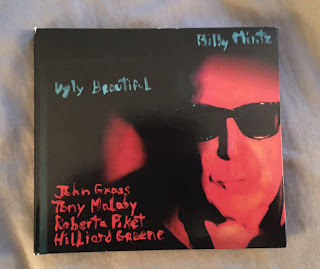
Billy Mintz, Ugly Beautiful (Thirteenth Note)
It's hard for me not to get a little ax-grind-y when I talk about Billy Mintz, once of my favorite living drummers and bandleaders and a good candidate for the title of most underrated jazz musician on the planet. Ugly Beautiful should be a critically adored Jazz Event Album, on the order of Iyer/WLS above; instead, it's practically invisible. At this moment, I can't turn up a single Google result for it, which is actually pretty depressing. As with most Thirteenth Note discs, no press push on this one, just a quiet roll-out. I ordered it after spotting it buried deep in a Downtown Music Gallery newsletter a couple months back. (If you're interested, and you should be, I'd suggest e-mailing or calling DMG, or dropping a line to Thirteenth Note, whose website hasn't been updated in a while.)
Simply put, Ugly Beautiful is an opus — more than two hours of music, spread across two discs. And it takes about that long to show off every worthy facet of Mintz's extremely broad, subtle and idiosyncratic talent. I wrote a while back about Mintz's "jazz infinity," as expressed on this disc's 2013 predecessor, simply called Mintz Quartet, the way he unfussily embraces the full spectrum of the so often pointlessly factionalized genre. Ugly Beautiful, featuring the incredible cast of John Gross and Tony Malaby on saxes, Roberta Piket (Mintz's wife and frequent collaborator) on piano and various keyboards, and Hilliard Greene on bass, is an even more potent illustration of this principle. There is just so much going on here: smeary, free-time, Paul Motian–y dirge ("Angels"), raging/rollicking inside/outside postbop ("Dit," "Relent"), stunningly precise yet beautifully laid-back neo-Tristano-ism ("Flight"), arrestingly somber ballad miniatures ("Vietnam," "Dirge"), borderline psychedelic groove pieces driven by Piket's expressive keys ("Umba," "Tumba"). And all powered by Mintz's phenomenally deep, drum sound. This man, who will turn 70 next year, has a groove that rumbles up from the earth, the way Elvin Jones' did; that bends time, the way Motian's did. I just get such an earthy, elemental feeling of authority from the way he interacts with the instrument and drives a band. And the fact that he wrote all this music (some pieces are reprised from earlier releases) makes this whole package even more stunning. I would like nothing more than to be able to embed a track here, but that's not possible, so I will just say: seek this out. And for God's sake, get hip to Billy Mintz; this great Shaun Brady Jazz Times profile from 2015 is a great place to start.
[Note: I've heard from Robert Piket that Ugly Beautiful only got a soft release this year via Downtown Music Gallery — stay tuned for a proper roll-out in 2017!]
Darkthrone, Arctic Thunder (Peaceville)
Speaking of earthy, elemental authority. I have not rocked out harder to any album this year. I love super-technical, nerd-out metal, but on the flip side, as ought to be clear from my short-listing of the Asphyx record, I also adore the raw, turn-off-your-brain-and-let-loose shit. I spent a good deal of time a few months back immersed in the Celtic Frost discography, and Arctic Thunder was a great follow-up to that phase. Lifers' mastery combined with a deeply ingrained don't-give-a-fuck-ness. This record is just so nasty and single-minded and, on the sly, intelligent in its composition. You don't just land by accident on this many profoundly awesome riffs. More on this one at RS.
Metallica, Hardwired ... to Self-Destruct (Blackened)
If I have an Album of the Year, it's probably this one. As predicted here, whatever reservations I may have had about this one at the outset have basically melted away — I've found something to love about every track here, even "Murder One" and "Am I Savage?," both of which sounded like duds at first but now work just fine for me in context. There's just so much great writing and convincing execution here. I don't think there's another album listed above where I could sing a part from every track on command, and for a song-focused listener such as myself, that's a very attractive feature. For all their niche "thrash" affiliation, Metallica's chief objective is the composition and delivery of Sturdy, Memorable Mainstream Rock Music. In this pursuit, they have succeeded handsomely on Hardwired. This album is not going to change the world the way the Black Album did, but if my reaction is any indication, this album has warmed the heart of a many a longtime fan — no small achievement for a band of Metallica's stature. I mean, goddamn, these songs! "Atlas, Rise!," "Moth Into Flame," "Confusion," "Here Comes Revenge" and, sweet Jesus, the utterly phenomenal "Spit Out the Bone," which I'd rank with their true classics. This album just fucking rules.
[Warning: The music video below is, sadly, horrendous. I recommend ignoring all visual content and focusing solely on the song.]
The Snails, Songs From the Shoebox (self-released)
The costumed, unassuming alter ego of the mighty Future Islands (who made my fave album of 2014) — sort of: the bands share two members, singer Samuel T. Herring and bassist William Cashion, both of whom perform under aliases here. But Herring's voice and conviction are unmistakable, even on a song called, accurately, "Barnacle on a Surfboard (Barnacle Boogie)." This is ostensibly a party album, driven by boogie-friendly lead-sax lines and taut, dance-punky rhythms. But as the album progresses, the songs just keep getting better: the hooks sharper, the emotional content more urgent. "Streets Walkin'" gives me more of classic-Fugazi feeling than anything I've heard since that band broke up, and soon after comes the driving, ecstatic twofer of "Tea Leaves" and "Flames," songs that, taken together, illustrate why Herring is one of the great frontmen on earth right now. (The chorus of the latter is utterly feral and insane.) And then the band winds things down with another sweet party jam in "Snails Christmas (I Want a New Shell)." A deceptively casual album with surprising punch, affect and staying power. (See also: Rolling Stone review.)
Sheer Mag, III and Compilation (Wilsuns)
Oh, what to do with you, Sheer Mag? They keep putting out these perfect four-song EPs that hit me harder than any full-length in sight. Their 2015 release, II, contained my favorite music of that year, and the same is true of III. I don't even want to think about how intense my obsession will become once they finally put out a proper LP (supposedly next year). Several times this year, sometimes in an attempt to get friends to accompany me to the two incredible Sheer Mag shows I saw in 2016, I've called them the best band in America. They make what is, for me, perfect rock/pop/soul music without an ounce of filler. Their songs are shrines to the enduring power of crunching, soaring, fiercely harnessed guitar, yearning vocals, cruising beats and a sort of elusive quality of toughness, authenticity, pathos. I weep thinking about the riffs in "Can't Stop Fighting," "Worth the Tears" and ... deep breath ... the mind-meltingly great "Nobody's Baby." I am always on the lookout for rock and roll that feels right and true to me, and though I often have to turn back the clock for that (Thin Lizzy, Black Sabbath and, lately, .38 Special), with Sheer Mag, I can have it all right here, right now. The EP is four tracks of grooving, snarling perfection that I can't not dance and sing to whenever they come on. This music does what I want all music, really of any kind, to do: (to paraphrase Ween) takes me away to some other land. (For the record, the Compilation LP reissues III, II and those EPs' only slightly less-incredible 2014 counterpart, I, on a single 12-inch — a must-buy for those, like me, who simply cannot stop playing this shit and are tired of flipping the 7-inches on the turntable.)
Bob Mould, Patch the Sky (Merge)
This guy, the 56-year-old master of the defiant three-minute pop-punk-before-it-had-a-name anthem, just won't stop pushing. So much passionate, authentic, driving, furiuosly hooky rock here. The style of Patch the Sky is similar to that of his last two, the equally excellent Silver Age and Beauty and Ruin, but Patch the Sky has a sort of weird, bold production sheen to it, with the vocals sitting oddly in the mix. The overall sonic picture perplexed me a little at first, but my hang-ups disintegrated as I played this thing over and over — and then bought it on vinyl and played it still more. I don't have anything deep to say here: Bob Mould just fucking rocks, OK? Especially with his current trio — feat. Jason Narducy and Jon Wurster — which, let's face it, is probably the best band he's ever been a part of. I'm absolutely a Hüsker Dü fan, but for me, this new stuff is where it's at. This music has a single-minded purpose, a rugged, sturdy excellence, that I find extremely appealing. No real surprises here, just wall-to-wall Mouldian quality, baby.
Jack DeJohnette / Ravi Coltrane / Matthew Garrison, In Movement (ECM)
This trio, with Ravi Coltrane and Matthew Garrison, has been playing NYC sporadically for the past few years, and I've been meaning to go check them out. After hearing this, their debut album, I'm kicking myself, because they really and truly slay, and in ways I wouldn't have expected. The opening version of "Alabama" here, which builds gradually from poetic wash to steely churn — dig Garrison's nasty fuzz bass — is one of the only John Coltrane covers I've ever heard that comes close to honoring the gravity of the original. And everything the band plays feels similarly unexpected yet right-on: from the lyrical, almost electronica-like dance of "In Movement" and "Two Jimmys" (which seem like a continuation of the sort of trance-jazz-drift aesthetic heard on '70s DeJohnette albums like New Directions) to the nasty, atmospheric funk of "Serpentine Fire" and the pristine palate cleanser "Soulful Ballad (2)." A veteran drummer in his prime, jamming out on some loose but stimulating and compellingly varied material with two strong-voiced younger players. This is every bit as good as last year's more high-profile Made in Chicago, and I hope this renewed DeJohnette/ECM hot streak continues.
/////
Here are a bunch of others (27 28 29 30 31 32 33 selections plus three archival bonus cuts) that I really dug. On any given day, many of these could've ranked in the upper tier above, or vice versa. Bandcamp links only b/c you know where to look otherwise.
Jason Moran, The Armory Concert (Yes)
A great, wide sweep of virtuosity and invention, with clearly delineated moods and, for all its experimentalism, a showman's versatility and verve. (In light of those qualities, the whole album strikes me as a clear hat-tip to Jaki Byard and, just maybe, to the perennially underrated genius Dave Burrell.) Shockingly accomplished yet warmly approachable.
Mitski, Puberty 2 (Dead Oceans)
This record hasn't yet completely stolen my heart the way Bury Me at Makeout Creek did in 2014, but harsh, true, white-hot — in other words, quintessentially Mitskian — songs abound here ("My Body's Made of Crushed Little Stars" — wow...). I sense her work will only get better and more fearsome from here...
Gorguts, Pleiades' Dust (Season of Mist)
The Luc Lemay renaissance continues. Another singular work of passion and thinkin'-person's-metal genius from this international treasure. (See also: Rolling Stone metal list.)
Descendents, Hypercaffium Spazzinate (Epitaph)
Not the best Descendents album, but a very good, worthy one, with some songs (classic Bill Stevenson heart-renders like "Without Love" and "Spineless and Scarlet Red") that I just could not shake. (See also: Rolling Stone feature, these awesome live-in-studio versions.)
Ethan Iverson, The Purity of the Turf (Criss Cross)
The ever-exemplary Iversonian project of showcasing his jazz heroes in new and flattering-but-not-fawning lights continues. (Here, the honoree / guest star is Ron Carter, with the magisterial Nasheet Waits on drums.) A scrappy, engaging, idiosyncratic trio record that's every bit as good as the ones he's made with Albert "Tootie" Heath.
Wakrat, Wakrat (Earache)
A batshit yet surprisingly sturdy first effort from a killer new math/prog/punk band fronted by Rage Against the Machine bass lord Tim Commerford. Some admirably frenetic energy at work here, as well as some honest-to-God killer, hook-filled songwriting. This album was majorly slept-on and deserved way more attention than it got. (See also: RS interview — it was a blast to talk to Tim and to see him play earlier this year with Prophets of Rage.)
Masabumi Kikuchi, Black Orpheus (ECM)
Slo-mo solo sorcery from the late master/enigma. I didn't throw this record on often, but when I gave myself time/space to immerse, I fell in deep.
Warfather, The Grey Eminence (Greyhaze)
Another completely and sadly slept-on record. Familiar style (intricate but accessible Morbid Angel–esque death metal from Steve Tucker, that band's former and current frontman/bassist/songwriter); near-flawless execution.
Joyce Manor, Cody (Epitaph)
I wish I'd loved this whole thing as much as I adore opening track "Fake ID," but there's a plainspoken poetry, and no shortage of hooks, running throughout this brief, scrappy album — the high-school-essay counterpart to the Hotelier's emo master's thesis? — that keeps me coming back. Joyce Manor come off like slackers, but they're pros at this emo/punk/pop shit.
Peter Evans Quintet, Genesis (More Is More)
Just fucking wild and inspired.
Crowbar, The Serpent Only Lies (eOne)
Not necessarily the gold-standard Crowbar record — I have to say: the aggressively Pro Tools–ed drum production on this and their other recent albums really bums me out, esp. in contrast to the raw, enormous sound they achieved on albums like Sonic Excess in Its Purest Form and Lifesblood for the Downtrodden — but the majority of these songs are great (let's hear it for the incredible "Embrace the Light") and very much up to the Kirk Windstein Standard, a statement I don't make lightly. (See also: Rolling Stone feature, DFSBP thoughts.)
Battle Trance, Blade of Love (New Amsterdam)
Seeing this monumental work live is a non-negotiable musical must. This keepsake is the next best thing.
Andrew Cyrille, The Declaration of Musical Independence (ECM)
Delicacy and idiosyncrasy by the pound from another (i.e., like Mintz, DeJohnette) elder drum master, who has found inspiration and refuge on ECM, a label that's really been outdoing itself in recent years. What a weird band Cyrille assembled here — Bill Frisell, Ben Street and the wild card Richard Teitelbaum on piano and electronics— but everyone commits fully and it all works beautifully, yielding a patient, wispy, tactile sound. I'll be going back to this one, for sure. (For the record, I dug the Cyrille / Bill McHenry duo on Sunnyside plenty, but this one lingered longer.)
Husbandry, Fera (Aqualamb)
Bold, progressive, melodic heaviness of a sort you just don't hear a lot of these days. (Shout-out to my youth.) Exceedingly rare blend of virtuoso band and vocal dynamo who can really and truly sing. If bands like Shudder to Think, Into Another and Quicksand get you going, you have to hear this. (PSA: I'm thrilled to report that my band STATS will share a killer bill with Husbandry and the esteemed Blind Idiot God at Saint Vitus on 2/15/17.)
Todrick Hall, Straight Outta Oz (Self-released)
A DIY Lemonade response that, while it didn't aim at the imposing gravity and depth of the original, still told a poignant autobiographical tale via a diverse set of instantly memorable pop songs (with full visual accompaniment to boot). I would love to see this thing onstage. Probably the capital-P Pop album I went back to most this year. (See also: Stephen Daw's great Rolling Stone feature.)
Jasmine Lovell-Smith's Towering Poppies, Yellow Red Blue (Self-released)
Outside-the-box jazz that's tuneful and melodic and accessible — doesn't seem like an outlandish concept, but it's pretty rare these days. A tremendously assured band (their last one was great too) that wears its authority lightly: bright, joyful, handsomely orchestrated chamber-bop that anyone could dig.
Paal Nilssen-Love Large Unit, Ana (PNL)
Free jazz meets Brazilian music for a raucous, rollicking avant-blowout. It's awesome to see this improv heavyweight putting forth such a strong, coherent vision as a big-bandleader/composer.
Aluk Todolo, Voix (The Ajna Offensive)
Darkly psychedelic instrumental jam rock. Wild-eyed guitar/bass/drums music that writhes, sprawls, throbs, convulses and hurtles ever-forward. Metal/prog/fusion/whocaresjustlisten.
Leonard Cohen, You Want It Darker (Sony)
As much as I dig what I know of Bowie's work, I don't (yet) have a strong personal relationship with his canon, Blackstar included. But Cohen's death hit me hard. You can't hear this and not feel the gravity of the End, and hear the resounding echo of a life really and truly lived to the last.
Virus, Memento Collider (Karisma)
More noir-ish "what in the living fuck..." goth-prog-rock from Czral and his band of Norwegian lunatics. So far out in left field, and yet sounding so relaxed, confident and complete within itself. Step into the black flux.
Bobby Kapp and Matthew Shipp, Cactus (Northern Spy)
A blessed intergenerational jazz meeting. Call it "free" if you must — something like "organic" sounds more right to me. Recording quality/presence are beyond A+; performances are curious and ever-engaged.
Mary Halvorson, Away With You (Firehouse 12)
Vanguard improvising, visionary composition — often strikingly weird but as with the Lovell-Smith above, never willfully obscure — and serious group unity. A hell of a working band captured in peak form.
Defeated Sanity, Disposal of the Dead // Dharmata (Willowtip)
An utterly demented band challenging itself to a friendly game of split-personality disorder. Half resolutely vomitous caveman-death; half hyperactive, dorked-out extreme prog. This album (or these two mini albums) brim with wild-eyed, for-the-love-of-the-craft glee. Can't wait to see what these maniacs do next.
Mannequin Pussy, Romantic (Tiny Engines)
Loud, raw, heart-spilling grunge that often reaches cataclysmically confessional peaks. These high-order punk tantrums are frequently unhinged but never sloppy or haphazard.
Sorcery, Garden of Bones (Xtreem)
Pure serrated-edge riff-barf from old-schoolers who eat this style (1991-y Swedish death metal) for breakfast, lunch and dinner. Think of them as Asphyx's keg-party counterpart: equally single-minded, but with more rawk abandon and diabolical mirth. I loooooved their 2013 comeback album, Arrival at Six, and though I haven't spent as much time with Garden of Bones, I can attest to the fact that it's another shaggily hulking bruiser. Why can't every metal album sound this nasty?
The Primitive, The Primitive EP (self-released)
More supremely rawking death metal, and an immensely charming (seems like a silly descriptor for a release of this nature, but go figure — this stuff is basically like no-nonsense blues to me at this point) labor of love from unsung drum hero Jim Roe, best known for his work on early Incantation classics like 1992's utterly disgusting-in-a-good-way (thanks in large part to Roe) Onward to Golgotha. In his current project the Primitive, Roe handles vocals and every instrument, and goddamn, this man is a pro. Alternately lumbering, charging nastiness with a deep, organic feel — extreme metal that maintains its connection to the dark, rich soil of rock and fucking roll. Shades of his Incantation work here, but this stuff has its own vibe. (Note: This is one of two EPs Roe put out this year under the Primitive handle; see also Founded in Hell, as well as Legion of Gore, an impressive two-song EP by veteran Cleveland band Terror that features Roe behind the kit — anything this guy does is worth savoring.)
Incantation, XXV (self-released)
Speaking of Incantation ... No Jim Roe here, but this vinyl-only 25th-anniversary set is nonetheless essential for any fan. This band's early work is undisputed canon, but as discussed here, core members John McEntee and Kyle Severn have surged back in recent years with a series of huge-sounding, gorgeously imposing LPs. This cool comp, which looks backward in terms of repertoire but showcases the band's current lineup exclusively, features one new song, some re-recorded old stuff and one side's worth of excellent live recordings.
Erica Freas, Patient Ones (Don Giovanni)
Coffeeshop-punk profundity from one of my favorite living songwriters. Fresh versions of some recent classics from last year's incredible Tether EP, as well as delicately devastating new songs. Freas is a movement unto herself. (See also: this Somnia record that I still need to catch up on.)
Diarrhea Planet, Turn to Gold (Infinity Cat)
As with the Mitski, this one didn't level me and own my year in quite the way I hoped it would based on my feelings for their last one. But these guys are still delivering the maximal-rock party-punk goods with serious panache.
Richard Sears Sextet feat. Albert "Tootie" Heath, Altadena (Ropeadope)
Either this one flew seriously under the radar, or I just missed it entirely. Would've been a strong contender for my jazz top 10 if I'd heard it in time. That said, I'm grateful to The New York City Jazz Record and Phil Freeman for the review in their December issue, which tipped me off. After one listen, I'm seriously impressed: a diverse, thoroughly engaging and surprisingly progressive little-big-band suite that reminds me of something Wayne Shorter might have put together in mid-'60s. A very natural blend of buoyant hardbop and a darker, freer postbop sound. Tootie is of course outstanding, and this might be the most ambitious setting I've heard him in; great follow-up to the ongoing Iverson/Street chapter of his brilliant six-decade career.
The Cookers, The Call of the Wild and Peaceful Heart (Smoke Sessions)
The latest dispatch of pure class and fire and soul — they just keep getting better — from one of my favorite bands on the planet, in any genre. Ineligible for me jazz-poll-wise b/c I worked on the liner notes (a huge honor), but I was a die-hard fan before that and would be all over Call regardless. If you dig 'em already, you'll love this; if you aren't yet hip, get it immediately. (Check out the EPK too.)
Voivod, Post Society (Century Media)
Latest dispatch from a veteran band in the midst of an unlikely new golden age. I've had my moments with the classic stuff, but it's in the post-Piggy era, from 2013's Target Earth forward, that I've really become a Voivod fanatic. A shining example of a band carrying on and, improbably, thriving after a core member's death. Absolutely cannot wait for the next LP.
Dysrhythmia, The Veil of Control (Profound Lore)
Take the time to really engage with this band and they're never going to disappoint you. The sort of communal interband Venn-diagram flowering that continues among Dys, Gorguts (see above), Krallice (see also 2016 dispatches Hyperion and the brand-new Prelapsarian), Behold ... the Arctopus (see Cognitive Emancipation), etc. has been such a glorious thing to watch up close. Drink in the rigor and the intrigue and the muscle-prog majesty on Veil — the latest brilliant chapter in the ever-unfolding Kevin Hufnagel / Colin Marston metal-vanguard multiverse.
Plus three on the archival tip:
Peter Kuhn, No Coming, No Going — The Music of Peter Kuhn 1978–79 (NoBusiness)
Squawking, swinging, shimmy-ing '70s loft jazz at its finest, via clarinetist Kuhn and his extraordinary band of like-minded ramblers, including trumpeters Toshinori Kondo and Arthur Williams, bassist William Parker and the late marvel Denis Charles on drums. The full disc of Kuhn/Charles duos is a thing of wild beauty. Check it.
Herbie Mann, Live at the Whisky 1969: The Unreleased Masters (Real Gone)
Still wading through this one, but what a heady bit of Sonny Sharrock lore, to say nothing of the rest of the band. We all know about the standout jazz-gone-rock/pop/funk revolutions of the day, but Mann was a badass in his own right — playing what he wanted to play, hiring who he wanted to hire, posing with his shirt off and just getting the fuck down. Kudos to him for turning Sonny — and Linda, on a couple tracks! — loose. It's beautiful to think of this and the Mann-produced Black Woman as part of the same weird hippie-jazz idiom. Wonder what the backstage hang was like?
Miles Davis, Freedom Jazz Dance, The Bootleg Series, Vol. 5 (Sony/Legacy)
Like the Dylan Bootleg Series, the Miles one just keeps digging up more and more from the periods you long ago thought were exhausted. On paper, this almost seems like a parody of a box set — complete session reels for Miles Smiles, band chatter and all — but I mean, this is Miles fucking Smiles we're talking about. I've only given this one concerted listen, but I got serious fly-on-the-wall goosebumps hearing this legendary day in the studio unfold in real time.
/////
Postscript: Five perfect pop (etc.) songs, 2016
Will leave you with this rawk monster from Dunsmuir. Glad tidings, and thanks as always to anyone readin'! -HS
This year, I have voted (or will vote) in at least three different year-end polls, Rolling Stone's metal survey; Francis Davis' esteemed annual Jazz Critics Poll; and the Village Voice's annual everything-in-play poll, which is apparently no longer called Pazz and Jop. I may share each of those lists (my jazz ballot is here), but honestly they seem to matter less to me than a more intuitive survey, an honest recap of what new music has entered my bloodstream, so to speak, which is a very different thing than me, either at the time I cast my ballot or at some earlier date, deeming a certain record worth of mention in some "official" regard.
Just as an example: I really enjoyed Beyoncé's Lemonade, both the film and the music. It's clearly a consensus album-of-the-year favorite, as it damn well should be. It's an intensely provocative, passionate, just all-around striking statement from pop's most dominant star. But aside from the incredible "Don't Hurt Yourself" — I'm still thinking about that ferocious VMAs performance — this is not a record that I've spent a lot of recurring personal time with since its release. That's no knock on the record; it's just the truth. There's a difference, in other words, between an album being "in the air" and in heavy rotation on my iPod.
In these list situations, you can call out the in-the-air picks, either because that's honestly what you spent all year listening to or because you feel obligated to aim at some kind of (false) universality. Yes, a record may have owned "the" year, but did it own yours? These kinds of lists too often read like mere checklists of Albums That People Were Talking About. If we're going to do this at all, we might as well get honest and idiosyncratic.
Some of the pertinent questions for me are: What new music did you listen to when you had the luxury of free choice? What did you go back to, sometimes again and again? Will those albums mean anything to you in a year, or five, or 10? That last part is, I believe, truly impossible to reckon with — there are really only like five new records from the past 10 years or so that have entered my personal canon in that way, Propagandhi's Supporting Caste probably being at the top of that list — but the other questions are fairly easily answered, maybe with the help of some notes.
Here are 15 new releases that have mattered a lot to me this year, in the ways outlined above, with a bunch more "bonus track" picks afterward. There's no ranking here: I picked the records I wanted to focus on and then, over a few days, wrote the below entries in an intuitive order, blurbing each as I felt like it.
40 Watt Sun, Wider Than the Sky (Radiance)
Singer-songwriter and 40 Watt Sun leader Patrick Walker started out playing doom metal and has slowly shed the trappings of genre like a wandering hermit gradually phasing out of society at large. His music stands alone and stands firm at this point, a kind of epic, transportive dirge-rock, methodical, entirely resistant to anything less than a complete kind of engagement. I feel a deep and almost dangerous sense of surrender when I really let this music in, so strong is its emotional pull, so raw and true is the feeling at its center, so ancient-seeming and wisdom-filled is Walker's gift for writing and singing melody. No other music I heard this year came anywhere close to this record in terms of this kind of gravity, potency, just realness. The most direct way I can put it is that Wider Than the Sky is unspeakably beautiful, a true gift. At this point, I basically can't put it on and not feel instantly transported and awed. Take 16 minutes and listen to "Stages," or more accurately, let it happen to you, and then take the time to savor each of the other songs on its own. They're each almost too much to reckon with any other way.
Deftones, Gore (Reprise)
A totally different sound, but I would place this album on a similar plane as the 40 Watt Sun. I'm awed by how completely this band commits to a mood on Gore and sustains it throughout the course of the album. Deftones, a band that came of age in the '90s, are working with fairly simple, time-tested, quintessentially of-that-era concepts here — the juxtaposition of swimming, swooning atmosphere and torrential crunch-rock climax, explored by everyone from Smashing Pumpkins to Slint. That said, I completely buy both this album's sense of dreamy entreaty and and its fearsome payoffs; it all feels true to me. Like Wider Than the Sky, Gore is a joy to surrender to, to swim in, in large part because the great majority of these songs boast gorgeous, instantly indelible Chino Moreno vocal hooks. I should note that I'm not a Deftones lifer — for whatever reason, I wasn't paying attention in the '90s, when this band was really on the ascent — and it almost makes me respect them even more that I could step into albums like Gore and its predecessor, 2012's Koi No Yokan, with little prior knowledge and be completely blown away. How many other bands are still operating at this level of conviction and excellence more than 20 years after their debut album?
If this does not move you, we have very different tastes:
Meshuggah, The Violent Sleep of Reason (Nuclear Blast)
Another legacy band that I only came around to fairly recently. It's hard for me to tell whether this album was really that much better than the Meshuggah albums that came before it, or if I'm just indulging in latecomer's bias, but having worked my way through their full discography just a couple months back, I truly believe that Meshuggah hasn't released a better — i.e., more ferocious, overwhelming, sheerly gigantic — album than Violent Sleep. A definitive album from a justly legendary band. Further thoughts here and on the RS metal list.
Crying, Beyond the Fleeting Gales (Run for Cover)
No 2016 album surprised or delighted me more than this. Like Gore, Beyond thrives on juxtaposition — between the delicate and the bombastic — but instead of Gore's shimmering dreamstate, this album achieves a kind of manic, candy-colored immediacy. Some sort of wild fusion of indie-pop delicacy and Big '80s Rock flash. A sound that can at first seem borderline absurd but makes more and more harmonious sense the more time you spend with the album. Elaiza Santos' gorgeously precise vocal melodies and disarmingly plainspoken lyrics bring what could be a relentlessly loopy album down to earth, adding a crucial sincerity to the band's weird stylistic mash-up. This is an absolutely insane, ecstatic, wonderful album that I've had on repeat for weeks and weeks. Absolutely, without question the best "new band discovery" I've made this year.
Esperanza Spalding, Emily's D+Evolution (Concord)
I see an affinity between this and the Crying LP just in the sense of aesthetic precision: both that band and Esperanza Spalding are aiming at something very specific, idiosyncratic and ambitious. Every time I put this on, I'm shocked by how many ideas are just spilling out of this thing. I paid less attention that I should've to Spalding's prior records, but this one just grabbed me right away. The extremely ballsy "Good Lava," easily one of the year's most audacious tracks, comes off as a fusion of Fishbone and Shudder to Think (in other words, it's basically heaven-sent to my ears). And then that sort of prog-alt-rock madness mingling with '70s-Joni prog-jazz-folk on tracks like "Earth to Heaven." (If it's not abundantly clear, I'm determined to make "prog" mean something again, way beyond genre — what I really mean is music that strives, reaches, and isn't afraid to show it.) Heartbursting hooks spilling out on "One," delivered with shocking vocal poise and command. You (or at least I!) simply do not hear this kind of virtuosity and vision in any kind of contemporary pop very often. There's a huge difference between the sort of "promising talent" that Spalding was portrayed as in the media just a few years ago and the awe-inspiring aesthetic dynamo she has grown into. This is an album that challenges you to forget genre entirely and just listen. What you're rewarded with is something shockingly advanced, absolutely singular and profoundly engaging.
The Hotelier, Goodness (Tiny Engines)
This album is a new obsession for me; I barely feel like I've scratched its surface. But I feel comfortable calling Goodness a major achievement on the order of the Spalding, a triumph of young musical vision in its boundless prime. People call it emo, or punk, or what have you. All those things make sense but I'm no taxonomist. What I hear here is extremely thoughtful, deeply felt rock music, made by a band that's clearly invested in putting it all in there: emotions, intellect, words, sensations. A deep kind of personal truth. I can see why these "emo" bands (another one that comes to mind is La Dispute, an incredible band, also currently in its aesthetic prime, with a somewhat similar stylistic approach) inspire such fierce devotion in their fans. They're working incredibly hard to capture ideas and feelings, crafting these sort of album-length audio movies, complete with spoken-word passages, acoustic interludes, an overwhelming sense of elegiac beauty and almost scarily liberated catharsis. I'd guess I'd call it something like sophisto-punk, what I hear on Goodness, an illustration of how a DIY aesthetic can grow up to a kind of glorious young-adulthood, retaining its wonder and its desperation but marrying those elements to unflashy virtuosity, dynamic command and real literary clout. (See: the astonishing "Soft Animal" with its unforgettable shouted refrain, pitched between triumph and desperation: "Make me feel alive/Make me believe that I don't have to die.") Honestly, what this record, again after limited exposure, really reminds me of is Bruce Springsteen, at the peak of his visionary-American-rock phase (Darkness on the Edge of Town, say). The Hotelier is after something vast and magical and their abilities seem absolutely up to the task. As someone with a bone-deep connection tp this kind of emo/indie-rock/what-have-you (shout-out to Boys Life, Giants Chair and other '90s KC legends), I feel with a pretty fierce certainty that there's genius all over this album.
Asphyx, Incoming Death (Century Media)
There's a lot above about artists with major scope of vision, and the flipside of that is this kind of arresting myopia. Asphyx want exactly one thing, to blow you out of the water, and even after the departure of their drummer/co-founder, the esteemed Bob Bagchus, they're still managing to further that mission. I put this record on and feel nothing but white-hot conviction and mastery. The voice of Martin Van Drunen is not the expression of something so small and puny as "death metal"; it's the sound of a true life's purpose, amplified and and projected and vomited forth. Metal, like any other style, can basically be about anything (shout-out to Gorguts' outstanding, proudly enlightened Pleiades' Dust), but for Asphyx, it's about colossal girth, steamrolling momentum, overwhelming disgust. Real destroyer-of-worlds shit — whether that's in the form of a tidal-wave-in-slo-mo dirge like "The Grand Denial" or a rotten-rawk rager like "It Came From the Skies" — and no one does this better than they do. Every album is better than the last, ergo Incoming Death is my favorite Asphyx album right now.
Vijay Iyer and Wadada Leo Smith, A Cosmic Rhythm With Each Stroke (ECM)
Lots of talk about lifers above, and the now 75-year-old WLS of course qualifies. He shows off new facets of his genius on this record, a fact that's sort of staggering given how much music he's been releasing during the past decade or so. A Cosmic Rhythm is about hush and communion and coexistence — in the macro sense, the record is essentially an album-length ballad — with Iyer (mostly) playing the role of master texturalist, laying out these sorts of sparkling sonic environments for Smith to explore. Smith's breath and vulnerability and imperfection contrast movingly with Iyer's subtle, carefully wrought creations. To me, the most fascinating moments here are when Iyer either augments the acoustic piano with electronics — as on "All Becomes Alive," where he layers lyrical keyboard work over a dubbed-out bass throb — or switches over altogether — as on "Notes on Water," where he achieves a wonderfully murky, pealing sound on Rhodes. A Cosmic Rhythm is not an album you (or at least I) dip into casually, but when I've put it on and really had the time to submerge in it, I've been totally fascinated and enthralled. Long live the WLS renaissance. (Awesome to see this duo live on Monday at Harlem Stage, by the way; I loved how they reprised motifs from the album but took many of these pieces somewhere entirely new. The Iyer/Smith duo, spun off from their outstanding work together in Smith's Golden Quartet, now feels to me like a true and proper band.)
Billy Mintz, Ugly Beautiful (Thirteenth Note)
It's hard for me not to get a little ax-grind-y when I talk about Billy Mintz, once of my favorite living drummers and bandleaders and a good candidate for the title of most underrated jazz musician on the planet. Ugly Beautiful should be a critically adored Jazz Event Album, on the order of Iyer/WLS above; instead, it's practically invisible. At this moment, I can't turn up a single Google result for it, which is actually pretty depressing. As with most Thirteenth Note discs, no press push on this one, just a quiet roll-out. I ordered it after spotting it buried deep in a Downtown Music Gallery newsletter a couple months back. (If you're interested, and you should be, I'd suggest e-mailing or calling DMG, or dropping a line to Thirteenth Note, whose website hasn't been updated in a while.)
Simply put, Ugly Beautiful is an opus — more than two hours of music, spread across two discs. And it takes about that long to show off every worthy facet of Mintz's extremely broad, subtle and idiosyncratic talent. I wrote a while back about Mintz's "jazz infinity," as expressed on this disc's 2013 predecessor, simply called Mintz Quartet, the way he unfussily embraces the full spectrum of the so often pointlessly factionalized genre. Ugly Beautiful, featuring the incredible cast of John Gross and Tony Malaby on saxes, Roberta Piket (Mintz's wife and frequent collaborator) on piano and various keyboards, and Hilliard Greene on bass, is an even more potent illustration of this principle. There is just so much going on here: smeary, free-time, Paul Motian–y dirge ("Angels"), raging/rollicking inside/outside postbop ("Dit," "Relent"), stunningly precise yet beautifully laid-back neo-Tristano-ism ("Flight"), arrestingly somber ballad miniatures ("Vietnam," "Dirge"), borderline psychedelic groove pieces driven by Piket's expressive keys ("Umba," "Tumba"). And all powered by Mintz's phenomenally deep, drum sound. This man, who will turn 70 next year, has a groove that rumbles up from the earth, the way Elvin Jones' did; that bends time, the way Motian's did. I just get such an earthy, elemental feeling of authority from the way he interacts with the instrument and drives a band. And the fact that he wrote all this music (some pieces are reprised from earlier releases) makes this whole package even more stunning. I would like nothing more than to be able to embed a track here, but that's not possible, so I will just say: seek this out. And for God's sake, get hip to Billy Mintz; this great Shaun Brady Jazz Times profile from 2015 is a great place to start.
[Note: I've heard from Robert Piket that Ugly Beautiful only got a soft release this year via Downtown Music Gallery — stay tuned for a proper roll-out in 2017!]

Darkthrone, Arctic Thunder (Peaceville)
Speaking of earthy, elemental authority. I have not rocked out harder to any album this year. I love super-technical, nerd-out metal, but on the flip side, as ought to be clear from my short-listing of the Asphyx record, I also adore the raw, turn-off-your-brain-and-let-loose shit. I spent a good deal of time a few months back immersed in the Celtic Frost discography, and Arctic Thunder was a great follow-up to that phase. Lifers' mastery combined with a deeply ingrained don't-give-a-fuck-ness. This record is just so nasty and single-minded and, on the sly, intelligent in its composition. You don't just land by accident on this many profoundly awesome riffs. More on this one at RS.
Metallica, Hardwired ... to Self-Destruct (Blackened)
If I have an Album of the Year, it's probably this one. As predicted here, whatever reservations I may have had about this one at the outset have basically melted away — I've found something to love about every track here, even "Murder One" and "Am I Savage?," both of which sounded like duds at first but now work just fine for me in context. There's just so much great writing and convincing execution here. I don't think there's another album listed above where I could sing a part from every track on command, and for a song-focused listener such as myself, that's a very attractive feature. For all their niche "thrash" affiliation, Metallica's chief objective is the composition and delivery of Sturdy, Memorable Mainstream Rock Music. In this pursuit, they have succeeded handsomely on Hardwired. This album is not going to change the world the way the Black Album did, but if my reaction is any indication, this album has warmed the heart of a many a longtime fan — no small achievement for a band of Metallica's stature. I mean, goddamn, these songs! "Atlas, Rise!," "Moth Into Flame," "Confusion," "Here Comes Revenge" and, sweet Jesus, the utterly phenomenal "Spit Out the Bone," which I'd rank with their true classics. This album just fucking rules.
[Warning: The music video below is, sadly, horrendous. I recommend ignoring all visual content and focusing solely on the song.]
The Snails, Songs From the Shoebox (self-released)
The costumed, unassuming alter ego of the mighty Future Islands (who made my fave album of 2014) — sort of: the bands share two members, singer Samuel T. Herring and bassist William Cashion, both of whom perform under aliases here. But Herring's voice and conviction are unmistakable, even on a song called, accurately, "Barnacle on a Surfboard (Barnacle Boogie)." This is ostensibly a party album, driven by boogie-friendly lead-sax lines and taut, dance-punky rhythms. But as the album progresses, the songs just keep getting better: the hooks sharper, the emotional content more urgent. "Streets Walkin'" gives me more of classic-Fugazi feeling than anything I've heard since that band broke up, and soon after comes the driving, ecstatic twofer of "Tea Leaves" and "Flames," songs that, taken together, illustrate why Herring is one of the great frontmen on earth right now. (The chorus of the latter is utterly feral and insane.) And then the band winds things down with another sweet party jam in "Snails Christmas (I Want a New Shell)." A deceptively casual album with surprising punch, affect and staying power. (See also: Rolling Stone review.)
Sheer Mag, III and Compilation (Wilsuns)
Oh, what to do with you, Sheer Mag? They keep putting out these perfect four-song EPs that hit me harder than any full-length in sight. Their 2015 release, II, contained my favorite music of that year, and the same is true of III. I don't even want to think about how intense my obsession will become once they finally put out a proper LP (supposedly next year). Several times this year, sometimes in an attempt to get friends to accompany me to the two incredible Sheer Mag shows I saw in 2016, I've called them the best band in America. They make what is, for me, perfect rock/pop/soul music without an ounce of filler. Their songs are shrines to the enduring power of crunching, soaring, fiercely harnessed guitar, yearning vocals, cruising beats and a sort of elusive quality of toughness, authenticity, pathos. I weep thinking about the riffs in "Can't Stop Fighting," "Worth the Tears" and ... deep breath ... the mind-meltingly great "Nobody's Baby." I am always on the lookout for rock and roll that feels right and true to me, and though I often have to turn back the clock for that (Thin Lizzy, Black Sabbath and, lately, .38 Special), with Sheer Mag, I can have it all right here, right now. The EP is four tracks of grooving, snarling perfection that I can't not dance and sing to whenever they come on. This music does what I want all music, really of any kind, to do: (to paraphrase Ween) takes me away to some other land. (For the record, the Compilation LP reissues III, II and those EPs' only slightly less-incredible 2014 counterpart, I, on a single 12-inch — a must-buy for those, like me, who simply cannot stop playing this shit and are tired of flipping the 7-inches on the turntable.)
Bob Mould, Patch the Sky (Merge)
This guy, the 56-year-old master of the defiant three-minute pop-punk-before-it-had-a-name anthem, just won't stop pushing. So much passionate, authentic, driving, furiuosly hooky rock here. The style of Patch the Sky is similar to that of his last two, the equally excellent Silver Age and Beauty and Ruin, but Patch the Sky has a sort of weird, bold production sheen to it, with the vocals sitting oddly in the mix. The overall sonic picture perplexed me a little at first, but my hang-ups disintegrated as I played this thing over and over — and then bought it on vinyl and played it still more. I don't have anything deep to say here: Bob Mould just fucking rocks, OK? Especially with his current trio — feat. Jason Narducy and Jon Wurster — which, let's face it, is probably the best band he's ever been a part of. I'm absolutely a Hüsker Dü fan, but for me, this new stuff is where it's at. This music has a single-minded purpose, a rugged, sturdy excellence, that I find extremely appealing. No real surprises here, just wall-to-wall Mouldian quality, baby.
Jack DeJohnette / Ravi Coltrane / Matthew Garrison, In Movement (ECM)
This trio, with Ravi Coltrane and Matthew Garrison, has been playing NYC sporadically for the past few years, and I've been meaning to go check them out. After hearing this, their debut album, I'm kicking myself, because they really and truly slay, and in ways I wouldn't have expected. The opening version of "Alabama" here, which builds gradually from poetic wash to steely churn — dig Garrison's nasty fuzz bass — is one of the only John Coltrane covers I've ever heard that comes close to honoring the gravity of the original. And everything the band plays feels similarly unexpected yet right-on: from the lyrical, almost electronica-like dance of "In Movement" and "Two Jimmys" (which seem like a continuation of the sort of trance-jazz-drift aesthetic heard on '70s DeJohnette albums like New Directions) to the nasty, atmospheric funk of "Serpentine Fire" and the pristine palate cleanser "Soulful Ballad (2)." A veteran drummer in his prime, jamming out on some loose but stimulating and compellingly varied material with two strong-voiced younger players. This is every bit as good as last year's more high-profile Made in Chicago, and I hope this renewed DeJohnette/ECM hot streak continues.
/////
Here are a bunch of others (
Jason Moran, The Armory Concert (Yes)
A great, wide sweep of virtuosity and invention, with clearly delineated moods and, for all its experimentalism, a showman's versatility and verve. (In light of those qualities, the whole album strikes me as a clear hat-tip to Jaki Byard and, just maybe, to the perennially underrated genius Dave Burrell.) Shockingly accomplished yet warmly approachable.
Mitski, Puberty 2 (Dead Oceans)
This record hasn't yet completely stolen my heart the way Bury Me at Makeout Creek did in 2014, but harsh, true, white-hot — in other words, quintessentially Mitskian — songs abound here ("My Body's Made of Crushed Little Stars" — wow...). I sense her work will only get better and more fearsome from here...
Gorguts, Pleiades' Dust (Season of Mist)
The Luc Lemay renaissance continues. Another singular work of passion and thinkin'-person's-metal genius from this international treasure. (See also: Rolling Stone metal list.)
Descendents, Hypercaffium Spazzinate (Epitaph)
Not the best Descendents album, but a very good, worthy one, with some songs (classic Bill Stevenson heart-renders like "Without Love" and "Spineless and Scarlet Red") that I just could not shake. (See also: Rolling Stone feature, these awesome live-in-studio versions.)
Ethan Iverson, The Purity of the Turf (Criss Cross)
The ever-exemplary Iversonian project of showcasing his jazz heroes in new and flattering-but-not-fawning lights continues. (Here, the honoree / guest star is Ron Carter, with the magisterial Nasheet Waits on drums.) A scrappy, engaging, idiosyncratic trio record that's every bit as good as the ones he's made with Albert "Tootie" Heath.
Wakrat, Wakrat (Earache)
A batshit yet surprisingly sturdy first effort from a killer new math/prog/punk band fronted by Rage Against the Machine bass lord Tim Commerford. Some admirably frenetic energy at work here, as well as some honest-to-God killer, hook-filled songwriting. This album was majorly slept-on and deserved way more attention than it got. (See also: RS interview — it was a blast to talk to Tim and to see him play earlier this year with Prophets of Rage.)
Masabumi Kikuchi, Black Orpheus (ECM)
Slo-mo solo sorcery from the late master/enigma. I didn't throw this record on often, but when I gave myself time/space to immerse, I fell in deep.
Warfather, The Grey Eminence (Greyhaze)
Another completely and sadly slept-on record. Familiar style (intricate but accessible Morbid Angel–esque death metal from Steve Tucker, that band's former and current frontman/bassist/songwriter); near-flawless execution.
Joyce Manor, Cody (Epitaph)
I wish I'd loved this whole thing as much as I adore opening track "Fake ID," but there's a plainspoken poetry, and no shortage of hooks, running throughout this brief, scrappy album — the high-school-essay counterpart to the Hotelier's emo master's thesis? — that keeps me coming back. Joyce Manor come off like slackers, but they're pros at this emo/punk/pop shit.
Peter Evans Quintet, Genesis (More Is More)
Just fucking wild and inspired.
Crowbar, The Serpent Only Lies (eOne)
Not necessarily the gold-standard Crowbar record — I have to say: the aggressively Pro Tools–ed drum production on this and their other recent albums really bums me out, esp. in contrast to the raw, enormous sound they achieved on albums like Sonic Excess in Its Purest Form and Lifesblood for the Downtrodden — but the majority of these songs are great (let's hear it for the incredible "Embrace the Light") and very much up to the Kirk Windstein Standard, a statement I don't make lightly. (See also: Rolling Stone feature, DFSBP thoughts.)
Battle Trance, Blade of Love (New Amsterdam)
Seeing this monumental work live is a non-negotiable musical must. This keepsake is the next best thing.
Andrew Cyrille, The Declaration of Musical Independence (ECM)
Delicacy and idiosyncrasy by the pound from another (i.e., like Mintz, DeJohnette) elder drum master, who has found inspiration and refuge on ECM, a label that's really been outdoing itself in recent years. What a weird band Cyrille assembled here — Bill Frisell, Ben Street and the wild card Richard Teitelbaum on piano and electronics— but everyone commits fully and it all works beautifully, yielding a patient, wispy, tactile sound. I'll be going back to this one, for sure. (For the record, I dug the Cyrille / Bill McHenry duo on Sunnyside plenty, but this one lingered longer.)
Husbandry, Fera (Aqualamb)
Bold, progressive, melodic heaviness of a sort you just don't hear a lot of these days. (Shout-out to my youth.) Exceedingly rare blend of virtuoso band and vocal dynamo who can really and truly sing. If bands like Shudder to Think, Into Another and Quicksand get you going, you have to hear this. (PSA: I'm thrilled to report that my band STATS will share a killer bill with Husbandry and the esteemed Blind Idiot God at Saint Vitus on 2/15/17.)
Todrick Hall, Straight Outta Oz (Self-released)
A DIY Lemonade response that, while it didn't aim at the imposing gravity and depth of the original, still told a poignant autobiographical tale via a diverse set of instantly memorable pop songs (with full visual accompaniment to boot). I would love to see this thing onstage. Probably the capital-P Pop album I went back to most this year. (See also: Stephen Daw's great Rolling Stone feature.)
Jasmine Lovell-Smith's Towering Poppies, Yellow Red Blue (Self-released)
Outside-the-box jazz that's tuneful and melodic and accessible — doesn't seem like an outlandish concept, but it's pretty rare these days. A tremendously assured band (their last one was great too) that wears its authority lightly: bright, joyful, handsomely orchestrated chamber-bop that anyone could dig.
Paal Nilssen-Love Large Unit, Ana (PNL)
Free jazz meets Brazilian music for a raucous, rollicking avant-blowout. It's awesome to see this improv heavyweight putting forth such a strong, coherent vision as a big-bandleader/composer.
Aluk Todolo, Voix (The Ajna Offensive)
Darkly psychedelic instrumental jam rock. Wild-eyed guitar/bass/drums music that writhes, sprawls, throbs, convulses and hurtles ever-forward. Metal/prog/fusion/whocaresjustlisten.
Leonard Cohen, You Want It Darker (Sony)
As much as I dig what I know of Bowie's work, I don't (yet) have a strong personal relationship with his canon, Blackstar included. But Cohen's death hit me hard. You can't hear this and not feel the gravity of the End, and hear the resounding echo of a life really and truly lived to the last.
Virus, Memento Collider (Karisma)
More noir-ish "what in the living fuck..." goth-prog-rock from Czral and his band of Norwegian lunatics. So far out in left field, and yet sounding so relaxed, confident and complete within itself. Step into the black flux.
Bobby Kapp and Matthew Shipp, Cactus (Northern Spy)
A blessed intergenerational jazz meeting. Call it "free" if you must — something like "organic" sounds more right to me. Recording quality/presence are beyond A+; performances are curious and ever-engaged.
Mary Halvorson, Away With You (Firehouse 12)
Vanguard improvising, visionary composition — often strikingly weird but as with the Lovell-Smith above, never willfully obscure — and serious group unity. A hell of a working band captured in peak form.
Defeated Sanity, Disposal of the Dead // Dharmata (Willowtip)
An utterly demented band challenging itself to a friendly game of split-personality disorder. Half resolutely vomitous caveman-death; half hyperactive, dorked-out extreme prog. This album (or these two mini albums) brim with wild-eyed, for-the-love-of-the-craft glee. Can't wait to see what these maniacs do next.
Mannequin Pussy, Romantic (Tiny Engines)
Loud, raw, heart-spilling grunge that often reaches cataclysmically confessional peaks. These high-order punk tantrums are frequently unhinged but never sloppy or haphazard.
Sorcery, Garden of Bones (Xtreem)
Pure serrated-edge riff-barf from old-schoolers who eat this style (1991-y Swedish death metal) for breakfast, lunch and dinner. Think of them as Asphyx's keg-party counterpart: equally single-minded, but with more rawk abandon and diabolical mirth. I loooooved their 2013 comeback album, Arrival at Six, and though I haven't spent as much time with Garden of Bones, I can attest to the fact that it's another shaggily hulking bruiser. Why can't every metal album sound this nasty?
The Primitive, The Primitive EP (self-released)
More supremely rawking death metal, and an immensely charming (seems like a silly descriptor for a release of this nature, but go figure — this stuff is basically like no-nonsense blues to me at this point) labor of love from unsung drum hero Jim Roe, best known for his work on early Incantation classics like 1992's utterly disgusting-in-a-good-way (thanks in large part to Roe) Onward to Golgotha. In his current project the Primitive, Roe handles vocals and every instrument, and goddamn, this man is a pro. Alternately lumbering, charging nastiness with a deep, organic feel — extreme metal that maintains its connection to the dark, rich soil of rock and fucking roll. Shades of his Incantation work here, but this stuff has its own vibe. (Note: This is one of two EPs Roe put out this year under the Primitive handle; see also Founded in Hell, as well as Legion of Gore, an impressive two-song EP by veteran Cleveland band Terror that features Roe behind the kit — anything this guy does is worth savoring.)
Incantation, XXV (self-released)
Speaking of Incantation ... No Jim Roe here, but this vinyl-only 25th-anniversary set is nonetheless essential for any fan. This band's early work is undisputed canon, but as discussed here, core members John McEntee and Kyle Severn have surged back in recent years with a series of huge-sounding, gorgeously imposing LPs. This cool comp, which looks backward in terms of repertoire but showcases the band's current lineup exclusively, features one new song, some re-recorded old stuff and one side's worth of excellent live recordings.
Erica Freas, Patient Ones (Don Giovanni)
Coffeeshop-punk profundity from one of my favorite living songwriters. Fresh versions of some recent classics from last year's incredible Tether EP, as well as delicately devastating new songs. Freas is a movement unto herself. (See also: this Somnia record that I still need to catch up on.)
Diarrhea Planet, Turn to Gold (Infinity Cat)
As with the Mitski, this one didn't level me and own my year in quite the way I hoped it would based on my feelings for their last one. But these guys are still delivering the maximal-rock party-punk goods with serious panache.
Richard Sears Sextet feat. Albert "Tootie" Heath, Altadena (Ropeadope)
Either this one flew seriously under the radar, or I just missed it entirely. Would've been a strong contender for my jazz top 10 if I'd heard it in time. That said, I'm grateful to The New York City Jazz Record and Phil Freeman for the review in their December issue, which tipped me off. After one listen, I'm seriously impressed: a diverse, thoroughly engaging and surprisingly progressive little-big-band suite that reminds me of something Wayne Shorter might have put together in mid-'60s. A very natural blend of buoyant hardbop and a darker, freer postbop sound. Tootie is of course outstanding, and this might be the most ambitious setting I've heard him in; great follow-up to the ongoing Iverson/Street chapter of his brilliant six-decade career.
The Cookers, The Call of the Wild and Peaceful Heart (Smoke Sessions)
The latest dispatch of pure class and fire and soul — they just keep getting better — from one of my favorite bands on the planet, in any genre. Ineligible for me jazz-poll-wise b/c I worked on the liner notes (a huge honor), but I was a die-hard fan before that and would be all over Call regardless. If you dig 'em already, you'll love this; if you aren't yet hip, get it immediately. (Check out the EPK too.)
Voivod, Post Society (Century Media)
Latest dispatch from a veteran band in the midst of an unlikely new golden age. I've had my moments with the classic stuff, but it's in the post-Piggy era, from 2013's Target Earth forward, that I've really become a Voivod fanatic. A shining example of a band carrying on and, improbably, thriving after a core member's death. Absolutely cannot wait for the next LP.
Dysrhythmia, The Veil of Control (Profound Lore)
Take the time to really engage with this band and they're never going to disappoint you. The sort of communal interband Venn-diagram flowering that continues among Dys, Gorguts (see above), Krallice (see also 2016 dispatches Hyperion and the brand-new Prelapsarian), Behold ... the Arctopus (see Cognitive Emancipation), etc. has been such a glorious thing to watch up close. Drink in the rigor and the intrigue and the muscle-prog majesty on Veil — the latest brilliant chapter in the ever-unfolding Kevin Hufnagel / Colin Marston metal-vanguard multiverse.
Plus three on the archival tip:
Peter Kuhn, No Coming, No Going — The Music of Peter Kuhn 1978–79 (NoBusiness)
Squawking, swinging, shimmy-ing '70s loft jazz at its finest, via clarinetist Kuhn and his extraordinary band of like-minded ramblers, including trumpeters Toshinori Kondo and Arthur Williams, bassist William Parker and the late marvel Denis Charles on drums. The full disc of Kuhn/Charles duos is a thing of wild beauty. Check it.
Herbie Mann, Live at the Whisky 1969: The Unreleased Masters (Real Gone)
Still wading through this one, but what a heady bit of Sonny Sharrock lore, to say nothing of the rest of the band. We all know about the standout jazz-gone-rock/pop/funk revolutions of the day, but Mann was a badass in his own right — playing what he wanted to play, hiring who he wanted to hire, posing with his shirt off and just getting the fuck down. Kudos to him for turning Sonny — and Linda, on a couple tracks! — loose. It's beautiful to think of this and the Mann-produced Black Woman as part of the same weird hippie-jazz idiom. Wonder what the backstage hang was like?
Miles Davis, Freedom Jazz Dance, The Bootleg Series, Vol. 5 (Sony/Legacy)
Like the Dylan Bootleg Series, the Miles one just keeps digging up more and more from the periods you long ago thought were exhausted. On paper, this almost seems like a parody of a box set — complete session reels for Miles Smiles, band chatter and all — but I mean, this is Miles fucking Smiles we're talking about. I've only given this one concerted listen, but I got serious fly-on-the-wall goosebumps hearing this legendary day in the studio unfold in real time.
/////
Postscript: Five perfect pop (etc.) songs, 2016
Will leave you with this rawk monster from Dunsmuir. Glad tidings, and thanks as always to anyone readin'! -HS
Friday, October 28, 2016
Warm blood: Why Meshuggah are better than ever on 'The Violent Sleep of Reason'

The riff that opens "Ivory Tower," the sixth song on Meshuggah's new album, The Violent Sleep of Reason, unfolds for 25 seconds before repeating. That doesn't sound like a lot, but listening, it feels like a small eternity. The band — I was about to type "the rhythm section," but in Meshuggah, that's pretty much everyone aside from vocalist Jens Kidman, and in some ways, he's a part of that mix as well — sort of half-stumbles, half-trudges through this section, as the notes emerge, relentlessly, up and down and down and up, and the syncopations intrude with stubborn constancy. It's a bumpy but strangely soothing ride. The band is, in their strange, singular mecha-prog way, cruising.
Meshuggah has, for some time, been a canonical band. I mean this more or less objectively. During the past, say, 10 years, the band has attained a certain elite status that's difficult to come by these days: a large and devoted "civilian" fan base, a decent amount of critical respect and that hard-to-pin down quality that I might define as street cred, wherein discerning musicians of many different persuasions regularly offer props, not just accepting Meshuggah as one of their own but designating them as one for the ages, a genuinely, deservedly legendary band. (Among jazz musicians, especially, they've "broken through" much in the way that Radiohead or Björk once did.) Meshuggah in 2016 are nominally a metal band, recording for a metal label, touring with metal bands, but they've attained something like the Ellingtonian designation of "beyond category."
Sometimes this process of saturation, canonization, etc., wherein a band's value to the larger world of music and the consistent integrity of their product becomes a fixed, almost objective truth can create a sort of tedious kind of consensus. Such and such an artist becomes Important, rendering moot the question of whether or not they're actually Any Good or still producing work that's worthy of the formative material that won them this reputation in the first place. (I'll admit that the suffocatingly ominpresent and often pompous assertions of Radiohead's Importance have probably gotten in the way of me really engaging with their more recent music, though I did enjoy The Bends, OK Computer and Kid A in their time.)
So Meshuggah is, I'll admit, a band I've had a little trouble really embracing in the past. I'd heard a decent amount of their music; favorably reviewed their 2008 album, obZen; and seen a live show in 2012 that I enjoyed. But I felt myself standing apart from the cult, my hard-to-pin-down skepticism about the band maybe intensified by the fact that I felt that this was a band that I, as a drummer and an avowed fan of progressive/aggressive/"mathy" music, was supposed, even obligated to blindly worship. I could quibble with this or that feature — for a long time, I found that Kidman's vocals, "harsh" but monochromatically so, with very little sense of any emotional toll being taken, kept me at arm's length — but I think that, I'm not all that proud to admit, my deep-seated contrarian impulses may have had something to do with it.
I have this tic, and at this point I'm not sure if it's a handicap or an asset, wherein I don't simply discard but sometimes actively resist received wisdom. The more ironclad the Consensus surrounding an artist becomes, the more ubiquitously they're praised, the more taken-for-granted their objective Relevance becomes, the more I shut down, turn away. I'm all for discernment, but honestly, this is a pretty childish characteristic in a lover of music, art, etc. You need to get to the thing itself, not the commentary or the culture surrounding the thing. (Hear the Dead, for example; don't get hung up critiquing/ridiculing Deadheads.) Moreover, it's important to note that Consensus is often pretty accurate. Bruce Springsteen really is as good as They say he is, a fact that I woke up to some years back after a long period of pointless resistance.
But we hold on to these ideas because we feel that our concerted dislikes are somehow an asset. And maybe in certain cases they are. Maybe Good Taste is really about not just what you embrace but what you exclude. But I'm wary of clinging too tightly to my prejudices; I often feel a kind of giddiness when I find that one is evaporating before my eyes. I was not in any sense anti-Meshuggah before, more just somewhat indifferent. I took them for granted as That Swedish Metal Band That Does That One Thing That Everyone Loves. (This response, skeptical and pompous, is perfectly parodied at 1:35 in this incredible Professor Brothers short by Brad Neely: "It's one of those ones — one of those [weary laugh] — [with whoop-dee-doo sarcasm] one of those fucking animated movies that everybody goes and sees and fuckin' eats their shit and loves.")
Which is all a protracted way of saying, I'm not really sure what changed recently, whether it was Meshuggah or me, but The Violent Sleep of Reason has jarred something loose. Hark, the wall has come down, and I'm all in. During the past few weeks, following my blissful Crowbar saturation, which has barely waned, I've listened to little else other than this band, trying to piece together how they got to a place, on Violent Sleep, where they are functioning at a level of excellence that seems, honestly, hard to fathom.
As it turns out, Meshuggah has been really good for a really long time. (I'm sure any pro-Meshuggah reader more reasonable than me is probably sitting here saying, "Duh" to themselves over and over, same as when I went public with the shocking (!) revelation that AC/DC were, in fact, a great band; yes, I realize how ridiculous I sound, and I'm doing my best to own it.) Once their mature sound crystallized around the time of 2002's Nothing, they've been marching pretty steadily toward true, top-of-their game command. And I fully see the appeal of their ante-up statements such as Destroy Erase Improve and Chaosphere too, though to me, these now sound like the work of an extraordinarily hungry, talented band still growing into greatness, putting all their insane, frantic ideas on the table at once rather than embracing the idea that occasional restraint or dynamic tension might actually make their full-on moments that much more scarily intense.
The obZen album is, in context of their larger discography, a standout. The vicious, churning turbulence of their early work is still there, but the band has come around to the idea that songs matter, not just Awesome Parts, that space and variety are needed to realize an album that's really worth savoring all the way through. (For the record, I think obZen's suitelike, mostly continuous predecessor, Catch Thirtythree, earns the same designation, but I find the obZen material much stickier and more memorable.) Koloss, from 2012, maintains obZen's high standard but seems in some ways like the sound of a band in a holding pattern. The great benefit of the band's epic 2014 live album, The Ophidian Trek, is that it culls together many of the best songs from this later period of the band with gems from throughout the prior 15-plus years, shuffling them together in a beautifully paced, gritty-sounding mixtape.
That "gritty-sounding" part is key to what would come next. If you care about Meshuggah in the slightest and have read anything about The Violent Sleep of Reason, you know that it's the first album they've recorded live — i.e., as a band setting up and playing simultaneously in the studio — since Chaosphere. In the almost two decades that separate that album from the new one, Meshuggah has, in some ways, operated like the world's heaviest electronica project, with each member writing full songs individually on computers, recording occurring piecemeal and non-digital instruments seeming almost incidental to the band's working method. In an interview in the November of Decibel, drummer Tomas Haake notes of Koloss that "If we didn't play it good enough, we would make it sound good enough." Meshuggah was never a band that concealed its allegiance to the Pro Tools era: programmed drums, digitally re-amped guitars, sound replacement. Listen to most of Meshuggah's catalog, in other words, and you're hearing something that's more synthetic than not.
That's not a value judgment. OK, maybe it is a little. I'll admit that I love warm, raw, live sounds. But on the other hand, I don't view Meshuggah's decision to go full-on high-tech with their process as some kind of compromise. For quite some time, they've been writing some of the more demanding, painstaking music on the planet, and I can completely understand why they've wanted their recordings to be as precise a representation of what that music is meant to sound like as possible. There's nothing punk about Meshuggah; in keeping with their overall sci-fi aesthetic, they really are after a certain kind of futuristic perfection.
Again, I return to that question of whether it was Meshuggah that changed or me. Having spent a good deal of time with Violent Sleep, I'd have to say that the former, namely their decision to go "real time" on this one, to let a little bit of natural grit in, has a lot to do with it. I think all the Meshuggah albums I've heard are worthwhile and that some of them achieve true greatness. But Violent Sleep really feels like a bar-raiser to me.
The band has always been after a kind of shock and awe, a sensation of protracted intensity and insanity and precision and just utter, overwhelming, iron-fisted control over the listener. But, for me, at least, the idea that I'm looking at a somehow synthetic sonic picture — whether that's super-apparent, on an album like Nothing, or subtler but still detectable, on an album like Koloss — stands in the way of me really feeling those earlier albums the way I think I'm supposed to feel them — or at least the way that I want to feel them.
On Violent Sleep, the beatdown is just so vivid, right from the start. Following the four hi-hat clicks that start off opening track "Clockwork," the band explodes into a signature stabbing riff as Haake human-tornadoes through the cyborg obstacle course, for the first time in his recording career seeming to focus on the idea of kicking up musical dust rather than eliminating it. You listen to Destroy Erase Improve, say, and it has no hair on it whatsoever. As I see it, aggressive music needs not just the gleaming, glossy, precision-engineered edges, but also the gristly sinew, the connective tissue, the ghost notes, so to speak. It's not that digitally scrubbed music can't achieve this sort of shading, this human complexity, but in the past, it often seemed like Meshuggah didn't want any part of it even if they knew how to reproduce it. And more power to them: They were busy remaking the spirit of metal, focusing all their energy on a maniacal degree of detail and order.
And, to be clear, that degree of detail and order hasn't lessened in the slightest on Violent Sleep. This is in some ways the most complex music Meshuggah has ever written. The band honestly sounds hungrier than ever, in a "how far can we take this thing without altering its fundamental DNA?" sort of way. The answer is, pretty goddamn far. The album contains enough peak-intensity/-density Meshuggh to satisfy any adrenaline-junkie fan. "Clockworks" alone is seven-plus minutes of glorious tech-prog hell, busy and badass enough to rival celebrated Meshuggah classics like obZen's "Bleed." The title track is another ultra-dense world-eater of a song — and, I've found, a perfect aural drill sergeant for the treadmill — featuring this almost comically awesome math-prog thresher of a centerpiece riff (it first shows up at :38 if you're playing along at home). To put it another way, this album will go harder than you every time — it's that massive, that complex, that vicious.
But there's also this other side to Violent Sleep, a sort of shadowy underbelly — and here we're back to the idea of contrast and shading that I mentioned above — that, for me, elevates this album from "mere" murderous awesomeness to something like sublimity. Describing the opening of "Ivory Tower" above, I alluded to this idea of the ever-unfolding riff, a concept the band takes even further on "By the Ton," one of the strangest and most refreshing metal songs I've ever heard. Like on "Ivory Tower," the band experiments here with a stumbling half-time feel, trudging during the verse riff through an seemingly endless series of ornaments and tangents so that the idea of any sort of "return to home base" seems increasingly remote and irrelevant. But when the band kicks into the next section around 1:01, which functions like some kind of chorus but is far too outlandish and slippery to really warrant that designation, they take this concept even further. The ensuing riff does, I think, eventually repeat, but the cycle is so lengthy and involved and relentlessly off-kilter that the only logical response seems to be to simply surrender to its slippery grandeur.
The most wondrous thing about this section for me — and about the sort of similar-in-feel-but-totally-different-in-content reprise that begins at 2:41 — is how gloriously bluesy it feels, as though by striving for the ultimate in jarring technicality the band had somehow fallen through a wormhole and ended up at the very heart and source of rock and roll, the bulbous, beating, bloody center of the thing, where music flows like quicksilver rather than clanging like steel. When I hear this section of this song, I can't help but think of Dr. Octopus's undulating arms, metal that writhes like flesh. The absolutely disgustingly deep and bass/guitar harsh tones that Meshuggah achieve on this record only intensify the sensation, common in the Meshuggah listening experience, that guitarists Mårten Hagström and Fredrik Thordendal (whose signature neon-rain leads sounds as bright and mesmerizing as ever throughout the record) and bassist Dick Lövgren are operating as a single gigantic cyber-snake.
To me, this sensation of Meshuggah's music as a living entity is a revelation. That a band could at once represent the pinnacle of technicality but find a way to inject their recorded work with warm blood, to drench it in hard-earned human sweat, is a cause for celebration for those of us who love our math but who also love our rawk. There's no substitute for that good, old human stink, and on The Violent Sleep of Reason, Meshuggah finally let us take a deep whiff.
/////
*I love this Spotify "Metal Talks" playlist, which intersperses tracks from Violent Sleep and throughout Meshuggah's career with commentary by Tomas Haake.
*For more from Haake on the album, check out my RS colleague Kory Grow's recent interview.
Friday, February 25, 2011
Heavy Metal Be-Bop #1: Dan Weiss

I'm pleased to announce the debut of Heavy Metal Be-Bop, a new interview series dealing with the intersections of jazz and metal. Cosmo Lee, the editor of Invisible Oranges—my favorite place to read about metal on the internet—has kindly agreed to play host.
The mission statement of the series could be expressed colloquially as, What's the deal with jazz and metal? As any reader of this blog knows, the two styles form the main pillars of my music consumption. I'm far from alone here: In addition to Ben Ratliff and NPR's Lars Gotrich—both of whose jazz/metal examinations I cite in the intro to HMB #1—Phil Freeman and various others have written extensively and intelligently about both genres and the ways in which they reflect one another. In terms of this series, though, my intent is to focus on musicians—more specifically (at least for starters) jazz-loving metal musicians, and still more specifically, jazz-loving metal musicians whose work might not reflect an obvious metal influence. ("Moving beyond Naked City" might be a good subheading for the endeavor as I see it.)
The brilliant drummer Dan Weiss—who made my favorite jazz album of 2010 and who used to play in doom-metal outfit Bloody Panda—is my first guest. As you'll read, we talked jazz and metal for a while and then listened to some music together (his choices): Gorguts, Metallica, Meshuggah. Dig, especially, Weiss's attunement to the emotional trajectory of the riff. The next installment of HMB (which will post as soon as the transcribing gods will allow) is a chat with jazz pianist and scarily knowledgeable metalhead Craig Taborn. I'm psyched to have HMB out there—do let me know what you think.
P.S. I can only view it as auspicious that the Times has just published a Brad Mehldau playlist that cites Cancer Bats.
P.P.S. A few of Dan Weiss's listening selections got edited out for space, and I wanted to list them here for the record:
1) Cardiacs - various songs, including the phenomenal "Dirty Boy". Insane British "pronk" (prog-punk) band—had never heard them before. It's like King Crimson gone Rocky Horror! Weiss: "For me, this is their anthem. I think I listened to this 10 or 15 times in a row one night. It just keeps going the whole way. And the harmony is almost like Renaissance, Medieval music, the way the harmony moves. Very strange. Beautiful stuff. So weird, fuckin’ weird melody. They just lay on this; they hang on it. I love the way they lay on that."
2) Ustad Rais Khan - "Raga Marwa." Weiss drew several parallels between the complex beat cycles in Indian classical music and extreme metal. Weiss: "Classical Indian music: Could it be equated to blast-beat metal? It’s just all groove to me."
3) Miles Davis - "Directions" (live at Antibes, 1969). Weiss: "Just the way [Jack DeJohnette] opens this shit up. He’s playing as hard as he can. Hear those crashes… He’s bashin’. That kills me."
Subscribe to:
Posts (Atom)