Happy New Year, and welcome once again to this little corner of the internet. As ever, if you're reading this, I appreciate your kind attention and do not take it for granted. Cheers to you. Onward!
Here are:
*A rundown of my 2019 Winter Jazzfest faves. I only caught a tiny fraction of what went down at the fest, but still managed to hear a broad array of world-class groups. I'm happy that WJF is now a firmly entrenched annual staple of the NYC concert calendar, and I look forward to many more.
*A piece on the Jawbox reunion, with commentary from three of the four members. I'm a huge fan of this band, and have been for around 25 years, so this was simply an honor and a pleasure to put together. See also an older DFSBP piece in which I delve into some of the reasons I find their music so inspired/inspiring.
*A brief write-up on the latest from Krallice, which I would not hesitate to name one of New York's, and the world's, premier avant-garde ensembles, regardless of genre. More on them, and what they mean to me, here.
Showing posts with label Winter Jazzfest. Show all posts
Showing posts with label Winter Jazzfest. Show all posts
Monday, January 14, 2019

Sunday, January 13, 2013
Radical convention: Winter Jazzfest 2013

Some quick thoughts about Winter Jazzfest 2013, which is wrapping up as I type this in the wee hours of Sunday, 1/13. This is by no means intended as any sort of comprehensive review of the fest—I'm sure we'll read many smart ones in the coming days—but merely as a distillation of my own (very enjoyable) experience of the event. Some from-the-field impressions can be found on my Twitter page.
I heard a lot of, for lack of a better term, high-tech music at WJF 2013: groups that used samples, groups that focused on proggish, daredevil precision, groups that nodded to funk, hip-hop and electronica, groups that foregrounded their now-ness, their distance from a conventional notion of what jazz is. I enjoyed several of these groups very much; I look forward to hearing more from, e.g., Marcus Strickland's Twi-Life (trombonist Frank Lacy was the MVP here) and Rafiq Bhatia's group.
But my favorite sets at the festival had nothing to do with any of that. They were unadorned, acoustic, lacking in any particular eye-catching hook. They were just about sensitive, in-the-moment interaction; they were about listening; they represented very different aesthetics, but they all, in one way or another, conformed to some relatively well-established, historically proven way of playing jazz.
1) The trio of pianist Kris Davis, bassist Eric Revis and drummer Andrew Cyrille (pictured above) at Zinc Bar on Friday. An extraordinarily sensitive set, that built from a hush to a subtle dance then back to a hush. It seems silly to say that the appeal here was the sound, but that's the only way I can think to put it. All three players were considering the sounds they were producing in relation to the sounds the others were producing. It's an obvious idea, but less commonly illustrated in practice than you'd think. Cyrille, master of timbre and touch dictated the pace (unhurried) and the focus level (extreme), but no one was really the star; or in another sense, everyone was. It was free jazz, but without any of the chest-thumping or catharsis. It was "out," but it was not self-consciously weird. It moved along as it pleased, but with real narrative intrigue. I would love to hear this band again soon. This is a moment for Andrew Cyrille: last year's Bill McHenry and David Virelles records, for example—the first of which Revis also appears on. I very much look forward to seeing Cyrille w/ Virelles at the Vanguard at the end of the month, and hopefully w/ Ethan Iverson, Tim Berne and Sam Newsome at Smalls the week before. (He's also playing a free big-band show at Lincoln Center next Thursday!)
2) The quartet of reedist Andrew D'Angelo, trumpeter Kirk Knuffke, bassist Ben Street and drummer Nasheet Waits, known collectively as Merger, at Culture Project on Saturday. On Twitter, I pegged what this band was playing as freebop. I'm not sure if that's the correct term, but I'm referring to a sort of inside/outside thing, part vanguard mid-’60s Blue Note, part late ’50s / early ’60s Ornette, part ’90s downtown. Jazzy, but also abstract, noise-embracing. Each player has an extremely distinctive voice on their respective instrument, and all those voices came through b/c each player made it his business to complement his bandmates' voices. Again, a "duh" idea, but to see it really happening, live, is special. Super-quiet moments, like a minutely detailed unaccompanied Knuffke solo, and aggressive ones, where D'Angelo was frothing in post-Zorn fashion. The rhythm section knew what to do with all of it, and that didn't necessarily mean rise up and meet the frontline; it just meant, "Find what's complementary, even if it's counterintuitive." Nasheet Waits is a poet of his instrument. He gets me closer to the bliss I get from primo Tony Williams than just about any other living drummer. The tempos are fluid, but the looseness does not signify slackness. There's such authority, whether the beat is explicit or left in the rearview. Nice thematic material in this set too. Merger needs to make a record, probably a live one.
3) The quartet of reedist Don Byron, pianist Aruán Ortiz, bassist Cameron Brown and drummer Rudy Royston at Le Poisson Rouge on Friday. I don't know Don Byron's work very well, but I do know that he has a penchant for the conceptual hook, the project devoted to a specific historical repertoire or genre, the kind of thing artists such as Dave Douglas and Ken Vandermark have often engaged in. Nothing against that approach, but this set was so, so not that. I didn't get to see the full performance, but what I did see was capital-J Jazz. Long solos, band swinging incredibly hard, each musician playing with serious flair and flash. No sense of "We need to get past this fossilized format." No. Merely a sense that what we need to do is play our asses off in a well-established mode, a mode that's well-established because it works. This was probably the most conventional set I saw all weekend, and interestingly, because of the context described at the top of this post, it also felt like one of the most radical. (Honorable mention in a similar vein: James Carter's Organ Trio at LPR on Saturday.)
P.S. Almost exactly 10 years ago, I interviewed Andrew Cyrille and wrote this profile.
Wednesday, January 09, 2013
Winter Jazzfest // Barry Altschul

Via Time Out New York, here's a preview of five promising sets at this coming weekend's Winter Jazzfest.
/////
Also, a very happy 70th b-day to Mr. Barry Altschul. (Dig Harris Eisenstadt's Q&A with the man over at Destination: Out.) I can't wait to check out the new 3dom Factor CD; that band sounded great at Roulette last night, as did Altschul's reunited BRAHMA trio.
It's been a real trip and a pleasure getting to know Altschul's playing in the present tense over the past few years. When I first started checking him out on record, around 2000, he didn't seem to be performing much, so my aural picture of his playing was that skittery, high-pitched style you hear on Dave Holland's Conference of the Birds. When I heard him a couple years back with Jon Irabagon—I think it was the Foxy release party at Cornelia Street Café—I couldn't believe how fat and forceful he sounded. The same was true of last night's performance. He really smacks the kit, revels in the booming, woody tones of the drums and the bash of the cymbals. And the Beaver Harris–inspired "ragtime to no time" principle that Eisenstadt discusses was in full effect at Roulette; you'll see few other drummers who not only execute this full spectrum convincingly but appear to be having a total blast no matter what mode they're playing in. Altschul is a radiant performer; see him if you have the chance.
Monday, January 10, 2011
Winter Jazzfest 2011: My top 5

Pictured (left to right): Loren Stillman, Nate Radley, Gary Versace and Ted Poor of Bad Touch.
Via The Volume, a list of the five best sets I caught at Winter Jazzfest 2011.
Friday, January 15, 2010
Lately

Anyone got any solid suggestions re: where to donate for Haiti relief? What a terrible thing this is.
/////
Two exceedingly less important items of business:
*My review of last night's Julian Casablancas show at Terminal 5, with pics by Laal. A solid show, one that did justice to Phrazes for the Young, which I love (especially "11th Dimension," "Left & Right in the Dark" and "River of Brakelights"). Apparently, Julian is a big Alicia Keys fan.
*My brief commentary on last weekend's smashingly successful Winter Jazzfest. Top discovery of the night: J.D. Allen's ultra-sick trio. I know I'm the last one on the Allen bandwagon; glad to find that the fuss was justified.
Friday, January 08, 2010
Jack DeJohnette at Birdland, etc.
It's the first week of the new year, and it's a busy one, musicwise and otherwise. Coming off a solidly lengthy "winter break"--it felt a little like college again--filled with good people (for one: a dear old comrade, now living overseas, payed a visit with his girlfriend) and a healthy amount of doing-nothing time.
The coming weekend was supposed to be all about ALL. Sadly, the shows--which I had previewed in this week's TONY--have been cancelled, a fact I find mildly devastating. I really hope that whatever's ailing one of the greatest drummers alive abates soon. Fortunately the Winter Jazzfest lineup looks stellar.
/////

[Jack DeJohnette pic: courtesy Celebrities Playing Table Tennis (!)]
Re: Jazzfest, I warmed up with Jack DeJohnette & Co. at Birdland last night. (Thanks to Steve for the multiple Twitter tips [e.g.] on this gig--I didn't even realize it was going down.) A great set, and I encourage you to head down tonight or tomorrow, even if it means missing a bit of WJF. I'd never caught DeJohnette live before, and that was a major draw, but I think what really enticed me was the backing band: Rudresh Mahanthappa on sax, David Fiuczynski on guitar (double-necked!), George Colligan on keys (w/ some serious MIDI vibes, simulating harpsichord, harmonium, organ, etc.) and Jerome Harris on acoustic bass guitar. I wasn't disappointed.
During the first few minutes of the opening tune, "One for Eric"--a classic that debuted on the fantastic Special Edition album in 1979--I was struck by how turbulent the improvising was. Whenever I'm hearing challenging or abstract jazz in a club like Birdland, I can't help but feel for those tourist-types who may have wandered in unawares in search of smooth dinner music. I'll just say I was glad I wasn't dining last night. DeJohnette really smacks the drums, and on "One for Eric" he laid down a rocky, free-time landscape once the solos got going. (He saved the incredibly supple and intricate low-volume swing for the bass solo.)
But the cool thing about DeJohnette as a bandleader and composer is that he makes that kind of wildness feel accessible and fun. The set closer, "Ahmad the Terrible," with its knotty melody and carnival-esque acceleration, registered more like off-the-wall party music than anything foreboding. And even during the prickly unaccompanied Mahanthappa solo--surely the out-est moment of the evening--that preceded the tune, DeJohnette flashed a few grins at Harris, which took a little of the edge off.
The drummer really knows how to construct a set. Last night, in addition to the bookend classics mentioned above, we got "Music We Are," a killer ballad with DeJohnette rocking the melodica in fine, yearning style--weirdly, his sound on the instrument reminds me of the beautiful synth-harmonica theme that accompanies the underwater level on the classic Super Nintendo game Donkey Kong Country--and some chaotic rubato poetry, "Dearly Beloved"-style, from the ensemble. Then, "Spanish Seven," a fast Latin-y romp in said time signature that built into a nasty sort of fusion, part electric-Miles funk and part jaunty klezmer. (I remember Colligan riding the groove with unhinged glee.) And "Ahmad" concluded with an odd Indian-music breakdown, with Colligan providing faux-harmonium and Harris on otherworldly vocals, a little like the higher pitched Tuvan stuff demonstrated here.
So it was all pretty out there but also down to earth. Challenging, but without any stone-faced self-importance. Flashy and occasionally even a bit gimmicky in its eclecticism, but not watered down. You left feeling like you'd been in good, honest hands. And somewhat unexpectedly, with less recollection of the individual players than of the band as a single organism. Wouldn't wanna deny props to Mahanthappa's solos (nimble and peppery, with a lot of sublimated freakiness) or Fiuczynski's (effortlessly classy on the fretted guitar neck, sproingy and slightly alien-sounding on the fretless one), but DeJohnette's concept(s) prevailed, and it was one all the sidemen got behind wholeheartedly. I don't know DeJohnette's full discography well enough to tell you how unprecedented this group's sound is within his catalog--in a Voice blurb, Jim Macnie alludes to a 1989 album called Audio-Visualscapes that I haven't heard--but I really think someone should record this band.
The coming weekend was supposed to be all about ALL. Sadly, the shows--which I had previewed in this week's TONY--have been cancelled, a fact I find mildly devastating. I really hope that whatever's ailing one of the greatest drummers alive abates soon. Fortunately the Winter Jazzfest lineup looks stellar.
/////
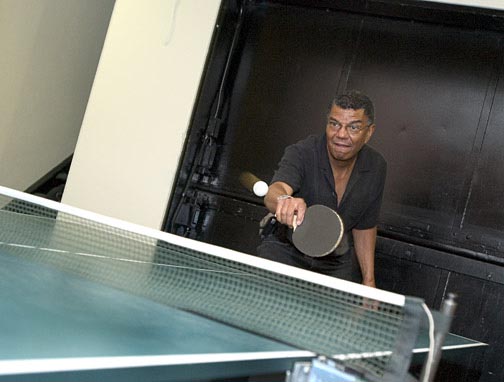
[Jack DeJohnette pic: courtesy Celebrities Playing Table Tennis (!)]
Re: Jazzfest, I warmed up with Jack DeJohnette & Co. at Birdland last night. (Thanks to Steve for the multiple Twitter tips [e.g.] on this gig--I didn't even realize it was going down.) A great set, and I encourage you to head down tonight or tomorrow, even if it means missing a bit of WJF. I'd never caught DeJohnette live before, and that was a major draw, but I think what really enticed me was the backing band: Rudresh Mahanthappa on sax, David Fiuczynski on guitar (double-necked!), George Colligan on keys (w/ some serious MIDI vibes, simulating harpsichord, harmonium, organ, etc.) and Jerome Harris on acoustic bass guitar. I wasn't disappointed.
During the first few minutes of the opening tune, "One for Eric"--a classic that debuted on the fantastic Special Edition album in 1979--I was struck by how turbulent the improvising was. Whenever I'm hearing challenging or abstract jazz in a club like Birdland, I can't help but feel for those tourist-types who may have wandered in unawares in search of smooth dinner music. I'll just say I was glad I wasn't dining last night. DeJohnette really smacks the drums, and on "One for Eric" he laid down a rocky, free-time landscape once the solos got going. (He saved the incredibly supple and intricate low-volume swing for the bass solo.)
But the cool thing about DeJohnette as a bandleader and composer is that he makes that kind of wildness feel accessible and fun. The set closer, "Ahmad the Terrible," with its knotty melody and carnival-esque acceleration, registered more like off-the-wall party music than anything foreboding. And even during the prickly unaccompanied Mahanthappa solo--surely the out-est moment of the evening--that preceded the tune, DeJohnette flashed a few grins at Harris, which took a little of the edge off.
The drummer really knows how to construct a set. Last night, in addition to the bookend classics mentioned above, we got "Music We Are," a killer ballad with DeJohnette rocking the melodica in fine, yearning style--weirdly, his sound on the instrument reminds me of the beautiful synth-harmonica theme that accompanies the underwater level on the classic Super Nintendo game Donkey Kong Country--and some chaotic rubato poetry, "Dearly Beloved"-style, from the ensemble. Then, "Spanish Seven," a fast Latin-y romp in said time signature that built into a nasty sort of fusion, part electric-Miles funk and part jaunty klezmer. (I remember Colligan riding the groove with unhinged glee.) And "Ahmad" concluded with an odd Indian-music breakdown, with Colligan providing faux-harmonium and Harris on otherworldly vocals, a little like the higher pitched Tuvan stuff demonstrated here.
So it was all pretty out there but also down to earth. Challenging, but without any stone-faced self-importance. Flashy and occasionally even a bit gimmicky in its eclecticism, but not watered down. You left feeling like you'd been in good, honest hands. And somewhat unexpectedly, with less recollection of the individual players than of the band as a single organism. Wouldn't wanna deny props to Mahanthappa's solos (nimble and peppery, with a lot of sublimated freakiness) or Fiuczynski's (effortlessly classy on the fretted guitar neck, sproingy and slightly alien-sounding on the fretless one), but DeJohnette's concept(s) prevailed, and it was one all the sidemen got behind wholeheartedly. I don't know DeJohnette's full discography well enough to tell you how unprecedented this group's sound is within his catalog--in a Voice blurb, Jim Macnie alludes to a 1989 album called Audio-Visualscapes that I haven't heard--but I really think someone should record this band.
Subscribe to:
Posts (Atom)