Showing posts with label alan shorter. Show all posts
Showing posts with label alan shorter. Show all posts
Sunday, April 03, 2016
Goodbye, Gato
I don't pretend to be an expert on the music of Gato Barbieri, who passed away yesterday at age 83, but I treasure a few of his early recordings. The track above—from a 1968 duo session with Dollar Brand that's been issued under various names over the years—chilled and electrified me when I first heard it. I distinctly remember throwing this one on during either a very late-night or early-morning DJ slot at WKCR and sitting in the control room spellbound by its strange tension, the way it slides back and forth between gravitas and savagery.
And I have never forgotten his elliptical proclamation in the liner notes (for the Arista/Freedom LP edition, titled Confluence): "'I do not scream,' said Gato, 'for the same reasons Pharoah Sanders screams.'" Wish there was more from that interview, but there you have it. His saxophonic "scream" is one of the most excruciating I know. There are many exquisite examples in the track above, where the sound swells to a horrible bursting. There is a quality of madness in the Barbieri scream that I find immensely appealing.
He also plays beautifully in these group settings...
Alan Shorter's Orgasm:
Don Cherry's Complete Communion:
Complete Communion in particular is simply a heavenly album. There are few more earthy and pleasurable and charming and exciting jazz sessions: four masters in, well... re-read the title, with a ton of meaty material to dig into. Barbieri is fully on board with Cherry's "cocktail piece" medley methodology—he's clearly having a blast digging into each melody and, eventually, detonating it. And the Shorter has a beautiful kind of stark, haunted vibe, to which Barbieri makes key contributions. Barbieri's own In Search of the Mystery, which features Calo Scott's cello in an odd yet highly effective foil role, is similarly underrated and heavy-duty.
If anyone knows the Flying Dutchman and Impulse albums well, I'm all ears re: recommendations. (The Third World is one I have my eye on.) I sense that for the listener attuned to Barbieri's early work, the intrigue thins out in the later part of Barbieri's career, but I could of course be very wrong. Discographical minutiae aside, farewell to a musician who honed a real voice on his instrument and made a focused yet indelible impact on this particular listener.

Monday, October 25, 2010
Permission: Marion Brown's genius
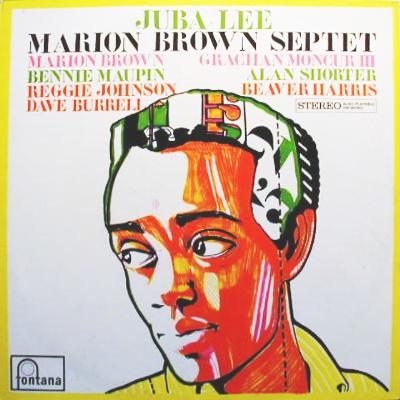
The Marion Brown tributes are piling up and they are fantastic, especially the personal reminiscences by Lars Gotrich and John Rogers, a great rare-record round-up courtesy of Destination: Out and Clifford Allen's typically thorough interview.
I have been on a Brown kick since the sad news hit, and I have to say that as much as I respect the thematically ambitious material that comes later, nothing hits me like his wordless mid-’60s albums, specifically those resulting from an extraordinary hot streak spanning October through December of 1966: Why Not?, Juba-Lee and Three for Shepp.
It sounds strange, but as a dedicated free-jazz fan, I'm always craving order. Go as far out as you want, but work your ass off on the organizational aspects: bandbuilding, composition, arrangement, solo lengths, sideman deployment, etc. If you're putting your name on a record, exercise some control. These records fulfill said criteria in such thrilling ways. For sheer organized-adventure quotient they are the equal of the mid-’60s Blue Note dates that more or less sum up my personal jazz ideal. (I always think of the holy trinity as Jackie McLean's One Step Beyond, Grachan Moncur's Evolution and Andrew Hill's Point of Departure.) The endlessly delightful romp known as "Spooks" (Three for Shepp) sums up these records' genius. There's freedom here, but there's also so much much economy and so much joy. These are songs you want to hear sung again and again, not merely groundbreaking expressions.
You also really hear each musician featured on these albums, not as a faint blare within a din, but as a true voice. Right now I'm checking out the aforementioned Grachan Moncur soloing on "Fortunato" (also on Three for Shepp), and I'm loving how much space he gets to stretch out and lament as he so loved to do. And Dave Burrell caressing chords underneath, with stunningly sensitive color from Beaver Harris, really one of the finest drummers of the period. (On Why Not? you hear similar sensitivity with different hues courtesy of Stanley Cowell and Rashied Ali.) It's been said time and again that Brown's is not your usual free jazz, that his music showed a greater sensitivity and openness than that of many of his peers. I don't want to drive this characterization into the ground, but I have to echo it here, simply because it's true. I like how Destination: Out put it: "Above all else, Marion Brown’s music insisted on communicating. It wanted to forge deep connections." You feel that when you're listening to these three records I've mentioned—Brown reaching out not just to his listeners but, crucially, to his collaborators as well.
"Play as long as you want; get out what you need to get out," he seems to say to his sidemen on brilliant performances such as Juba-Lee's "Iditus" (streaming at Destination: Out), which features one of the best Alan Shorter solos I've ever taken in, not to mention an awesome turn from Bennie Maupin, whom I've never really heard in such a classic-free-jazz context. Moncur is here too, and Harris, and Burrell—a real all-star team of the period. And of course the leader, just another deep, true voice in a chorus of them, but also the crucial guiding hand that—as Bill Dixon was also doing around the same time—said, "It's okay to slow down, to draw forth the feelings underneath the frenzy." That kind of permission is why these records stand out and truly endure, right up to now.
P.S. Another essential Marion Brown record is Reeds ’N Vibes, a duet session with Gunter Hampel. Poetic, spare, reflective improvisation.
Subscribe to:
Posts (Atom)