Showing posts with label clifford allen. Show all posts

Thursday, August 02, 2018

Two New Yorks, one epic night: BarrSheaDahl's 10th Anniversary Special Large Ensemble + Alan Braufman's 'Valley of Search'

My ears are still ringing from the second of two shows I saw tonight, a 10th-anniversary improv blowout by the trio known as BarrSheaDahl (consisting, respectively, of MickKevinTim) and 12 of their closest friends. The glorious happening they staged at Bushwick's Market Hotel was something like a post-jazz/noise/metal version of Ascension, or maybe more accurately, Free Jazz: five guitar-bass-drums trios situated throughout the room and playing a loosely structured 47-minute piece governed by a simple yet ingenious Tim Dahl score, consisting of a series of timed cues.

So, for example, one trio would play alone for around five minutes, then another would either join it or take its place. At other times, you'd hear only the guitars, or only the basses. Sometimes the entire 15-member ensemble would rest. Or (more frequently) blare forth in a single writhing mass. You would roam around the room, shifting your focus, paying special attention to, say, the way the relaxed yet focused drumming of Oran Canfield (an excellent local mainstay mainly known for his work in the bands Child Abuse and Chaser) contrasted with the full-bore blasting of Nandor Nevai, or the way guitarist Brandon Seabrook's furious right-hand trilling differed from Colin Marston's more fractured attack.

Mostly, though, you were just soaking in the spectacle, the density, the cacophony, the microdetail, the spatial disorientation, the "happening"-ness of it all. It was, at times, literally painful (on the ears); it was simultaneously joyous. I wasn't the only one seen grinning with a sort of dazed disbelief. To me, the event felt like one big toast, an homage to a scene, a community, a movement that has taken shape during the past decade or so in New York. It is a collective without a name, without even a unified purpose other than a sort of absolute conviction and a kind of roll-up-your-sleeves aesthetic extremity. There is no one sound, one background, one intent. There is only the sense that none of these musicians really belong anywhere else, so they might as well band together. (I wrote a bit about this loose community a few years back as well, after hearing Krallice at the Stone.)

I'm talking, in part, about the specific participants in tonight's event: clockwise from the center, those would be, taken by trio and listed as guitarist, bassist, drummer, respectively, Barr, Shea and Dahl; Ava Mendoza, Erik Malave and Nevai; Seabrook, Evan Lipson and Walter; Marston, Shayna Dulberger and Canfield; Kevin Hufnagel, Johnny DeBlase and Shayna Dunkelman. Among these musicians are current and former members of Child Abuse, Krallice, the Flying Luttenbachers, Dysrhythmia, Xiu Xiu, Orthrelm, Lydia Lunch's band, Pyrrhon, Seabrook Power Plant, Behold... the Arctopus, Cellular Chaos, Coptic Light and on and on. Some images from the event:


And the circle extends ever outward from there. I'm proud to call myself a member of this loose, unofficial confederacy, having shared bills with these musicians' various projects and in some cases even collaborated with them, for roughly the past 15 years.

Tonight's event was far from definitive, in terms of being a summation of these players' activities. But it was sort of a marker in time, a statement that yes, something has been built here in NYC that is distinct from what was built here in decades' past. It has no catch-all name (No Wave or Energy Music or 2001 Rock Revival or any of the others we know from the history books), not yet at least. It's a scene still in the making. But as tonight's event reaffirmed, its roots are deep and intertwined, stretching from Saint Vitus to the Stone to the late, great Death by Audio to all those defunct mid-2000s spaces whose names I can't remember. Yet another chapter in the continuing saga of American DIY.

And earlier in the evening, in downtown Manhattan, I caught a glimpse of another New York, via a combination concert and talk celebrating the recent reissue of Valley of Search, a 1975 album by the alto saxophonist Alan Braufman. I'd only done a quick needle drop on the album before catching the show, so I was coming in mostly fresh. But as soon as I entered WNYC's Greene Space, where the gig took place, I felt right at home.

Braufman's band, which featured pianist Cooper-Moore from the original album, along with bassist Ken Filiano and drummer Andrew Drury, were in the midst of a surging free-jazz invocation when I arrived. I've had the good fortune of seeing Cooper-Moore and Ken Filiano play many times, but I was struck anew by their intensity and precision, and by the poise and tastefulness of Drury, who I've caught in a few different contexts over the years. But the real surprise was Braufman himself, a player who was entirely new to me before I got wind of this reissues. His playing was extremely forceful yet full of song, clear and radiant and agile and proud, with hints here and there of the familiar free-jazz "scream" but refusing to lean on mere aggression as a crutch.


And best of all, the band's churning improvisation gave way at several points to Braufman's catchy, ingenious themes. Repetitive, folk-like, minimal, but extremely nourishing. The perfect launch pads for further excursions into more open territory. This was a music clearly redolent of Pharoah (of whom Braufman spoke reverently during an illuminating post-concert talk — moderated by my friend and fellow writer Clifford Allen, who wrote the liner notes to the new edition of Valley of Search, and also featuring Braufman's nephew Nabil Ayers, the man responsible for the reissue), of Coltrane, at times perhaps of Ayler, but it very clearly represented a '70s aesthetic as opposed to a first-wave '60s one. It's hard to put my finger on what the distinction there is, but there was a sense of that initial spark of '60s being reined in, sublimated, refined, so that the end product was perhaps more song-driven, more streamlined. (Hear for yourself when the band, with the additional of the outstanding young saxophonist James Brandon Lewis, plays National Sawdust on Friday.)

I'm generalizing of course, and these are minor distinctions, really, but I really felt like I was being transported back to a time and place. And, as Braufman and Cooper-Moore laid out during the talk — and as Patrick Jarenwattananon explains in his excellent Bandcamp Daily piece on Valley of Search — that time was the mid-'70s, when you could still rent an entire multi-story loft downtown for around $500, and the place was 501 Canal Street. There was no heat. Braufman pointed out that during the winters, the warmest place on the floor he shared with the late, great David S. Ware (who around that time was one third, along with Cooper-Moore and the great drummer Marc Edwards, who was in attendance tonight, of a trio called Apogee) was inside the refrigerator. They would cook up brown rice and vegetables, one pot for the entire week, and simply live the music, day in and day out. They had firsthand access to the giants of an earlier generation: Miles, Mingus, Rahsaan, Sam Rivers. To hear Cooper-Moore and Braufman tell it, it was hand-to-mouth but it was also heaven. (Cooper-Moore asked Braufman at one point the rhetorical question of why he put up with all the hardship, and answered it with the obvious assertion that it was, in so many words, for the sake of the music.)

And all of that joy and struggle is in the music, the same way the sort of keyed-up, frenetic, boiling-over, polyglot insanity of the New York of the past decade or so was in the BarrSheaDahl jam/exorcism/sound-mass. A great divide separates these two New Yorks — the latter performance, for example, felt distinctly post-punk, while the former was more like an echo of free jazz's original Edenic moment. But both events were manifestations of the strange artistic Petri dish that this city is and has been for decades upon decades. (I'm reminded of Off the Wall, Calvin Tomkins' excellent book on Robert Rauschenberg and his circle — Cunningham, Cage, Jasper Johns and so many others — a chronicle of a whole other New York school that flourished in the '50s and '60s.)

Every era, seemingly, has its project(s). It's not a unified, directed thing — though as tonight's BarrSheaDahl event, or certain pivotal group shows described in the Tomkins book, for example, demonstrates, sometimes you do have these moments of dedicated convergence. It's more like this sort of self-sustaining ecosystem operating within, either in harmony with or in opposition to or a mixture of both, the larger struggle and grind of this insane and wonderful place. Tonight these moments, these movements criss-crossed, overlapped, cross-pollinated — and not just in my mind; indeed, the poet and consummate scenester Steve Dalachinsky, in the words of Steve Smith, "as consistent an indicator of a high-quality concert experience as any I have found during 20 years of concertgoing in New York," could be seen digging the sounds of Braufman's band and then a few hours later walking around the BarrSheaDahl happening wide-eyed and giddy, as we all were.

Two New Yorks, two generations, two worlds converging. Or maybe they were one and the same.

Sunday, February 09, 2014

Soundchasing: Sunny Murray


In various writings on Milford Graves, I've mentioned the idea of chasing a sound. I'm not sure what it is about this certain species of drummer—Graves, Paul Motian, Sunny Murray, Elvin Jones—but sometimes I get it into my head that I just can't listen to anything else other than the sound of one of these players. It's like a craving for a certain kind of food that overcomes me, sticks around and then gradually departs. And I'm finding that it's cyclical. My pantheon is taking concrete shape, in other words. I'm open to new information, but I think the names mentioned above will always be a part of the rotation; these strong desires to hear them, and only them, will come back around.

Lately, the sound I'm chasing is Sunny Murray's. As with Milford Graves's, Murray's sound can be a hard one to really locate. It's been ages since I've seen the man perform, and that was not a positive experience. So I've been been busy sifting through what's there to sift through on record. Again, as with Milford Graves, I defy the museum-ification of artists like this, the holding up of their
"legendary" early recordings—often the ones on ESP or BYG, or the ones with some similar kind of first-wave cachet—as the best place (other than live) to hear them. Recent examples aren't as numerous as I'd like them to be, but both Graves and Murray have been extremely well-served by state-of-the-art modern recording technology.

Right now, I'm listening to Tiresias, a 2011 release under Louie Belogenis's name. As Clifford Allen—a serious Murray scholar—points out in the liner notes, we should treasure this opportunity to hear Murray in such gorgeous studio fidelity. (Beyond Quantum, a 2008 Tzadik set featuring William Parker and Anthony Braxton, is probably the closest equivalent in the Milford Graves discography.) So I've got this record on, and I just want to dive deep down in it. The crisp rattle of the snare, the lavish boom of the toms and bass drums—a sublimated thunder, as though Murray could shake the walls if he wanted to, but is content to flutter around wraithlike. And then gradually swelling the cymbals, rustling and conjuring, behind Belogenis. It's such a loving curtain of sound that Murray drapes over this session. He was obviously onto something similiar as early as Spiritual Unity, but I think he's a better listener, a better drummer, a better musician now.

The sound quality on I Stepped Onto a Bee, recorded in 2010 with Murray's current working-triomates Tony Bevan and John Edwards, isn't quite as stellar as what you hear on Tiresias—there's a certain brittleness to the sound, kind to the high end, but less so to the Elvin-y low end that's so crucial to Murray's overall delivery—but this one's also essential for the devoted Sunny Murray soundchaser.

There's a prevailing sense that Murray's approach to drumming is a sort of a default: He couldn't swing back in the day, so he had to resort to this. There aren't enough good vintage examples of Murray trying to "swing" for us to really make that call. I think Murray's dangerously easy to underestimate, though. Certainly, unlike Milford Graves—at least in my experience of seeing him play, Graves has never seemed anything less than scarily poised—there are times (such as the 2003 Tonic gig I caught) where Murray has appeared on the bandstand in a less-than-ideal headspace. You listen to these recent records, though, and you hear Murray's voice as clearly as if he were speaking; he's not doing this thing because he can't do that thing. He's doing this thing because it's the thing he's chosen and perfected.

This signature Murray style isn't the only style he's capable of delivering, by any means. There are plenty of obscure recent sessions—such as this very strange and not quite satisfying Archie Shepp record with Richard Davis, and an astounding bootleg I grabbed off Soulseek years ago of a 1998 Sonny Simmons / Sonny Murray duo gig in Cambridge—where you can hear Sunny Murray capably swinging in a relatively traditional vein, and sounding utterly like himself at the same time. But at his best, such as on I Stepped Onto a Bee, the idea of whether or not he's technically swinging is irrelevant. The point is that he controls the pace and the sensation of the music completely, decides whether it will be a ghostly dirge-blues, or this sort of surging free shout. And while the Murray sound is enveloping, especially that patented irregular cymbal swell, which carries you along like a mist at your back, what's most impressive is the blend, the way he occupies certain frequencies, fills up all the sound around his collaborators, so that he's buffeting them rather than drowning him out. (It would seem from this great Paris Transatlantic interview with Murray that there's more science to this—i.e., that very special way in which Murray inhabits and sort of plasticizes musical space—than many have thought. "I wanted to get more from the beat than just the beat," as he puts it.)

On Dawn of a New Vibration, Murray's tough-to-find 2000 duo session with the late Arthur Doyle (see also: Burning Ambulance), the drummer gets so much more from the beat than just the beat. One of the tracks here is titled "Elephant Dreams," and that's exactly how I think of Murray's sound on this record. The shaggy, loping weight of the sound coming off his kit here is just extraordinary. More and more, this is what I look for in a drum sound. It's Bonham; it's Elvin; it's Milford; it's Motian; it's prime Sunny Murray. It's that sense of dragging sound and rhythm, hauling it around like a sack of potatoes. It's not mutually exclusive with a certain kind of nimbleness, but the principal imperative is the earth-ness of the sound, the way that it rumbles through the ground and the air. Dawn of a new vibration, indeed.

During times like these, I need nothing more than that thwack, that thump and shimmer, that unmistakable sonic signature. It's not something you can capture. You need to be in the room with it, really. But recent, top-quality studio recordings can get you about halfway there, which is saying a lot. Right now, I'm breathing it in like oxygen.

/////

In terms of sheer distinctiveness of voice, I've also been deep into both Neil Young's Waging Heavy Peace and Stanley Crouch's Kansas City Lightning. Such a pleasure to hear these men speaking, as Sunny Murray does, with such authority and idiosyncrasy—being themselves at such a simultaneously refined and unapologetically raw level, in other words. That is what we mean by author, artist.

And since hearing this wonderful news, I've also been chasing the sound of Slint drummer Britt Walford, another player who's got a secure spot in my aforementioned percussive pantheon. When it comes to boomy, wide-open girth of sound, and a gorgeously loose feel, he is one of our contemporary masters. Such a shame that his discography is so tiny—really just three Slint releases and one relatively unrepresentative LP apiece by the Breeders and Evergreen, as well as various odds and ends, including this crucial pre-Slint rarity by Maurice. Even Graves's and Murray's relatively scant recorded works dwarf Walford's. I did find this enticing tidbit from last year, though. By the way, all fans of Britt Walford specifically and Slint in general need to read Scott Tennent's 33 1/3 book on Spiderland. The coming Lance Bangs doc ought to be a revelation, but until then, Scott's volume represents the deepest knowledge base we have on this insular band/scene.

Monday, October 25, 2010

Permission: Marion Brown's genius


The Marion Brown tributes are piling up and they are fantastic, especially the personal reminiscences by Lars Gotrich and John Rogers, a great rare-record round-up courtesy of Destination: Out and Clifford Allen's typically thorough interview.

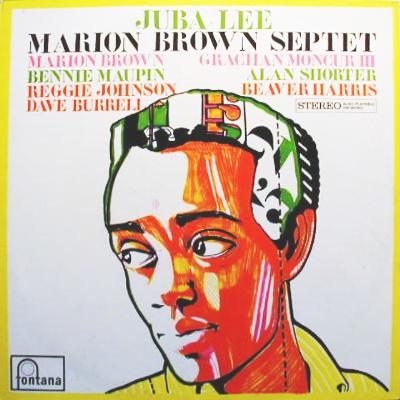
I have been on a Brown kick since the sad news hit, and I have to say that as much as I respect the thematically ambitious material that comes later, nothing hits me like his wordless mid-’60s albums, specifically those resulting from an extraordinary hot streak spanning October through December of 1966: Why Not?, Juba-Lee and Three for Shepp.

It sounds strange, but as a dedicated free-jazz fan, I'm always craving order. Go as far out as you want, but work your ass off on the organizational aspects: bandbuilding, composition, arrangement, solo lengths, sideman deployment, etc. If you're putting your name on a record, exercise some control. These records fulfill said criteria in such thrilling ways. For sheer organized-adventure quotient they are the equal of the mid-’60s Blue Note dates that more or less sum up my personal jazz ideal. (I always think of the holy trinity as Jackie McLean's One Step Beyond, Grachan Moncur's Evolution and Andrew Hill's Point of Departure.) The endlessly delightful romp known as "Spooks" (Three for Shepp) sums up these records' genius. There's freedom here, but there's also so much much economy and so much joy. These are songs you want to hear sung again and again, not merely groundbreaking expressions.

You also really hear each musician featured on these albums, not as a faint blare within a din, but as a true voice. Right now I'm checking out the aforementioned Grachan Moncur soloing on "Fortunato" (also on Three for Shepp), and I'm loving how much space he gets to stretch out and lament as he so loved to do. And Dave Burrell caressing chords underneath, with stunningly sensitive color from Beaver Harris, really one of the finest drummers of the period. (On Why Not? you hear similar sensitivity with different hues courtesy of Stanley Cowell and Rashied Ali.) It's been said time and again that Brown's is not your usual free jazz, that his music showed a greater sensitivity and openness than that of many of his peers. I don't want to drive this characterization into the ground, but I have to echo it here, simply because it's true. I like how Destination: Out put it: "Above all else, Marion Brown’s music insisted on communicating. It wanted to forge deep connections." You feel that when you're listening to these three records I've mentioned—Brown reaching out not just to his listeners but, crucially, to his collaborators as well.

"Play as long as you want; get out what you need to get out," he seems to say to his sidemen on brilliant performances such as Juba-Lee's "Iditus" (streaming at Destination: Out), which features one of the best Alan Shorter solos I've ever taken in, not to mention an awesome turn from Bennie Maupin, whom I've never really heard in such a classic-free-jazz context. Moncur is here too, and Harris, and Burrell—a real all-star team of the period. And of course the leader, just another deep, true voice in a chorus of them, but also the crucial guiding hand that—as Bill Dixon was also doing around the same time—said, "It's okay to slow down, to draw forth the feelings underneath the frenzy." That kind of permission is why these records stand out and truly endure, right up to now.

P.S. Another essential Marion Brown record is Reeds ’N Vibes, a duet session with Gunter Hampel. Poetic, spare, reflective improvisation.