Showing posts with label aum fidelity. Show all posts

Sunday, August 10, 2014

Somewhere we've never been: Farmers by Nature at ShapeShifter Lab


The debate over the now-infamous "Sonny Rollins" New Yorker piece continues. I'm not going to get into what I think of the original article, or the points made by its various supporters and detractors, or even Sonny's own response, mainly because I think both the incident and its aftershocks are beside the point. That point being: music ("jazz," or what have you) as an actual human practice, happening now, in real time—rather than an idea to be lobbed about abstractly.

I bring up the Sonny business mainly because I read Justin Moyer's jazz-bashing response in The Washington Post yesterday, and then went out to see a very satisfying night of what you might call jazz—the Aum Fidelity–backed double-record-release bill of Darius Jones and Matthew Shipp and the Farmers by Nature trio (Craig Taborn, William Parker and Gerald Cleaver, pictured above, left to right) at ShapeShifter Lab; and a trio set by Travis Laplante, Mick Barr and Nick Podgurski in a Clinton Hill living room, part of the Home Audio series. One of Moyer's points ("There’s not much difference between a screechy performance by avant-garde saxophonist Peter Brötzmann from 1974 and one from 2014") stuck with me—the idea being that "free jazz" always sounds the same. I've seen enough supposedly free performances to know that, when it comes to the post-Coltrane/Ayler tradition, at least, "free" can indeed refer to a well-rehearsed script. I happen to love Peter Brötzmann—’74, ’14, whenever—and I think he's a much better listener/collaborator and more diverse performer than he's given credit for. But yes, you go to see him, and you know that a certain flavor of ornery, macho catharsis is going to be part of the deal.

But I take issue with the idea that actual freedom, actual improvisation, is a myth, and that, to cite another one of Moyer's points, improvisation is overrated as a rule. Again, I agree with him in the macro sense. Moyer writes, "…the fact that music is improvised doesn’t make it great." Amen to that—I think the idea of improvisation (or any other philosophical construct that informs music's creation or performance, be that serialism, or graphic scores or Conduction, or what have you) being presented as an inherent virtue of that given piece of music is b.s. I'm really only interested in the result, and very often songs, or more generally, compositions, are what I'm after. As a metalhead, I love riffs; as a jazz guy, I love melodies—Ellington, Mingus, Andrew Hill, etc.; as a lifelong pop fan, I love hooks.

But, in some cases, improvised music appears before you as a kind of miracle. Watching Farmers by Nature last night, I felt like I was witnessing the honest-to-God creation of something out of nothing. It wasn't free jazz, or any other kind of calcified thing. It wasn't self-important about its method. It was just an honest shot at doing what improvisers ought, ideally, to do every time, which is not simply to empty your closet of every idea you might have stuffed in there, but to deal with the moment, with its possibility, and to listen, really listen, to what your collaborators have to say, and concern yourself with supporting those ideas, as well as the overall continuity, as fragile as a bubble, of the collective statement.


The set had a real elegance of design to it. Parker started out solo, and the other two slowly built up a kind of murky groove, rising out of nothingness. From there, over roughly an hour, the music visited roughly six or seven different zones, like track demarcations on an album. Each proceeded logically from the one before, and never arrived till the group had fully explored the prior area of inquiry. I remember an episode of fractured funk, with Taborn and Cleaver clanking out jagged accents, completing each other's sentences; an exquisitely chill section that felt almost like placid bossa nova; a couple of frenzied Taborn flights, where he came off like a short-circuiting cyborg, juxtaposing single, percussive notes from different registers of the keyboard; a long unaccompanied Cleaver solo that took full advantage of some expert tom-tom tuning—the drum kit was really singing, in the melodic sense—and ramped up to torrential density; and maybe most profound of all, a section featuring Parker on arco. I don't think I've ever heard a double bass cry out with such grain and elegy and deep feeling as it did last night in Parker's hands. Taborn accompanied with superhuman restraint, serving up quiet yet extremely resonant chords.

So, yes, sensitivity and restraint are a big part of why this music succeeded. But as I attempted to describe above, the group raged plenty as well. I think what impressed me so much was, again, this sense of continuity, of each player's—and the trio's, as a collective unit—awareness of the overall arc. Too often, long sets of improvised music follow a predictable quiet-loud-quiet shape. This felt more like a suite, with each movement taking on its own special mini contour. The band went for the climax when it was there, but they never milked it. Intensity was only one color on the palette. And the same goes for the hierarchy of the music, as it were. For long stretches, the band played in a way that seemed totally collective, i.e., sans soloist, almost in the way that groups like the Necks improvise. But, as with the varied dynamics, collectivity was just one strategy. During plenty of other moments, the more traditional soloist-plus-accompanists concept was very much at play. Each of the three players starred in turn.

Most amazing to me, though, was how the moment, the actual spontaneous unfolding circumstance, seemed to drive the set, as much as the will of any one player, or even of the trio as a whole. I'm thinking, for example, about how Gerald Cleaver's smallest cymbal—the size of a splash, but with a more ping-y, less tinny sound than I've often heard out of splashes—turned out to be something like a central character during the last 10 or 15 minutes of the set. Throughout the performance, Cleaver moved this cymbal around the kit—sometimes it was perched on its own stand to his right, sometimes it was resting on the hi-hat stand above those cymbals or on the floor tom or snare. So, in the middle of one such transfer, Cleaver happened to drop this little cymbal. He reached down beside the bass drum and picked it up, and then he went to put it back on its original stand to his right. But this act became, in and of itself, a sort of tic or weird fixation. He didn't just replace the cymbal and go on playing the full kit. He began obsessively, continuously spinning the cymbal around on the stand, eliciting a faint little creak. The other players didn't seem to directly respond, but as Cleaver turned the cymbal around and around, it was almost like he was drawing the accumulated momentum of the set down into a final moment—draining the water from the tub, funneling the creative material out of the air. Taborn and Parker gradually quieted, and Cleaver was striking the still-spinning cymbal with a wire brush, almost inaudibly. He stopped spinning it and continued whacking the brush into the air, engaging in movement but producing essentially no sound. And that was the end of the set.

I trust that none of the above episodes, the high-intensity Taborn solos, the Parker arco feature, the concluding Cleaver small-cymbal mini drama, were planned. Befitting their group name, the three musicians actually were harvesting moments, turning them over, wringing out all their potential. The overall result didn't sound anything like any stereotypical idea of "free jazz," or any other style of improvised music I can think of. But at the same time, it wasn't alien; it felt fully logical, narrative, directed, harmonious, complete. The set lasted for exactly the right amount of time, and for the band to have played a single note after the ending would've felt (to me, at least) superfluous. This Farmers by Nature set wasn't great because it was improvised; it was great because of, as I've attempted to describe, the brilliance of the various individual moments and the coherence of the overall form. At the same time, I think the set's uniqueness, the fact that what happened last night hasn't happened before and won't happen again, was part of its immense appeal. We shouldn't fetishize the means of production—how something was made, or according to what principle—but when something truly special arises from a certain method, or lack of method, it's good to remember that, yes, that method has potential. It is absolutely no guarantee—not whatsoever—but improvisation can, under certain circumstances, take both players and audience somewhere they've never been. Last night's Farmers by Nature set reaffirmed that fact for me. As always, I'll be staying tuned.

/////

P.S. My focus on the Taborn/Parker/Cleaver performance isn't intended to slight the other sets I saw last night. Both were fierce and beautiful. Darius Jones and Matthew Shipp burrowed ever further into the special kind of poignant, stormy melancholy—doled out in three- or four-minute chunks, the so-called Cosmic Lieder of their album titles—they've been creating as a duo for the past few years. And Travis Laplante and Mick Barr, both scarily extreme, virtuosic and idiosyncratic musicians, unleashed their respective aesthetic selves, but with no sense of autopilot whatsoever, building something collective and response-based, with help from Nick Podgurski's expertly tension-ratcheting percussion, moving imperceptibly from sparseness to brutal density. A hell of a night all around.

Friday, February 28, 2014

DFSBP archives: Whit Dickey


During my interview with Andrew Hock, we talked quite a bit about the guitarist Joe Morris. I hadn't spun a Morris record in a while, so I pulled out a few old favorites in the days that followed, and this listening excursion led me to the latest in a neverending series of drumcentric soundchasing jags—this one focused on Whit Dickey, a frequent Morris collaborator for two-plus decades.

I've always felt that Dickey was a seriously underrated artist, even among free-jazz heads. I first heard him right as I began to explore the downtown NYC scene in the early aughts. I have a distinct memory of seeing him play at the Mercury Lounge, of all places, as part of an improv round robin organized by the Vision Festival crew. I think it was at that show that I approached him to see if he'd be interested in appearing on air with me, for an episode of WKCR's Musician's Show. (DFSBP readers might recall the Grachan Moncur III interview, another installment of the same program.) You can stream—via the blue Streampad bar at the bottom of the page—or download that three-hour program below, split into four segments:

Whit Dickey - WKCR Musician's Show - 5/2/01, pt. 1
Whit Dickey - WKCR Musician's Show - 5/2/01, pt. 2
Whit Dickey - WKCR Musician's Show - 5/2/01, pt. 3 
Whit Dickey - WKCR Musician's Show - 5/2/01, pt. 4

I was, and still am, a huge fan of Transonic, Dickey's 1998 debut as a leader—a trio date with saxist Rob Brown and bassist Chris Lightcap. I reviewed it for AllMusic.com way back when. I know I wouldn't frame my impression now the way I did then—"One does not normally look to a drummer-led jazz session for innovative compositions…" (groan)—but I'm still struck by what a strong concept Dickey puts forth on this record. It's not just his writing, which is punchy, concise and memorable; it's the way he drives a band with palpable yet slippery force. Much like the great Sunny Murray, whom Dickey really sounds very little like, his playing acts as a sort of vortex, drawing the music toward it, sometimes very subtly. I feel the same sort of confidence, the same entrancement when I listen to both players, the sense that they're helping to lend a sort of elemental weight to whatever setting they appear in, without having to assert themselves in bombastic ways. This kind of sorcery, or cultivation-of-vibe, if you will—heard in everyone from Motian to Oxley to Graves—is my number-one aesthetic priority when it comes to improv-driven percussion, and Whit Dickey's playing oozes that quality. In the WKCR interview, Dickey talks quite a bit about environmental vibration, and how he seeks to translate what he hears around him into his playing; that might sound like mumbo-jumbo, but if you listen to enough of his work, you'll understand exactly what he means. (On the other hand, he also discusses his studies at New England Conservatory, so there's more than intuition at work in what he does.)

I actually know what are probably the best-known Dickey records—his collaborations with David S. Ware—the least well. I reserve a special place in my jazz pantheon for his leader dates: Transonic; its follow-ups, Big Top and Life Cycle (credited to the Nommonsemble); the extraordinary and hard-to-find Prophet Moon (by Trio Ahxoloxha, i.e., Dickey/Brown/Morris, the same trio heard on the earlier Youniverse); the more recent Coalescence (with Brown, Morris [on bass here] and the late Roy Campbell Jr.) and Emergence (with Daniel Carter and Eri Yamamoto); and, a record I've just discovered, Understory, a super-earthy/emotive 2013 collaboration with Sabir Mateen and Michael Bisio under the Blood Trio moniker. (I haven't yet spent good time with the handful of recent Ivo Perelman records on the Leo label that feature Dickey, but those are definitely on my list.) These albums could all be considered part of the free-jazz continuum, stretching from the ’60s ESP cats up through the ’90s Aum Fidelity / Vision Festival cohort and beyond, but thanks in large part to Dickey's presence, they embody a special kind of sonic poetry. He's among a select group of improvisers whose affiliation with a given session makes the record in question an instant must-hear for me.

The Aum Fidelity website identifies Dickey as a "somewhat mysterious figure." As you'll hear, he was perfectly friendly and forthcoming in the interview setting, but I understand what that description was getting at. Dickey's never been much for self-promotion; to this day, he doesn't have a real Web presence, and I always seem to hear about his releases and gigs after they occur. (It's worth noting too that there don't seem to be any other interviews with him online.) It's been a good while since I've seen him live—I caught a great show by Matthew Shipp's trio, which includes Dickey and Bisio, at the Stone probably four or five years back—and I hope to remedy that soon. In the meantime, there's a substantial body of recorded work to savor. You'll hear a nice sampling from both Transonic and Big Top in the WKCR program—as well as Dickey-curated selections from his favorite drummers, including Steve McCall, Freddie Waits and Milford Graves. To complement that, here's a good chunk of Whit Dickey on Spotify:


Friday, October 19, 2012

Go see the world: David S. Ware and ELEW


The past couple days have brought startling news from the jazz world:

First, last night's announcement of David S. Ware's passing at the relatively young age of 62, circulated by Patricia Parker and reported by various sources, including Peter Hum's blog.

Second, the publication on Wednesday, via Do the Math, of what can only be called a manifesto from the self-dubbed Rockjazz piano star Eric Lewis (who performs as ELEW). It's a remarkable piece of writing. AccuJazz.com dubbed it "really engrossing straight talk"; I'd second that and add that it's also stupendously witty.

It seems odd to link word of a death with any other bit of information; I hope I don't sound crass in that regard. At the same time, I'd be lying if I said that the two figures didn't converge in my mind when I heard about Ware. Let me explain:

When I think about Ware, I think about beautiful music: e.g., an intimate Brooklyn solo concert I had the privilege to attend in March of 2010 (released last year on Aum Fidelity as one half of Organica), or my favorite Ware record, 1979's Birth of a Being, as far as I know the only officially released document of the collective trio known as Apogee, with pianist Gene Ashton (later to be known as Cooper-Moore; read his fascinating reminiscences re: the group—including an account of opening for a band led by Ware's friend Sonny Rollins at the Vanguard—a little more than halfway the page here) and drummer Marc Edwards (still kicking ass in NYC on a regular basis). Respect to Ware's celebrated quartets of the ’90s and aughts, but this early release has captured my imagination more than any other DSW release. To my ears, it's probably the single greatest document of second-wave free jazz. Happily, a blogger has uploaded it to SoundCloud; the pleasures of this music, that heartbreaking, hymnal, post-Ayler lyricism, which gradually splinters apart, like a homey cottage in the path of a tornado, are plain:


But when I think about David S. Ware, I also think about what it means to have a career in jazz. The discussion of how musicians operating in this genre can make a decent living while retaining integrity is a constant one, which seems to flare up about once a year at least. (See also: another recent post by Peter Hum.) While I doubt that Mr. Ware was a particularly wealthy man in the grand scheme of things, certainly it's fair to say that he was one of the more visible jazz musicians of his generation (maybe "peer group" would be more accurate). I don't think I'll ever forget this Gary Giddins assertion, via a July, 2001 installment of his Weather Bird column in the Voice:

"Let's be bold: The David S. Ware Quartet is the best small band in jazz today. I realize that I will almost certainly hear another quartet, or trio or quintet or octet, this week or next, that will make me want to backpedal. But every time I see Ware's group or return to the records, it flushes the competition from memory."

I didn't know enough about the state of jazz in July of 2001 to particularly agree or disagree with Giddins's assertion, but I admired the ballsiness of the statement. (Looking back on the period now, I'd probably give the nod to Tim Berne's then-nascent Hard Cell band, later to be expanded into Science Friction.) But whatever my own feelings about Ware's music, I had an understanding that he was something like the Michael Jordan of this world of Vision Festival–affiliated NYC free jazz that I was just then starting to discover, the member of that crew who had achieved some measure of niche-transcending fame. Around that time, I remember visiting the apartment of a not particularly jazz-fixated friend and spotting a copy of Ware's 1998 Columbia debut, Go See the World, in his CD collection. It was only later that I came to understand how exactly it was that Ware had achieved this name-brandedness, which began to snowball around 1994, thanks in large part to the passionate advocacy of current Aum Fidelity boss Steven Joerg, then working at the Homestead label. (Brad Cohan's 2011 interview with Joerg is a valuable primer on all this: "The idea of signing the Ware Quartet was a bit of a stretch, but I convinced [Homestead]," says Joerg. "The first record we did—Cryptology—ended up being the lead review in Rolling Stone.") I have a memory of Ware's 1999 Columbia record, Surrendered, as being a bit tamer, but listening back to the two now, I realize that both were/are marvelous anomalies, HTGMLPCFJRs! (honest-to-God major-label post-Coltrane free-jazz records, i.e.) I look forward to getting better acquainted with these albums.


I can't speak to the nitty-gritty details of Ware's Columbia signing; it would be fascinating to read an interview with the A&R rep who was responsible for that deal. [Update: Mark Stryker informs me it was none other than Branford Marsalis! I had no idea. Peter Hum points the way to this valuable document: "Branford said don't change a thing," says Ware. Given that Wynton figures into the ELEW saga, it makes me wonder how many jazz success stories of the past 20 years or so don't include the Marsalises in some respect.] But details aside, and whatever the net effect of this episode on the Ware's quality of life then and later on, one has to marvel at and respect the fact that DSW busted through a glass ceiling in a certain respect. Obviously the scale is vastly smaller, and the analogy is iffy due to the fact that unlike Cobain & Co., Ware's signing did not pave the way for a whole wave of like-minded indie artists, but it's hard not to see Go See the World as the Nevermind of American free jazz, a record that mainstreamed, or at least attempted to, an inherently underground aesthetic without masking its essential rawness—and a record that even celebrated that rawness. It seems to me, in other words, that Ware succeeded in the marketplace without compromising in the slightest, that Go See the World is more or less the next record his band would've made for Aum Fidelity had Columbia not stepped in. If you think about it, that's pretty damn cool.

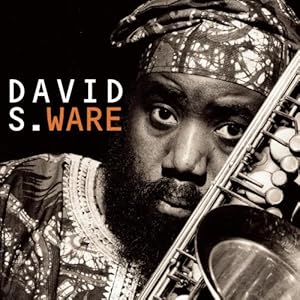
So when I say I linked Ware and Eric Lewis in my mind, what I mean is that, having just read Lewis's disarmingly candid account of how he forged a thriving career in music—proceeding at first through conventional jazz channels and then later fashioning an arena-ready aesthetic built around improv-heavy covers of well-known rock songs—I couldn't help thinking about how these two figures might have regarded one another. Ware's circle was obviously not the same one (i.e., the Wynton Marsalis orbit) that Lewis occupied before rebranding himself—and if you've read the piece, you know that I mean that phrase very literally—as ELEW. But these are obviously two extraordinarily skilled musicians who labored for years over their respective brands of jazz and managed—again, each in their own respective ways—to carve out a place for themselves in the jazz-unfriendly marketplace. (And even Ware, whether consciously or not, was a brand: It's hard to look at the album cover above and argue that there wasn't some image-building going on there.)

I'm not making any value judgment here. I haven't heard enough of ELEW's music (really, just a cover of "Mr. Brightside" at a Jazz Foundation of America event a few years back) to give an informed opinion on it, and my knowledge of Ware's work in the ’90s and 2000s is spotty as well. But it is fascinating to think of these two figures, both "stars" in a certain sense, one of whom won a degree of fame (and even a major-label deal) working in one of the most seemingly "difficult" subgenres in American music, i.e., post-Coltrane free jazz, without altering his core values in the slightest, and the other, who strategically retooled his entire aesthetic, grafting his love for and command of jazz onto a commercially viable "hook" and succeeding beyond just about any contemporary jazz musician's wildest dreams (touring with Josh Groban, etc.). There is no right path. Ware seemed entirely in love with his artistic pursuit, and Lewis, in his own way, seems to be in love with his. Yes, in the latter case, art intermingles more straightforwardly with commerce, but as anyone who has ever tried to make a living at anything creative (writing, ahem) could tell you, it pretty much has to at one point or another, so why not be open about that fact?

Again, I'm not advocating for the ELEW model, nor am I criticizing it. I'm simply stating that it seems to have worked for him, in the sense that he appears to be happy and fulfilled doing what he does, over and above the fact that he's making a good living doing it, and that that is in many ways the definition of success. Ware succeeded too, in that he reached many more listeners than 99 percent of the other free-jazz musicians who have ever lived. Think of the great John Tchicai, who passed away recently at the age of 76. I don't have encyclopedic knowledge of his work (I will say that I adore the early New York Art Quartet works), but I feel comfortable asserting without verifying it first that Tchicai never landed the lead review in Rolling Stone—or, for that matter, toured with Josh Groban. Everyone loves an unsung hero, but sometimes it's worth thinking hard about the players, like Ware and Lewis, who have "made it," and about why and how they did: how much, i.e., was due to their own deliberate efforts, as in the case of Eric Lewis reimagining himself as ELEW; how much was due to tireless advocates, e.g., Steven Joerg in Ware's case; how much was due to the conditions of the marketplace during a given period, etc. As jazz fans, we're bred to be suspicious of success, of visibility, etc., and certainly many of the music's brilliant statements, especially since the ’70s have been made underground, as it were, but we should celebrate the fact that certain artists in the field have managed to climb a little higher, to position themselves a little closer to the popular sphere, to go see the world, as it were. As Lewis suggests, there are lessons to be learned even from Kenny G.

I don't mean to reduce Ware's sad passing to an occasion for soapboxing; all I mean to say is that, with Lewis's fascinating career arc on my mind, I couldn't help but muse a bit on art-and-commerce as it pertains to jazz. May DSW rest in peace, and may ELEW continue to thrive on his own terms.

Wednesday, June 13, 2012

Vision Festival: NYC North Star


Last night, I caught an extraordinary set by the Darius Jones Quartet at Vision Festival 17, which runs through Sunday at Roulette. (I very much enjoyed what I saw of the Farmers by Nature trio—with Craig Taborn, William Parker and Gerald Cleaver—and Parker's own In Order to Survive quintet, but the Jones band hit me the hardest.) The performance centered on a series of heart-rending ballads. Jones sounded as precise and openhearted as I've ever heard him. Every time I go see him, I'm struck by the care and gravity he puts into each phrase; even if the passage is a delicate one, he gears up, bears down, applies enormous psychic pressure. The notes have a vocal cry—smooth, yet with rasp always threatening to creep in around the edges, like peppered honey—but they're sculpted and purposeful.

The same goes for Jones's suitelike compositions. By "free jazz" standards, they're compact and accessible; they have movement and narrative drive. (The episodic, busy-to-sparse "You Have Me Seeing Red" and the tender "The Enjoli Moon" are two that stuck in my head.) When they work up to a screaming peak, that peak is earned, contextualized. The rest of the band—pianist Matt Mitchell, bassist Trevor Dunn and drummer Ches Smith—sounded really alert and attuned, but each time Jones entered, I felt a different kind of grip on my brain and heart. He's entered a new phase of maturity with this project. Its emotional spectrum is total. (Hear for yourself on Book of Mæ'bul (Another Kind of Sunrise), out now on Aum Fidelity, which celebrated its 15th anniversary at last night's Vision gig.)

As I listened I thought about my history with the Vision Festival, and how I might not have appreciate a set this nuanced and straightforwardly beautiful had I seen it back in 2000, when I first attended the event. (I volunteered at the fest that year, via my DJ-ing gig at WKCR, and I remember a fun afternoon spent folding programs in the company of heavy players like Alan Silva and Mat Maneri.) At that time, I had a real stake in the idea of avant-garde-ness in music. I was looking for a kind of assault, the freer, longer, more difficult and abstract—and often, louder—the better. I remember countless variations on this idea from various Vision Fests: a set by Peter Kowald's trio with drummer Gunter Sommer and a monster of a David S. Ware solo performance at a space above St. Marks Place; the 2 Days in April band with Fred Anderson, Kidd Jordan, William Parker and Hamid Drake at a cavernous venue in Soho (and a variant of that band minus Anderson, plus Henry Grimes many years later); mammoth Bill Dixon and Sam Rivers ensembles at Angel Orensanz; Peter Brötzmann in various settings at Abrons Arts Center last year.

Though my tastes—i.e., exactly what it is I'm looking for when I attend a jazz performance—might have changed somewhat, I treasure all those memories, not to mention the longevity/consistency of the Vision Festival, which has been something like a personal North Star in my NYC concertgoing life. I may have been guilty of taking the fest for granted the past few years. (Talking between sets last night, a friend and I were struck anew by the fact that many people travel from out of town for the event, which has come to seem to us like an everyday neighborhood hang.) Last night, I did my best to appreciate the awesome bounty of this event—for one thing, Roulette might be the ideal Vision venue; the sight lines and sound were about as good as I've ever found them to be at any previous edition—especially the fact that after so many years, it still had new joys to offer. Sure, there was an element of old-guard free-jazz stampede to be found in the In Order to Survive set, but the Jones performance (and in a very different way, the Farmers by Nature set) gave me hope that younger practitioners of what is often called "this music" are looking for ways to shatter the wall of impenetrability that surrounds the subgenre, to retain the gut-busting passion while at the same time putting on a warm, relatable show, one that avoids improvisational bombast, that places a premium on sensitivity and experiment (not just a pat idea of what's "experimental"). On the latter tip, I think of the drowsy impressionist blues that ended the Farmers set—a major surprise to me and, I think, the musicians themselves, and a definite highlight of the evening.

There's little more to say other than this: Check out the Vision Festival over the next few days if you can. (Joe McPhee and Sonny Simmons play tonight, Wednesday.) Go back next year and the year after, even if you think you've got this territory fully mapped. Like any great cultural institution, Vision can grow with you, and you with it.

Tuesday, June 14, 2011

Studio visit: Milford Graves on record


In a March post, I attempted to make the point that free jazz ought to be documented in the studio from time to time. The only problem was that the Peter Brötzmann albums I chose as examples were actually live recordings. I stand by my argument, however, and it's because of albums like Real Deal and Beyond Quantum, sessions from, respectively, 1991 and 2008 featuring the drummer Milford Graves.

I've been on a Milford Graves kick over the past few days, incited by an interview subject who named Graves's 1976 LP Babi as an all-time favorite. Checking out that record, it was easy to see the appeal: It is as unhinged and raw a free-jazz document as you will find. Like Graves's many ESP-Disk recordings (I happened to catch some great material from 1964's The Giuseppi Logan Quartet on WKCR the other day as part of a Don Pullen profile), it sounds DIY, punk. There's something romantic about that. The legend of free jazz hinges on ideas of subversion and underground-ness. We like to think of these sorts of recordings as having been made hastily and cheaply—or in the case of Babi, a live album, almost incidentally, i.e., the music would have raged on whether or not the tape recorder was rolling. Graves's ESP sessions were mostly (all?) recorded in the studio in NYC, but there's nothing meticulous about them. The resulting documents are more or less the polar opposite of the kinds of gorgeously warm and balanced albums being made for Blue Note nearby at Rudy Van Gelder's New Jersey studio.

Despite all the financial shadiness surrounding ESP, fans of this music—myself included—tend to be glad that those mid-’60s records exist. We should also be happy, though, that many of the artists in question, e.g., Mr. Graves, have survived/thrived long enough to take advantage of more sophisticated recording technology. Just like with old, scratchy blues recordings sourced from 78s, we fetishize the thin, sometimes borderline crappy sound on those old ESPs, hold it up as a badge of authenticity, forgetting that no free jazz actually sounded like that in the flesh. You want to hear a Milford Graves album? Get Real Deal, a duet recording with David Murray recorded in the decidedly non–historically sexy year of 1991, or Beyond Quantum, a 2008 trio album with Anthony Braxton and William Parker. (Both are available as Amazon downloads via the links above.)

I can't express to you the sheer beauty of these recordings—not just the performances, but the SOUND. On Real Deal, Milford Graves sounds like the wind and the rain. He sounds like he's worshiping the drum kit, its glorious range of timbres. I'm listening to the first track right now, and it sounds heartbreakingly alive. The recording is wonderfully three-dimensional: You have the ride cymbal over in the left channel, the toms and bass drum closer to the center along with Murray's tenor, the hi-hat slightly to the right of those. I don't think I've ever heard another drummer paint with his kit the way Graves does, coax as much nuance out, and a musician like that deserves to be heard in a warm and resonant document like this, without that obfuscating aspect of rawness—obfuscating not just in the sense that detail is lost, but in the sense that it invites you to impose upon it a kind of punk romanticism. The romanticism is all there in the drums, though—you don't need an invitation to heap on your own baggage.

In short, free jazz deserves the studio treatment just as much as any other music. Sure it's a style built on rawness and spontaneity, but with the truly great musicians like Graves, you're going to get that no matter what. Why not hear him in glorious hi-fi? Here is a sample of Beyond Quantum—skip to around 1:50 for a taste of what I'm talking about:


I love that the ESP records exist (The New York Art Quartet is a particular fave), that Babi survives. But in terms of what I would take to a desert island, it's the pro-shot stuff, so to speak, where the music brings the heat and the recording soaks up the whole range of frequencies. Interstellar Space, anyone? Recorded at the aforementioned Van Gelder facility, not at some no-name Times Square facility or at a gig with a room mic. These Graves records are part of that illustrious tradition. Like many of the recordings in, say, the Aum Fidelity catalog—I've been very impressed recently by the new Planetary Unknown, with David S. Ware, Cooper-Moore, the aforementioned William Parker and Muhammad Ali—they're about museum-quality preservation, not DIY mythmaking. Artists of this caliber deserve such treatment. It is, I would venture to say, the real deal.

P.S. ECM is another label that has long understood the value of superior sound quality and studio documentation. You won't hear the full range of a Paul Motian performance on any other label. (See I Have the Room Above Her.) Speaking of which, I wrote about a handsome new studio-recorded Craig Taborn solo disc on ECM in this week's Time Out New York.

Thursday, April 28, 2011

In the zones: Darius Jones and Matthew Shipp at Jazz Standard


In their new duo, Darius Jones and Matthew Shipp are limiting themselves, and it sounds really good. Tonight I saw the pair, on alto saxophone and piano respectively, at Jazz Standard, where they were celebrating a new Aum Fidelity album, Cosmic Lieder. The record is very good; the show was much more than that—an arresting demonstration of a shared philosophy of improvisation, a series of sharp answers to age-old questions like "Where do we start?," "Who leads?," "Who follows?" and maybe most importantly, "Where do we end?"

As far as I can tell, the Jones/Shipp duo is an all-improv project, but it is not a free-for-all. These are songs, in a way—brief (averaging four minutes or so) and highly directional. The titular cosmos delivered with pop-song economy.

At Jazz Standard, the duo was incredibly decisive, each piece a single sustained idea, kicked around and prodded at but fixed, secure in its center. I think of Ghostbusters, when each of the three 'busters zaps Slimer and they slowly, steadily lower him into the trap in unison. It was that kind of teamwork.

Darius Jones already has a formidable reputation for gutsy free-jazz soul. (See Steve Dollar's fine Wall Street Journal profile.) If you've heard him in Little Women, you know it's not just soul that interests him, but maniacal, stabbing noise as well. The key thing to understand about Jones's work with Shipp, though, is that he's playing here with an almost heroic restraint. That's not to say that his ideas are restrained; he unleashed plenty of throaty shrieks and yelps tonight. It's more that he doesn't let them fully off the leash. This is not a blow-till-you-drop free-jazz concept (a good thing, in my opinion—we've got quite enough of those)—it's a concept of harnessing moments of wildness, violence boiling up and receding, leaving behind its scent. Wind the tension till it snaps, work through the tantrum and then bring it back to a whisper. Tonight Jones played with such tension, bearing down even at barely audible volumes. Always deciding, to do or to not do, to attack or to grit teeth and let the moment pass, winding, winding. Letting go and reining in. Making a song out of raw materials, letting their edges show but obeying an imaginary hourglass—when it's time to stop, you stop. You don't mourn the passing. You pause and you get on with what's next. These songs had an imperative to get somewhere, and almost without fail, they did.

Matthew Shipp made damn sure they did, actually. The pianist has a reputation for cantankerousness off the bandstand, and that tendency is often projected onto his playing. I feel like I've read descriptions that likened his improvising to boxing—I could've sworn the word "pugilistic" was used somewhere [NOTE: After the fact, I turned up this boxing-and-jazz piece by Shipp himself!]as though he was this swaggering, merciless hard-ass. And of course there are the vague Cecil Taylor comparisons. But specifically on the latter front, there's an immense difference, namely that Matthew Shipp goes to Herculean lengths to ensure that his collaborators sound good. (For all his strengths, CT is not, on the whole, what one would call a deeply sensitive collaborator.) Or, maybe I should say, he did so tonight—I suppose his trio (where he is the nominal leader and principal soloist) is a somewhat different story. With Jones he was like a shadow, cushioning and supporting at all times, providing just the right backdrop, vamping when need be, hammering out the framework so that Jones could dance within it. The word I kept thinking of, and writing down, was GRACIOUS. This was a duo music, i.e., neither player really soloed per se, but the roles were clear—Shipp was ground and Jones was sky. So the tension, and there was so much and it was so very exciting, came from the ideas and not from some sort of hackneyed clash between the players. Shipp is no pugilist—he's a master scene-setter, like some sort of production designer, laying out sumptuous period furnishings that help the actors immerse in their roles, accessing new truths.

The moods and textures were many. There was the eerie impressionism that is something like Shipp's signature. (Jones shouts-out this special Shippian vibe in this great joint appearance on Jason Crane's The Jazz Session, zeroing in on New Orbit, a truly fantastic 2001 record—maybe my favorite of Shipp's that I've heard.) Faster, choppier excursions. Hushed sonic mobiles with Shipp plucking the piano strings by hand. Jones always sounding so incredibly vocal, crying out with something there's not even a word for. "Anguish" seems too broad. It's like a simmering combination of mad and sad, wounded and vengeful. Bearing down immensely on the notes till they pop out. It was like soul surgery, with Shipp laying out all the tools on the operating table.

The two railed, in a way, against the semi-swanky jazz-club setting. They paused after each piece, just long enough to let you know it was indeed over, and the applause would begin. But they were onto the next one immediately—no time for basking or even, really, acknowledgment. I think about Keith Jarrett and how when I saw him at Carnegie Hall earlier this year, he bowed ponderously after each piece, enervating the room each time. Jones and Shipp weren't about to break the fourth wall. They were in the zone, or should I say in the zones, each brief song its own cosmos that for those four minutes or so was their shared, sole objective. Anyone improvising "open-endedly," "seeing how it goes," "relaxing," "emoting," doing whatever you're doing other than deciding where a piece should go and going there, NOW, take heed. However "experimental" you fancy yourself, you are competing with composed music; there is an imperative to pick an idea, to state that idea, make it stick and call "Scene." If further clarification is needed, consult your copy of Cosmic Lieder or the next Jones/Shipp duo gig.