Showing posts with label matthew shipp. Show all posts

Sunday, August 10, 2014

Somewhere we've never been: Farmers by Nature at ShapeShifter Lab


The debate over the now-infamous "Sonny Rollins" New Yorker piece continues. I'm not going to get into what I think of the original article, or the points made by its various supporters and detractors, or even Sonny's own response, mainly because I think both the incident and its aftershocks are beside the point. That point being: music ("jazz," or what have you) as an actual human practice, happening now, in real time—rather than an idea to be lobbed about abstractly.

I bring up the Sonny business mainly because I read Justin Moyer's jazz-bashing response in The Washington Post yesterday, and then went out to see a very satisfying night of what you might call jazz—the Aum Fidelity–backed double-record-release bill of Darius Jones and Matthew Shipp and the Farmers by Nature trio (Craig Taborn, William Parker and Gerald Cleaver, pictured above, left to right) at ShapeShifter Lab; and a trio set by Travis Laplante, Mick Barr and Nick Podgurski in a Clinton Hill living room, part of the Home Audio series. One of Moyer's points ("There’s not much difference between a screechy performance by avant-garde saxophonist Peter Brötzmann from 1974 and one from 2014") stuck with me—the idea being that "free jazz" always sounds the same. I've seen enough supposedly free performances to know that, when it comes to the post-Coltrane/Ayler tradition, at least, "free" can indeed refer to a well-rehearsed script. I happen to love Peter Brötzmann—’74, ’14, whenever—and I think he's a much better listener/collaborator and more diverse performer than he's given credit for. But yes, you go to see him, and you know that a certain flavor of ornery, macho catharsis is going to be part of the deal.

But I take issue with the idea that actual freedom, actual improvisation, is a myth, and that, to cite another one of Moyer's points, improvisation is overrated as a rule. Again, I agree with him in the macro sense. Moyer writes, "…the fact that music is improvised doesn’t make it great." Amen to that—I think the idea of improvisation (or any other philosophical construct that informs music's creation or performance, be that serialism, or graphic scores or Conduction, or what have you) being presented as an inherent virtue of that given piece of music is b.s. I'm really only interested in the result, and very often songs, or more generally, compositions, are what I'm after. As a metalhead, I love riffs; as a jazz guy, I love melodies—Ellington, Mingus, Andrew Hill, etc.; as a lifelong pop fan, I love hooks.

But, in some cases, improvised music appears before you as a kind of miracle. Watching Farmers by Nature last night, I felt like I was witnessing the honest-to-God creation of something out of nothing. It wasn't free jazz, or any other kind of calcified thing. It wasn't self-important about its method. It was just an honest shot at doing what improvisers ought, ideally, to do every time, which is not simply to empty your closet of every idea you might have stuffed in there, but to deal with the moment, with its possibility, and to listen, really listen, to what your collaborators have to say, and concern yourself with supporting those ideas, as well as the overall continuity, as fragile as a bubble, of the collective statement.


The set had a real elegance of design to it. Parker started out solo, and the other two slowly built up a kind of murky groove, rising out of nothingness. From there, over roughly an hour, the music visited roughly six or seven different zones, like track demarcations on an album. Each proceeded logically from the one before, and never arrived till the group had fully explored the prior area of inquiry. I remember an episode of fractured funk, with Taborn and Cleaver clanking out jagged accents, completing each other's sentences; an exquisitely chill section that felt almost like placid bossa nova; a couple of frenzied Taborn flights, where he came off like a short-circuiting cyborg, juxtaposing single, percussive notes from different registers of the keyboard; a long unaccompanied Cleaver solo that took full advantage of some expert tom-tom tuning—the drum kit was really singing, in the melodic sense—and ramped up to torrential density; and maybe most profound of all, a section featuring Parker on arco. I don't think I've ever heard a double bass cry out with such grain and elegy and deep feeling as it did last night in Parker's hands. Taborn accompanied with superhuman restraint, serving up quiet yet extremely resonant chords.

So, yes, sensitivity and restraint are a big part of why this music succeeded. But as I attempted to describe above, the group raged plenty as well. I think what impressed me so much was, again, this sense of continuity, of each player's—and the trio's, as a collective unit—awareness of the overall arc. Too often, long sets of improvised music follow a predictable quiet-loud-quiet shape. This felt more like a suite, with each movement taking on its own special mini contour. The band went for the climax when it was there, but they never milked it. Intensity was only one color on the palette. And the same goes for the hierarchy of the music, as it were. For long stretches, the band played in a way that seemed totally collective, i.e., sans soloist, almost in the way that groups like the Necks improvise. But, as with the varied dynamics, collectivity was just one strategy. During plenty of other moments, the more traditional soloist-plus-accompanists concept was very much at play. Each of the three players starred in turn.

Most amazing to me, though, was how the moment, the actual spontaneous unfolding circumstance, seemed to drive the set, as much as the will of any one player, or even of the trio as a whole. I'm thinking, for example, about how Gerald Cleaver's smallest cymbal—the size of a splash, but with a more ping-y, less tinny sound than I've often heard out of splashes—turned out to be something like a central character during the last 10 or 15 minutes of the set. Throughout the performance, Cleaver moved this cymbal around the kit—sometimes it was perched on its own stand to his right, sometimes it was resting on the hi-hat stand above those cymbals or on the floor tom or snare. So, in the middle of one such transfer, Cleaver happened to drop this little cymbal. He reached down beside the bass drum and picked it up, and then he went to put it back on its original stand to his right. But this act became, in and of itself, a sort of tic or weird fixation. He didn't just replace the cymbal and go on playing the full kit. He began obsessively, continuously spinning the cymbal around on the stand, eliciting a faint little creak. The other players didn't seem to directly respond, but as Cleaver turned the cymbal around and around, it was almost like he was drawing the accumulated momentum of the set down into a final moment—draining the water from the tub, funneling the creative material out of the air. Taborn and Parker gradually quieted, and Cleaver was striking the still-spinning cymbal with a wire brush, almost inaudibly. He stopped spinning it and continued whacking the brush into the air, engaging in movement but producing essentially no sound. And that was the end of the set.

I trust that none of the above episodes, the high-intensity Taborn solos, the Parker arco feature, the concluding Cleaver small-cymbal mini drama, were planned. Befitting their group name, the three musicians actually were harvesting moments, turning them over, wringing out all their potential. The overall result didn't sound anything like any stereotypical idea of "free jazz," or any other style of improvised music I can think of. But at the same time, it wasn't alien; it felt fully logical, narrative, directed, harmonious, complete. The set lasted for exactly the right amount of time, and for the band to have played a single note after the ending would've felt (to me, at least) superfluous. This Farmers by Nature set wasn't great because it was improvised; it was great because of, as I've attempted to describe, the brilliance of the various individual moments and the coherence of the overall form. At the same time, I think the set's uniqueness, the fact that what happened last night hasn't happened before and won't happen again, was part of its immense appeal. We shouldn't fetishize the means of production—how something was made, or according to what principle—but when something truly special arises from a certain method, or lack of method, it's good to remember that, yes, that method has potential. It is absolutely no guarantee—not whatsoever—but improvisation can, under certain circumstances, take both players and audience somewhere they've never been. Last night's Farmers by Nature set reaffirmed that fact for me. As always, I'll be staying tuned.

/////

P.S. My focus on the Taborn/Parker/Cleaver performance isn't intended to slight the other sets I saw last night. Both were fierce and beautiful. Darius Jones and Matthew Shipp burrowed ever further into the special kind of poignant, stormy melancholy—doled out in three- or four-minute chunks, the so-called Cosmic Lieder of their album titles—they've been creating as a duo for the past few years. And Travis Laplante and Mick Barr, both scarily extreme, virtuosic and idiosyncratic musicians, unleashed their respective aesthetic selves, but with no sense of autopilot whatsoever, building something collective and response-based, with help from Nick Podgurski's expertly tension-ratcheting percussion, moving imperceptibly from sparseness to brutal density. A hell of a night all around.

Friday, February 28, 2014

DFSBP archives: Whit Dickey


During my interview with Andrew Hock, we talked quite a bit about the guitarist Joe Morris. I hadn't spun a Morris record in a while, so I pulled out a few old favorites in the days that followed, and this listening excursion led me to the latest in a neverending series of drumcentric soundchasing jags—this one focused on Whit Dickey, a frequent Morris collaborator for two-plus decades.

I've always felt that Dickey was a seriously underrated artist, even among free-jazz heads. I first heard him right as I began to explore the downtown NYC scene in the early aughts. I have a distinct memory of seeing him play at the Mercury Lounge, of all places, as part of an improv round robin organized by the Vision Festival crew. I think it was at that show that I approached him to see if he'd be interested in appearing on air with me, for an episode of WKCR's Musician's Show. (DFSBP readers might recall the Grachan Moncur III interview, another installment of the same program.) You can stream—via the blue Streampad bar at the bottom of the page—or download that three-hour program below, split into four segments:

Whit Dickey - WKCR Musician's Show - 5/2/01, pt. 1
Whit Dickey - WKCR Musician's Show - 5/2/01, pt. 2
Whit Dickey - WKCR Musician's Show - 5/2/01, pt. 3 
Whit Dickey - WKCR Musician's Show - 5/2/01, pt. 4

I was, and still am, a huge fan of Transonic, Dickey's 1998 debut as a leader—a trio date with saxist Rob Brown and bassist Chris Lightcap. I reviewed it for AllMusic.com way back when. I know I wouldn't frame my impression now the way I did then—"One does not normally look to a drummer-led jazz session for innovative compositions…" (groan)—but I'm still struck by what a strong concept Dickey puts forth on this record. It's not just his writing, which is punchy, concise and memorable; it's the way he drives a band with palpable yet slippery force. Much like the great Sunny Murray, whom Dickey really sounds very little like, his playing acts as a sort of vortex, drawing the music toward it, sometimes very subtly. I feel the same sort of confidence, the same entrancement when I listen to both players, the sense that they're helping to lend a sort of elemental weight to whatever setting they appear in, without having to assert themselves in bombastic ways. This kind of sorcery, or cultivation-of-vibe, if you will—heard in everyone from Motian to Oxley to Graves—is my number-one aesthetic priority when it comes to improv-driven percussion, and Whit Dickey's playing oozes that quality. In the WKCR interview, Dickey talks quite a bit about environmental vibration, and how he seeks to translate what he hears around him into his playing; that might sound like mumbo-jumbo, but if you listen to enough of his work, you'll understand exactly what he means. (On the other hand, he also discusses his studies at New England Conservatory, so there's more than intuition at work in what he does.)

I actually know what are probably the best-known Dickey records—his collaborations with David S. Ware—the least well. I reserve a special place in my jazz pantheon for his leader dates: Transonic; its follow-ups, Big Top and Life Cycle (credited to the Nommonsemble); the extraordinary and hard-to-find Prophet Moon (by Trio Ahxoloxha, i.e., Dickey/Brown/Morris, the same trio heard on the earlier Youniverse); the more recent Coalescence (with Brown, Morris [on bass here] and the late Roy Campbell Jr.) and Emergence (with Daniel Carter and Eri Yamamoto); and, a record I've just discovered, Understory, a super-earthy/emotive 2013 collaboration with Sabir Mateen and Michael Bisio under the Blood Trio moniker. (I haven't yet spent good time with the handful of recent Ivo Perelman records on the Leo label that feature Dickey, but those are definitely on my list.) These albums could all be considered part of the free-jazz continuum, stretching from the ’60s ESP cats up through the ’90s Aum Fidelity / Vision Festival cohort and beyond, but thanks in large part to Dickey's presence, they embody a special kind of sonic poetry. He's among a select group of improvisers whose affiliation with a given session makes the record in question an instant must-hear for me.

The Aum Fidelity website identifies Dickey as a "somewhat mysterious figure." As you'll hear, he was perfectly friendly and forthcoming in the interview setting, but I understand what that description was getting at. Dickey's never been much for self-promotion; to this day, he doesn't have a real Web presence, and I always seem to hear about his releases and gigs after they occur. (It's worth noting too that there don't seem to be any other interviews with him online.) It's been a good while since I've seen him live—I caught a great show by Matthew Shipp's trio, which includes Dickey and Bisio, at the Stone probably four or five years back—and I hope to remedy that soon. In the meantime, there's a substantial body of recorded work to savor. You'll hear a nice sampling from both Transonic and Big Top in the WKCR program—as well as Dickey-curated selections from his favorite drummers, including Steve McCall, Freddie Waits and Milford Graves. To complement that, here's a good chunk of Whit Dickey on Spotify:


Monday, December 23, 2013

2013 jazz top 10

My 2013 jazz top 10 is live now at the Jazz Journalists Association site. My 2012 year-end jazz list was pretty extensive; this one is more concise, simply because I didn't spend as much time with new jazz, either on disc or out and about, as I did last year. That wasn't by design, or any indication of a large-scale shift in my tastes; jazz just wasn't as much where my listening brain was at during these past 12 months. That said: plenty of great records heard, and a handful of great shows witnessed, so let's talk about ’em.

(The Lloyd/Moran, Parks and Lonnie Smith albums aren't on Spotify; you can stream the other seven selections here.)


1. Black Host Life in the Sugar Candle Mines [Northern Spy]

I had high expectations for this record. I'd heard this band live two years back and was mightily intrigued. Life absolutely measures up. The Cleaver-as-a-leader discography is one of my favorite in contemporary jazz, and this is at least as strong a statement as Be It as I See It (discussed here). Probably stronger, because the personnel—Darius Jones, Brandon Seabrook, Cooper-Moore, Pascal Niggenkemper—is just so damn impressive. Serious kudos to Cleaver for figuring out a way to re-present the perennially underrated Cooper-Moore to the world. C-M's understated star turn on Life's concluding track, "May Be Home," is one of my favorite musical moments of the year. There's plenty of electrifying skronk on this record—some of which drags on a bit long for my tastes, that being the main reason this didn't crack my all-genres-in-play top 10—but the almost gospel-ish, soul-stirring element is what really draws me in. The quieter moments, such as the dreamy breakdown around 4:00 in "Hover," the heartbreakingly fragile "Citizen Rose" or the aforementioned "May Be Home" are pure bliss. For more on Life, see my Pitchfork review.


2. Charles Lloyd / Jason Moran Hagar's Song [ECM]

What a warm and sumptuous album this is. These two are just hanging out and playing great songs together. I'm a big fan of the Bandwagon, but I prefer Moran in a more unadorned setting, like this. There's no hook, no concept, just full engagement with the material. I'm currently revisiting one of my favorite tracks, "Bess, You Is My Woman Now," and Moran takes the most loving, unflashy solo, laying out the red carpet for Lloyd, whose presence throughout is, at the risk of sounding cliché, totally Zen-ed out. The epitome of a nothing-to-prove session. There's a little bit of modernist scrambling, but mostly this album is just songs (pop standards such as "God Only Knows" are treated as reverently as the jazz ones), with a bias toward luminous ballads. Absolutely fine by me. This is jazz you can really live with.


3. Aaron Parks Arborescence [ECM]

I would say the same of this album. I say, without shame, that both have served as cooking-dinner soundtracks for me. Is it doing a disservice to the deep beauty of Arborescence to say that it's ideal mood-setting music? I shy away from the idea of background music, but I wonder if the pianist himself would even take offense to that? He seems to really want to reach his audience here. These are mostly improvised pieces; to my ear, they're unrepentantly pretty and more classical-ish than jazzy. It's strange, but in a way, my experience of Arborescence is what I imagine the experience of The Köln Concert to be. I've never spent good time with that legendary record—no bias; I just haven't gotten around to the Jarrett solo repertoire in general—but judging by everything I've heard about Köln, Arborescence is, at least niche-wise if not style-wise, the same kind of piano record. One that, in theory, anyone could enjoy, and one that a purist might see fit to frown upon. Sometimes Arborescence is so wispy and drawn out that it almost seems to disappear, but there's real power in that ephemerality. You sit with this and you marvel at Parks's ability to simply make music, and to do so selflessly enough to make it so universal. It's hard to imagine an ear that doesn't crane toward this music as to soft morning sunlight, as mine is doing right now as I revisit it.


4. David Ake Bridges [Posi-Tone]

For me, the jazz writer of the year was Phil Freeman. He covered more of the music, in a more genuinely useful way—i.e., a way that made you want to seek out the sounds—than anyone else I read in 2013. Phil's year-end jazz round-up is essential; among the records he cited there, I got particularly into David Ake's Bridges, which I checked out a while back after reading this Burning Ambulance post. Bridges is one of those somewhat rare sessions where, going in, I'd never heard of the leader but I knew most of the other players well. The lineup is stellar—trumpeter Ralph Alessi, saxists Peter Epstein and Ravi Coltrane, bassist Scott Colley and drummer Mark Ferber—but it's what Ake, a pianist, does with the personnel that makes this album work. The compositions are maybe the tightest, most intricate and most memorable that I've heard on a jazz album this year. Ake leaves space for his sidemen to speak up—I'm listening to a great Colley solo, with commentary from Alessi, on the track "Sonomads"—but what you'll remember are these beautifully arranged, little-big-band themes, executed in a modern postbop style. Phil cited a minimalism influence, and I can definitely hear that, combined with the lusher, more meticulous end of the mid-’60s Blue Note sound—maybe a little bit of Dimensions and Extensions or The All-Seeing Eye, though Bridges is lighter in tone, funkier and more approachable, in a way that sometimes reminds me of Ravi Coltrane's own 2012 date Spirit Fiction (discussed here), which also features Alessi. Sometimes the mood gets greasier, slurrier, such as on the raucous and bluesy "Year in Review," where—as often happens on the album—the horns solo in unison. Even there, though, there's such a wonderful sense of order to this record, of a leader taking the time not only to assemble a great band but also to put together a compelling context for them to work within. I'd recommend this to any fan of well-made, composer-centric but also player-friendly small-group jazz.


5. Aaron Diehl The Bespoke Man's Narrative [Mack Avenue]

Same deal here, but in a more consciously retro idiom. As with the Aaron Parks above, I can think back to a time when I might have found a session like this—one that, God forbid, dares to hark back to that age-old connection between jazz and snappy dressing—distasteful. Now I find it to be the opposite. Anyone who writes this off due to the cover art is going to be missing on a gorgeous record. Steve Smith likened the concept here to the Modern Jazz Quartet, and he's right: That similarity is inescapable, given the piano-vibes-bass-drums instrumentation and almost obsessive polish and elegance on display in the playing and composition. But if there's retro-ness at play here, it's the most lived-in, un-gimmicky kind. There is such a nothing-to-prove quality about a piece like "Blue Nude" here; as with the Lloyd/Moran above—note that Bespoke also includes a marvelous version of "Bess, You Is My Woman Now"—Diehl just wants to play songs, to swing crisply, muse tastefully, give you a good feeling while at the same time presenting a striking portrait of who he is as a bandleader. You could hear, say, this group's reading of "Moonlight in Vermont" in passing and think it was merely "right," in the not-a-hair-out-of-place sense, but as with the MJQ, you listen closely and you're blown away by the unassuming skill, shrewdness, loving care of it all. Diehl's solo version of Ellington's "Single Petal of a Rose," burrows a little deeper; the ballads on Hagar's Song are astonishing in their unhurried composure, but this might even be more so. This record radiates love and care, for the material, yes, but also for the listener. Diehl wants to make you comfortable, not as an end in itself, but so that he can move you. The Bespoke Man's Narrative is radical in its sheer composure.


6. Matthew Shipp Piano Sutras [Thirsty Ear]

We think of Matthew Shipp as an avant-garde guy, someone on the opposite end of the spectrum from an immaculately groomed, Juilliard-trained, J@LC–anointed (complete with Wynton co-sign and Crouch liner notes) prodigy such as Diehl. And, to judge by Shipp's pugilistic stance toward the jazz maintream, he thinks of himself that way. But strip away the rhetoric and you're left with an aesthetic that's plenty approachable, plenty jazzy and, as heard on Piano Sutras, really, really satisfying. For one thing, Shipp takes the trouble to make records, as such. He's no Cecil Taylor, who for roughly the past 35 years has released almost exclusively live records, or rather others have released them. Taylor seems to have very little regard for how his music is consumed after it's made; Shipp, on the other hand, seems to only be getting better at plotting out programs that his listeners can genuinely engage with. Piano Sutras is a collection of 13 short-ish pieces. Aside from the standards, I'm not sure which are based on preconceived ideas and which were improvised on the spot, but each one seems to have a strong center and purpose—we're not just listening to Shipp jam. There are some tracks on this record that set a killer mood, that make essentially abstract, solo, sort-of-jazz piano seem like the same thing as songwriting: "Space Bubble" captures that crystalline sense of mystery that I associate with my favorite Shipp recordings (New Orbit, e.g.); "Blue Orbit" does sound like a blues, but refracted beautifully through the Shipp prism; "Cosmic Dust" comes off like a tug-of-war between Taylor and Andrew Hill. And then there are the standards, which strike me as deeply generous. I know that's a weird word to use, but the 71-second "Giant Steps" is just pure nourishing gorgeousness. "Nefertiti" is little more diffuse, but again, this is no deconstruction of, no attack on a chestnut; like the "Giant Steps," and like all great interpretations of standards, it's a celebration of the raw material. Overall, Piano Sutras is as warmly swinging as it is mad-scientist demented (see esp. "Cosmic Shuffle," which perfectly illustrates the tension between those two currents in Shipp's playing); it can be difficult, but generally, it meets you halfway. In that sense, I think Shipp has more in common with Hill than with Taylor. Thinking of Shipp as merely an iconoclast, whose output is as forbidding as his verbal critiques, does him a disservice. I like Piano Sutras because it's a record of weird solo piano that nevertheless invites you in.


7. Dr. Lonnie Smith Octet In the Beginning, Vols. 1 and 2 [Pilgrimage]

The second release from this veteran organist's own label, Pilgrimage, and the follow-up to a highly enjoyable trio set that made my jazz honorable-mentions list for 2012. Frequently, this record is the epitome of what you might estimate it to be: an exemplary soul-jazz set in the mode that Smith helped to perfect. Then, suddenly, when the leader goes off on one of his skipping-record excursions, wiggling his fingers relentlessly between two notes, or holding down a chord so long that it starts to feel like a laser beam of joy aimed at your skull, you start to realize that you're glimpsing the infinite. The band is pure fire and focus, whether the mode on display is crackling hardbop ("Turning Point"), strutting funk ("Move Your Hand," which features a beautiful Smith lead vocal) or pensive balladry ("In the Beginning"). The other soloists are generally strong; the arrangements, by saxist-flutist Ian Hendrickson-Smith; and the rhythm section—with guitarist Ed Cherry and drummer Jonathan Blake—kicks a great deal of ass. But the glory of this set is the leader himself, how hard he pushes, how, with each solo, he erases the line between music for your body and music for your spirit. You rarely hear a man so clearly convinced that his chosen instrument is a vehicle for transcendence, even salvation. Let's let Smith have the last word, via a quote from Ted Panken's informative liner notes: "I always say that the Hammond has all the elements in the world to me—the thunder and the lightning and the rainbow, the feel of the earth, the sun, the moon, the water."


8. Kirk Knuffke Chorale [SteepleChase]

I've dug cornetist's Kirk Knuffke's playing whenever I've heard him live, with bands like Ideal Bread or Merger (discussed here), as well as on recent records like Federico Ughi's self-titled quartet album, Max Johnson's Elevated Vegetation and the collaborative trio Sifter. I think Chorale is the first record I'd heard under Knuffke's own name. He's been making a bunch of cool CDs for the venerable SteepleChase label—including various collaborations with pianist Jesse Stacken—that I really need to take a closer look at, but Chorale grabbed me instantly, largely because I'm a complete sucker for anything with Billy Hart on it. Because of the unmistakable presence of Hart's drumming, its authority and weight—even when he's barely playing—he's going to be more or less a co-leader in any band in which he appears. That's definitely the case here, but Hart isn't dominating. The great thing is, no one is. Knuffke is a wonderfully patient, lyrical player, who's seemingly obsessed with the simple beauty of the line. You'll sometimes hear him going for slight timbral distortions, but mostly he's just singing, softly yet forcefully. He's not coming to the table on Chorale with a huge amount of compositional baggage. He seems to want to simply mix it up with the wonderful band he's assembled, which also includes pianist Russ Lossing and bassist Michael Formanek. What they're playing is a kind of cool-toned free jazz. In pieces like "Made," the musicians are jumping from one lily pad to the next, unbound by meter, but the interplay is so right-on—each player seeming so willing to help the others, as well as the overall sound, along. Sometimes the sound is more traditional, like on the gentle postbop dance "Standing," but the band maintains its wonderfully plush feel. Listening back now, I'm starting to hear the whole group concept of this record as an extension of Knuffke's songful cornet style, a style so self-assured that he doesn't have to raise his voice. There's not a lot of overt heat on Chorale, but the mojo bubbling beneath the surface is formidable. Like Hart, the rest of the players here know how to make their mark on a session simply by speaking clearly as themselves.


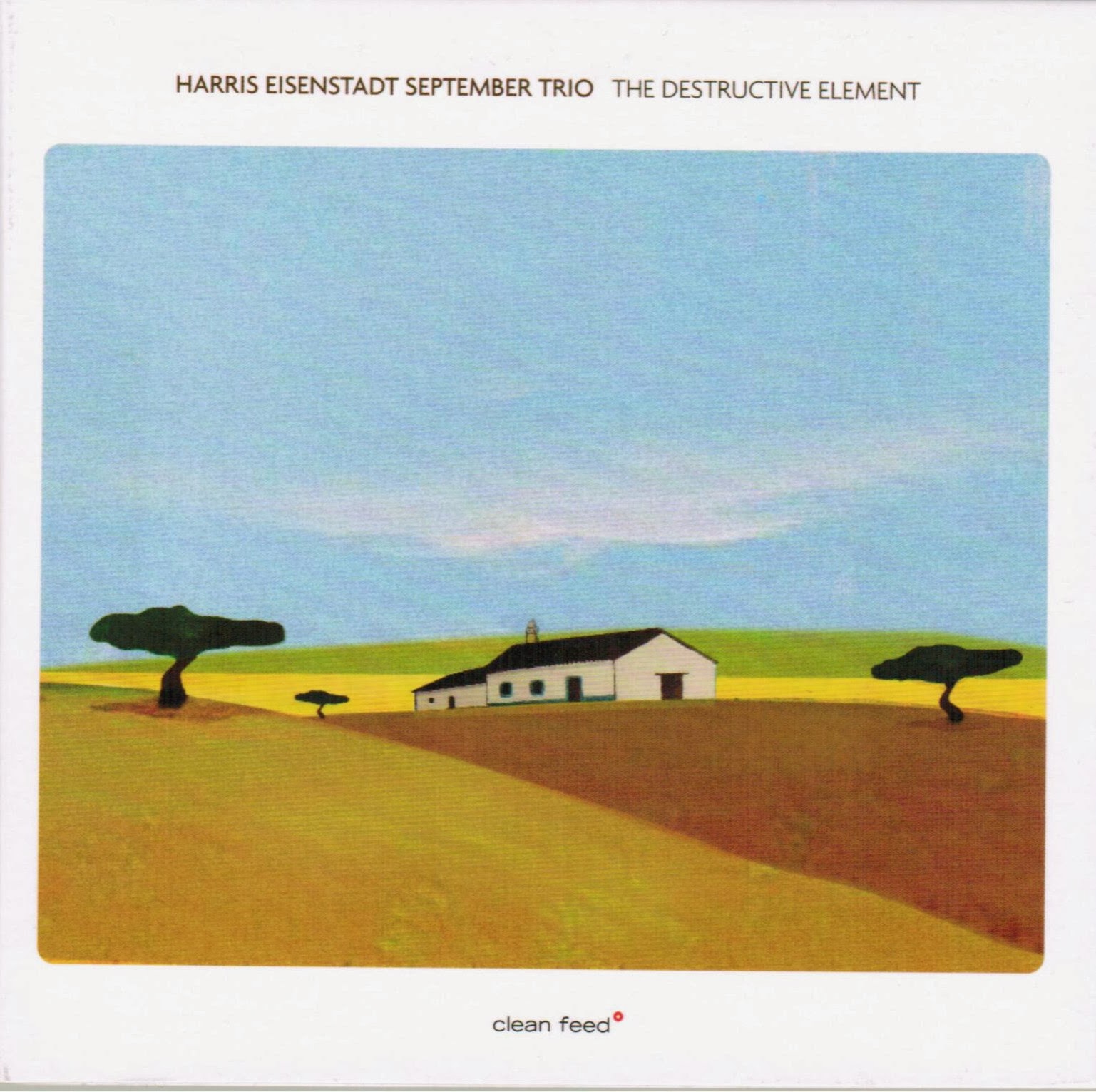
9. Harris Eisenstadt September Trio The Destructive Element [Clean Feed]

The Destructive Element is slightly heavier on the compositional emphasis than Chorale, i.e., the specific pieces here stand out as much as the overall feel, where on the Knuffke I tend to come away savoring the latter. As I indicated on last year's jazz recap, which featured a pair of new Harris Eisenstadt records (I think these were the third and fourth Eisenstadt albums that have turned up in my year-end coverage in recent years), I'm consistently impressed by this drummer-composer's ability to build bands that matter, that have something to say. A lot of jazz musicians are really fond of hatching projects, period. It's not always clear why a given composer/conceptualist feels the constant need to found their various ventures. But with Eisenstadt, I always feel like I understand why this group needs to be playing this music. That's really the case in the repertoire of the September Trio, which features two extraordinary players: pianist Angelica Sanchez and saxophonist Ellery Eskelin. I remember liking this band's self-titled 2011 debut, but I think this is better. The compositions on The Destructive Element seem to me to be Eisenstadt's love letters to his collaborators. He really seems to be working hard to give them what they need compositionally to be themselves as players. There are few things I've heard on record this year as beautiful as the ballad "Back and Forth"—Sanchez and Eisenstadt marching steadily forward as Eskelin emotes in that passion-packed yet anti-histrionic style of his. "Swimming, Then Rained Out"—an almost gospel-ish slow-burner—is another piece with the same kind of unassuming authority. All three of these players are known for venturing into various sorts of free-jazz territory, and there is a bit of hectic scramble on this record (e.g., the brief improv episodes that fall between the signpost theme statements in "Additives"). But gorgeousness is, I'd say, the chief imperative. There is so much pleasure and care and warmth and soul in these pieces—Eisenstadt working hard for Sanchez and Eskelin, and them working hard for him in turn. This isn't an all-ballads program, like they used to make back in the day, but it's definitely oriented that way, and it has the same spirit, i.e., "This is the vibe we're going to be working with, so get on board with it." I really admire that commitment, and I find myself wishing that this band would go even further in that direction on their next effort. Few working jazz groups I can think of have a more affecting, unpretentious way of singing a song together.


10. Kris Davis Massive Threads [Thirsty Ear]

This was a serious year for solo piano. In addition to Massive Threads, you've got the Parks and Shipp albums above, and a few other acclaimed discs—by Myra Melford, Bobby Avey, Geri Allen (hers was mostly solo, some duo)—that sounded intriguing to me on a first spin but that I didn't get a chance to put in good time with. This might be the most challenging of the whole crop. What I like about Massive Threads is that it sounds genuinely experimental, i.e., like a document of fresh ideas being road-tested, without coming off as ponderous. The first piece, "Ten Exorcists," is a study in what sounds like prepared-piano minimalism; I'm not sure if Davis is actually placing objects inside the piano, or simply muting the hammers with her fingers, but the net effect is something like a mini tuned-percussion orchestra. It's technically impressive, but why it works is that it sounds genuinely curious—like Davis is excited to share what she's found, rather than austerely demonstrating some rarefied technique. I feel the same of "Dancing Marlins," where she seems to really be getting down to basics with the piano, reveling in it as a sound generator, rather than an instrument with all this heavy tradition behind it. On a piece like this, she sounds almost playful, but there's clearly a heavy thought going into these exursions, as though she'd spent days and weeks homing in on a specific area of inquiry before tossing away the blueprints and hitting record. Like Craig Taborn—and I think of Massive Threads as a cousin to his Avenging Angel (discussed here), in a way—Davis is clearly a player of frighteningly advanced technique who often seems utterly ambivalent about showing it off. The idea is primary, the sense of chasing down some weird sound zone—cornering it, dissecting it, finally inhabiting it. These players are poker-faced; they can verge on Cecil Taylor's density and destabilization, but the torrential outbursts he's famous for aren't their style. With Taborn and Davis, there's more the sense that, yes, they could slay you at any moment, but they'd rather keep you, and themselves, in infinite suspense. You get on their wavelength or you turn the record off; it's that simple. As intimidating as that sounds, there's a deep, human pleasure in listening to Davis live with these ideas. "Desolation and Despair" (what a title!)—just crawling, limping along, but not maudlin or emotionally showy. She's seeking stillness on Massive Threads, just as much as she's seeking herky-jerky mobility on some of the other pieces. As with Taborn, whatever the area of inquiry, Davis is going to get to the very bottom of it, at her own pace. And that's a thrilling thing to witness.

/////

There are a bunch of other 2013 jazz records that I dug and hope to be able to spend more time with. These include the two Ethan Iverson–plus-contemporaries-and-veteran sessions (Tootie's Tempo, Costumes Are Mandatory), Tarbaby's Ballad of Sam Langford, Hush Point's self-titled debut, Dan Tepfer and Ben Wendel's Small Constructions and Dave Holland's Prism.


But the one formal honorable mention I feel like I need to make is of Ben Allison's The Stars Look Very Different Today, an album that came out recently and only made its greatest impact on me once I'd already filed my 2013 jazz ballot. I'm not sure that this one would've ended up displacing anything listed above, but I still probably would've given the matter serious thought if I'd had another couple weeks. Like Eisenstadt, Ben Allison has shown up on my end-of-year jazz list before; I loved Action-Refraction from 2011. I think Stars might be better. Allison is the kind of composer-bandleader that always seems to be heading further from jazz, per se, and nearer to his own personal soundworld. On The Stars, he's firmly in his own space. The instrumentation—Brandon Seabrook (it's great to compare his work here with that on the Black Host record, btw) and Steve Cardenas on wonderfully complementary guitars, and Allison Miller on drums—helps to give the record its individualized feel, but it's also the writing and the thrust of the performances. I've placed so much emphasis above on the idea of song. I have no problem repeating myself, because it so pleases me to hear a band zeroing in on that notion and getting it right. The songs here are magical—"Neutron Star," a sort of psychedelic roots-rock theme, is one of my favorite pieces of music of the year. There's great soloing on The Stars, but when I reflect on it, I think of a band laboring intensely in the pursuit of Allison's beautiful writing. Such that when they improvise, it's more like embellishment rather than departure. The thing is the singing of these wordless reveries, and the little mini idiom Allison has created here, this sort of folksy, funky, emotive, spacey-textured wordless pop that he's focusing on. He seems to want the instrumentation and the material to exist in perfect balance, so that you don't hear jazz, you hear these themes, and underlying them, the personal signatures of himself and his collaborators. I wish all "jazz" felt this personal, this generous, this simultaneously unfamiliar and inviting.

/////

My favorite historical releases (reissues/unearthings) of 2013 were:

Miles Davis The Bootleg Series, Volume 2: Live in Europe 1969 [Columbia/Legacy] 
Pitchfork review here.

New York Art Quartet call it art [Triple Point]
Thoughts here.


Woody Shaw The Complete Muse Sessions [Mosaic]
I'm slowly making my way through this set, and it's sounding excellent—an important document of a period (mostly ’74–’87) that's a blank spot on many jazz maps, and was on mine until not that long ago. One session that blows my mind is the December ’65 date Shaw originally recorded for Blue Note—Wikipedia says it was a demo tape; the Mosaic liners say that Alfred Lion intended to release it but backed out after he sold the company. Anyway, those five tracks are as good as you'd hope/expect given the vintage and the personnel: Joe Henderson and Joe Chambers, along with either Larry Young (on piano rather than organ, a month after the great Unity, which features Shaw and Henderson) and Ron Carter, or Herbie Hancock and Paul Chambers. I'm curious to know how Woody Shaw's general stature in jazz would look if this album had come out on Blue Note at the time it was made. Anyway, point is, it's great, and I can't wait to spend more time with this set as a whole. (Speaking of Mosaic, I really want to get my hands on that Clifford Jordan box, as well.)


/////

On the live front, my favorite jazz performances of the year were:

1.11.13
Eric Revis, Kris Davis and Andrew Cyrille at Winter Jazzfest
Thoughts here.

3.22.13
A Tribute to Paul Motian at Symphony Space
Thoughts here.

10.5.13
McCoy Tyner, Gary Bartz and Co. at the Blue Note
Thoughts here.

9.21.13
9.28.13
12.6.13
Milford Graves with, respectively, Evan Parker, John Zorn and Joe Lovano, at, respectively, the Stone, the Metropolitan Museum of Art and the Stone.
Thoughts here.

I also loved seeing Black Host at Seeds (May 29) and Roy Haynes at the Blue Note (June 27).

/////

P.S. Aside from Phil Freeman's excellent jazz round-up, linked above, I've really enjoyed perusing the latest installment of Francis Davis's annual Jazz Critics Poll (plus the always-fascinating data breakdown by Tom Hull), as well as Seth Colter Walls's Rhapsody list, and Ben Ratliff and Nate Chinen's jazz-heavy NYT top 10s.

Friday, July 26, 2013

Sandbags, part II: On Jarrett, Shipp and getting past Us vs. Them


If Matthew Shipp had posted an Emperor Has No Clothes take on Keith Jarrett in, say, early 2001, my response probably would've been something along the lines of "Amen." At that time, I was still in college—a budding jazz obsessive who thought he knew something about the music, by virtue of the fact that he had spent many hours during the prior couple years learning from master jazz scholars such as Phil Schaap, interviewing master jazz musicians such as Steve Lacy and poring over the vast LP holdings at WKCR. Back then, my core notions about jazz, many still intact, were starting to take shape. Among the truths I recall myself then holding self-evident:

1) Much of the best jazz seems to date from the middle 1960s, when records such as Evolution, One Step Beyond, Point of Departure, Fuchsia Swing Song and Out to Lunch! were being made for Blue Note. (No, it's not a coincidence that Tony Williams is on all of those dates.)

2) I love Booker Little, especially the Out Front album.

3) I love Steve Lacy, especially Trickles (with Roswell Rudd, Kent Carter and Beaver Harris) and School Days (with Rudd, Henry Grimes and Denis Charles).

4) Having sat in what I'm thinking must have been William Parker and Patricia Nicholson's East Village apartment and prepped Vision Festival programs along with awe-inspiring musicians such as Alan Silva, and having attended at least one entire (or nearly so) Vision, I love this festival, and the players—such as Parker, Whit Dickey and, yes, Matthew Shipp—who frequent it.

5) I do not care for the work of, among others, Pat Metheny, Chick Corea, Branford Marsalis and, yes, Keith Jarrett.

It shouldn't be too hard to guess which of the above opinions were derived from actual roll-up-my-sleeves dirty work—i.e., time spent studying/relishing music—and which stemmed from… I'm not sure how to put it other than a blind sort of prejudice. Names like Metheny's, Marsalis's (take your pick), Jarrett's signified the sort of jazz that they liked—they being the world at large. At that time, I'm not sure that I'd ever spent much time in the presence of anyone who actually enjoyed the work of Metheny or Jarrett, but I'd spent plenty of time in the presence of people who were choosy about their jazz, who separated the music into factions that could basically be pegged as Worth yand Unworthy. So, as many green fanatics do, I began to develop a sort of Us vs. Them sensibility regarding the genre. Jazz that I perceived to be popular—I'm not sure how I arrived at this classification; maybe by reading select issues of Downbeat or Jazziz?—was more or less automatically suspect. Anything "free" or "avant-garde" was, just by virtue of its inherent unpopularity, more or less automatically brilliant.

Now, as I implied above, items (1) through (4) in my numbered list above all stemmed from what were essentially joyous sessions of autodidacticism. I'd check out a stack of records from WKCR, hurry home to my dorm room and just study, which really meant blissing out on pure information—not just musical, but also biographical, historical, contextual. I was devouring books like Valerie Wilmer's As Serious as Your Life around this time, cramming for interviews with underrated geniuses such as Grachan Moncur III. In short, I was following my nose, blooming into a lifelong lover of this music.

But in constructing a personal jazz pantheon, I was also, whether intentionally or simply by default, deciding who didn't belong there. At the time, I couldn't have told you exactly why, say, Metheny or Jarrett didn't rank among the Andrew Hills and the Sam Riverses and the Bobby Hutchersons and the Mal Waldrons I worshiped. (I probably would've muttered something about them being "cheesy" and/or inauthentic, whatever that might have meant.) I simply had an intuitive sense that these musicians weren't worth my time. I guess the logic was: "Too many people like them; they must be suspect."

Flash forward to the present. I still love those mid-’60s "inside-outside" Blue Note classics. I still adore Out Front—maybe even more than I did then, if that's possible. I still cherish Steve Lacy's enormous and unwieldy discography. At the same time, I love Now He Sings, How He Sobs; I love Bright Size Life and Song X; I love Songs of Mirth and Melancholy; I love Byablue, Shades, Fort Yawuh, Facing You and the Jarrett/Haden/Motian trio. I also love New Orbit and Shipp's (still-active?) working trio with Michael Bisio and Whit Dickey. I'm not sure what would be an example of jazz that I particularly dislike; even if I could think of one, I'm not sure I'd be inclined to waste virtual space by mentioning it here.

Here's a list of points I'm not trying to make in this post:

1) I'm not trying to say I love Keith Jarrett's work unconditionally. In fact, I'd be suspect of anyone who made that claim, not because I think any of his output is particularly crappy, but because there's just so damn much of it. I only know a very tiny sliver of what's out there. I can say with authority—the authority that comes from actually doing the earwork—that I love the American Quartet. I'll admit that I've never heard The Köln Concert—not because I'm wary of it, but because I simply haven't gotten there yet. (I mean, I've never heard Exile on Main Street front-to-back, either—every one of us has our blind spots.) I'm not wild about what I know of the so-called Standards trio with Gary Peacock and Jack DeJohnette, but I'm no expert. I haven't yet spend any good time with Somewhere, the record Shipp wrote about, but I'm looking forward to doing so.

2) I'm absolutely not trying to say that I think Shipp doesn't know Jarrett's work well enough to comment on it authoritatively. As Ethan Iverson pointed out, Shipp's piece doesn't mention the American Quartet, but that omission is far from an admission of ignorance regarding that period of Jarrett's output. (It would be hard to imagine a player of Shipp's age and disposition not knowing, say, Fort Yawuh inside and out, but again, I'm speculating.)

As for the general sentiment of the piece, I applaud Shipp's nerve, but given his track record for assailing sacred cows, I wonder what all his aggregate rhetoric along those lines has won him over the years, and whether journalists' consistent solicitation of his opinion on famous jazz musicians might not be viewed as opportunistic, or even crass. That is to say: At this point, writers know that Shipp will spout off if given half the chance, but is reducing him, or any other musician, to a caricatured hater really the best thing for jazz journalism, for Matthew Shipp, for the music? Shipp is very clearly a brilliant musician. (As with the Jarrett discography, Shipp's body of work is enormous. I adore some of it—the aforementioned New Orbit, with Wadada Leo Smith, is a particular enduring favorite, and the recent duo project with Darius Jones is remarkable; other records—Equilibrium, for example, and certain other electronic-beat-driven Blue Series titles—leave me cold.) His work speaks for itself; I'm just not sure that knowing he's suspicious—and even disdainful—of Keith Jarrett enhances my enjoyment/understanding of his art in any way. It bums me out that Shipp might go down in the history books—whether through his own persistent soapboxing or through journalists' calculated foregrounding of same—not as "The guy who made all that beautiful, turbulent, haunting music," but as "The guy who persistently dared to dis Shorter, Hancock, Jarrett and other sacred cows in the press."

Here's my best attempt at summing up the point I am trying to make in this post:

The great thing about being a music fan is you don't have to take sides. The other day I had the privilege of speaking to the kids at the School of Rock in Montclair, NJ, about the subgenre known as pop-punk. We listened to Descendents, the Misfits, the Buzzcocks, the Ramones and a few other great, old bands—true forefathers of the style. We also listened to Green Day and Paramore, and during my preparation, I checked out others whose material the students were learning: New Found Glory, Something Corporate, Fall Out Boy. I enjoyed it all: old and new, "authentic" and "commercial," "arty and "populist." I guess what I'm trying to say is, I no longer have any stake in the Us vs. Them game. I love everything that sounds good to me. This week I marveled at both Missing Persons and Gorguts. A lot of times, I tune in to WKCR when I'm driving, but just as often, I'm blasting freestyle on 103.5 or soft rock on 106.7. I'd like to think I don't spend as much time worrying about what I don't like or what isn't worthy, and that I value really doing the listening legwork over spouting blanket opinions. As I've written here before, musical prejudices are like sandbags; there's a great liberation in letting them go, either because you've learned to love an artist you'd previously deemed lame, or because there's simply too much great music to focus on instead, and far too little time in which to do so.

P.S. A totally unrelated Shipp/Jarrett comparison I published in 2011. The more I think on it, the more the two figures seem to be running on parallel tracks—aside from the points I make in the piece, consider each musician's long, super-prolific association with a single label (Thirsty Ear's Blue Series—actually curated by Shipp—and ECM, respectively).

Thursday, April 28, 2011

In the zones: Darius Jones and Matthew Shipp at Jazz Standard


In their new duo, Darius Jones and Matthew Shipp are limiting themselves, and it sounds really good. Tonight I saw the pair, on alto saxophone and piano respectively, at Jazz Standard, where they were celebrating a new Aum Fidelity album, Cosmic Lieder. The record is very good; the show was much more than that—an arresting demonstration of a shared philosophy of improvisation, a series of sharp answers to age-old questions like "Where do we start?," "Who leads?," "Who follows?" and maybe most importantly, "Where do we end?"

As far as I can tell, the Jones/Shipp duo is an all-improv project, but it is not a free-for-all. These are songs, in a way—brief (averaging four minutes or so) and highly directional. The titular cosmos delivered with pop-song economy.

At Jazz Standard, the duo was incredibly decisive, each piece a single sustained idea, kicked around and prodded at but fixed, secure in its center. I think of Ghostbusters, when each of the three 'busters zaps Slimer and they slowly, steadily lower him into the trap in unison. It was that kind of teamwork.

Darius Jones already has a formidable reputation for gutsy free-jazz soul. (See Steve Dollar's fine Wall Street Journal profile.) If you've heard him in Little Women, you know it's not just soul that interests him, but maniacal, stabbing noise as well. The key thing to understand about Jones's work with Shipp, though, is that he's playing here with an almost heroic restraint. That's not to say that his ideas are restrained; he unleashed plenty of throaty shrieks and yelps tonight. It's more that he doesn't let them fully off the leash. This is not a blow-till-you-drop free-jazz concept (a good thing, in my opinion—we've got quite enough of those)—it's a concept of harnessing moments of wildness, violence boiling up and receding, leaving behind its scent. Wind the tension till it snaps, work through the tantrum and then bring it back to a whisper. Tonight Jones played with such tension, bearing down even at barely audible volumes. Always deciding, to do or to not do, to attack or to grit teeth and let the moment pass, winding, winding. Letting go and reining in. Making a song out of raw materials, letting their edges show but obeying an imaginary hourglass—when it's time to stop, you stop. You don't mourn the passing. You pause and you get on with what's next. These songs had an imperative to get somewhere, and almost without fail, they did.

Matthew Shipp made damn sure they did, actually. The pianist has a reputation for cantankerousness off the bandstand, and that tendency is often projected onto his playing. I feel like I've read descriptions that likened his improvising to boxing—I could've sworn the word "pugilistic" was used somewhere [NOTE: After the fact, I turned up this boxing-and-jazz piece by Shipp himself!]as though he was this swaggering, merciless hard-ass. And of course there are the vague Cecil Taylor comparisons. But specifically on the latter front, there's an immense difference, namely that Matthew Shipp goes to Herculean lengths to ensure that his collaborators sound good. (For all his strengths, CT is not, on the whole, what one would call a deeply sensitive collaborator.) Or, maybe I should say, he did so tonight—I suppose his trio (where he is the nominal leader and principal soloist) is a somewhat different story. With Jones he was like a shadow, cushioning and supporting at all times, providing just the right backdrop, vamping when need be, hammering out the framework so that Jones could dance within it. The word I kept thinking of, and writing down, was GRACIOUS. This was a duo music, i.e., neither player really soloed per se, but the roles were clear—Shipp was ground and Jones was sky. So the tension, and there was so much and it was so very exciting, came from the ideas and not from some sort of hackneyed clash between the players. Shipp is no pugilist—he's a master scene-setter, like some sort of production designer, laying out sumptuous period furnishings that help the actors immerse in their roles, accessing new truths.

The moods and textures were many. There was the eerie impressionism that is something like Shipp's signature. (Jones shouts-out this special Shippian vibe in this great joint appearance on Jason Crane's The Jazz Session, zeroing in on New Orbit, a truly fantastic 2001 record—maybe my favorite of Shipp's that I've heard.) Faster, choppier excursions. Hushed sonic mobiles with Shipp plucking the piano strings by hand. Jones always sounding so incredibly vocal, crying out with something there's not even a word for. "Anguish" seems too broad. It's like a simmering combination of mad and sad, wounded and vengeful. Bearing down immensely on the notes till they pop out. It was like soul surgery, with Shipp laying out all the tools on the operating table.

The two railed, in a way, against the semi-swanky jazz-club setting. They paused after each piece, just long enough to let you know it was indeed over, and the applause would begin. But they were onto the next one immediately—no time for basking or even, really, acknowledgment. I think about Keith Jarrett and how when I saw him at Carnegie Hall earlier this year, he bowed ponderously after each piece, enervating the room each time. Jones and Shipp weren't about to break the fourth wall. They were in the zone, or should I say in the zones, each brief song its own cosmos that for those four minutes or so was their shared, sole objective. Anyone improvising "open-endedly," "seeing how it goes," "relaxing," "emoting," doing whatever you're doing other than deciding where a piece should go and going there, NOW, take heed. However "experimental" you fancy yourself, you are competing with composed music; there is an imperative to pick an idea, to state that idea, make it stick and call "Scene." If further clarification is needed, consult your copy of Cosmic Lieder or the next Jones/Shipp duo gig.