A new survey of great/essential titles on the legendary Dischord label, published over at Shfl.
Showing posts with label dischord. Show all posts
Showing posts with label dischord. Show all posts
Thursday, November 16, 2023

Friday, February 06, 2015
Panorama: The joys of the Fugazi Live Series

In a recent post about the Paul Motian Trio, I wrote about spirit music, sound that feeds, and maybe even heals. My current obsession is Fugazi—kicked off by an excellent interview with drummer Brendan Canty, via The Trap Set, a new podcast hosted by Joe Wong, who happens to be my West Coast counterpart in the band Aa—and though the sound is very different, the effect, the aftermath of listening, feels similarly restorative.
It's common to speak of the uprightness of this band, whether in terms of how they resisted the evils of the business of music (or the often-barbaric practices that attend its live performance: moshing, crowd-surfing, etc.), or how they helped raise awareness re: the evils of government and commerce. And it's also, perhaps, in a sort of reverse-cliché way, common to speak about how their real contribution was a musical one, or how they were one of the most transformative live bands of their (or all) time.
What I don't hear a lot of, in terms of general Fugazi-ology, except among my closest friends, is appreciation for the meat and substance of the Fugazi experience, which is the songs. It's easy to forget, since the hoopla has died down—see this NPR piece and this New York Times article, both from 2011—that the Fugazi Live Series is still online and accessible to all. If you're not familiar with the endeavor, it's very likely the most extensive authorized single-band concert-download archive in the world. (Short of maybe the Dead, although I'm not even sure if they make their shows available direct to fans in such an accessible, no-b.s. format.) You don't have to mess with iTunes or any kind of tedious sign-up process; you just go in and browse the shows—all helpfully rated in terms of sound quality and equipped with a free sample track—and grab whichever ones you like for a suggested price of $5.
I'm nowhere near an authority on this archive—it would take years of dedicated listening and browsing to really get familiar—but I have zeroed in on particular favorite periods. The 2002 shows hold a special fascination for me. For starters, I can highly recommend the Boston gigs from April 19 (mislabeled in the URL and iTunes tags as May 19) and 20 of that year—also available as YouTube videos, here and here. I love the shows from this era simply because by this point, the band's final year of performance to date, Fugazi were drawing on their entire recorded output, all seven albums (well, six plus a pair of EPs that I came to know jointly as 13 Songs). What strikes me as I listen to these sets and others from 1995 (the year that one of my favorite Fugazi albums, Red Medicine, came out, and the year that I saw them live for the first time, at this St. Louis show; have just downloaded that, and it sounds incredible—I picture myself back in that room; and my friend/bandmate Joe told me he had a similar experience looking over this set list, from the first Fugazi show he attended, earlier in the same year; this Philly show is also a must) is that one of Fugazi's main contributions, and maybe the one that means the most to me, is their egalitarian approach to their own catalog. We all know that Fugazi didn't release proper singles (a couple scattered 7-inches, yes, but no actual singles, in the classic "airplay"-oriented sense) or videos, but beyond that, the degree to which they really stood by—as in performed live, consistently, and with passion and conviction—just about every song they ever put out is really striking.
Most bands of any longevity gradually whittle down their catalog, encapsulating entire periods with just a few songs sprinkled into their live sets. Fugazi refused to let their songs die. The main Fugazi Live Series search actually has a song selector, so you can track individual songs as they appeared in live sets throughout the band's career. Just for fun, I typed in "Burning Too," a track from 13 Songs (or from the Margin Walker EP, if you want to get technical), and, if I'm being honest, one of my least favorite Fugazi songs and not one I've heard fellow fans shout out as a particular favorite. Sure enough, there are eight pages of results, stretching from 1988 to 2001. My point is that Fugazi put their entire weight behind everything they released. Yes, of course, the band had what you might call hits—"fan favorites" is probably more accurate—songs like "Waiting Room," "Bad Mouth," "Suggestion" and "Merchandise," songs that every Fugazi fan, however casual, knows by heart, but in terms of how they operated, especially near the end of their performing lifespan so far, they treated their entire catalog with equal care, did away with the oppressive hierarchy of "greatest hits" and "deep cuts" that ends up polluting the catalogs of so many great bands (Zeppelin, for one; how wonderful it would be to revise "classic rock" history and do away with the idea that this monster band's masterful, meaty output ought to be reduced to 10 or so radio staples). So at the best of these Fugazi performances, you get the early material colliding off the late, as though the band had placed their entire catalog on shuffle. But of course this is live and real and organic. We've all heard about how the band didn't use set lists and how they all had to be prepared to unleash pretty much any one of their songs at any time, which is a pretty staggering notion once you really think about it, especially if you've ever had the experience of being in a band and dusting off material you haven't played in years; the recall / muscle memory is often pretty appalling.
I love how, in the second Boston show mentioned above, the band uses 1993's In On the Kill Taker (another album I adore, not that there's a Fugazi album I don't feel that way about) as a center of gravity, starting off the show with two of that album's most rousing songs, the Ian MacKaye–sung rager "Facet Squared" and the Guy Picciotto–sung partially a cappella masterpiece "Rend It," and sprinkling the set with various other IOTKT gems, like "Public Witness Program" and "Last Chance for a Slow Dance" (maybe my single favorite Fugazi song), while also making room for plenty of material from the then-new Argument album, as well as two brilliant Joe Lally–sung songs in a row ("Recap Modotti" and "By You"), a couple 13 Songs oldies (notice how "Waiting Room" is sort of thrown unassumingly in the middle there; no "Let's encore with our best-known song!" hoopla here) and Steady Diet of Nothing closer "KYEO" to end the set.
If you know all these albums by heart, the effect—the thrill of "What song are they going to play next?" and "How will it play off the one before and the one after?"—is a profound one. You start to see Fugazi's whole catalog as this glorious 360-degree panorama. The fast songs, the slow songs, the Guy songs, the Ian songs, the Joe songs, the instrumentals (dig "Number 5," from the "Furniture" single, which opens the 4/20/02 Boston show). It's all material—to be used, to be played, to be savored. No song privileged over any other. No staples—songs that have to be played at every show or the audience will go home unhappy. You create, you amass and then you just play, from the heart, whatever song wants to come out at that time, in that city, under that set of conditions. Yes, the $5 door price and the outspoken political stance were radical, but to me, this attitude toward one's catalog is even more so. You aren't writing a bunch of songs just so you can hit the jackpot with one or two, sell a million copies of those and then populate your albums with all the filler. You're standing by everything you create, letting none of it go to waste. And you're keeping your legacy pure, because every single one of those albums stands up, all the way through. As do the shows themselves. Each one has its own logic, its own arc, its own emotional and intellectual journey, its own story. I have a feeling I'll be playing in the Fugazi Live Series sandbox for years to come.
Thursday, December 08, 2011
Players, not orators: The Fugazi Live Series

By now you've likely heard about the bounty that is the Fugazi Live Series. If you're just diving in, allow me to recommend the following shows, which I've been savoring over the past few days:
Kansas City, KS - 8/28/93
Several close friends of mine, then and now, were at this show. I was not yet a Fugazi fan; the conversion process occurred a year or so later, and thus I did not see the band till ’95, when some of those same buddies and I took a train trip to St. Louis to catch a gig. The sound quality on this show is good, not great, but the band plays with a fierce energy (befitting the fact that they were touring behind their most aggressive—and, in my opinion, best, though it's a tough call—album, In On The Kill Taker). Plus there's some tense, pervasive crowd interaction: Basically, Ian wants the house lights on, while certain audience members want them off—so badly that they pass around a petition!
Leeds, UK - 10/31/02
An epic set with absolutely extraordinary sound. Seriously, you've got to hear this. The energy level isn't quite as high as in the ’93 show; you can hear that Guy and Ian have mellowed a tad in the intervening nine years. But the set list is just glorious. To many, Fugazi are some kind of symbol, a political statement rather than a band. But as much as I admire their ethics, that wouldn't mean a thing to me if I didn't celebrate their entire catalog. So the later the date of the show, the richer the performance (this one goes the full distance, from 13 Songs through to The Argument); the band's famous no-set-list policy meant that what you got every night was a one-of-a-kind mixtape. If you tune in now and restrain yourself from taking a peek at the song titles in advance, you get the thrill of hearing that unfold in real time.
The Live Series is a wonderful thing. As much as people are obviously going to focus on all the occasionally hilarious banter in these recordings—I swear, sometimes it almost seems to me like Ian planted an asshole or two in each audience so that he could have someone to reprimand—hopefully it will help shore up Fugazi's musical legacy. They are players, not orators, and their range, craft and technique are all breathtaking. Obviously, the DIY infrastructure the band built around itself is impressive, but in the end, it's just a backdrop to an all-time-great body of work: wrenching ("Blueprint"), funky ("Two Beats Off"), catchy ("Public Witness Program"), bitter ("Shut the Door"), triumphant ("Reclamation"), sultry ("Life and Limb"), heartbreaking ("Sweet and Low"), borderline goofy ("Bed for the Scraping") and sometimes, weird as hell ("Cassavetes," anyone?). Long live ’em.
Friday, October 28, 2011
Into the Void; Buildings on Fire

I'm happy to share my Pitchfork review of Dischord's new Void rarities compilation, Sessions 1981–83. If you're looking for a quick intro to these guys—at their best, possibly the most off-the-rails hardcore band of them all—try "Think", from the immortal Faith/Void. If you're already a fan, you will eat Sessions up.
/////
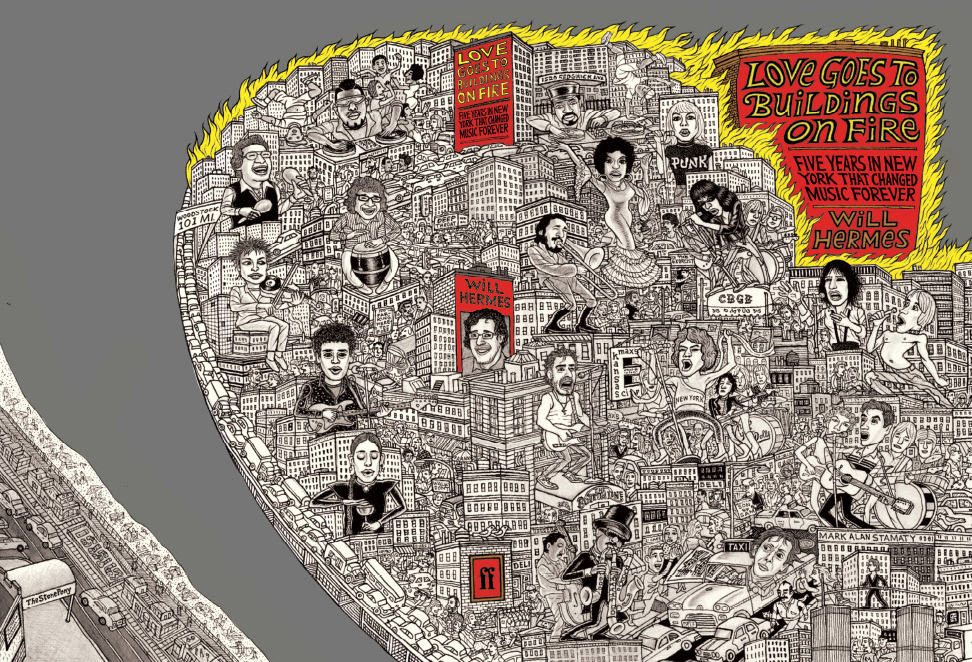
I'm loving the new Will Hermes book, Love Goes to Buildings on Fire. It's a panorama of NYC music from 1973 through 1977, touching on rock, punk, jazz, salsa, classical, hip-hop, disco and more. In other words, you get to see how, e.g., Bruce Springsteen, Television, Rashied Ali, Eddie Palmieri, Steve Reich, Afrika Bambaataa and Tom Moulton (the latter's name is new to me, and the story of how he originated the modern dance mix is fascinating) played on the same field during the same era. I can't think of too many writers who could juggle all these narratives while keeping the blend brisk and reader-friendly. This book gets you visualizing history and thirsting for the records in question.
Friday, May 06, 2011
A model mellow-out: Freddie T and the People

I am never not going to want to know what's up with Fred Erskine. As discussed in this ancient DFSBP post, I've been interested in the man's work since the mid-’90s, when he played bass in two of my then-favorite active bands (the Crownhate Ruin and June of 44, both of whom blew my mind live) and one of my then-favorite nonactive bands (Hoover). (I still really dig all three of these bands, esp. Hoover, which I consider all-time-great.) Erskine's achievement, incorporating funk and reggae elements meaningfully within the post-hardcore idiom, was simple-sounding but totally profound. As with Joe Lally from Fugazi, Erskine made me want to focus on the bass above all else while listening—his bulbous, trancey lines (rendered in one the coolest and most distinctive tones I've ever heard on the instrument) were magnetizing. He was like a guru of groove—"Remember kids, this may be punk, but we can't forget the lessons of great soul"—and he elevated any band he was in to a certain level of class and worldliness, helping them to transcend the sometimes-hermetic post-hardcore sphere. Fred was also a really unusual and expressive vocalist—part bleater and part screecher. He always sounded like he meant it.
Aside from the three bands mentioned above, Erskine has undertaken a bunch of other projects, and I've dutifully checked them all out. I haven't always been thrilled. Him, his dubbed-out, somewhat Tortoise-y project with June of 44 drummer Doug Scharin (together, Erskine and Scharin were maybe the most incredible rhythm section I've ever seen live) seemed monotonous and not edgy enough, and the horns-heavy Boom (check out these two posts from Hardcore for Nerds) was an interesting detour but not something I ever really felt like spending good time with. Ditto for the band Abilene, a later project led by Erskine's Hoover comrade Alex T. Dunham, in which Fred played trumpet.
Just a Fire, a now defunct Chicago-based band, was an exception—definitely my favorite latter-day Erskine concern. Their two LPs were slightly spotty, but the good stuff on them was truly great. I would highly recommend the first JaF album, 2004's Light Up, to any Crownhate Ruin fan, and there were a few mindblowing tracks (e.g., "Runaway") on the second one, Spanish Time, which I reviewed for Time Out NY a while back. As promising as Just a Fire was, the project never seemed to really take. I saw them in ’05 or ’06, and it was a cool but sadly underattended show. At some point after that, I heard that Erskine had moved to Indiana to start a family, and I assumed that I wouldn't be hearing too much more music from him.
Thus, I was very pleasantly surprised the other day when I stumbled upon People In, the semi-new (December 2010) debut album by a new Erskine project, Freddie T and the People. The band came through Brooklyn last year, and I'm really bummed I missed it, because this record is honestly outstanding—one of my favorites of the year so far. (It technically came out last year, yeah, but to me, it's a new release.) What Freddie T and the People sounds like to me is Erskine coming into a very legitimate kind of maturity—not a tedious growing up, but an honest, natural mellowing out, with just enough feistiness under the surface. I heard the Boom, which was active at the same time as June of 44, as a mash-up, an awkward marriage of Erskine's post-hardcore and soul/reggae influences. But Freddie T and the People is all of a piece: People In is basically a very convincing soul record (complete with horns, backing vox, reverby production, the whole thing) seasoned with tasteful little Erskine-isms.
As in the Boom, Erskine plays guitar rather than bass in this band. On paper, that fact is a bummer to me—again, I adore his bass work and want to hear as much of it as I can. In practice, I'm cool with it. Erskine brings a ton of flair to his guitar playing here. I'm in love with his twangy punk-Ventures lead on People In's self-titled opening instrumental, in which you can hear some of his trademark sinuous rhythm sense translated to the guitar, with an added element of fun, fiery grandstanding. (Here's a clip of him ripping it live in Chicago.) I remember that back in the Crownhate Ruin days, Erskine was rocking a sort of ’50s greaser vibe, with pomaded hair and gas-station-attendant-type shirts; here his music seems to have caught up to that. It's like super-soulful surf funk executed with punk rawness.
The record works just as well when Erskine is singing. "Enemies" is a little masterpiece. Again you have that sort of Dick Dale feel in the guitar, laid over a driving beat. Erskine's lyrics ("I been running myself into the ground") have a sort of classic Beat vibe, i.e., sort of cosmically bummed. Unlike in Just a Fire, where he was writing about politics, here Erskine is just talking about the way he feels; it's totally lived-in and plainspoken and real. The horn arrangement is so natural and happy-making. The band name comes into clear focus here—this sounds like a gang—a huge ’70s-style band like Earth, Wind & Fire or Parliament—a leader and a bunch of friendly collaborators, all committed to bringing the tunes to vibrant life. (I'm not familiar with any of these other players, but they're all great—even, yes, the bass player. Apparently some of ’em hail from Racebannon, a ferocious band I've heard a bit of but need to check out more.) And in contrast with the Boom, Erskine is actually writing really hooky music these days: The "Enemies" refrain has been cycling in my head for days.
What really blows my mind about the album is that it typifies what can be a somewhat painful process for a fan to witness—namely the gradual mellowing of an artist you know and love from really intense projects—yet completely bucks the stereotype of that having be a lame or disappointing progression. Take "Beautiful Simple Moments," a straightforward song that's actually about beautiful, simple moments ("a warm autumn day," "my fireplace is burnin' in the living room," etc.). Miraculously, it's totally unsappy. Despite the subject matter, the song has a defiant spirit to it, and it actually feels kind of hard-ass. And this is coming from an artist who used to specialize in seething frustration ("You want to play games / I want to play war," Erskine screeches in one of my favorite Hoover songs, "Weeds," from the excellent self-titled posthumous EP) and inscrutable spaz-outs (I've never had the slightest idea what he was yowling about in "Distant" from Hoover's The Lurid Traversal of Route 7—"I've got my cat back / You've got those glasses"??!).
People In is concise and good all the way through. While I dig the reworking of the great Just a Fire track "Graduation," the new tracks get me the most. The hooks just burst out, and I love the pacing of the record, how brief, super-melodic instrumentals (like "People In") serve as interludes between the longer, meatier tracks. It's crazy—I've only had this album for a few days, and I'm starting to think of many of the songs as bona fide hits. (To name just two, the showstopping soul ballad "You Are Your Brother" and the hard-as-nails funk-rock track "Voodoo" are both total killers.) Erskine's voice is still eccentric and maybe an acquired taste if you're not familiar with his prior work, but it's just such a pleasure to hear him belt this music out, to sound so native in this new style. Nothing put-on or forced—just a joyous "This is where I'm at right now." The biggest compliment I can pay People In is that I don't miss Erskine's previous output when I'm listening to it, and considering how I feel about Hoover and the Crownhate Ruin, that's really saying something. People In is maybe the classiest, most thoroughly enjoyable late-career mellow-out album I've ever heard. I'm thrilled that Erskine, chill though he may be at this stage, has retained the fire, the bite and the soul.
BUY THIS RECORD (digital or limited-edition LP)!
P.S. If you don't know Erskine's prior work, you need to hear:
1) "Ride Your Ride" by the Crownhate Ruin
2) "Electrolux" by Hoover
3) "Seemingly Endless Steamer" by June of 44 (dear God, the Erskine/Scharin interplay on this song…)
Subscribe to:
Posts (Atom)